CBSE Class 11 Syllabus 2022-23 Legal Studies
Finished viewing? Save it for later —
Download CBSE Class 11 Syllabus 2022-23 Legal Studies (PDF · 8 pages)About CBSE Class 11 Syllabus 2022-23 Legal Studies
CBSE Class 11 Syllabus 2022-23 Legal Studies is available here for free download. Published by CBSE for Class 11, this syllabus can be viewed online or downloaded as a PDF (8 pages). Candidates preparing for Class 11 can use CBSE Class 11 Syllabus 2022-23 Legal Studies to understand the exam pattern, the type of questions asked, and the overall difficulty level.
Frequently Asked Questions
How can I download CBSE Class 11 Syllabus 2022-23 Legal Studies?
Open this page and click the Download button to save CBSE Class 11 Syllabus 2022-23 Legal Studies as a PDF. It is completely free on AglaSem Docs.
Is CBSE Class 11 Syllabus 2022-23 Legal Studies free to download?
Yes. CBSE Class 11 Syllabus 2022-23 Legal Studies can be viewed online and downloaded as a PDF free of cost on AglaSem Docs.
How many pages does CBSE Class 11 Syllabus 2022-23 Legal Studies have?
CBSE Class 11 Syllabus 2022-23 Legal Studies contains 8 pages, which you can read online or download together as a single PDF.
Where can I find more Class 11 study material?
You can find more Class 11 question papers, sample papers, syllabus, and answer keys on AglaSem Docs.
CBSE Class 11 Syllabus 2022-23 Legal Studies – Text
Read the full text of this syllabus below — useful to quickly search, copy and reference the content online without downloading the PDF.
📄 View text version (8 pages)
Page 1
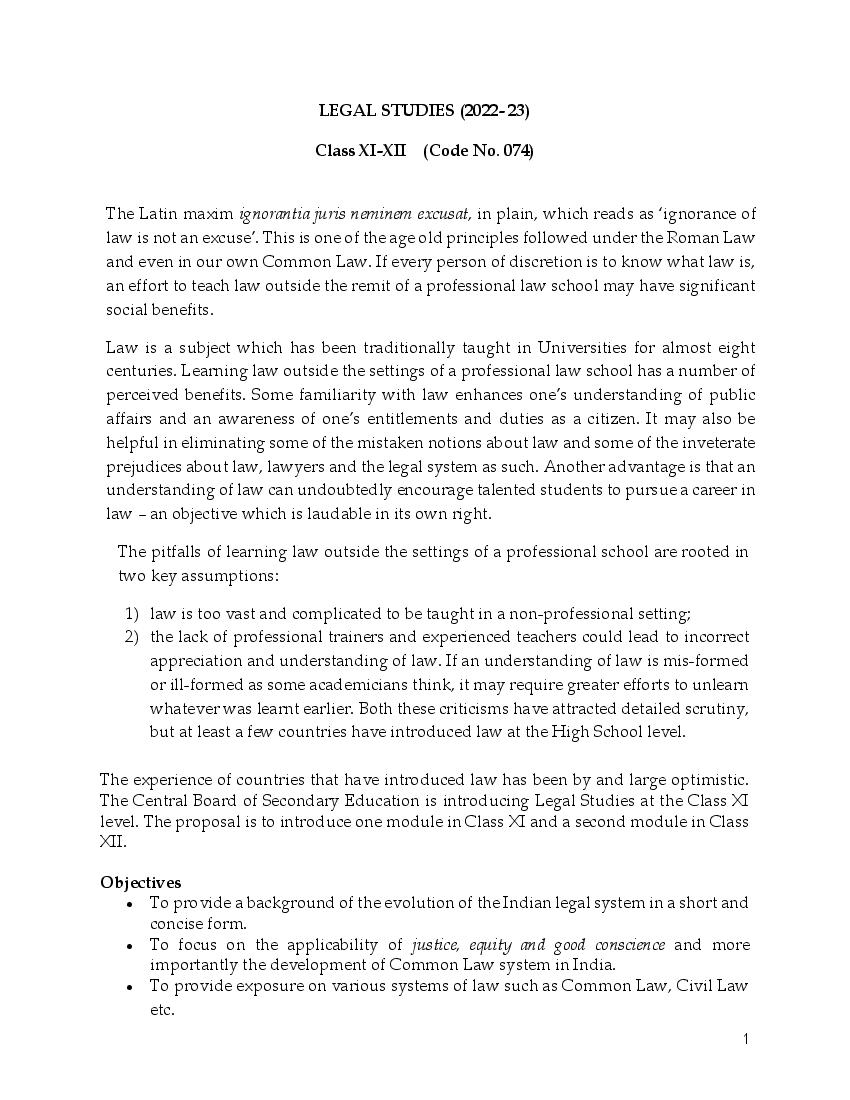
Class XI-XII (Code No. 074)
The Latin maxim ignorantia juris neminem excusat, in plain, which reads as ‘ignorance of
law is not an excuse’. This is one of the age old principles followed under the Roman Law
and even in our own Common Law. If every person of discretion is to know what law is,
an effort to teach law outside the remit of a professional law school may have significant
social benefits.
Law is a subject which has been traditionally taught in Universities for almost eight
centuries. Learning law outside the settings of a professional law school has a number of
perceived benefits. Some familiarity with law enhances one’s understanding of public
affairs and an awareness of one’s entitlements and duties as a citizen. It may also be
helpful in eliminating some of the mistaken notions about law and some of the inveterate
prejudices about law, lawyers and the legal system as such. Another advantage is that an
understanding of law can undoubtedly encourage talented students to pursue a career in
law – an objective which is laudable in its own right.
The pitfalls of learning law outside the settings of a professional school are rooted in
two key assumptions:
1) law is too vast and complicated to be taught in a non-professional setting;
2) the lack of professional trainers and experienced teachers could lead to incorrect
appreciation and understanding of law. If an understanding of law is mis-formed
or ill-formed as some academicians think, it may require greater efforts to unlearn
whatever was learnt earlier. Both these criticisms have attracted detailed scrutiny,
but at least a few countries have introduced law at the High School level.
The experience of countries that have introduced law has been by and large optimistic.
The Central Board of Secondary Education is introducing Legal Studies at the Class XI
level. The proposal is to introduce one module in Class XI and a second module in Class
XII.
Objectives
● To provide a background of the evolution of the Indian legal system in a short and
concise form.
● To focus on the applicability of justice, equity and good conscience and more
importantly the development of Common Law system in India.
● To provide exposure on various systems of law such as Common Law, Civil Law
etc.
1
Page 2
including the role and importance of Fundamental Rights, Separation of Powers,
Structure and operation of Courts, concept of precedent in judicial functioning, the
of legislation, basic principles of statutory interpretation, etc.
● To deal with principles of practical utility such as the concept of Rule of Law,
principles of justice, differences between criminal and civil cases, the concept of
crime and the fundamental theories of punishment, rights available to the accused
at various stages of the criminal investigative process, or the key components of
Human Rights, etc.
● To understand the fundamental concept and subject matter of property, contract
and tort.
● To understand the rudimentary aspects of contract law such as formation of
contract, terms and conditions, discharge, etc.
● To enables students to form an understanding of rights and duties and various
categories of liability principles which form the bedrock for an understanding of
Law.
Competencies expected after this course
Students will be able to:
i. acquire knowledge of legal theory, laws, legal procedure, drafting,
interpretation and application of laws;
ii. identify legal issues from facts, differentiate between ratio decidendi and
obiter dicta;
iii. ask relevant and probing questions to understand the differences among facts,
opinions, analyse judgments and recognize and meaningfully respond to legal
fallacies;
iv. apply the law, and draw conclusions by applying analytical reasoning;
v. apply knowledge and understanding of law, legal theory and procedure to
solve legal problems;
vi. evaluate, seek feedback and modify solutions to legal problems;
vii. carry out legal research;
viii. acquire values such as justice, fairness, openness, honesty, integrity, respect
for diversity, and respect for the rule of law; and
ix. prepare themselves for pursuing higher education in the field of Law
2
Page 3
(BASED ON REVISED BOOK WITH NEW CHAPTERS)
S.no. Units Periods Marks
1 Introduction to Political Institutions 40 15
2 Basic Features of The Constitution of 40 15
India
3 Jurisprudence, Nature and Sources of 40 15
Laws
4 Judiciary : Constitutional, Civil And 40 20
Criminal Courts And Processes
5 Family Justice System 40 15
6 Project 20 20
Total 220 100
Contents:
S no. Unit Topics
Unit I Introduction to Political Institutions
1. Concept of I. What is a State?
State II. The concept of State and Article 12 of the Indian
Constitution
III. What is a Government?
IV. Emergence of the State from Society
V. Definition of State
2. Forms and I .Introduction to the Organs of Government
Organs of II. Forms of Government
Government A. Monarchy
B. Aristocracy
C. Dictatorship
D. Democracy
III. Main organs of Government and its functions
A. General Functions of Legislature as Organ of
Government
B. General Functions of Executive as Organ of
Government
C. General Functions of Judiciary as an Organ of the
Government
3
Page 4
Powers II. Historical Background and Evolution of
Montesquieu’s Doctrine of Separation of Powers
A. Montesquieu’s Doctrine of Separation of Powers
B. Basic Features of the Doctrine Separation of Powers
as Enunciated by Montesquieu
C. Checks and Balances of Power
D. Impact of the Doctrine
III. Evaluation of The Doctrine of Separation of Powers
A. Key Benefits and Advantages of The Doctrine of
Separation of Powers
B. Defects of the Doctrine
IV. Separation of Powers In Practice
A. Separation of Powers in Britain
B. Separation of Powers in the United States of
America
C. Separation of Powers in India
Unit 2 Basic Features of The Constitution of India
1. Salient Features of i. Meaning of the term Constitution
The Constitution of ii. Definition of the term Constitution
India iii. Historical Perspective of Indian Constitution
iv. Salient Features of The Constitution of India
A. A Modern Constitution
B. Lengthiest written Constitution
C. Preamble to the Constitution
D. Fundamental Rights; Directive Principles of
State Policy; Fundamental Duties
E. Constitutional Provision for Amendment of
the Indian Constitution
F. Adult Suffrage
G. Single Citizenship
H. Independent Judiciary
I. Emergency Provisions
J. Federal in form Unitary in character
K. Division of Power- Centre- State Relations
L. Schedules to the Constitution
Unit 3 Jurisprudence, Nature and Sources of Laws
2. Classification of I. Classification of Law based on Subject matter
Laws II. Classification of Law based on Scope of Law
III. Classification of Law based on Jurisdiction
3. Sources of Law i. I.Where does law come from?
ii. II. Custom as a source of Law
iii. Importance of Custom as a source of Law in India
iv. Judicial Precedent as a Source of Law
v. V. Legislation as a Source of Law
4
Page 5
ii. Law Reforms in India
iii. III. Recent Law Reforms in Independent India
5. Cyber Laws, i.Introduction
Safety and ii.Why do we need Cyber Laws
Security in India iii. What is Cyber Law?
iv. What is Cyber safety and Security?
v. What is cyber Crime?
vi. Categories of Cyber Crime
vii. Cyber law in India
viii. Scope and Extent of The Information and
Technology Act, 2000(IT Act)
ix. IX. What was Section 66A of IT Act, 2000?
Unit 4 JUDICIARY : CONSTITUTIONAL, CIVIL AND CRIMINAL COURTS AND
PROCESSES
Judiciary: i. Introduction: Establishment of the Supreme
Constitutional, Court and High Courts
Civil and ii. CONSTITUTION, ROLES AND IMPARTIALITY
Criminal Courts a. Independence and Impartiality of the
and Processes Supreme Court
b. Structure and Hierarchy of the Courts in
India
c. The civil process and functioning of Civil
courts
III. THE CIVIL COURT STRUCTURE
a. Common legal terminology
b. Types of jurisdiction
c. Res subjudice and Res judicata in code of
civil procedure 1908
IV. STRUCTURE AND FUNCTIONING OF
CRIMINAL COURTS IN INDIA
a) Types of offences
b) Criminal investigation and First Information
Report
c) The criminal process- Investigation and
prosecution
d) Doctrine of autrefois acquit and autrefois
convict
V. Other courts in India
a) Family Courts
b) Administrative Tribunals
Unit 5 Family Justice System
5
Page 6
Framework; II. Human rights and gender perspective
Marriage and III. Institutional framework- family Courts
Divorce IV. Role of women in the creation of family courts
V. Role of lawyers and counselors in Family courts
VI. Role of counselors and gender issues
VII. Marriage and Divorce
5. Prevention of I. What is Domestic abuse / violence?
Violence against II. International legal framework
Women III. Laws in India on prevention of violence against
women
PROJECT WORK- One Project
PROJECT GUIDELINES CLASS 11
Students can opt for any ONE Project from the three topics given.
Topic 1: Students can prepare a research paper on any legal problem from the
textbook/around them that needs immediate redressal.
Some suggested topics-
Uniform civil code
Law reforms in India
Juvenile justice
Death penalty
Any other course related topic
OR
Topic 2- Conduct research and draft a report on any recent legislation/ amendment that
brought about a social change, for example: Consumer Protection Act, Information
Technology Act, Right to Information Act etc.
Examine the conditions that give rise to the need for law reform; − The agencies of reform;
− Mechanisms of reform; − Assess the effectiveness of law reform in achieving just
outcomes with regards to the issue
6
Page 7
The project work aims to enable students to:
identify a legal problem and provide its remedy
select relevant legal sources and conduct research
analyse and distinguish between types of cases
apply case laws and relevant statutory laws
METHODOLOGY for Topic 1 & 2-
The project file should be at least 15 pages.
Steps:-
● Choose a topic
● Gather information from various sources
● Write a statement of purpose of the project
● Support it with research evidence
● Presentation of project should include headings
● List the sources
Or
Topic 3 - ‘Understanding the important elements of JUDICIAL DECISION ‘
OBJECTIVES-
The project work aims to enable students to:
identify a legal problem and provide its remedy
select relevant legal sources and conduct research
analyse and distinguish between types of cases
apply case laws and relevant statutory laws
understand parts of a judicial decision
METHODOLOGY-
1) The student is required to select any 5 decided cases where in One case is of
criminal nature, one is civil nature, one is constitutional, one is international
context and one is of student’s choice (PIL if possible)
2) The research on the cases must include the following points:
a. Name of the case
b. Parties to the case
c. Nature of the case (Civil, criminal or Constitutional)
d. Facts of the case and issues involved
e. Decision of the case
f. Citation of the case
7
Page 8
S.no. Parameters for assessment Marks
1 Preparation and presentation of file 5 marks
2 Research work 5 marks
3 Application and understanding of legal 5 marks
concept
4 Viva 5 marks
8
Document Details
| Board / Org | CBSE |
| Exam | Class 11 |
| Type | Syllabus |
| Pages | 8 |
| Language | english |
| Updated | 15 Jul 2026 |