CBSE Class 11 Syllabus 2022-23 Informatics Practices
Finished viewing? Save it for later —
Download CBSE Class 11 Syllabus 2022-23 Informatics Practices (PDF · 4 pages)About CBSE Class 11 Syllabus 2022-23 Informatics Practices
CBSE Class 11 Syllabus 2022-23 Informatics Practices is available here for free download. Published by CBSE for Class 11, this syllabus can be viewed online or downloaded as a PDF (4 pages). Candidates preparing for Class 11 can use CBSE Class 11 Syllabus 2022-23 Informatics Practices to understand the exam pattern, the type of questions asked, and the overall difficulty level.
Frequently Asked Questions
How can I download CBSE Class 11 Syllabus 2022-23 Informatics Practices?
Open this page and click the Download button to save CBSE Class 11 Syllabus 2022-23 Informatics Practices as a PDF. It is completely free on AglaSem Docs.
Is CBSE Class 11 Syllabus 2022-23 Informatics Practices free to download?
Yes. CBSE Class 11 Syllabus 2022-23 Informatics Practices can be viewed online and downloaded as a PDF free of cost on AglaSem Docs.
How many pages does CBSE Class 11 Syllabus 2022-23 Informatics Practices have?
CBSE Class 11 Syllabus 2022-23 Informatics Practices contains 4 pages, which you can read online or download together as a single PDF.
Where can I find more Class 11 study material?
You can find more Class 11 question papers, sample papers, syllabus, and answer keys on AglaSem Docs.
CBSE Class 11 Syllabus 2022-23 Informatics Practices – Text
Read the full text of this syllabus below — useful to quickly search, copy and reference the content online without downloading the PDF.
📄 View text version (4 pages)
Page 1
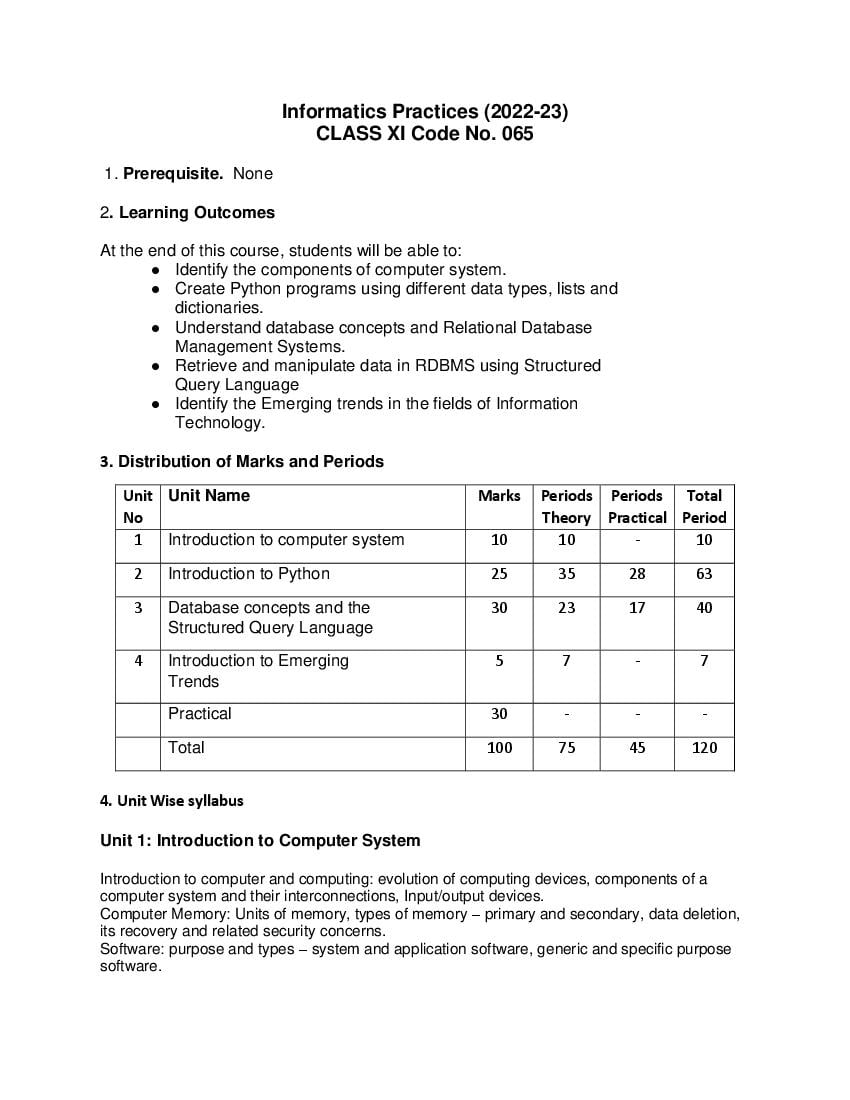
CLASS XI Code No. 065
1. Prerequisite. None
2. Learning Outcomes
At the end of this course, students will be able to:
● Identify the components of computer system.
● Create Python programs using different data types, lists and
dictionaries.
● Understand database concepts and Relational Database
Management Systems.
● Retrieve and manipulate data in RDBMS using Structured
Query Language
● Identify the Emerging trends in the fields of Information
Technology.
3. Distribution of Marks and Periods
Unit Unit Name Marks Periods Periods Total
No Theory Practical Period
1 Introduction to computer system 10 10 - 10
2 Introduction to Python 25 35 28 63
3 Database concepts and the 30 23 17 40
Structured Query Language
4 Introduction to Emerging 5 7 - 7
Trends
Practical 30 - - -
Total 100 75 45 120
4. Unit Wise syllabus
Unit 1: Introduction to Computer System
Introduction to computer and computing: evolution of computing devices, components of a
computer system and their interconnections, Input/output devices.
Computer Memory: Units of memory, types of memory – primary and secondary, data deletion,
its recovery and related security concerns.
Software: purpose and types – system and application software, generic and specific purpose
software.
Page 2
Basics of Python programming, Python interpreter - interactive and script mode, the structure of
a program, indentation, identifiers, keywords, constants, variables, types of operators,
precedence of operators, data types, mutable and immutable data types, statements,
expressions, evaluation and comments, input and output statements, data type conversion,
debugging.
Control Statements: if-else, for
loop
Lists: list operations - creating, initializing, traversing and manipulating lists, list methods and
built-in functions.
Dictionary: concept of key-value pair, creating, initializing, traversing, updating and deleting
elements, dictionary methods and built-in functions.
Unit 3: Database concepts and the Structured Query Language
Database Concepts: Introduction to database concepts and its need, Database Management
System.
Relational data model: Concept of domain, tuple, relation, candidate key, primary key, alternate
key
Advantages of using Structured Query Language, Data Definition Language, Data Query
Language and Data Manipulation Language, Introduction to MySQL, creating a database using
MySQL, Data Types
Data Definition: CREATE TABLE
Data Query: SELECT, FROM, WHERE.
Data Manipulation: INSERT
Unit 4: Introduction to the Emerging Trends
Artificial Intelligence, Machine Learning, Natural Language Processing, Immersive experience
(AR, VR), Robotics, Big data and its characteristics, Internet of Things (IoT), Sensors, Smart
cities, Cloud Computing and Cloud Services (SaaS, IaaS, PaaS); Grid Computing, Block chain
technology.
Page 3
S.No. Unit Name Marks
1 Problem solving using Python programming language 11
3 Creating database using MySQL and performing Queries 7
4 Practical file (minimum of 14 python programs, and 14 SQL 7
queries)
5 Viva-Voce 5
Total 30
5. Suggested Practical List
5.1 Programming in Python
1. To find average and grade for given marks.
2. To find sale price of an item with given cost and discount (%).
3. To calculate perimeter/circumference and area of shapes such as triangle, rectangle,
square and circle.
4. To calculate Simple and Compound interest.
5. To calculate profit-loss for given Cost and Sell Price.
6. To calculate EMI for Amount, Period and Interest.
7. To calculate tax - GST / Income Tax.
8. To find the largest and smallest numbers in a list.
9. To find the third largest/smallest number in a list.
10. To find the sum of squares of the first 100 natural numbers.
11. To print the first ‘n’ multiples of given number.
12. To count the number of vowels in user entered string.
13. To print the words starting with a alphabet in a user entered string.
14. To print number of occurrences of a given alphabet in each string.
15. Create a dictionary to store names of states and their capitals.
16. Create a dictionary of students to store names and marks obtained in 5 subjects.
17. To print the highest and lowest values in the dictionary.
5.3 Data Management: SQL Commands
18. To create a database
19. To create student table with the student id, class, section, gender, name, dob, and
marks as attributes where the student id is the primary key.
20. To insert the details of at least 10 students in the above table.
21. To display the entire content of table.
22. To display Rno, Name and Marks of those students who are scoring marks more than
50.
23. To find the average of marks from the student table.
Page 4
25. To display the information all the students, whose name starts with ‘AN’ (Examples:
ANAND, ANGAD,..)
26. To display Rno, Name, DOB of those students who are born between ‘2005- 01-01’ and
‘2005-12-31’.
27. To display Rno, Name, DOB, Marks, Email of those male students in ascending order of
their names.
28. To display Rno, Gender, Name, DOB, Marks, Email in descending order of their marks.
29. To display the unique section available in the table.
Suggested material
NCERT Informatics Practices - Text book for class - XI (ISBN- 978-93-5292-148-5 )
Excluded topics
Nested loop(Chapter -3, Section - 3.13)
Loading and saving NumPy array in text files (Chapter-6, Sections- 6.10 and
6.11)
Document Details
| Board / Org | CBSE |
| Exam | Class 11 |
| Type | Syllabus |
| Pages | 4 |
| Language | english |
| Updated | 15 Jul 2026 |