DUET 2021 Question Paper M.Sc Food and Nutrition
Finished viewing? Save it for later —
Download DUET 2021 Question Paper M.Sc Food and Nutrition (PDF · 14 pages)About DUET 2021 Question Paper M.Sc Food and Nutrition
DUET 2021 Question Paper M.Sc Food and Nutrition is available here for free download. Published by NTA for DUET, this question paper can be viewed online or downloaded as a PDF (14 pages). Candidates preparing for DUET can use DUET 2021 Question Paper M.Sc Food and Nutrition to understand the exam pattern, the type of questions asked, and the overall difficulty level.
Frequently Asked Questions
How can I download DUET 2021 Question Paper M.Sc Food and Nutrition?
Open this page and click the Download button to save DUET 2021 Question Paper M.Sc Food and Nutrition as a PDF. It is completely free on AglaSem Docs.
Is DUET 2021 Question Paper M.Sc Food and Nutrition free to download?
Yes. DUET 2021 Question Paper M.Sc Food and Nutrition can be viewed online and downloaded as a PDF free of cost on AglaSem Docs.
How many pages does DUET 2021 Question Paper M.Sc Food and Nutrition have?
DUET 2021 Question Paper M.Sc Food and Nutrition contains 14 pages, which you can read online or download together as a single PDF.
Where can I find more DUET study material?
You can find more DUET question papers, sample papers, syllabus, and answer keys on AglaSem Docs.
DUET 2021 Question Paper M.Sc Food and Nutrition – Text
Read the full text of this question paper below — useful to quickly search, copy and reference the content online without downloading the PDF.
📄 View text version (14 pages)
Page 1
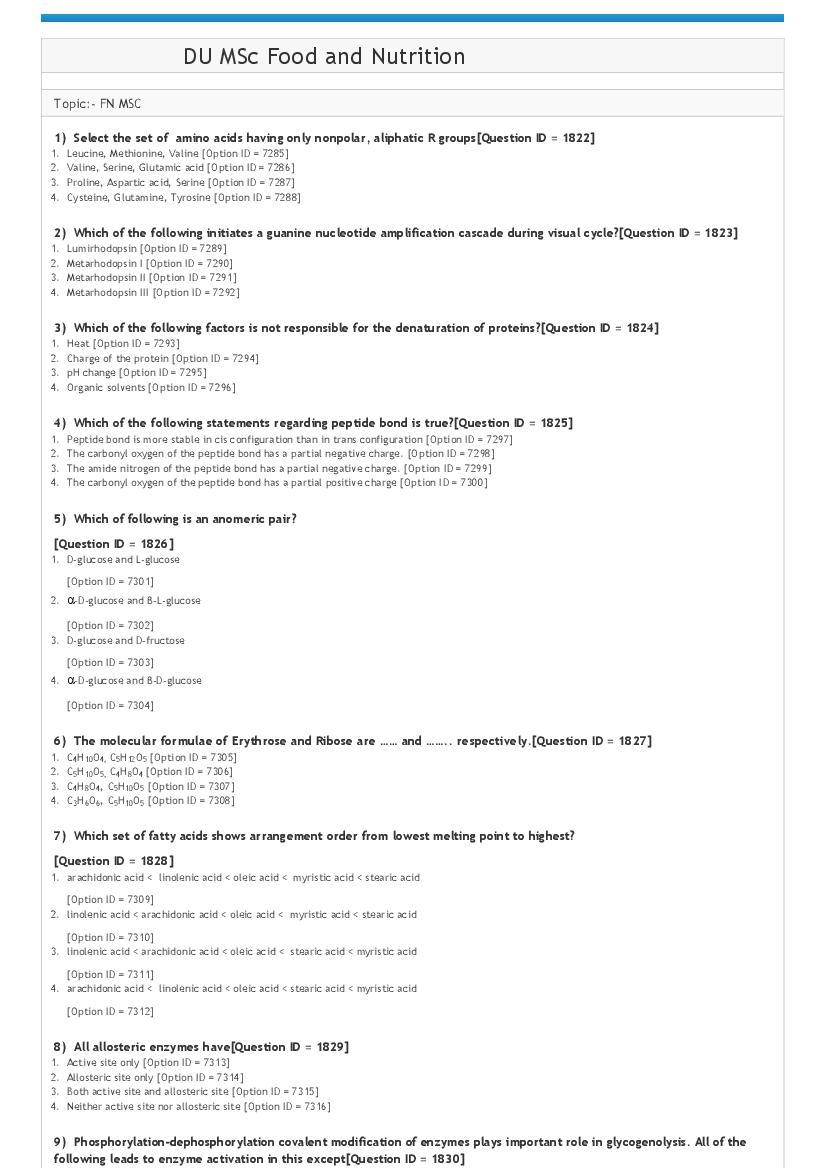
Topic:‐ FN MSC
1) Select the set of amino acids having only nonpolar, aliphatic R groups[Question ID = 1822]
1. Leucine, Methionine, Valine [Option ID = 7285]
2. Valine, Serine, Glutamic acid [Option ID = 7286]
3. Proline, Aspartic acid, Serine [Option ID = 7287]
4. Cysteine, Glutamine, Tyrosine [Option ID = 7288]
2) Which of the following initiates a guanine nucleotide amplification cascade during visual cycle?[Question ID = 1823]
1. Lumirhodopsin [Option ID = 7289]
2. Metarhodopsin I [Option ID = 7290]
3. Metarhodopsin II [Option ID = 7291]
4. Metarhodopsin III [Option ID = 7292]
3) Which of the following factors is not responsible for the denaturation of proteins?[Question ID = 1824]
1. Heat [Option ID = 7293]
2. Charge of the protein [Option ID = 7294]
3. pH change [Option ID = 7295]
4. Organic solvents [Option ID = 7296]
4) Which of the following statements regarding peptide bond is true?[Question ID = 1825]
1. Peptide bond is more stable in cis configuration than in trans configuration [Option ID = 7297]
2. The carbonyl oxygen of the peptide bond has a partial negative charge. [Option ID = 7298]
3. The amide nitrogen of the peptide bond has a partial negative charge. [Option ID = 7299]
4. The carbonyl oxygen of the peptide bond has a partial positive charge [Option ID = 7300]
5) Which of following is an anomeric pair?
[Question ID = 1826]
1. D‐glucose and L‐glucose
[Option ID = 7301]
2. α‐D‐glucose and β‐L‐glucose
[Option ID = 7302]
3. D‐glucose and D‐fructose
[Option ID = 7303]
4. α‐D‐glucose and β‐D‐glucose
[Option ID = 7304]
6) The molecular formulae of Erythrose and Ribose are …… and …….. respectively.[Question ID = 1827]
1. C4H 10O4, C5H 12O5 [Option ID = 7305]
2. C5H 10O5, C4H 8O4 [Option ID = 7306]
3. C4H 8O4, C5H 10O5 [Option ID = 7307]
4. C3H 6O6, C5H 10O5 [Option ID = 7308]
7) Which set of fatty acids shows arrangement order from lowest melting point to highest?
[Question ID = 1828]
1. arachidonic acid < linolenic acid < oleic acid < myristic acid < stearic acid
[Option ID = 7309]
2. linolenic acid < arachidonic acid < oleic acid < myristic acid < stearic acid
[Option ID = 7310]
3. linolenic acid < arachidonic acid < oleic acid < stearic acid < myristic acid
[Option ID = 7311]
4. arachidonic acid < linolenic acid < oleic acid < stearic acid < myristic acid
[Option ID = 7312]
8) All allosteric enzymes have[Question ID = 1829]
1. Active site only [Option ID = 7313]
2. Allosteric site only [Option ID = 7314]
3. Both active site and allosteric site [Option ID = 7315]
4. Neither active site nor allosteric site [Option ID = 7316]
9) Phosphorylation‐dephosphorylation covalent modification of enzymes plays important role in glycogenolysis. All of the
following leads to enzyme activation in this except[Question ID = 1830]
Page 2
2. Phosphorylation of glycogen phosphorylase [Option ID = 7318]
3. Dephosphorylation of glycogen synthase [Option ID = 7319]
4. Phosphorylation of phosphorylase kinase [Option ID = 7320]
10) Which of the following enzyme steps from glycolysis is performed by a different enzyme in gluconeogenesis?[Question
ID = 1831]
1. Phosphohexose isomerase [Option ID = 7321]
2. Phosphofructokinase [Option ID = 7322]
3. Glyceraldehyde‐3‐phosphate dehydrogenase [Option ID = 7323]
4. Enolase [Option ID = 7324]
11) Which of the following is true about secondary protein structure?
A. Secondary structure is the local spatial arrangement of the main‐chain atoms in a selected segment of polypeptide chain.
B. All polypeptides can form stable α‐helix.
C. The proline residue introduces a stabilizing kink in the αhelix.
D. The steric influence of amino acid residues is important to secondary structure.
Choose the correct answer from the options given below
[Question ID = 1832]
1. A and C
[Option ID = 7325]
2. B and C
[Option ID = 7326]
3. A and D
[Option ID = 7327]
4. A, B and D
[Option ID = 7328]
12) Which of the following occurs during glycolysis?
A. Conversion of fructose‐1,6‐bisphosphate to fructose‐6‐phosphate
B. An aldolase‐ketose isomerization step
C. Pyruvate, NADH and ATP are produced
D. Two net molecules of ATP are produced through substrate‐level phosphorylation
Choose the correct answer from the options given below
[Question ID = 1833]
1. A and B
[Option ID = 7329]
2. B and C
[Option ID = 7330]
3. C and D
[Option ID = 7331]
4. B, C and D
[Option ID = 7332]
13) Given below are two statements, one is labelled as Assertion A and the other is labelled as Reason R
Assertion A : Glycolysis in erythrocytes always terminates with the formation of lactate.
Reason R : This is because the subsequent reactions of pyruvate oxidation are mitochondrial and erythrocytes have few
mitochondria.
[Question ID = 1834]
[Option ID = 7333]
[Option ID = 7334]
[Option ID = 7335]
[Option ID = 7336]
Page 3
1. Dehydration of cis‐aconitate and rehydration to isocitrate [Option ID = 7337]
2. Rehydration of cis‐aconitate and dehydration to isocitrate [Option ID = 7338]
3. Isomerization to cis‐aconitate and rehydration to isocitrate [Option ID = 7339]
4. Condensation and hydration [Option ID = 7340]
15) During aerobic oxidation of one molecule of glucose, 32 molecules of ATP are produced, out of which[Question ID =
1836]
1. Two are produced outside mitochondria and thirty are produced inside mitochondria [Option ID = 7341]
2. Four are produced outside mitochondria and twenty eight are produced inside mitochondria [Option ID = 7342]
3. Four are produced inside mitochondria and twenty eight are produced outside mitochondria [Option ID = 7343]
4. All are produced inside mitochondria [Option ID = 7344]
16) Which of the following vitamin is necessary for the TCA cycle?[Question ID = 1837]
1. Thiamine [Option ID = 7345]
2. Biotin [Option ID = 7346]
3. Vitamin E [Option ID = 7347]
4. Vitamin A [Option ID = 7348]
17) Given below are two statements, one is labelled as Assertion A and the other is labelled as Reason R
Assertion A : The Krebs cycle provides substrates for gluconeogenesis and transamination.
Reason R : This is because during oxidation of acetyl‐CoA through Krebs cycle coenzymes are reduced and subsequently
reoxidized in the respiratory chain.
[Question ID = 1838]
[Option ID = 7349]
[Option ID = 7350]
[Option ID = 7351]
[Option ID = 7352]
18) Which of the following enzyme does not take part in the TCA cycle?[Question ID = 1839]
1. Citrate synthase [Option ID = 7353]
2. Iso‐citrate dehydrogenase [Option ID = 7354]
3. Pyruvate dehydrogenase complex [Option ID = 7355]
4. Malate dehydrogenase [Option ID = 7356]
19) Starting with Ornithine transcarbamoylase reaction, the order in which intermediates in the urea cycle would be
occur[Question ID = 1840]
1. citrulline, argininosuccinate, arginine, ornithine [Option ID = 7357]
2. argininosuccinate, citrulline, arginine, ornithine [Option ID = 7358]
3. argininosuccinate, arginine, citrulline, ornithine [Option ID = 7359]
4. citrulline, arginine, argininosuccinate, ornithine [Option ID = 7360]
20) A second amino group is transferred to citrulline from……[Question ID = 1841]
1. Glutamate [Option ID = 7361]
2. Alanine [Option ID = 7362]
3. Tyrosine [Option ID = 7363]
4. Aspartate [Option ID = 7364]
21) The enzyme just preceding thiolase in β‐oxidation of fatty acids is[Question ID = 1842]
1. Acyl‐CoA dehydrogenase [Option ID = 7365]
2. 3‐ketoacyl‐CoA dehydrogenase [Option ID = 7366]
3. Enoyl‐CoA hydratase [Option ID = 7367]
4. 3‐hydroxyacyl‐CoA dehydrogenase [Option ID = 7368]
22) Overproduction of ketone bodies is often seen during starvation due to
A. Overproduction of acetyl CoA
B. Increased rate of fatty acid oxidation
C. Increased synthesis of fatty acid
D. Increased rate of glycolysis
Page 4
1. A and B only
[Option ID = 7369]
2. B and D only
[Option ID = 7370]
3. A and C only
[Option ID = 7371]
4. C and D only
[Option ID = 7372]
23) The high energy cost of gluconeogenesis is majorly met by[Question ID = 1844]
1. Beta oxidation of fatty acids [Option ID = 7373]
2. Breakdown of amino acids [Option ID = 7374]
3. Degradation of glycogen [Option ID = 7375]
4. Citric acid cycle [Option ID = 7376]
24) The allosteric activator of liver glutamate dehydrogenase enzyme is[Question ID = 1845]
1. ATP [Option ID = 7377]
2. ADP [Option ID = 7378]
3. GTP [Option ID = 7379]
4. NADH [Option ID = 7380]
25) Mark the correct statements about glycogen metabolism.
A. In muscle in the fasting state, glycogen is broken down to glucose 6‐phosphate, then free glucose.
B. Glucagon inhibits the synthesis of glycogen.
C. Phosphorylation activates protein kinase A during glycogen degradation
D. Insulin inhibits the synthesis of glycogen.
[Question ID = 1846]
1. B only
[Option ID = 7381]
2. B and C
[Option ID = 7382]
3. A and C
[Option ID = 7383]
4. C and D
[Option ID = 7384]
26) A 45 year old woman gave her blood sample after breaking her overnight fast by eating three slices of toast and a
boiled egg. Which one of the following would be at a higher concentration than if the blood sample had been taken before
breakfast?[Question ID = 1847]
1. Free fatty acids [Option ID = 7385]
2. Glucose [Option ID = 7386]
3. Glucagon [Option ID = 7387]
4. Ketone Bodies [Option ID = 7388]
27) Match List I with List II
List I List II
Hormone Effect
A. Insulin I. Hepatic glycogenolysis only
B. Glucagon II. Calcium homeostasis
C. Epinephrine III. Muscle and liver glycogenolysis
D. Parathyroid IV. Decreased ketogenesis
[Question ID = 1848]
1. A ‐ IV, B ‐ I, C ‐ III, D ‐ II [Option ID = 7389]
2. A ‐ III, B ‐ I, C ‐ IV, D ‐ II [Option ID = 7390]
3. A ‐ I, B ‐ IV, C ‐ II, D ‐ III [Option ID = 7391]
4. A ‐ III, B ‐ II, C ‐ I, D ‐ IV [Option ID = 7392]
28) Match List I with List II
List I List II
Metabolic Pathway Enzyme
Page 5
B. Beta‐oxidation II. Acyl‐CoA dehydrogenase
C. Gluconeogenesis III. 3‐Hydroxy‐3‐methylglutaryl‐CoA
D. Glycogen MetabolismIV. Glucan transferase
[Question ID = 1849]
1. A ‐ IV, B ‐ I, C ‐ III, D ‐ II [Option ID = 7393]
2. A ‐ III, B ‐ I, C ‐ IV, D ‐ II [Option ID = 7394]
3. A ‐ I, B ‐ IV, C ‐ II, D ‐ III [Option ID = 7395]
4. A ‐ III, B ‐ II, C ‐ I, D ‐ IV [Option ID = 7396]
29) Which of the following is not formed during synthesis of biologically active form of vitamin D?[Question ID = 1850]
1. Calcitriol [Option ID = 7397]
2. 25‐hydroxycholecalciferol [Option ID = 7398]
3. 24‐hydroxycholecalciferol [Option ID = 7399]
4. Cholecalciferol [Option ID = 7400]
30) Beta carotene is found in plants foods. It is cleaved in the intestine by carotene dioxygenase to produce__________.
[Question ID = 1851]
1. Retinal [Option ID = 7401]
2. Carotene [Option ID = 7402]
3. Retinol [Option ID = 7403]
4. Vitamin A [Option ID = 7404]
31) Match List I with List II
List I List II
Enzyme Reaction Type
A. Alpha‐ketoglutarate dehydrogenase complexI. Substrate‐level‐phosphorylation
B. Succinate thiokinase II. Hydration
C. Citrate synthase III. Oxidative decarboxylation
D. Fumarase IV. Condensation
[Question ID = 1852]
1. A ‐ IV, B ‐ I, C ‐ III, D ‐ II [Option ID = 7405]
2. A ‐ III, B ‐ I, C ‐ IV, D ‐ II [Option ID = 7406]
3. A ‐ I, B ‐ IV, C ‐ II, D ‐ III [Option ID = 7407]
4. A ‐ III, B ‐ II, C ‐ I, D ‐ IV [Option ID = 7408]
32) Which of the following reacts with opsin forming rhodopsin in visual cycle?[Question ID = 1853]
1. 11‐cis‐retinol [Option ID = 7409]
2. 11‐cis‐retinaldehyde [Option ID = 7410]
3. All‐trans‐retinol [Option ID = 7411]
4. All‐trans‐retinaldehyde [Option ID = 7412]
33) Given below are two statements, one is labelled as Assertion A and the other is labelled as Reason R
Assertion A : Transamination reactions are involved in amino acid biosynthesis and catabolism of proteins.
Reason R : This is because these reactions are readily reversible.
[Question ID = 1854]
[Option ID = 7413]
[Option ID = 7414]
[Option ID = 7415]
[Option ID = 7416]
34) Which of the following clinical symptom is not associated with Marasmus?[Question ID = 1855]
1. Severe muscle wasting [Option ID = 7417]
2. Loss of subcutaneous fat [Option ID = 7418]
3. Wrinkled skin [Option ID = 7419]
4. Oedema [Option ID = 7420]
35) Namit is 36 months old boy who is brought to a health facility with the complaint of swelling in both legs. His
anthropometric assessment reveals his weight for height was below ‐3SD and MUAC less than 115 mm. Which condition is he
Page 6
1. Obesity [Option ID = 7421]
2. Severe acute malnutrition [Option ID = 7422]
3. Dehydration [Option ID = 7423]
4. Typhoid [Option ID = 7424]
36) As per NFHS 4, prevalence of anaemia among children aged 6‐59 months in India is[Question ID = 1857]
1. 65.5 percent [Option ID = 7425]
2. 58.6 percent [Option ID = 7426]
3. 50.5 percent [Option ID = 7427]
4. 45.5 percent [Option ID = 7428]
37) Vitamin A deficiency is considered a public health problem if prevalence rate of night blindness in children between 6
months to 6 years is more than[Question ID = 1858]
1. 5.0 percent [Option ID = 7429]
2. 1 percent [Option ID = 7430]
3. 0.5 percent [Option ID = 7431]
4. 0.1 percent [Option ID = 7432]
38) Which of these diseases is not related to thyroid glands?[Question ID = 1859]
1. Myxoedematous Cretinism [Option ID = 7433]
2. Deaf mutism [Option ID = 7434]
3. Goitre [Option ID = 7435]
4. Pernicious Anaemia [Option ID = 7436]
39) Given below are two statements
Statement I: Fluorosis is caused due to excess fluoride in water
Statement II: Mottling of teeth due to fluorosis is reversible.
In light of the above statements, choose the most appropriate answer from the options given below
[Question ID = 1860]
1. Both Statement I and Statement II are correct
[Option ID = 7437]
2. Both Statement I and Statement II are incorrect
[Option ID = 7438]
3. Statement I is correct but Statement II is incorrect
[Option ID = 7439]
4. Statement I is incorrect but Statement II is correct
[Option ID = 7440]
40) Folic acid supplementation is advised preconceptionally and throughout pregnancy, for women to prevent[Question ID
= 1861]
1. Cleft palate [Option ID = 7441]
2. Protein energy malnutrition [Option ID = 7442]
3. Neural tube defects [Option ID = 7443]
4. Microcytic anemia [Option ID = 7444]
41) The target reduction of low birth weight per annum under the National Nutrition Mission is[Question ID = 1862]
1. 1 percent [Option ID = 7445]
2. 2 percent [Option ID = 7446]
3. 3 percent [Option ID = 7447]
4. 5 percent [Option ID = 7448]
42) Given below are two statements, one is labeled as Assertion A and the other is labeled as Reason R
Assertion A: All children older than 6 months should be given zinc supplementation as soon as diarrhea starts
Reason R: Zinc is known to play a central role in the immune system
[Question ID = 1863]
[Option ID = 7449]
[Option ID = 7450]
[Option ID = 7451]
[Option ID = 7452]
Page 7
1. Muscle [Option ID = 7453]
2. Liver [Option ID = 7454]
3. Gall bladder [Option ID = 7455]
4. Stomach [Option ID = 7456]
44) Which of the following statements are correct about the Mid‐day meal scheme?
A. In drought‐affected areas, midday meals shall be supplied even during summer vacations
B. The scheme has been initiated under the National Programme of Nutritional Support to Primary Education (NP‐NSPE)
C. Under this program, a cooked mid‐day meal with 700 calories and 20 grams of protein is provided to all children enrolled
in classes one to five
D. The Midday Meal Scheme is covered by the National Food Security Act, 2013
[Question ID = 1865]
1. A, B and C only
[Option ID = 7457]
2. A, B and D only
[Option ID = 7458]
3. B, C and D only
[Option ID = 7459]
4. A, C and D only
[Option ID = 7460]
45) A common anthropometric measure for infants is:[Question ID = 1866]
1. Standing height [Option ID = 7461]
2. Recumbent length [Option ID = 7462]
3. Sitting height [Option ID = 7463]
4. Laying height [Option ID = 7464]
46) Which dietary assessment method determines nutrient intake by asking how often certain foods are consumed?
[Question ID = 1867]
1. Diet History [Option ID = 7465]
2. Food frequency [Option ID = 7466]
3. 24‐hour dietary recall [Option ID = 7467]
4. Food balance sheet [Option ID = 7468]
47) Which of the following is not part of the 4 P’s social marketing mix?[Question ID = 1868]
1. Product [Option ID = 7469]
2. Price [Option ID = 7470]
3. Place [Option ID = 7471]
4. People [Option ID = 7472]
48) Which of the following is not a limitation of the focus group method?[Question ID = 1869]
1. The researcher has little control over how the discussion proceeds [Option ID = 7473]
2. It reveals the way social meanings are jointly constructed [Option ID = 7474]
3. It produces a large volume of data that can be difficult to analyse [Option ID = 7475]
4. People in groups tend to agree and express socially desirable views [Option ID = 7476]
49) Match List I with List II
List I List II
A. Nutrition survey I. Continuous monitoring of the nutritional status of a selected population group
B. Evaluation II. Identification of malnourished individuals requiring intervention
C. Nutrition screening III. Cross‐sectional studies performed to assess the nutritional status of a selected population
D. Nutrition Surveillance IV. Measurement of the amount of progress made for the nutrition intervention
[Question ID = 1870]
1. A ‐ I, B ‐ II, C ‐ III, D ‐ IV [Option ID = 7477]
2. A ‐ IV, B ‐ III, C ‐ I, D ‐ II [Option ID = 7478]
3. A ‐ III, B ‐ IV, C ‐ II, D ‐ I [Option ID = 7479]
4. A ‐ II, B ‐ I, C ‐ IV, D ‐ III [Option ID = 7480]
50) A research study intends to access the awareness of consumers about food fortification. Which research method will be
most appropriate for this study?[Question ID = 1871]
1. Descriptive method [Option ID = 7481]
2. Historical method [Option ID = 7482]
3. Ex‐post facto method [Option ID = 7483]
Page 8
51) In order to pursue the research, which of the following is priorly required?[Question ID = 1872]
1. Developing a research design [Option ID = 7485]
2. Formulating a research question [Option ID = 7486]
3. Deciding about the data analysis procedure [Option ID = 7487]
4. Formulating a research hypothesis [Option ID = 7488]
52) Which of the following does not correspond to characteristics of research?[Question ID = 1873]
1. Research is not passive [Option ID = 7489]
2. Research is systematic [Option ID = 7490]
3. Research is logical [Option ID = 7491]
4. Research is not a process [Option ID = 7492]
53) Match List I with List II
List I List II
A. Systematic Sampling
I. Sample is selected on the judgment of the researcher
Technique
B. Purposive Sampling
II. Sample is selected according to specific traits or qualities.
Technique
C. Quota Sampling Technique III. Existing study subjects refer to other subjects from among their acquaintances.
D. Snowball Sampling IV. Sample members are selected according to a random starting point but with a fixed,
Technique periodic interval.
[Question ID = 1874]
1. A ‐ II, B ‐ III, C ‐ IV, D ‐ I [Option ID = 7493]
2. A ‐ IV, B ‐ I, C ‐ II, D ‐ III [Option ID = 7494]
3. A ‐ III, B ‐ IV, C ‐ II, D ‐ I [Option ID = 7495]
4. A ‐ II, B ‐ I, C ‐ IV, D ‐ III [Option ID = 7496]
54) What does the term 'reliability' indicate?[Question ID = 1875]
1. We can say that the research has being carried out to according to the research design [Option ID = 7497]
2. That the results can be statistically proved [Option ID = 7498]
3. That the researcher can be trusted. [Option ID = 7499]
4. That the tool of data collection can be regarded as measuring consistently. [Option ID = 7500]
55) Researchers use both open‐ended and closed‐ended questions to collect data. Which of the following statements is
true?[Question ID = 1876]
1. Open‐ended questions directly provide quantitative data based on the researcher’s predetermined response categories [Option ID = 7501]
2. Closed‐ended questions provide quantitative data in the participant’s own words [Option ID = 7502]
3. Open‐ended questions provide qualitative data in the participant’s own words [Option ID = 7503]
4. Closed‐ended questions directly provide qualitative data in the participants’ own words [Option ID = 7504]
56) Winterization is associated with which processing method?[Question ID = 1877]
1. Milling of rice [Option ID = 7505]
2. Emulsion [Option ID = 7506]
3. Parboiling of rice [Option ID = 7507]
4. Refining of oil [Option ID = 7508]
57) Name the enzyme responsible for coagulation of milk in cheese manufacture [Question ID = 1878]
1. Pepsin [Option ID = 7509]
2. Lipase [Option ID = 7510]
3. Amylase [Option ID = 7511]
4. Rennin [Option ID = 7512]
58) When wheat is converted to maida,_______________ is lost[Question ID = 1879]
1. Thiamin [Option ID = 7513]
2. Phosphorus [Option ID = 7514]
3. Protein [Option ID = 7515]
4. Fat [Option ID = 7516]
59) The pectin present in fruit is useful for the production of
A.Pickles
B.Jams
C.Jelly
D.Crystallised fruits
[Question ID = 1880]
Page 9
[Option ID = 7517]
2. C and D only
[Option ID = 7518]
3. B and C only
[Option ID = 7519]
4. A and D only
[Option ID = 7520]
60) Given below are two statements, one is labelled as Assertion A and the other is labelled as Reason R
Assertion A : When starch products is subjected to dry heat carbohydrate compounds called dextrins are formed
Reason R : Extensive dextrinization increased the thickening power of starches
[Question ID = 1881]
[Option ID = 7521]
[Option ID = 7522]
[Option ID = 7523]
[Option ID = 7524]
61) Match List I with List II
List I List II
A. Lemon Juice I. Tartaric acid
B. Vinegar II. Citric acid
C. Tamarind extract III. Malic acid
D. Apple IV. Acetic acid
[Question ID = 1882]
1. A ‐ II, B ‐ IV , C ‐ I, D ‐III [Option ID = 7525]
2. A ‐ I, B ‐ II, C ‐IV , D ‐III [Option ID = 7526]
3. A ‐II , B ‐IV , C ‐III , D ‐I [Option ID = 7527]
4. A ‐III , B ‐I , C ‐II , D ‐ IV [Option ID = 7528]
62) Property of solids that enables them to hold their shape under small pressure[Question ID = 1883]
1. Rancidity [Option ID = 7529]
2. Viscosity [Option ID = 7530]
3. Plasticity [Option ID = 7531]
4. Adsorption [Option ID = 7532]
63) Process responsible for the staling of bread is[Question ID = 1884]
1. Gelatinization [Option ID = 7533]
2. Retrogradation [Option ID = 7534]
3. Hydrolysis of starch [Option ID = 7535]
4. Lipolysis [Option ID = 7536]
64) Yeast fermentation produces chemical changes in which enzymes produced by the yeast cell converts[Question ID =
1885]
1. Alcohol into Sugar [Option ID = 7537]
2. Proteins into amino acids [Option ID = 7538]
3. Fats into Fatty acids [Option ID = 7539]
4. Sugar into Alcohol [Option ID = 7540]
65) The phosphoprotein which is precipitated from raw milk at pH 4.6 is[Question ID = 1886]
1. Albumin [Option ID = 7541]
2. Lactoglobulin [Option ID = 7542]
3. Lactalbumin [Option ID = 7543]
4. Casein [Option ID = 7544]
66) A trained panel should comprise of following number of members[Question ID = 1887]
1. 10‐15 [Option ID = 7545]
Page 10
3. 15‐20 [Option ID = 7547]
4. 50‐100 [Option ID = 7548]
67) Iodine value measures[Question ID = 1888]
1. Degree of unsaturation [Option ID = 7549]
2. Degree of saturation [Option ID = 7550]
3. Amount of carbon present [Option ID = 7551]
4. Number of iodine present [Option ID = 7552]
68) When egg is cooked _____ gets completely destroyed[Question ID = 1889]
1. Avidin [Option ID = 7553]
2. Iron [Option ID = 7554]
3. Protein [Option ID = 7555]
4. Fat [Option ID = 7556]
69) Given below are two statements, one is labelled as Assertion A and the other is labelled as Reason R
Assertion A : Irradiation is generally termed as “cold sterilization’’ method of food preservation.
Reason R : Food becomes free of microorganisms without the need of high temperature.
[Question ID = 1890]
[Option ID = 7557]
[Option ID = 7558]
[Option ID = 7559]
[Option ID = 7560]
70) Name the SNF resource book for workplace[Question ID = 1891]
1. Pink Book [Option ID = 7561]
2. Yellow Book [Option ID = 7562]
3. Orange Book [Option ID = 7563]
4. Green Book [Option ID = 7564]
71) Match List I with List II
List I List II
A. Milk I. Rigor Mortis
B. Apple II. Maillard reaction
C. Egg III. Gelatinization
D. Meat IV. Poaching
E. Cereal V. Browning reaction
[Question ID = 1892]
1. A ‐ I , B ‐ III , C ‐IV , D ‐V, E‐II [Option ID = 7565]
2. A ‐ II, B ‐V , C ‐ IV, D ‐I, E‐III [Option ID = 7566]
3. A ‐III , B ‐I , C ‐II , D ‐ IV, E‐V [Option ID = 7567]
4. A ‐ IV, B ‐ V, C ‐III , D ‐ I, E‐II [Option ID = 7568]
72) Which of the following is the omega‐3 fatty acid[Question ID = 1893]
1. Linoleic acid [Option ID = 7569]
2. Linolenic acid [Option ID = 7570]
3. Arachadonic acid [Option ID = 7571]
4. Oleic acid [Option ID = 7572]
73) Tenderization of meat can be achieved by which enzyme[Question ID = 1894]
1. Cellulase [Option ID = 7573]
2. Amylase [Option ID = 7574]
3. Papain [Option ID = 7575]
4. Lipoxygenase [Option ID = 7576]
74) The rapid and constant rate of multiplication of an organism occurs during the[Question ID = 1895]
1. Lag phase [Option ID = 7577]
Page 11
3. Stationary phase [Option ID = 7579]
4. Survival phase [Option ID = 7580]
75) Which one of the following acts as a bleaching agent as well as improver for wheat flour?[Question ID = 1896]
1. Chlorine dioxide [Option ID = 7581]
2. Ascorbic acid [Option ID = 7582]
3. Benzoyl peroxide [Option ID = 7583]
4. Azodicarbonamide [Option ID = 7584]
76) Which one of the following reactions is not resulted from sugars?[Question ID = 1897]
1. Caramelization [Option ID = 7585]
2. Crystallization [Option ID = 7586]
3. Gelation [Option ID = 7587]
4. Maillard reaction [Option ID = 7588]
77) Which chemical component, produced as a result of certain acid producing micro‐organism, is responsible for the
delicate desirable flavor and aroma of butter?[Question ID = 1898]
1. Diacetyl [Option ID = 7589]
2. Ethanol [Option ID = 7590]
3. Acetic acid [Option ID = 7591]
4. Trimethylamine [Option ID = 7592]
78) Which enzyme is involved in browning of the cut surfaces of potatoes?[Question ID = 1899]
1. Polyphenol oxidase [Option ID = 7593]
2. Amylase [Option ID = 7594]
3. Protease [Option ID = 7595]
4. Lipase [Option ID = 7596]
79) The active principal in garlic is[Question ID = 1900]
1. Eugenol [Option ID = 7597]
2. Capsaicin [Option ID = 7598]
3. Gingerol [Option ID = 7599]
4. Allicin [Option ID = 7600]
80) Milk sugar lactose is a combination of which two mono‐saccharides[Question ID = 1901]
1. Glucose and Glucose [Option ID = 7601]
2. Glucose and Fructose [Option ID = 7602]
3. Glucose and Galactose [Option ID = 7603]
4. Fructose and Galactose [Option ID = 7604]
81) Blanching of fruits and vegetables cannot be used to[Question ID = 1902]
1. Improves colour [Option ID = 7605]
2. Inactivate enzymes [Option ID = 7606]
3. Reduces surface contamination [Option ID = 7607]
4. Destroy all pathogens [Option ID = 7608]
82) Which of the following foods does not contain gluten?
A. Wheat flour
B. Rice flour
C. Gram flour
D. Corn flour
[Question ID = 1903]
1. B, C and D only
[Option ID = 7609]
2. D, A and B only
[Option ID = 7610]
3. A,B and C only
[Option ID = 7611]
4. C, D and A only
[Option ID = 7612]
83) Toxic constituents of pulses that possess the property of producing lather or foam when shaken with water is[Question
ID = 1904]
1. Trypsin inhibitor [Option ID = 7613]
2. Haemagglutinins [Option ID = 7614]
3. Saponins [Option ID = 7615]
Page 12
84) Match List I with List II
List I List II
A. Betalains I. Tomatoes
B. ChlorophyllII. Red Beet
C. Lycopene III. Red Pepper
D. CapsanthinIV. Spinach
[Question ID = 1905]
1. A ‐ IV, B ‐ I, C ‐ III, D ‐ II [Option ID = 7617]
2. A ‐ II, B ‐ IV, C ‐ I, D ‐ III [Option ID = 7618]
3. A ‐ I, B ‐ III, C ‐ II, D ‐ IV [Option ID = 7619]
4. A ‐ I, B ‐ II, C ‐ III, D ‐ IV [Option ID = 7620]
85) The minimum MSNF of Skim milk should be as follows :[Question ID = 1906]
1. 8.7% [Option ID = 7621]
2. 7.2 % [Option ID = 7622]
3. 6.5 % [Option ID = 7623]
4. 5.2 % [Option ID = 7624]
86) Radicidation is used for:[Question ID = 1907]
1. Elimination of particular pathogen [Option ID = 7625]
2. Extension of product’s shelf life [Option ID = 7626]
3. Making product shelf stable [Option ID = 7627]
4. Improvement of product flavour [Option ID = 7628]
87) Which of the following is not a preservation factor?[Question ID = 1908]
1. Restricted oxygen [Option ID = 7629]
2. Radiation [Option ID = 7630]
3. Heat [Option ID = 7631]
4. Mechanical damage [Option ID = 7632]
88) Given below are two statements, one is labelled as Assertion A and the other is labelled as Reason R
Assertion A : Ice crystal formation during freezing affects the texture of many frozen foods.
Reason R : High concentration of dissolved substances in the unfrozen liquid can induce crystallization and impart a gritty
texture to the food.
[Question ID = 1909]
[Option ID = 7633]
[Option ID = 7634]
[Option ID = 7635]
[Option ID = 7636]
89) When a protein source deficient in certain amino acid is consumed with another protein source and makes up for the
deficiency in the other is called as‐[Question ID = 1910]
1. Chemical score [Option ID = 7637]
2. Mutual supplementation [Option ID = 7638]
3. Reference protein [Option ID = 7639]
4. Biological value [Option ID = 7640]
90) Conversion of beta carotene to retinol is primarily affected in the following disease condition‐[Question ID = 1911]
1. HIV AIDS [Option ID = 7641]
2. Diarrhoea [Option ID = 7642]
3. Typhoid [Option ID = 7643]
4. Tuberculosis [Option ID = 7644]
91) In patients with severe diarrhoea, which types of foods are usually suggested initially?[Question ID = 1912]
1. Low fibre and low residue foods [Option ID = 7645]
2. Low fibre and high residue foods [Option ID = 7646]
3. High residue and low fibre foods [Option ID = 7647]
4. High fibre and high residue foods [Option ID = 7648]
Page 13
A. Macrocytic anemia generally is caused by either folate or vitamin B12 deficient erythropoiesis.
B. Ferritin is the storage protein that stores iron.
C. Microcytic anemia is associated most often with folic acid deficiency.
D. Transferrin is a globulin protein that transports calcium to the bone marrow.
Choose the correct answer from the options given below
[Question ID = 1913]
1. A and B only
[Option ID = 7649]
2. A and C only
[Option ID = 7650]
3. B and D only
[Option ID = 7651]
4. C and D only
[Option ID = 7652]
93) Which of the following statement is incorrect?[Question ID = 1914]
1. Thiamine pyrophosphate (TPP) participates in the carbohydrate metabolism [Option ID = 7653]
2. Niacin deficiency results in Casal’s Necklace [Option ID = 7654]
3. Wernicke‐Korsakoff Syndrome is also known as wet beri‐beri [Option ID = 7655]
4. High protein diet have been found to cure and prevent pellagra [Option ID = 7656]
94) The following is the daily nutrient intake level estimated to meet the requirements of half of the healthy individuals in
a particular life stage and gender group. It is used primarily to evaluate populations or groups‐[Question ID = 1915]
1. Recommended dietary allowances (RDA) [Option ID = 7657]
2. Tolerable upper level (TUL) [Option ID = 7658]
3. Estimated average requirement (EAR) [Option ID = 7659]
4. Adequate intake (AI) [Option ID = 7660]
95) As per Adult Treatment Panel III (ATP III) classification the desirable level of cholesterol in the serum is
[Question ID = 1916]
1. < 240 mg/dl
[Option ID = 7661]
2. < 200 mg/dl
[Option ID = 7662]
3. < 220 mg/dl
[Option ID = 7663]
4. < 260 mg/dl
[Option ID = 7664]
96) Which of the following statement is incorrect?[Question ID = 1917]
1. Monomeric formulas contain free amino acids, glucose, medium chain triglycerides and/or essential fatty acids [Option ID = 7665]
2. Oligomeric formulas are given to patients suffering from digestion and absorption problems or pancreatic enzymatic insufficiency [Option ID =
7666]
3. Polymeric formulas are nutritionally complete and given to patients with non‐functional gastro intestinal system [Option ID = 7667]
4. Polymeric formula is composed of complete protein, polysaccharides, and fat as medium‐chain fatty acids [Option ID = 7668]
97) Which of the following statement is incorrect?[Question ID = 1918]
1. DASH diet is used for prevention of hypertension [Option ID = 7669]
2. DASH diet emphasizes mainly on low salt intake [Option ID = 7670]
3. DASH diet emphasizes on increase in low fat dairy products, fruits and vegetables consumption [Option ID = 7671]
4. DASH diet emphasizes on reduction in sweets and red meat consumption [Option ID = 7672]
98) A patient has been advised to follow a low saturated fat diet to help reduce the risk of heart disease. Which of the
following foods would most likely be recommended as part of this meal plan?[Question ID = 1919]
1. Meat curry made with ghee and whole coconut milk [Option ID = 7673]
2. Pomfret (white) and vegetables sautéed with olive oil [Option ID = 7674]
3. Baked potato topped with chili and margarine [Option ID = 7675]
4. Organ meats and egg [Option ID = 7676]
99) Given below are two statements, one is labelled as Assertion A and the other is labelled as Reason R
Assertion A : Micronutrients especially B vitamins helps the body to utilise energy
Reason R : B vitamins functions as co‐enzymes and participates in energy metabolism.
Page 14
[Option ID = 7677]
[Option ID = 7678]
[Option ID = 7679]
[Option ID = 7680]
100) Given below are two statements, one is labelled as Assertion A and the other is labelled as Reason R
Assertion A : A fibre rich diet helps in lowering post prandial blood glucose level and cholesterol levels.
Reason R : Soluble fibre acts as physical barrier between food and enzymes and also binds faecal bile acids
[Question ID = 1921]
[Option ID = 7681]
[Option ID = 7682]
[Option ID = 7683]
[Option ID = 7684]
Document Details
| Board / Org | NTA |
| Exam | DUET |
| Type | Question Paper |
| Pages | 14 |
| Language | english |
| Updated | 30 Apr 2026 |