JEE NEET Chemistry Question Bank - Some Basic Principle of Organic Chemistry
Finished viewing? Save it for later —
Download JEE NEET Chemistry Question Bank - Some Basic Principle of Organic Chemistry (PDF · 15 pages)About JEE NEET Chemistry Question Bank - Some Basic Principle of Organic Chemistry
JEE NEET Chemistry Question Bank - Some Basic Principle of Organic Chemistry is available here for free download. Published by NTA for NEET UG, this question bank can be viewed online or downloaded as a PDF (15 pages). Candidates preparing for NEET UG can use JEE NEET Chemistry Question Bank - Some Basic Principle of Organic Chemistry to understand the exam pattern, the type of questions asked, and the overall difficulty level.
Frequently Asked Questions
How can I download JEE NEET Chemistry Question Bank - Some Basic Principle of Organic Chemistry?
Open this page and click the Download button to save JEE NEET Chemistry Question Bank - Some Basic Principle of Organic Chemistry as a PDF. It is completely free on AglaSem Docs.
Is JEE NEET Chemistry Question Bank - Some Basic Principle of Organic Chemistry free to download?
Yes. JEE NEET Chemistry Question Bank - Some Basic Principle of Organic Chemistry can be viewed online and downloaded as a PDF free of cost on AglaSem Docs.
How many pages does JEE NEET Chemistry Question Bank - Some Basic Principle of Organic Chemistry have?
JEE NEET Chemistry Question Bank - Some Basic Principle of Organic Chemistry contains 15 pages, which you can read online or download together as a single PDF.
Where can I find more NEET UG study material?
You can find more NEET UG question papers, sample papers, syllabus, and answer keys on AglaSem Docs.
JEE NEET Chemistry Question Bank - Some Basic Principle of Organic Chemistry – Text
Read the full text of this question bank below — useful to quickly search, copy and reference the content online without downloading the PDF.
📄 View text version (15 pages)
Page 1
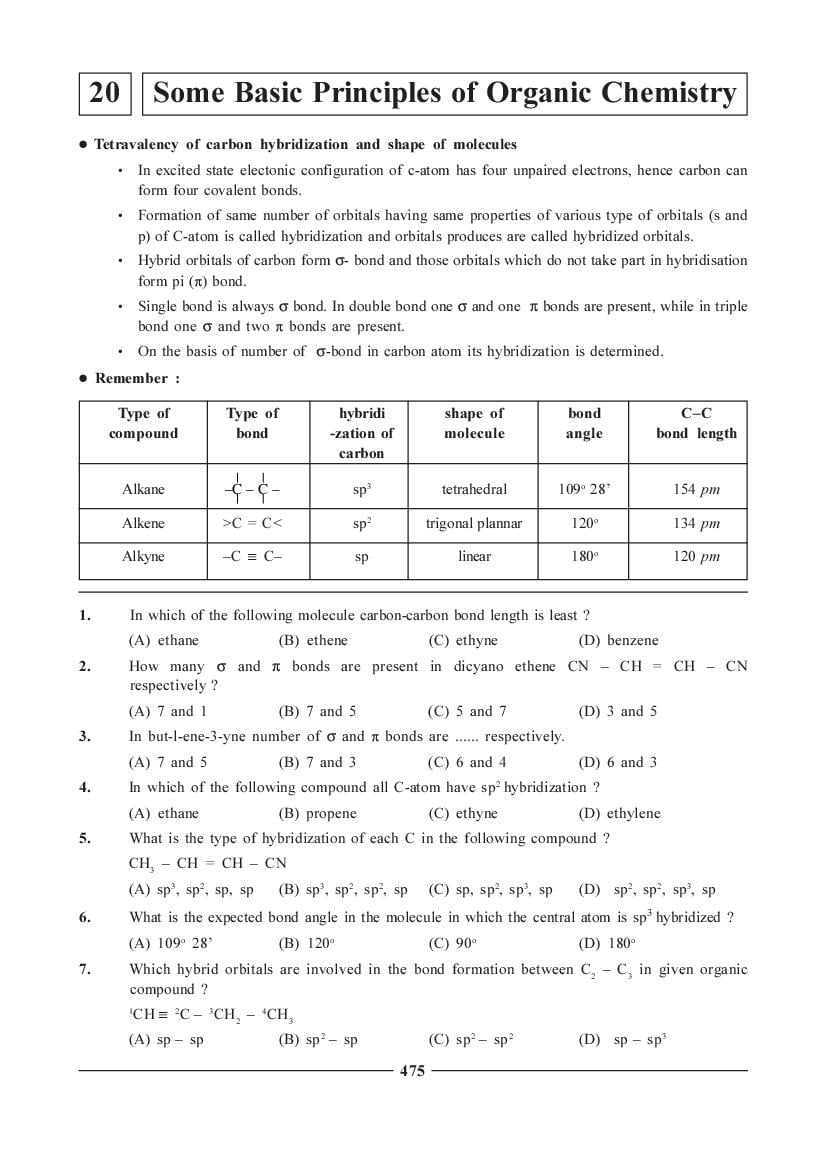
Tetravalency of carbon hybridization and shape of molecules
In excited state electonic configuration of c-atom has four unpaired electrons, hence carbon can
form four covalent bonds.
Formation of same number of orbitals having same properties of various type of orbitals (s and
p) of C-atom is called hybridization and orbitals produces are called hybridized orbitals.
Hybrid orbitals of carbon form s- bond and those orbitals which do not take part in hybridisation
form pi (p) bond.
Single bond is always s bond. In double bond one s and one p bonds are present, while in triple
bond one s and two p bonds are present.
On the basis of number of s -bond in carbon atom its hybridization is determined.
Remember :
Type of Type of hybridi shape of bond CC
compound bond -zation of molecule angle bond length
carbon
Alkane –C – C – sp3 tetrahedral 109o 28 154 pm
Alkene >C = C< sp2 trigonal plannar 120o 134 pm
Alkyne C º C sp linear 180o 120 pm
1. In which of the following molecule carbon-carbon bond length is least ?
(A) ethane (B) ethene (C) ethyne (D) benzene
2. How many s and p bonds are present in dicyano ethene CN CH = CH CN
respectively ?
(A) 7 and 1 (B) 7 and 5 (C) 5 and 7 (D) 3 and 5
3. In but-l-ene-3-yne number of s and p bonds are ...... respectively.
(A) 7 and 5 (B) 7 and 3 (C) 6 and 4 (D) 6 and 3
2
4. In which of the following compound all C-atom have sp hybridization ?
(A) ethane (B) propene (C) ethyne (D) ethylene
5. What is the type of hybridization of each C in the following compound ?
CH3 CH = CH CN
(A) sp3, sp2, sp, sp (B) sp3, sp2, sp2, sp (C) sp, sp2, sp3, sp (D) sp2, sp2, sp3, sp
6. What is the expected bond angle in the molecule in which the central atom is sp3 hybridized ?
(A) 109o 28 (B) 120o (C) 90o (D) 180o
7. Which hybrid orbitals are involved in the bond formation between C2 C3 in given organic
compound ?
1
CH º 2C 3CH2 4CH3
(A) sp sp (B) sp2 sp (C) sp2 sp2 (D) sp sp3
475
Page 2
8. In the dehydration reaction CH3CONH2 CH3CN hybridization of carbonyl carbon changes
to what ?
(A) sp3 to sp2 (B) sp2 to sp3 (C) sp2 to sp (D) sp to sp3
9. What are the changes in hybridization of carbon in addition halogenation reaction of ethene ?
(A) sp3 to sp2 (B) sp2 to sp3 (C) sp2 to sp2 (D) sp to sp3
10. What is the correct order of CC bond length ?
(A) C2H6 > C2H4 > C2H2 (B) C2H4 > C2H6 > C2H2
(C) C2H2 < C2H6 < C2H4 (D) C2H6 < C2H4 < C2H2
Answers : 1. (C), 2. (B), 3. (B), 4. (D), 5. (B), 6. (A), 7. (D), 8. (C), 9. (B), 10. (A)
Classification of organic compounds on the basis of functional group
The atom or group of atom which is responsible for characteristic reactions of organic compunds
is called functional group.
While writing the structure of organic compounds it is necessary to remember the number of
bonds. For example carbon has four bonds, nitrogen has three bonds, oxygen has two bond and
for hydrogen and halogen single bond.
While writing the name of organic compounds on the basis of number of C atom present in it
corresponding word root (Greekword) is used which as follows :
Number of C ® 1 2 3 4 5 6 7 8 9 10
word root ® meth eth prop but pent hex hept oct non dec
Organic compounds classified into 14 parts based on functional group :
Type of Functional Prefix/suffix Example IUPAC
compound group in nomenclature Name
(1) Alkane –C – C – | ane CH 3 CH 2 CH 3 propane
R H
(2) Alkene >C=C< | ene CH 3CH=CH 2 propene
(3) Alkyne CºC | yne CH3CºCH propyne
(4) Alcohol OH | ol CH 3CH 2CH 2OH propan-1-ol
(5) Ether O alkoxy | CH 3OCH 2CH 3 Methoxy ethane
(6) Aldehyde CHO | al CH 3 CH 2 CHO propanal
(7) Ketone CO | one CH 3COCH 3 propanone
(8) Carboxylic COOH | oic CH3 CH2COOH propanoic
acid acid acid
(9) Ester COOR | oate CH3 COOCH3 Methyl
R=alkyl ethanoate
(10) Amine (a) NH 2 | amine CH 3 CH 2CH 2 NH 2 propan-1
primary amine -amine
476
Page 3
secondary amine ethanamine
Amine (c) –N– | amine CH 3CH 2NCH 3 N,N-dimethyl
tertiary amine CH3 ethanamine
(11) Amide CONH 2 | amide CH 3CH 2CONH 2 Propananide
(12) Nitro NO 2 Nitro | CH 3CH 2CH 2NO 2 1-nitro propane
(13) Cyanide CN | nitrile CH 3CH 2CN propane nitrile
(14) Halide X halo | CH 3CH 2CH 2Cl 1-chloro propane
X=F, Cl, Br, I
Note :
(1) In alkane, alkene and alkynes nomenclature proper suffix is added to wordroot on the basis of
number of carbon
eg., CH3 CH = CH2 word root + suffix
prop + ene = propene
(2) In other compounds nomenclature appropriate prefix or suffix is added to alkane name.
eg., CH3 CH CH3 prefix + alkane
2 - chloro + propane
Cl
= 2 - chloro propane
(3) In case of ether, group with less number of carbon atom attached to oxygen is given
prefix alkoxy and group with greater number of carbon is taken as alkane.
(4) In ester (COOR), after writing the name of alkyl group connected in place of R,
remaining carbon is taken as alkane and oate suffix is added.
(5) In 2 o and 3o amine, group with highest number of carbon is taken as alkane, suffix
amine is added and remaining groups taken as alkyl group.
11. From which of the following compounds suffix oate is added ?
(A) aldehyde (B) ketone (C) ester (D) ether
12. In IUPAC nomenclaure of cyanide compound which suffix is added ?
(A) cyano (B) cyanide (C) cyanate (D) nitrile
13. Compounds with which hybridization of carbon get suffix ene in IUPAC nomenclature ?
(A) dsp 2 (B) sp2 (C) sp3 (D) sp
14. Mention the IUPAC name of CH3CH2COOCH3.
(A) butanoate (B) ethyl ethanoate (C) Methyl propanoate (D) Methyl propanoate
15. Identify the formula of butane nitrile :
(A) CH 3CH 2CH 2CN (B) CH 3CH 2CH 2NH 2
(C) CH 3CH 2CH 2CH 2CN (D) CH 3CH 2CH 2CH 2NO 2
16. In which compound having only one functional group, prefix is added in nomenclature ?
(A) alcohol (B) ether (C) amide (D) ketone
Answers : 11. (C), 12. (D), 13. (B), 14. (D), 15. (A), 16. (B)
477
Page 4
Series of compounds having difference of CH2 between two successive member is
called homologous series. eg. alkane series.
CH4, C2H6, C3H8, C4H10, C5H12
Compounds having same molecular formula but different properties are called isomers of
each other and this phenomenon is called isomerism.
Classification of isomerism as follows :
Isomerism
¯
¯ ¯
Structural isomerism Stereo isomerism
¯
¯ ¯ ¯ ¯
(1) chain isomerism conformational geometrical optical
(2) position isomerism isomerism isomerism isomerism
(3) functional isomerism ¯ ¯ ¯
(4) metamerism staggered as enantiomers
(5) Tautomerism eclipsed trans diasteveomers
(6) ring-chain isomerism meso
Chain isomerism : arrangement of carbon atom is linear or branched.
eg., CH3 CH2 CH2 CH3 and CH3 CH CH3
n butane I
CH 3
iso butane
Position isomerism : Position of functional group is different.
eg., CH3 CH2 CH2 OH and CH3 CH CH3
Propan-1-ol I
OH
propan 2 ol
Functional group isomerism : Functional groups are different.
eg., CH3 CH2 COOH and CH3 COOCH3
Propanoic acid Methyl ethanoate
This isomerism is observed in ester-acid alcohol-ether, aldehyde-ketone and 1o, 2o, 3o amine.
metamerism : functional group is same but alkyl groups connected on both side have
different numbers of carbon atoms.
eg., CH3 O CH2CH2CH3 and CH3CH2 O CH2CH3
1methoxy propane Ethoxy ethane
This isomerism is observed in ether, ester, 2o and 3o amine.
478
Page 5
eg., CH3 C CH3 CH2 = C CH3
II I
O OH
keto form enol form
Ring chain isomerism : one isomer has cyclic structure and other isomer has linear chain struc-
ture.
eg., CH2 and CH3 CH = CH2
Propene
CH2 CH2
Cyclo propane
17. How do successive members of homologous series differ from each other ?
(A) CH3 group (B) CH2 group (C) C2H5 group (D) CH group
18. Between successive members of alkane homologous series, difference between molecular
mass is ...... .
(A) 16 amu (B) 12 amu (C) 14 amu (D) 18 amu
19. Which of the following pair shows functional group isomerisms ?
(A) aldehyde and alcohol (B) alcohol and amine
(C) carboxylic acid and aldehyde (D) alcohol and ether
20. How many isomers does pentane chain contain ?
(A) 2 (B) 3 (C) 4 (D) 6
21. How many isomers of C3H9N compound having amine group ?
(A) 5 (B) 3 (C) 4 (D) 6
22. How many chain isomers are possible for C4H8 ?
(A) 3 (B) 5 (C) 4 (D) 6
23. Which of the following compound does not show position isomerism ?
(A) butene (B) butanal (C) but-1-amine (D) butyne
24. How many chain isomers are possible for pentanol ?
(A) 4 (B) 5 (C) 6 (D) 7
25. Which of the following is not isomer of diethyl ether ?
(A) Methyl propyl ether (B) butan-1-ol
(C) 2-Methyl-propan-1-ol (D) diethyl ketone
26. Number of isomers of C4H10 O ...... .
(A) 7 (B) 8 (C) 5 (D) 6
27. Isomer of ethyl alcohol is ...... .
(A) diethyl ether (B) dimethyl ether (C) ethanal (D) acetone
28. ...... type of isomerism is observed in urea.
(A) chain (B) position (C) geometrical (D) tautomerism
479
Page 6
(A) position (B) chain (C) metamerism (D) tautomerism
30. Pair of Acetone and prop-1-en-2-ol are example of which type of isomerism ?
(A) Position (B) Tautomerism (C) Functonal group (D) Metamerism
31. Which type of isomerism is observed in but-2-ene ?
(A) functional group (B) metamerism (C) geometrical (D) optical
32. Diethyl ether and methyl propyl ether are ...... .
(A) position isomer (B) functional group isomer
(C) metamers (D) rotamers
33. Cyclo alkene and alkyne are which type of isomers ?
(A) Chain (B) Functional group (C) Metamers (D) Votamers
34. npropyl alcohol and iso propyl alcohol are examples of which type of isomerism.
(A) position (B) chain (C) geometrical (D) stereo
35. Functional isomers of propionic acids are ...... .
(A) HCOOC2H5 and CH3COOCH3 (B) HCOOC2H5 and C3H7COOH
(C) C3H7OH and CH3COCH3 (D) CH3CH2COOH and C3H7OH
36. How many isomers of C6H14 are possible ?
(A) 3 (B) 4 (C) 5 (D) 6
37. Which isomerism is ehibited by C5H10O ?
(A) Position (B) Functional group (C) Metamerism (D) All the given
38. Which isomerism is not shown by alkene ?
(A) chain (B) geometrical (C) position (D) metamerism
39. Which type of compounds do not have metamers ?
(A) ketone (B) amine (C) ether (D) alcohol
40. Which isomerism is shown by R C º N and R N+ º C ?
(A) Position (B) Functional group (C) metamerism (D) Tautomerism
Answers : 17. (B), 18. (C), 19. (D), 20. (B), 21. (C), 22. (A), 23. (B), 24. (A), 25. (D),
26. (A), 27. (B), 28. (D), 29. (C), 30. (B), 31. (C), 32. (C), 33. (D), 34. (A),
35. (A), 36. (C), 37. (D), 38. (D), 39. (D), 40. (B)
Nomenclature of organic compounds (Common and IUPAC)
Organic compounds are named on the basis of rules of IUPAC which is called its IUPAC
name. Apart from this some organic compounds are known by common name or popular name.
Study IUPAC rules appropriately from text book.
Simple method to write IUPAC name.
attach 1st determine longest attach
prefix of hydrocarbon root suffix of
substituted (alkane, alkene, alkyne) principal
group or branch functional
group
480
Page 7
COOH > COOR > CONH2 > CN > CHO > CO > OH >
NH2 > C = C > C º C > Substituted groups (OR, X, NO2, R)
Substituded group or branch means which is not included in chain of hydro carbon root.
Examples of IUPAC nomenclature
CH3
I
(1) 1CH3 2C 3CH2 4CH 5CH3 2, 2, 4 trimethyl pentane
I I ¯ ¯
CH3 CH3 prefix hydrocarbon root
4
(2) CH2 = 3CH 2CH2 1CH2 OH But 3 en 1 ol
¯ ¯
hydro carbon root suffix
(3) CH3 CH CH2 CH CH2 CH 1CH3
7 6 5 4 3 2
I I I
Br CH2CH3 OH
6Bromo4ethyl heptan 2 ol
¯ ¯ ¯
prefix Hydro carbon root suffix
4
(4) CH3 3CH 2CH2 1COOH 3hydroxy butanoic acid
I ¯ ¯
OH prefix hydro carbon root + suffix
41. Correct IUPAC name of CH3CH2CH(CH3)CH (C2H5)2 is ...... .
(A) 4ethyl 3Methyl hexane (B) 3ethyl 4Methyl hexane
(C) 4Methyl 3ethyl hexane (D) 2, 4diethyl pentane
42. Give IUPAC name of following compound :
CH3 CH C CH2 CH3
I II
CH3 CH2
(A) 2ethyl 3Methyl but-l-ene (B) 2iso propyl but-1-ene
(C) 2Methyl 3ethyl but-3-ene (D) 2(1Methyl ethyl) but-l-ene
43. What is correct IUPAC name of CH2 = CH CH2 CH2 CH2 Cl ?
(A) 1chloro pent-4-ene (B) Pent-4-ene chloride
(C) 5chloro pent-1-ene (D) 1chloro pentene
44. IUPAC name of CH2 = CH CH2 CH2 OH is ...... .
(A) But-3-en-1-ol (B) but-1-en-3-ol
(C) 4-hydroxy but-1-ene (D) butenol
481
Page 8
OH CH3
(A) 4hydroxy-1-Methyl pentenal (B) 4-hydroxy-2-Mehtyl-pent-2-enal
(C) 2-hydroxy-4-Methyl pent-3-en-5-al (D) 2-hydroxy-3-methyl pent-2-enal
46. IUPAC name of urea is ...... .
(A) diamino ketone (B) amino methanamide (C) amino ethanamide (D) amino acetamide
47. IUPAC name of CH3 CH = CH C º CH is ...... .
(A) Pent-2-en-4-yne (B) Pent-2-yn-3-ene
(C) Pent-3-en-1-yne (D) Pent-2-en-5-yne
48. Mention IUPAC name of NC CH2 CH CH2 CN
I
CH 2CN
(A) iso butane tri nitrile (B) 3cyano methyl pentane dinitrile
(C) 2, 2Bis (Cyano methyl) enthane nitrile (D) tri ethane nitrile methane
49. IUPAC name of HOOC CH = CH COOH is ...... .
(A) but-2-en-oic acid (B) butene di oic acid
(C) butene1, 4dioic acid (D) but-2-ene dioic acid
50. Mention IUPAC Name of :
(A) Nonane (B) etetra ethylmethane
(C) 3ethyl pentane (D) 3, 3diehtyl pentane
Answers : 41. (B), 42. (A), 43. (C), 44. (A), 45. (B), 46. (B), 47. (C), 48. (B), 49. (D),
50. (D)
Electronic transfer in covalent bond
In organic compounds electron pair of covalent bond transfer by four different ways.
(1) Inductive Effect :
s electron pair present in carbon chain transfer to more electronegative atom or group.
On moving away from electronegative atom to carbon atom away from it this effect reduces.
This effect is permanent
eg., C > C >> C d+ > > > Cd
Inductive effect (Ieffect) are of two types : (1) If electron attracting group is connected at
the end of chain, then it is called I effect. Decreasing order of I effect is as follows :
R3N+ > +NH3 > NO2 > CN > SO3H > CHO > CO > COOH > COCl > COOR > CONH2 >
F > Cl > Br > I > OH > NH2 > C6H5 > H
If electron donor group is attached at the end of chain then it is called + I effect. Decreasing
order of + I effect :
R3+C > R2 +CH > R +
CH2 > +
CH3
3o 2o 1o methyl
482
Page 9
p-electron pair connected by double or triple bond transfer to one of the atom (mainly
electronegative atom) due to contact of attacking reagent.
This effect is temporary.
Electromeric effect is of two types :
(i) If p electron pair displaces towards the attacking reagent then it is called +E effect
+ +
eg. >C = C < + H >C C<
H
(ii) If p electron pair displaces away from the attacking reagent then it is called E effect.
-
eg. >C = O + CN >C O
CN
(3) Mesomeric effect or Resonance effect :
In some organic compounds, two or more than two structures are in vibration state. Such
structures are called resonating structures. Their real structure is shown by intermediate state
between two or more than two structures. Such structures are called resonance hybrid structure.
This effect is known as mesomeric or resonance effect.
This effect is observed in the system having alternate s and p bond.
eg., benzene C6H6
Molecules having resonance structure have greater stability.
e donor groups have +R effect and
e attracting groups have R effect.
(4) Hyper conjugation :
When C C single bond is directly bonded with C = C or benzene ring, then s e pair of
C H bond is attracted towards double bond. This effect called hyper conjugation.
H H
H – C ––– CH = CH2 H – C = CH ––– CH2
H H
Order of + I effect of alkyl group is 3o > 2o > 1o > methyl but when alkyl group is
connected with double bond or benzene ring this order is reversed as methyl > 1o > 2o > 3o this is
hyper-conjugation.
Importance of hyper conjugation is as follows :
(i) Greater the number of CH3 group bonded with C = C greater is the stability of alkene.
(ii) Stability order of carbocation and free radical is 3o > 2o > 1o > methyl.
(iii) Bond length of C C bond adjacent to C = C decreases.
483
Page 10
(A) NO 2 (B) COOH (C) F (D) N +R 3
52. Which of the following group has highest + I effect ability ?
(A) (CH 3 ) 3C (B) (CH 3) 2 CH (C) CH3 CH2 (D) CH3
53. Which group has maximum hyper conjugative effect ?
(A) R 3 C (B) R 2CH (C) RCH 2 (D) CH3
54. In which of the following compound electromeric effect is not observed ?
(A) alkene (B) ether (C) aldehyde (D) ketone
55. In which of the following molecule resonance (delocalized electrons) is observed ?
(A) methane (B) ethane (C) benzene (D) cyclohexane
56. Which group has +R effect ?
(A) CN (B) CHO (C) NH 2 (D) NO 2
57. Which of the following alkene is the most stable ?
(A) CH 3CH=CHCH 3 (B) (CH 3) 2C=CH 2
(C) (CH3)2 C=CHCH3 (D) (CH 3) 2C=C(CH 3) 2
58. Which carbo cation is the most stable ?
(A) CH 3CH 2+ (B) CH2 = CH+ (C) CH º C+ (D) C 6H 5+
59. Which type of conjugation is hyper conjugation ?
(A) s p (B) s s (C) p p (D) p s
60. Which of the following free radical is the most stable ?
· · · ·
(A) C 6H 5CH 2CH 2 (B) C 6H 5C HCH 3 (C) CH3 CH 2 (D) CH 3 CHCH 3
Answers : 51. (C), 52. (A), 53. (D), 54. (B), 55. (C), 56. (C), 57. (D), 58. (A), 59. (A),
60. (B)
Fission of covalent bond
Fission of covalent bond is done in two different ways.
(1) Homolytic fission : Two atoms bonded by covalent bond are separated by gaining one
electron each and as a result free radical is formed.
hυ
eg., Cl − Cl
→ Cl ⋅ + Cl ⋅ free radicals
(2) heterolytic fission : If during fission of covalent bond more electronegative atom
separated by gaining two electrons and as a result positive and negative ion are formed.
+
eg., CH3 Cl ® CH3 + Cl :
Positive ion negative ion
Positive ion or some neutral molecules which have capacity to accept electrons are called
electrophiles.
eg., +NO2, +Cl, +CH3, BF3, AlCl3, SnCl2
484
Page 11
nucleophile.
− −
eg., X , OH , NH 2 , NH3, H2O
Chemical species having positively charged carbon is called carbocation or carbonium ion.
+
eg., CH3
–
Chemical species having negatively charged carbon is called carbanion eg. CH3
Stability order of carbanion : methyl > 1o > 2o > 3o
61. What is called positive ion formed by heterolytic fission of covalent bond ?
(A) Electrophile (B) Nucleophile (C) Lewis acid (D) Both (A) and (C)
62. Which carbanion has the least stability ?
(A) CH3 (B) CH3 – CH2 (C) (CH3)2 CH (D) (CH3)3 C
63. Which of the following is nucleophile ?
(A) H 2 O (B) BF 3 (C) AlCl3 (D) SO 3
64. Which particles are obtained by homolytic fission of A B bond ?
(A) One positive and one anion (B) two carbocation
(C) one carbocation and one carb anion (D) two free radicals
65. Which sentence is incorrect with reference to free radical ?
(A) They are paramagnetic species having unpaired electrons.
(B) They are electrically neutral and highly reactive.
(C) Carbon atom of free radical has 7 electron in valence orbital.
(D) They are highly stable and long lasting.
Answers : 61. (D), 62. (D), 63. (A), 64. (D), 65. (D)
Types of organic reactions
Substitution reaction : Atom or group atom present in organic compound is substituted by another
atom or group of atom.
eg., CH4 + Cl2
→ CH3Cl + HCl
Addition reaction : p bond of double or triple bond is broken and another molecule is added.
eg., CH2 = CH2 + Cl2
→ Cl CH2 CH2 Cl
Eliminaton reaction : From adjacent carbon atoms, a group of atoms is removed as molecule and as a
Al O
2 3
result between two carbon new pbond forms. eg., CH3 CH2 OH
→
350 − 400o C CH2 = CH2 + H2O
Rearrangement reaction : Displacement of atom or group of atoms to other place within the same
molecule.
AlCl
3→
eg., CH3 CH2 CH2 CH3 CH3 CH CH3
nbutane I
CH 3
485
Page 12
66. Mention the type of the following ®
alcohol reaction :
CH3 CH2 Cl + KOH CH2 = CH2 + KCl + H2O
(A) substitution (B) addition (C) elimination (D) rearrangement
67. Identify the type of reaction : CH3 CH2 I + acqueous KOH ® CH3CH2OH + KI.
(A) substitution (B) addition (C) elimination (D) halogenation
68. Which product is obtained by hydrogenation of ethene in presence of nickel catalyst ?
(A) ethanol (B) ethyne (C) ethane (D) methane
69. In which reaction new p bond is formed ?
(A) substitution (B) addition (C) elimination (D) rearrangement
70. Which of the following is elimination reaction ?
(A) Chlorination of ethene (B) Hydration of ethene
(C) Conversion of But-1-ene into But-2-ene (D) Dehydration of ethanol
71. Number of s and p bonds in pent-l-en-4-yne is ....... .
(A) 3, 10 (B) 9, 4 (C) 4, 9 (D) 10, 3
72. In buta-1,2 diene compound ....... .
(A) Only sp hybridized carbon atoms (B) Only sp2 hybridized carbon atoms
(C) sp and sp2 hybridized carbon atoms (D) sp, sp2 and sp3 hybridized carbon atoms
73. Which of the following IUPAC name is incorrect ?
(A) CH3 C – CH CH3 2Methyl butan-3-one
O CH3
(B) CH3 CH CH CH3 2, 3 di methyl pentane
I I
CH3 CH2 CH3
(C) CH3 C º C×CH (CH3)2 4 Methyl pent 2 yne
(D) CH3 CH CH CH3 2 bromo 3 chlorobutane
I I
Cl Br
74. Match the column X with column Y and choose correct option :
Column -X Column-Y
(i) free radical (A) Lewis base
(ii) electrophile (B) Electrically neutral
(iii) nucleophile (C) Complete octet in valence orbit
(D) Lewis acid
(E) Electron octet is incomplete and in valence orbit single e
(F) Electron octet incomplete
(A) (i)-(B),(E), (ii)-(D),(F), (iii)-(A),(C) (B) (i)-(A),(C), (ii)-(D),(F), (iii)-(B),(E)
(C) (i)-(D),(F), (ii)-(B),(E), (iii)-(A),(C) (D) (i)-(B),(E), (ii)-(A),(C), (iii)-(D),(F)
486
Page 13
(1) IUPAC name of propyl cyanide is propane nitrile.
(2) IUPAC name of diethyl ether is ethoxy ethane.
(3) Ethanol and vinyl alcohols are tautomers.
(4) Methoxy propane and ethoxy ethane are metamers.
(5) Stability of 2, 3dimethyl but-2-ene is more than 2methyl but-2-ene.
(6) Stability order of carbo cation is 1o < 2o < 3o.
(7) In Elimination reaction hybridization of carbon atom do not change.
(8) Nucleophites are Lewis acid.
(A) (1), (3), (5), (7) (B) (2), (4), (6), (8) (C) (2), (4), (5), (6) (D) (2), (4), (6), (7)
76. In column I bondline structures and in column II IUPAC names are given. Match them and
select correct option.
Column-I Column-II
(1) OH (p) but-1-ene (A) (1)(q), (2)(p), (3)(t)
(2) (q) 2hydroxy butane (B) (1)(s), (2)(r), (3)(u)
(3) (r) but-2-ene (C) (1)(q), (2)(r), (3)(u),
(s) pentan-2-ol (D) (1)(q), (2)(p), (3)(u),
(t) 3, 3dimethyl butane
(u) 3, 3dimethyl pentane
77. On matching common name in column-I with structural formula of column II which of the
following pair is correct :
Column-I Column-II
(P) formic anhydride (W) CH 3CHO (A) (P)-(X), (Q)-(W), (R)-(Y), (S)-(Z)
(Q) methyl acetate (X) CH3 COOCH3 (B) (P)-(Z), (Q)-(Y), (R)-(W), (S)-(X)
(R) acetamide (Y) (HCO)2O (C) (P)-(Y), (Q)-(X), (R)-(Z), (S)-(W)
(S) acetaldehyde (Z) CH3CONH2 (D) (P)-(W), (Q)-(Z), (R)-(X), (S)-(Y)
78. Match the column X with column Y and mention correct option :
Column X Column Y
(Hydrocarbon group) (Common name)
(a) (CH3)2 CH (p) tertiary butyl (A) (a)-(t), (b)-(q), (c)-(t), (d)-(u)
(b) CH3CH2 CH (q) iso butyl (B) (a)-(r), (b)-(q), (c)-(t), (d)-(u)
I
CH3
(c) (CH3)3 C (r) vinyl (C) (a)-(r), (b)-(s), (c)-(t), (d)-(u)
(d) CH2 = CH (s) secondary butyl (D) (a)-(t), (b)-(s), (c)-(p), (d)-(r)
(t) iso propyl
(u) ethyl
Answers : 66. (C), 67. (A), 68. (C), 69. (C), 70. (D), 71. (D), 72. (D), 73. (A), 74. (A),
75. (C), 76. (B), 77. (C) 78. (D)
487
Page 14
Paragraph : While giving IUPAC names of the organic compounds having more than one
functional group the functional group with highest priority is considered as principal functional
group and other functional groups are considered as substituted group. Carbon chain is given
numbers in such away that principal functional group gets least number. (Que. No. 79 80)
79. Give IUPAC name of the following compound :
CH3 – CH = C – CH2 – COOH
CONH2
(A) 2ethyledene3carboxy propanamide (B) 3ethyl-3-carbyl, propanoic acid
(C) 2-carboxymethyl but-2-en-1-amide (D) 3-carbamoyl pent-3-en-1-oic acid
80. IUPAC name of following compound is ....... .
OMe
NC
OMe O
(A) Methyl 4-cyano-3-methoxy pentanoate
(B) 4-methoxy-carbonyl-1-methoxy butanenitrile
(C) Methyl-4-cyano-3-methoxy butanoate
(D) 4-carbmethoxy-2-methoxy butanenitrile
Instruction : Question no. 81 to 90 are assertion (A) and reason (R) types. Their four
options are as follows. Select correct option :
(A) Assertion (A) and reason (R) both are correct and reason (R) is correct explanation of
assertion (A).
(B) Assertion (A) and reason (R) both are correct but reason (R) is not correct explanation
of assertion (A).
(C) Assertion (A) is correct while reason (R) is incorrect.
(D) Assertion (A) is incorrect while reason (R) is correct.
81. Assertion (A) : CN is called cyclohexane carbonitrile.
Reason (R) : Suffix nitrile is given to alicyclic ring.
82. Assertion (A) : IUPAC name of CH3 CH = CH C º CH is pent 2 en 4 yne.
Reason (R) : While determining the position of functional group rule of least set of
locant is applied.
83. Assertion (A) : IUPAC name of C2H5 C CH2 OH is 2 ethyl prop-2-en-1-ol
II
CH 2
Reason (R) : Instead of methylene ethyl is accepted as substituted group because
alphabatically e of ethyl comes before m of methylene.
488
Page 15
point of fumaric acid is more than maliec acid.
Reason (R) : Molecules of fumaric acid are more symmetric hence they can arrange
more closely packed in crystal structure.
85. Assertion (A) : In styrene geometrical isomerism is not observed.
Reason (R) : All the atoms in styrene molecule are in one plane
86. Assertion (A) : free radicals are paramagnetic.
Reason (R) : Free radicals have unpaired electrons.
87. Assertion (A) : Stability order of carbocation is 3o > 2o > 1o .
Reason (R) : As distance between alkyl group and reaction site increases +I effect
decreases.
88. Assertion (A) : Boiling point of cis isomer is more than trans isomer.
Reason (R) : Dipole moment of cis isomer is more than trans isomer.
89. Assertion (A) : Allyl free radicals are more stable than alkyl free radical.
Reason (R) : Due to resonance allyl free radicals are more stable.
90. Assertion (A) : CHBr = CHCl has geometrical isomers but CH2Br CH2Cl has no
geometrical isomers.
Reason (R) : For geometrical isomers presence of C = C is essential..
Answers : 78. (D), 79. (D), 80. (C), 81. (C), 82. (D), 83. (C), 84. (A), 85. (B), 86. (A),
87. (B), 88. (A), 89. (A), 90. (C).
489
Document Details
| Board / Org | NTA |
| Exam | NEET UG |
| Type | Question Bank |
| Pages | 15 |
| Updated | 22 Jul 2026 |