UPSC IFS 2018 Question Paper for Physics Paper - II
Finished viewing? Save it for later —
Download UPSC IFS 2018 Question Paper for Physics Paper - II (PDF · 8 pages)About UPSC IFS 2018 Question Paper for Physics Paper - II
UPSC IFS 2018 Question Paper for Physics Paper - II is available here for free download. Published by UPSC for Indian Forest Service Examination, this question paper can be viewed online or downloaded as a PDF (8 pages). Candidates preparing for Indian Forest Service Examination can use UPSC IFS 2018 Question Paper for Physics Paper - II to understand the exam pattern, the type of questions asked, and the overall difficulty level.
Frequently Asked Questions
How can I download UPSC IFS 2018 Question Paper for Physics Paper - II?
Open this page and click the Download button to save UPSC IFS 2018 Question Paper for Physics Paper - II as a PDF. It is completely free on AglaSem Docs.
Is UPSC IFS 2018 Question Paper for Physics Paper - II free to download?
Yes. UPSC IFS 2018 Question Paper for Physics Paper - II can be viewed online and downloaded as a PDF free of cost on AglaSem Docs.
How many pages does UPSC IFS 2018 Question Paper for Physics Paper - II have?
UPSC IFS 2018 Question Paper for Physics Paper - II contains 8 pages, which you can read online or download together as a single PDF.
Where can I find more Indian Forest Service Examination study material?
You can find more Indian Forest Service Examination question papers, sample papers, syllabus, and answer keys on AglaSem Docs.
UPSC IFS 2018 Question Paper for Physics Paper - II – Text
Read the full text of this question paper below — useful to quickly search, copy and reference the content online without downloading the PDF.
📄 View text version (8 pages)
Page 1
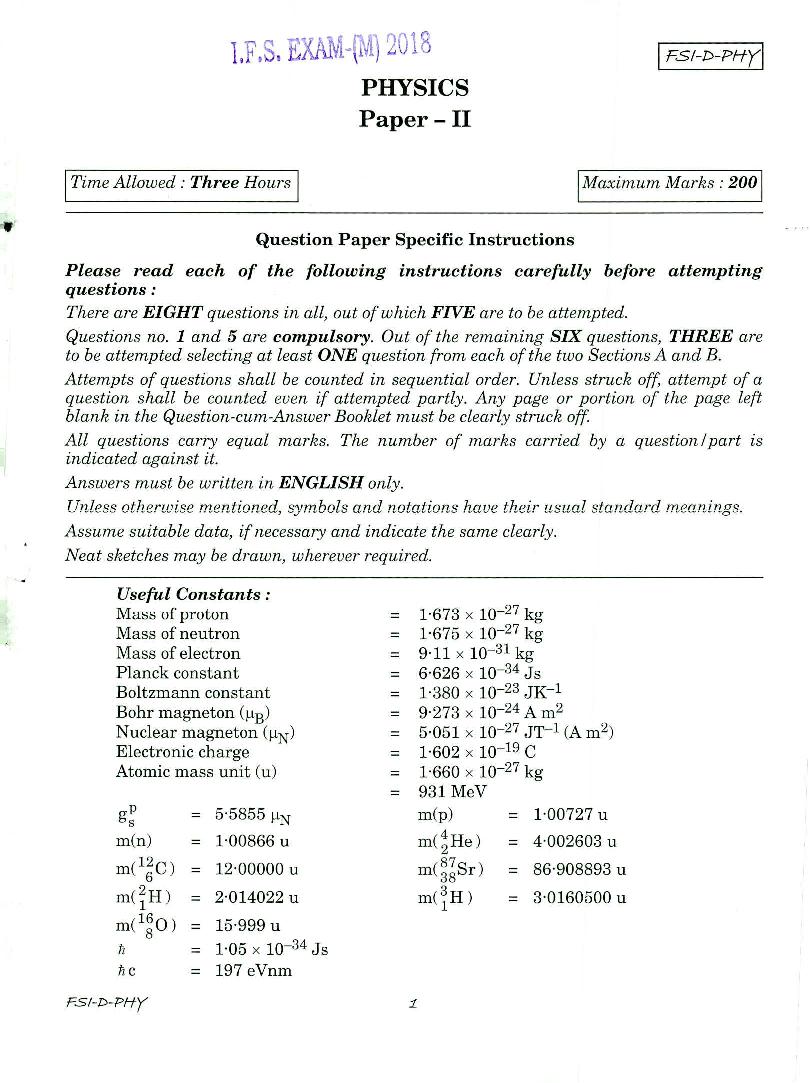
PHYSICS
Paper - II
Time Allowed: Three Hours Maximum Marks : 200
Question Paper Specific Instructions
Please read each of the following instructions carefully before attempting
questions:
There are EIGHT questions in all, out of which FIVE are to be attempted.
Questions no. 1 and 5 are compulsory. Out of the remaining SIX questions, THREE are
to be attempted selecting at least ONE question from each of the two Sections A and B.
Attempts of questions shall be counted in sequential order. Unless struck off attempt of a
question shall be counted even if attempted partly. Any page or portion of the page left
blank in the Question-cum-Answer Booklet must be clearly struck off.
All questions carry equal marks. The number of marks carried by a question/part is
indicated against it.
Answers must be written in ENGLISH only.
Unless otherwise mentioned, symbols and notations have their usual standard meanings.
Assume suitable data, if necessary and indicate the same clearly.
Neat sketches may be drawn, wherever required.
Useful Constants:
Mass of proton 1-673 x 10-27 kg
Mass of neutron 1.675 x 10⁻²⁷ kg
Mass of electron 9-11 x 10-31 kg
Planck constant 6-626 x 10-34 Js
Boltzmann constant 1-380 x 10-23 JK-1
Bohr magneton (µB) 9.273 x 10⁻²⁴ A m2
Nuclear magneton (MN) 5-051 x 10-27 JT-i (A m2)
Electronic charge 1-602 x 10-19
Atomic mass unit (u) F660 x 10-27 kg
= 931 MeV
= 5.5855 isINT m(p) 1.00727 u
m(n) = 1-00866 u m(He) 4-002603 u
m(162 c = 12-00000 u m(Sr) 86-908893 u
m(ill) = 2014022u m( 1
31-1) 3.0160500 u
m(1g0) = 15999u
= F05 x 10-34 Js
h 197 eVnm
Page 2
Ql. (a) Use uncertainty principle to estimate the ground state energy of a linear
harmonic oscillator. 8
Consider an electron circulating around a proton (as shown in figure) in
a circular orbit of radius, r. Assuming the motion of orbiting electron
equivalent to an electrical current loop, find the expression for the ratio
of magnetic moment to the angular momentum of the system and
estimate the numerical value of this ratio. 8
Electrons with energies of FO eV and 2.0 eV are incident on a barrier
10.00 eV high and 0.50 nm (nanometer) wide. Calculate the ratio of their
respective transmission probabilities across the barrier. 8
Page 3
through a non-uniform magnetic field. After passing through the
magnetic field the atomic beam strikes at the screen and is detected as
shown in the given figure.
Obtain an expression of the force acting on the p-atoms beam due to
gradient in the magnetic field acting along z-axis as shown. Also
comment on the number of spots that are found on the screen as an .
outcome and explain. 4+4
south pole
z-direction
beam of
p-state atoms
Atomic
beam
oven north pole
of magnet
Screen
(e) Given the time dependent one-dimensional Schredinger wave equation as
—> —>
aw(t)'
Hy(t) = ih at with H = P P + VOk> )
2m
as Hermitian operator for a particle of momentum under the influence
—> d
of a potential V( x ). Find the value of — w*(t) w(t) dx 8
dt
Q2. (a) How many different wavelengths may be observed in the spectrum from
a hydrogen sample, if the atoms are excited to states with principle
quantum number n? 5
FSI-D-m-ty 3
Page 4
e2
spherical symmetric potential V(r) = is given as:
thczor
1 d 11.2 dR) ± [E v(r) h2 1(1+1)
R = 0,
r2 dr dr ) h2 21.t r2
mM
where µ = is reduced mass and m and M are mass of electron
m+M
and proton respectively.
Obtain the form of the above equation for ground state electron of
hydrogen atom.
Also starting with a trial wave function for the radial equation,
R = A ciao, for the 1 = 0 state, find the expressions of energy E
and orbital radius for the ground state of hydrogen atom. 5+15=20
(c) The quantum theory describes the angular momentum ( J ) as a linear
operator with three components J., and Jz in three dimensions. For
4
the angular momentum operator prove that [J2, = 0, where i = x, y,
and z and comment on the measurability of J2 and its components as
operators. 15
Q3. (a) Write down the Schriidinger wave equation for a one-dimensional
harmonic oscillator in which a particle of mass m and frequency co is
subject to a parabolic potential V(x) = mw2x2/2. Let one of the possible
—,c2bc2
energy eigen states be given by w(x) = Ax e 0. Find the energy E
corresponding to the eigen state given by kv(x). Is it a ground state
energy or one of the excited state energies ? Comment. 20
(b) Consider an experiment in which a beam of electrons is directed at a
plate containing two slits, labelled as A and B. Beyond the plate is a
screen, where electrons hit the screen and are detected. For each of the
following cases sketch the variation of the relative number of incident
electrons as a function of position along the screen and also provide brief
explanation about each observation:
Slit A open, slit B closed,
Both A and B are open. 10
ES/-13-7,H-r 4
Page 5
sin mix Calculate the expectation
2 sin
function is given by kv. (n) = .1-
value of the position <x> of the particle. How is this result different from
classical consideration of finding the particle inside the box? 10
Q4. (a) Show that for pure rotational spectrum of a diatomic molecule the wave
number difference between the consecutive lines
It
A V = 27EIC , where I is the moment of interia. 20
If A v = 4050 m-1 for the HF molecule, what is the interatomic distance
of this molecule? [Given It = 1-05 x 10-34 Js} 10
The most intense vibrational bands of CO and HC1 molecules have the
wave numbers 2143 x 105 m-1 and 2-886 x 105 m-1 respectively.
Calculate the force constants of these molecules. 10
FSI-A-FT- fr 5
Page 6
Q5. (a) The nuclear radius of 8016 is 3 fermi. What will be the nuclear radius
of U235 ? 8
Draw the baryon octet according to Murray Gell-Mann. 8
Show that the _probability of occupation for an electron state at the
Fermi energy is equal to 0.5 for all finite temperatures. 8
A small magnet is placed on the surface of a disc of normal material.
Explain what happens when the disc is cooled down so that it becomes
superconducting. Can this be explained from classical viewpoint if we
simply treat the superconductor as a material which has zero
resistivity? 8
Find the output voltage of the three-input adder circuit shown below. 8
Q6. (a) What is the source of the Sun's energy ? Explain with proper nuclear
reaction. /0
What do you mean by nuclear reactors ? With a neat diagram, describe
the essential parts of a nuclear reactor and discuss about its
applications. 20
An atomic power reactor can deliver 300 MW. If due to fission of each
atom of 92U235, the energy released is 200 MeV, calculate the mass of
uranium fissioned per hour. 10
6
Page 7
semiconductor. 5
Calculate the total conductivity in an intrinsic semiconductor. How does
this conductivity change with temperature? 15
Derive the expression for electron concentration in the conduction band
of an intrinsic semiconductor. 20
Q8. (a) Draw the circuit of a phase shift oscillator using transistor. Obtain the
expression for the frequency of oscillations and condition for sustained
oscillations. Give necessary equivalent circuit while deriving the
expression of frequency of oscillations and condition for sustained
oscillations. 20
A pair of transistors operates in a class B push-pull circuit with a power
supply of voltage Vcc = 12 V. If the turns ratio of the output transformer
is 2 and the load resistance RL is 6 Q, calculate the maximum output
power and maximum dc power supplied. Hence find efficiency of the
circuit. Neglect transformer winding resistance. 10
Estimate the current gain of an n-p-n transistor if only 0.3% of the
conduction electrons that enter the base from the emitter recombine in
the base region. 10
FSI-D-Pfly
Page 8
Document Details
| Board / Org | UPSC |
| Exam | Indian Forest Service Examination |
| Type | Question Paper |
| Pages | 8 |
| Updated | 30 Apr 2026 |