JNUEE 2020 Question Paper M.Phil Inner Asian Studies
Finished viewing? Save it for later —
Download JNUEE 2020 Question Paper M.Phil Inner Asian Studies (PDF · 26 pages)About JNUEE 2020 Question Paper M.Phil Inner Asian Studies
JNUEE 2020 Question Paper M.Phil Inner Asian Studies is available here for free download. Published by NTA for Jawaharlal Nehru University Entrance Examination, this question paper can be viewed online or downloaded as a PDF (26 pages). Candidates preparing for Jawaharlal Nehru University Entrance Examination can use JNUEE 2020 Question Paper M.Phil Inner Asian Studies to understand the exam pattern, the type of questions asked, and the overall difficulty level.
Frequently Asked Questions
How can I download JNUEE 2020 Question Paper M.Phil Inner Asian Studies?
Open this page and click the Download button to save JNUEE 2020 Question Paper M.Phil Inner Asian Studies as a PDF. It is completely free on AglaSem Docs.
Is JNUEE 2020 Question Paper M.Phil Inner Asian Studies free to download?
Yes. JNUEE 2020 Question Paper M.Phil Inner Asian Studies can be viewed online and downloaded as a PDF free of cost on AglaSem Docs.
How many pages does JNUEE 2020 Question Paper M.Phil Inner Asian Studies have?
JNUEE 2020 Question Paper M.Phil Inner Asian Studies contains 26 pages, which you can read online or download together as a single PDF.
Where can I find more Jawaharlal Nehru University Entrance Examination study material?
You can find more Jawaharlal Nehru University Entrance Examination question papers, sample papers, syllabus, and answer keys on AglaSem Docs.
JNUEE 2020 Question Paper M.Phil Inner Asian Studies – Text
Read the full text of this question paper below — useful to quickly search, copy and reference the content online without downloading the PDF.
📄 View text version (26 pages)
Page 1
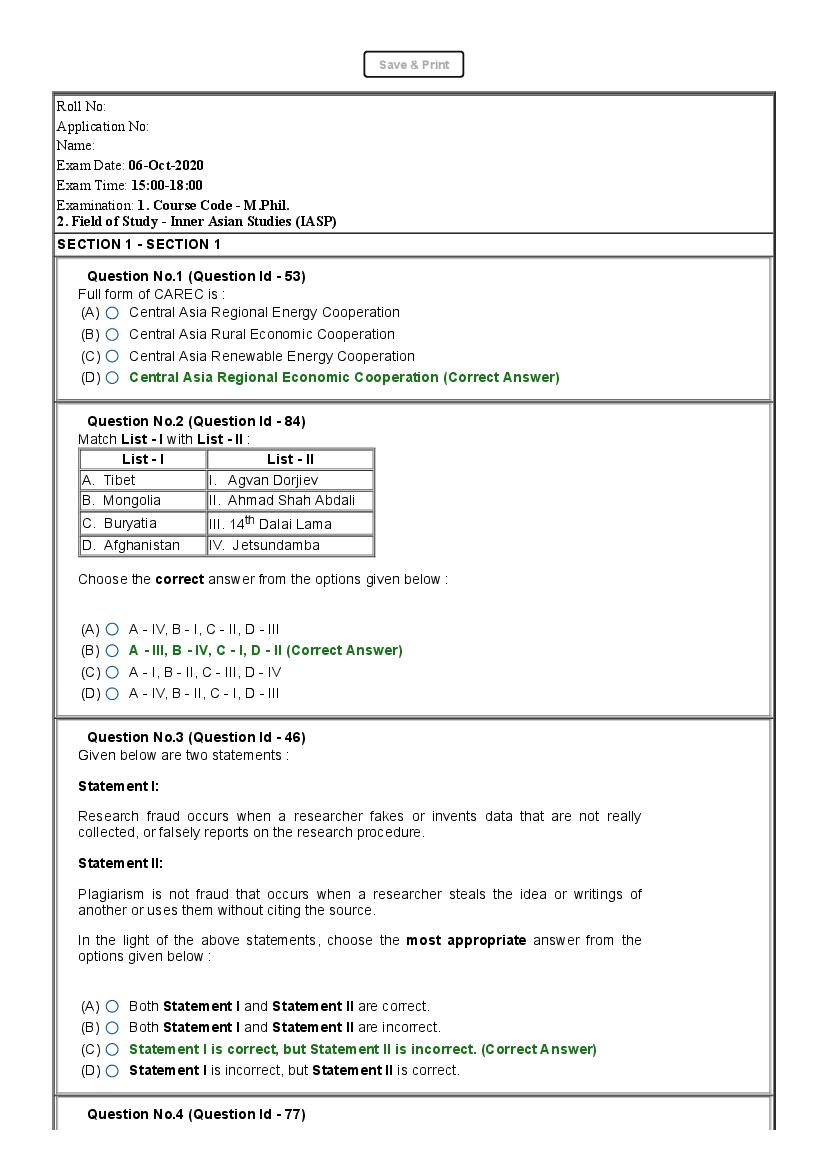
Roll No:
Application No:
Name:
Exam Date: 06-Oct-2020
Exam Time: 15:00-18:00
Examination: 1. Course Code - M.Phil.
2. Field of Study - Inner Asian Studies (IASP)
SECTION 1 - SECTION 1
Question No.1 (Question Id - 53)
Full form of CAREC is :
(A) Central Asia Regional Energy Cooperation
(B) Central Asia Rural Economic Cooperation
(C) Central Asia Renewable Energy Cooperation
(D) Central Asia Regional Economic Cooperation (Correct Answer)
Question No.2 (Question Id - 84)
Match List - I with List - II :
List - I List - II
A. Tibet I. Agvan Dorjiev
B. Mongolia II. Ahmad Shah Abdali
C. Buryatia III. 14th Dalai Lama
D. Afghanistan IV. Jetsundamba
(A) A - IV, B - I, C - II, D - III
(B) A - III, B - IV, C - I, D - II (Correct Answer)
(C) A - I, B - II, C - III, D - IV
(D) A - IV, B - II, C - I, D - III
Question No.3 (Question Id - 46)
Statement I:
Research fraud occurs when a researcher fakes or invents data that are not really
collected, or falsely reports on the research procedure.
Statement II:
Plagiarism is not fraud that occurs when a researcher steals the idea or writings of
another or uses them without citing the source.
(A) Both Statement I and Statement II are correct.
(B) Both Statement I and Statement II are incorrect.
(C) Statement I is correct, but Statement II is incorrect. (Correct Answer)
(D) Statement I is incorrect, but Statement II is correct.
Question No.4 (Question Id - 77)
Page 2
(A) 7th Dalai Lama
(B) 5th Dalai Lama
(C) 6th Dalai Lama (Correct Answer)
(D) 10th Dalai Lama
Question No.5 (Question Id - 36)
Match List - I with List - II :
List - I List - II
A. Working hypothesis
I. Preliminary assumption of Researcher
II. A statement based on sufficient theoretical and empirical
B. Scientific hypothesis
data
III. A proposition about facts without reference to its
C. Research hypothesis
particular attributes
D. Alternative hypothesis
IV. A set of research and null hypotheses
(A) A - I, B - II, C - III, D - IV (Correct Answer)
(B) A - I, B - III, C - II, D - IV
(C) A - I, B - IV, C - II, D - III
(D) A - II, B - I, C - III, D - IV
Question No.6 (Question Id - 10)
When was Positivist method propounded ?
(A) 1789
(B) 1805
(C) 1825
(D) 1848 (Correct Answer)
Question No.7 (Question Id - 43)
According to Ackoff combination of simple + simple sampling, simple + systematic
(internal) sampling and systematic + systematic sampling falls under the category of :
(A) Cluster Sampling
(B) Stratified Random Sampling
(C) Multi-stage Sampling (Correct Answer)
(D) Convenience Sampling
Question No.8 (Question Id - 95)
Given below are two statements : one is labelled as Assertion A and the other is
labelled as Reason R.
Assertion A :
The Centre of global power in the last seven decades has been located in the United
States.
Reason R :
Western Europe and parts of East Asia have been seen as natural extensions of
American power.
Page 3
below :
(A) Both A and R are true and R is the correct explanation of A.
(B) Both A and R are true, but R is not the correct explanation of A. (Correct
Answer)
(C) A is true, but R is false.
(D) A is false, but R is true.
Question No.9 (Question Id - 27)
Professor R.A. Fisher’s name is associated with :
(A) Experimental Research Designs (Correct Answer)
(B) Exploratory Research Designs
(C) Descriptive Research Designs
(D) Diagnostic Research Designs
Question No.10 (Question Id - 60)
Statement I:
Uzbekistan has largest population in Central Asia and it shares borders with all Central
Asian countries as well as Afghanistan.
Statement II:
Uzbekistan is not a member of the Shanghai Cooperation Organisation.
(A) Both Statement I and Statement II are correct.
(B) Both Statement I and Statement II are incorrect.
(C) Statement I is correct, but Statement II is incorrect. (Correct Answer)
(D) Statement I is incorrect, but Statement II is correct.
Question No.11 (Question Id - 28)
The below question has been dropped and full marks are awarded.
What is an extraneous variable in a research design ?
(A) A dependent variable
(B) An independent variable
(C) An independent variable that does not affect the dependent variable
(D) An independent variable that does affect the dependent variable
Question No.12 (Question Id - 92)
Match List - I with List - II :
List - I List - II
A. Mao Tse Tung I. Nobel Prize for Peace
B. Deng Xiaoping II. Chinese Dream
C. The Dalailama III. Hundred Flowers Bloom
D. Xi Jinping IV. Great Western Development Programme
Page 4
(B) A - IV, B - III, C - II, D - I
(C) A - II, B - I, C - IV, D - III
(D) A - III, B - IV, C - I, D - II (Correct Answer)
Question No.13 (Question Id - 89)
Which of the following countries have signed an agreement to grant preferential
treatment and tariff reductions at Chabahar port to Indian goods headed towards Central
Asia and Afghanistan ?
A. India
B. Iran
C. Afghanistan
D. Pakistan
(A) A and B only
(B) A, B and C only (Correct Answer)
(C) C and D only
(D) B and D only
Question No.14 (Question Id - 41)
Match List - I with List - II :
List - I List - II
A. Editing I. Arrange the data in some kind of concise and logical order
B. Coding II. Reduce into homogeneous groups
C. Classification III. Assign numbers or other symbols to answers
D. Tabulation IV. Examine the collected raw data
(A) A - I, B - II, C - IV, D - III
(B) A - IV, B - III, C - II, D - I (Correct Answer)
(C) A - III, B - IV, C - I, D - II
(D) A - I, B - II, C - III, D - IV
Question No.15 (Question Id - 93)
Statement I:
Eurasia is becoming smaller, more integrated, the stage for intense rivalry and
competition between different powers.
Statement II:
Each of the competing powers in Eurasia project influence outwards and create new
connections.
(A) Both Statement I and Statement II are correct. (Correct Answer)
(B) Both Statement I and Statement II are incorrect.
Page 5
(D) Statement I is incorrect, but Statement II is correct.
Question No.16 (Question Id - 82)
Tibet is known to the world as a ‘Forbidden Land’ because of :
(A) Snowy mountains
(B) High altitude
(C) Unknown location (Correct Answer)
(D) Religious cults
Question No.17 (Question Id - 6)
Write in ascending order of the model of research :
A. Select Topic
B. Identify broad area
C. Formulate plan
D. Present finding
E. Analysis of data
(A) E, C, B, D, A
(B) B, A, C, E, D (Correct Answer)
(C) A, B, C, D, E
(D) D, A, C, B, E
Question No.18 (Question Id - 68)
China shares international borders with which of the following three Central Asian
Countries ?
(A) Turkmenistan - Uzbekistan - Tajikistan
(B) Kyrgyzstan - Tajikistan - Uzbekistan
(C) Kazakhstan - Kyrgyzstan - Tajikistan (Correct Answer)
(D) Kazakhstan - Turkmenistan - Kyrgyzstan
Question No.19 (Question Id - 32)
The term “ethnological imagination” was popularised by :
(A) Eron Guba
(B) Paul Atkinson (Correct Answer)
(C) D. Anderson
(D) S. Woolgar
Question No.20 (Question Id - 24)
Identify which of the following are the weaknesses of participant observation in
qualitative research.
A. Studying everyday life events as experienced by the participants.
B. Sometime the participant becomes so involved that he loses objectivity.
C. He influences the events.
D. He interprets events subjectively.
Page 6
(A) A, B, C and D only
(B) B, C, D and E only (Correct Answer)
(C) A, C, D and E only
(D) A, B, D and E only
Question No.21 (Question Id - 7)
Statement I :
Science is popularly defined as an accumulation of systematic knowledge.
Statement II :
Science is a method of approach to the empirical world.
(A) Both Statement I and Statement II are correct. (Correct Answer)
(B) Both Statement I and Statement II are incorrect.
(C) Statement I is correct, but Statement II is incorrect.
(D) Statement I is incorrect, but Statement II is correct.
Question No.22 (Question Id - 23)
Statement I :
Case study employs several methods in data collection to prevent errors and distortions.
Statement II :
Case study perceives the respondent as a knowledgeable person, not just as a source
of data.
(A) Both Statement I and Statement II are correct. (Correct Answer)
(B) Both Statement I and Statement II are incorrect.
(C) Statement I is correct, but Statement II is incorrect.
(D) Statement I is incorrect, but Statement II is correct.
Question No.23 (Question Id - 63)
Which one of the following Central Asian countries shares highest trade with India ?
(A) Turkmenistan
(B) Uzbekistan
(C) Kazakhstan (Correct Answer)
(D) Tajikistan
Question No.24 (Question Id - 72)
Which of the following is the predominant religion of Mongolia ?
Page 7
(B) Islam
(C) Manicheism
(D) Shamanism
Question No.25 (Question Id - 9)
Who is the author of the book, “The Methodology of the Social Sciences” ?
(A) August Comte
(B) E. Durkheim
(C) Max Weber (Correct Answer)
(D) Karl Popper
Question No.26 (Question Id - 58)
The new name of capital of Kazakhstan is :
(A) Almaty
(B) Shymkent
(C) Karagandy
(D) Nur-Sultan (Correct Answer)
Question No.27 (Question Id - 88)
Match List - I with List - II :
List - I List - II
A. Russian invasion of Afghanistan I. 1996
B. Global War on Terrorism II. 1991
C. Taliban rule in Afghanistan III. 1979
D. End of Cold War IV. 2001
(A) A - I, B - II, C - III, D - IV
(B) A - IV, B - III, C - II, D - I
(C) A - III, B - IV, C - I, D - II (Correct Answer)
(D) A - II, B - I, C - IV, D - III
Question No.28 (Question Id - 90)
Statement I:
In 2018, there were several reports about a new Chinese military base in the Wakhan
Corridor in Afghanistan.
Statement II:
According to Afghan officials, China and Afghanistan were discussing to build a base in
Badakhshan region.
(A) Both Statement I and Statement II are correct. (Correct Answer)
(B) Both Statement I and Statement II are incorrect.
(C) Statement I is correct, but Statement II is incorrect.
(D) Statement I is incorrect, but Statement II is correct.
Page 8
Which of the following are the characteristics of observation method ?
A. Observation is always direct.
B. Observation is based on hypothesis-free inquiry.
C. Field observation takes place in natural setting.
D. It makes only quantitative (not qualitative) study.
E. It determines reality from the perspective of observed person himself.
(A) A, B, C and D only
(B) B, C, D and E only
(C) C, D and E only
(D) A, B, C and E only (Correct Answer)
Question No.30 (Question Id - 73)
A renowned musical instrument “horse-headed fiddle” is associated with which of the
following countries ?
(A) Afghanistan
(B) Turkmenistan
(C) Mongolia (Correct Answer)
(D) Uzbekistan
Question No.31 (Question Id - 65)
Which of the following statements are correct ?
A. Indo-Central Asian ties are much older than migration of Turkic tribes and advent of
Islam in C.A.
B. Kushan coins bear testimony of co-existence of Zoroastrianism, Buddhism and
Sainism in C.A.
C. Great Silk Route trade between India and C.A. was not good during Kushan period.
D. Families of Architects from Khojent (Tajikistan) were associated with Mughal
buildings in India.
E. Sufi saints went from India to Central Asia.
(A) A, B, D (Correct Answer)
(B) B, C, D, E
(C) A, C, D, E
(D) C, D, E
Question No.32 (Question Id - 11)
The positivist approach to do research in Social Sciences is also known as :
(A) Classical approach
(B) Functional approach
(C) Scientific approach (Correct Answer)
(D) Theoretical approach
Page 9
Given below are two statements : one is labelled as Assertion A and the other is
labelled as Reason R.
Assertion A:
Ethics begin and end with the researcher.
Reason R:
A researcher’s personal moral code is the best defense against unethical behaviour.
(A) Both A and R are correct and R is the correct explanation of A. (Correct
Answer)
(B) Both A and R are correct, but R is not the correct explanation of A.
(C) A is correct, but R is not correct.
(D) A is not correct, but R is correct.
Question No.34 (Question Id - 4)
Empirical research generally relies on :
(A) Abstract idea and theory
(B) Experience and observation (Correct Answer)
(C) System and concept
(D) Survey and fact-finding
Question No.35 (Question Id - 67)
In which year, the Tajikistan Civil War broke out ?
(A) 1992 (Correct Answer)
(B) 1994
(C) 1996
(D) 1998
Question No.36 (Question Id - 30)
Match Authors (List - I) with Books (List - II) :
List - I List - II
A. G.E. Seboyar I. Manual for Report and Thesis writing
B. Karl R. Popper II. Social Research, Strategy and Tactics
C. A.N. Oppenheim III. The Logic of Scientific Discovery
D. Bernard S. Phillips IV. Questionnaire Design and Attitude Measurement
(A) A - I, B - II, C - III, D - IV
(B) A - IV, B - III, C - I, D - II
(C) A - IV, B - I, C - II, D - III
(D) A - I, B - III, C - IV, D - II (Correct Answer)
Question No.37 (Question Id - 81)
Which of the following dynasties was ruled by a Mongol ?
(A) Ming
(B) Qing
Page 10
(D) Yuan (Correct Answer)
Question No.38 (Question Id - 94)
Which of the following autonomous regions of China is the largest in terms of area ?
(A) Inner Mongolia
(B) Tibet
(C) Xinjiang (Correct Answer)
(D) Ningxia
Question No.39 (Question Id - 62)
Statement I:
The distinctive style of monumental architecture known as Timurid architecture was first
established at Samarqand in Uzbekistan.
Statement II:
The Poi-Kalayan Ensemble in Bukhara is one of the outstanding examples of Timurid
architecture.
(A) Both Statement I and Statement II are correct. (Correct Answer)
(B) Both Statement I and Statement II are incorrect.
(C) Statement I is correct, but Statement II is incorrect.
(D) Statement I is incorrect, but Statement II is correct.
Question No.40 (Question Id - 87)
The road running from Bangladesh to Afghanistan through northern India and Pakistan
is known as :
(A) Grand Trunk Road (Correct Answer)
(B) Karakorum Highway
(C) One Belt, One Road
(D) Wakhan Corridor
Question No.41 (Question Id - 8)
Difference between ‘Scientific Method’ and ‘Scientific Methodology’.
A. Method is a tool to collect data.
B. Method is based on empirical observation and logical reasoning.
C. Methodology is a logic of scientific investigation.
D. Methodology is not a philosophy on which research is based.
(A) D, A, B only
(B) A, B, C only (Correct Answer)
Page 11
(D) B, D only
Question No.42 (Question Id - 59)
Registan in Samarqand is :
(A) Desert Area
(B) Shopping Mall
(C) Historical Monument (Correct Answer)
(D) Residential Colony
Question No.43 (Question Id - 1)
The main aim of research is to find out the __________.
(A) question
(B) problem
(C) answer
(D) truth (Correct Answer)
Question No.44 (Question Id - 18)
Identify the correct sequence of stages of research.
A. Research Project
B. Research Design
C. Research Report
D. Research Study
(A) A, B, C, D
(B) B, A, C, D
(C) B, A, D, C (Correct Answer)
(D) A, C, D, B
Case Study - 45 to 49 (Question Id - 96)
Read the passage given below and answer the questions that follow:
India’s “interest in the Central Asia comes from a mixture of politico-strategic concerns, and
perhaps to a lesser extent, perceived commercial prospects”. India’s initial reaction to the newly
independent states of Central Asia, was like China’s, largely defensive in nature. The rapid growth of
Pakistan’s, Iran’s and Turkey’s influence in Central Asia generated a growing concern and resentment
in Indian nationalist circles. The Indian political elites saw Pakistan’s rapid rapproachment in Central
Asia as an attempt to establish a bloc of Islamic states. Anthony Hyman argues that some Indian
political elites interpreted the independence of the Central Asian states “in an alarmist fashion, as a
highly unwelcome strengthening of Pakistan’s regional position, with five potential new allies”. Of
particular note were the reports claiming Pakistan had acquired enriched uranium from Tajikistan and
Kazakhstan, while India’s own efforts to acquire the same material from Kyrgyzstan, under
International Atomic Energy Agency (IAEA) safeguards, had languished. However, Indian nationalists
and media discussions and reporting largely overplayed fear of a new Muslim fundamentalist belt.
Question No.45 (Question Id - 97)
Where does India’s interest in Central Asia come from ?
A. Politico-strategic concerns
B. Domestic concerns
Page 12
D. Cultural prospects
(A) A and B only
(B) B and C only
(C) C and D only
(D) A and C only (Correct Answer)
Question No.46 (Question Id - 98)
India’s initial reaction to the newly independent Central Asian States was similar to the
reaction of which of the following countries ?
(A) Pakistan
(B) China (Correct Answer)
(C) Turkey
(D) Iran
Question No.47 (Question Id - 99)
The influence of which of the following countries in Central Asia led to growing concern
and resentment in Indian nationalist circles ?
A. Pakistan
B. Iran
C. Turkey
D. China
(A) A and D only
(B) B and D only
(C) C and D only
(D) A, B and C only (Correct Answer)
Question No.48 (Question Id - 100)
Pakistan’s rapproachment in Central Asia was seen by Indian political elites as an
attempt to establish :
(A) Special Economic Zone
(B) Cultural Centre
(C) A bloc of Islamic States (Correct Answer)
(D) Military Base
Question No.49 (Question Id - 101)
Pakistan had reportedly acquired enriched Uranium from which of the following Central
Asian countries ?
A. Uzbekistan
B. Turkmenistan
Page 13
D. Tajikistan
(A) A and B only
(B) B and C only
(C) A and C only
(D) C and D only (Correct Answer)
Question No.50 (Question Id - 14)
Given below are two statements : One is labelled as Assertion A and the other is
labelled as Reason R.
Assertion A :
Karl Popper’s perspective on falsification depends on the assumption that theories can
be compared with each other.
Reason R :
Post-positivist theorists have rejected Karl Popper’s perspective on falsification.
In the light of the above statements, choose the correct answer from the options given
below :
(A) Both A and R are true and R is the correct explanation of A.
(B) Both A and R are true, but R is not the correct explanation of A. (Correct
Answer)
(C) A is true, but R is false.
(D) A is false, but R is true.
Question No.51 (Question Id - 74)
The first “democratic” constitution in the history of Mongolia was adopted in which of the
following year ?
(A) 1991
(B) 1992 (Correct Answer)
(C) 1993
(D) 1994
Question No.52 (Question Id - 56)
Which of the following countries share border with Kazakhstan ?
A. Uzbekistan
B. Kyrgyzstan
C. Turkmenistan
D. Tajikistan
(A) A, B, D only
(B) B, C, D only
(C) A, C , D only
Page 14
Question No.53 (Question Id - 50)
Statement I:
The main principle behind sampling is that we seek knowledge about the total units
(called population) by observing a few units (called sample) and extend our inference
about the sample to the entire population.
Statement II:
The study of sample becomes necessary because study of large population is not
possible in reasonable time and limited resources.
(A) Both Statement I and Statement II are correct. (Correct Answer)
(B) Both Statement I and Statement II are incorrect.
(C) Statement I is correct, but Statement II is incorrect.
(D) Statement I is incorrect, but Statement II is correct.
Question No.54 (Question Id - 79)
Given below are two statements : one is labelled as Assertion A and the other is
labelled as Reason R.
Assertion A :
China could establish its full legal claims over Tibet only after Nehru recognized Tibet as
a part of China in 1954.
Reason R :
Once this happened, China then began officially to claim territory along the Indo-Tibetan
border using the provisions of the 1954 treaty as its rationale.
In the light of the above statements, choose the correct answer from the options given
below :
(A) Both A and R are true and R is the correct explanation of A. (Correct
Answer)
(B) Both A and R are true, but R is not the correct explanation of A.
(C) A is true, but R is false.
(D) A is false, but R is true.
Question No.55 (Question Id - 12)
The ‘Law of three stages’ was propounded by which of the following Theorists ?
(A) August Comte (Correct Answer)
(B) Durkheim
(C) Karl Popper
(D) Karl Marx
Question No.56 (Question Id - 37)
Given below are two statements : one is labelled as Assertion A and the other is
labelled as Reason R.
Assertion A :
Page 15
period of time.
Reason R :
In educational research, the focus may be on large number of schools or large number
of classrooms, teachers, etc. within number of schools.
In the light of the above statements, choose the correct answer from the options given
below :
(A) Both A and R are true and R is the correct explanation of A.
(B) Both A and R are true, but R is not the correct explanation of A.
(C) A is true, but R is false. (Correct Answer)
(D) A is false, but R is true.
Question No.57 (Question Id - 55)
Match the Central Asian Countries (List - I) with their Currencies (List - II) :
List - I List - II
A. Kazakhstan I. Somoni
B. Kyrgyzstan II. Tenge
C. Tajikistan III. Manat
D. Turkmenistan IV. Som
(A) A - I, B - II, C - III, D - IV
(B) A - III, B - I, C - IV, D - II
(C) A - IV, B - III, C - II, D - I
(D) A - II, B - IV, C - I, D - III (Correct Answer)
Question No.58 (Question Id - 40)
Match List - I with List - II :
List - I List - II
A. Face-to-face interview I. More common as technological advances
B. Postal questionnaires II. Delivered by email
C. Telephone interviews III. Respondent is questioned in person
D. Online surveys IV. Widely used as relatively cheap to administer
(A) A - I, B - II, C - III, D - IV
(B) A - III, B - II, C - I, D - IV
(C) A - III, B - IV, C - I, D - II (Correct Answer)
(D) A - IV, B - III, C - II, D - I
Question No.59 (Question Id - 66)
Who referred to all the nomeds of Central Asia as ‘Sakas’ ?
(A) Persians (Correct Answer)
(B) Greeks
(C) Russians
(D) Arabians
Question No.60 (Question Id - 54)
Page 16
(A) Moscow (Correct Answer)
(B) Almaty
(C) Minsk
(D) Bishkek
Question No.61 (Question Id - 71)
Statement I:
Ferghana region is characterized by its complicated relations among nationalities, a
backward social economy and conflicts among nationalities across the borders.
Statement II:
Extremist forces keep causing trouble in the region, in the name of revitalizing the
traditional culture and protecting the interest of the minority nationalities.
(A) Both Statement I and Statement II are correct. (Correct Answer)
(B) Both Statement I and Statement II are incorrect.
(C) Statement I is correct, but Statement II is incorrect.
(D) Statement I is incorrect, but Statement II is correct.
Question No.62 (Question Id - 80)
Match List - I with List - II :
List - I List - II
A. Dost Mohamad I. 1901 - 19
B. Amanullah II. 1826 - 63
C. Habibullah III. 1919 - 29
D. Abdur Rahman IV. 1880 - 1991
(A) A - III, B - II, C - IV, D - I
(B) A - I, B - IV, C - III, D - II
(C) A - II, B - III, C - I, D - IV (Correct Answer)
(D) A - IV, B - II, C - I, D - III
Question No.63 (Question Id - 33)
How a Hypothesis is formulated ?
A. It should be empirically testable, whether it is right or wrong.
B. It should be specific and precise.
C. It should be in the form of a question.
D. The statements in the hypothesis should not be contradictory.
(A) A, B, C only
(B) B, C, D only
Page 17
(D) A, C, D only
Question No.64 (Question Id - 29)
Match List - I with List - II :
List - I List - II
A. Sampling design I. Pre-planned design for analysis
B. Statistical design II. Advanced decisions about operational procedures
C. Observational design III. Random sampling
D. Operational design IV. Structured instrument for data collection
(A) A - I, B - III, C - II, D - IV
(B) A - III, B - IV, C - I, D - II
(C) A - III, B - I, C - IV, D - II (Correct Answer)
(D) A - IV, B - II, C - III, D - I
Question No.65 (Question Id - 44)
Define the term Archives.
A. Archives are records of permanent value.
B. Archives is the building where public records are kept.
C. All records created by government are Archives.
D. Archives are primary sources for research.
E. All collections of libraries are Archives.
(A) A, B and E only
(B) A, B and D only (Correct Answer)
(C) A, D and E only
(D) A, C and D only
Question No.66 (Question Id - 31)
Statement I:
The literature review provides a critical appraisal of the theoretical backdrop.
Statement II:
The literature review does not help make sense of the research.
(A) Both Statement I and Statement II are correct.
(B) Both Statement I and Statement II are incorrect.
(C) Statement I is correct, but Statement II is incorrect. (Correct Answer)
(D) Statement I is incorrect, but Statement II is correct.
Page 18
The term ‘Ex post facto’ used generally for which type of research ?
(A) Descriptive research (Correct Answer)
(B) Applied research
(C) Conceptual research
(D) Empirical research
Question No.68 (Question Id - 61)
Match Books (List - I) with Authors (List - II) :
List - I List - II
A. Arctic Home in the Vedas I. S. Frederick Starr
B. Central Asia in Modern Times II. Edgar Snow
C. The Long Game on the Silk Road III. Bal Gangadhar Tilak
D. Red Stars Over China IV. Devendra Kaushik
(A) A - IV, B - III, C - II, D - I
(B) A - III, B - IV, C - I, D - II (Correct Answer)
(C) A - II, B - III, C - IV, D - I
(D) A - I, B - II, C - III, D - IV
Question No.69 (Question Id - 21)
Which among the following are elements of a research proposal ?
A. Analysis
B. Data Collection
C. Literature Review
D. Speculation
(A) A, D only
(B) B, C only
(C) A, B, C only (Correct Answer)
(D) A, B, C, D
Question No.70 (Question Id - 64)
Lal Bahadur Shastri Indian Cultural Centre is located in :
(A) Dushanbe
(B) Almaty
(C) Tashkent (Correct Answer)
(D) Kabul
Question No.71 (Question Id - 69)
Shanghai Cooperation Organization (SCO) has been characterized as :
A. a security organization
B. a regional forum
C. an anti-terrorism coalition
D. an interstate conflict resolution body
Page 19
(B) B, C, D only
(C) A, C, D only
(D) A, B, D only
Question No.72 (Question Id - 52)
Statement I:
Inner Asia can be described as a group of regions that have neither a frontage on the
sea nor navigable rivers leading to the sea.
Statement II:
Most of Inner Asia either touches or stands astride on the erstwhile soviet frontier in
Asia-the longest frontier in the world during soviet period.
(A) Both Statement I and Statement II are correct. (Correct Answer)
(B) Both Statement I and Statement II are incorrect.
(C) Statement I is correct, but Statement II is incorrect.
(D) Statement I is incorrect, but Statement II is correct.
Question No.73 (Question Id - 13)
Match Theories (List - I) with Theorists (List - II) :
List - I List - II
A. Positivism I. David Hume
B. Falsificationism II. T.S. Kuhn
C. Critique of induction III. August Comte
D. Structure of scientific revolutions IV. Karl Popper
(A) A - I, B - II, C - III, D - IV
(B) A - IV, B - III, C - II, D - I
(C) A - III, B - IV, C - I, D - II (Correct Answer)
(D) A - II, B - I, C - IV, D - III
Question No.74 (Question Id - 48)
Statement I:
Arithmetic mean is the most common measure of central tendency and may be defined
as the value which we get by dividing the total of the values of various given items in a
series by the total number of items.
Statement II:
Median is the most commonly or frequently occurring value in a series.
Page 20
(B) Both Statement I and Statement II are incorrect.
(C) Statement I is correct, but Statement II is incorrect. (Correct Answer)
(D) Statement I is incorrect, but Statement II is correct.
Question No.75 (Question Id - 19)
Arrange in ascending order the research process :
A. Collect data
B. Design research
C. Formulate hypothesis
D. Define research problem
(A) D, C, B, A (Correct Answer)
(B) C, D, B, A
(C) B, A, C, D
(D) A, B, C, D
Question No.76 (Question Id - 42)
Statement I:
Sample surveys are conducted in order to provide the researcher with statistical
information.
Statement II:
Sample surveys are done on a particular issue or problem that needs resolving or to test
the robustness (or not) of an existing theory.
(A) Both Statement I and Statement II are correct. (Correct Answer)
(B) Both Statement I and Statement II are incorrect.
(C) Statement I is correct, but Statement II is incorrect.
(D) Statement I is incorrect, but Statement II is correct.
Question No.77 (Question Id - 16)
The famous book “The Open Society and its Enemies” was written in the year :
(A) 1945 (Correct Answer)
(B) 1963
(C) 1972
(D) 1980
Question No.78 (Question Id - 38)
The logic of conducting research using quantitative methods is to :
A. Collect data
B. Search for patterns of causal relationships
Page 21
D. Conduct online survey
(A) A, B and D only
(B) A, C and D only
(C) B, C and D only
(D) A, B and C only (Correct Answer)
Question No.79 (Question Id - 70)
In which Belt and Road Summit, Xi Jinping hailed it as the “ Project of the Century” ?
(A) 2016
(B) 2017 (Correct Answer)
(C) 2018
(D) 2019
Question No.80 (Question Id - 45)
Given below are two statements : one is labelled as Assertion A and the other is
labelled as Reason R.
Assertion A :
Scientific misconduct occurs when a researcher falsifies or distorts the data or the
methods of data collection, or plagiarizes the work of others.
Reason R :
Research institutes and universities have policies and procedures to detect misconduct,
report it to scientific community and funding agencies, and penalize researchers who
engage in it.
In the light of the above statements, choose the correct answer from the options
given below :
(A) Both A and R are true and R is the correct explanation of A. (Correct
Answer)
(B) Both A and R are true, but R is not the correct explanation of A.
(C) A is true, but R is false.
(D) A is false, but R is true.
Question No.81 (Question Id - 20)
Arrange in sequence the three qualities of good research :
A. Systematic
B. Empirical
C. Logical
D. Prejudice
E. Replicable
(A) E, A, D
(B) D, B, C
Page 22
(D) B, C, D
Question No.82 (Question Id - 76)
Trace the origin of the Dalai Lamas and their emergence to power.
(A) 12th Century
(B) 16th Century
(C) 14th Century
(D) 15th Century (Correct Answer)
Question No.83 (Question Id - 2)
Research as a “Systematized effort to gain new knowledge” is defined by :
(A) Clifford Woody
(B) Matthemn and Mark Weinstein
(C) C.R. Kothari
(D) Redman and Mory (Correct Answer)
Question No.84 (Question Id - 86)
Which of the following two languages are the official languages of Afghanistan ?
(A) Hindi, Urdu
(B) Arabic, Hebrew
(C) Pashto, Dari (Correct Answer)
(D) Russian, Uyghur
Question No.85 (Question Id - 26)
Statement I:
Naive observation is unstructured and unplanned.
Statement II:
Naive observation becomes scientific when it is systematically planned and executed.
(A) Both Statement I and Statement II are correct. (Correct Answer)
(B) Both Statement I and Statement II are incorrect.
(C) Statement I is correct, but Statement II is incorrect.
(D) Statement I is incorrect, but Statement II is correct.
Question No.86 (Question Id - 3)
Which of the following are the two basic approaches of research ?
(A) Experimental and inferential
(B) Quantitative and qualitative (Correct Answer)
(C) Personal interview and group interview
(D) Survey and field work
Question No.87 (Question Id - 35)
Statement I:
Page 23
Statement II:
Some hypotheses are concerned with complex ideal types.
(A) Both Statement I and Statement II are correct. (Correct Answer)
(B) Both Statement I and Statement II are incorrect.
(C) Statement I is correct, but Statement II is incorrect.
(D) Statement I is incorrect, but Statement II is correct.
Question No.88 (Question Id - 39)
Match Authors (List - I) with Books (List - II) :
List - I List - II
A. Srinibas Bhattacharya I. Quantitative Techniques
B. C.R. Kothari II. The Design of Social Research
C. Kenneth D. Baily III. Psychometrics and Behavioural Research
D. Russel L. Ackoff IV. Methods of Social Research
(A) A - IV, B - III, C - II, D - I
(B) A - III, B - I, C - IV, D - II (Correct Answer)
(C) A - II, B - I, C - III, D - IV
(D) A - I, B - II, C - IV, D - III
Question No.89 (Question Id - 85)
Given below are two statements : one is labelled as Assertion A and the other is
labelled as Reason R.
Assertion A :
The Tibetan social structure has been shaped and reshaped during its long historical
interaction with its neighboring countries.
Reason R :
Buddhism and language came from India, astronomy and medicine from China and
political structure from Mongolia.
In the light of the above statements, choose the correct answer from the options given
below :
(A) Both A and R are true and R is the correct explanation of A. (Correct
Answer)
(B) Both A and R are true, but R is not the correct explanation of A.
(C) A is true, but R is false.
(D) A is false, but R is true.
Question No.90 (Question Id - 78)
Statement I:
Page 24
aggression against China’s Tibet region.
Statement II:
New agreement on Tibet would ease relations with India and open the way to settling
other questions.
(A) Both Statement I and Statement II are correct. (Correct Answer)
(B) Both Statement I and Statement II are incorrect.
(C) Statement I is correct, but Statement II is incorrect.
(D) Statement I is incorrect, but Statement II is correct.
Question No.91 (Question Id - 91)
Belt and Road Initiative (BRI) includes which of the following ?
A. East West Belt
B. East West Road
C. Silk Road Economic Belt
D. 21st Century Maritime Silk Road
(A) A and B only
(B) B and C only
(C) C and D only (Correct Answer)
(D) A and D only
Question No.92 (Question Id - 51)
Huns were the nomadic tribes of which of the following regions ?
(A) Africa
(B) Inner Asia (Correct Answer)
(C) Middle East
(D) South America
Question No.93 (Question Id - 22)
Statement I :
The historical-comparative research combines a sensitivity to specific historical or
cultural contexts with theoretical generalisation.
Statement II :
The logic and goals of historical-comparative research are closer to those of traditional
positivist approaches.
(A) Both Statement I and Statement II are correct. (Correct Answer)
(B) Both Statement I and Statement II are incorrect.
Page 25
(D) Statement I is incorrect, but Statement II is correct.
Question No.94 (Question Id - 75)
Statement I:
Inner Mongolia Autonomous Region of China was proclaimed in May 1947.
Statement II:
Hohhot is the capital of Inner Mongolia Autonomous Region.
(A) Both Statement I and Statement II are correct. (Correct Answer)
(B) Both Statement I and Statement II are incorrect.
(C) Statement I is correct, but Statement II is incorrect.
(D) Statement I is incorrect, but Statement II is correct.
Question No.95 (Question Id - 57)
Which one of the following countries holds the largest natural gas reserves in Central
Asia and fourth highest gas reserves in the world ?
(A) Kazakhstan
(B) Turkmenistan (Correct Answer)
(C) Uzbekistan
(D) Kyrgyzstan
Question No.96 (Question Id - 15)
Match Theorists (List - I) with Theories/Ideologies (List - II) :
List - I List - II
A. Yvonna Lincoln and Egon Guba I. Triangulation
B. Norman K. Denzin II. Catalytic Validity
C. Patti Lather III. Neo-Positivism
D. Franklin H. Giddings IV. Member Checks and Peer Debriefing
(A) A - I, B - II, C - III, D - IV
(B) A - IV, B - III, C - II, D - I
(C) A - III, B - I, C - IV, D - II
(D) A - IV, B - I, C - II, D - III (Correct Answer)
Question No.97 (Question Id - 34)
Experimental hypothesis-testing research is that :
(A) where independent variable is manipulated. (Correct Answer)
(B) where dependent variable is manipulated.
(C) where both independent and dependent variables are manipulated.
(D) where neither independent nor dependent variable is manipulated.
Question No.98 (Question Id - 49)
Page 26
labelled as Reason R.
Assertion A :
Measures of Dispersion gives idea about the scatter of the values of items of a variable
in the series around the true value of average.
Reason R :
To measure this scatter, statistical devices like (a) mean deviation, (b) standard
deviation, etc. are used.
In the light of the above statements, choose the correct answer from the options given
below :
(A) Both A and R are true and R is the correct explanation of A. (Correct
Answer)
(B) Both A and R are true, but R is not the correct explanation of A.
(C) A is true, but R is false.
(D) A is false, but R is true.
Question No.99 (Question Id - 17)
Which among the following helps provide a justification for the research study ?
(A) Methodology
(B) Literature Review (Correct Answer)
(C) Research Design
(D) Research Problem
Question No.100 (Question Id - 83)
Dhammapada, a kind of hymn Buddhist text originally is written in which language ?
(A) Sanskrit
(B) Pali (Correct Answer)
(C) Hindi
(D) Prakrit
Save & Print
Document Details
| Board / Org | NTA |
| Exam | Jawaharlal Nehru University Entrance Examination |
| Type | Question Paper |
| Pages | 26 |
| Language | english |
| Updated | 22 Jul 2026 |