Goa Board Class 12 Question Paper Mar 2019 Apparel
Finished viewing? Save it for later —
Download Goa Board Class 12 Question Paper Mar 2019 Apparel (PDF · 6 pages)About Goa Board Class 12 Question Paper Mar 2019 Apparel
Goa Board Class 12 Question Paper Mar 2019 Apparel is available here for free download. Published by Goa Board for Class 12, this question paper can be viewed online or downloaded as a PDF (6 pages). Candidates preparing for Class 12 can use Goa Board Class 12 Question Paper Mar 2019 Apparel to understand the exam pattern, the type of questions asked, and the overall difficulty level.
Frequently Asked Questions
How can I download Goa Board Class 12 Question Paper Mar 2019 Apparel?
Open this page and click the Download button to save Goa Board Class 12 Question Paper Mar 2019 Apparel as a PDF. It is completely free on AglaSem Docs.
Is Goa Board Class 12 Question Paper Mar 2019 Apparel free to download?
Yes. Goa Board Class 12 Question Paper Mar 2019 Apparel can be viewed online and downloaded as a PDF free of cost on AglaSem Docs.
How many pages does Goa Board Class 12 Question Paper Mar 2019 Apparel have?
Goa Board Class 12 Question Paper Mar 2019 Apparel contains 6 pages, which you can read online or download together as a single PDF.
Where can I find more Class 12 study material?
You can find more Class 12 question papers, sample papers, syllabus, and answer keys on AglaSem Docs.
Goa Board Class 12 Question Paper Mar 2019 Apparel – Text
Read the full text of this question paper below — useful to quickly search, copy and reference the content online without downloading the PDF.
📄 View text version (5 pages)
Page 1
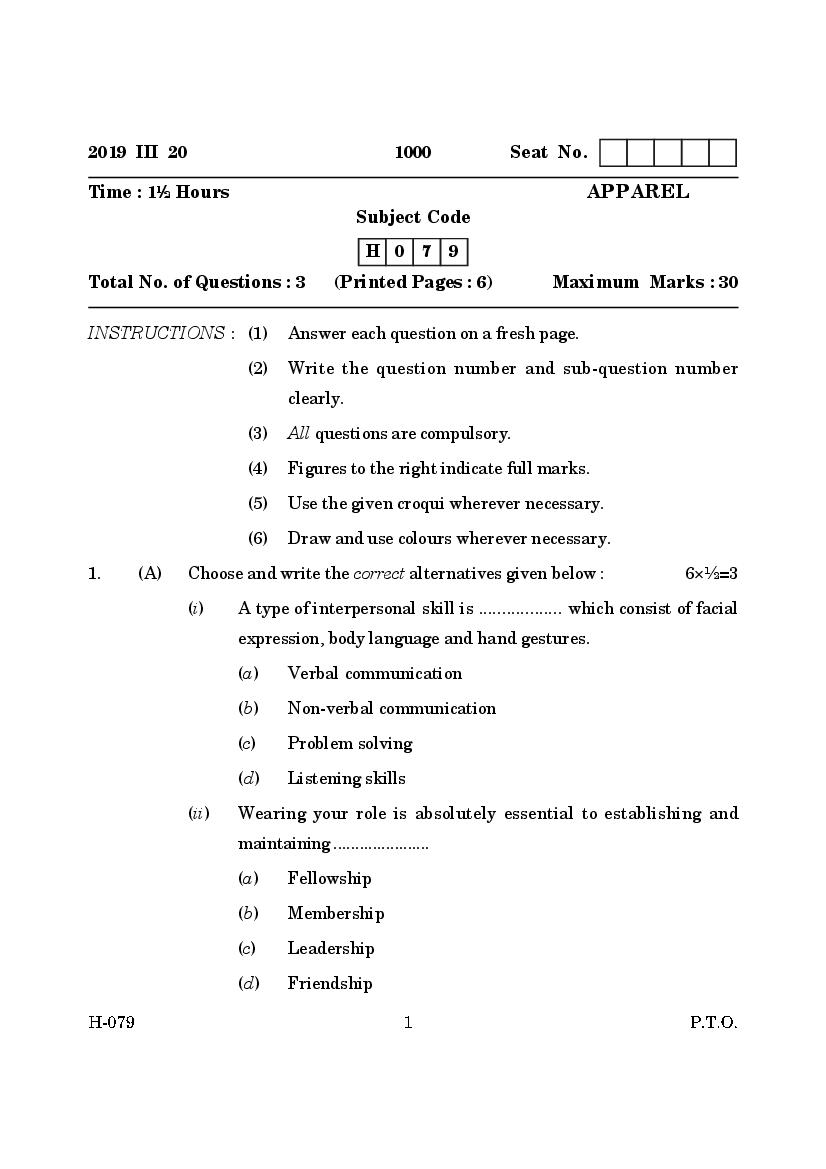
Time : 1½ Hours APPAREL
Subject Code
H 0 7 9
Total No. of Questions : 3 (Printed Pages : 6) Maximum Marks : 30
INSTRUCTIONS : (1) Answer each question on a fresh page.
(2) Write the question number and sub-question number
clearly.
(3) All questions are compulsory.
(4) Figures to the right indicate full marks.
(5) Use the given croqui wherever necessary.
(6) Draw and use colours wherever necessary.
1. (A) Choose and write the correct alternatives given below : 6×½=3
(i) A type of interpersonal skill is .................. which consist of facial
expression, body language and hand gestures.
(a) Verbal communication
(b) Non-verbal communication
(c) Problem solving
(d) Listening skills
(ii) Wearing your role is absolutely essential to establishing and
maintaining ......................
(a) Fellowship
(b) Membership
(c) Leadership
(d) Friendship
Page 2
feel.
(a) Space
(b) Texture
(c) Rhythm
(d) Line
(iv) A smooth texture is formed by the ................. weave.
(a) Plain
(b) Twill
(c) Satin
(d) Rib
(v) When a person is ................... cheeks get red, there are crease near
the eyes and lips pursed.
(a) Smiling
(b) Angry
(c) Sad
(d) Laughing
(vi) Understanding anatomy will help you to draw .................. figures in
a variety of poses.
(a) Natural
(b) Fashion
(c) Geometrical
(d) Line
Page 3
(i) Define negotiation skill.
(ii) Enlist various types of basic stitches.
(iii) Explain importance of direct dyeing. (any 2 points)
(C) Answer the following questions in three to four sentences each : 2×2=4
(i) What is the difference between tactile and visual texture.
(ii) Explain any two techniques of Batik printing.
2. (A) Choose and write the correct alternatives given below : 6×½=3
(i) Shearing and ............... method removes the fine protruding fibers
on the surface of the fabric.
(a) Brushing
(b) Mercerization
(c) Singeing
(d) Bleaching
(ii) The outline shape of the garment is called ....................
(a) Form
(b) Line
(c) Drape
(d) Silhouette
(iii) In pre-historic times people were using .................. fiber as a
thread.
(a) Rayon
(b) Cotton
(c) Leaf
(d) Nylon
Page 4
(a) Wet
(b) Direct
(c) Hot
(d) Cold
(v) Chikan work is also known as ................ embroidery.
(a) Grey
(b) White
(c) Red
(d) Blue
(vi) Chamba Rumaal is one of the rarest craft forms that uses ....................
stitch.
(a) Bukhia
(b) Satin
(c) Kasuti
(d) Herringbone
(B) Answer the following questions in one sentence each : 3×1=3
(i) Describe the motif used in patola sarees.
(ii) Why are mood board and colour board used in designing ?
(iii) Describe the colour board ?
(C) Answer the following questions in three to four sentences each : 2×2=4
(i) Write the stitches, threads used in Phulkari embroideries.
(ii) Write any two procedures for development of final product.
Page 5
(i) The fabric painting technique in which the devotees of Lord Krishna
is depicted.
(ii) The main objectives of the department include designing new
product and developing the product.
(iii) A person who sketch the garment to show all details of garment
construction for record.
(B) Answer the following questions in three to four sentences each : 2×2=4
(i) Explain the composition of client board.
(ii) Explain any two different sections of Indian Apparel Industry ?
(C) Illustrate the following : 1×3=3
Using the given croqui design a formal wear, using a bell silhouettes.
Document Details
| Board / Org | Goa Board |
| Exam | Class 12 |
| Type | Question Paper |
| Pages | 6 |
| Updated | 22 Jul 2026 |