UPSC IFS 2018 Question Paper for Zoology Paper - II
Finished viewing? Save it for later —
Download UPSC IFS 2018 Question Paper for Zoology Paper - II (PDF · 4 pages)About UPSC IFS 2018 Question Paper for Zoology Paper - II
UPSC IFS 2018 Question Paper for Zoology Paper - II is available here for free download. Published by UPSC for Indian Forest Service Examination, this question paper can be viewed online or downloaded as a PDF (4 pages). Candidates preparing for Indian Forest Service Examination can use UPSC IFS 2018 Question Paper for Zoology Paper - II to understand the exam pattern, the type of questions asked, and the overall difficulty level.
Frequently Asked Questions
How can I download UPSC IFS 2018 Question Paper for Zoology Paper - II?
Open this page and click the Download button to save UPSC IFS 2018 Question Paper for Zoology Paper - II as a PDF. It is completely free on AglaSem Docs.
Is UPSC IFS 2018 Question Paper for Zoology Paper - II free to download?
Yes. UPSC IFS 2018 Question Paper for Zoology Paper - II can be viewed online and downloaded as a PDF free of cost on AglaSem Docs.
How many pages does UPSC IFS 2018 Question Paper for Zoology Paper - II have?
UPSC IFS 2018 Question Paper for Zoology Paper - II contains 4 pages, which you can read online or download together as a single PDF.
Where can I find more Indian Forest Service Examination study material?
You can find more Indian Forest Service Examination question papers, sample papers, syllabus, and answer keys on AglaSem Docs.
UPSC IFS 2018 Question Paper for Zoology Paper - II – Text
Read the full text of this question paper below — useful to quickly search, copy and reference the content online without downloading the PDF.
📄 View text version (3 pages)
Page 1
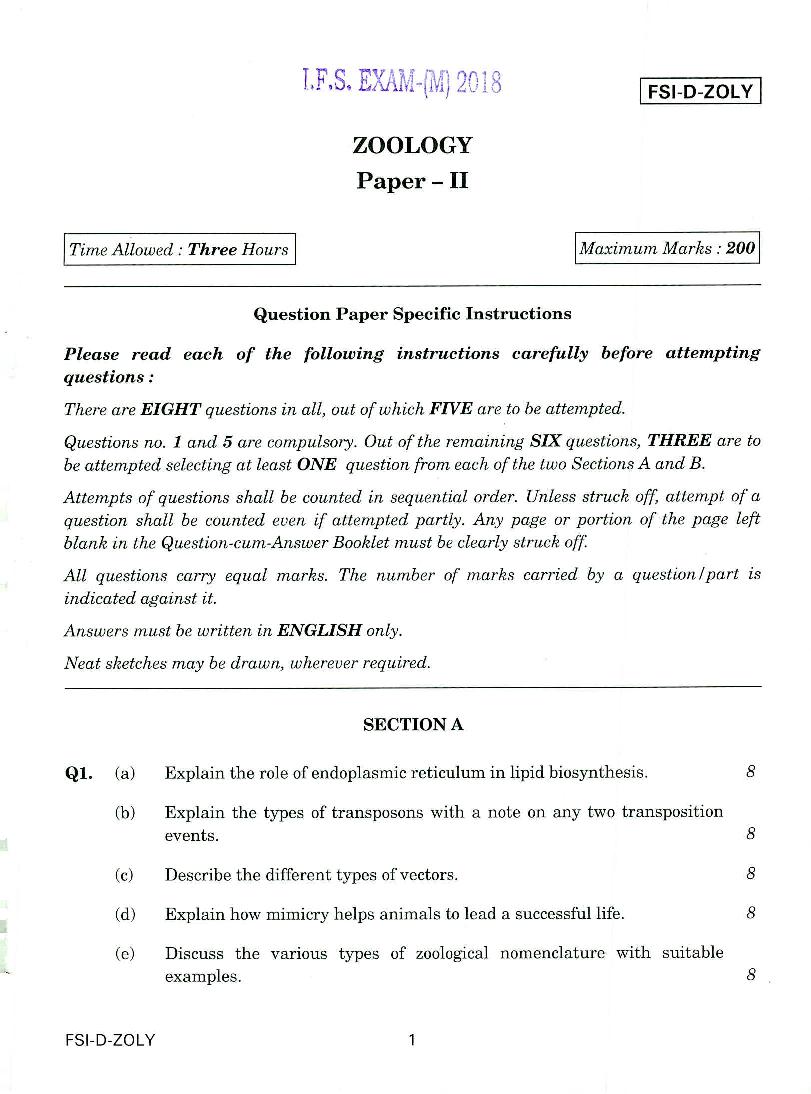
ZOOLOGY
Paper -II
Time Allowed: Three Hours Maximum Marks : 200
Question Paper Specific Instructions
Please read each of the following instructions carefully before attempting
questions:
There are EIGHT questions in all, out of which FIVE are to be attempted.
Questions no. 1 and 5 are compulsory. Out of the remaining SIX questions, THREE are to
be attempted selecting at least ONE question from each of the two Sections A and B.
Attempts of questions shall be counted in sequential order. Unless struck off, attempt of a
question shall be counted even if attempted partly. Any page or portion of the page left
blank in the Question-cum-Answer Booklet must be clearly struck off
All questions carry equal marks. The number of marks carried by a question I part is
indicated against it.
Answers must be written in ENGLISH only.
Neat sketches may be drawn, wherever required.
SECTION A
Ql. (a) Explain the role of endoplasmic reticulum in lipid biosynthesis. 8
Explain the types of transposons with a note on any two transposition
events. 8
Describe the different types of vectors. 8
Explain how mimicry helps animals to lead a successful life. 8
Discuss the various types of zoological nomenclature with suitable
examples.
FSI-D-ZOLY 1
Page 2
What are lysosomes ? Discuss their role in intracellular digestion. Give
an example of lysosomal storage disorder. 15
Describe the steps involved in gene regulation in eukaryotes. 10
Q3. With a neatly labelled diagram, explain sodium-potassium pump and its
role in membrane transport. 10
Explain the mode of speciation in evolution with examples. 15
Explain how protein synthesis is the key to the expression of biological
information. 15
Q4. Explain how unknown five-toed Condylarthra evolved in Equus. State
the evolutionary pattern in each geological era. 10
Discuss the structure and functions of Ribosomes and Golgi bodies with
an emphasis on secretion of proteins. 15
Describe the mechanism of DNA replication. 15
FSI-D-ZOLY 2
Page 3
Q5. (a) Explain enzyme kinetics with suitable examples. 8
Explain how the biological energy transformations obey the laws of
thermodynamics. 8
Explain the extrinsic pathway for initiation of blood clotting. 8
Describe the respiratory regulation of acid-base balance in body fluids. 8
What is neoteny ? Discuss the phenomenon in Amphibia giving suitable
example. 8
Q6. (a) Draw the structure of cAMP. Explain how cAMP acts as second
messenger for fl-adrenergic receptor system. 15
Describe the molecular mechanism of skeletal muscle contraction. 10
Define cloning. Explain somatic cell nuclear transfer method with
suitable examples 15
Q7. (a) Discuss the transport of oxygen in the blood. Give an account of various
factors that shift oxygen-hemoglobin dissociation curve. 15
Explain enzyme specificity with suitable examples. How is enzyme
activity controlled? 15
Describe the process of metamorphosis in frogs and explain the role of
thyroxin. 10
Q8. (a) What is embryonic induction ? Describe the mechanism of induction
giving examples. 15
Enlist the composition of bile. Discuss the role of bile salts in fat
digestion and absorption. 15
What is immunity? Giving suitable examples explain humoral and cell
mediated immunity. 10
FSI-D-ZOLY 3
Document Details
| Board / Org | UPSC |
| Exam | Indian Forest Service Examination |
| Type | Question Paper |
| Pages | 4 |
| Updated | 30 Apr 2026 |