CBSE Class 11 Syllabus 2022-23 Psychology
Finished viewing? Save it for later —
Download CBSE Class 11 Syllabus 2022-23 Psychology (PDF · 6 pages)About CBSE Class 11 Syllabus 2022-23 Psychology
CBSE Class 11 Syllabus 2022-23 Psychology is available here for free download. Published by CBSE for Class 11, this syllabus can be viewed online or downloaded as a PDF (6 pages). Candidates preparing for Class 11 can use CBSE Class 11 Syllabus 2022-23 Psychology to understand the exam pattern, the type of questions asked, and the overall difficulty level.
Frequently Asked Questions
How can I download CBSE Class 11 Syllabus 2022-23 Psychology?
Open this page and click the Download button to save CBSE Class 11 Syllabus 2022-23 Psychology as a PDF. It is completely free on AglaSem Docs.
Is CBSE Class 11 Syllabus 2022-23 Psychology free to download?
Yes. CBSE Class 11 Syllabus 2022-23 Psychology can be viewed online and downloaded as a PDF free of cost on AglaSem Docs.
How many pages does CBSE Class 11 Syllabus 2022-23 Psychology have?
CBSE Class 11 Syllabus 2022-23 Psychology contains 6 pages, which you can read online or download together as a single PDF.
Where can I find more Class 11 study material?
You can find more Class 11 question papers, sample papers, syllabus, and answer keys on AglaSem Docs.
CBSE Class 11 Syllabus 2022-23 Psychology – Text
Read the full text of this syllabus below — useful to quickly search, copy and reference the content online without downloading the PDF.
📄 View text version (6 pages)
Page 1
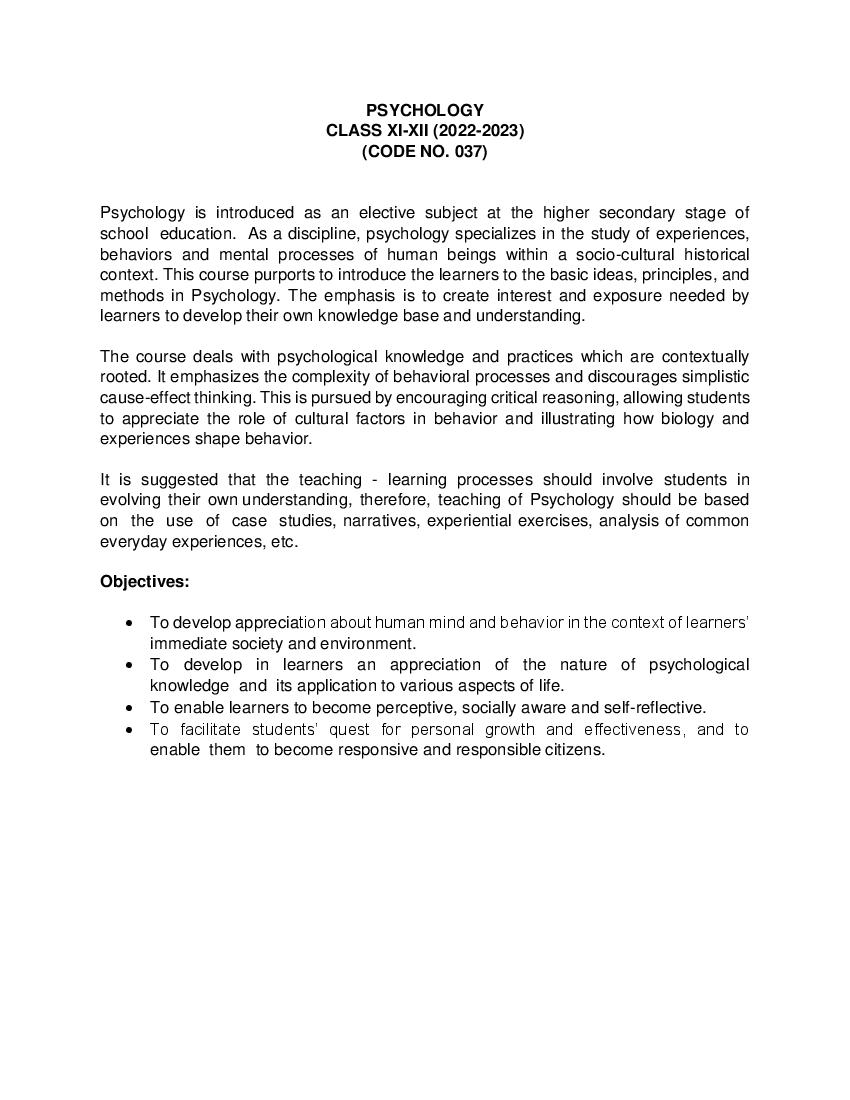
CLASS XI-XII (2022-2023)
(CODE NO. 037)
Psychology is introduced as an elective subject at the higher secondary stage of
school education. As a discipline, psychology specializes in the study of experiences,
behaviors and mental processes of human beings within a socio-cultural historical
context. This course purports to introduce the learners to the basic ideas, principles, and
methods in Psychology. The emphasis is to create interest and exposure needed by
learners to develop their own knowledge base and understanding.
The course deals with psychological knowledge and practices which are contextually
rooted. It emphasizes the complexity of behavioral processes and discourages simplistic
cause-effect thinking. This is pursued by encouraging critical reasoning, allowing students
to appreciate the role of cultural factors in behavior and illustrating how biology and
experiences shape behavior.
It is suggested that the teaching - learning processes should involve students in
evolving their own understanding, therefore, teaching of Psychology should be based
on the use of case studies, narratives, experiential exercises, analysis of common
everyday experiences, etc.
Objectives:
To develop appreciation about human mind and behavior in the context of learners’
immediate society and environment.
To develop in learners an appreciation of the nature of psychological
knowledge and its application to various aspects of life.
To enable learners to become perceptive, socially aware and self-reflective.
To facilitate students’ quest for personal growth and effectiveness, and to
enable them to become responsive and responsible citizens.
Page 2
CLASS XI (2022-2023)
Theory Paper 3 Hours
Marks: 70
Units Topics No. of Marks
periods
I What is Psychology? 27 11
II Methods of Enquiry in Psychology 32 13
IV Human Development 26 11
V Sensory, Attentional and Perceptual 18 8
Processes
VI Learning 20 9
VII Human Memory 19 8
VIII Thinking 14 5
IX Motivation and Emotion 14 5
Total 170 70
COURSE STRUCTURE
Unit I What is Psychology? 27 Periods
2. What is Psychology?
Psychology as a Discipline
Psychology as a Natural Science
Psychology as a Social Science
3. Understanding Mind and Behaviour
4. Popular Notions about the Discipline of Psychology
5. Evolution of Psychology
6. Development of Psychology in India
7. Branches of Psychology
8. Psychology and Other Disciplines
9. Psychology in Everyday Life
Unit II Methods of Enquiry in Psychology 32 Periods
2. Goals of Psychological Enquiry
Steps in Conducting Scientific Research
Page 3
3. Nature of Psychological Data
4. Some Important Methods in Psychology
Observational Method
Experimental Method
Correlational Research
Survey Research
Psychological Testing
Case Study
5. Analysis of Data
Quantitative Method
Qualitative Method
6. Limitations of Psychological Enquiry
7. Ethical Issues
Unit IV Human Development 26 Periods
2. Meaning of Development
Life-Span Perspective on Development
3. Factors Influencing Development
4. Context of Development
5. Overview of Developmental Stages
Prenatal Stage
Infancy
Childhood
Challenges of Adolescence
Adulthood and Old Age
Unit V Sensory, Attentional and Perceptual Processes 18 Periods
2. Knowing the world
3. Nature and varieties of Stimulus
4. Sense Modalities
Functional limitation of sense organs
5. Attentional Processes
Selective Attention
Sustained Attention
Page 4
Processing Approaches in Perception
7. The Perceiver
8. Principles of Perceptual Organisation
9. Perception of Space, Depth and Distance
Monocular Cues and Binocular Cues
10. Perceptual Constancies
11. Illusions
12. Socio-Cultural Influences on Perception
Unit VI Learning 20 Periods
2. Nature of Learning
3. Paradigms of Learning
4. Classical Conditioning
Determinants of Classical Conditioning
5. Operant/Instrumental Conditioning
Determinants of Operant Conditioning
Key Learning Processes
6. Observational Learning
7. Cognitive Learning
8. Verbal Learning
9. Skill Learning
10. Factors Facilitating Learning
11. Learning Disabilities
Unit VII Human Memory 19 Periods
2. Nature of memory
3. Information Processing Approach : The Stage Model
4. Memory Systems : Sensory, Short-term and Long-
term Memories
5. Levels of Processing
6. Types of Long-term Memory
Declarative and Procedural; Episodic and
Semantic
7. Nature and Causes of Forgetting
Page 5
Retrieval Failure
8. Enhancing Memory
Mnemonics using Images and Organisation
Unit VIII Thinking 14 Periods
2. Nature of Thinking
Building Blocks of Thought
3. The Processes of Thinking
4. Problem Solving
5. Reasoning
6. Decision-making
7. Nature and Process of Creative Thinking
Nature of Creative Thinking
Process of Creative Thinking
8. Thought and Language
9. Development of Language and Language Use
Unit IX Motivation and Emotion 14 Periods
2. Nature of Motivation
3. Types of Motives
Biological Motives
Psychosocial Motives
4. Maslow’s Hierarchy of Needs
5. Nature of Emotions
6. Expression of Emotions
Culture and Emotional Expression
Culture and Emotional Labelling
7. Managing Negative Emotions
8. Enhancing Positive Emotions
Practical (Projects, experiments, small studies, etc.) 30 marks 60 Periods
The students shall be required to undertake one project and conduct
two experiments. The project would involve the use of different
methods of enquiry like observation, survey, interview, questionnaire,
small studies related to the topics covered in the course (e.g. Human
Page 6
Thinking). Experiments could focus on cause-and-effect relationship.
Practical Examination
Practical (Experiments) file 05 Marks
Project File 05 Marks
Viva Voce (Project and experiments) 05 Marks
One experiment (05 marks for conduct of 15 Marks
experiment and 10 marks for reporting)
Total 30 Marks
QUESTION PAPER DESIGN
CLASS –XI (2022-23)
I. Theory
Time: 3 Hours Maximum Marks: 70
S. Competencies Total Marks %
No. Weightage
1 Remembering and Understanding: Exhibiting 25 35%
memory of previously learned material by recalling
facts, terms, basic concepts, and answers;
Demonstrating understanding of facts and ideas by
organizing, comparing, translating, interpreting, giving
descriptions and stating main ideas
2 Applying: Solving problems to new situations by 31 45%
applying acquired knowledge, facts, techniques and
rules in a different way
3 Formulating, Analysing, Evaluating and 14 20%
Creating: Examining and breaking information into
parts by identifying motives or causes; Making
inferences and finding evidence to support
generalizations; Presenting and defending opinions
by making judgments about information, validity of
ideas, or quality of work based on a set of criteria;
Compiling information together in a different way by
combining elements in a new pattern or proposing
alternative solutions
Total 70 100%
II. Practical: 30 Marks
Document Details
| Board / Org | CBSE |
| Exam | Class 11 |
| Type | Syllabus |
| Pages | 6 |
| Language | english |
| Updated | 15 Jul 2026 |