DU SOL Question Paper 2018 B.Com (Hons.) Business Law
Course : B.Com (Hons.)
Semester: I
Paper Code: A-106
Subject: Business Law
More Detail
Finished viewing? Save it for later —
Download DU SOL Question Paper 2018 B.Com (Hons.) Business Law (PDF · 10 pages)About DU SOL Question Paper 2018 B.Com (Hons.) Business Law
DU SOL Question Paper 2018 B.Com (Hons.) Business Law is available here for free download. Published by University of Delhi for DU SOL, this question paper can be viewed online or downloaded as a PDF (10 pages). Candidates preparing for DU SOL can use DU SOL Question Paper 2018 B.Com (Hons.) Business Law to understand the exam pattern, the type of questions asked, and the overall difficulty level.
Frequently Asked Questions
How can I download DU SOL Question Paper 2018 B.Com (Hons.) Business Law?
Open this page and click the Download button to save DU SOL Question Paper 2018 B.Com (Hons.) Business Law as a PDF. It is completely free on AglaSem Docs.
Is DU SOL Question Paper 2018 B.Com (Hons.) Business Law free to download?
Yes. DU SOL Question Paper 2018 B.Com (Hons.) Business Law can be viewed online and downloaded as a PDF free of cost on AglaSem Docs.
How many pages does DU SOL Question Paper 2018 B.Com (Hons.) Business Law have?
DU SOL Question Paper 2018 B.Com (Hons.) Business Law contains 10 pages, which you can read online or download together as a single PDF.
Where can I find more DU SOL study material?
You can find more DU SOL question papers, sample papers, syllabus, and answer keys on AglaSem Docs.
DU SOL Question Paper 2018 B.Com (Hons.) Business Law – Text
Read the full text of this question paper below — useful to quickly search, copy and reference the content online without downloading the PDF.
📄 View text version (10 pages)
Page 1
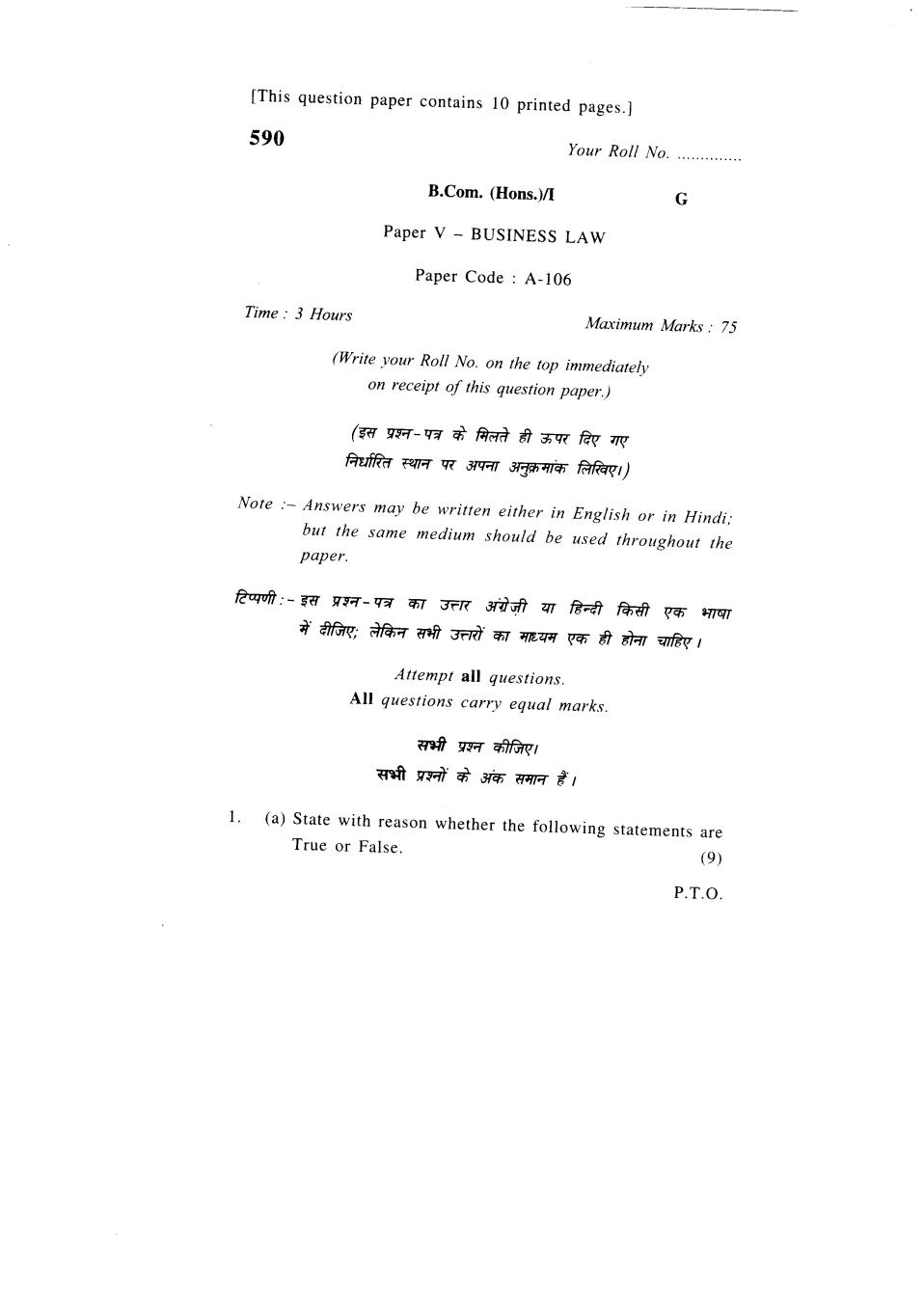
590 your Roll No.
B.Com. (Hons.)/I
c
PaperV-BUSINESSLAW
Paper Code : A_106
Time: 3 Hours
Marimum Marks . 75
(Write y-our Roll No. on the top
immediately
on receipt of this question paper.)
(ev yw_s-r + ft?"+ A a-cr As ,K
ftrfu eil;r yt erwT Wtr416 ftr?rrr/
Note Answers may be written either in
"- Engrish or in Hindi;
but the same medium should be used
throughout the
paper.
M:-Fa rw-s? w Frt ,n)fr qT ffi lhf q_*. *Tt6tT
+ flftg er*r ara wrd. ar q*w w fr dtar q*v
r
Attempt all questions.
All questions carry equal marks.
d yw eflFdvr
q$ rgdi + sfm- acn { r
1' (a) state with reason whether the
fo'owing statemenrs are
True or False.
(9)
P.T.O.
Page 2
(i) Consideration need not be adequate.
(ii) A void contract is one which is void ab initio'
(iii) Supervening impossibility does not include the
difficulty of performance.
(b) 'A quasi contract is not a contract at all. It is an
obligation which the law creates'. Explain the statement
as recognized under Indian Contract Act. (6)
OR
(a) State with reason whether the following statements are
True or False. (9)
(i) Law does not debar a minor from becoming a
promisee in a contract'
(ii) Communication of offer is complete when the letter
of offer is posted.
(iii) A surety is a favoured debtor'
(b) A offers to sell a painting to B, which A knows is a
copy of a well-known masterpiece' B, thinking that the
painting is the original one, agrees to buy it at a very
high price. Is this a valid contract? Give reasons' (6)
Page 3
590
qI onrtu i :
(o.) enw {trd
qdrtt m FrqRRq-d qerr {€
qS tr
(i) sRs-d{ qr qdq *<r enssq:*'
(ii) r,-r *'f rffisr i * fr sntT
t 'ft q'l *r
* qFcftd Tff frqr
(iii) eruare-<t i Rqrr{ m o,ffi
qFTTt
rt fficr qff *err 46 6lTr ERr €rd
(te) vo ** frqt rc €qr+
sl?trr (obligation) *r wcfta ffiqr sIFrFr{m + 3ff4
rrt q'm d qq dF';rqt
iil?fAf
q-€ qt erss i'
(o.) or<vt qtrd s-dTga fr
FFRFc-d 6'ert
qt qt<r T & q-c<r fr qa qqq UEnt
(i) ol-1t qq 3rsrr6'
(Promisee) {fr A ftratl
sta frqr qrcr i fr wdrs
6T
(ii) ue s<re 6l qd sr6 fr
{sR$*qrmtr
uft1 (surety) q6 =q t+en
ir
(iii) r
qFr{T H qr s€Is d fr
qrmt * fr ao oift
(e) q qr S d
qnt fr q6 W qift i v-?q rr€ qt
fr tr6d *r S qa Ev
q,tq q<rgtr
Tqft iil tr wr q6 q'5 +{ lx-gcu *?
P.T.O.
Page 4
2. (a) Define the term 'Offer'. Explain the legal rules regarding
a valid offer. (5)
(b) 'A stranger to a contract cannot sue'. Are there any
exceptions to this rule? Explain. (5)
(c., Differentiate between a Contract of Indemnity and a
Contract of Guarantee. (5)
OR
(a) Distinguish between 'Coercion' and 'Undue Influence'.
(5)
(b) What principles are applied in order to assess the amount
of damages recoverable for a breach of contract? (5)
(c) A minor fraudulently represented to a money lender that
he was a full-age and obtained a loan of Rupees
5,000/-. Has the moneylender any right of action against
the minor for the money lent. Give reasons. (5)
(m) nq 's<rq' + cffi( dfrqr vs' fu vwre + emflrq-€F
ffi6 ffi qr euf;r frfrqt
(e) ffier + yR €ffi{& sr€ Kd qft qr wnirl gq fr{q + +{
wrcrE rft +? efr qitfrq,
(rr) uR -wq. (Indemnity) ffiqr *i qr& ffi-{r + 3r_<+d dFvrqr
Page 5
Srerdt
(o) '31ff3q'' stt irgfu( yqrq' I ir;ildE frFqqr
(q) r-+. ffi-a rrr A+ .n ecrt* S sFc rtfu + fuiwr eg frtt
+ ft€FiT arrl ffi drt *?
(tr) q-*. ircr.refi' * qa ee 6T q-d d. s,ooo HqFR t ftqr fr
T6 q{r€F *r wr ff{fiR rfiT BrilR {c+ ?+ + ftq srrirefi' yr
frt{ BTh+.R ir qnq qRa qtrs+r
(a) Explain the doctrine of Caveat Emptor. Are there any
exceptions? (5)
(b) Why is it important to know the exact time when the
property in goods passes from a seller to a buyer? (5)
(c) Who is an'Unpaid Seller'? What are his rights against
the buyer personally? (5)
OR
(a) Explain the Implied Conditions as per Sale of Goods
Act, 1930. (5)
(b) Define the term 'Delivery of Goods,. State the different
modes of Effective Delivery of Goods. (5)
P.T.O.
Page 6
(c) X. a lacly. handed over her old jewelry to Y' a goldsrnith'
for the ptlrpose of remaking after melting it' Every
evening, as soon as Y's work for the day is over'
the
lady usetl to take the semi-finished jcwelry and
put it in
a box in goldsmith's shop but carry the key to
the box
with her. One night. jewelry was lost from the box'
Explain the liability of tire goldsmith in this regard'
(5)
(o.) frm <rtrsln it + ft-tr< 6r sut{ dfrqr wr E{+ +t€ e*rer€
r{l €i
(re) ffR+c trrq, qqh' B{r t *f,r d {qR 61 atilir<qr $lT
A, d qw{r qdf ft-is$ e?
(.r) vo wea ffiar 6tq e? 3T+ *-dr +
qklrd w t et
3{Erm.R t?
qr atra 416o'
(6) qR fr'm'q $Drfrq{, le30 + 3I$R rrFfd rrff
(q) 'rt-f, fr g5d,T' (oelivery of Goods) {r€ A
qRrtfrd dfrqt
sqrsmrft q€S al W{rft * An- <ffi or suFq qilfrql
qr{ \'o gm +1 5u+ rrd+
(rr) gm, vs'sftmr +, erc+ 5u} 116+,
rren tF{ ca ft+ ffir+ + frq frgr at rrrq, +t fi qr{ 6T
t
6r{T rr.{t<T A=dr, qFf,r 116+ dg{R fr gor+ i
"e-nffi<
Page 7
s+ T5*^ t r-cs +ft Bfu T-{*,, !fr qr& €c ne Aftr F. {riT
q1 wT{fi+ rm* rncs
d rrh Fq €"rt n grn + Erft€
tnT qqFr qil
4. (a) How is a Controller of
Certifying Authority appointed?
What are his functions under the
Information Technology
Act, 2000?
(s)
(b) Discuss the provisions
of Information Technology Act,
2000 relating to ,Digital
Signature, and 'Electronic
Signature' ?
(5)
(c) Explain the legal recognition
of electronic records as
per the Informarion Technology
Act, 2000. (5t
OR
(a) Define the following terms:
(i) Private Key and public Key,
(ii) Asymmetric Crypto System.
(s)
(b) A person knowingly or
intentionally conceals, destroys
or alters any computer source, computer
program,
computer system or network.
Is such an act an offence?
If so, what is the punishment?
(5)
P.T.O.
Page 8
(c) Explain the terms 'e-Commerce' and 'e-Governance'
with reference to the Information Technology Act, 2000'
(5)
(o.) vreqn IFTIWT HT fuT*. a1 ft5w ft-qr qrcr *? €{r{ A
sfifr{c 2ooo + irfl{d E{+ qlf wr +?
(rs) 'GSra ERreR' (oigitat Signature) *t 'Eftr{ft5 ERrqR'
t TqRr{ qr<r ffiFr* e{fufr{t, 2000 + vreEn+ qT qsh
dFwr
(u) qn<r ffiffi slfuRqq, 2ooo + w1tn ffifro M *
auTFq.. cretf,r qr qoiq *Fqqt
Slsrqt
(o) ffiRao a-d * qfr{rRn dfrq:
(i) fifr €fr slli 6.6+. Efr
(ii) otR+F*. M d-{ (Assymetric Crypto System)
(q) \.o qk tn;rcsot zII RKd;r e.q d fucrf,r *, eryl *f,,
qr q'r{6-q, qR t-* qr H d wrq qr ttt * qr
q+o ttr *r qt tcr q.r{ vdr oFRIEI fr }fr } elrtr e? qR
d. A cs eqr *?
Page 9
(n) qa-<r qdffi elFtfrqq, 2000 + Teti + {-o.rr€ 3i{ €-n-qt{
(E-Governance) rrd q1 qdT +lFqqt
5. (a) Define a Negotiable Instrument' What are its
(s)
characteristics ?
(b) Define Negotiation' What are the different modes of
(s)
negotiation?
(s)
(c) Write short notes on:
(i) Sans recourse endorsement
(ii) Facultative endorsement
OR
(a).Define a Bill of Exchange' What are the essential
(5)
features of a Bill of Exchange?
(s)
(b) Write short notes on:
(i) Blank or General endorsement
(ii) Special of Full endorsement
(c) Explain the privileges granted to a'holder in due
course'.
(5)
(c.) RRw qrte fr€ 6] qfr{rfrd frRqr Esff lN wr i?
P.T.O.
Page 10
590
dt qR{rRR dftrqr cc*FTqr * Anrq
(ra) rr*nror (Negotiation)
aG qr t?
(.r) ag frlnFrqi 6ffi:
(i) qrffi{ kFT
(ii) eo,R{*, tsm
SI9IEII
qfr{rfd dRNr so frfrw fr{ + 3{ffi
(e') vo frRqq trn d
1ot"{ wr ii
(ta) q frqFrqf frR{q
(i) frffi q1 lfiurisr tsm
(ii) 1d qt GRrq fcio.{
qr sR€ dRqt
(rr) 'qutRfr urq'' *
fftsrBellr
(10,000)
Document Details
| Board / Org | University of Delhi |
| Exam | DU SOL |
| Type | Question Paper |
| Pages | 10 |
| Updated | 23 Oct 2026 |