Goa Board Class 12 Question Paper Mar 2019 Psychology _CWSN_
Finished viewing? Save it for later —
Download Goa Board Class 12 Question Paper Mar 2019 Psychology _CWSN_ (PDF · 10 pages)About Goa Board Class 12 Question Paper Mar 2019 Psychology _CWSN_
Goa Board Class 12 Question Paper Mar 2019 Psychology _CWSN_ is available here for free download. Published by Goa Board for Class 12, this question paper can be viewed online or downloaded as a PDF (10 pages). Candidates preparing for Class 12 can use Goa Board Class 12 Question Paper Mar 2019 Psychology _CWSN_ to understand the exam pattern, the type of questions asked, and the overall difficulty level.
Frequently Asked Questions
How can I download Goa Board Class 12 Question Paper Mar 2019 Psychology _CWSN_?
Open this page and click the Download button to save Goa Board Class 12 Question Paper Mar 2019 Psychology _CWSN_ as a PDF. It is completely free on AglaSem Docs.
Is Goa Board Class 12 Question Paper Mar 2019 Psychology _CWSN_ free to download?
Yes. Goa Board Class 12 Question Paper Mar 2019 Psychology _CWSN_ can be viewed online and downloaded as a PDF free of cost on AglaSem Docs.
How many pages does Goa Board Class 12 Question Paper Mar 2019 Psychology _CWSN_ have?
Goa Board Class 12 Question Paper Mar 2019 Psychology _CWSN_ contains 10 pages, which you can read online or download together as a single PDF.
Where can I find more Class 12 study material?
You can find more Class 12 question papers, sample papers, syllabus, and answer keys on AglaSem Docs.
Goa Board Class 12 Question Paper Mar 2019 Psychology _CWSN_ – Text
Read the full text of this question paper below — useful to quickly search, copy and reference the content online without downloading the PDF.
📄 View text version (10 pages)
Page 1
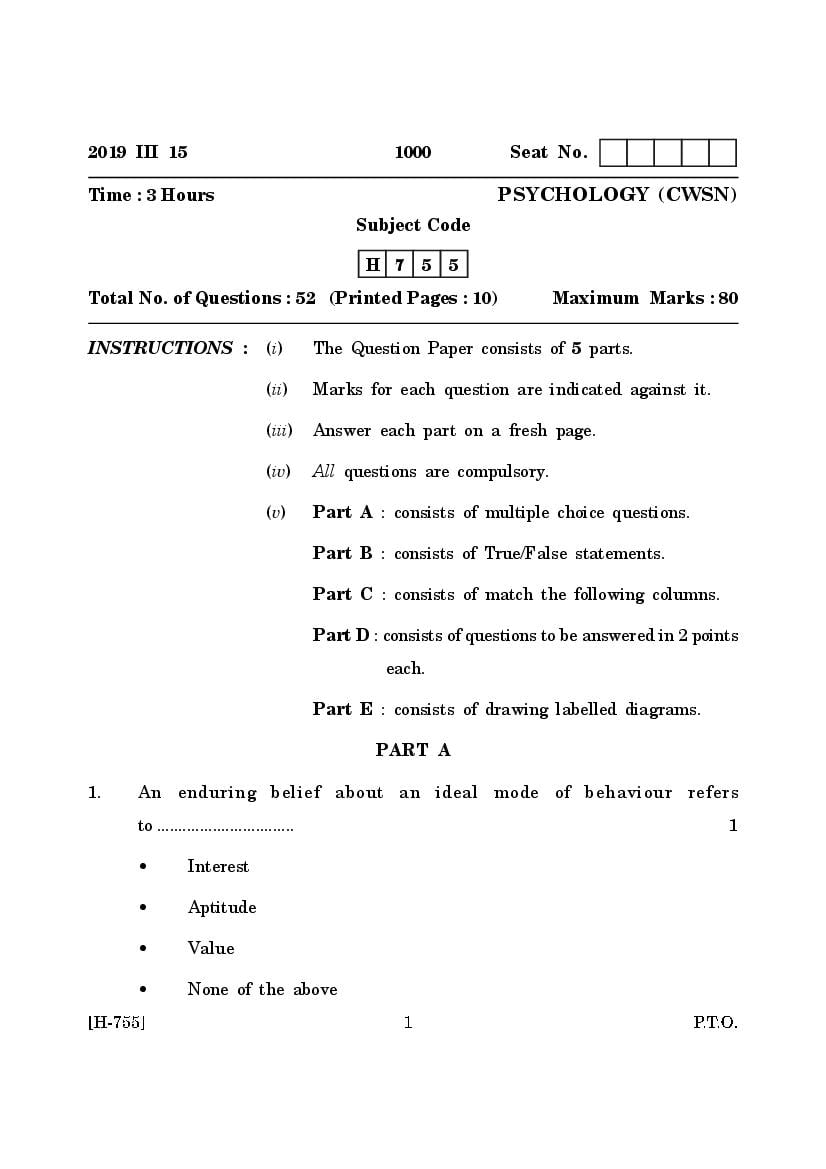
Time : 3 Hours PSYCHOLOGY (CWSN)
Subject Code
H 7 5 5
Total No. of Questions : 52 (Printed Pages : 10) Maximum Marks : 80
INSTRUCTIONS : (i) The Question Paper consists of 5 parts.
(ii) Marks for each question are indicated against it.
(iii) Answer each part on a fresh page.
(iv) All questions are compulsory.
(v) Part A : consists of multiple choice questions.
Part B : consists of True/False statements.
Part C : consists of match the following columns.
Part D : consists of questions to be answered in 2 points
each.
Part E : consists of drawing labelled diagrams.
PART A
1. An enduring belief about an ideal mode of behaviour refers
to ................................ 1
• Interest
• Aptitude
• Value
• None of the above
Page 2
• Observation
• None of these
• Interview
• Self-report
3. The theory proposed by Charles Spearman is ................................ 1
• None of these
• Two-factor theory
• One factor
• Structure of intellect model
4. The biological age from birth is ................................ 1
• Mental age
• None of these
• Chronological age
• Intelligence quotient
5. The distinctiveness and variations among people’s characteristics and
behaviour problems is ................................ 1
• Assessment
• Values
• None of these
• Individual differences
Page 3
• Stress
• Distress
• None of these
• Strain
7. The result from blocking of needs and motives by something or someone that
hinders us from achieving a desired goals is ................................ 1
• Conflicts
• Frustration
• None of these
• Social pressure
8. The state of physical, emotional and psychological exhaustion
is ................................ 1
• Burnout
• Hassles
• Relaxation
• None of the above
9. It is a set of beliefs about oneself, the world and how they
react ................................ 1
• None of these
• Exercise
• Hardiness
• Relaxation
Page 4
called ................................ 1
• All of these
• Diet
• Self-care
• Health
11. It deals with various psychological issues pertaining to environmental
interaction ................................ 1
• Social Psychology
• None of these
• Biological Psychology
• Environmental Psychology
12. The study of relationship between living beings and their
environment ................................ 1
• Psychology
• Sociology
• None of these
• Ecology
13. Any sound that is annoying is called ................................ 1
• Pollution
• Noise
• Crowding
• Discrimination
Page 5
is ................................ 1
• None of these
• Poverty
• Deprivation
• Discrimination
15. A behaviour by a person or persons that is intended to cause harm to another
person or persons is ................................ 1
• Aggression
• Peace
• Displacement
• Violence
16. It provides a large amount of infotainment in an attractive
form ................................ 1
• Radio
• None of these
• Newspaper
• Television
17. It is defined as proficiency facility that is acquired or developed through training
and experience is ................................ 1
• Interview
• Skill
• None of the above
• Observation
Page 6
is ................................ 1
• Cluster
• Attitude
• Clothing style
• Body language
19. It is a helping relationship between counsellor and
counsellee ................................ 1
• Counselling
• Interview
• Listening
• None of the above
20. The observation where a person is observed in a natural set-up
is ................................ 1
• Channel
• Participant
• Non-participant
• Naturalistic
21. The message that is translated and put for another person’s understanding
is ................................ 1
• Channel
• Encode
• Decode
• Record
Page 7
22. Assessment is the first step in undertaking a psychological attribute.
(T/F) 1
23. Mother-child interaction cannot be easily studies through observation.
(T/F) 1
24. IQ refers to the mental age divided by the chronological age multiplied by
100. (T/F) 1
25. A general feature of most of the creativity tests is that they are closed ended.
(T/F) 1
26. Emotional intelligence is the feeling side of intelligence. (T/F) 1
27. Conflicts may occur between two or more compatible needs or motives.
(T/F) 1
28. Social events like death or illness in the family, strained relatinships, trouble
with neighbours are examples of social stress. (T/F) 1
29. Behaviour stress does not affect our behaviour in the form of eating less.
(T/F) 1
30. Regular exercise improves the efficiency of the heart, enhances the function
of the lungs, maintains good circulation etc. (T/F) 1
31. Diet cannot lift one’s mood, gives less energy, does not improve circulation.
(T/F) 1
32. Exercise is good for health. (T/F) 1
33. Inborn tendency is not a cause of aggression. (T/F) 1
34. Environmental pollution is in the form of air, water and soil pollution.
(T/F) 1
Page 8
from problems. (T/F) 1
36. Individuals learn to be aggressive by observing others showing aggression.
(T/F) 1
37. Behaviour does not influence health. (T/F) 1
38. Aggression is not an expression in consequence of frustration. (T/F) 1
39. Interpersonal communication involves communicating with yourself. (T/F) 1
40. Counselling is confidential and voluntary. (T/F) 1
41. Participant observation is not a type of observation. (T/F) 1
42. In observation we pay close attention to the surroundings. (T/F) 1
43. In encoding we give ideas but not meaning to the message. (T/F) 1
PART C
44. Match the columns : 8
Column-1 Column-2
(i) 110-119 (a) Low average
(ii) 90-109 (b) Average
(iii) 80-89 (c) High average
(iv) Distress (d) Stress that is good
(v) Eustress (e) Stress that is bad
(vi) Tangible support (f) When a person is loved, cared and
valued.
(vii) Informational support (g) Materials such as goods, money etc.
(viii) Emotional support (h) Fear of exams, being sad.
Page 9
Column-1 Column-2
(i) Spiritual perspective (a) States that the physical environ-
ment has minimal influence on
human behaviour.
(ii) Instrumental perspective (b) The view of the environment as
something to be respected and
valued.
(iii) Minimalist perspective (c) Suggests that the physical
environment exists mainly for use
by human beings for their comfort.
(iv) Deprivation (d) Refers to shortage of resources.
(v) Poverty (e) State in which a person feels he has
lost something.
(vi) Pro-environmental behaviour (f) Managing garbage disposal.
(vii) Intrapersonal communication (g) Characterised by the speaker
sending a message to the audience.
(viii) Interpersonal communication (h) Involves communicating with
oneself.
(ix) Public communication (i) Communication that takes place
between two or more persons.
Page 10
46. Explain in short, Charles Spearman’s two-factor theory. 2
47. Explain two stress management techniques. 2
48. Explain two types of stress. 2
49. Explain two promotive actions to protect the environment from pollution. 2
50. State two advantages and two disadvantages of observation. 2
PART E
51. Draw the Normal Distribution Curve and show the percentagewise distribution
of I.Q. scores in the general population. 5
52. Draw a neat labelled diagram of the Basic Communication Process. 5
Document Details
| Board / Org | Goa Board |
| Exam | Class 12 |
| Type | Question Paper |
| Pages | 10 |
| Updated | 22 Jul 2026 |