DUET 2021 Question Paper M.Sc Microbiology
Finished viewing? Save it for later —
Download DUET 2021 Question Paper M.Sc Microbiology (PDF · 15 pages)About DUET 2021 Question Paper M.Sc Microbiology
DUET 2021 Question Paper M.Sc Microbiology is available here for free download. Published by NTA for DUET, this question paper can be viewed online or downloaded as a PDF (15 pages). Candidates preparing for DUET can use DUET 2021 Question Paper M.Sc Microbiology to understand the exam pattern, the type of questions asked, and the overall difficulty level.
Frequently Asked Questions
How can I download DUET 2021 Question Paper M.Sc Microbiology?
Open this page and click the Download button to save DUET 2021 Question Paper M.Sc Microbiology as a PDF. It is completely free on AglaSem Docs.
Is DUET 2021 Question Paper M.Sc Microbiology free to download?
Yes. DUET 2021 Question Paper M.Sc Microbiology can be viewed online and downloaded as a PDF free of cost on AglaSem Docs.
How many pages does DUET 2021 Question Paper M.Sc Microbiology have?
DUET 2021 Question Paper M.Sc Microbiology contains 15 pages, which you can read online or download together as a single PDF.
Where can I find more DUET study material?
You can find more DUET question papers, sample papers, syllabus, and answer keys on AglaSem Docs.
DUET 2021 Question Paper M.Sc Microbiology – Text
Read the full text of this question paper below — useful to quickly search, copy and reference the content online without downloading the PDF.
📄 View text version (15 pages)
Page 1
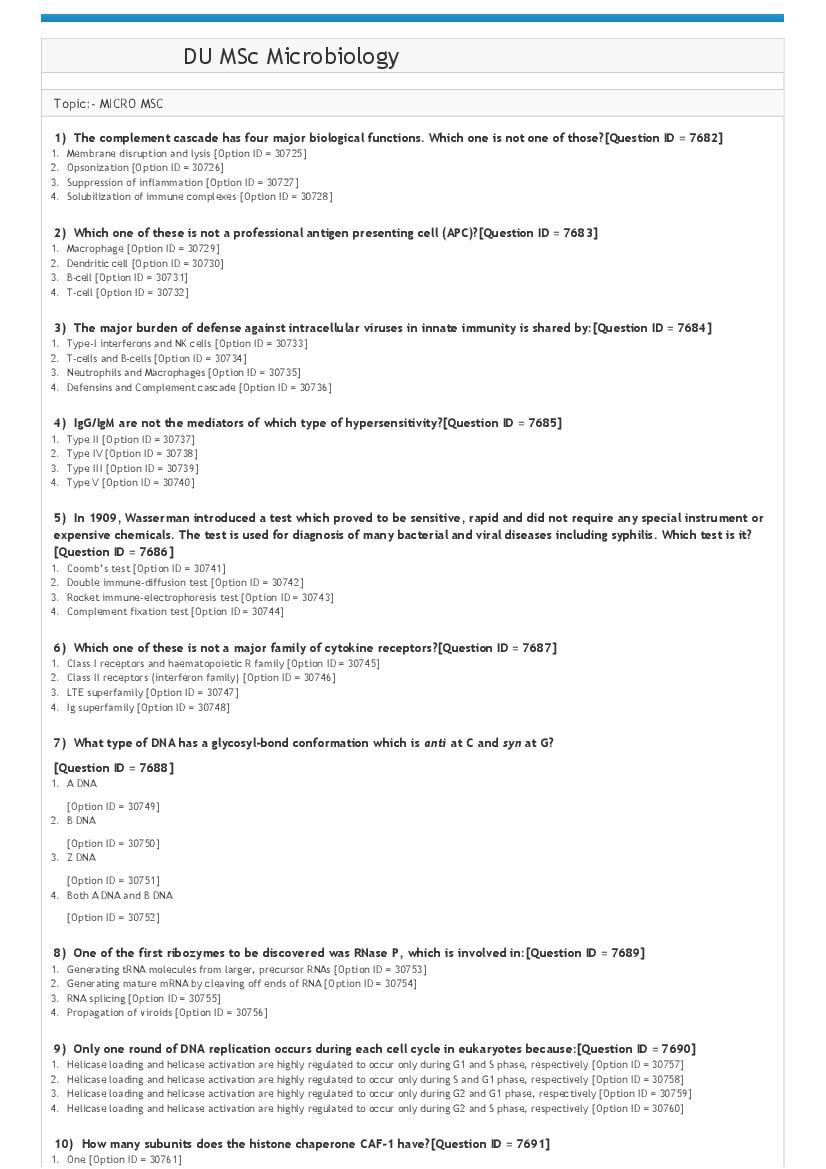
Topic:‐ MICRO MSC
1) The complement cascade has four major biological functions. Which one is not one of those?[Question ID = 7682]
1. Membrane disruption and lysis [Option ID = 30725]
2. Opsonization [Option ID = 30726]
3. Suppression of inflammation [Option ID = 30727]
4. Solubilization of immune complexes [Option ID = 30728]
2) Which one of these is not a professional antigen presenting cell (APC)?[Question ID = 7683]
1. Macrophage [Option ID = 30729]
2. Dendritic cell [Option ID = 30730]
3. B‐cell [Option ID = 30731]
4. T‐cell [Option ID = 30732]
3) The major burden of defense against intracellular viruses in innate immunity is shared by:[Question ID = 7684]
1. Type‐I interferons and NK cells [Option ID = 30733]
2. T‐cells and B‐cells [Option ID = 30734]
3. Neutrophils and Macrophages [Option ID = 30735]
4. Defensins and Complement cascade [Option ID = 30736]
4) IgG/IgM are not the mediators of which type of hypersensitivity?[Question ID = 7685]
1. Type II [Option ID = 30737]
2. Type IV [Option ID = 30738]
3. Type III [Option ID = 30739]
4. Type V [Option ID = 30740]
5) In 1909, Wasserman introduced a test which proved to be sensitive, rapid and did not require any special instrument or
expensive chemicals. The test is used for diagnosis of many bacterial and viral diseases including syphilis. Which test is it?
[Question ID = 7686]
1. Coomb’s test [Option ID = 30741]
2. Double immune‐diffusion test [Option ID = 30742]
3. Rocket immune‐electrophoresis test [Option ID = 30743]
4. Complement fixation test [Option ID = 30744]
6) Which one of these is not a major family of cytokine receptors?[Question ID = 7687]
1. Class I receptors and haematopoietic R family [Option ID = 30745]
2. Class II receptors (interferon family) [Option ID = 30746]
3. LTE superfamily [Option ID = 30747]
4. Ig superfamily [Option ID = 30748]
7) What type of DNA has a glycosyl‐bond conformation which is anti at C and syn at G?
[Question ID = 7688]
1. A DNA
[Option ID = 30749]
2. B DNA
[Option ID = 30750]
3. Z DNA
[Option ID = 30751]
4. Both A DNA and B DNA
[Option ID = 30752]
8) One of the first ribozymes to be discovered was RNase P, which is involved in:[Question ID = 7689]
1. Generating tRNA molecules from larger, precursor RNAs [Option ID = 30753]
2. Generating mature mRNA by cleaving off ends of RNA [Option ID = 30754]
3. RNA splicing [Option ID = 30755]
4. Propagation of viroids [Option ID = 30756]
9) Only one round of DNA replication occurs during each cell cycle in eukaryotes because:[Question ID = 7690]
1. Helicase loading and helicase activation are highly regulated to occur only during G1 and S phase, respectively [Option ID = 30757]
2. Helicase loading and helicase activation are highly regulated to occur only during S and G1 phase, respectively [Option ID = 30758]
3. Helicase loading and helicase activation are highly regulated to occur only during G2 and G1 phase, respectively [Option ID = 30759]
4. Helicase loading and helicase activation are highly regulated to occur only during G2 and S phase, respectively [Option ID = 30760]
10) How many subunits does the histone chaperone CAF‐1 have?[Question ID = 7691]
1. One [Option ID = 30761]
Page 2
3. Three [Option ID = 30763]
4. Four [Option ID = 30764]
11) During transcription, the DNA nucleotide encoding the beginning of the RNA chain is designated as:[Question ID =
7692]
1. ‐1 [Option ID = 30765]
2. 0 [Option ID = 30766]
3. +1 [Option ID = 30767]
4. +2 [Option ID = 30768]
12) The large subunit of Pol II has a carboxy‐terminal domain which contains a series of repeats of the heptapeptide
sequence. The number of these repeats in yeast, Drosophila, and humans (respectively) are:[Question ID = 7693]
1. 27, 45, 52 [Option ID = 30769]
2. 27, 32, 52 [Option ID = 30770]
3. 32, 45, 52 [Option ID = 30771]
4. 32, 42, 52 [Option ID = 30772]
13) RNA polymerase I transcribes which genes?[Question ID = 7694]
1. tRNA [Option ID = 30773]
2. rRNA [Option ID = 30774]
3. mRNA [Option ID = 30775]
4. gRNA [Option ID = 30776]
14) Viroids are parasites of:[Question ID = 7695]
1. Host replication machinery [Option ID = 30777]
2. Host transcription machinery [Option ID = 30778]
3. Host translation machinery [Option ID = 30779]
4. Host secretion pathway machinery [Option ID = 30780]
15) The origin of satellite viruses is most likely from:[Question ID = 7696]
1. The helper virus [Option ID = 30781]
2. Viroid [Option ID = 30782]
3. Host [Option ID = 30783]
4. A relic from RNA world [Option ID = 30784]
16) Rotaviruses encode 12 polypeptides, out of which ____ are located in the virion, and ____ form the inner shell,
______ form the middle shell, and ______ form the outer shell.[Question ID = 7697]
1. 6, 3, 1, 2 [Option ID = 30785]
2. 6, 1, 3, 2 [Option ID = 30786]
3. 6, 3, 2, 1 [Option ID = 30787]
4. 6, 2, 2, 2 [Option ID = 30788]
17) In a virus infection experiment in cell culture, at multiplicity of infection (moi) of 1, what percentage of cells will be
infected?[Question ID = 7698]
1. About 10% [Option ID = 30789]
2. About 33% [Option ID = 30790]
3. About 67% [Option ID = 30791]
4. About 100% [Option ID = 30792]
18) Which of these viruses is a reverse‐transcribing virus?[Question ID = 7699]
1. Tobacco mosaic virus [Option ID = 30793]
2. Cauliflower mosaic virus [Option ID = 30794]
3. Tomato mosaic virus [Option ID = 30795]
4. Potato mosaic virus [Option ID = 30796]
19) Which one of these pattern recognition receptors does not recognize dsRNA during virus infection?[Question ID = 7700]
1. TLR3 [Option ID = 30797]
2. Mda5 [Option ID = 30798]
3. RIG‐I [Option ID = 30799]
4. AIM2 [Option ID = 30800]
20) Which of these viruses undergoes latency in host cell that involves integration of viral genome into host genome?
[Question ID = 7701]
1. Herpes Simplex Virus [Option ID = 30801]
2. Epstein‐Barr virus [Option ID = 30802]
3. Adeno‐associated virus [Option ID = 30803]
4. Kaposi sarcoma‐associated herpesvirus [Option ID = 30804]
21) The size of the repeat sequences in VNTRs is generally how many base pairs?[Question ID = 7702]
1. 20 ‐100 [Option ID = 30805]
2. 100‐500 [Option ID = 30806]
3. 500‐1000 [Option ID = 30807]
Page 3
22) Streptococcus pyogenes is the cause of streptococcal pharyngitis which is better known as:
[Question ID = 7703]
1. Strep throat
[Option ID = 30809]
2. Sore throat
[Option ID = 30810]
3. Sour throat
[Option ID = 30811]
4. Hoarse throat
[Option ID = 30812]
23) Mycobacterium leprae, a relative of M. tuberculosis, causes the disease leprosy, which is more formally known as:
[Question ID = 7704]
1. Hansen’s disease
[Option ID = 30813]
2. Handerson’s disease
[Option ID = 30814]
3. Hudson’s disease
[Option ID = 30815]
4. Harlsen’s disease
[Option ID = 30816]
24) This is a gram positive, highly motile, spiral‐shaped bacterium which is associated with gastritis and ulcers, and
colonizes the non‐acid secreting mucosa of stomach and upper intestinal tract. Identify the bacterium.
[Question ID = 7705]
1. S.aureus
[Option ID = 30817]
2. V.cholerae
[Option ID = 30818]
3. H.pylori
[Option ID = 30819]
4. S.pyogenes
[Option ID = 30820]
25) Rickettsias are divided into three groups based on the clinical disease they cause. Which of the following is not one of
the groups?[Question ID = 7706]
1. Typhus group [Option ID = 30821]
2. Spotted fever group [Option ID = 30822]
3. Ehrlichiosis group [Option ID = 30823]
4. Plasmosis group [Option ID = 30824]
26) Choose the incorrect statement about light microscopy.[Question ID = 7707]
1. Magnification can be increased without limit, but resolution cannot [Option ID = 30825]
2. Limit of resolution of a light microscope is 2 µm [Option ID = 30826]
3. Magnification of a compound microscope is the product of the magnification of its objective and ocular lenses [Option ID = 30827]
4. Resolving power is directly proportional to wavelength of illumination used [Option ID = 30828]
27) Choose the correct statement/s among the following about electron transport
A. Carbon monoxide binds cytochrome a3 thus preventing O2 reduction
B. Azide binds tightly to NADH‐dehydrogenase and inhibits flow of electrons
C. Uncouplers inhibit ATP synthesis without affecting ATPase
D. Dinitrophenol and dicumarol are lipid insoluble uncouplers
Choose the correct answer from the options given below:
[Question ID = 7708]
1. A and C only
[Option ID = 30829]
2. A, C and D only
[Option ID = 30830]
3. C only
[Option ID = 30831]
Page 4
[Option ID = 30832]
28) Match the groups listed in Column A with their source of energy and carbon from those listed in Column B:
Column A Column B
A. Chemolithotroph I. Glucose both as source of energy and carbon
B. Chemoorganotroph II. Inorganic compound and CO2
C. Photoheterotroph III. Light and CO2
D. Photoautotroph IV. Light and organic compound
Choose the correct answer from the options given below:
[Question ID = 7709]
1. A‐II, B‐I, C‐IV, D‐III
[Option ID = 30833]
2. A‐I, B‐IV, C‐II, D‐III
[Option ID = 30834]
3. A‐III, B‐II, C‐I , D‐IV
[Option ID = 30835]
4. A‐I, B‐II, C‐III, D‐IV
[Option ID = 30836]
29) Which of the following is a pair of omega6 and omega3 fatty acids?[Question ID = 7710]
1. Palmitic acid and oleic acid [Option ID = 30837]
2. Linoleic acid and arachidonic acid [Option ID = 30838]
3. Linoleic acid and linolenic acid [Option ID = 30839]
4. Oleic acid and linolenic acid [Option ID = 30840]
30) Which of the following groups of archaea has mesophiles?[Question ID = 7711]
1. Crenarchaeota [Option ID = 30841]
2. Thaumarchaeota [Option ID = 30842]
3. Euryarchaeota [Option ID = 30843]
4. Nanoarchaeota [Option ID = 30844]
31) Chlamydiae are:[Question ID = 7712]
1. Obligate parasites and causative agent of Trachoma in human [Option ID = 30845]
2. Facultative parasites and causative agent of several animal diseases [Option ID = 30846]
3. Transmitted from animal to animal through arthropods [Option ID = 30847]
4. Waterborne and food borne pathogens [Option ID = 30848]
32) Which is not true about both Aquifex and Thermotoga?
[Question ID = 7713]
1. Both belong to domain archaea
[Option ID = 30849]
2. Aquifex is chemolithotroph and Thermotoga is chemoorganotroph
[Option ID = 30850]
3. Both branch closest to the root of the universal phylogenetic tree
[Option ID = 30851]
4. Both are thermophiles
[Option ID = 30852]
33) What is not true for shock‐sensitive transport systems?[Question ID = 7714]
1. They are not functional in cells subjected to osmotic shock [Option ID = 30853]
2. They have a periplasmic binding protein [Option ID = 30854]
3. They are energy independent [Option ID = 30855]
4. ABC transporters come under this category [Option ID = 30856]
34) Which among the following features is not true for archaeal cell walls?
[Question ID = 7715]
1. Archaeal cell walls are made up of either pseudomurein or protein (the S‐layer)
[Option ID = 30857]
2. These walls are not susceptible to lysozyme hydrolysis
[Option ID = 30858]
3. The sugars in archaeal cell walls are linked by β ‐ ( β → 4 ) linkage
[Option ID = 30859]
4. Amino acids in these walls are L‐amino acids rather than D‐ amino acids as in eubacteria.
[Option ID = 30860]
Page 5
1. Aquaporin channel [Option ID = 30861]
2. Mechanosensitive channel [Option ID = 30862]
3. Non‐specific porin channel [Option ID = 30863]
4. Sodium potassium channel [Option ID = 30864]
36) What is not true for domain archaea?
[Question ID = 7717]
1. Multiple origins of replication in Sulfolobus sp.
[Option ID = 30865]
2. All archaea are thermophiles
[Option ID = 30866]
3. Methanogens belong to group Euryarchaeota
[Option ID = 30867]
4. First archaeal genome sequenced is of Methanococcus jannaschii
[Option ID = 30868]
37) Chlorosomes lie immediately underneath the cytoplasmic membranes of which group of photosynthetic bacteria?
[Question ID = 7718]
1. Green sulfur bacteria [Option ID = 30869]
2. Cyanobacteria [Option ID = 30870]
3. Purple sulphur bacteria [Option ID = 30871]
4. Purple non‐sulphur bacteria [Option ID = 30872]
38) Which of the following is not an example of multi‐enzyme complex?[Question ID = 7719]
1. Pyruvate dehydrogenase [Option ID = 30873]
2. Pyruvate carboxylase [Option ID = 30874]
3. Alpha‐ketoglutarate dehydrogenase [Option ID = 30875]
4. Fatty acid synthase [Option ID = 30876]
39) Reverse electron transport is observed among:[Question ID = 7720]
1. Photoheterotrophs [Option ID = 30877]
2. Chemoorganotrophs [Option ID = 30878]
3. Chemolithotrophs [Option ID = 30879]
4. Photoautotrophs [Option ID = 30880]
40) Which of the statements are true for bacterial electron transport?
A. E.coli transfers electrons from reduced quinones to cytochrome o, which is major one when oxygen levels are high.
B. Important difference between electron transport chain in bacteria and that in mitochondria is that the former is
branched.
C. Cytochrome d is an alternate to cytochrome o in bacteria to rapidly reduce oxygen during high concentration.
D. Menaquinone is important for electron transport in anaerobic gram‐negative bacteria.
Choose the correct answer from the options given below:
[Question ID = 7721]
1. A and B only
[Option ID = 30881]
2. A, B and C only
[Option ID = 30882]
3. B, C and D only
[Option ID = 30883]
4. A, B and D only
[Option ID = 30884]
41) Enter‐Doudoroff pathway has one of the following unique enzymes:[Question ID = 7722]
1. Glucose‐6‐phosphate dehydrogenase [Option ID = 30885]
2. 6‐phosphogluconate dehydrogenase [Option ID = 30886]
3. Phosphoketolase [Option ID = 30887]
4. Transaldolase [Option ID = 30888]
42) Oxaloacetate is replenished during TCA cycle by one of the following enzyme activities:[Question ID = 7723]
1. Pyruvate decarboxylase [Option ID = 30889]
2. Malate synthase [Option ID = 30890]
3. Pyruvate carboxylase [Option ID = 30891]
4. Malate dehydrogenase [Option ID = 30892]
Page 6
concentrations. The larger the inhibitor concentration, the larger was the observed Km value. Based on these observations,
identify the type of enzyme inhibition:[Question ID = 7724]
1. Uncompetitive Inhibition [Option ID = 30893]
2. Competitive Inhibition [Option ID = 30894]
3. Noncompetitive Inhibition [Option ID = 30895]
4. Irreversible Competitive Inhibition [Option ID = 30896]
44) Microbial activity is measured by dehydrogenase assay using one the following reagents:[Question ID = 7725]
1. Folin’s reagent [Option ID = 30897]
2. Triphenyl tetrazolium chloride [Option ID = 30898]
3. 2– hydroxy‐3‐5‐ dinitrobenzoic acid [Option ID = 30899]
4. Benedict’s regent [Option ID = 30900]
45) Bacterial endospores have large amount of:[Question ID = 7726]
1. Decanoic acid [Option ID = 30901]
2. Dicarboxylic acid [Option ID = 30902]
3. Dipicolinic acid [Option ID = 30903]
4. Dodecanoic acid [Option ID = 30904]
46) Homofermenter and heterofermenter lactic acid bacteria are differentiated based on fermentation products they form.
This difference is because of enzyme activities present in them.
Choose the correct statement.
[Question ID = 7727]
1. Homofermenters lack transketolase but have aldolase
[Option ID = 30905]
2. Heterofermenters have phosphoketolase and lack aldolase enzyme
[Option ID = 30906]
3. Heterofermenters lack phosphofructokinase enzyme
[Option ID = 30907]
4. Homofermenters cannot break fructose bis‐phosphate to triose phosphate
[Option ID = 30908]
47) An organism lacks cell wall and yields no reaction with Gram stain. Cells are small coccoids, are highly pleomorphic, and
require sterol for their growth. Identify the organism.[Question ID = 7728]
1. Thermoplasma [Option ID = 30909]
2. Mycoplasma [Option ID = 30910]
3. Acholeoplasma [Option ID = 30911]
4. Spiroplasma [Option ID = 30912]
48) Which of the following is not a halophile?[Question ID = 7729]
1. Halobacterium [Option ID = 30913]
2. Natronococcus [Option ID = 30914]
3. Halococcus [Option ID = 30915]
4. Heliobacterium [Option ID = 30916]
49) Which pair of bacteria are a part of the group of electricity generating bacteria?
[Question ID = 7730]
1. Geobacter and Geotrichum
[Option ID = 30917]
2. Geobacter and Shigella
[Option ID = 30918]
3. Shigella and Shewanella
[Option ID = 30919]
4. Geobacter and Shewanella
[Option ID = 30920]
50) A student could not distinguish correctly between Salmonella and Shigella based on sugar fermentation test although
E.coli was distinguishable. What must be the mistake done by the candidate while preparing triple sugar agar?
[Question ID = 7731]
1. Forgot to add lactose
[Option ID = 30921]
2. Did not add iron
[Option ID = 30922]
3. Did not add sucrose
[Option ID = 30923]
Page 7
[Option ID = 30924]
51) Given below are two statements, one is labelled as Assertion A and the other is labelled as Reason R
Assertion A: A mutation in the lacY gene results in the bacterium failing to grow on medium where lactose is the sole
carbon source.
Reason R: The lacY gene encodes for beta‐galactosidase, the enzyme that breaks down lactose.
In light of the above statements, choose the most appropriate answer from the options given below
[Question ID = 7732]
1. Both A and R are correct and R is the correct explanation of A
[Option ID = 30925]
2. Both A and R are correct but R is NOT the correct explanation of A
[Option ID = 30926]
3. A is correct but R is not correct
[Option ID = 30927]
4. A is not correct but R is correct
[Option ID = 30928]
52) The following is the list of steps involved in the transfer of bacterial DNA by generalized transduction. Which option
represents the correct sequence of steps?
I. Packaging of host genomic DNA fragment into P1 phage head
II. Injection of DNA of transducing particle into bacterial host
III. Injection of P1 phage DNA into bacterial host
IV. Release of transducing particle from bacterial host cell
V. Fragmentation of host genomic DNA by phage‐encoded endonuclease
Choose the correct answer from the options given below
[Question ID = 7733]
1. III‐I‐II‐V‐IV
[Option ID = 30929]
2. I‐IV‐II‐V‐III
[Option ID = 30930]
3. III‐V‐I‐IV‐II
[Option ID = 30931]
4. II‐V‐I‐IV‐III
[Option ID = 30932]
53) Which of the following statements made with regards to plasmid incompatibility are true?
A. Plasmids having the same origin of replication belong to the same Incompatibility group
B. Plasmids having different origins of replication belong to the same Incompatibility group
C. Plasmids of the same Incompatibility group are compatible
D. Plasmids of the same Incompatibility group are incompatible
Choose the correct answer from the options given below:
[Question ID = 7734]
1. A and C only
[Option ID = 30933]
2. A and D only
[Option ID = 30934]
3. B and C only
[Option ID = 30935]
4. B and D only
[Option ID = 30936]
54) Choose the most suitable option correctly matching the DNA repair system listed in Column A with the kind of DNA
damage from among those listed in Column B
Column A Column B
A. Photoreactivation I. Double strand breaks
Page 8
C. Base excision repair III. oxoG
D. NHEJ repair IV. Replication errors
Choose the correct answer from the options given below:
[Question ID = 7735]
1. A‐II, B‐IV, C‐III, D‐I [Option ID = 30937]
2. A‐II, B‐III, C‐IV, D‐I [Option ID = 30938]
3. A‐III, B‐I, C‐IV, D‐II [Option ID = 30939]
4. A‐IV, B‐I, C‐III, D‐II [Option ID = 30940]
55) Given below are two statements, one is labelled as Assertion A and the other is labelled as Reason R
Assertion A: Mutation in the codon 5’‐ACG‐3’ to 5’‐ACC‐3’ is a silent mutation.
Reason R: The new codon created by the mutation encodes for the same amino acid as the original codon.
In the light of the above statements, choose the most appropriate answer from the options given below
[Question ID = 7736]
1. Both A and R are correct and R is the correct explanation of A
[Option ID = 30941]
2. Both A and R are correct but R is NOT the correct explanation of A
[Option ID = 30942]
3. A is correct but R is not correct
[Option ID = 30943]
4. A is not correct but R is correct
[Option ID = 30944]
56) Which of the following phage exhibit non‐integrative lysogeny?[Question ID = 7737]
1. Mu [Option ID = 30945]
2. T4 [Option ID = 30946]
3. Lambda [Option ID = 30947]
4. P1 [Option ID = 30948]
57) Which of the following is a Drosophila transposon?
[Question ID = 7738]
1. Ty
[Option ID = 30949]
2. Ac
[Option ID = 30950]
3. P
[Option ID = 30951]
4. Tn10
[Option ID = 30952]
58) Mapping bacterial genomes by interrupted mating uses:
[Question ID = 7739]
1. rec‐ strains
[Option ID = 30953]
2. Hfr strains
[Option ID = 30954]
3. end‐ strains
[Option ID = 30955]
4. lac‐ strains
[Option ID = 30956]
59) R plasmids are medically important because:[Question ID = 7740]
1. They carry a large number of antibiotic resistance cassettes [Option ID = 30957]
2. They decrease the generation time of the host bacterium [Option ID = 30958]
3. They move across bacterial populations easily through transduction [Option ID = 30959]
4. They allow the host bacterium to survive for long periods of time without nutrition [Option ID = 30960]
60) Which of these cannot be an effect of transposition?[Question ID = 7741]
1. Activates gene expression [Option ID = 30961]
2. Inactivates gene expression [Option ID = 30962]
3. Confers on the host bacterium the ability to act as a donor in conjugation [Option ID = 30963]
4. Confers the host with resistance to an antibiotic [Option ID = 30964]
Page 9
I. Transformation with blue‐and‐white selection
II. RFLP analysis
III. Isolation of plasmid DNA
IV. Ligation of gene into TA‐cloning vector
V. Amplification of gene by PCR using Taq DNA polymerase
Choose the correct answer from the options given below
[Question ID = 7742]
1. V‐II‐IV‐III‐I
[Option ID = 30965]
2. III‐V‐II‐IV‐I
[Option ID = 30966]
3. III‐II‐IV‐I‐V
[Option ID = 30967]
4. V‐IV‐I‐III‐II
[Option ID = 30968]
62) Choose the most suitable option matching the enzyme listed in Column A with their application from among those listed
in Column B
Column A Column B
A. Alkaline phosphatase I. RFLP analysis
B. DNA ligase II. Dephosphorylation
C. Type II restriction enzyme III. DNA footprinting
D. DNase I IV. Gene cloning
Choose the correct answer from the options given below:
[Question ID = 7743]
1. A‐II, B‐IV, C‐I, D‐III [Option ID = 30969]
2. A‐II, B‐III, C‐I, D‐IV [Option ID = 30970]
3. A‐III, B‐IV, C‐I, D‐II [Option ID = 30971]
4. A‐IV, B‐III, C‐I, D‐II [Option ID = 30972]
63) Given below are two statements, one is labelled as Assertion A and the other is labelled as Reason R
Assertion A: Some restriction enzymes exhibit star activity.
Reason R: The same sequence of DNA can be recognized by two different restriction enzymes.
In light of the above statements, choose the most appropriate answer from the options given below
[Question ID = 7744]
1. Both A and R are correct and R is the correct explanation of A
[Option ID = 30973]
2. Both A and R are correct but R is NOT the correct explanation of A
[Option ID = 30974]
3. A is correct but R is not correct
[Option ID = 30975]
4. A is not correct but R is correct
[Option ID = 30976]
64) Which of the following statements made with regards to Sanger’s method ‐ based automated DNA sequencing are true?
A. Uses DNA Pol I
B. Uses chain termination to detect DNA sequence
C. Uses PCR to carry out the sequencing reaction
D. Uses fluorophore‐tagged deoxynucleotides
Choose the correct answer from the options given below:
[Question ID = 7745]
1. A, B and D only
[Option ID = 30977]
Page 10
[Option ID = 30978]
3. B and D only
[Option ID = 30979]
4. B and C only
[Option ID = 30980]
65) Choose the most suitable option matching the method listed in Column A with its application from among those listed in
Column B
Column A Column B
A. Northern blotting I. Epitope mapping
B. Western blotting II. RNA analysis
C. Phage display III. DNA delivery
D. Electroporation IV. Protein analysis
Choose the correct answer from the options given below:
[Question ID = 7746]
1. A‐I, B‐IV, C‐II, D‐III [Option ID = 30981]
2. A‐III, B‐IV, C‐I, D‐II [Option ID = 30982]
3. A‐II, B‐IV, C‐I, D‐III [Option ID = 30983]
4. A‐III, B‐IV, C‐II, D‐I [Option ID = 30984]
66) Which of the following methods is most suitable for screening cDNA expression libraries?[Question ID = 7747]
1. Colony hybridization [Option ID = 30985]
2. Colony PCR [Option ID = 30986]
3. Immunological screening [Option ID = 30987]
4. Southern blotting [Option ID = 30988]
67) When making radiolabelled probe using Klenow which of the following methods would be used?[Question ID = 7748]
1. Nick translation [Option ID = 30989]
2. Random priming [Option ID = 30990]
3. Homopolymeric tailing [Option ID = 30991]
4. 5’ end‐labelling [Option ID = 30992]
68) The use of YACs in whole genome sequencing is associated with certain problems. Which of the following is NOT one of
them?[Question ID = 7749]
1. Occurrence of chimeric inserts [Option ID = 30993]
2. Frequent point mutations arising with time [Option ID = 30994]
3. Instability of inserts [Option ID = 30995]
4. Difficulty in separating YAC from other yeast chromosomes [Option ID = 30996]
69) Which of the following CANNOT be carried out using electrophoresis through agarose?[Question ID = 7750]
1. Determination of molecular weight of DNA [Option ID = 30997]
2. Purification of DNA fragments [Option ID = 30998]
3. Electrophoretic mobility shift assay [Option ID = 30999]
4. DNA footprinting [Option ID = 31000]
70) Which of the following is NOT a promoter that drives recombinant protein expression in E.coli?
[Question ID = 7751]
1. Lac
[Option ID = 31001]
2. T7
[Option ID = 31002]
3. CMV
[Option ID = 31003]
4. Tetracycline promoter
[Option ID = 31004]
71) Choose the most suitable option matching the nuclear component listed in Column A with its function from among those
listed in Column B
Column A Column B
A. Nucleolus I. Movement of RNA to cytoplasm
B. Nucleoplasm II. Suspension medium for nuclear
organelles
Page 11
D. Nuclear pore complex IV. Structural support
Choose the correct answer from the options given below:
[Question ID = 7752]
1. A‐I, B‐III, C‐II, D‐IV [Option ID = 31005]
2. A‐IV, B‐I, C‐III, D‐II [Option ID = 31006]
3. A‐III, B‐IV, C‐II, D‐I [Option ID = 31007]
4. A‐III, B‐II, C‐IV, D‐I [Option ID = 31008]
72) Given below are two statements, one is labelled as Assertion A and the other is labelled as Reason R
Assertion A: The addition of the amino acid motif KDEL to the carboxy terminus of a protein that is normally secreted will
block its secretion.
Reason R: Proteins bearing the KDEL motif bind to specific recycling receptors in the membranes of the ER‐Golgi
intermediate compartment and are selectively transported back to the ER.
In light of the above statements, choose the most appropriate answer from the options given below
[Question ID = 7753]
1. Both A and R are correct and R is the correct explanation of A
[Option ID = 31009]
2. Both A and R are correct but R is NOT the correct explanation of A
[Option ID = 31010]
3. A is correct but R is not correct
[Option ID = 31011]
4. A is not correct but R is correct
[Option ID = 31012]
73) Which of the following statements made with regards to membrane transport are true?
A. Channel proteins form open pores through which suitably sized molecules/ions can cross the membrane
B. Carrier proteins selectively bind specific molecules and transport them across the membrane by undergoing a
conformation change
C. Transport of molecules across membranes through channel proteins and carrier proteins always involves active transport
D. Small uncharged molecules can diffuse freely through the phospholipid bilayers
Choose the correct answer from the options given below:
[Question ID = 7754]
1. A and B only
[Option ID = 31013]
2. A, B and C only
[Option ID = 31014]
3. A, B and D only
[Option ID = 31015]
4. C and D only
[Option ID = 31016]
74) In mitosis, what is the correct sequence of steps from those listed below?
I. Chromosomes are aligned at the equator midway between the spindle poles
II. Chromosomes condense
III. Daughter chromosomes move to the poles of the spindle
IV. Sister chromatids synchronously separate to form two daughter chromosomes
V. Breakdown of nuclear envelope
Choose the correct answer from the options given below
[Question ID = 7755]
1. II‐V‐I‐IV‐III
[Option ID = 31017]
2. V‐II‐I‐IV‐III
[Option ID = 31018]
3. I‐II‐IV‐III‐V
[Option ID = 31019]
4. I‐IV‐III‐II‐V
Page 12
75) Proteins that transport peptides or small molecules across membranes using the energy of ATP hydrolysis are:[Question
ID = 7756]
1. ABC transporters [Option ID = 31021]
2. Formins [Option ID = 31022]
3. Integrins [Option ID = 31023]
4. Nucleoporins [Option ID = 31024]
76) Which of the following condition correctly represents the washout state in a continuous stirred tank reactor where µ is
the specific growth rate of microorganism, and D is the dilution rate of the bioreactor?
[Question ID = 7757]
1. µ=D
[Option ID = 31025]
2. µ>D
[Option ID = 31026]
3. µ<D
[Option ID = 31027]
4. µ=2D
[Option ID = 31028]
77) The maximum theoretical yield of ethanol production from glucose using Saccharomyces cerevisiae under ideal
conditions is:
[Question ID = 7758]
1. 0.51 g/g
[Option ID = 31029]
2. 1.00 g/g
[Option ID = 31030]
3. 1.51 g/g
[Option ID = 31031]
4. 2.00 g/g
[Option ID = 31032]
78) Which of the following fermenter components does not affect the mixing?[Question ID = 7759]
1. Sparger [Option ID = 31033]
2. Baffles [Option ID = 31034]
3. Impellers [Option ID = 31035]
4. Cooling coil [Option ID = 31036]
79) A continuous stirred tank reactor of working volume 8 liters is operated with a constant flow of fresh medium at a rate
of 4 L/h. Calculate the dilution rate of CSTR operation.[Question ID = 7760]
1. 0.2 h‐1 [Option ID = 31037]
2. 0.4 h‐1 [Option ID = 31038]
3. 0.5 h‐1 [Option ID = 31039]
4. 0.6 h‐1 [Option ID = 31040]
80) Actinobacteria are the common producer of which of the following compounds?[Question ID = 7761]
1. Antibiotics [Option ID = 31041]
2. Antibodies [Option ID = 31042]
3. Anti‐coagulants [Option ID = 31043]
4. Anti‐spasmodic [Option ID = 31044]
81) Which of the following microorganisms is generally used as the test organism during the steam sterilization process?
[Question ID = 7762]
1. Clostridium sporogenes
[Option ID = 31045]
2. Bacillus pumilus
[Option ID = 31046]
3. Bacillus stearothermophilus
[Option ID = 31047]
4. Clostridium botulinum
[Option ID = 31048]
82) For the long‐term storage, which of the following strategies is best suited for the higher viability of microbial cultures?
[Question ID = 7763]
1. Storage at 4 oC as slants [Option ID = 31049]
Page 13
3. Storage at ‐20 oC without glycerol [Option ID = 31051]
4. Storage at ‐80 oC with glycerol [Option ID = 31052]
83) In the case of recombinant therapeutics, which of the following factors is not detrimental to its final market cost of the
product?[Question ID = 7764]
1. Product stability [Option ID = 31053]
2. Product purification strategies [Option ID = 31054]
3. Low productivity of the system [Option ID = 31055]
4. Product labeling and branding [Option ID = 31056]
84) To recover an intracellular product from a bacterial culture, which of the following enzymes is predominantly used for
cell wall disruption?[Question ID = 7765]
1. Cellulase [Option ID = 31057]
2. Hemicellulose [Option ID = 31058]
3. Lysozyme [Option ID = 31059]
4. Pectinase [Option ID = 31060]
85) Gluconobacter is used in the preparation of:
[Question ID = 7766]
1. Vinegar
[Option ID = 31061]
2. Beers
[Option ID = 31062]
3. Distilled alcohols
[Option ID = 31063]
4. Swiss cheese
[Option ID = 31064]
86) Mare milk is traditionally used to make which of the following fermented products?[Question ID = 7767]
1. Koumiss [Option ID = 31065]
2. Kefir [Option ID = 31066]
3. Khalpi [Option ID = 31067]
4. Koji [Option ID = 31068]
87) The flavor enhancement and eye formation in Swiss cheese are done by which of the following microorganisms?
[Question ID = 7768]
1. Penicillium chrysogenum
[Option ID = 31069]
2. Propionibacterium freudenreichii
[Option ID = 31070]
3. Penicillium camemberti
[Option ID = 31071]
4. Rhizopus stolonifera
[Option ID = 31072]
88) Lactobacillus bulgaricus and Streptococcus thermophilus are generally used to prepare which of the following
fermented dairy producta?
[Question ID = 7769]
1. Koumiss
[Option ID = 31073]
2. Yogurt
[Option ID = 31074]
3. Cultured buttermilk
[Option ID = 31075]
4. Kefir
[Option ID = 31076]
89) The concept of ‘Appertization’ is used for the preservation of which of the following items?[Question ID = 7770]
1. Dairy products [Option ID = 31077]
2. Alcohol products [Option ID = 31078]
3. Cheese products [Option ID = 31079]
4. Canned food products [Option ID = 31080]
90) Oxidation of organic acids in foods leads to the formation of which of the following ions?[Question ID = 7771]
1. Ammonium ions [Option ID = 31081]
Page 14
3. Sulphate ions [Option ID = 31083]
4. Acetate ions [Option ID = 31084]
91) Pseudomonas fluorescens is primarily responsible for the green rot of:
[Question ID = 7772]
1. Eggs
[Option ID = 31085]
2. Cheese
[Option ID = 31086]
3. Salami
[Option ID = 31087]
4. Yogurt
[Option ID = 31088]
92) “The Book for all Households; or, the Art of Preserving Animal and Vegetable Substances for many years” was
authored by:
[Question ID = 7773]
1. Lazzaro Spallanzani
[Option ID = 31089]
2. Nicolas Appert
[Option ID = 31090]
3. Peter Durand
[Option ID = 31091]
4. Louis Pasteur
[Option ID = 31092]
93) The sugarcane’s red rot is caused by which of the following pathogens?
[Question ID = 7774]
1. Colletotrichum falcatum
[Option ID = 31093]
2. Pseudomonas syringae
[Option ID = 31094]
3. Colletotrichum pisi
[Option ID = 31095]
4. Pseudomonas aeruginosa
[Option ID = 31096]
94) Harold Henry Flor proposed which of the following hypotheses?[Question ID = 7775]
1. Gene for gene hypothesis [Option ID = 31097]
2. Protein for protein hypothesis [Option ID = 31098]
3. Gene for Protein hypothesis [Option ID = 31099]
4. Null hypothesis for disease progression [Option ID = 31100]
95) The host non‐specific Tabtoxin is a:[Question ID = 7776]
1. Dipeptide [Option ID = 31101]
2. Tripeptide [Option ID = 31102]
3. Tetrapeptide [Option ID = 31103]
4. Pentapeptide [Option ID = 31104]
96) The Macarthur‐Forrest hydrometallurgical Process is used for the recovery of which of the following metals from their
natural ores?[Question ID = 7777]
1. Gold [Option ID = 31105]
2. Copper [Option ID = 31106]
3. Iron [Option ID = 31107]
4. Aluminium [Option ID = 31108]
97) The term “ Metagenomics” was coined by which of the following scientists?[Question ID = 7778]
1. Jo Emily Handelsman [Option ID = 31109]
2. John Craig Venter [Option ID = 31110]
3. Rita Rossi Colwell [Option ID = 31111]
4. Lior Pachter [Option ID = 31112]
98) The phenomenon of ‘Magnetotaxis’ in certain bacteria is due to the presence of:[Question ID = 7779]
1. Magnetite particles [Option ID = 31113]
2. Manganese granules [Option ID = 31114]
Page 15
4. Sulphur granules [Option ID = 31116]
99) The salt tolerance in Ectothiorhodospira halochloris is conferred by:
[Question ID = 7780]
1. Betains
[Option ID = 31117]
2. Ectoines
[Option ID = 31118]
3. Glycerol
[Option ID = 31119]
4. Proline
[Option ID = 31120]
100) Which of the following is not an international culture collection center for their long‐term storage?[Question ID =
7781]
1. American Type Culture Collection [Option ID = 31121]
2. American Type Collection Culture [Option ID = 31122]
3. National collection of Type Cultures [Option ID = 31123]
4. Microbial Type Culture Collection [Option ID = 31124]
Document Details
| Board / Org | NTA |
| Exam | DUET |
| Type | Question Paper |
| Pages | 15 |
| Language | english |
| Updated | 30 Apr 2026 |