DUET 2021 Question Paper M.Sc Physics
Finished viewing? Save it for later —
Download DUET 2021 Question Paper M.Sc Physics (PDF · 12 pages)About DUET 2021 Question Paper M.Sc Physics
DUET 2021 Question Paper M.Sc Physics is available here for free download. Published by NTA for DUET, this question paper can be viewed online or downloaded as a PDF (12 pages). Candidates preparing for DUET can use DUET 2021 Question Paper M.Sc Physics to understand the exam pattern, the type of questions asked, and the overall difficulty level.
Frequently Asked Questions
How can I download DUET 2021 Question Paper M.Sc Physics?
Open this page and click the Download button to save DUET 2021 Question Paper M.Sc Physics as a PDF. It is completely free on AglaSem Docs.
Is DUET 2021 Question Paper M.Sc Physics free to download?
Yes. DUET 2021 Question Paper M.Sc Physics can be viewed online and downloaded as a PDF free of cost on AglaSem Docs.
How many pages does DUET 2021 Question Paper M.Sc Physics have?
DUET 2021 Question Paper M.Sc Physics contains 12 pages, which you can read online or download together as a single PDF.
Where can I find more DUET study material?
You can find more DUET question papers, sample papers, syllabus, and answer keys on AglaSem Docs.
DUET 2021 Question Paper M.Sc Physics – Text
Read the full text of this question paper below — useful to quickly search, copy and reference the content online without downloading the PDF.
📄 View text version (12 pages)
Page 1
Topic:‐ PHY MSC
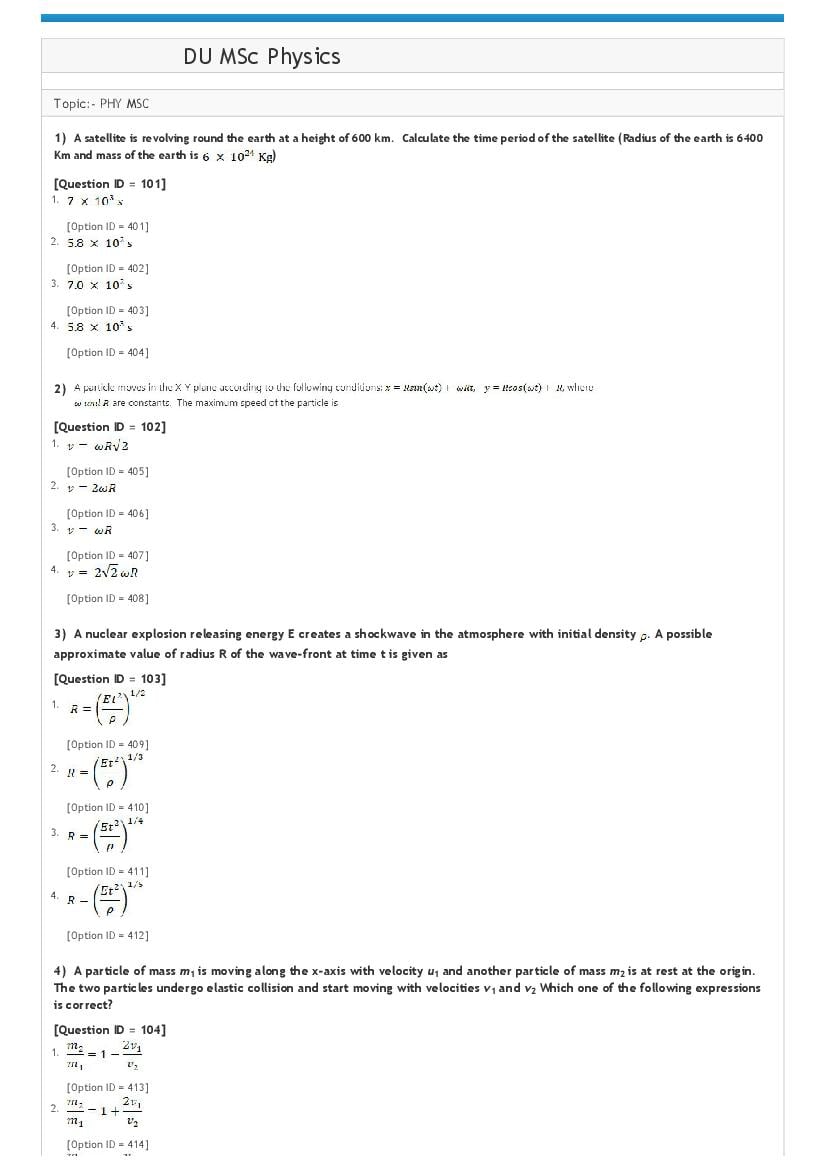
1) A satellite is revolving round the earth at a height of 600 km. Calculate the time period of the satellite (Radius of the earth is 6400
Km and mass of the earth is )
[Question ID = 101]
1.
[Option ID = 401]
2.
[Option ID = 402]
3.
[Option ID = 403]
4.
[Option ID = 404]
2)
[Question ID = 102]
1.
[Option ID = 405]
2.
[Option ID = 406]
3.
[Option ID = 407]
4.
[Option ID = 408]
3) A nuclear explosion releasing energy E creates a shockwave in the atmosphere with initial density . A possible
approximate value of radius R of the wave‐front at time t is given as
[Question ID = 103]
1.
[Option ID = 409]
2.
[Option ID = 410]
3.
[Option ID = 411]
4.
[Option ID = 412]
4) A particle of mass m1 is moving along the x‐axis with velocity u1 and another particle of mass m2 is at rest at the origin.
The two particles undergo elastic collision and start moving with velocities v1 and v2 Which one of the following expressions
is correct?
[Question ID = 104]
1.
[Option ID = 413]
2.
[Option ID = 414]
Page 2
[Option ID = 415]
4.
[Option ID = 416]
5) A particle of mass m is moving along a circle of radius ro in a horizontal plane with speed vo as it is connected to the
center of the circle through an inextensible string. The other end of the string is being pulled down through a vertical tube
at a slow rate resulting in the gradual reduction in the radius of the circular orbit of the particle from its initial value ro . The
work done by the pulling force in reducing the radius from ro to r is
[Question ID = 105]
1.
[Option ID = 417]
2.
[Option ID = 418]
3.
[Option ID = 419]
4.
[Option ID = 420]
6)
[Question ID = 106]
1.
[Option ID = 421]
2.
[Option ID = 422]
3.
[Option ID = 423]
4.
[Option ID = 424]
7) Complex conjugate of the derivative operator is
[Question ID = 107]
1.
[Option ID = 425]
2.
[Option ID = 426]
3.
[Option ID = 427]
4.
[Option ID = 428]
8)
Page 3
1. has a finite discontinuity
[Option ID = 429]
2. is continuous but not differentiable
[Option ID = 430]
3. is differentiable
[Option ID = 431]
4. has infinite discontinuity
[Option ID = 432]
9)
[Question ID = 109]
1.
[Option ID = 433]
2.
[Option ID = 434]
3.
[Option ID = 435]
4.
[Option ID = 436]
10) A beam of monochromatic light of frequency ν, intensity I and linearly polarized in the vertical plane consists
of n photons per unit time. It is passed through a polarizer whose pass angle is 45° to the vertical. The emerging light has
[Question ID = 110]
1. (n/2) photons of frequency ν and polarized along the vertical plane
[Option ID = 437]
2. n photons of frequency ( ν/2) and polarized along the vertical plane
[Option ID = 438]
3. (n/2) photons of frequency ν and polarized along the plane 45° to the vertical.
[Option ID = 439]
4. n photons of frequency ν and polarized along the plane 45° to the vertical.
[Option ID = 440]
11) The decimal equivalent of the binary number 10111.0110 is given by
[Question ID = 111]
1. (23.1875)10
[Option ID = 441]
2. (23.375)10
[Option ID = 442]
3. (46.375)10
[Option ID = 443]
4. (46.1875)10
[Option ID = 444]
12) In a npn transistor, 90% of the emitted electrons reach the collector. If the collector current is 18 mA, the base
current (in mA) will be
[Question ID = 112]
1. 1.62
[Option ID = 445]
2. 1.8
[Option ID = 446]
3. 2.0
[Option ID = 447]
4. 2.5
[Option ID = 448]
13)
Page 4
1.
[Option ID = 449]
2.
[Option ID = 450]
3.
[Option ID = 451]
4.
[Option ID = 452]
14) In an amplitude modulated wave with maximum peak‐to‐peak voltage of 20 mV and minimum peak‐to‐peak voltage of
4 mV, the percentage modulation is
[Question ID = 114]
1. 66.7%
[Option ID = 453]
2. 50%
[Option ID = 454]
3. 15%
[Option ID = 455]
4. 77%
[Option ID = 456]
15) For an applied forward bias of 0.2 V in a germanium diode with reverse saturation current Io = 1µA, the static and
dynamic resistance at 27 °C, respectively is
[Question ID = 115]
1. 88 Ω and 11.4 Ω
[Option ID = 457]
2. 114 Ω and 88 Ω
[Option ID = 458]
3. 8.8 kΩ and 1.14 kΩ
[Option ID = 459]
4. 8.8 Ω and 1.14 Ω
[Option ID = 460]
16)
[Question ID = 116]
1. 6
[Option ID = 461]
2. 3
[Option ID = 462]
3. 4
[Option ID = 463]
4. 8
[Option ID = 464]
Page 5
[Question ID = 117]
1.
[Option ID = 465]
2.
[Option ID = 466]
3.
[Option ID = 467]
4.
[Option ID = 468]
18)
[Question ID = 118]
1.
[Option ID = 469]
2.
[Option ID = 470]
3.
[Option ID = 471]
4.
[Option ID = 472]
19)
Evaluate the Integral
[Question ID = 119]
1.
[Option ID = 473]
2.
[Option ID = 474]
3.
[Option ID = 475]
4.
[Option ID = 476]
20)
[Question ID = 120]
1.
[Option ID = 477]
2.
[Option ID = 478]
3.
[Option ID = 479]
4.
[Option ID = 480]
Page 6
[Question ID = 121]
1.
[Option ID = 481]
2.
[Option ID = 482]
3.
[Option ID = 483]
4.
[Option ID = 484]
22)
[Question ID = 122]
1. 1
[Option ID = 485]
2. 2
[Option ID = 486]
3. 3
[Option ID = 487]
4. 4
[Option ID = 488]
23)
[Question ID = 123]
1.
[Option ID = 489]
2.
[Option ID = 490]
3.
[Option ID = 491]
4.
[Option ID = 492]
24) Consider a sphere carrying an electric polarization , where r denotes the radial distance from the center.
The electric field inside the sphere is
[Question ID = 124]
1.
[Option ID = 493]
2.
[Option ID = 494]
3.
[Option ID = 495]
4.
[Option ID = 496]
25) Let the electric field due to a spherical distribution of charge be given by, Where and
Page 7
be minimum
[Question ID = 125]
1.
[Option ID = 497]
2.
[Option ID = 498]
3.
[Option ID = 499]
4.
[Option ID = 500]
26) A finite conductor is made up of a metal of permittivity . For a uniform conductivity , the volume charge density would evolve
with time as
[Question ID = 126]
1.
[Option ID = 501]
2.
[Option ID = 502]
3.
[Option ID = 503]
4.
[Option ID = 504]
27)
[Question ID = 127]
1.
[Option ID = 505]
2.
[Option ID = 506]
3.
[Option ID = 507]
4.
[Option ID = 508]
28) An ionic solid is in thermal equilibrium at temperature T. In order to maintain the charge neutrality, vacancy defects
are created in pairs (+ and ‐ ions). N is the number of molecules (each containing a pair of oppositely charged ions) per unit
volume and n is the number of vacancies per unit volume. Which statement is true about the plot of as a function of
T.
[Question ID = 128]
1. It is a straight line.
[Option ID = 509]
2. It is a hyperbolic curve
[Option ID = 510]
3. It is a logarithmic curve.
[Option ID = 511]
4. It is an exponential curve
[Option ID = 512]
Page 8
ohm and the surface density of electrons is 1021 /m2 . Following Drude’s theory for the collisions of electrons in the metal, the mean
free path of an electron would be close to [Given, J/K , , and ]
[Question ID = 129]
1. 95 Å
[Option ID = 513]
2. 9.5 Å
[Option ID = 514]
3. 950 Å
[Option ID = 515]
4. 0.95 Å
[Option ID = 516]
30) For a doped semiconductor, represent the hole and electron mobilities respectively. If ni represents the
intrinsic carrier density,then at a given temperature the required electron concentration at which the resistivity becomes
maximum is given by,
[Question ID = 130]
1.
[Option ID = 517]
2.
[Option ID = 518]
3.
[Option ID = 519]
4.
[Option ID = 520]
31) What will be the proton separation energy of 197Au. (Given mass of 197Au= 196.966552 amu, mass of 196Pt = 195.9649
amu)
[Question ID = 131]
1. 4.22 MeV
[Option ID = 521]
2. 5.44 MeV
[Option ID = 522]
3. 3.66 MeV
[Option ID = 523]
4. 7.28 MeV
[Option ID = 524]
32) What will be the Q‐value (energy release) when a Λ particle decays to a proton and a pion (Λ ‐> pπ‐) (rest mass of Λ =
1115.6 MeV/c2). [Take rest mass = 139.6 MeV/c2].
[Question ID = 132]
1. 32.5 MeV
[Option ID = 525]
2. 37.7 MeV
[Option ID = 526]
3. 39.8 MeV
[Option ID = 527]
4. 42.5 MeV
[Option ID = 528]
33) Any nucleus emitting an alpha particle followed by two beta negative decays is
[Question ID = 133]
1. an isotope of the original one.
[Option ID = 529]
2. an isotone of the original one.
[Option ID = 530]
Page 9
[Option ID = 531]
4. an isomer of the original one.
[Option ID = 532]
34) The strong nuclear force between the nucleons present inside the nucleus is[Question ID = 134]
1. charge dependent. [Option ID = 533]
2. spin dependent. [Option ID = 534]
3. both charge and spin dependent. [Option ID = 535]
4. spin dependent but charge independent. [Option ID = 536]
35) A scalar meson decays into three pseudo scalar mesons. The decay happens through
[Question ID = 135]
1. weak interaction
[Option ID = 537]
2. strong interaction
[Option ID = 538]
3. electromagnetic interaction
[Option ID = 539]
4. gravitational interaction
[Option ID = 540]
36) Which of the following statements about the reaction is wrong?
[Question ID = 136]
1. Baryon number is conserved.
[Option ID = 541]
2. Electric charge is conserved.
[Option ID = 542]
3. The reaction is allowed only if the incident protons have energy greater than a particular threshold.
[Option ID = 543]
4. The reaction is not allowed because the conservation of (rest) mass is violated.
[Option ID = 544]
37)
[Question ID = 137]
1.
[Option ID = 545]
2.
[Option ID = 546]
3.
[Option ID = 547]
4.
[Option ID = 548]
38)
[Question ID = 138]
1. 628 nm
[Option ID = 549]
2. 2500 nm
[Option ID = 550]
3. 5000 nm
[Option ID = 551]
4. 6280 nm
Page 10
39) Two points seen as white dots are 1 mm apart on a black paper. They are viewed by an eye of pupil having a diameter
of 3.0 mm. The maximum distance at which these dots can be resolved by the eye is:
(Take wavelength of light = 500 nm)
[Question ID = 139]
1. 5 m
[Option ID = 553]
2. 1 m
[Option ID = 554]
3. 6 m
[Option ID = 555]
4. 3 m
[Option ID = 556]
40) A parallel beam of light of wavelength falls on a uniformly thick soap film making an angle of 30o with the
normal to the surface of the film. If constructive second order interference pattern is observed with the refelected light,
then the thickness of the soap film is
[Question ID = 140]
1. 0.426 nm
[Option ID = 557]
2. 0.5 nm
[Option ID = 558]
3. 4.26 nm
[Option ID = 559]
4. 0.0426 nm
[Option ID = 560]
41) The isothermal compressibility and expansivity of a substance are respectively given by (βT = aT2/P2) and (α = bT/P),
where ‘a’ and ‘b’ are constants, T and P and temperature and pressure respectively. The equation of state for the system
under consideration is
[Question ID = 141]
1.
[Option ID = 561]
2.
[Option ID = 562]
3.
[Option ID = 563]
4.
[Option ID = 564]
42) A thermally insulated container contains n moles of gas molecules having gas constant R molar mass M and ratio of
specific heats if the temperature inside the container suddenly increases by ΔT , the velocity of the gas
molecules would be
[Question ID = 142]
1.
[Option ID = 565]
2.
[Option ID = 566]
3.
[Option ID = 567]
4. unchanged
[Option ID = 568]
43) A Carnot engine operates at an efficiency of 60%. If the sink temperature is 100 °C, the source temperature is closest
Page 11
1. 165 °C [Option ID = 569]
2. 250 °C [Option ID = 570]
3. 660 °C [Option ID = 571]
4. 930 °C [Option ID = 572]
44) A collection of 3 dimensional isotropic simple harmonic oscillators is in equilibrium with a heat bath of temperature. The
number of oscillators in the first excited state to that in ground state is
[Question ID = 144]
1.
[Option ID = 573]
2.
[Option ID = 574]
3.
[Option ID = 575]
4.
[Option ID = 576]
45) Suppose that the potential energy of an hypothetical atom consisting of a proton and electron is given by . Then if
Bohr’s postulates are applied to this atom, then the radius of the orbit will be proportional to
[Question ID = 145]
1.
[Option ID = 577]
2.
[Option ID = 578]
3.
[Option ID = 579]
4.
[Option ID = 580]
46) A moving hydrogen atom makes a head on collision with a stationary hydrogen atom. Before collision both the atoms are
in ground state and after collision they stick and move together. What is the minimum value of the kinetic energy of the
moving hydrogen atom, such that one of the atoms reaches one of the excited states?[Question ID = 146]
1. 10.2 eV [Option ID = 581]
2. 12.08 eV [Option ID = 582]
3. 20.4 eV [Option ID = 583]
4. 5.1 eV [Option ID = 584]
47)
[Question ID = 147]
1.
[Option ID = 585]
2.
[Option ID = 586]
3.
[Option ID = 587]
4.
[Option ID = 588]
48)
[Question ID = 148]
1. 18
[Option ID = 589]
2. 16
Page 12
3. 8
[Option ID = 591]
4. 24
[Option ID = 592]
49) Which of the following is an acceptable spin orbital for a two electron system? (“α” and “β” represent spin‐up and
spin‐down states respectively and labels “1” and “2” represent the two electrons)
[Question ID = 149]
1.
[Option ID = 593]
2.
[Option ID = 594]
3.
[Option ID = 595]
4.
[Option ID = 596]
50) A photon of initial wavelength 0.4 Å suffers two successive collisions with two electrons. The deflection in the first
collision is 90° and the deflection in the second collision is 60°. The final wavelength of the photon is:
[Question ID = 150]
1. 0.024 Å
[Option ID = 597]
2. 0.012 Å
[Option ID = 598]
3. 0.4 Å
[Option ID = 599]
4. 0.436 Å
[Option ID = 600]
Document Details
| Board / Org | NTA |
| Exam | DUET |
| Type | Question Paper |
| Pages | 12 |
| Language | english |
| Updated | 30 Apr 2026 |