DUET 2021 Question Paper M.Sc Plant Molecular Biology and Biotech
Finished viewing? Save it for later —
Download DUET 2021 Question Paper M.Sc Plant Molecular Biology and Biotech (PDF · 10 pages)About DUET 2021 Question Paper M.Sc Plant Molecular Biology and Biotech
DUET 2021 Question Paper M.Sc Plant Molecular Biology and Biotech is available here for free download. Published by NTA for DUET, this question paper can be viewed online or downloaded as a PDF (10 pages). Candidates preparing for DUET can use DUET 2021 Question Paper M.Sc Plant Molecular Biology and Biotech to understand the exam pattern, the type of questions asked, and the overall difficulty level.
Frequently Asked Questions
How can I download DUET 2021 Question Paper M.Sc Plant Molecular Biology and Biotech?
Open this page and click the Download button to save DUET 2021 Question Paper M.Sc Plant Molecular Biology and Biotech as a PDF. It is completely free on AglaSem Docs.
Is DUET 2021 Question Paper M.Sc Plant Molecular Biology and Biotech free to download?
Yes. DUET 2021 Question Paper M.Sc Plant Molecular Biology and Biotech can be viewed online and downloaded as a PDF free of cost on AglaSem Docs.
How many pages does DUET 2021 Question Paper M.Sc Plant Molecular Biology and Biotech have?
DUET 2021 Question Paper M.Sc Plant Molecular Biology and Biotech contains 10 pages, which you can read online or download together as a single PDF.
Where can I find more DUET study material?
You can find more DUET question papers, sample papers, syllabus, and answer keys on AglaSem Docs.
DUET 2021 Question Paper M.Sc Plant Molecular Biology and Biotech – Text
Read the full text of this question paper below — useful to quickly search, copy and reference the content online without downloading the PDF.
📄 View text version (10 pages)
Page 1
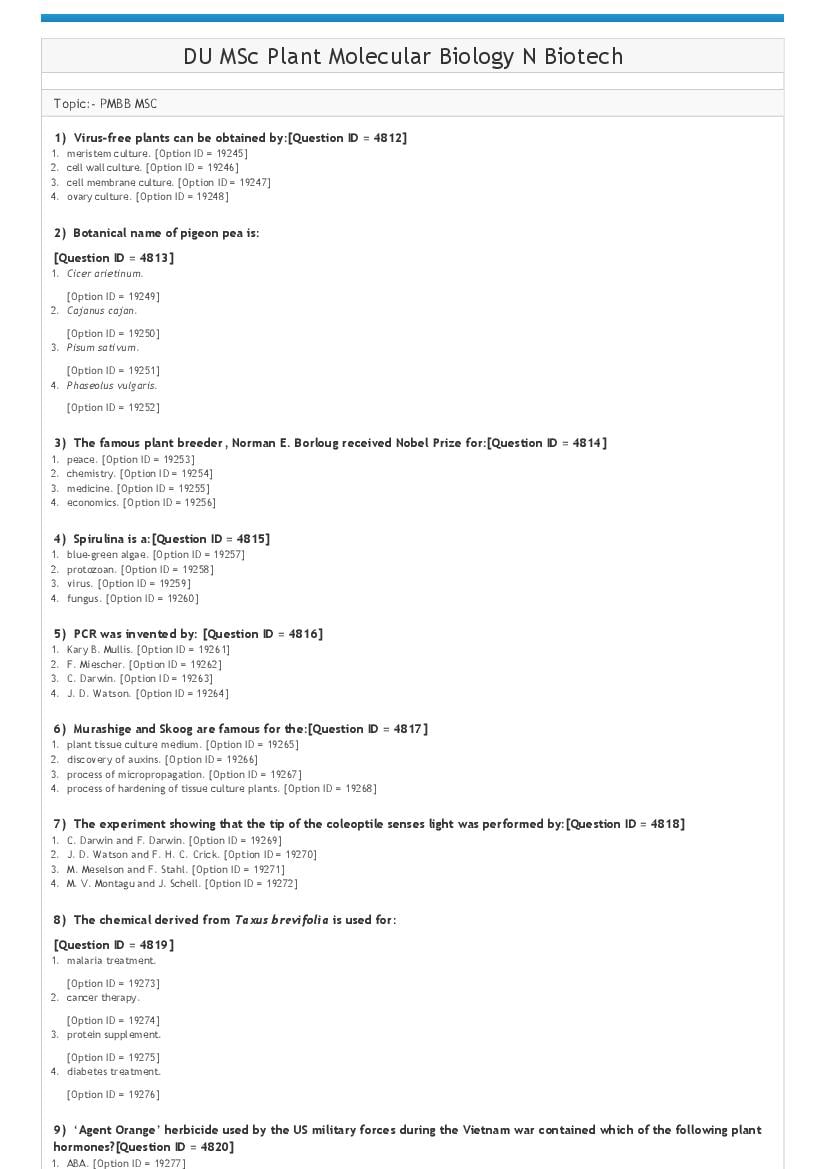
Topic:‐ PMBB MSC
1) Virus‐free plants can be obtained by:[Question ID = 4812]
1. meristem culture. [Option ID = 19245]
2. cell wall culture. [Option ID = 19246]
3. cell membrane culture. [Option ID = 19247]
4. ovary culture. [Option ID = 19248]
2) Botanical name of pigeon pea is:
[Question ID = 4813]
1. Cicer arietinum.
[Option ID = 19249]
2. Cajanus cajan.
[Option ID = 19250]
3. Pisum sativum.
[Option ID = 19251]
4. Phaseolus vulgaris.
[Option ID = 19252]
3) The famous plant breeder, Norman E. Borloug received Nobel Prize for:[Question ID = 4814]
1. peace. [Option ID = 19253]
2. chemistry. [Option ID = 19254]
3. medicine. [Option ID = 19255]
4. economics. [Option ID = 19256]
4) Spirulina is a:[Question ID = 4815]
1. blue‐green algae. [Option ID = 19257]
2. protozoan. [Option ID = 19258]
3. virus. [Option ID = 19259]
4. fungus. [Option ID = 19260]
5) PCR was invented by: [Question ID = 4816]
1. Kary B. Mullis. [Option ID = 19261]
2. F. Miescher. [Option ID = 19262]
3. C. Darwin. [Option ID = 19263]
4. J. D. Watson. [Option ID = 19264]
6) Murashige and Skoog are famous for the:[Question ID = 4817]
1. plant tissue culture medium. [Option ID = 19265]
2. discovery of auxins. [Option ID = 19266]
3. process of micropropagation. [Option ID = 19267]
4. process of hardening of tissue culture plants. [Option ID = 19268]
7) The experiment showing that the tip of the coleoptile senses light was performed by:[Question ID = 4818]
1. C. Darwin and F. Darwin. [Option ID = 19269]
2. J. D. Watson and F. H. C. Crick. [Option ID = 19270]
3. M. Meselson and F. Stahl. [Option ID = 19271]
4. M. V. Montagu and J. Schell. [Option ID = 19272]
8) The chemical derived from Taxus brevifolia is used for:
[Question ID = 4819]
1. malaria treatment.
[Option ID = 19273]
2. cancer therapy.
[Option ID = 19274]
3. protein supplement.
[Option ID = 19275]
4. diabetes treatment.
[Option ID = 19276]
9) ‘Agent Orange’ herbicide used by the US military forces during the Vietnam war contained which of the following plant
hormones?[Question ID = 4820]
1. ABA. [Option ID = 19277]
Page 2
3. Auxin. [Option ID = 19279]
4. Gibberellins. [Option ID = 19280]
10) ‘Gram staining’ in bacteria primarily stains:[Question ID = 4821]
1. ribosomes. [Option ID = 19281]
2. cell lipids. [Option ID = 19282]
3. cell wall. [Option ID = 19283]
4. cell nucleus. [Option ID = 19284]
11) An example of a scorable marker in plants is:[Question ID = 4822]
1. Gus. [Option ID = 19285]
2. NptII. [Option ID = 19286]
3. Hpt. [Option ID = 19287]
4. CAT. [Option ID = 19288]
12) Isozyme analysis can be performed with which of the following polyacrylamide gel types?[Question ID = 4823]
1. SDS‐gel. [Option ID = 19289]
2. Urea‐isoelectric focusing gel. [Option ID = 19290]
3. Non‐denaturing gel. [Option ID = 19291]
4. SDS‐gradient gel. [Option ID = 19292]
13) One gram of which of the following molecule can produce maximum amount of ATP upon complete oxidation?[Question
ID = 4824]
1. Glucose. [Option ID = 19293]
2. Starch. [Option ID = 19294]
3. Phospholipids. [Option ID = 19295]
4. Triglycerides. [Option ID = 19296]
14) S‐adenosyl methionine is the precursor for biosynthesis of:[Question ID = 4825]
1. lycopene. [Option ID = 19297]
2. phosphatidylcholine. [Option ID = 19298]
3. carotene. [Option ID = 19299]
4. putrescine. [Option ID = 19300]
15) Which of the following is not a reducing sugar?[Question ID = 4826]
1. Glucose. [Option ID = 19301]
2. Maltose. [Option ID = 19302]
3. Lactose. [Option ID = 19303]
4. Sucrose. [Option ID = 19304]
16) Why are polysaccharides better suited to store energy in cells as compared to monosaccharides?[Question ID = 4827]
1. Monosaccharides are toxic. [Option ID = 19305]
2. Monosaccharides would create excessive osmotic pressure. [Option ID = 19306]
3. Polysaccharides require less energy for their synthesis. [Option ID = 19307]
4. Monosaccharides are very unstable. [Option ID = 19308]
17) Which of the following is an amino derivative of a hexose sugar?[Question ID = 4828]
1. Uric acid. [Option ID = 19309]
2. Gluconic acid. [Option ID = 19310]
3. Urea. [Option ID = 19311]
4. Sialic acid. [Option ID = 19312]
18) The main site of synthesis of cross‐linking glycans and pectins of plant cell wall is:[Question ID = 4829]
1. cell wall. [Option ID = 19313]
2. Golgi apparatus. [Option ID = 19314]
3. chloroplast. [Option ID = 19315]
4. cytosol. [Option ID = 19316]
19) Which enzyme is the prime target of the commercially important herbicide glyphosate?[Question ID = 4830]
1. Shikimate dehydrogenase. [Option ID = 19317]
2. Shikimate kinase. [Option ID = 19318]
3. Enolpyruvylshikimate‐3‐phosphate (EPSP) synthase. [Option ID = 19319]
4. Chorismate synthase. [Option ID = 19320]
20) The biosynthesis of aromatic amino acids in plants primarily takes place in:[Question ID = 4831]
1. mitochondria. [Option ID = 19321]
2. Golgi complex. [Option ID = 19322]
3. plastid. [Option ID = 19323]
4. cytosol. [Option ID = 19324]
21) Which of the following amino acids is the precursor for polyamine biosynthesis in plants?[Question ID = 4832]
1. Lysine. [Option ID = 19325]
Page 3
3. Arginine. [Option ID = 19327]
4. Threonine. [Option ID = 19328]
22) Fatty acid biosynthesis in plants takes place in:[Question ID = 4833]
1. chloroplasts. [Option ID = 19329]
2. mitochondria. [Option ID = 19330]
3. peroxisomes. [Option ID = 19331]
4. cytosol. [Option ID = 19332]
23) Quantum yield efficiency of 1.0 during photochemical reactions of photosynthesis indicates that:[Question ID = 4834]
1. the efficiency of photochemistry is 10%. [Option ID = 19333]
2. every absorbed photon is converted into chemical product. [Option ID = 19334]
3. 1% photons are converted to a chemical product. [Option ID = 19335]
4. there is a total inhibition of photosynthesis. [Option ID = 19336]
24) Cyclic photophosphorylation produces only:[Question ID = 4835]
1. ATP and NADPH. [Option ID = 19337]
2. oxygen and ATP. [Option ID = 19338]
3. oxygen, ATP and NADPH. [Option ID = 19339]
4. ATP. [Option ID = 19340]
25) QTL represents:[Question ID = 4836]
1. Quantitative test locus. [Option ID = 19341]
2. Quantitative trait locus. [Option ID = 19342]
3. Quantitative trade locus. [Option ID = 19343]
4. Quality trait locus. [Option ID = 19344]
26) ENCODE expands to:[Question ID = 4837]
1. Encyclopedia of DNA Elements. [Option ID = 19345]
2. Entire Compendium of DNA Elements. [Option ID = 19346]
3. Encyclopedia of Disease Estimates. [Option ID = 19347]
4. Encyclopedia of Disaster Estimates. [Option ID = 19348]
27) tRNA is synthesized by:[Question ID = 4838]
1. RNA polymerase I. [Option ID = 19349]
2. RNA polymerase II. [Option ID = 19350]
3. RNA polymerase III. [Option ID = 19351]
4. RNA polymerase IV. [Option ID = 19352]
28) Introns (non‐coding part) are removed at the level of:[Question ID = 4839]
1. DNA. [Option ID = 19353]
2. DNA and RNA. [Option ID = 19354]
3. RNA. [Option ID = 19355]
4. protein. [Option ID = 19356]
29) Which of the following scientists was awarded the Nobel Prize for DNA sequencing?[Question ID = 4840]
1. P. Berg. [Option ID = 19357]
2. B. McClintock. [Option ID = 19358]
3. W. Arber. [Option ID = 19359]
4. W. Gilbert. [Option ID = 19360]
30) Activation tagging involves:[Question ID = 4841]
1. tagging of active genes. [Option ID = 19361]
2. tagging a gene by its activation. [Option ID = 19362]
3. actively tagging of a gene. [Option ID = 19363]
4. identification of an active gene. [Option ID = 19364]
31) A nonsense mutation involves:[Question ID = 4842]
1. a regulatory sequence. [Option ID = 19365]
2. an AG splice acceptor site. [Option ID = 19366]
3. creation of a different amino acid. [Option ID = 19367]
4. creation of a stop codon. [Option ID = 19368]
32) Mobilization of retrotransposons involves:[Question ID = 4843]
1. only RNA form. [Option ID = 19369]
2. both RNA and DNA form. [Option ID = 19370]
3. only DNA form. [Option ID = 19371]
4. infective form. [Option ID = 19372]
33) Small nucleolar RNAs are involved in:[Question ID = 4844]
1. rRNA processing. [Option ID = 19373]
2. small RNA processing. [Option ID = 19374]
Page 4
4. mRNA processing. [Option ID = 19376]
34) Nucleosome is made of:[Question ID = 4845]
1. histones. [Option ID = 19377]
2. histones and DNA. [Option ID = 19378]
3. DNA. [Option ID = 19379]
4. histones and RNA. [Option ID = 19380]
35) A plant cell contains DNA in:[Question ID = 4846]
1. one organelle. [Option ID = 19381]
2. two organelles. [Option ID = 19382]
3. three organelles. [Option ID = 19383]
4. four organelles. [Option ID = 19384]
36) What is the maximum resolving power of a light microscope?[Question ID = 4847]
1. 350 nm. [Option ID = 19385]
2. 300 nm. [Option ID = 19386]
3. 250 nm. [Option ID = 19387]
4. 200 nm. [Option ID = 19388]
37) Which of the following microscopy is used for live cell imaging? [Question ID = 4848]
1. Transmission electron microscopy. [Option ID = 19389]
2. Freeze‐fracture microscopy. [Option ID = 19390]
3. Phase contrast microscopy. [Option ID = 19391]
4. Deep‐etch microscopy. [Option ID = 19392]
38) High magnification of electron microscope is due to:[Question ID = 4849]
1. high voltage. [Option ID = 19393]
2. vacuum. [Option ID = 19394]
3. electromagnetic lenses. [Option ID = 19395]
4. electron beam. [Option ID = 19396]
39) Which of the following organelles exhibits highest succinate dehydrogenase activity?[Question ID = 4850]
1. Nuclei. [Option ID = 19397]
2. Lysosomes. [Option ID = 19398]
3. Peroxisomes. [Option ID = 19399]
4. Mitochondria. [Option ID = 19400]
40) In plants, the process of photorespiration takes place in the following cellular organelles:[Question ID = 4851]
1. Mitochondria, Golgi apparatus and lysosome. [Option ID = 19401]
2. Mitochondria, chloroplast and peroxisome. [Option ID = 19402]
3. Mitochondria, chloroplast and Golgi apparatus. [Option ID = 19403]
4. Mitochondria, endoplasmic reticulum and peroxisome. [Option ID = 19404]
41) What is the primary role of ‘cdc’ proteins in the cell?[Question ID = 4852]
1. Cellular transport. [Option ID = 19405]
2. Cellular respiration. [Option ID = 19406]
3. Cell division. [Option ID = 19407]
4. Cell motility. [Option ID = 19408]
42) Which one of these is a true statement?[Question ID = 4853]
1. Plant vacuoles have their own genetic machinery. [Option ID = 19409]
2. Plant vacuoles are also considered as versatile lysosome. [Option ID = 19410]
3. Plant vacuoles are involved in respiration. [Option ID = 19411]
4. Plant vacuoles are involved in biosynthesis of lipids [Option ID = 19412]
43) Tonoplast is the membrane of which organelle?[Question ID = 4854]
1. Chloroplast. [Option ID = 19413]
2. Vacuole. [Option ID = 19414]
3. Peroxisome. [Option ID = 19415]
4. Golgi apparatus. [Option ID = 19416]
44) Middle lamella is made up of pectin. Pectin is chemically:[Question ID = 4855]
1. N‐acetylglucosamine and N‐acetylmuramic acid. [Option ID = 19417]
2. heteropolymer of xylose, mannose and arabinose. [Option ID = 19418]
3. Glucuronic and galacturonic acid. [Option ID = 19419]
4. polymer of D‐glucose units. [Option ID = 19420]
45) Which organelle is NOT involved in vesicular transport in the eukaryotic cell?[Question ID = 4856]
1. Golgi apparatus. [Option ID = 19421]
2. Endoplasmic reticulum. [Option ID = 19422]
3. Lysosome. [Option ID = 19423]
Page 5
46) X‐ray crystallographic analysis of DNA was performed for the first time by:[Question ID = 4857]
1. Rosalind E. Franklin. [Option ID = 19425]
2. James D. Watson. [Option ID = 19426]
3. Erwin Chargaff. [Option ID = 19427]
4. John C. Kendrew. [Option ID = 19428]
47) The method which played a crucial role in deciphering the genetic code was:[Question ID = 4858]
1. DNA sequencing. [Option ID = 19429]
2. cDNA synthesis of differentially expressed transcripts. [Option ID = 19430]
3. filter‐binding assay using radioactive amino acids. [Option ID = 19431]
4. proflavin‐induced frameshift mutations in bacteriophages. [Option ID = 19432]
48) ‘Hfr’ strain in bacteria is one in which:[Question ID = 4859]
1. there are multiple copies of F plasmid. [Option ID = 19433]
2. the chromosome has suffered a deletion. [Option ID = 19434]
3. the transfer of F plasmid is very rapid. [Option ID = 19435]
4. the F plasmid is integrated in the chromosome. [Option ID = 19436]
49) Which of the following statements is true for bacterial promoters?[Question ID = 4860]
1. ‐10 region is always located 10 bp downstream of the transcription start site. [Option ID = 19437]
2. ‐10 region shows more conservation than the ‐35 region. [Option ID = 19438]
3. ‐35 region is more conserved than ‐10 region. [Option ID = 19439]
4. ‐35 region is AT‐rich. [Option ID = 19440]
50) When E. coli is grown in a mixture of glucose and lactose, it catabolizes:
[Question ID = 4861]
1. glucose and lactose together.
[Option ID = 19441]
2. first glucose, till it is exhausted, then lactose.
[Option ID = 19442]
3. first lactose, till it is exhausted, then glucose.
[Option ID = 19443]
4. alternately glucose and lactose.
[Option ID = 19444]
51) Transfer DNA from a Ti plasmid is maintained in a transgenic plant as:[Question ID = 4862]
1. an independent linear replicon. [Option ID = 19445]
2. an independent circular replicon. [Option ID = 19446]
3. integrated DNA in chromosome. [Option ID = 19447]
4. multiple autonomously replicating copies of introduced DNA. [Option ID = 19448]
52) Lederberg and Tatum’s experiment demonstrating the exchange of genetic material in bacteria used:[Question ID =
4863]
1. auxotrophic mutants. [Option ID = 19449]
2. antibiotic resistance markers. [Option ID = 19450]
3. bacteriophages. [Option ID = 19451]
4. chromosomal duplications. [Option ID = 19452]
53) “Golden rice” is the name of a genetically engineered rice containing genes derived from:[Question ID = 4864]
1. papaya. [Option ID = 19453]
2. marigold. [Option ID = 19454]
3. turmeric. [Option ID = 19455]
4. daffodil. [Option ID = 19456]
54) Phytoalexins are:[Question ID = 4865]
1. plant secondary metabolites which show a diurnal cycle of accumulation. [Option ID = 19457]
2. compounds produced by plants in response to pathogen attack. [Option ID = 19458]
3. volatile compounds found in garlic. [Option ID = 19459]
4. compounds secreted by roots during nodulation. [Option ID = 19460]
55) Which of the following has iron as part of its structure[Question ID = 4866]
1. Chlorophyll. [Option ID = 19461]
2. Phaeophytin. [Option ID = 19462]
3. Cytochrome. [Option ID = 19463]
4. Phytochrome. [Option ID = 19464]
56) Telomerase complex involves the following:[Question ID = 4867]
1. DNA polymerase and template RNA. [Option ID = 19465]
2. Topoisomerase and primer RNA. [Option ID = 19466]
Page 6
4. Reverse transcription and primer RNA. [Option ID = 19468]
57) In bacteriophage lambda, the repressor protein acts to promote:[Question ID = 4868]
1. lysogeny. [Option ID = 19469]
2. lysis. [Option ID = 19470]
3. transcription. [Option ID = 19471]
4. excision. [Option ID = 19472]
58) Ethyl methanesulfonate causes mutations by:[Question ID = 4869]
1. alkylation of bases of DNA. [Option ID = 19473]
2. acetylation of bases of DNA. [Option ID = 19474]
3. intercalation between bases of DNA. [Option ID = 19475]
4. causing double‐stranded breaks in DNA. [Option ID = 19476]
59) Which of the following antibiotics results in translation termination?[Question ID = 4870]
1. Alpha‐amanitin. [Option ID = 19477]
2. Ampicillin. [Option ID = 19478]
3. Puromycin. [Option ID = 19479]
4. Streptomycin. [Option ID = 19480]
60) The ploidy level of endosperm is:[Question ID = 4871]
1. n. [Option ID = 19481]
2. 2n. [Option ID = 19482]
3. 3n. [Option ID = 19483]
4. 4n. [Option ID = 19484]
61) Scutellum in the cereal grains represents the:[Question ID = 4872]
1. coleoptile. [Option ID = 19485]
2. coleorrhiza. [Option ID = 19486]
3. cotyledon. [Option ID = 19487]
4. prophyll. [Option ID = 19488]
62) The aleurone layer is the source of:[Question ID = 4873]
1. starch. [Option ID = 19489]
2. lipids. [Option ID = 19490]
3. auxins. [Option ID = 19491]
4. vitamins. [Option ID = 19492]
63) The principal nitrogen‐fixing algae in paddy fields is:
[Question ID = 4874]
1. Spirogyra spp.
[Option ID = 19493]
2. Vaucheria spp.
[Option ID = 19494]
3. Ulothrix spp.
[Option ID = 19495]
4. Oscillatoria spp.
[Option ID = 19496]
64) Who is credited with advancing the science of paleobotany in India?[Question ID = 4875]
1. M. S. Swaminathan. [Option ID = 19497]
2. Birbal Sahni. [Option ID = 19498]
3. P. Maheshwari. [Option ID = 19499]
4. J. K. Maheshwari. [Option ID = 19500]
65) 'Eyes' on potato tubers represent:[Question ID = 4876]
1. rootlets. [Option ID = 19501]
2. nodes with buds. [Option ID = 19502]
3. scars. [Option ID = 19503]
4. sutures. [Option ID = 19504]
66) Root cap is not found in:[Question ID = 4877]
1. mesophytes. [Option ID = 19505]
2. hydrophytes. [Option ID = 19506]
3. xerophytes. [Option ID = 19507]
4. halophytes. [Option ID = 19508]
67) In certain parts of India, muscular dystrophy‐like symptoms are commonly found in people who consume seeds of:
[Question ID = 4878]
Page 7
[Option ID = 19509]
2. Lathyrus sativus.
[Option ID = 19510]
3. Cicer arietinum.
[Option ID = 19511]
4. Phaseolus mungo.
[Option ID = 19512]
68) ‘Chilgoza’ is an edible product obtained from:
[Question ID = 4879]
1. Pinus roxburghii.
[Option ID = 19513]
2. Pinus gerardiana.
[Option ID = 19514]
3. Pinus monophyla.
[Option ID = 19515]
4. Pinus sylvestris.
[Option ID = 19516]
69) ‘Casparian strips’ are found in:[Question ID = 4880]
1. periderm. [Option ID = 19517]
2. epidermis. [Option ID = 19518]
3. endodermis. [Option ID = 19519]
4. hypodermis. [Option ID = 19520]
70) The bread wheat, Triticum aestivum, that is commonly used all over the world is a:
[Question ID = 4881]
1. diploid.
[Option ID = 19521]
2. triploid.
[Option ID = 19522]
3. tetraploid.
[Option ID = 19523]
4. hexaploid.
[Option ID = 19524]
71) The phenomenon of reversion of mature cells to the meristematic state leading to the formation of callus is known as:
[Question ID = 4882]
1. growth. [Option ID = 19525]
2. commitment. [Option ID = 19526]
3. differentiation. [Option ID = 19527]
4. dedifferentiation. [Option ID = 19528]
72) To obtain intergeneric hybrids, which of the following is practised?[Question ID = 4883]
1. Embryo culture. [Option ID = 19529]
2. Haploid culture. [Option ID = 19530]
3. Protoplast culture. [Option ID = 19531]
4. Meristem culture. [Option ID = 19532]
73) Signaling during pollen tube growth and guidance in the pistil involves:[Question ID = 4884]
1. K+. [Option ID = 19533]
2. Mg++. [Option ID = 19534]
3. Ca++. [Option ID = 19535]
4. Na+. [Option ID = 19536]
74) Which of the following statements is true for a double stranded DNA with 40% guanine?[Question ID = 4885]
1. Adenine=10%, thymine=10% and cytosine=40%. [Option ID = 19537]
2. Adenine=40%, thymine=10% and cytosine=10%. [Option ID = 19538]
3. Adenine=10%, thymine=40% and cytosine=10%. [Option ID = 19539]
4. Adenine=20%, thymine=20% and cytosine=20%. [Option ID = 19540]
75) Which of the following set of enzymes will be required for cloning a 500 bp DNA fragment in a 3 kb vector?[Question ID
= 4886]
1. Transposase and Proteinase K. [Option ID = 19541]
2. Restriction endonuclease and Ligase. [Option ID = 19542]
3. Restriction endonuclease and DNAse I. [Option ID = 19543]
Page 8
76) What is the function of ‘lacZ gene’ in plasmid cloning vectors?
[Question ID = 4887]
1. It allows bacteria to grow on selection medium.
[Option ID = 19545]
2. It allows identification of bacteria containing recombinant plasmid.
[Option ID = 19546]
3. It allows shuttling of vectors in two hosts.
[Option ID = 19547]
4. It allows bacteria to grow at high temperatures.
[Option ID = 19548]
77) In a tube, a mRNA molecule and its corresponding genomic DNA fragment were mixed, denatured and conditions were
provided to promote their hybridization. The hybridized product showed incomplete pairing in some portions, resulting in
formation of loops. These loops correspond to:[Question ID = 4888]
1. introns. [Option ID = 19549]
2. exons. [Option ID = 19550]
3. 5’ UTR. [Option ID = 19551]
4. 3’ UTR. [Option ID = 19552]
78) Which of the following attributes are associated with E. coli DNA polymerase I?
[Question ID = 4889]
1. Only 5’‐3’ polymerase activity.
[Option ID = 19553]
2. Only 5’‐3’ polymerase and 3’‐5’ exonuclease activities.
[Option ID = 19554]
3. 5’‐3’ polymerase, 3’‐5’ exonuclease and 5’‐3’ exonuclease activities.
[Option ID = 19555]
4. 3’‐5’ polymerase, 3’‐5’ exonuclease and 5’‐3’ exonuclease activities.
[Option ID = 19556]
79) Reverse transcriptase enzyme acts as:[Question ID = 4890]
1. DNA‐dependent DNA polymerase. [Option ID = 19557]
2. DNA‐dependent RNA polymerase. [Option ID = 19558]
3. RNA‐dependent RNA polymerase. [Option ID = 19559]
4. RNA‐dependent DNA polymerase. [Option ID = 19560]
80) With regard to the epigenetic regulation of eukaryotic genes, which of the following statements holds true?[Question ID
= 4891]
1. Addition of methyl groups to cytosine bases of DNA. [Option ID = 19561]
2. Fragmentation of heterochromatin. [Option ID = 19562]
3. Removal of introns and splicing of exons. [Option ID = 19563]
4. Duplication of transcription factor encoding genes. [Option ID = 19564]
81) In Drosophila, a dominant allele H reduces the number of body bristles, giving rise to a ‘hairless’ phenotype. In the
homozygous condition, H is lethal. When the hairless progeny are backcrossed with a parental hairy fly, what phenotypic
ratio of hairless and hairy flies would you expect to find among their ‘live’ progeny?
[Question ID = 4892]
1. 1:3
[Option ID = 19565]
2. 1:2
[Option ID = 19566]
3. 0:3
[Option ID = 19567]
4. 1:1
[Option ID = 19568]
82) What is ‘Reverse Genetics’?
[Question ID = 4893]
1. Experimental approach to decipher function of a selected gene by disrupting its function.
[Option ID = 19569]
2. Concept that involves reversal of evolution by human intervention.
[Option ID = 19570]
3. Method to synthesize double‐stranded DNA from mRNA.
Page 9
4. Concept that involves insertion of DNA of extinct organisms into modern day plants/animals to enhance genetic diversity.
[Option ID = 19572]
83) Which of the following plant photoreceptors is principally involved in regulating seed germination?[Question ID = 4894]
1. Cryptochrome. [Option ID = 19573]
2. Phytochrome. [Option ID = 19574]
3. Phototropin. [Option ID = 19575]
4. ß‐Carotene. [Option ID = 19576]
84) In germinating rice seeds, gibberellic acid induces the de novo synthesis of α‐amylase in:
[Question ID = 4895]
1. aleurone layer.
[Option ID = 19577]
2. endosperm.
[Option ID = 19578]
3. embryonic axis.
[Option ID = 19579]
4. seed coat.
[Option ID = 19580]
85) Gene transfer in plant cells can be obtained by:[Question ID = 4896]
1. evaporation. [Option ID = 19581]
2. electroporation. [Option ID = 19582]
3. etiolation. [Option ID = 19583]
4. evacuation. [Option ID = 19584]
86) Which of the following is used for the preparation of competent bacterial cells?[Question ID = 4897]
1. Sodium chloride. [Option ID = 19585]
2. Calcium chloride. [Option ID = 19586]
3. Potassium chloride. [Option ID = 19587]
4. Silver chloride. [Option ID = 19588]
87) Which of the following DNA sequences is a palindrome?[Question ID = 4898]
1. 5’‐TTTTAA‐3’. [Option ID = 19589]
2. 5’‐AAGCTT‐3’. [Option ID = 19590]
3. 5’‐GCTTGC‐3’. [Option ID = 19591]
4. 5’‐ATGCTT‐3’. [Option ID = 19592]
88) Which type of restriction enzymes cleaves DNA at or close to recognition sequence?[Question ID = 4899]
1. Type I. [Option ID = 19593]
2. Type II. [Option ID = 19594]
3. Type III. [Option ID = 19595]
4. Type IV. [Option ID = 19596]
89) The first animal produced through cloning was a:[Question ID = 4900]
1. cow. [Option ID = 19597]
2. camel. [Option ID = 19598]
3. sheep. [Option ID = 19599]
4. goat. [Option ID = 19600]
90) Thermal cycler is used for the:[Question ID = 4901]
1. amplification of DNA. [Option ID = 19601]
2. detection of proteins. [Option ID = 19602]
3. separation of DNA fragments. [Option ID = 19603]
4. separation of RNA molecules. [Option ID = 19604]
91) VNTR is:[Question ID = 4902]
1. Variable Nucleoside Tandem Repeat. [Option ID = 19605]
2. Variable Number Tandem Repeat. [Option ID = 19606]
3. Variable Nucleotide Triplet Repeat. [Option ID = 19607]
4. Variable Nucleoside Triplet Repeat. [Option ID = 19608]
92) Which of the following scientists were awarded the Nobel Prize in Chemistry in the year 2020 for the discovery of
CRISPR/Cas gene editing technology?[Question ID = 4903]
1. E. Charpentier and J. Doudna. [Option ID = 19609]
2. A. Z. Fire and C. C. Mello. [Option ID = 19610]
3. J. B. Gurdon and S. Yamanaka. [Option ID = 19611]
4. E. H. Blackburn and L. B. Buck. [Option ID = 19612]
Page 10
[Question ID = 4904]
1. Triticum aestivum.
[Option ID = 19613]
2. Oryza sativa.
[Option ID = 19614]
3. Nicotiana tabacum.
[Option ID = 19615]
4. Brassica napus.
[Option ID = 19616]
94) Sanger’s method of sequencing DNA is also known as:[Question ID = 4905]
1. chemical method. [Option ID = 19617]
2. chain termination method. [Option ID = 19618]
3. pyrosequencing method. [Option ID = 19619]
4. sequence‐by‐synthesis method. [Option ID = 19620]
95) The cell fractions obtained by differential centrifugation are in the following order:[Question ID = 4906]
1. nuclei, microsomes, mitochondria, ribosomes. [Option ID = 19621]
2. nuclei, mitochondria, microsomes, ribosomes. [Option ID = 19622]
3. nuclei, ribosomes, microsomes, mitochondria. [Option ID = 19623]
4. nuclei, ribosomes, mitochondria, microsomes. [Option ID = 19624]
96) EDTA is used as a chelator of the following ions:[Question ID = 4907]
1. Ca2+ and Mg2+. [Option ID = 19625]
2. Ca2+ and K+. [Option ID = 19626]
3. Na+ and Mn2+. [Option ID = 19627]
4. K+ and Mn2+. [Option ID = 19628]
97) A typical ‘Polymerase Chain Reaction’ requires:[Question ID = 4908]
1. DNA ligase, dNTPs, primers, template. [Option ID = 19629]
2. DNA polymerase, primers, ddNTPs, template. [Option ID = 19630]
3. DNA polymerase, dNTPs, primers, template. [Option ID = 19631]
4. DNA ligase, DNA polymerase, primers, template. [Option ID = 19632]
98) Which of the following file formats can be used to store protein sequences?[Question ID = 4909]
1. BAM. [Option ID = 19633]
2. SAM. [Option ID = 19634]
3. FASTA. [Option ID = 19635]
4. GFF. [Option ID = 19636]
99) Which of the following is a 6‐base‐cutter restriction endonuclease?
[Question ID = 4910]
1. BamH1.
[Option ID = 19637]
2. Sau3A1.
[Option ID = 19638]
3. Mbo1.
[Option ID = 19639]
4. Msp1.
[Option ID = 19640]
100) Which of the following techniques does NOT require any kind of gel electrophoresis?[Question ID = 4911]
1. Western analysis. [Option ID = 19641]
2. Northern analysis. [Option ID = 19642]
3. Southern analysis. [Option ID = 19643]
4. Microarray analysis. [Option ID = 19644]
Document Details
| Board / Org | NTA |
| Exam | DUET |
| Type | Question Paper |
| Pages | 10 |
| Language | english |
| Updated | 30 Apr 2026 |