DUET 2021 Question Paper M.Sc Zoology
Finished viewing? Save it for later —
Download DUET 2021 Question Paper M.Sc Zoology (PDF · 11 pages)About DUET 2021 Question Paper M.Sc Zoology
DUET 2021 Question Paper M.Sc Zoology is available here for free download. Published by NTA for DUET, this question paper can be viewed online or downloaded as a PDF (11 pages). Candidates preparing for DUET can use DUET 2021 Question Paper M.Sc Zoology to understand the exam pattern, the type of questions asked, and the overall difficulty level.
Frequently Asked Questions
How can I download DUET 2021 Question Paper M.Sc Zoology?
Open this page and click the Download button to save DUET 2021 Question Paper M.Sc Zoology as a PDF. It is completely free on AglaSem Docs.
Is DUET 2021 Question Paper M.Sc Zoology free to download?
Yes. DUET 2021 Question Paper M.Sc Zoology can be viewed online and downloaded as a PDF free of cost on AglaSem Docs.
How many pages does DUET 2021 Question Paper M.Sc Zoology have?
DUET 2021 Question Paper M.Sc Zoology contains 11 pages, which you can read online or download together as a single PDF.
Where can I find more DUET study material?
You can find more DUET question papers, sample papers, syllabus, and answer keys on AglaSem Docs.
DUET 2021 Question Paper M.Sc Zoology – Text
Read the full text of this question paper below — useful to quickly search, copy and reference the content online without downloading the PDF.
📄 View text version (11 pages)
Page 1
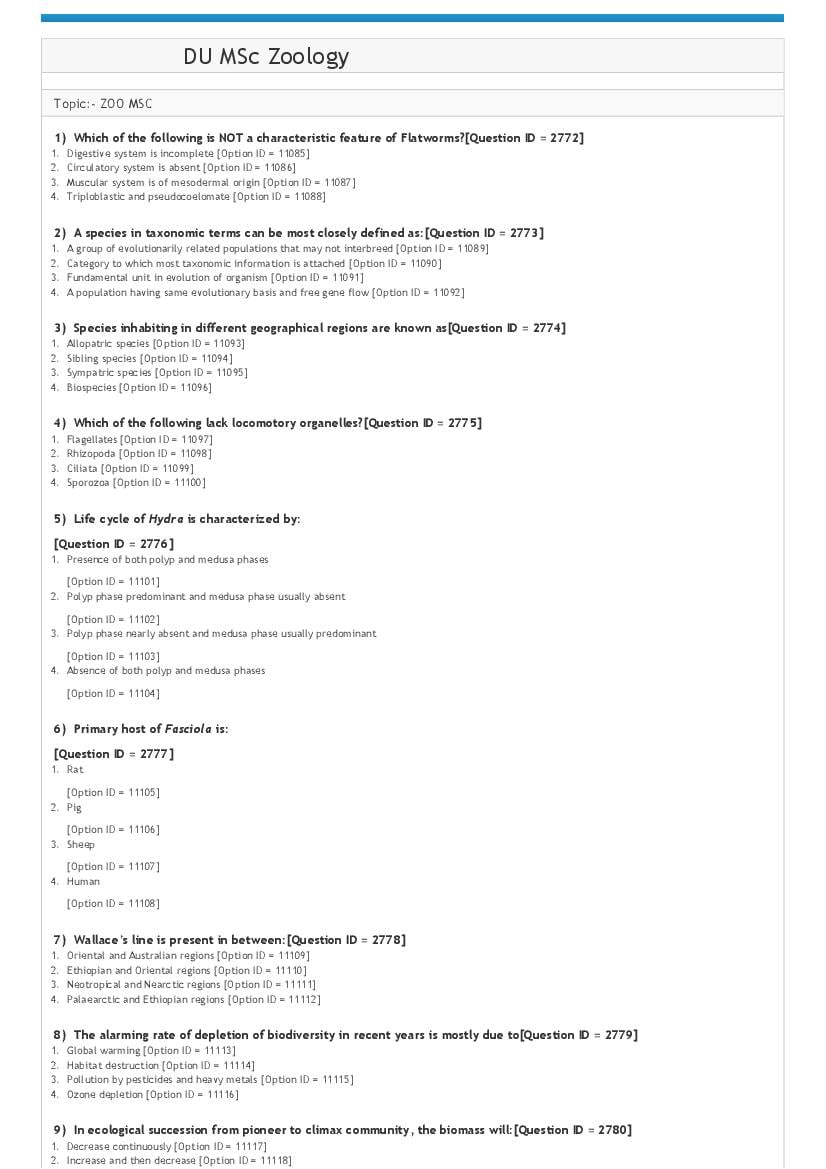
Topic:‐ ZOO MSC
1) Which of the following is NOT a characteristic feature of Flatworms?[Question ID = 2772]
1. Digestive system is incomplete [Option ID = 11085]
2. Circulatory system is absent [Option ID = 11086]
3. Muscular system is of mesodermal origin [Option ID = 11087]
4. Triploblastic and pseudocoelomate [Option ID = 11088]
2) A species in taxonomic terms can be most closely defined as:[Question ID = 2773]
1. A group of evolutionarily related populations that may not interbreed [Option ID = 11089]
2. Category to which most taxonomic information is attached [Option ID = 11090]
3. Fundamental unit in evolution of organism [Option ID = 11091]
4. A population having same evolutionary basis and free gene flow [Option ID = 11092]
3) Species inhabiting in different geographical regions are known as[Question ID = 2774]
1. Allopatric species [Option ID = 11093]
2. Sibling species [Option ID = 11094]
3. Sympatric species [Option ID = 11095]
4. Biospecies [Option ID = 11096]
4) Which of the following lack locomotory organelles?[Question ID = 2775]
1. Flagellates [Option ID = 11097]
2. Rhizopoda [Option ID = 11098]
3. Ciliata [Option ID = 11099]
4. Sporozoa [Option ID = 11100]
5) Life cycle of Hydra is characterized by:
[Question ID = 2776]
1. Presence of both polyp and medusa phases
[Option ID = 11101]
2. Polyp phase predominant and medusa phase usually absent
[Option ID = 11102]
3. Polyp phase nearly absent and medusa phase usually predominant
[Option ID = 11103]
4. Absence of both polyp and medusa phases
[Option ID = 11104]
6) Primary host of Fasciola is:
[Question ID = 2777]
1. Rat
[Option ID = 11105]
2. Pig
[Option ID = 11106]
3. Sheep
[Option ID = 11107]
4. Human
[Option ID = 11108]
7) Wallace’s line is present in between:[Question ID = 2778]
1. Oriental and Australian regions [Option ID = 11109]
2. Ethiopian and Oriental regions [Option ID = 11110]
3. Neotropical and Nearctic regions [Option ID = 11111]
4. Palaearctic and Ethiopian regions [Option ID = 11112]
8) The alarming rate of depletion of biodiversity in recent years is mostly due to[Question ID = 2779]
1. Global warming [Option ID = 11113]
2. Habitat destruction [Option ID = 11114]
3. Pollution by pesticides and heavy metals [Option ID = 11115]
4. Ozone depletion [Option ID = 11116]
9) In ecological succession from pioneer to climax community, the biomass will:[Question ID = 2780]
1. Decrease continuously [Option ID = 11117]
2. Increase and then decrease [Option ID = 11118]
Page 2
4. Increase continuously [Option ID = 11120]
10) The region in India that is NOT yet marked as Biodiversity hotspot:[Question ID = 2781]
1. The Himalayas [Option ID = 11121]
2. Indo‐Burma Region [Option ID = 11122]
3. The Western Ghat [Option ID = 11123]
4. Gangetic plane [Option ID = 11124]
11) A group of bacteria that extract inorganic compounds from their environment and convert them into organic nutrient
compounds can be classified as:[Question ID = 2782]
1. Chemoheterotrophs [Option ID = 11125]
2. Chemoautotrophs [Option ID = 11126]
3. Heterotrophs [Option ID = 11127]
4. Auxotrophs [Option ID = 11128]
12) What type of food chain is it?
Dead animals → blowfly maggot → frog → snake
[Question ID = 2783]
1. Detrital food chain
[Option ID = 11129]
2. Decomposer food chain
[Option ID = 11130]
3. Predator food chain
[Option ID = 11131]
4. Grazing food chain
[Option ID = 11132]
13) Allelopathy refers to[Question ID = 2784]
1. Inhibition of growth of one species by another by the production of secondary metabolites [Option ID = 11133]
2. Augmentation of sporulation of pathogen by the host [Option ID = 11134]
3. Altering the reproductive cycle of one organism by another [Option ID = 11135]
4. Artificial protection of crops using pheromones [Option ID = 11136]
14) Match List I with List II
List I List II
A. Taenia I. Hexacanth
B. Obelia II. Glochidium
C. Unio III. Planula
D. Balanoglossus IV. Tornaria
V. Miracidium
Choose the correct answer from the options given below:
[Question ID = 2785]
1. A ‐ I, B ‐ II, C ‐ III, D ‐ V [Option ID = 11137]
2. A ‐ III, B ‐ II, C ‐ I, D ‐ V [Option ID = 11138]
3. A ‐ I, B ‐ III, C ‐ II, D ‐ IV [Option ID = 11139]
4. A ‐ II, B ‐ V, C ‐ III, D ‐ IV [Option ID = 11140]
15) A haltere is a/an[Question ID = 2786]
1. Vestibular organ of butterfly [Option ID = 11141]
2. Modified forewing of beetle [Option ID = 11142]
3. Balancing organ of housefly [Option ID = 11143]
4. Organ used by a male insect to attract female for mating [Option ID = 11144]
16) Which of the following are schizocoelomates?[Question ID = 2787]
1. Platyhelminthes, Annelida, and Mollusca [Option ID = 11145]
2. Aschelminthes, Annelida, Arthropoda [Option ID = 11146]
3. Annelida, Arthropoda, and Mollusca [Option ID = 11147]
4. Arthropoda, Mollusca and Echinodermata [Option ID = 11148]
17) In bivalves, which structure secretes pearl?[Question ID = 2788]
1. Periostracum layer [Option ID = 11149]
2. Prismatic layer [Option ID = 11150]
3. Nacreous layer [Option ID = 11151]
4. Mantle layer [Option ID = 11152]
18) The common character of Anopheles, Hirudinea, Cimex, Xenopsylla
[Question ID = 2789]
Page 3
[Option ID = 11153]
2. Saliva contains anti‐coagulant
[Option ID = 11154]
3. All are insects
[Option ID = 11155]
4. Lay eggs on stagnant water
[Option ID = 11156]
19) Following are the statements regarding cephalic appendages of prawn:
Statement I:There are 3 pairs of cephalic appendages of prawn.
Statement II:The cephalic appendages of prawn are, the antennae, the mandibles and the maxillulae
In light of the above statements, choose the most appropriate answer from the options given below
[Question ID = 2790]
1. Both Statement I and Statement II are correct
[Option ID = 11157]
2. Both Statement I and Statement II are incorrect
[Option ID = 11158]
3. Statement I is correct but Statement II is incorrect
[Option ID = 11159]
4. Statement I is incorrect but Statement II is correct
[Option ID = 11160]
20) Formation of migratory locust swarms occur due to:[Question ID = 2791]
1. Surge of aggregation pheromones and developmental hormones [Option ID = 11161]
2. Seasonal changes in insect behavior [Option ID = 11162]
3. Favorable environmental conditions and plenty of food in their breeding places [Option ID = 11163]
4. Crop cycle as they are ready to eat [Option ID = 11164]
21) Ospharadium is associated with[Question ID = 2792]
1. Digestive system [Option ID = 11165]
2. Respiratory system [Option ID = 11166]
3. Excretory system [Option ID = 11167]
4. Olfactory system [Option ID = 11168]
22) Identify the statement that is NOT true for desmosomes.[Question ID = 2793]
1. These are cell‐cell junctions found between adjacent cells. [Option ID = 11169]
2. These contain desmosomal cadherins. [Option ID = 11170]
3. The cytosolic domains of desmosomal cadherins are linked to the actin cytoskeleton by adaptor proteins. [Option ID = 11171]
4. The extracellular domain of desmosomal cadherins of adjacent cells bind to each other by heterophilic interactions. [Option ID = 11172]
23) The zonula occludens protein in tight junctions of epithelial cell sheets is required for:[Question ID = 2794]
1. Binding of tight junction proteins in adjacent cells. [Option ID = 11173]
2. Linking the cytosolic domain of tight junction proteins to the actin cytoskeleton. [Option ID = 11174]
3. Withstanding shearing forces by epithelial sheets. [Option ID = 11175]
4. Defining the apical and basolateral regions of the plasma membrane. [Option ID = 11176]
24) If the pH of the mitochondrial matrix is maintained at 7.0 and pH of intermembrane space remains unaffected[Question
ID = 2795]
1. ATP synthesis would be unaffected. [Option ID = 11177]
2. Movement of protons through the F0 complex reduced. [Option ID = 11178]
3. The potential would remain at 140 mV [Option ID = 11179]
4. ADP would be imported into the matrix. [Option ID = 11180]
25) Which one of the following is NOT an actin binding protein?[Question ID = 2796]
1. Spectrin [Option ID = 11181]
2. alpha‐actinin [Option ID = 11182]
3. Ankyrin [Option ID = 11183]
4. Filamin [Option ID = 11184]
26) Phosphorylation of intermediate filaments generally leads to their disassembly. This modification is observed in:
[Question ID = 2797]
1. Migrating cells [Option ID = 11185]
2. Smooth muscle cells [Option ID = 11186]
3. Neurons [Option ID = 11187]
4. Skeletal muscle cells [Option ID = 11188]
Page 4
1. Duplication of the centrosome takes place. [Option ID = 11189]
2. The duplicated centrosomes start moving to the opposite side of the nucleus. [Option ID = 11190]
3. Microtubules of the mitotic spindle attach to the kinetochores of condensed chromosomes [Option ID = 11191]
4. The chromosomes start moving towards the centre of the mitotic spindle [Option ID = 11192]
28) Which of the following is NOT a component of the epinephrine‐cAMP signalling pathway for glycogen breakdown?
[Question ID = 2799]
1. Adenylyl cyclase [Option ID = 11193]
2. Protein kinase A [Option ID = 11194]
3. Phosphorylase kinase [Option ID = 11195]
4. CRE‐binding protein [Option ID = 11196]
29) In the mismatch repair system in E. coli, MutS, MutH and MutL are the key players. The repair of mismatch in the
newly replicated DNA can be initiated by these proteins because[Question ID = 2800]
1. MutS recognizes the mismatch and activates the endonuclease MutH. [Option ID = 11197]
2. MutS recognizes the mismatch and binds as a complex with MutL and MutH. [Option ID = 11198]
3. The adenine is methylated in the newly synthesized strand. [Option ID = 11199]
4. The complex recognizes unmethylated adenine in the GATC sequences in newly synthesized strand. [Option ID = 11200]
30) Which of the modified nucleotide in the tRNA is responsible for wobble in codon‐anticodon?[Question ID = 2801]
1. Wyosine [Option ID = 11201]
2. Inosine [Option ID = 11202]
3. Queuosine [Option ID = 11203]
4. Pseudouridine [Option ID = 11204]
31) In eukaryotic cells unfolded or misfolded proteins are degraded in:[Question ID = 2802]
1. Mitochondria [Option ID = 11205]
2. Proteasome [Option ID = 11206]
3. Golgi [Option ID = 11207]
4. Endoplasmic reticulum [Option ID = 11208]
32) Which of the following is observed during Anaphase A?[Question ID = 2803]
1. Depolymerisation of microtubules [Option ID = 11209]
2. Shortening of polar microtubules [Option ID = 11210]
3. Consumption of ATP by motor proteins [Option ID = 11211]
4. Sliding of polar microtubules [Option ID = 11212]
33) Bidirectional movement of vesicles requires[Question ID = 2804]
1. Kinesin I [Option ID = 11213]
2. Microtubules and microfilaments [Option ID = 11214]
3. A flexible neck region on the motor proteins [Option ID = 11215]
4. Association of (+) and (‐) end‐directed motors [Option ID = 11216]
34) Symporters are cotransporters that transport:[Question ID = 2805]
1. Small molecules and gases in the same direction [Option ID = 11217]
2. Cations and anions in the opposite direction [Option ID = 11218]
3. Na+ ions and glucose against the concentration gradient [Option ID = 11219]
4. Glucose against its concentration gradient [Option ID = 11220]
35) Gap junctions are not essential for:[Question ID = 2806]
1. Transfer of second messengers [Option ID = 11221]
2. Metabolic coupling [Option ID = 11222]
3. Peristalsis [Option ID = 11223]
4. Skeletal muscle contraction [Option ID = 11224]
36) Cilia and flagella contain a contractile protein called:[Question ID = 2807]
1. Dynein [Option ID = 11225]
2. Tubulin [Option ID = 11226]
3. Actin [Option ID = 11227]
4. Myosin [Option ID = 11228]
37) At what stage of the eukaryotic cell cycle, the chromatin will be least compact?[Question ID = 2808]
1. G1 Phase [Option ID = 11229]
2. Mitosis [Option ID = 11230]
3. S Phase [Option ID = 11231]
4. Leptotene [Option ID = 11232]
38) At centromeres, heterochromatin formation is directed by which biochemical process that silences the gene expression
in eukaryotes.[Question ID = 2809]
1. RNA interference [Option ID = 11233]
2. RNA splicing [Option ID = 11234]
3. lncRNA acetylation [Option ID = 11235]
Page 5
39) You have been asked to choose a fixative to fix the tissue by making the methylene bridges in proteins. Which one
would you choose?[Question ID = 2810]
1. Glacial acetic acid [Option ID = 11237]
2. Formalin [Option ID = 11238]
3. Picric acid [Option ID = 11239]
4. Osmium tetraoxide [Option ID = 11240]
40) Pharyngeal gill slits are:[Question ID = 2811]
1. Unique chordate characteristic [Option ID = 11241]
2. Found in fishes, crabs, snails, aquatic insects [Option ID = 11242]
3. Found in higher invertebrates and vertebrates [Option ID = 11243]
4. Not found in protochordates, but are present in vertebrates, at least during the embryonic life [Option ID = 11244]
41) In terrestrial vertebrates, which of the following structures DID NOT arise from the pharyngeal pouches?[Question ID =
2812]
1. Eustachian tube [Option ID = 11245]
2. Middle ear [Option ID = 11246]
3. Intervertebral discs [Option ID = 11247]
4. Parathyroid gland [Option ID = 11248]
42) The origin of the jaw in the gnathostomes is from the:[Question ID = 2813]
1. Gill arch [Option ID = 11249]
2. Bones supporting the cranium [Option ID = 11250]
3. Notochord [Option ID = 11251]
4. Rathke’s pouch [Option ID = 11252]
43) Match List I with List II
List I List II
A. Division I. Anura
B. Class II. Ranidae
C. Order III. Gnathostomata
D. Family IV. Amphibia
V. Chordata
Choose the correct answer from the options given below:
[Question ID = 2814]
1. A ‐ III, B ‐ IV, C ‐ I, D ‐ II [Option ID = 11253]
2. A ‐ I, B ‐ V, C ‐ III, D ‐ IV [Option ID = 11254]
3. A ‐ IV, B ‐ II, C ‐ I, D ‐ III [Option ID = 11255]
4. A ‐ V, B ‐ I, C ‐ III, D ‐ II [Option ID = 11256]
44) Dentition in mammals is:[Question ID = 2815]
1. Thecodont, homodont, diphyodont [Option ID = 11257]
2. Thecodont, heterodont, diphyodont [Option ID = 11258]
3. Acrodont, homodont, monophyodont [Option ID = 11259]
4. Acrodont, heterodont, polyphyodont [Option ID = 11260]
45) Hilsa migrates for breeding purpose from____ ; and hence classified as _____fishes.
[Question ID = 2816]
1. One location to another location within fresh water; potamodromous
[Option ID = 11261]
2. One location to another within salt water; oceonodromous
[Option ID = 11262]
3. Salt water to fresh water; anadromous
[Option ID = 11263]
4. Fresh water to salt water; catadromous
[Option ID = 11264]
46) During the muscle contraction, calcium ions released from the sarcoplasmic reticulum binds to which one of the
following to initiate the muscular contraction?[Question ID = 2817]
1. Troponin [Option ID = 11265]
2. Tropomyosin [Option ID = 11266]
3. Actin [Option ID = 11267]
4. Myosin [Option ID = 11268]
47) Which of the following cells would likely be found in the tissue lining the organ that produces and releases mucus?
[Question ID = 2818]
1. Goblet cells [Option ID = 11269]
Page 6
3. Macrophages [Option ID = 11271]
4. Osteoblasts [Option ID = 11272]
48) In bone, the crystallized inorganic mineral salts and the collagen fibers along with other organic molecules contribute
to:[Question ID = 2819]
1. Hardness and tensile strength, respectively [Option ID = 11273]
2. Tensile strength and hardness, respectively [Option ID = 11274]
3. Regeneration and hardness, respectively [Option ID = 11275]
4. Light weight and tensile strength, respectively [Option ID = 11276]
49) Which of the following are sources of ATP for human muscle contraction? A. Glycolysis B. Creatine phosphate C. Aerobic
cellular respiration D. Arginine phosphate Choose the correct combination from the options given below[Question ID = 2820]
1. A, B and C only [Option ID = 11277]
2. B, C and D only [Option ID = 11278]
3. A, C and D only [Option ID = 11279]
4. A, B and D only [Option ID = 11280]
50) Neurotransmitters are removed from the synaptic cleft by A. Axonal transport B. Diffusion away from the cleft
C. Neurosecretory cells D. Enzymatic breakdown E. Cellular uptake Choose the correct combination from the options given
below:[Question ID = 2821]
1. A, B, C and D only [Option ID = 11281]
2. B, D and E only [Option ID = 11282]
3. B, C and D only [Option ID = 11283]
4. A, D and E only [Option ID = 11284]
51) Which of the following is the major integrating link between the nervous and endocrine systems and helps to control
the stress response?[Question ID = 2822]
1. Hypothalamus [Option ID = 11285]
2. Pituitary Gland [Option ID = 11286]
3. Pineal Gland [Option ID = 11287]
4. Thymus [Option ID = 11288]
52) Oral contraceptives work by:
A. Causing a thickening of the cervical mucus
B. Blocking the uterine tubes
C. Inhibiting the release of FSH and LH
D. Preventing ovulation
E. Disrupting the plasma membranes of sperm
F. Irritating the endometrial lining so that it is inhospitable for fetal development
Choose the correct combination of mechanisms from the options given below:
[Question ID = 2823]
1. C, D and F only
[Option ID = 11289]
2. A, B and E only
[Option ID = 11290]
3. A, C, and D only
[Option ID = 11291]
4. A, B, C, D and E only
[Option ID = 11292]
53) The information of a protein structure is contained in the:[Question ID = 2824]
1. Bonds between the amino acid residues [Option ID = 11293]
2. Sequence of first twenty amino acid residues [Option ID = 11294]
3. Sequence of last twenty amino acid residues [Option ID = 11295]
4. Sequence of all the amino acid residues [Option ID = 11296]
54) At isoelectric pH, a protein carries:[Question ID = 2825]
1. No charge [Option ID = 11297]
2. Positive charge only [Option ID = 11298]
3. Negative charge only [Option ID = 11299]
4. Zero net charge [Option ID = 11300]
55) Ampicillin inhibits bacterial:[Question ID = 2826]
1. DNA synthesis [Option ID = 11301]
2. RNA synthesis [Option ID = 11302]
3. Protein synthesis [Option ID = 11303]
Page 7
56) The absorbance of UV light (280nm) by a protein is largely due to the presence of amino acids with:[Question ID =
2827]
1. Aliphatic R group [Option ID = 11305]
2. Acidic R group [Option ID = 11306]
3. Aromatic R group [Option ID = 11307]
4. Basic R group [Option ID = 11308]
57) Which one of the following is WRONG match for enzyme classification?[Question ID = 2828]
1. EC 1 ‐ Oxidoreductases [Option ID = 11309]
2. EC 2 – Transferases [Option ID = 11310]
3. EC 3 ‐ Hydrolases [Option ID = 11311]
4. EC 4 ‐ Ligases [Option ID = 11312]
58) If the sequence of coding strand in a transcription unit is as follows:
5’‐GAACCGCCAATTGCAGTC‐3’, the sequence of mRNA transcribed from the transcription unit would be:
[Question ID = 2829]
1. 5’‐GAACCGCCAAUUGCAGUC‐3’
[Option ID = 11313]
2. 5’‐CUUGGCGGUUAACGUCAG‐3’
[Option ID = 11314]
3. 5’‐GACUGCAAUUGGCGGUUC‐3’
[Option ID = 11315]
4. 3’‐GAACCGCCAAUUGCAGUC‐5’
[Option ID = 11316]
59) Nucleosome core is a structural unit of chromatin consisting of[Question ID = 2830]
1. Four histones molecules and a specific length of DNA [Option ID = 11317]
2. Eight histones molecules and a specific sequence of DNA [Option ID = 11318]
3. Eight histones molecules and a specific length of DNA [Option ID = 11319]
4. Four histones molecules and a specific sequence of DNA [Option ID = 11320]
60) How many chambers are there in the heart of the frog tadpole?[Question ID = 2831]
1. One [Option ID = 11321]
2. Two [Option ID = 11322]
3. Three [Option ID = 11323]
4. Four [Option ID = 11324]
61) Centrum, pre‐ and post‐zygapophysis, transverse process are part of[Question ID = 2832]
1. Skull [Option ID = 11325]
2. Vertebrae [Option ID = 11326]
3. Sternum [Option ID = 11327]
4. Pectoral girdle [Option ID = 11328]
62) Y‐shaped chevron bone is present in[Question ID = 2833]
1. Thoracic vertebrae of mammal [Option ID = 11329]
2. Cervical vertebrae of bird [Option ID = 11330]
3. Caudal vertebrae of reptile [Option ID = 11331]
4. Lumbar vertebrae of amphibian [Option ID = 11332]
63) Pick the integument modification which is NOT epidermal derivative.[Question ID = 2834]
1. Beaks [Option ID = 11333]
2. Antlers [Option ID = 11334]
3. Hoofs [Option ID = 11335]
4. Claws [Option ID = 11336]
64) In ruminants, true stomach that is homologous to other mammals is represented by:[Question ID = 2835]
1. Abomasum [Option ID = 11337]
2. Reticulum [Option ID = 11338]
3. Rumen [Option ID = 11339]
4. Omasum [Option ID = 11340]
65) Oviduct in vertebrates is modified:[Question ID = 2836]
1. Wolffian duct [Option ID = 11341]
2. Mullerian duct [Option ID = 11342]
3. Inguinal canal [Option ID = 11343]
4. Urinary duct [Option ID = 11344]
66) Thyroxine is a:[Question ID = 2837]
Page 8
2. Steroid [Option ID = 11346]
3. Peptide [Option ID = 11347]
4. Fatty acid derivative [Option ID = 11348]
67) Which of the following proteins is rich in proline/hydroxyproline?[Question ID = 2838]
1. Collagen [Option ID = 11349]
2. Trypsin [Option ID = 11350]
3. Myosin [Option ID = 11351]
4. Actin [Option ID = 11352]
68) Which system is active under stress?[Question ID = 2839]
1. Parasympathetic nervous system [Option ID = 11353]
2. Sympathetic nervous system [Option ID = 11354]
3. Central nervous system [Option ID = 11355]
4. Somatic nervous system [Option ID = 11356]
69) P‐wave in the ECG represents[Question ID = 2840]
1. Ventricular depolarization [Option ID = 11357]
2. Atrial depolarization [Option ID = 11358]
3. Rapid repolarization of Atrial chamber [Option ID = 11359]
4. Repolarization of ventricles [Option ID = 11360]
70) Bile is produced in our body, which[Question ID = 2841]
1. Helps in controlling blood pressure [Option ID = 11361]
2. Act as a surfactant to emulsify lipids in intestine [Option ID = 11362]
3. Helps in digestion of starch in intestine [Option ID = 11363]
4. Helps in absorption of water soluble vitamins [Option ID = 11364]
71) Hemophilia is due to a defective gene which DOES NOT produce:[Question ID = 2842]
1. Fibrinogen [Option ID = 11365]
2. Hemoglobin [Option ID = 11366]
3. Thromboplastin [Option ID = 11367]
4. Prothrombin [Option ID = 11368]
72) When oxygen supply is not enough, and ATP is needed, glucose is converted to lactic acid because:[Question ID =
2843]
1. Lactic acid can enter into TCA cycle to generate more ATP [Option ID = 11369]
2. Lactic acid will maintain pH of the blood [Option ID = 11370]
3. NAD+ needs to be generated for use in glycolysis [Option ID = 11371]
4. Lactic acid can enhance oxygen uptake [Option ID = 11372]
73) The major pathway producing NADPH is:[Question ID = 2844]
1. TCA cycle [Option ID = 11373]
2. Fatty acid synthesis pathway [Option ID = 11374]
3. Glycogen degradation pathway [Option ID = 11375]
4. Hexose monophosphate pathway [Option ID = 11376]
74) Precursor for steroid hormone synthesis is[Question ID = 2845]
1. Tryptophan [Option ID = 11377]
2. Cholesterol [Option ID = 11378]
3. Stearic acid [Option ID = 11379]
4. Glycogen [Option ID = 11380]
75) During synthesis of ATP in glycolysis, phosphate is provided by[Question ID = 2846]
1. AMP [Option ID = 11381]
2. Inorganic phosphate [Option ID = 11382]
3. PRPP [Option ID = 11383]
4. High energy phosphorylated compound [Option ID = 11384]
76) Import of glucose by the liver cell[Question ID = 2847]
1. Is dependent on hydrolysis of ATP [Option ID = 11385]
2. Requires expression of GLUT1 on the plasma membrane [Option ID = 11386]
3. Occurs throughout the phospholipid bilayer [Option ID = 11387]
4. Is facilitated by GLUT2 [Option ID = 11388]
77) A cDNA library is[Question ID = 2848]
1. Full DNA complement present in a cell [Option ID = 11389]
2. Only coding sequences corresponding to mRNA [Option ID = 11390]
3. A set of sequences from both introns and exons [Option ID = 11391]
4. A set of sequences from introns, rRNA and lncRNA [Option ID = 11392]
78) Southern Blot Analysis/ Hybridization is used for detection of specific[Question ID = 2849]
Page 9
2. RNA sequence [Option ID = 11394]
3. Protein‐protein interactions [Option ID = 11395]
4. DNA‐protein interactions [Option ID = 11396]
79) DNA finger‐printing technique employs[Question ID = 2850]
1. Unique and house‐keeping genes as probes [Option ID = 11397]
2. Specific metabolic genes as probes [Option ID = 11398]
3. Variable number tandem repeats as probes [Option ID = 11399]
4. Intron regions as probes [Option ID = 11400]
80) Which of the following techniques was used by Messelon and Stahl to separate DNA labeled with 15N from 14N‐labeled
DNA?[Question ID = 2851]
1. Isopycnic equilibrium density gradient centrifugation [Option ID = 11401]
2. Agarose Gel electrophoresis [Option ID = 11402]
3. Molecular‐sieve chromatography [Option ID = 11403]
4. Ion‐exchange chromatography [Option ID = 11404]
81) The transcription of gene A resulted in the synthesis of a 100‐kDa protein, in one cell type, and 48‐kDa protein in
another cell type owing to the site‐specific conversion of CAA codon to UAA codon by enzyme cytidine deaminase. Which
one of the below mentioned regulatory mechanisms is involved in the phenomenon?[Question ID = 2852]
1. Use of alternate promoters [Option ID = 11405]
2. RNA editing [Option ID = 11406]
3. Gene silencing [Option ID = 11407]
4. Gene conversion [Option ID = 11408]
82) In Drosophila, sperm enters in the egg through
[Question ID = 2853]
1. Micropyle
[Option ID = 11409]
2. Aeropyle
[Option ID = 11410]
3. Pole cells
[Option ID = 11411]
4. Germ cells
[Option ID = 11412]
83) Which component of transcribed RNA in eukaryotes is present in the initial transcript but is removed before translation
occurs?[Question ID = 2854]
1. Intron [Option ID = 11413]
2. 3’ Poly A tail [Option ID = 11414]
3. Ribosome binding site [Option ID = 11415]
4. 5’ cap region [Option ID = 11416]
84) Exon skipping is associated with[Question ID = 2855]
1. Nonsense mutations [Option ID = 11417]
2. Promoter mutations [Option ID = 11418]
3. Splice sites mutations [Option ID = 11419]
4. Silent mutations [Option ID = 11420]
85) The allele associated with sickle cell anemia apparently reached a high frequency in some human populations due
to[Question ID = 2856]
1. Random mating [Option ID = 11421]
2. Superior fitness of heterozygotes in areas where malaria was present [Option ID = 11422]
3. Migration of individuals with the allele into other populations [Option ID = 11423]
4. A high mutation rate in that specific gene [Option ID = 11424]
86) Which of the following genotypes causes Klinefelter syndrome?[Question ID = 2857]
1. XO [Option ID = 11425]
2. XXY [Option ID = 11426]
3. XX [Option ID = 11427]
4. XYY [Option ID = 11428]
87) In a Robertsonian translocation, fusion occurs at the[Question ID = 2858]
1. Telomeres [Option ID = 11429]
2. Centromeres [Option ID = 11430]
3. Long terminal repeats [Option ID = 11431]
4. Ends of the long arms [Option ID = 11432]
88) A gene showing co‐dominance has[Question ID = 2859]
1. One allele dominant to the other [Option ID = 11433]
Page 10
3. Alleles tightly linked on the same chromosome [Option ID = 11435]
4. Alleles expressed at the same time in development [Option ID = 11436]
89) Repeat core sequences consisting of 2, 3, or 4 base pairs are known as[Question ID = 2860]
1. Single nucleotide polymorphisms [Option ID = 11437]
2. Microsatellites [Option ID = 11438]
3. Minisatellites [Option ID = 11439]
4. Telomeres [Option ID = 11440]
90) When a heterozygous dog mated with homozygous recessive parent, what will you describe this as[Question ID = 2861]
1. Test cross [Option ID = 11441]
2. Reciprocal cross [Option ID = 11442]
3. Monohybrid cross [Option ID = 11443]
4. Dihybrid cross [Option ID = 11444]
91) Hemophilia is an example of a trait that is carried as a/an[Question ID = 2862]
1. Autosomal dominant [Option ID = 11445]
2. Autosomal recessive [Option ID = 11446]
3. Sex‐linked dominant [Option ID = 11447]
4. Sex‐linked recessive [Option ID = 11448]
92) If recombination frequency between two genes is 10 then the distance between the two genes is[Question ID = 2863]
1. 1 cM [Option ID = 11449]
2. 10 cM [Option ID = 11450]
3. 0.1 cM [Option ID = 11451]
4. 100 cM [Option ID = 11452]
93) During development, if a cell is committed to have a particular fate, it is called as[Question ID = 2864]
1. Totipotent [Option ID = 11453]
2. Pluripotent [Option ID = 11454]
3. Differentiated [Option ID = 11455]
4. Determined [Option ID = 11456]
94) When protein synthesized by one cell diffuses over a small distance to induce changes in a neighboring cell, the event
is called as[Question ID = 2865]
1. Paracrine interaction [Option ID = 11457]
2. Juxtracrine interaction [Option ID = 11458]
3. Autocrine interaction [Option ID = 11459]
4. Endocrine interaction [Option ID = 11460]
95) Kidney of the vertebrate embryo develops from[Question ID = 2866]
1. Ectoderm [Option ID = 11461]
2. Endoderm [Option ID = 11462]
3. Mesoderm [Option ID = 11463]
4. Notochord [Option ID = 11464]
96) In some animal groups, only small area of the egg is free of yolk and hence serves as a potential site to initiate the
embryonic cell division. This type of cell division in eggs of such animal groups is referred as[Question ID = 2867]
1. Superficial [Option ID = 11465]
2. Meroblastic [Option ID = 11466]
3. Discoidal [Option ID = 11467]
4. Holoblastic [Option ID = 11468]
97) The transition from water to land in the evolution of vertebrates occurred during[Question ID = 2868]
1. Cambrian period [Option ID = 11469]
2. Jurassic period [Option ID = 11470]
3. Carboniferous period [Option ID = 11471]
4. Devonian period [Option ID = 11472]
98) Which of the following gases was probably absent at the time of origin of life?[Question ID = 2869]
1. Hydrogen [Option ID = 11473]
2. Oxygen [Option ID = 11474]
3. Methane [Option ID = 11475]
4. Carbon dioxide [Option ID = 11476]
99) Stabilizing selection is a type of natural selection wherein[Question ID = 2870]
1. Selective pressures are working against two extremes of a trait, and therefore the intermediate trait is selected [Option ID = 11477]
2. Selective pressures are working in favor of one extreme of a trait [Option ID = 11478]
3. Selective pressures are working in favor of the two extremes and against the intermediate trait [Option ID = 11479]
4. There is no selective pressure for the two extremes and the intermediate trait [Option ID = 11480]
100) Phenomenon of polyethism is exhibited in the life history of
Page 11
1. Periplaneta americana
[Option ID = 11481]
2. Parasteatoda tepidariorum
[Option ID = 11482]
3. Apis mellifera
[Option ID = 11483]
4. Musca domestica
[Option ID = 11484]
Document Details
| Board / Org | NTA |
| Exam | DUET |
| Type | Question Paper |
| Pages | 11 |
| Language | english |
| Updated | 30 Apr 2026 |