NBSE Class 6 Syllabus 2027 English, Mathematics, Science, Social Science
Finished viewing? Save it for later —
Download NBSE Class 6 Syllabus 2027 English, Mathematics, Science, Social Science (PDF · 39 pages)About NBSE Class 6 Syllabus 2027 English, Mathematics, Science, Social Science
NBSE Class 6 Syllabus 2027 English, Mathematics, Science, Social Science is available here for free download. Published by Nagaland Board for Class 6, this syllabus can be viewed online or downloaded as a PDF (39 pages). Candidates preparing for Class 6 can use NBSE Class 6 Syllabus 2027 English, Mathematics, Science, Social Science to understand the exam pattern, the type of questions asked, and the overall difficulty level.
Frequently Asked Questions
How can I download NBSE Class 6 Syllabus 2027 English, Mathematics, Science, Social Science?
Open this page and click the Download button to save NBSE Class 6 Syllabus 2027 English, Mathematics, Science, Social Science as a PDF. It is completely free on AglaSem Docs.
Is NBSE Class 6 Syllabus 2027 English, Mathematics, Science, Social Science free to download?
Yes. NBSE Class 6 Syllabus 2027 English, Mathematics, Science, Social Science can be viewed online and downloaded as a PDF free of cost on AglaSem Docs.
How many pages does NBSE Class 6 Syllabus 2027 English, Mathematics, Science, Social Science have?
NBSE Class 6 Syllabus 2027 English, Mathematics, Science, Social Science contains 39 pages, which you can read online or download together as a single PDF.
Where can I find more Class 6 study material?
You can find more Class 6 question papers, sample papers, syllabus, and answer keys on AglaSem Docs.
NBSE Class 6 Syllabus 2027 English, Mathematics, Science, Social Science – Text
Read the full text of this syllabus below — useful to quickly search, copy and reference the content online without downloading the PDF.
📄 View text version (40 pages)
Page 1
NBSE Class 6 Syllabus
2027 English,
Mathematics, Science,
Social Science
EXAM YEAR TYPE SUBJECT
Nagaland Class 6 2027 Syllabus Science
Notes · Sample Papers · Previous Year Papers · Mock Tests
Page 2
m .co
m .co s e m
se g l a
a
m
m .co
.co s e m
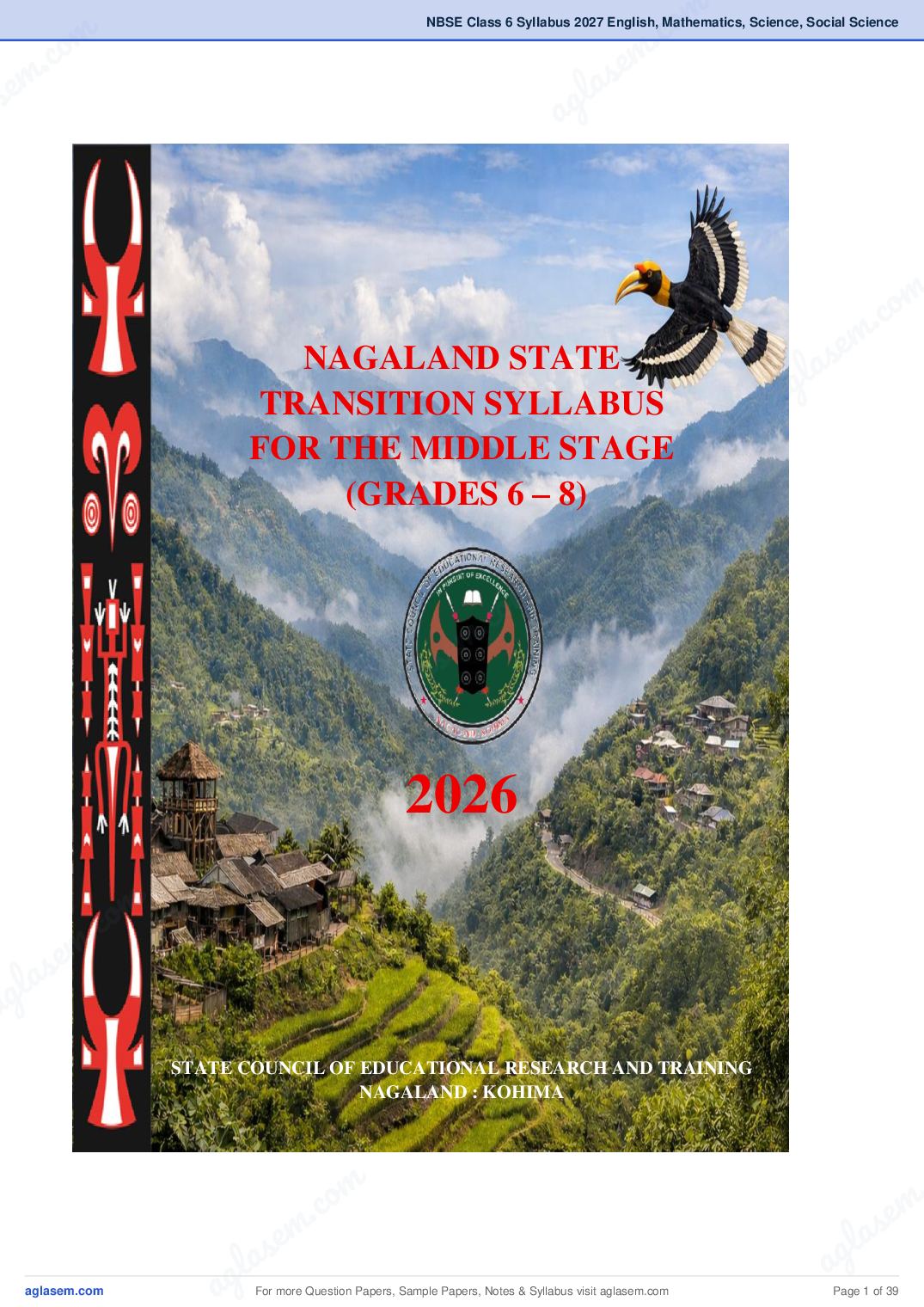
s em NAGALAND STATE l a
g la TRANSITION SYLLABUS ag
a
FOR THE MIDDLE STAGE
(GRADES 6 – 8)
m
m .co
s e
g la
a
2026
m
m .co
m .co s e m
s e g l a
g la a
a
STATE COUNCIL OF EDUCATIONAL RESEARCH AND TRAINING
NAGALAND : KOHIMA
m .
.co s e m
s em l a
g la ag
a For more Question Papers, Sample Papers, Notes & Syllabus visit Page 1 of 39
Page 3
TRANSITION SYLLABUS
FOR THE MIDDLE STAGE
(GRADES 6 – 8)
2026
STATE COUNCIL OF EDUCATIONAL RESEARCH AND TRAINING
NAGALAND : KOHIMA
For more Question Papers, Sample Papers, Notes & Syllabus visit Page 2 of 39
Page 4
m .co
m .co s e m
se g l a
a
m
.co
TABLE OF CONTENTS
m
.co s e m
s em l a
ag
Page No.
g l a
Note toathe Reader
Transition Syllabus for the Middle Stage (Grades 6 – 8)
English …………………………………………………………………… 1–5
Mathematics ……………………………………………………………... 6 – 20
m
Social Science …………………………………………………………….
m .co 21 – 35
s e
la
Science …………………………………………………………………… 36 – 51
ag
m
m .co
m .co s e m
s e g l a
g la a
a
m .
.co s e m
s em l a
g la ag
a For more Question Papers, Sample Papers, Notes & Syllabus visit Page 3 of 39
Page 5
The introduction of the National Education Policy (NEP 2020) and the subsequent release of
the National Curriculum Framework for School Education (NCF-SE 2023) marks a
significant shift in the vision and direction of school education in India. These developments
call for a systematic alignment of existing State curricula and syllabi with national priorities,
including competency-based learning, conceptual understanding, and holistic development.
At present, the Nagaland State Curriculum Framework for School Education (SCF-SE) and
the corresponding revised curriculum across the different Stages of school education are
under development and have not yet been formally notified. At the same time, there is an
immediate need to ensure that teaching–learning processes, particularly at the Middle Stage
(Grades 6 – 8), begin to reflect the spirit and expectations of these national reforms.
In this context, the State Council of Educational Research and Training (SCERT) has
developed this Transition Syllabus for the Middle Stage. This document is intended as an
interim measure to support schools and teachers in gradually aligning classroom practices
with the principles of NEP 2020 and NCF-SE 2023. It seeks to bridge the gap between the
existing syllabus and the forthcoming State Curriculum Framework and curriculum
documents.
Teachers and schools are encouraged to use this Transition Syllabus as a guiding framework
for the current phase, while remaining responsive to future revisions once the full State
Curriculum Framework and detailed curricula are released.
Director
SCERT Nagaland
For more Question Papers, Sample Papers, Notes & Syllabus visit Page 4 of 39
Page 6
m .co
m .co s e m
se g l a
a
ENGLISH
A. Introduction and Rationale
The English textbooks for Grades 6, 7, and 8 have been developed in alignment with the
vision of the National Education Policy (NEP 2020) and the State Curriculum Framework for
School Education (SCF-SE). The English Reader textbooks are designed to foster
m
.co
competencies in Listening, Speaking, Reading, and Writing, while simultaneously
m
.co m
strengthening Vocabulary and Grammar through contextualized learning. This academic year
s e
em
2026, there is a change in the overall contents in the English Reader textbooks for Grades 6, 7
s l a
ag
and 8. However, the teaching and learning principles remains the same. Accordingly, the
g la
contents for Grades 6, 7, and 8 have been systematically organized into three academic terms.
a
B. Language learning in the Middle Stage
Language education at the Middle Stage focuses on listening, speaking, reading and writing
proficiency through literature, debates, complex texts, sentence structure analysis
presentations and critical thinking. Different active learning methods such as storytelling,
role-play, theater, and debates are used for engaging students to enhance their communicative
skills. The objective of language learning at the middle stage is to transition students from
m
Preparatory Stage literacy skills to a more complex use of language involving critical
thinking and creative expression.
m .co
s e
la
C. Learning Standards
ag
Table: Curricular Goals and associated Competencies for Middle Stage English
Curricular Goal (CG) Competency (C)
C-1.1 Identifies main points and summarises from a careful listening
or reading of the text (news articles, reports, editorials)
C-1.2 Listens to, plans, and conducts different kinds of interviews
CG-1 Develops the capacity for (structured and unstructured)
m
effective communication using C-1.3 Raises probing questions about social experiences using
.co
language skills for description, appropriate language (open-ended/closed-ended, formal/ informal,
m
.co m
analysis, and response relevant to context, with sensitivity)
m s e
C-1.4 Writes different kinds of letters, essays, and reports using
s e l a
appropriate style and registers for different audiences and purposes
g
la a
C-1.5 Creates content for audio, visual, or both, for different
ag audiences and purposes
C-2.1 Identifies and appreciates different forms of literature (prose,
CG-2 Appreciates the language and poetry, drama) and styles of writing (narrative, descriptive,
literary and cultural heritage in and expository, persuasive) from various cultures and time periods
related to language by exploring the C-2.2 Identifies literary devices [simile, metaphor, personification,
various forms of literary devices hyperbole, alliteration, idioms, proverbs, and riddles] by reading a
variety of literature and uses them in writing
m .
C-2.3 Expresses through speech and writing their ideas and critiques
.co s e m
em a
1
s l
l a ag
ag For more Question Papers, Sample Papers, Notes & Syllabus visit Page 5 of 39
Page 7
C-3.1 Interprets and understands basic linguistic aspects (rules), such
CG-3 Develops the ability to as sentence structure, punctuation, tense, gender, and parts of speech,
recognise basic linguistic aspects while reading different forms of literature, and applies them while
(word and sentence structure) and writing
use them in oral and written C-3.2 Writes prose, poetry, and drama using appropriate style and
expression language
CG-4 Develops the ability to write C-4.1 Reads, responds to, and critically reviews books of varied
reviews and uses the Library to find genres (fiction and non-fiction)
references C-4.2 Uses books and other media resources effectively to find
references to use in projects and other activities
C-5.1 Understands the phonetics and script of the language, the
CG-5 Develops an appreciation of number of vowels and consonants, and how they interact and are used
the distinctive features of the C-5.2 Engages in the use of puns, rhymes, alliteration, and other
particular language, including its wordplays in the language, to make speech and writing more
alphabet and script, sounds, rhymes, interesting and enjoyable
puns, and other wordplays and C-5.3 Becomes familiar with some of the major word games in the
games unique to the language language (e.g., palindromes, spoonerisms, sentences without given
letters or sounds, riddles, jokes, antakshari (singing songs starting
with the last letter of the previous song), anagrams, crosswords)
D. Pedagogy
Students in the Middle stage learn to use language more formally than in the Preparatory
stage. They progress to learning critical listening skills, listening to a variety of texts,
contexts and varied kind of literature that would enhance their vocabulary, leading to
proficiency in listening, speaking, reading and writing. Panel discussions, debates, interviews,
anchoring, public speaking and reviews of movies, plays, or short films are some activities
for listening and speaking skills at the Middle stage. To develop functional reading skills
applications, letters, reports, invitations, emails, essays, posters and circulars can be taught
using examples. Teachers can conduct a variety of literature related activities and discuss on
the overall experience of reading the text and also encourage independent interpretation of
the text. Teachers can build interest in reading among students by making a trip to library,
organising literature festival and book exhibition. Teachers should provide students with
opportunities to write a variety of forms including essays, reports, emails, blogs and social
media comments and posts. Students writing critical appreciation on literary work should be
encouraged.
E. Assessment
Assessment for language learning at the Middle emphasises on assessing proficiency through
competencies and learning outcomes. Students must be assessed for their language
acquisition in listening, speaking, reading, writing and critical thinking. The skill of reading
and writing in various forms such as picture descriptions, simple stories, complex essays,
2
For more Question Papers, Sample Papers, Notes & Syllabus visit Page 6 of 39
Page 8
m .co
m .co s em
se g la
a must also be assessed in
literary descriptions and research must be assessed. Students
answering questions based on familiar/seen as well as unseen passages/ unfamiliar text,
producing a variety of written materials such as essays, letters, posters and other creative
writing pieces, oral communication in class discussions, debates, role plays and other forms
of presentations.
m
.co
SUGGESTED DISTRIBUTION OF PERIODS AND MARKS FOR ENGLISH
o m READER GRADE 6
m
c
Sl.No Name of the. Lesson s e
em a
Approximate Marks
s l
la ag
Teaching
ag Period Internal External
First Term
1. A Bottle of Dew 12 8 12
2. The Chair 15 10 16
3. What a Bird Thought 10 6 10
4. Neem Baba 10
m 6 10
5. The Kites 13
.co 10 12
Total
s em 60 40 60
g la Second Term
1. The Unlikely Best Friends
a 13 10 14
2. The Raven and the Fox 10 7 10
3. Yoga-A Way of Life 11 7 12
4. National War Memorial 8 4 8
5. Ila Sachani: Embroidering 14 12 16
Dreams with her Feet
Total 60 40
o m60
m Third Term
. c
c. o s e m
em 2. a
1. Rama to the Rescue 10 10 12
s g l
la
A Friend’s Prayer
g
9
a 4 8
a 3.
4.
Spices that Heal Us
Change of Heart
9
12
5
10
8
12
5. Hamara Bharat-Incredible 12 7 12
India!
6. The Winner 8 4 8
Total 60 40 60
Total number of Working Days = 220
m .
Total number of instructional Days = 180
.co s e m
em a
3
s l
l a ag
ag For more Question Papers, Sample Papers, Notes & Syllabus visit Page 7 of 39
Page 9
A. Introduction and Rationale
This Transitional Mathematics Syllabus for the Middle Stage (Grades 6 – 8) is grounded in
the vision and Learning Standards architecture of the Nagaland State Curriculum Framework
for School Education (SCF-SE). It is aligned with the structure and pedagogical philosophy at
the national level, especially outlined in the National Curriculum Framework for School
Education (NCF-SE 2023) . The syllabus is designed to operate within the instructional time
available in the Middle Stage timetable, which provides for approximately 180 instructional
days.
The Middle Stage marks a critical developmental transition in mathematical learning.
Students move from primarily concrete and arithmetic reasoning toward structured thinking,
generalisation, abstraction, and early formal reasoning. At this stage, Mathematics must
simultaneously remain connected to learners’ experiences while introducing them to
symbolic representation, algebraic structure, and logical argumentation.
In alignment with the five Aims of School Education articulated in the SCF-SE, Mathematics
education at the Middle Stage contributes significantly to the development of rational and
critical thinking, creativity and aesthetic appreciation, ethical and responsible citizenship
through quantitative literacy, and preparation for advanced learning in the Secondary Stage.
Mathematics cultivates habits of disciplined reasoning, clarity of expression, and respect for
evidence. These are foundational to both individual development and societal participation.
The syllabus is intentionally lean and competency-focused. It prioritises conceptual depth
over content breadth, in keeping with the reduction of content load recommended in the NEP
2020 and the emphasis on core Competencies rather than extensive coverage.
B. Learning Standards
The Learning Standards framework for the entire nation flows from the five ‘Aims of School
Education’, down to the ‘Curricular Aims’ (here, the Curricular Aims of Mathematics
Education will be applicable). These are further concretised in the form of ‘Curricular Goals’
and ‘Competencies’ for the Middle Stage. The Standards are articulated as Stage-end
expectations rather than grade-wise outcomes. Accordingly, this syllabus provides a grade-
wise progression that cumulatively supports the attainment of these stage-end Competencies
by the end of Grade 8.
The table below shows the Curricular Goals and associated Competencies that learners must
attain by the time they complete the Middle Stage for Mathematics.
6
For more Question Papers, Sample Papers, Notes & Syllabus visit Page 8 of 39
Page 10
m .co
m .co s e m
se g l a
a
Table: Curricular Goals and associated Competencies for Middle Stage Mathematics
Curricular Goal (CG) Competency (C)
C-1.1 Develops a sense for and an ability to manipulate (e.g., read, write,
form, compare, estimate, and apply operations) and name (in words) large
whole numbers of up to 20 digits, and expresses them in scientific notation
m
.co
using exponents and powers.
m Discovers, identifies, and explores patterns in numbers and describes
c. o C-1.2 m
CG-1
Understands numbers and sets
s e
em
rules for their formation (e.g., multiples of 7, powers of 3, prime numbers),
of numbers (whole numbers,
s
and explains relations between different Patterns.
g l a
la C-1.3 Learns about the inclusion of zero and negative quantities a
fractions, integers, rational
ag
numbers, and real numbers), as
looks for patterns, and numbers, and the arithmetic operations on them, as given by Brahmagupta.
appreciates relationships
between numbers. C-1.4 Explores and understands sets of numbers, such as whole numbers,
fractions, integers, rational numbers, and real numbers, and their properties,
and visualises them on the number line.
C-1.5 Explores the idea of percentage and applies it to solve problems.
C-1.6 Explores and applies fractions.
m
.co
C-2.1 Understands equality between numerical expressions and learns to
em
check arithmetical equations.
CG-2
Understands the concepts of
la s
C-2.2 Extends the representation of a number in the form of a variable or an
variable, constant, coefficient,
expression, and (one-variable) ag
algebraic expression using a variable.
equation, and uses these C-2.3 Forms algebraic expressions using variables, coefficients, and
concepts to solve meaningful constants and manipulates them through basic operations.
daily-life problems with
procedural fluency. C-2.4 Poses and solves linear equations to find the value of an unknown,
including to solve puzzles and word problems.
C-2.5 Develops own methods to solve puzzles and problems using
algebraic thinking.
m
m .co
m .co s e m
s e g l a
g la a
a
m .
.co s e m
em a
7
s l
l a ag
ag For more Question Papers, Sample Papers, Notes & Syllabus visit Page 9 of 39
Page 11
types of two- and three-dimensional shapes usingtheir defining
properties/attributes.
C-3.2 Outlines the properties of lines, angles, triangles, quadrilaterals, and
polygons and applies them to solve related problems.
CG-3
Understands, formulates, and C-3.3 Identifies attributes of three-dimensional shapes (cubes,
applies properties and parallelepipeds, cylinders, cones), works hands-on with material to
theorems regarding simple construct these shapes, and also uses two-dimensional representations of
geometric shapes (2D and 3D) three-dimensional objects to visualise and solve problems.
C-3.4 Draws and constructs geometric shapes, such as lines, parallel lines,
perpendicular lines, angles, and simple triangles, with specified properties
using a compass and straightedge.
C-3.5 Understands congruence and similarity as it applies to geometric
shapes and identifies similar and congruent triangles
Curricular Goal (CG) Competency (C)
C-4.1 Discovers, understands, and uses formulae to determine the area of a
square, triangle, parallelogram, and trapezium and develops strategies to
find the areas of composite 2D shapes.
CG-4 C-4.2 Learns the Baudhayana-Pythagoras theorem on the lengths of the
Develops understanding of sides of a right-angled triangle, and discovers a geometric proof using areas
perimeter and area for 2D of squares erected on the sides of the triangle, and other related geometric
shapes and uses them to solve constructions from the Sulba-Sutras.
day-to-day life problems.
C-4.3 Constructs various designs (using tiling) on a plane surface using
different 2D shapes and appreciates their appearances in art in India and
around the world.
C-4.4 Develops familiarity with the notion of fractal and identifies and
appreciates the appearances of fractals in nature and art in India and around
the world.
CG-5 C-5.1 Collects, organises, and interprets the data using measures of central
Collects, organises, represents tendencies such as average/mean, mode, and median.
(graphically and in tables),
and interprets C-5.2 Selects, creates, and uses appropriate graphical representations (e.g.,
data/information from daily- pictographs, bar graphs, histograms, line graphs, and pie charts) of data to
life experiences. make interpretations.
CG-6 C-6.1 Applies both inductive and deductive logic to formulate definitions
Develops mathematical and conjectures, evaluate and produce convincing arguments/ proofs to turn
thinking and the ability to these definitions and conjectures into theorems or correct statements,
communicate mathematical particularly in the areas of algebra, elementary number theory, and
ideas logically and precisely. geometry.
8
For more Question Papers, Sample Papers, Notes & Syllabus visit Page 10 of 39
Page 12
m .co
m .co s e m
se g l a
a
CG-7 C-7.1 Demonstrates creativity in discovering one’s own solutions to puzzles
Engages with puzzles and and other problems, and appreciates the work of others in finding their own,
mathematical problems and possibly different, solutions.
develops own creative
methods and strategies to C-7.2 Engages in and appreciates the artistry and aesthetics of puzzle-
solve them. making and puzzle-solving.
CG-8 C-8.1 Approaches problems using programmatic thinking techniques such
m
.co
Develops basic skills and as iteration, symbolic representation, and logical operations and
m
.co m
capacities of computational reformulates problems into series of ordered steps (i.e., algorithmic
thinking,
m
namely, thinking).
s e
e C-8.2 Learns systematic counting and listing, systematic reasoning about la
decomposition, pattern
recognition,
l as data
representation, generalisation, counts and iterative patterns, and multiple data representations; learns tog
a
ag
abstraction, and algorithms in
order to solve problems where
devise and follow algorithms, with an eye towards understanding
correctness, effectiveness, and efficiency of algorithms.
such techniques of
computational thinking are
effective.
CG-9 C-9.1 Recognises how concepts (like counting numbers, whole numbers,
Knows and appreciates the negative numbers, rational numbers, zero, concepts of algebra, geometry)
development of mathematical evolved over a period of time in different civilisations.
m
ideas over a period of time
.co
and the contributions of past C-9.2 Knows and appreciates the contributions of specific Indian
and modern mathematicians mathematicians (such as Baudhayana, Pingala, Aryabhata, Brahmagupta,
from India and across the
em
Virahanka, Bhaskara, and Ramanujan).
s
la interaction of Mathematics with multiple subjects across
world
CG-10 g
a Science, Visual Arts, Music, Vocational Education, and
C-10.1 Recognises
Knows about and appreciates Science, Social
the interaction of Mathematics Sports.
with each of their other school
subjects.
At the end of the Middle Stage, students are expected to demonstrate a deep understanding of
m
.co
number systems and operations, the ability to represent and manipulate algebraic expressions,
m
.co
the capacity to analyse geometric relationships using logical reasoning, competence in
e m
s
proportional reasoning, and the habit of constructing and evaluating mathematical arguments.
e m l a
s
They should be able to move fluently between verbal, symbolic, numerical, and visual
la representations and communicate mathematical ideas clearly and coherently.
ag
ag
Mathematics has an extremely rich history in India spanning thousands of years. By learning
about the development of Mathematics in India as well as throughout the world, the
rootedness in India can be enhanced, along with a more general appreciation of the history of
Mathematics, and of the remarkable evolution and development of mathematical concepts
through time (and India’s critical roles in these developments).
m .
.co s e m
em a
9
s l
l a ag
ag For more Question Papers, Sample Papers, Notes & Syllabus visit Page 11 of 39
Page 13
conceptual understanding, procedural fluency, mathematical reasoning, representation and
modelling, and mathematical communication. All content and pedagogical decisions are
guided by the objective of strengthening these clusters in an integrated manner.
C. Design Principles of the Syllabus
This Mathematics Syllabus for the Middle Stage is designed to be coherent, rigorous, and
realistic within available instructional time. It seeks to cultivate deep conceptual
understanding, structured reasoning, and mathematical communication, ensuring that by the
end of Grade 8, students are prepared intellectually and dispositionally for the demands of the
Secondary Stage. With approximately 180 instructional days per year, the focus must remain
on core mathematical structures and essential competencies.
Three guiding principles inform the design:
First, conceptual coherence is prioritised over topic accumulation. Each concept is introduced
in a manner that connects with prior learning and prepares for subsequent formalisation in the
Secondary Stage.
Second, progression is structured across Grades 6, 7, and 8 in increasing levels of abstraction.
Students move from concrete reasoning and pattern recognition in Grade 6 to structural
understanding and generalisation in Grade 7, and to more formal algebraic and proportional
reasoning in Grade 8.
Third, pedagogy and assessment are inseparable from content. The syllabus assumes a
classroom culture of inquiry, explanation, and justification rather than mechanical
algorithmic practice alone.
D. Scope and Sequencing Across Grades
Grade 6
In Grade 6, students consolidate and deepen their understanding of whole numbers, large
numbers, integers, and fractions. The foundations of Algebraic thinking is laid while
exploring shape and number patterns and relationships. Geometry focuses on lines, angles,
and basic properties of shapes, along with their constructions, encouraging visual reasoning
and informal justification. Data Handling and its presentation are formally introduced.
Grade 7
Grade 7 builds on numbers and their operations taught in Grade 6, with operations on
fractions and decimals focussing more on conceptual understanding instead of just
procedures. Algebra develops through the study of algebraic expressions, simplification,
substitution, and early equation concepts. Geometry advances through the study of parallel
lines, angle relationships, and properties of triangles, and constructions with increasing
emphasis on logical sequencing and justification. For Data Handling, Dot Plots are
introduced and used to build the concepts of measures of central tendencies.
10
For more Question Papers, Sample Papers, Notes & Syllabus visit Page 12 of 39
Page 14
m .co
m .co s e m
se g l a
a
By the end of Grade 7, students should be comfortable identifying patterns, generalising
relationships, and expressing them symbolically. The groundwork is laid for the distributive
law, proportional reasoning, and formal equation solving in Grade 8.
Grade 8
Grade 8 consolidates number systems through the study of squares, cubes, exponents, and
m
.co
rational numbers. Algebra becomes more structured with the explicit development of the
m
.co m
distributive law, manipulation of linear expressions, and equation solving. Proportional
s e
em
reasoning emerges as a distinct strand, enabling students to compare quantities
s l a
ag
multiplicatively and model real-life quantitative situations. Geometry advances to
g la
quadrilaterals and more structured deductive reasoning.
a
By the end of Grade 8, students are expected to demonstrate an appreciation of the
contributions of different cultures around the world to the number system, and readiness for
the formal algebraic and geometric reasoning required in the Secondary Stage.
E. Pedagogical Orientation
m
The pedagogical orientation of this syllabus reflects the principles articulated in the SCF-SE.
.co
Mathematics teaching at the Middle Stage must balance intuition and rigour. Concepts should
em
often emerge from patterns, stories, puzzles, and exploration before being formalised.
s
g la remains important, especially in the
a expressions, and exponents. Classroom discourse
The Concrete–Pictorial–Abstract progression
development of fraction concepts, algebraic
must encourage explanation, comparison of methods, and critique of reasoning. Students
should be asked not only “What is the answer?” but also “Why does this work?” and “How do
you know?”
Proof is introduced informally through reasoning chains, visual arguments, and structured
explanation. The aim is not formal theorem-proof style but the development of logical
m
.co
coherence and respect for justification.
m
c. oSpiral reinforcement is encouraged, with concepts revisited at increasing
s e m levels of
s em sophistication. Computational thinking is embedded through structured
g l aproblem-solving tasks
la a
ag
and logical puzzles.
F. Assessment Framework
Assessment in the Middle Stage must align with Competencies rather than mere content
coverage. Cognitive demand should be distributed so that tasks assess recall and procedural
fluency, application, and reasoning and justification. Students must be given opportunities to
explain their thinking in writing and orally. Project tasks, structured investigations, and
reasoning-based questions should form an integral part of assessment practice. Assessment
m .
.co s e m
em a
11
s l
l a ag
ag For more Question Papers, Sample Papers, Notes & Syllabus visit Page 13 of 39
Page 15
representation, and not only on accuracy or the ‘correct answer’.
At its core, the primary purpose of assessment is to support learning. It serves as a link
between teaching and learning by providing information or evidence of learning that informs
teaching practices, helping ensure that students achieve the learning goals.
Assessment, therefore, serves two main purposes: (a) measuring achievement of student
learning, and (b) gauging the effectiveness of classroom processes and teaching materials
used for teaching and learning.
The following key principles must inform any assessment in Mathematics:
(i) Assessment should measure achievement of Competencies and Learning Outcomes
leading to attainment of Curricular Goals.
(ii) Assessments should be constructive, developmental, and learning focussed.
(iii) Assessments should be Stage appropriate.
(iv) Assessments should accommodate student diversity.
(iv) Assessments should be supported by timely, credible, and constructive feedback to
students.
(iv) Assessments should support in meaningful aggregation/summation of student learning.
How teachers can apply these principles in their classroom:
(a) Know the key areas to assess: Assessment in Mathematics should focus on conceptual
understanding and mathematical skills and capacities, such as problem solving, procedural
fluency, computational thinking, visualization, representation, generalisation and
optimisation, mathematical communication.
(b) Focus on assessment as part of the instructional/learning process: Classroom assessment
has evolved to a more holistic approach which supports student learning and informs
teaching.
In order to get a comprehensive understanding of student learning in Mathematics, we must
(i) use diverse assessment strategies. We can pose problems that have multiple solutions, or
problems with different pathways leading to a single solution, use problems that are
interlinked, i.e., the solution of one problem leads to solving another problem, use problems
where the focus is on finding the optimal path instead of focusing on the solution, design
‘project’ tasks so that they assess a variety of interconnected mathematical competencies, use
formats other than written tests, such as pair or group work, or oral presentations, open-ended
questioning, through learner’s portfolios, ask learners to construct their own problems based
on some conditions, employ structured interviews, open book assessments, etc., and
(ii) ensure student involvement in the process of assessment. This can be done by sharing
expected learning outcomes and developing rubrics which can be used for self-assessment as
well as peer-assessment.
12
For more Question Papers, Sample Papers, Notes & Syllabus visit Page 14 of 39
Page 16
m .co
m .co s e m
se g l a
a
G. Content List and Period Allocation
CONTENT LIST FOR GRADE 6
THEME: NUMBERS
Sub-theme: Number sequences and relations among them-
Counting numbers, Odd numbers, Even numbers, Triangular numbers, Cube numbers
Visualising number sequences (pictorial representation)
m
m .co
.co m
Sub-theme: Patterns and relationships in numbers-
Patterns of numbers on the number line
m s e
e
Cells with numbers that are larger than their adjacent cells (Supercells)
s l a
a ag
Playing with digits (Digit sums of numbers)
g l
Palindromic patterns (numbers that read the same from both sides)
a
The magic number of Kaprekar (‘6174’)
Mental Math (use operations to explore numbers)
The Collatz Conjecture (rules in a sequence of numbers)
Sub-theme: Multiples, Factors, Primes, and Divisibility
Multiples and Factors, Prime numbers, Co-prime numbers, Prime factorisation (check if two numbers are
co-prime, if one number is divisible by another), Divisibility Rule of 2, 4, 5, 8, 10 (by identifying
patterns)
m
Sub-theme: Mental Math
.co
Estimation of quantities/magnitudes
Sub-theme: Fractions
s em
Fractional units and equal shares, Fractional units as parts of a whole
g l a
Fractions as measures, Reading as ‘a times , Fractions on number line
a
Mixed fractions (fractions greater than one)
Equivalent fractions (using a fraction wall to find equal fractional lengths and using equal shares)
Expression of fractions in its lowest terms/simplest form
Comparison of fractions (by finding common denominator)
Addition and Subtraction of Fractions (with same and different fractional unit/denominator)
Brahmagupta’s method for adding and subtracting fractions
Fraction in ancient India, and ancient cultures like Egyptian and Babylonian civilisations
Sub-theme: Integers
Positive and Negative Integers, zero as an integer that is neither positive nor negative
m
.co
Addition and Subtraction of Integers, Additive Inverse
m
.co
Number line to visualise integers, Addition and Subtraction of integers on the number line
Converting subtraction to addition and addition to subtraction
e m
e m as
Use of integers in credits and debits, geographical cross sections (above and below sea level),
l
las temperature
ag
ag Brahmagupta’s rules of addition and subtraction of integers
THEME: SHAPES, SPACE, AND MEASURES
Sub-theme: Shapes
Point, Line Segment, Lines, Ray, Angles (arms and vertex of the angle), Comparison of angles with and
without superimposition, Types of angles (Straight angle, Right angle, Acute angle, Obtuse angle, Reflex
angle), Measurement of angles (history of how 360 degrees came, measurement using protractor)
Constructions of straight lines, circles, squares and rectangles, construction of rectangles and squares by
exploring their diagonals
Patterns in shapes (regular polygons, complete graphs, stacked squares, stacked triangles, Koch
m .
.co
snowflake)
e m
em
13
l as
l as ag
ag For more Question Papers, Sample Papers, Notes & Syllabus visit Page 15 of 39
Page 17
Symmetrical figures in the surroundings, Line of Symmetry, Figures with multiple lines of symmetry,
Reflection Symmetry, Generating shapes having lines of symmetry (Ink Blot Devils, Paper folding and
cutting, Squared paper, Dot grid), Rotational Symmetry (Centre of rotation, Angle of symmetry,
Symmetries in a circle), Tiling
Sub-theme: Measures
Perimeter and Area formulae of Rectangle, Square, Triangle
Perimeter and Area of Regular Polygons
Estimation of area using unit squares
Two closed figures with same perimeter and different areas, or same area and different perimeters
THEME: STATISTICS
Meaning of Data, Collection and Organisation of data (using tally marks and tabular form, frequencies of
data), Pictographs, Bar Graphs, Artistic and Aesthetic considerations in presentation of data,
Infographics
SUGGESTED DISTRIBUTION OF PERIODS AND MARKS FOR MATHEMATICS
GRADE 6
Term-wise Name of the Chapter Approximate Mark
Assessment number of Distribution for
Teaching External
Periods Assessment
1. Patterns in Mathematics 12 15
2. Lines and Angles 14 15
3. Number Play 14 15
1st Term
4. Data Handling and Presentation 14 15
Revision and Remedial Teaching 06 -
Total = 60 Total = 60
5. Prime Time 18 20
6. Perimeter and Area 18 20
2nd Term 7. Fractions 18 20
Revision and Remedial Teaching 06 -
Total = 60 Total = 60
8. Playing with Constructions 18 20
9. Symmetry 18 20
3rd Term 10. The Other Side of Zero 18 20
Revision and Remedial Teaching 06 -
Total = 60 Total = 60
Total number of instructional days = 180 days
Total number of working days = 220 days
14
For more Question Papers, Sample Papers, Notes & Syllabus visit Page 16 of 39
Page 18
m .co
m .co s e m
se g l a
SOCIAL SCIENCE a
A. Introduction and Rationale
The Middle Stage (Grades VI–VIII) marks a significant transition in learners’ intellectual and
social development. At this stage, students move from primarily experiential and descriptive
learning to more structured, analytical, and abstract thinking. The teaching of Social Science
m
.co
during this period is therefore essential for developing informed understanding, critical
m
.co m
awareness, and responsible participation in society.
Social Science atemthe Middle Stage provides a systematic introduction to the study of History, as
e
Geography, a s g l
g l how societies evolve over time, how physical and human environments a
Political Science, and Economics. These disciplines collectively enable learners
a
to understand
interact, how governance systems function, and how economic activities shape everyday life.
By exploring these interrelated domains, learners develop a holistic understanding of the
world around them.
The study of History helps students understand continuity and change, appreciate diverse
cultures and traditions, and develop historical perspective. It encourages critical engagement
m
with sources and narratives, fostering analytical thinking rather than rote memorization.
.co
Geography develops spatial awareness and environmental understanding, helping learners
m
e
examine natural processes, resource distribution, human settlements, and issues related to
s
la
sustainability. Political Science introduces learners to the principles and functioning of
ag
democratic institutions, rights and responsibilities, rule of law, and civic participation.
Economics provides foundational knowledge about livelihoods, production, markets, and the
equitable use of resources, linking classroom concepts to real-life contexts.
At this Stage, Social Science also plays a crucial role in nurturing constitutional values,
ethical reasoning, and social responsibility. It encourages learners to respect diversity,
practice empathy, uphold equality, and engage constructively with social issues. Through the
exploration of themes such as justice, governance, environmental stewardship, and
m
.co
community life, students are guided to become thoughtful and responsible citizens.
m
c. oIn essence, the rationale for teaching Social Science at the Middle Stagesem
m
e building historical consciousness, geographic literacy, civic competence, l
lies in its role in
a and economic
las g
a but also for meaningful
ag
awareness. It prepares learners not only for higher stages of education
participation in society. By fostering knowledge, skills, values, and attitudes essential for
democratic living, Social Science contributes significantly to the holistic development of
learners.
m .
.co s e m
em a
21
s l
l a ag
ag For more Question Papers, Sample Papers, Notes & Syllabus visit Page 17 of 39
Page 19
Table: Curricular Goals and associated Competencies for Middle Stage Social Science
Curricular Goals (CG) Competency (C)
C-1.1: Collects and interprets multiple sources of information
CG-1: Comprehends and interprets (primary and secondary) to understand the historical, cultural,
sources related to different aspects of geographical, and socio-political aspects of human life
human life and makes meaningful
interpretations C-1.2: Represents and analyses data related to various aspects of
human life given in the form of text, tables, charts, diagrams, and
maps
CG-2: Explores the process of C-2.1: Explains and analyzes major changes in the past and their
continuity and change in human impact on society
civilisations through specific examples C-2.2: Recognises elements of the continued prevalence of certain
from their context and a few historical beliefs, relationships, practices, and activities in human society,
episodes notwithstanding major changes in society
C-3.1: Analyzes the effect of various changes in early human
society from nomadic to settled life and early civilisation (such as
the Naga origin and migration, traditional farming, changes in
patterns of farming, construction, transport, pottery, metallurgy,
CG-3: Draws connections between the wood carving, bamboo crafts, weaving etc.), and changes in human
causes and effects of different social and habitation, family structures and relationships, the nature of work,
historical events or episodes and connects people’s socio cultural beliefs and concepts over time (e.g., the
them with the overall impact on human emergence of Christianity in Nagaland and its impact on the social,
life cultural, political, economic and religious life of the Nagas) that
significantly impacted human societies
C-3.2: Identifies reasons behind harmony and conflict among
social groups and communities, in their region and in other parts of
the world, and their impact on human societies
CG-4: Understands the functioning of C-4.1: Collects, organizes, and interprets information about various
social, cultural, and political institutions social, cultural, economic, and political institutions in their vicinity
and their impact on society, and the way and region, and realizes its significance for human society
individuals and collectives shape these
institutions C-4.2: Assesses the influence of social, cultural, and political
institutions on an individual/ group/ community/ society in general
CG-5: Understands various forms of C-5.1: Identifies, explains, and raises questions about different
inequality and prejudice in society — forms of inequality, prejudice, and discrimination prevailing in one’s
from those prevalent in a family to those own family, locality, region, and national and global levels
at a community/ regional/ national level C-5.2: Identifies, explains, and appreciates efforts (being) made at
— and also the initiatives and efforts at different levels through various (including social, cultural,
various levels to address these issues economic, and political) mechanisms and institutions, and what
individuals can do, to address these to ensure equity, inclusion, and
justice
CG-6: Understands the spatial C-6.1: Explains key natural phenomena such as climate, weather,
distribution of resources (from local to ocean cycles, soil formation, the flow of rivers, and how they are
22
For more Question Papers, Sample Papers, Notes & Syllabus visit Page 18 of 39
Page 20
m .co
m .co s e m
se g l a
global), their conservation, the spatially distributed a
interdependence between natural C-6.2: Identifies the distribution of resources such as water,
phenomena and human life, and their agriculture, raw materials, and services across geographies
environmental and other implications C-6.3: Analyzes Indian perspectives on and efforts towards
conservation and sustainability in society, and advocates the
importance of the same, and what more needs to be done in these
directions including in the context of global climate change
C-6.4: Correlates the existence of different patterns of livelihoods
with different types of landforms, availability of resources, and
climatic conditions and changes (in local, regional, national, and
m
.co
global contexts)
m
.co
mthe importance and C-7.1: Explains India’s unity in diversity by recognisinglas e m
s
CG-7: Appreciates e g
l a
meaning of being
g a
Indian (Bharatiya) by commonalities in its rich and diverse cultural elements, languages,
present a
understanding (a) India’s rich past and art, philosophical ideas, values, clothing, cuisines, traditions,
including its glorious cultural festivals, trade, commerce, and health practices including the
unity in diversity, pluralism, heritage, practices of Ethno medicinal plants and herbs in Nagaland.
traditions, literature, art, architecture, C-7.2: Discovers the topographical diversity of the Indian
philosophy, medicine, science, and other landmass – from the semi-arid zone in the west and the areas of
contributions to humanity, and (b) other heavy rains in the north-east to the long coastal areas in the south
integrating factors despite the and the snow-clad mountains in the north, as well as the rich
geographical diversity of India biodiversity of the country
C-7.3: Appreciates India’s tradition of inclusion across
communities and social groups, and its influence in vast parts of the
m
world through its cultural elements
m .co
s e
la
C-8.1: Understands the need for a constitution for any country
during the last few centuries – especially in a country such as India –
process of development of the a
CG-8: Understands and appreciates the g and its deeper objectives
C-8.2: Explains the process of formation of the Indian Constitution
Constitution of India and upholds its and understands the ideas and ideals of the Indian national
importance to promote democratic values movement enshrined in it as well as those drawn from India’s
in Indian society civilisational heritage
C-8.3: Explains the working of the three tiers of local self-
government and appreciates its significance in upholding democracy
at the grassroot level
m
m .co
CG-9: Understands the processes of C-9.1: Explains the key elements of trade and commerce
.co m
economic activities (production and (commodity, production, consumption, and capital) and its impact
consumption, trade, and commerce) on individual life and society
s e
s em CG-10: Understands and appreciates the C-10.1: Knows and explains the significant g l a
l a a
ag
contributions of India to
contributions of India through history and all matters (concepts, explanations, methods) studied within the
in the present times, to the overall field of curriculum, in an integrated manner along with the particular matter
Social Science, including the different – illustratively, understands the strengths of India’s democratic
disciplines that constitute it traditions through its history
CG-11: In the curricular goals CG-1 to
CG-10, there is a basic and adequate Note: Competencies for this Curricular Goal have already been
understanding of the history, geography, incorporated under CG-1 to CG-10
and culture of the locality, region, and
country
m .
.co s e m
em a
23
s l
l a ag
ag For more Question Papers, Sample Papers, Notes & Syllabus visit Page 19 of 39
Page 21
The syllabus outlines a clearly defined scope that encompasses key themes, concepts, skills,
and values appropriate to the developmental stage of learners. The content is designed to
provide comprehensive yet focused coverage of essential disciplinary knowledge while
fostering critical thinking and civic understanding.
The sequencing of content follows a logical and pedagogically sound progression. Topics are
organized from simple to complex, concrete to abstract, and local to broader contexts,
ensuring continuity and conceptual clarity. It progresses from the immediate to local-
regional- national- global. In History, themes are arranged chronologically to enable
understanding of change and continuity. It progresses from prehistory to ancient- medieval-
modern. In Geography, the concepts reflect a structured and pedagogically progressive
approach. The arrangement of the chapters shows a clear movement from foundational
physical concepts to human-environment interactions, and from global understanding to
regional/local contexts. In Economics, learners move from familiar community-based
experiences to broader institutional and economic structures. This structured progression
ensures coherence, depth, and meaningful learning across the middle stage.
D. Pedagogy for Social Science
Social Science is commonly taught as a definitive set of facts, failing to acknowledge the
importance of interpretation in its formation. This has resulted in students resorting to
memorizing information from textbooks, which does not equate to authentic learning in
Social Science. It is essential for Social Science classrooms to be engaging and interactive.
Students achieve a more profound understanding of the subject when they are encouraged to
actively participate in the process of Social Science thinking. To make the process of learning
participative, there is a need to shift from mere imparting of information to debate and
discussion.
Social science teaching therefore needs to be revitalized towards helping the learner acquire
knowledge and skills in an interactive environment. The teaching of Social Science must
adopt methods that promote creativity, aesthetics, and critical perspectives, and enable
children to draw relationships between past and present, to understand changes taking place
in society. Problem solving, dramatization and role play are some hitherto underexplored
strategies that could be employed. Teaching should utilize greater resources of audio-visual
materials, including photographs, charts and maps, and replicas of archaeological and
material cultures. (Position Paper on Teaching of Social Science 1.5 2006)
E. Pedagogical considerations:
In order to draw the interest of the students to the subject and to make the learning of the
subject more meaningful, the classroom transaction should be interactive and participatory in
nature. Some of the pedagogical considerations that should be kept in mind while planning
for Social Science classes are as below:
a. Classroom transactions should help students engage with the method of doing Social
Science to enable them to appreciate the processes involved in knowledge creation in
Social Science. For example, students should be motivated to examine the prevalence of
24
For more Question Papers, Sample Papers, Notes & Syllabus visit Page 20 of 39
Page 22
m .co
m .co s em
se g la
different governmental systems, such as democracies,a monarchies, and dictatorships,
around the world and to articulate potential reasons for these patterns by drawing on the
historical, geographical, socio-political, and economic contexts. For example, practice of
Angh system/Chieftaincy in parts of Nagaland, Customary Laws, etc.
b. Classroom teaching should inculcate an awareness and appreciation of normative
concerns. Teachers should provide opportunities for students to reflect on various social
and environmental issues in their own environment. This process would stimulate
m
.co
thoughtful discussions and promote the development of constructive responses to these
m
.co m
issues. For instance, natural calamities such as landslides, rockslides, floods etc., which
are common in Nagaland, and which affect the daily activities of the people may be taken
s e
up.
s em g l a
l a a
ag
c. Encouraging and supporting multidisciplinary thinking is vital for students to achieve
a well-rounded and integrated comprehension of concepts as they relate to society.
Historical events should be viewed through the socio-political and economic lenses of
their time; geographical phenomena need to be evaluated for their influence on space,
human lives, and their broader economic and societal implications. Similarly, economic
concepts must be contextualized within their historical and socio-political frameworks.
Examples can be – Early history of Nagas and trade with the outside world can be
explored through their lifestyles, socio-economic relations with the neighbouring villages
m
and kingdoms etc.
.co
d. Social Science is envisioned as an interdisciplinary area of study that integrates
m
s e
History, Geography, Political Science, and Economics to provide learners with a holistic
la
understanding of society. Instead of studying these disciplines in isolation, students
g
a
explore themes such as environment, governance, resources, culture, and social justice
through interconnected perspectives. This approach enables learners to understand the
relationships between people, places, institutions, and historical processes, while also
developing critical thinking, inquiry skills, and civic responsibility. By linking concepts
across disciplines, Social Science in the middle stage fosters analytical abilities and
prepares students to engage thoughtfully with contemporary social realities.
m
e. A Social Science classroom should be a place for contesting ideas, debating, and
.co
arguing with empathy and care. This approach to learning will keep both the learner and
m
.co m
teacher alive to social realities. It has often been observed that cultural, social and class
m s
differences generate their own biases, prejudices and attitudes in classroom contexts.e
s e g l a
Therefore, students should be motivated to share their unique experiences and viewpoints
g la a
without the fear of criticism or ridicule. Teachers should consciously avoid imposing their
a own beliefs and biases on the students, but rather facilitate an environment where issues
can be analysed from various perspectives. The pedagogical framework in a Social
Science classroom should strive to unveil new facets of social reality and cultivate self-
awareness and reflection among both teachers and students. For example, substance abuse
among the youths in Nagaland, its influence on the Naga culture, tradition, socio-political
and economic aspects.
m .
.co s e m
em a
25
s l
l a ag
ag For more Question Papers, Sample Papers, Notes & Syllabus visit Page 21 of 39
Page 23
different dimensions of social reality in the class, and work towards creating increasing
self-awareness amongst themselves and in the learners. (Position Paper 1.5 2006).
f. Facts and concepts in Social Science should be made relevant to the students’
contexts and experiences. This process should promote respectful dialogue and
interactions that honour the cultural and socio-economic diversity, along with the multiple
viewpoints that students bring to the classroom. Example - the diversity of different Naga
tribes – their culture, food habits, customary practices, attires, etc. reflecting their own
identity and an awareness & introspection.
g. Concepts in Social Science need to be clarified with adequate depth and rigor: In a
Social Science classroom, it is essential to allocate sufficient time and attention to the
development and understanding of key concepts. For instance, students need to
comprehend the migration history of different Naga tribes and their settlement creating
diversity of present Nagaland. They also need to engage with various types of evidence
sources to construct meaningful interpretations of historical events. Moreover, a deep
understanding of plurality and democracy is crucial for appreciating the values embedded
in the Constitution and emphasized in NEP 2020. The classroom atmosphere should
promote a commitment to academic excellence in the pursuit of knowledge.
h. The opportunity to engage with various social-political and environmental matters by
examining and analysing diverse sources of evidence, including documentaries, literature
(such as books, local narratives, and travelogs), newspaper articles, and pertinent films. It
is vital to choose materials that are engaging for students and encourage their curiosity
about the subject matter. Additionally, it is crucial to ensure that the chosen resources
originate from credible sources and maintain an impartial stance, avoiding any biases
toward or against specific ideologies, philosophies, groups, or communities. For instance,
the oral tradition of Naga reflected through the folktales, folklore, folk songs, stone
monolith, traditional attire, tattoos, monuments, morungs, etc. that helps to create the
identity of each tribe and understand their geographical origin.
i. Authentic tasks/performance-based tasks, such as project-based learning activities and
assignments, should be incorporated for providing learners with the opportunity to
cultivate various skills. These include surveying, data analysis, problem-solving, and
collaboration, which enable them to validate and explore their assumptions and beliefs.
For example, identification & documentation of usage of indigenous medicinal herbs and
spices, their usage, and benefits, etc.
F. Pedagogical Strategies
There are numerous strategies that teachers can utilize to structure lessons based on these
considerations. For instance:
1. Inquiry: Inquiry-driven strategies facilitate students' understanding of the ways in
which social scientists produce knowledge. For example, students can propose, and test
hypotheses related to the existence of morungs among the Naga communities, its purpose
based on the culture and traditions, beliefs and practices of each tribe. The significance of
morungs according to different tribes and their uniqueness.
26
For more Question Papers, Sample Papers, Notes & Syllabus visit Page 22 of 39
Page 24
m .co
m .co s em
se g la
a method for helping students
2. Issues-based learning: Issues-based learning is a powerful
understand different aspects of social realities, as it integrates insights from various
disciplines to examine the causes of societal issues and to reflect on potential social
actions. Since it deals with normative questions, it is important for students to learn much
of the Social Science curriculum through direct engagement with pressing issues in their
immediate or related environments. For example, in a state like Nagaland where
deforestation is rampant, students might analyse the issue of deforestation in their area,
which could lead to questions such as: What drives deforestation? Can we reduce
m
m
deforestation? How does agriculture vary across different regions? What are the effects of
.co
.co
deforestation? How can we prevent deforestation and make a difference? Is there an
s e m
em a
equitable distribution of forest area? What actions are being taken to stop deforestation?
as
Enumerate impactful ways to stop deforestation and safeguard forests.
g l
g l a
a
This approach can be a conducive tool for acquainting students with various aspects of
social realities, integrating perspectives from different disciplines in investigating the
causes of problems, and thinking about relevant social actions. As a subject addressing
normative concerns, it is also vital that students learn much of the social science content
by engaging with real issues in their immediate/related context. (SCF-SE 2023 pg. 348).
This will enable the students to engage in using a multi-disciplinary approach with the
interplay of social, geographical and economic factors.
m
3. Conversations, discussions, and debates: Engaging in conversations is crucial within a
.co
Social Science classroom. These dialogues should facilitate focused discussions
m
surrounding concepts, ideologies, belief systems, and value assertions. Discussion is
e
las
critical in stimulating mental activity, developing fluency and ease of expression, clarity
ag
of ideas in thinking and training in presenting thoughts and facts. An exchange of views
and opinions offers valuable training to students in reflective thinking. Occasionally,
these discussions may evolve into debates. Encouraging such debates is essential, as they
allow students to express their viewpoints, address conflicts, clarify opposing ideas, and
learn collaboratively. Using debates provides students the opportunity to work in a
collaborative and cooperative group setting. They help students learn through friendly
competition and deepen their understanding of complex and controversial topics. It also
helps students develop critical thinking and communication skills. Classroom discussions
and debates provide opportunities for students to practice active listening, respectful
m
.co
communication and constructive criticism. However, it is vital to ensure that these
m
.co m
conversations, discussions and debates remain respectful and do not offend any social
m s e
group. Potential discussion topics may include climate change, the diversity of clothing
s e g
and food influenced by historical and geographical contexts, and the practice of l a
g la democratic processes within educational settings. a
a 4. Role plays and simulations: Utilizing role plays and simulations can enhance students'
understanding of decision-making and conflict resolution. These techniques assist the
teacher in providing excellent opportunities for each pupil to develop the intellectual
skills of comprehension, application, analysis, synthesis and in some instances evaluation.
For example, conducting role plays that reflect the role of communities in social issues or
settlement of land issues through the Naga customary law, can effectively convey the
principles behind the operation of a democratic institution.
m .
.co s e m
em a
27
s l
l a ag
ag For more Question Papers, Sample Papers, Notes & Syllabus visit Page 23 of 39
Page 25
powerful method for enhancing learning in a Social Science classroom. This approach not
only offers practical experiences that reinforce curriculum concepts but also helps
students cultivate important values. By participating in diverse projects with local
government agencies, students gain firsthand real-world experiences and exposure to
societal challenges and have the chance to support individuals in need. Furthermore, they
provide ample opportunities for seeing, hearing, examining, gathering data and asking
questions making learning more meaningful and memorable. It also provides meaningful
engagement with the material, encompassing activities such as nature walks, heritage
explorations, food tours, and visits to various establishments, including police stations,
post offices, planetariums, and both government and digital archives. For example, visits
to museums at local, state and national level will enhance students' learning. A trip to
agricultural sites can be done to understand the different types of agriculture in Nagaland.
Students may be asked to explore the local surroundings (e.g., weaving units, basket
making, cane/woodwork etc.) and observe the activities of the artisans engaged in
different crafts using local skills and materials. A trip to the Kisama Heritage village
during the Hornbill festival will also give students opportunities to experience local
cuisines, arts and crafts, folk songs and dances and architectural designs of the different
tribes of Nagaland.
NEP 2020 recommends that ‘10 bagless days will be encouraged throughout the year for
various types of enrichment activities involving arts, quizzes, sports, and vocational
crafts. Children will be given periodic exposure to activities outside school through visits
to places/monuments of historical, cultural and tourist importance….’’ (NEP 2020, p.50,
4.26). Schools should plan out the 10 bagless days for meaningful and enriching activities
for the learners.
6. Reflective essays: Reflective essays on various curriculum-related topics can be
written by students. These essays can also assist teachers in gauging how well students
have understood the key concepts and skills. For instance, students might explore topics
such as, ‘Agriculture in Nagaland’, ‘How and why terrace cultivation is practiced?’,
‘How can we increase the yield of terrace cultivation?’, ‘What are the other agricultural
methods practiced in Nagaland?’, ‘What are the impacts and challenges of agriculture in
Nagaland?’, ‘How does different methods of agricultural practices affect our
environment?’, ‘What sustainable agricultural approaches could be considered in different
geographical regions?’.
7. Project work: Project based learning allows students to acquire ideas, concepts related
to social issues, democratic skills and values by conducting projects with their peers.
They help students to improve their real-world skills such as research, scientific thinking,
creative and critical thinking, hands on skills, communication and presentation abilities
by working in groups in accordance with their own managerial skills. Project based
learning environments in social sciences help students to acquire knowledge as well as
develop skills, values and attitudes. For instance: i) Students use their scientific process
skills by observing weather, reading and interpreting maps in more detail. ii) A Project on
making a model depicting different mountains and rivers of Nagaland can be given where
students use hands-on skills. iii) A Project on collection of various pictures of products
advertised in newspapers and classification of products according to the industry to which
28
For more Question Papers, Sample Papers, Notes & Syllabus visit Page 24 of 39
Page 26
m .co
m .co s em
se g la
a Successful teaching in the field
they belong is taken up where students use research skills.
of Social Science occurs when students work together on projects or specific assignments.
Examples of such activities include conducting surveys and interviews, such as household
surveys or discussions with community leaders like area/village chairman, creating a map
of their classroom, exploring historical resources in their area, and categorizing different
types of bazaars or markets. It is essential that these projects are developed in
collaboration with students, allowing ample time for data collection, analysis, and
presentation in the classroom.
m
m .co
.co m
8. Some specific opportunities for projects to create models and artifacts: It is essential
for students to have chances to apply their knowledge through the development of models
m s e
s e
and artifacts. These activities may encompass creating posters, curating collections
l a
l a
(including items like old coins, newspapers, stamps, different rock types, leaves, flowers,
g ag
a
photographs, and pamphlets), building models (either two-dimensional or three-
dimensional, such as monuments, Morungs, village gates, church, schools, Dzukou
valley, Mt. Saramati, terrace cultivation, rain water harvesting, etc.), and recording videos
of local events, including rallies, weekly bazaars, sales day, Agri-expo, book fairs, or any
other community activities.
G. Principles of Assessment
Assessment that promotes learning is considered as effective assessment. Key principles that
m
.co
could guide our thinking on effective use of assessments to aid better teaching and learning
are listed below:
e m
las
a. Assessment should measure achievement of Competencies and Learning Outcomes leading
ag
to attainment of Curricular Goals. Assessments should explicitly track student progress on all
aspects of learning as stated in the Competencies for each Stage and Learning Outcomes for
each Grade. Assessments should accurately reflect the intent of evaluating the achievement of
a Competency or Learning Outcome. The connection between the Competency or Learning
Outcome and the assessment should be clear and precise. Appropriate forms of assessments
may be chosen in alignment with the Competencies and Learning Outcomes to be assessed.
b. Assessments should be constructive, developmental, and learning focussed.
m
Assessments need to be visualised as an ongoing process which Teachers integrate within the
m .co
teaching-learning process using formal and informal ways to elicit reliable evidence about
.co m
student learning. Collecting such evidence helps Teachers understand the effectiveness of
m s e
a
their pedagogy in terms of what the students have understood, what needs to be worked on
s e g
further, which methods of teaching work, what kinds of resources work, and so on. Forl
g la a
students, assessments need to be placed as an important tool that will help them understand
a and reflect on their own learning. Assessment should not become an intimidating process that
involves the labelling and segregation of students.
c. Assessments should be Stage appropriate. At the Foundational Stage, Teachers would
primarily drive all assessment activities, which are largely based on observation. At the
Preparatory and Middle Stages, multiple tools and methods should be introduced. Students
should also be given a more proactive role in assessing their own learning trajectories.
Additionally, at the Secondary Stage, students should be prepared to take standardised tests
m
including Board and other examinations.
.
.co s e m
em a
29
s l
l a ag
ag For more Question Papers, Sample Papers, Notes & Syllabus visit Page 25 of 39
Page 27
'one size fits all' approach while designing assessments. A variety of assessment methods,
e.g., paper-pencil tests, oral assessments, project work, and group assignments should be
used. Assessment tools and processes must accommodate for students performing at different
levels in a classroom. Well-designed, graded assessments can be used to understand
individual student needs better so that their learning needs can be adequately catered to.
e. Assessments should be supported by timely, credible, and constructive feedback to
students. Teachers must provide ongoing feedback that describes where students are in their
progress and the specific steps, they need to take to achieve their learning goals. Such
feedback needs to be constructive with information on what has worked well and what areas
might need improvement and how can this be achieved. Short comments on whether students
have correctly answered to questions or not at the end of a test/examination without any
further directions to improve learning, do not constitute feedback that promotes learning.
Constructive feedback should acknowledge student's achievement, address any
misconceptions, motivate and challenge for improvement. For example, instead of saying
"Well done", say, "Great job on completing the maths problem on time. You used the correct
formula and your calculations are all correct. You could do better if you could pay closer
attention to the units used in the problem. Next time, read the questions more carefully and
mark the units used in order to avoid missing out on them." Use of Holistic Progress Cards
(HPCs) that detail out student performance in multiple aspects, including formative and
summative assessments, should be explored.
f. Assessments should support in meaningful aggregation/summation of student learning.
While the formative function of assessment is critical, the summative function of assessment
is also important. Summative examinations, including certification examinations, continue to
be relevant as they serve as a necessary test to understand students achievement of
Competencies and Learning Outcomes. While the significance of summative examinations is
well established, what needs immediate attention is the approach to the same. Examinations
should move away from testing rote memorisation and instead focus on conceptual
understanding, application of concepts, problem solving abilities, critical thinking, and other
such capacities.
H. Assessment on Social Science
Assessment is a part of the teaching-learning process. It involves the systematic gathering of
information from different sources regarding children's learning. While content and pedagogy
help to organize learning experiences for children, it is assessments that help provide
information to the teacher, parents, and children themselves about their achievements.
Teachers can use information from regular ongoing assessments for planning and organizing
learning experiences for children.
Assessment on Social Sciences should normally be on evaluating students’ understanding and
application of concepts, theories, and methods in subjects across History, Geography,
Political Science, Economics, Sociology, Anthropology, and Psychology. In the Foundational
Stage, focus should be on developing foundational skills in literacy, numeracy, and social
skills. Assessment in this stage should be done mostly on qualitative observation by the
teacher. In the Preparatory Stage, focus should be on the extension on building foundational
skills, introducing new subjects and developing initial critical thinking. Along with
30
For more Question Papers, Sample Papers, Notes & Syllabus visit Page 26 of 39
Page 28
m .co
m .co s em
se g la
a tests, project-based, and lots of
qualitative observation, assessment can be done on periodic
formative assessments. In the middle stage, the focus is on consolidating knowledge,
developing problem solving skills and introducing specialized subjects like History,
Geography and Political Science. In this stage, assessment can be done on periodic tests,
project-based and of different techniques of formative assessment. In the Secondary Stage,
the focus is mainly on in-depth learning, critical thinking, and developing analytical skills.
Here assessment is based on both formative assessment and summative assessment along
with open book tests.
m
m .co
.co m
It is universally accepted that learners will acquire a skill sooner, if given frequent feedback
about what they have done, while they are doing it. So, assessment is where real time
m s e
s e
feedback from students is used to modify instructions in the classroom and can help teachers
l a
l a
understand exactly what students are learning so that an adequate response can be given
g ag
a
immediately.
Some key principles of assessment having particular relevance to Social Science:
a. Students should be evaluated on their grasp of fundamental ideas, facts, and concepts in
Social Science, as well as their ability to demonstrate a comprehensive understanding of how
society operates through the interplay of historical, geographical, social, cultural, economic,
political, and other factors. Additionally, their capacity to anticipate and devise potential
strategies for addressing current or future social, political, and environmental issues should be
m
.co
assessed—not for the effectiveness of those strategies, which is often difficult to measure, but
for the thought processes they employ and their incorporation of various materials and
factors.
s em
b. Students should be evaluated on their
g laability to demonstrate essential skills and mindsets
a including critical thinking, chronological reasoning,
that facilitate inquiry in social sciences,
spatial awareness, cultural competence and analytical thinking. These skills will enable
students to effectively explore, understand and engage with social sciences concepts.
c. Students should be evaluated through diverse methods, such as answering questions with
reasoning and evidence, conducting field surveys, map reading and interpretation, creating
geographical models, and engaging in debates and discussions.
m
d. Students should be assessed more on formative assessment which creates a supportive
m .co
learning environment and is non-threatening. It encourages discussions to take place in the
.co m
learning process which is very much required in the teaching and learning of Social Science.
m s e
s e l a
The system of assessment should shift from the current practice which is heavily based on
g
g la a
rote memorization to that of competency based. It is imperative that assessment should be
a designed in such a way that rather than testing the facts and figures of the content in a lesson,
the core concepts and the learning objectives should be assessed upon. It should align with
the curricular goals and the learning outcomes, that ultimately leads to the achievement of the
aims of education. This shift of practice will ensure that the learners are equipped with
adequate skills, dispositions and values and are competent enough to apply their knowledge
in the real-life scenario.
m .
.co s e m
em a
31
s l
l a ag
ag For more Question Papers, Sample Papers, Notes & Syllabus visit Page 27 of 39
Page 29
SCIENCE GRADE 6
32
For more Question Papers, Sample Papers, Notes & Syllabus visit Page 28 of 39
Page 30
m .co
m .co s e m
se g l a
SCIENCE a
A. Introduction and Rationale
In alignment with NEP 2020, the National Curriculum Framework (NCF) 2023 views the
Middle Stage as a transition where the students shift from observing the world around them
to understanding the underlying principles that governs it. The Middle Stage marks a critical
m
m .co
transition from experiential learning to subject-oriented scientific inquiry. This curriculum
.co
aims to strengthen conceptual understanding, develop analytical thinking, and nurture
m learners. s e m
scientific tempereamong
s g l a
Science g l a a
aeducation at the Middle Stage builds foundational competencies required for
advanced learning in secondary education. It enables learners to understand natural
phenomena through observation, experimentation, reasoning, and evidence-based
conclusions.
B. Learning Standards
o m
c
Learning standards lay out expectations that are concise, written descriptions of the
m . at specific stages of education. It sets
e and helps ensure consistency, quality, and
knowledge and skills students are expected to acquire
la s
measurable expectations for student learning
progression across grades. ag
The Curricular Goals and Competencies for the Middle Stage as given in NCF-2023 are dealt
with as ‘forms of understanding’ with explicit engagement with pragmatic theories and
conceptual structure.
m
m .co
m .co s e m
s e g l a
g la a
a
m .
.co s e m
em a
36
s l
l a ag
ag For more Question Papers, Sample Papers, Notes & Syllabus visit Page 29 of 39
Page 31
Curricular Goal (CG) Competency (C)
CG-1 C-1.1 Classifies matter based on observable
Explores the world of matter and its physical (solid, liquid, gas, shape, volume,
constituents, properties, and behaviour density, transparent, opaque, translucent,
magnetic, non-magnetic, conducting, non-
conducting) and chemical (pure, impure;
acid, base; metal, non-metal; element,
compound) characteristics
C-1.2 Describes changes in matter (physical
and chemical) and uses particulate nature to
represent the properties of matter and the
changes
C-1.3 Explains the importance of
measurement and measures physical
properties of matter (such as volume,
weight, temperature, density) in indigenous,
non-standard and standard units using
simple instruments
C-1.4 Observes and explains the
phenomena caused due to differences in
pressure, temperature, and density (e.g.,
breathing, sinking-floating, water pumps in
homes, cooling of things, formation of
winds)
CG-2 C-2.1 Describes one-dimensional motion
Explores the physical world in scientific and (uniform, nonuniform, horizontal, vertical)
mathematical terms using physical measurements (position,
speed, and changes in speed) through
mathematical and diagrammatic
representations
C-2.2 Describes how electricity works
through manipulating different elements in
simple circuits and demonstrates the heating
and magnetic effects of electricity
C-2.3 Describes the properties of a magnet
(natural and artificial; Earth as a magnet)
C-2.4 Demonstrates rectilinear propagation
of light from different sources (natural,
artificial, reflecting surfaces), verifies the
laws of reflection through manipulation of
light sources and objects and the use of
apparatus and artefacts (such as plane and
curved mirrors, pinhole camera,
kaleidoscope, periscope)
C-2.5 Observes and identifies celestial
objects (stars, planets, natural and artificial
37
For more Question Papers, Sample Papers, Notes & Syllabus visit Page 30 of 39
Page 32
m .co
m .co s em
se g la
a
satellites, constellations, comets) in the
night sky using a simple telescope and
images/ photographs, and explains their role
in navigation, calendars, and other
phenomena (phases of the moon, eclipse,
life on earth)
CG-3 C-3.1 Describes the diversity of living
Explores the living world in scientific terms things observed in the natural surroundings
m
.co
(insects, earthworms, snails, birds,
m
.co
mammals, reptiles, spiders, diverse plants,
e m
s
and fungi), including at a smaller scale
e m (microscopic organisms)
l a
l as C-3.2 Distinguishes the characteristics of
ag
ag living organisms (need for nutrition, growth
and development, need for respiration,
response to stimuli, reproduction, excretion,
cellular organisation) from non-living things
C-3.3 Analyses patterns of relationships
between living organisms and their
environments in terms of dependence on
and response to each other
C-3.4 Explains the conditions suitable for
m
.co
sustaining life on Earth and other planets
(atmosphere; suitable temperature-pressure,
e m
light; properties of water)
CG-4
las C-4.1 Undertakes a nutrition-based analysis
Understands the components of health,
hygiene, and wellbeing ag of food components with special reference
to Indian culinary practices and modern
understanding of nutrition, and explains the
effect of nutrition on health
C-4.2 Examines different dimensions of
diversity of food — sources, nutrients,
climatic conditions, diets
C-4.3 Describes biological changes
(growth, hormonal) during adolescence, and
measures to ensure overall well-being
m
m C-4.4 Recognises and discusses substance
.co
.co e m
abuse, viewing school as a safe space to
e m CG-5 raise these concerns
l as
las g
C-5.1 Illustrates how Science and
a
g
Understands the interface of Science, Technology can help to improve the quality
a Technology, and Society of human life (health care, communication,
transportation, food security, mitigation of
climate change, judicious consumption of
resources, applications of artificial
satellites) as well as some of the harmful
uses of science in history
C-5.2 Shares views on news and articles
related to the impact that
m Science/Technology and society have on
.
.co s e m
em a
38
s l
l a ag
ag For more Question Papers, Sample Papers, Notes & Syllabus visit Page 31 of 39
Page 33
CG-6 C-6.1 Illustrates how scientific knowledge
Explores the nature and processes of and ideas have changed over time
Science through engaging with the (description of motion of objects and
evolution of scientific knowledge and planets, spontaneous generation of life,
conducting scientific inquiry number of planets) and identifies the
scientific values that are inherent and
common across the evolution of scientific
knowledge (scientific temper, Science as a
collective endeavour, conserving
biodiversity and ecosystems)
C-6.2 Formulates questions using scientific
terminology (to identify possible causes for
an event, patterns, or behaviour of objects)
and collects data as evidence (through
observation of the natural environment,
design of simple experiments, or use of
simple scientific instruments)
CG-7 C-7.1 Uses scientific vocabulary to
Communicates questions, observations, and communicate Science accurately in oral and
conclusions related to Science written form, and through visual
representation
C-7.2 Designs and builds simple models to
demonstrate scientific concepts
C-7.3 Represents real world events and
relationships through diagrams and simple
mathematical representations
CG-8 C-8.1 Knows and explains the significant
Understands and appreciates the contributions of India to all matters
contribution of India through history and the (concepts, explanations, methods) that are
present times to the overall field of Science, studied within the curriculum in an
including the disciplines that constitute it integrated manner
CG-9 C-9.1 States concepts that represent the
Develops awareness of the most current most current understanding of the matter
discoveries, ideas, and frontiers in all areas being studied — ranging from mere
of scientific knowledge in order to familiarity to conceptual understanding of
appreciate that Science is ever evolving and the matter as appropriate to the
that there are still many unanswered developmental stage of the students
questions C-9.2 States questions related to matters in
the curriculum for which current scientific
understanding is wellrecognised to be
inadequate
C. Essential Concepts
There is a general agreement that the processes of Science are equally important to learn as
the concepts. But usually, this does not seem to get translated into our classrooms. There is a
tendency to treat Science as merely a ‘bunch of facts’. This approach assumes that there are
39
For more Question Papers, Sample Papers, Notes & Syllabus visit Page 32 of 39
Page 34
m .co
m .co s em
se g la
a must know, and once acquired,
certain concepts, theories, facts, and information that students
they have knowledge of Science. However, the knowledge base of Science known today is
vast and continues to grow at an unprecedented rate. This implies that no matter how many
‘facts of Science’ we learn, it will never be enough.
The question that this throws up is — what are the essential concepts that students must learn
m
m .co
in Science at the school level?
.co
Even though it would be clear that this is not complete ‘knowledge of Science’, this ‘essential
s e m
s em l a
ag
set’ could be decided based on the following criteria:
g l a
a. a
It provides adequate knowledge of the world for that age group.
b. It provides the base and platform for further learning of scientific ideas.
c. It provides adequate ‘material’ for developing the capacities and values related to
Science Education.
d. It provides sufficient scope for inquiry and development of capacities for scientific
inquiry.
m
.co
In addition, whatever concepts are chosen, they should be interesting, challenging, and
intelligible for young minds.
s em
g lacapacities for scientific inquiry and the ability to
a
At the same time, students must develop
communicate scientific questions and ideas aligned with each Stage. These are addressed in
the Curricular Goals and Competencies.
D. Pedagogical Approaches
Science is introduced as a separate curricular area from the middle stage. It is a bridge
between the environmental studies (The World Around Us) at the Preparatory Stage and the
m
.co
disciplined abstract subjects (Physics, Chemistry, Biology, Earth Sciences) at the Secondary
m
c. oStage. s e m
s em At this stage, considering the shift from simple observation to systematic
g l a inquiry and logical
g la a following pedagogical
a reasoning, and as suggested in the Curriculum Framework the
approaches has been emphasised on –
a. Hands-on Science: The most important part of learning Science is actually ‘doing
Science’ through hands-on experiential learning. ‘Doing Science’ can range from trial
and error, using materials around them, or using basic scientific instruments (measuring
instruments), and laboratory apparatus. In this process, students gain conceptual
m .
.co s e m
em a
40
s l
l a ag
ag For more Question Papers, Sample Papers, Notes & Syllabus visit Page 33 of 39
Page 35
experiments and demonstrations.
b. Discovery approach: Students explore the natural world following their own interests
and discover patterns of how the world works during their explorations. Teachers may
also create opportunities or draw attention to natural phenomena that students can
explore further. Often, this discovery is followed by other, more structured approaches to
ensure learning. For example, the Teacher draws the attention of the students to changes
in the length of the shadows as the day progresses or to the venation patterns of the
leaves of different plants. Students’ observations on shadows are then connected to
scientific concepts such as the path of light, and the venation pattern is connected to the
shapes of the leaves.
c. Inquiry approach: The inquiry approach allows students to navigate through unknown
questions and explore solutions on their own. It allows students to work in the same way
as scientists. The inquiry approach engages students with systematic observation,
visualising, experimenting, inferring, communicating, and discovering relations. This
approach allows Teachers to choose the appropriate type of inquiry with respect to the
concept and to scaffold (support as per need) students’ learning.
d. Project-centred approach: This approach allows learning within the classroom to
continue outside the classroom and extend over a period of time. For example, observing
the changes in the moon over a month to understand the phases of the moon. In this
process, connections to daily life are also made. The project-centred approach allows
students to develop artefacts/products (charts, presentations, speeches) that reflect and
communicate their emerging understanding. It also allows the integration of concepts
across different curricular areas. Visits to the sites of local professional communities and
interactions with the people engaged there, such as potters, weavers, craftsperson,
farmers, blacksmiths, carpenters, and electricians would enable integrating concepts from
vocational education and art with Science.
e. Didactic approach: Often, teaching Science involves communicating certain
important information in the form of scientific terms, phenomena, and the historical
development of concepts and ideas. In this approach, the Teacher largely regulates the
direction and flow of the lesson. For example, after students have discovered changes in
the length of the shadows throughout the day, the Teacher can explain the effect of the
position of the sun on the length of the shadow and how students can use it to keep track
of the time as well.
f. Demonstration: The Teacher demonstrates the working of certain instruments or
outcomes of experimental set-ups to draw the attention of the students to relevant
concepts. These demonstrations enrich students’ learning experiences of the concepts
and can be implemented in a variety of settings.
E. Pedagogic Principles
Science pedagogy across stages must be informed by the following principles:
41
For more Question Papers, Sample Papers, Notes & Syllabus visit Page 34 of 39
Page 36
m .co
m .co s em
se g la
a with the world around them
a. Learning Science requires an active engagement of students
to understand it. Science pedagogy achieves this through:
i. Simulating the processes of Science such as asking questions, hypothesising,
observing, testing, finding evidence, collecting data, analysing, modifying
conclusions, communicating, and re-questioning.
Exposing students to a variety of aspects of learning Science in varied settings —
ii.
m
m
the laboratory, classroom, and field — through approaches such as inquiry, .co
.co s e m
em and sustaining curiosity by providing varied experiences that may
discovery, didactic, hands-on Science.
s g l a
a
iii. Encouraging
l a
agchallenge students’ existing notions and ideas.
b. Learning Science requires communication and sharing of ideas and observations. Science
pedagogy achieves this through:
i. Using scientific vocabulary during instruction and creating a variety of contexts
and situations for students to communicate their understanding, ideas, and
observations.
o m
c
ii. Peer and collaborative learning.
c. Learning Science requires a gradual increase .in the capacity to engage with complex and
s em
l a
abstract ideas, aligned with the cognitive and procedural capacities of students. Science
ag on students’ existing knowledge and using multiple
pedagogy achieves this by building
representations (mathematical, graphical, diagrammatic, and models).
d. Learning Science requires making linkages between knowledge for the holistic and
multidisciplinary learning emphasised in NEP 2020. Science pedagogy achieves this
through:
i. Connecting scientific knowledge inside and outside the classroom.
m
m ii. Horizontal connections with other curricular areas.
c. ob. Learning Science enables the development of certain values, suchsem as collaboration,
.co
s em sensitivity, empathy, equality of opportunities, respect for diversity,
g l a and other values
la mentioned in NEP 2020. Science pedagogy must facilitate thisaprocess.
ag
F. Suggestive Pedagogical Processes:
The learner is to be provided with opportunities in pairs/groups/individually in an inclusive
setup and encouraged to-
m
a. Explore surroundings, natural processes, phenomena using senses.
.
.co s e m
em a
42
s l
l a ag
ag For more Question Papers, Sample Papers, Notes & Syllabus visit Page 35 of 39
Page 37
performing appropriate activities, role plays, debates, use of ICT etc.
c. Record the observations during the activity, experiments, surveys, field trips etc.
d. Analyse recorded data, interpret results and draw inference/generalisations and sharing
findings with peers and adults.
e. Exhibit creativity presenting novel ideas, new designs/patterns, improvisation etc.
Internalise, acquire and appreciate values such as cooperation, collaboration, honest
reporting, judicious uses of resources etc.
G. Assessment Framework For The Middle Stage
Assessment in science under NEP 2020 and NCF-SE 2023 emphasizes a shift from rote
learning and memorization toward conceptual understanding, critical thinking and
application based learning aligning it with the larger goals of developing scientific temper,
creativity and problem-solving skills among students.
Focus should be made on competency-based assessment where students are assessed on their
understanding of core science concepts and their ability to apply them in real life situations
rather than memorization of theories, laws and facts. Formative and summative assessment
with equal importance to both should be the approach where formative assessment should be
done to assess the students holistically throughout the academic calendar.
Assessment at the Middle Stage is competency-based and continuous. It measures conceptual
understanding, practical skills, and application ability.
Assessment Components:
Formative Assessment (Class activities, quizzes, projects, observations, etc).
Summative Assessment (Periodic written tests/examinations).
Practical Assessment (Laboratory work, hands-on activities and experiments).
Case Studies and Project Work (Research-based assignments, group work,
presentations).
All this should be a part of the assessment and it is to be taken care that the questions are to
be framed in such a way so as to evaluate their critical thinking, problem solving and
application of scientific knowledge rather than just facts.
The following are few key principles for assessment in Science across Stages:
43
For more Question Papers, Sample Papers, Notes & Syllabus visit Page 36 of 39
Page 38
m .co
m .co s em
se g la
a and for the ability to use the
a. Students must be assessed for understanding of concepts
scientific method, i.e., observe, ask questions, hypothesize, experiment, collect data,
infer, predict, analyze, decide, and evaluate (4.6.2 of NCF-SE 2023 p-316).
b. Students must be assessed through a variety of ways, e.g., answering good questions,
designing, and conducting experiments, developing models, and participating in
debates and discussions (4.6.2 of NCF-SE 2023 p-316).
m
c o m m .co
m . Period Allocation s e
e
H. Content List and
s l a
g l a ag
a
THEME/ SUB-THEME
CONTENT LIST FOR GRADE 6
KEY CONCEPTS
FOOD Nutrients (carbohydrates, fats, proteins, vitamins,
minerals, fibres); functions of nutrients; malnutrition
Components of Food, Sources of and lifestyle choices, deficiency diseases, healthy
Food eating habits, importance of hygiene and safe food;
balanced diet.
MATTER AND MATERIALS Grouping materials according to common physical
m
properties, natural and synthetic materials; Sorting and
.co
Types of materials, Sorting grouping materials (lustre, hardness, solubility, density
m
e
Materials, Properties of Materials - floating and sinking, transparency).
and their uses
las
Different methods of separation – handpicking,
SEPARATION OF
SUBSTANCES ag
threshing, winnowing, sieving; sedimentation,
decantation and filtration; solutions and mixtures;
Need for Separation, Physical practical applications in daily life.
Methods of Separation, Filtration
and Evaporation
LIVING WORLD Plants as herbs, shrubs and trees; creepers and
climbers; basis of classification (habitat, food habits,
Plants and Animals – Forms and structure); biodiversity and its importance.
Functions, Classification of Living
m
m
Organism, Microorganisms
.co
.co e m
(introductory)
e m CHARACTERISTICS
a
OF Meaning of habitat; terrestrial and aquatic habitat;
l s
las LIVING ORGANISMS
g
Characteristics of organisms (respiration, movement,
a
g
response to stimuli, reproduction and movement);
a Adaptation and Survival, Growth adaptation in plants and animals; interdependence in
and Reproduction (introductory) ecosystems.
MOTION AND MEASUREMENT Physical quantities (length, mass, time and
temperature); S.I. unit of length and its sub-units;
Units of Measurement (Length and correct way to measure length (scale, measuring tape);
Temperature), S.I. unit (Length and difference between heat and temperature; clinical and
Temperature), Types of Motion laboratory thermometers; safe handling of
thermometers; types of motion (rectilinear, circular and
m periodic motion).
.
.co s e m
em a
44
s l
l a ag
ag For more Question Papers, Sample Papers, Notes & Syllabus visit Page 37 of 39
Page 39
translucent; shadow: its formation; pinhole camera;
reflection.
MAGNETS Discovery of magnets; magnetic and non-magnetic
materials; poles of a magnet; attraction and repulsion;
Properties and Uses of Magnets finding direction using a bar magnet; magnetic
compass.
STATES OF WATER Solid, liquid, gas; evaporation, condensation, melting,
freezing; importance of water in the environment.
States of Matter, Changes of States,
Water Cycle
EARTH AND SPACE Sun as a star; rotation and revolution; constellations;
milky way galaxy; artificial satellites and their uses;
Solar System, Planets and
Satellites, Space Exploration
45
For more Question Papers, Sample Papers, Notes & Syllabus visit Page 38 of 39
Page 40
m .co
m .co s em
se g la
a MARKS FOR SCIENCE
SUGGESTED DISTRIBUTION OF PERIODS AND
GRADE 6
Approximate Marks
Sl.
Name of the Lesson teaching
No. External Internal
period
Assessment Assessment
m
.co
First Evaluation/ Assessment
m
.co e m
1. The Wonderful World of
s
4 Non-Evaluative Chapter
em a
Science
s l
a Eating: A Path to a ag
2.
l
Diversity in the Living World 19 21
3. ag
Mindful
19 21
Healthy Body
4. Exploring Magnets 18 18
TOTAL 60 60 40
Second Evaluation/ Assessment
5. Measurement of Length and
10 10
Motion
m
.co
6. Materials Around Us 18 18
7. Temperature and its
s em
18 18
Measurement
g la
8. A Journey Through States of
Water
a 14 14
TOTAL 60 60 40
Third Evaluation/ Assessment
9. Methods of Separation in
10 10
Everyday Life
Living Creatures: Exploring
m
10. 18 18
.co
their Characteristics
m Nature’s Treasures
c. o12. Beyond Earth
11. 18 18
e m
e m 14 14
l as
las TOTAL 60 60 g
a 40
ag
Total number of working days = 220
Total number of instructional days = 180
m .
.co s e m
em a
46
s l
l a ag
ag For more Question Papers, Sample Papers, Notes & Syllabus visit Page 39 of 39