Kerala SET 2018 Feb Question Paper Statistics
Finished viewing? Save it for later —
Download Kerala SET 2018 Feb Question Paper Statistics (PDF · 13 pages)About Kerala SET 2018 Feb Question Paper Statistics
Kerala SET 2018 Feb Question Paper Statistics is available here for free download. Published by Kerala Exams for Kerala SET, this question paper can be viewed online or downloaded as a PDF (13 pages). Candidates preparing for Kerala SET can use Kerala SET 2018 Feb Question Paper Statistics to understand the exam pattern, the type of questions asked, and the overall difficulty level.
Frequently Asked Questions
How can I download Kerala SET 2018 Feb Question Paper Statistics?
Open this page and click the Download button to save Kerala SET 2018 Feb Question Paper Statistics as a PDF. It is completely free on AglaSem Docs.
Is Kerala SET 2018 Feb Question Paper Statistics free to download?
Yes. Kerala SET 2018 Feb Question Paper Statistics can be viewed online and downloaded as a PDF free of cost on AglaSem Docs.
How many pages does Kerala SET 2018 Feb Question Paper Statistics have?
Kerala SET 2018 Feb Question Paper Statistics contains 13 pages, which you can read online or download together as a single PDF.
Where can I find more Kerala SET study material?
You can find more Kerala SET question papers, sample papers, syllabus, and answer keys on AglaSem Docs.
Kerala SET 2018 Feb Question Paper Statistics – Text
Read the full text of this question paper below — useful to quickly search, copy and reference the content online without downloading the PDF.
📄 View text version (13 pages)
Page 1
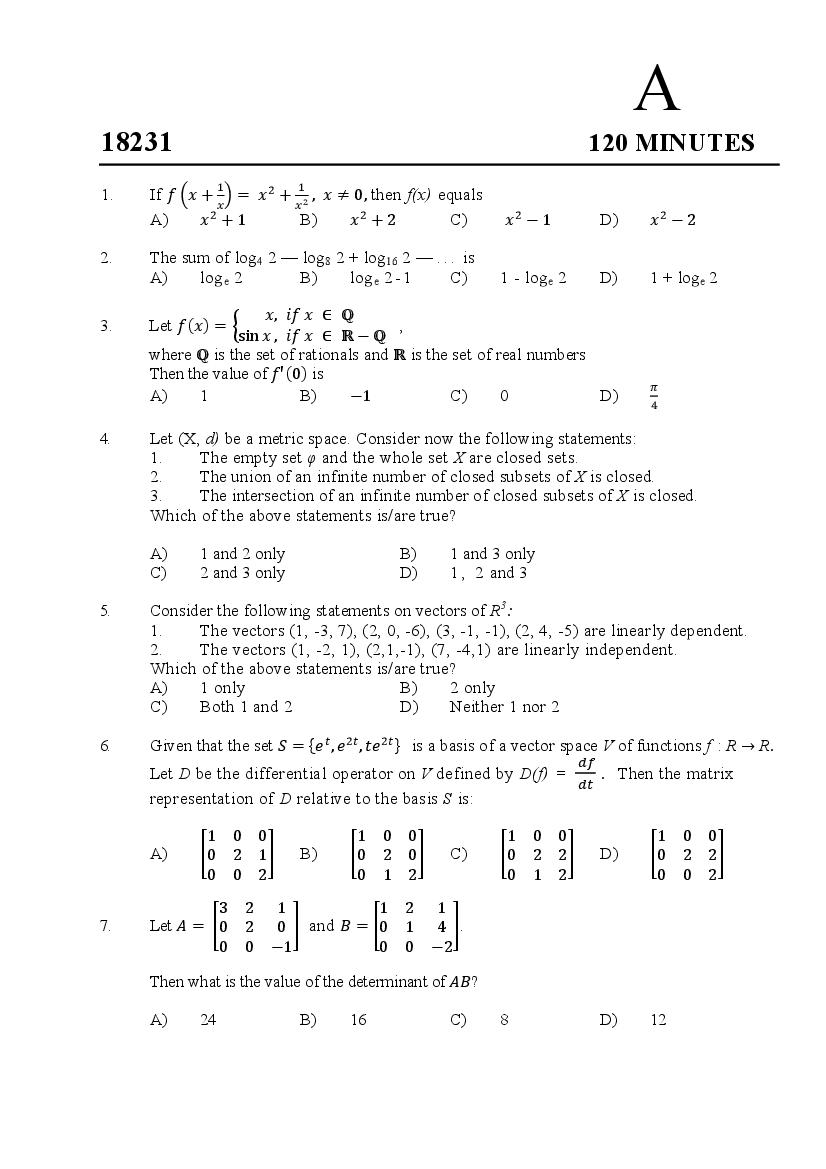
18231 120 MINUTES
1. If + = + , ≠ 0, then f(x) equals
A) +1 B) +2 C) −1 D) −2
2. The sum of log4 2 — log8 2 + log16 2 — . . . is
A) log e 2 B) log e 2 - 1 C) 1 - log e 2 D) 1 + loge 2
, ∈ ℚ
3. Let ( ) = ,
sin , ∈ ℝ−ℚ
where ℚ is the set of rationals and ℝ is the set of real numbers
Then the value of ′(0) is
A) 1 B) −1 C) 0 D)
4. Let (X, d) be a metric space. Consider now the following statements:
1. The empty set φ and the whole set X are closed sets.
2. The union of an infinite number of closed subsets of X is closed.
3. The intersection of an infinite number of closed subsets of X is closed.
A) 1 and 2 only B) 1 and 3 only
C) 2 and 3 only D) 1 , 2 and 3
5. Consider the following statements on vectors of R3 :
1. The vectors (1, -3, 7), (2, 0, -6), (3, -1, -1), (2, 4, -5) are linearly dependent.
2. The vectors (1, -2, 1), (2,1,-1), (7, -4,1) are linearly independent.
A) 1 only B) 2 only
C) Both 1 and 2 D) Neither 1 nor 2
6. Given that the set ={ , , } is a basis of a vector space V of functions f : R → R.
Let D be the differential operator on V defined by D(f) = . Then the matrix
representation of D relative to the basis S is:
1 0 0 1 0 0 1 0 0 1 0 0
A) 0 2 1 B) 0 2 0 C) 0 2 2 D) 0 2 2
0 0 2 0 1 2 0 1 2 0 0 2
3 2 1 1 2 1
7. Let = 0 2 0 and = 0 1 4 .
0 0 −1 0 0 −2
Then what is the value of the determinant of ?
A) 24 B) 16 C) 8 D) 12
Page 2
matrix M. If ρ(A) = 5 and ρ(B) = 4, then what is the minimum value of ρ(AB)?
A) 1 B) 2 C) 3 D) 4
9. Let A + be used to denote the Moore-Penrose -inverse of a matrix A. Then
which of the following is true?
A) A+ exists always and is not unique
B) A+ exists always and is unique
C) A+ may not exist always and is unique if it exists
D) A+ is defined only when A is square matrix
10. Consider the following statements for limit superior and limit inferior of a sequence
{ } of sets:
1. limit inf An is the set of points belonging to all but finitely many of the sets An
2. limit sup An is the set of points belonging to infinitely many of the sets An
3. limit inf A n ⊂ limit sup A n
A) 1 and 2 only B) 1 and 3 only
C) 2 and 3 only D) 1, 2 and 3
11. Which one of the following statements about the Borel field of subsets of ℝ is not true?
A) is a σ-field generated by the class {(−∞, ), ∈ ℝ}
B) is a minimal σ-field containing the class {(−∞, ), ∈ ℝ}
C) is a field generated by the class {(−∞, ], ∈ ℝ}
D) is a σ-field generated by the class {(−∞, ], ∈ ℝ}
12. Let { } be a sequence of non-negative measurable functions and let be a measurable
function such that → in measure (μ). Then which of the following is true?
A) ∫ ≤ lim inf ∫
B) ∫ ≥ lim inf ∫
C) ∫ ≥ lim sup ∫
D) ∫ ≤ lim inf ∫ only for the case ∫ <∞
13. A fair coin is tossed 5 times. What is the probability that the number of heads exceeds
the number of tails?
A) B) C) D)
14. If P(A) = 0.9 and P(B) = 0.8, then the minimum value of P( ∩ ) is
A) 0.9 B) 0.8 C) 0.72 D) 0.7
2
Page 3
from the urn without replacement. Then probability that the drawn bulbs are of both
colors is:
A) B) C) D)
16. Person A speaks truth in 75 % cases and another person B speaks truth in 80 %
cases. Then the probability that they contradict each other is:
A) B) C) D)
17. Consider families with two children and assume that all possible distributions of gender
are equally likely. Let E be the event that a randomly chosen family has atmost one boy
and F, the event that the family has both genders. Then which of the following is true?
A) E and F are independent
B) E and F are not independent
C) E and F are mutually exclusive
D) E and F are independent and mutually exclusive
18. Let ∶ → be a random variable. Let be a σ-field of subsets of Ω and , the Borel
field of subsets of ℝ. Which of the following statements is not true?
A) ( ) ∈ for some ∈
B) ( ) ∈ ,∀ ∈
C) (−∞, ) ∈ , ∀ ∈ ℝ
D) ( )∈
19. Let X, Y be two random variables such that Cov (X, Y) = 0. Then we can conclude that
A) , are independent B) Cov (X2, Y2) = 0
3 3
C) Cov (X ,Y ) = 0 D) V(X + Y) = V(X) + V(Y)
, −2 < <2
20. Let the p.d.f. of a random variable be ( ) =
0, ℎ
Then ⎪ ⎪ < 1 is:
A) 0 B) ¼ C) ½ D) ¾
21. If X is a non-negative random variable with c.d.f. F and if E(X) exists, then the
expression for E(X) is
A) ∫ [ ( ) − 1] B) ∫ ( )
C) ∫ [1 + ( )] D) ∫ [1 − ( )]
22. Let ( ) be the probability generating function of a nonnegative integer valued random
variable . Then ∫ ( ) equals
A) B) C) D) ( )
3
Page 4
A) B) C) D) 1
24. Let { , ≥ 1} be a sequence of random variables defined on a probability space
(Ω, A, P) and be a random variable, defined on the same probability space. Now,
consider the following relations among convergence of { }:
. .
(1) → ⟹ → (2) → ⟹ → (3) ⟹ →
Which of the above relations is/are true?
A) 1 and 2 only B) 1 and 3 only C) 2 and 3 only D) 1 , 2 and 3
25. Let { } be a sequence of i.i.d. random variables and for ≥ 1, let = ∑ .
. .
Then if and only if ⎪ ⎪ < ∞, where = ( ). This law of large
numbers is known as:
A) Kolmogorov's B) Khintchin's
C) Chebychev's D) Bernoulli's
26. Name the version of the central limit theorem given below:
Let { } be a sequence of i.i.d. random variables for which ( ) < ∞ and let
= ∑ , ≥ 1. If ( )= and ( )= > 0, then → , where
√
~ (0, 1).
A) Lindberg-Levy B) Demoivre- Laplace
C) Lindberg-Feller D) Liapunouv
27. Let X have binomial distribution with mean 10. Then which one of the following is a
possibility for the variance of X?
A) 14 B) 12 C) 4 D) 6
28. Given that random variable X has a Poisson distribution with parameter value 1. Then
value of [1/( + 1)] is:
A) 1 - (1/e) B) 1/e C) 1/2 D) 1
29. Consider the hyper geometric distribution based on M items of first kind and N — M items
of second kind, from which n items are drawn without replacement at random. If X denotes
the number of items of the first kind in the sample, then E(X) is
A) B) C) D)
4
Page 5
30. Suppose that X is a random variable with p.d.f. given by ( ) =
0, ℎ .
Given that 0.04, 0.36, 0.0225, 0.0625 and 0.49 are five randomly drawn numbers in the
interval (0,1). Using the above random numbers, which of the following can be
considered a random sample drawn from the above distribution?
A) 0.04, 0.36, 0.0225, 0.0625, 0.49
B) 0.08, 0.72, 0.045, 0.125, 0.98
C) 0.02, 0.18, 0.01125, 0.03125, 0.245
D) 0.2, 0.6, 0.15, 0.25, 0.7
31. If X follows a beta distribution of the first kind with parameters α and β, denoted by
( , β), then the distribution of 1− X is
A) ( , )
B) ( , )
C) gamma with parameters with α and β
D) gamma with parameters with β and α
32. Distribution of a sample mean is the same as that of each component random variable in
the sample. Then the distribution can be
A) Cauchy
B) Normal
C) Discrete distribution taking nonnegative integers
D) Exponential
33. Let and be independent standard normal variates. Consider now the following
statements:
1. The distribution of ( − ) is the standard normal.
2. The distribution of ( / ) is the standard Cauchy.
3. The distribution of ( + ) is ( )
A) 1 and 2 only B) 1 and 3 only
C) 2 and 3 only D) 1 , 2 and 3
34. If , , … . is a random sample of size n arising from (0,1), then the
distribution of the first order statistic : is
A) uniform over (0,1)
B) standard Cauchy
C) beta distribution of the second kind with parameters (n, 1)
D) beta distribution of the first kind with parameters ( 1, n )
5
Page 6
p.d.f., ( ) = , ≥ 0. Then the distribution of = : − : is
A) exponential with mean 1 B) exponential with mean
C) exponential with mean D) exponential with mean r
36. If X is the standard normal random variable, then the distribution of is
A) exponential with parameter value 1/2
B) gamma with parameter values (1/2, 1/2)
C) Cauchy with parameter values (1/2, 1/2)
D) normal with mean 0 and variance 1
37. If , , are independent standard normal variates, then the distribution of
√
= is
A) Student's t with 1 d.f. B) standard normal
C) Student's t with 2 d.f. D) F with (1, 2) degrees of freedom
38. Given { , > 4.30} = 0.05, where , is −statistic with 10 and 12 degrees of
freedom. Then the value of { , < 0.2326} is
A) 0.50 B) 0.01 C) 0.05 D) 0.95
39. Let ( , ) ~ bivariate normal ( , , , ) Then the conditional distribution of
X/Y = y is
A) univariate + ( − ),
B) univariate + ( − ), (1 − )
C) univariate + ( − ),
D) univariate + ( − ), (1 − )
40. Consider the following statements on some bivariate distributions:
1. There is only one bivariate normal distribution for which both marginal
distributions are univariate normal distributions.
2. There are many bivariate exponential distributions for which marginal
distributions are univariate exponential distributions.
A) 1 only B) 2 only
C) Both 1 and 2 D) Neither 1 nor 2
6
Page 7
Consider the following statements:
1. The nth order statistic : is unbiased for θ.
2. : is consistent for θ.
Then which of the above statements is/are true?
A) 1 only B) 2 only C) Both 1 and 2 D) Neither 1 nor 2
42. If , ,…., are i.i.d. random variables with common distribution with p.d.f
( , )= ( )
, > ; ∈ ℝ , then UMVUE of is
A) : − B) : C) : D) : +
43. If , , … . are i.i.d. random variables with common ( , 1) distribution,
where ∈ ℝ , then an ancillary statistic for θ is given by
A) : B) :
C) D) ∑ ( − )
( )
44. Let X have the Bernoulli distribution with parameter , 0 ≤ ≤ 1 and let
ℎ( ) = (1 − ) be a parametric function. If X1, X2, . . ., Xn are independent and
identically distributed as Bernoulli distribution, then the maximum likelihood
estimator (m.l.e.) of h(θ) is given by
A) X B) (l− ) C) ( )2 D) ( − 1)
45. Let , ,…., be a random sample from [ − + .]. Then an m.l.e. of θ is
∶ ∶ ∶ – ∶
A) B) C) ∶ − D) ∶ +
46. Which of the following statements about the moment estimators is not true?
1. Moment estimators are asymptotically unbiased.
2. Moment estimators are generally consistent.
3. Moment estimators are always efficient.
4. Moment estimators are asymptotically normal under certain conditions.
A) 1 B) 2 C) 3 D) 4
7
Page 8
∶ = 1 against ∶ = 2, the test to be used is given by
1, >2
( )=
0, ℎ
Then power of the test is given by
A) B) C) D)
48. Consider the following statements for likelihood ratio test:
1. For testing ∈ ⊝ against ∈ ⊝ , the likelihood ratio test is a function
of every sufficient statistic for θ.
2. Under some regularity conditions, −2ln λ( ) under is asymptotically
distributed as chi-square.
A) 1 only B) 2 only C) Both 1 and 2 D) Neither 1 nor 2
49. To test H 0 : M = M 0 , where M is the median of a distribution function F(x) and M 0
is a specified value. Assume that F(x) is continuous in the vicinity of M.
Let θ = P{X > M 0 } = P{X < M 0 } and let K be the test statistic. Then the null
distribution of K is
A) Poisson (θ) B) Binomial (n, θ)
C) Bernoulli (θ) D) Geometric (θ)
50. Observed values in two independent samples from two continuous distributions with
distribution functions F and G are as follows:
X: 2, 3, 5, 7, 9, 11, 16
Y: 4, 6, 8, 10, 12, 13, 14, 17
The value of the Mann-Whitney test statistic U for testing H 0 : F(x) = G(x), ∀ is
given by
A) 40 B) 39 C) 37 D) 41
51. Consider the following statements for the sequential probability ratio test (SPRT):
1. The sample size is fixed.
2. SPRT is intended to test a simple null hypothesis against a composite
alternate hypothesis.
A) 1 only B) 2 only C) both 1 and 2 D) neither 1 nor 2
8
Page 9
(1 — α)-level confidence interval for is given by
( ) ( )
A) , B) ,
, / , / , / , /
C) , D) ,
, / , / , / , /
53. If the loss function is the absolute error, ( , ) = | — |, then the Bayes' estimator
of a real parameter is given by
A) mean of the posterior distribution of θ
B) median of the posterior distribution of θ
C) median of the prior distribution of θ
D) mode of the posterior distribution of θ
54. Consider the following statements regarding consistency of an estimator Tn of a
parameter θ:
1. is consistent for θ if → .
2. If is consistent for θ, then E( ) ⟶ and V( ) ⟶ 0 as n ⟶ ∞ .
3. Consistency is a large sample property
A) 1 and 2 only B) 1 and 3 only
C) 2 and 3 only D) 1, 2 and 3
55. From a population of size 10, a sample of size 3 is drawn. Then the total number of
possible samples to be drawn from the population using SRSWR exceeds the total
number of samples using SRSWOR by a number equal to
A) 880 B) 520 C) 120 D) 50
56. Let a population of size N = 5 have its mean = 12 and S2 = 100. A simple random
sample of size n = 2 is drawn without replacement. If the sample mean is , then
E( ) is:
A) 30 B) 50 C) 144 D) 174
57. If a stratified sample of size 45 is to be selected by Neymann allocation from a
population with = 150, = 350, = 4, = 9, then the number of units
to be selected from the first stratum is:
A) 20 B) 10 C) 35 D) 75
58. From a population of size 20, a sample of size 4 is to be selected by systematic sampling.
If the 3 rd unit is first selected, then what are the other units?
A) 7, 15, 20 B) 5, 9, 13 C) 18, 13, 8 D) 7, 15, 18
9
Page 10
of is
A) 625 B) 575 C) 550 D) 525
60. A sample of 2 units is to be selected from a population of N units as described below.
In the first draw one unit is drawn from the population with probabilit y
proportional to its size and in the next draw, one unit is drawn by simple random
sampling from the remaining (N −1) population units. If the selection probability of a
particular unit in the first draw is p, then the probability that this unit is included in the
sample is given by
( ) ( )
A) + B) +
1
C) + −1
D)
61. Consider the probability proportional to size sampling scheme without replacement in
which two units and are drawn at the first and second draws respectively from a
population of N units. Let and be the characteristic values of and with
respective initial probabilities of selection and . Then which of the following
estimators is not an unbiased estimator of the population mean?
1 ( 1)
A) B) [ 1+ 2
]
1 2
( 1) 1 ( 1) 1
C) [ 1
+ 2
] D) [ 1
+ 2
]
1 2 1 2
62. Let , , , be four independent random observations with means
( )= + =E(Y3 ), E(Y2 ) = + = E(Y ) and common variance σ2 . Consider
the following statements:
1. − is estimable.
2. + 2 − is estimable.
A) 1 only B) 2 only C) Both 1 and 2 D) Neither 1 nor 2
63. Consider the following statements on linear combinations of observations Y , Y , Y .
1. Y — 2Y + Y is a linear contrast.
2. The linear contrasts Y + Y — 2Y and 2Y — 2Y are orthogonal.
A) 1 only B) 2 only C) Both 1 and 2 D) Neither 1 nor 2
64. Which of the following principles of experimentation is/are used in the completely
randomized design?
A) Local control only B) Replication only
C) Randomization only D) Both replication and randomization
10
Page 11
freedom of the error sum of squares is
A) − − B) − −1
C) − − +1 D) − − −1
66. In a Latin square design, what is an unbiased estimate of σ2 ?
A) row mean square B) column mean square
C) treatment mean square D) error mean square
67. For a 23 -factorial design with r replications, what is the error df?
A) 8 B) 6 C) 8(r-1) D) 6(r - 1)
68. Match List I with List II and select the correct answer using the codes given below the
lists.
List I List II
a. No local control 1. Analysis of covariance
b. Elimination of variation caused by concomitant variables 2. Incomplete Block Design
c. Handling of largeness of the no. of treatment combinations 3. CRD
d. Controlling of heterogeneity of the experimental material 4. Local control
Codes:
A) a-2, b-4, c-3, d-1 B) a-3, b-1, c-2, d-4
C) a-3, b-1, c-4, d-2 D) a-2, b-1, c-3, d-4
69. Let X , X ,..., X be N vectors constituting a sample from N p (μ, Σ), where p < N. If X
and A denote the sample mean vector and the matrix of sum of squares and products of
deviations about the mean, then maximum likelihood estimators of μ and Σ are
respectively given by
A) X and B) X and
C) X and D) X and
70. Let be a random vector which is assumed to be distributed as multivariate normal,
(0, ). Then a necessary and sufficient condit ion for the quadratic forms ′
and ′ to be independently distributed is that
A) = 0 B) ≠ 0 C) = 0 D) ≠0
71. If X , X ,..., X are N vectors which constitute a sample from (0, ) with being
non-singular, then the distribution of (X − μ ) Σ (X − μ ) is
A) ( ) B) ( ) C) ( ) D) ( )
11
Page 12
normalN (μ, Σ) with unknown dispersion matrix Σ, based on a sample
X , X ,..., X . If X and A denote the sample mean vector and the matrix of sum of
squares and products of deviations about the mean, then the test statistic T is
given by
A) N (X − μ )′ A (X − μ ) B) (N − 1) (X − μ )′ A (X − μ )
C) (X − μ )′ A (X − μ ) D) N(N − 1)(X − μ )′ A (X − μ )
73. The transit ion probabilit y matrix associated with a Markov chain is given by
1/2 1/2
P = and
1/3 2/3
one of the eigen values of P is 1/6. Then the other eigen value is
A) B) −1 C) 1 D) 0
74. Consider the following statements regarding a Markov chain:
1. A Markov chain is irreducible if all states communicate with each other.
2. In a finite-state Markov chain all states can be transient.
A) 1 only B) 2 only
C) Both 1 and 2 D) Neither 1 nor 2
75. For a Poisson process, the inter-arrival times are distributed as
A) i.i.d. gamma B) i.i.d. uniform
C) i.i.d. exponential D) i.i.d. Poisson
76. In a M/M/1 queue, suppose that customers arrive at a Poisson rate of one per every
12 minutes and that the service time is exponential at a rate of one service per 8
minutes. Then the average time a customer spends in the queue is
A) 16 minutes B) 24 minutes C) 12 minutes D) 20 minutes
77. Consider the model Y =T x S x C x I in time series analysis, where Y denotes the
observation at time t and T, S, C, I represent the effects of the components trend,
seasonal variation, cyclic variation and irregular variation respectively of a time
series. Then which of the following is not true of the model?
A) It is known as the multiplicative model
B) It is the most commonly used model in time series analysis
C) The model assumes the independence of the four components of the time
series
D) The model is used for prediction
12
Page 13
component viz. seasonal variation of a time series?
A) Ratio to trend method B) Simple average method
C) Moving average method D) Ratio to moving average method
79. If Laspeyre's index number is 324 and Fisher's ideal index number is 216, then the
Paasche's index number is:
A) 121 B) 144 C) 169 D) 196
80. The following are some of the adequacy tests for index numbers:
1. Time reversal test
2. Factor reversal test
3. Circular test
Then which of the above tests are satisfied by Fisher's ideal index number?
A) 1 and 2 only B) 1 and 3 only
C) 2 and 3 only D) 1, 2 and 3
_______________________
13
Document Details
| Board / Org | Kerala Exams |
| Exam | Kerala SET |
| Type | Question Paper |
| Pages | 13 |
| Updated | 23 Oct 2026 |