AP Class 12 Model Paper 2027 Chemistry
Finished viewing? Save it for later —
Download AP Class 12 Model Paper 2027 Chemistry (PDF · 3 pages)About AP Class 12 Model Paper 2027 Chemistry
AP Class 12 Model Paper 2027 Chemistry is available here for free download. Published by Andhra Pradesh Board for Class 12, this document can be viewed online or downloaded as a PDF (3 pages). Candidates preparing for Class 12 can use AP Class 12 Model Paper 2027 Chemistry to understand the exam pattern, the type of questions asked, and the overall difficulty level.
Frequently Asked Questions
How can I download AP Class 12 Model Paper 2027 Chemistry?
Open this page and click the Download button to save AP Class 12 Model Paper 2027 Chemistry as a PDF. It is completely free on AglaSem Docs.
Is AP Class 12 Model Paper 2027 Chemistry free to download?
Yes. AP Class 12 Model Paper 2027 Chemistry can be viewed online and downloaded as a PDF free of cost on AglaSem Docs.
How many pages does AP Class 12 Model Paper 2027 Chemistry have?
AP Class 12 Model Paper 2027 Chemistry contains 3 pages, which you can read online or download together as a single PDF.
Where can I find more Class 12 study material?
You can find more Class 12 question papers, sample papers, syllabus, and answer keys on AglaSem Docs.
AP Class 12 Model Paper 2027 Chemistry – Text
Read the full text of this below — useful to quickly search, copy and reference the content online without downloading the PDF.
📄 View text version (3 pages)
Page 1
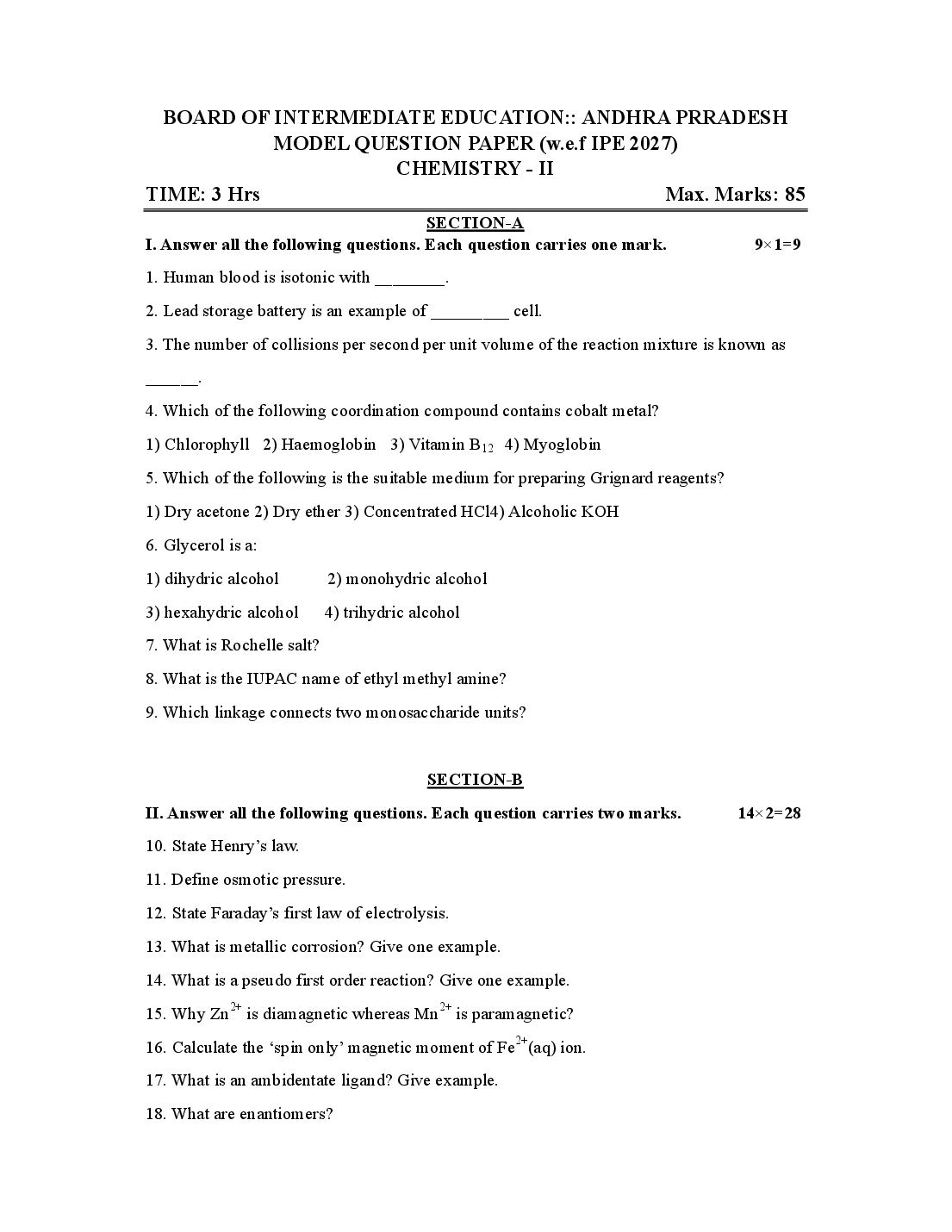
MODEL QUESTION PAPER (w.e.f IPE 2027)
CHEMISTRY - II
TIME: 3 Hrs Max. Marks: 85
SECTION-A
I. Answer all the following questions. Each question carries one mark. 9×1=9
1. Human blood is isotonic with ________.
2. Lead storage battery is an example of _________ cell.
3. The number of collisions per second per unit volume of the reaction mixture is known as
______.
4. Which of the following coordination compound contains cobalt metal?
1) Chlorophyll 2) Haemoglobin 3) Vitamin B12 4) Myoglobin
5. Which of the following is the suitable medium for preparing Grignard reagents?
1) Dry acetone 2) Dry ether 3) Concentrated HCl4) Alcoholic KOH
6. Glycerol is a:
1) dihydric alcohol 2) monohydric alcohol
3) hexahydric alcohol 4) trihydric alcohol
7. What is Rochelle salt?
8. What is the IUPAC name of ethyl methyl amine?
9. Which linkage connects two monosaccharide units?
SECTION-B
II. Answer all the following questions. Each question carries two marks. 14×2=28
10. State Henry’s law.
11. Define osmotic pressure.
12. State Faraday’s first law of electrolysis.
13. What is metallic corrosion? Give one example.
14. What is a pseudo first order reaction? Give one example.
15. Why Zn2+ is diamagnetic whereas Mn2+ is paramagnetic?
16. Calculate the ‘spin only’ magnetic moment of Fe2+(aq) ion.
17. What is an ambidentate ligand? Give example.
18. What are enantiomers?
Page 2
20. List the reagents suitable to reduce carboxylic acid to alcohol.
21. Arrange the following bases in increasing order of their basic strength. Aniline,
P - nitroaniline and p - toluidine.
22. What are essential and non-essential amino acids? Give one example for each.
23. Differentiate between globular and fibrous proteins.
SECTION-C
III. Answer any eight of the following questions. Each question carries four marks.
8×4=32
24. What is meant by positive deviations from Raoult’s law and how is the sign of “mixH”
related to positive deviation from Raoult’slaw?
25. State and explain Kohlrausch’s law of independent migration of ions.
26. What is molecularity of a reaction? How does it differ from the order of a reaction? Name
one bimolecular and one trimolecular gaseous reaction.
27. What are galvanic cells? Explain the working of a galvanic cell with a neat sketch taking
Daniell cell as an example.
28. Write the characteristics properties of transition elements.
29. What are homoleptic and heteroleptic complexes? Give one example for each.
30. Explain the mechanism of SN1 with example.
31. Explain the acidic nature of phenols and compare with that of alcohols.
32. Give the equations for the preparation of phenol from cumene.
33. What is Tollen’s reagent? Explain its reaction with aldehydes.
34. Explain the following named reactions:
i) Sandmeyer reaction ii) Gattermann reaction
35. Give the dietary sources of the following vitamins and name the diseases caused by their
deficiency:
a) A b) D c) E and d) K
Page 3
IV. Answer any two of the following questions. Each question carries eight marks.
2×8=16
36. Give a detailed account of the collision theory for reaction rates of bimolecular
gaseousreactions.
37. a) Write four postulates of Werner’s theory of coordination compounds.
b) Explain cis-trans isomerism in [Pt(NH3)2Cl2 ] complex.
38. Explain the following reactions.
a) Aldol reaction b) Esterification
c) H.V.Z. reaction d) Bromination of Benzoic acid
Document Details
| Board / Org | Andhra Pradesh Board |
| Exam | Class 12 |
| Pages | 3 |
| Language | english |
| Updated | 24 Sep 2026 |