MBOSE Class 10 Question Paper 2020 for Computer Science Old Course
Finished viewing? Save it for later —
Download MBOSE Class 10 Question Paper 2020 for Computer Science Old Course (PDF · 16 pages)About MBOSE Class 10 Question Paper 2020 for Computer Science Old Course
MBOSE Class 10 Question Paper 2020 for Computer Science Old Course is available here for free download. Published by Meghalaya Board for Class 10, this question paper can be viewed online or downloaded as a PDF (16 pages). Candidates preparing for Class 10 can use MBOSE Class 10 Question Paper 2020 for Computer Science Old Course to understand the exam pattern, the type of questions asked, and the overall difficulty level.
Frequently Asked Questions
How can I download MBOSE Class 10 Question Paper 2020 for Computer Science Old Course?
Open this page and click the Download button to save MBOSE Class 10 Question Paper 2020 for Computer Science Old Course as a PDF. It is completely free on AglaSem Docs.
Is MBOSE Class 10 Question Paper 2020 for Computer Science Old Course free to download?
Yes. MBOSE Class 10 Question Paper 2020 for Computer Science Old Course can be viewed online and downloaded as a PDF free of cost on AglaSem Docs.
How many pages does MBOSE Class 10 Question Paper 2020 for Computer Science Old Course have?
MBOSE Class 10 Question Paper 2020 for Computer Science Old Course contains 16 pages, which you can read online or download together as a single PDF.
Where can I find more Class 10 study material?
You can find more Class 10 question papers, sample papers, syllabus, and answer keys on AglaSem Docs.
MBOSE Class 10 Question Paper 2020 for Computer Science Old Course – Text
Read the full text of this question paper below — useful to quickly search, copy and reference the content online without downloading the PDF.
📄 View text version (16 pages)
Page 1
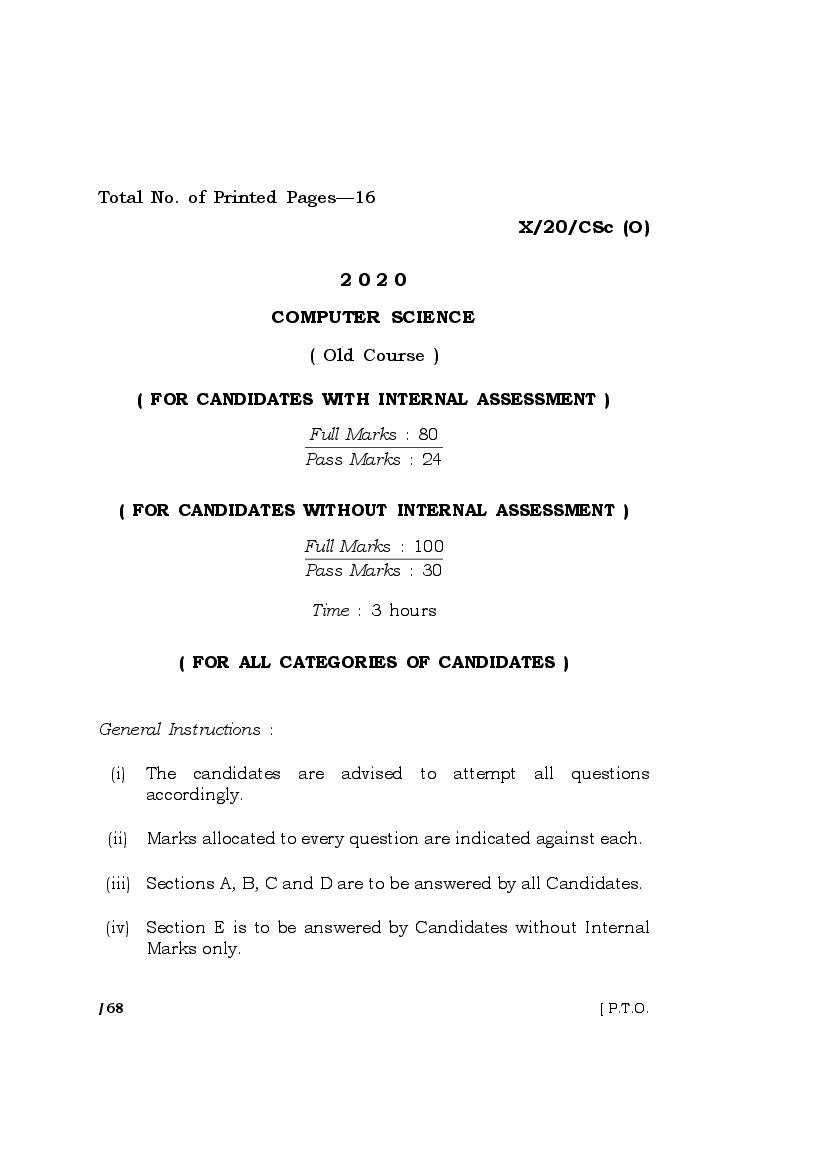
X/20/CSc (O)
2020
COMPUTER SCIENCE
( Old Course )
( FOR CANDIDATES WITH INTERNAL ASSESSMENT )
Full Marks : 80
Pass Marks : 24
( FOR CANDIDATES WITHOUT INTERNAL ASSESSMENT )
Full Marks : 100
Pass Marks : 30
Time : 3 hours
( FOR ALL CATEGORIES OF CANDIDATES )
General Instructions :
(i) The candidates are advised to attempt all questions
accordingly.
(ii) Marks allocated to every question are indicated against each.
(iii) Sections A, B, C and D are to be answered by all Candidates.
(iv) Section E is to be answered by Candidates without Internal
Marks only.
/68 [ P.T.O.
Page 2
SECTION—A
( COMPUTER FUNDAMENTALS )
( Maximum Marks : 20 )
( Objective-type Questions )
I. Choose and write the correct answer for the following
(any three) : 1×3=3
1. Which of the following number systems has no base
at all?
(a) Binary
(b) Octal
(c) Decimal
(d) Roman
2. What is the decimal equivalent of the binary number
11011?
(a) 31 (b) 27
(c) 26 (d) 30
3. What is the product of (10110)2 × (101)2?
(a) (1101110)2
(b) (11100)2
(c) (101011)2
(d) (110011)2
X/20/CSc (O)/68 [ Contd.
Page 3
4. The OR operator is represented by the symbol
(a) “ · ”
(b) “ + ”
(c) “–”
(d) “ * ”
5. Which of the following Boolean expressions
represents the NOR gate?
(a) Y A · B (b) Y A B
(c) Y AB (d) Y A
6. The 2’s complement of 1001001 is
(a) 0110111
(b) 0110110
(c) 1110110
(d) 1110111
II. State whether the following statements are True or False
(any two) : 1×2=2
1. EBCDIC represents a total of 256 characters.
2. Hexadecimal number system has base 10.
3. The binary equivalent of decimal number (0·428)10
is (0·011)2.
4. The computer logic circuits are based on Boolean
expressions.
X/20/CSc (O)/68 [ P.T.O.
Page 4
III. Fill in the blanks of the following sentences (any two) :
1×2=2
1. A combination of the AND gate and the NOT gate is
known as the _____ gate.
2. The computer actually performs subtraction by the
process of _____.
3. The ASCII uses 7 bits, thereby allowing a total of
_____ different codes.
4. The computer recognizes only two states of current,
that is ______.
( Short Answer-type Questions )
IV. Answer the following questions : 1×3=3
1. What is BCD?
2. Subtract (1110011)2 from (110011)2 using the 2’s
complement method.
3. Give the truth table for the expression
Y AB
( Descriptive-type Questions )
V. Either
(a) (i) Explain briefly the positional and non-positional
number systems. 1+1=2
(ii) Differentiate between the 1’s complement and
the 2’s complement with examples. 1½+1½=3
Or
(b) (i) Convert the following :
(1101·101)2 = ( ? )10 1
(ii) Verify the following Boolean expression using
truth table : 2
X Y ·Z ( X Y )·( X Z )
(iii) Divide (11101011)2 by (101)2. 2
X/20/CSc (O)/68 [ Contd.
Page 5
VI. Either
(a) (i) What is the difference between a bit and
a byte? 1+1=2
(ii) Draw the Logic circuit for the following : 3
A (x y )·(x z )·(y z )
[ For the Visually Handicapped (Blind) Students only
in lieu of Question No. VI(a)(ii) above ]
(ii) Differentiate between the NOR gate and the
NAND gate. 3
Or
(b) (i) Why is the ASCII code important for computer
operation? 2
(ii) Give the Boolean expression of the following logic
circuit : 3
[ For the Visually Handicapped (Blind) Students only
in lieu of Question No. VI(b)(ii) above ]
(ii) Explain the AND operation with its truth table.
1½+1½=3
X/20/CSc (O)/68 [ P.T.O.
Page 6
SECTION—B
( ADVANCED DOS AND LINUX )
( Maximum Marks : 20 )
( Objective-type Questions )
I. Choose and write the correct answer for the following
(any two) : 1×2=2
1. Which of the following commands is used to view the
list of directories and subdirectories present in the
disk in graphical form?
(a) DIR
(b) LIST
(c) TREE
(d) VOL
2. Which of the following is not a valid LINUX
command?
(a) data
(b) pwd
(c) cat
(d) touch
3. Which of the following commands is a filter?
(a) DOSKEY (b) FIND
(c) FORMAT (d) MOVE
X/20/CSc (O)/68 [ Contd.
Page 7
4. Which of the following is not permission associated
with the chmod command in Linux?
(a) r
(b) w
(c) x
(d) y
II. State whether the following statements are True or False
(any two) : 1×2=2
1. In Linux, every user is assigned an individual home
directory.
2. FORMAT is an internal command in DOS.
3. The DOS command XCopy is used to selectively copy
files from one disk to another.
4. In Linux, a user can remove a directory by using
‘rmdir’ command without having write and execute
permission.
III. Fill in the blanks of the following sentences (any two) :
1×2=2
1. _____ DOS command is used to change/modify the
name(s) of a file or files.
2. The _____ DOS command is used to display one
screen of output at a time.
3. _____ is the process by which a file is written on a
disk in parts.
4. The _____ directory contains executable files for most
of the commands in Linux.
X/20/CSc (O)/68 [ P.T.O.
Page 8
( Short Answer-type Questions )
IV. Write the commands and their switches (or options) for
the following (any two ) : 2×2=4
1. List the contents of your home directory in Linux
with file types.
2. Delete all the files with extension .BAK in the
current directory with the option to confirm before
each one is deleted (in DOS).
3. Remove the fragmentation of files in D : drive
(in DOS).
4. Format the floppy in drive A : with the label set to
BOARD (in DOS).
( Descriptive-type Questions )
V. Either
(a) (i) What is the purpose of the REPLACE command? 1
(ii) How is proprietary software different from open-
source software? 2+2=4
Or
(b) (i) What does the ‘media’ directory contain in Linux? 1
(ii) How is DELTREE different from DEL? 2+2=4
VI. Either
(a) Name and explain five different types of directories
in Linux. 1+1+1+1+1=5
Or
(b) Explain in detail the EDIT command with syntax
and its various switches. 2+1+2=5
X/20/CSc (O)/68 [ Contd.
Page 9
SECTION—C
( QBASIC )
( Maximum Marks : 28 )
( Objective-type Questions )
I. Choose and write the correct answer for the following
(any two) : 1×2=2
1. Which of the following cannot be used as a valid
data type for a numeric type of data?
(a) INTEGER
(b) LONG
(c) DOUBLE
(d) STRING
2. Which of the following is not a relational operator?
(a) =
(b) <>
(c) >
(d) ^
3. Which one of the following is known as a user-
defined function?
(a) SUB-END SUB
(b) LIBRARY FUNCTION
(c) DEF-FN
(d) ON-GOSUB
X/20/CSc (O)/68 [ P.T.O.
Page 10
4. The library function which is used to find the
position of one string in another string is
(a) INSTR
(b) MID$
(c) CHR$
(d) RIGHT$
II. State whether the following statements are True or False
(any two) : 1×2=2
1. The format string used in PRINT USING statement
consists of one or more character(s) having pre-
defined meaning.
2. A variable in QBasic may contain any number of
characters and special characters.
3. We cannot pass an entire array of cells to a
subprogram or a function.
4. A subprogram always begins with a SUB statement
and ends with the END SUB statement.
III. Fill in the blanks of the following sentences (any two) :
1×2=2
1. Every expression contains _____ and operators.
2. In the PRINT USING statement, the digit position is
denoted by the _____ symbol.
3. _____ functions are also called library functions.
4. In _____ type of array, you can easily change its size.
X/20/CSc (O)/68 [ Contd.
Page 11
IV. Answer the following questions : 1×3=3
1. What is global variable?
2. Explain briefly the MID$ statement.
3. Write the QBasic expression of
2
abc
b
a
( Short Answer-type Questions )
V. Answer the following questions within 2 or 3 sentences
or steps each (any two ) : 2×2=4
1. How is a user-defined function different from
subroutines?
2. What is the use of the ERASE statement?
3. Why do we use the READ-DATA-RESTORE
statement? Explain with suitable example.
4. Differentiate between ASC and CHR$ functions.
( Descriptive-type Questions )
VI. Answer the following questions : 5×3=15
1. Either
(a) Explain the SELECT-CASE-END SELECT
structure. Discuss its various syntaxes with
examples. 5
Or
(b) Discuss the different versions of the DO...LOOP
statement. 5
X/20/CSc (O)/68 [ P.T.O.
Page 12
2. Either
(a) Write the output generated by the following
QBasic program : 5
DIM I AS INTEGER, J AS INTEGER
FOR I = 5 TO 9
FOR J = 1 TO 5
PRINT I * J;
NEXT J
NEXT I
END
Or
(b) Develop QBasic codes to generate all the
Armstrong numbers in the range 1 to 999. 5
3. Either
(a) Write a program to accept a sentence from the
user and count the number of words present in
the sentence. 5
Or
(b) Write a program to store the names of all your
classmates in a one-dimensional array and
display them in ascending order. 5
X/20/CSc (O)/68 [ Contd.
Page 13
SECTION—D
( JAVA CONCEPT )
( Maximum Marks : 12 )
( Objective-type Questions )
I. Choose and write the correct answer for the following
(any two) : 1×2=2
1. Which of the following operators is not in the
numeric category?
(a) %
(b) ++
(c) ––
(d) ||
2. Which of the following tools compiles a Java source
code?
(a) java
(b) javac
(c) java.io
(d) java.util
3. Which of the following is not a data type in Java?
(a) byte
(b) short
(c) single
(d) float
X/20/CSc (O)/68 [ P.T.O.
Page 14
4. A collection of objects of same type is called a/an
(a) method
(b) class
(c) data member
(d) object
II. State whether the following statements are True or False
(any two) : 1×2=2
1. A constant in Java is declared by using the
keyword ‘final’.
2. The scanner class is defined in the package
‘java.util’.
3. The process of creating an object from a class is
called instantiation.
4. Java is case-insensitive.
III. Fill in the blanks of the following sentences (any two) :
1×2=2
1. By default the starting index of an array is _____.
2. Boolean operator && represents _____ operator.
3. ‘float’ data type is stored in _____ bytes.
4. The _____ visibility modifier makes the data
members and methods invisible or inaccessible to
the outside classes.
X/20/CSc (O)/68 [ Contd.
Page 15
IV. Answer the following questions : 1×3=3
1. Expand JSL.
2. Name the two categories of data types in Java.
3. Define encapsulation.
V. Either
(a) What is a class and how is it different from an
object? 1½+1½=3
Or
(b) What is a method? What do we understand by
overloading of methods? 1½+1½=3
SECTION—E
( Maximum Marks : 20 )
( For Candidates without Internal Assessment )
I. Answer the following questions within 2 or 3 sentences
each (any five) : 2×5=10
1. What is the difference between the TAB function and
the SPC function? 1+1=2
2. What are the different data types available in QBasic? 2
3. Differentiate between the INPUT statement and the
LINE INPUT statement. 1+1=2
4. How can PRINT USING be used for string types of
data? Give examples. 1+1=2
5. How is an argument passed to a subprogram or
a function? Explain. 1+1=2
6. How is the FIX function different from the INT
function? Give examples. 1+1=2
X/20/CSc (O)/68 [ P.T.O.
Page 16
II. Answer the following questions : 5×2=10
1. Either
(a) Write a QBasic program to display a given
integer by reversing its digits. 5
Or
(b) Write a program to display the largest and the
smallest elements in an array containing n
number of elements. 5
2. Either
(a) What are the rules for naming a variable
in QBasic? 5
Or
(b) Enumerate the rules for READ-DATA statement. 5
X/20/CSc (O)/68 20K
Document Details
| Board / Org | Meghalaya Board |
| Exam | Class 10 |
| Type | Question Paper |
| Pages | 16 |
| Updated | 30 Apr 2026 |