PGDBA 2027 Sample Paper
Finished viewing? Save it for later —
Download PGDBA 2027 Sample Paper (PDF · 11 pages)About PGDBA 2027 Sample Paper
PGDBA 2027 Sample Paper is available here for free download. Published by IIM for PGDBA, this sample paper can be viewed online or downloaded as a PDF (11 pages). Candidates preparing for PGDBA can use PGDBA 2027 Sample Paper to understand the exam pattern, the type of questions asked, and the overall difficulty level.
Frequently Asked Questions
How can I download PGDBA 2027 Sample Paper?
Open this page and click the Download button to save PGDBA 2027 Sample Paper as a PDF. It is completely free on AglaSem Docs.
Is PGDBA 2027 Sample Paper free to download?
Yes. PGDBA 2027 Sample Paper can be viewed online and downloaded as a PDF free of cost on AglaSem Docs.
How many pages does PGDBA 2027 Sample Paper have?
PGDBA 2027 Sample Paper contains 11 pages, which you can read online or download together as a single PDF.
Where can I find more PGDBA study material?
You can find more PGDBA question papers, sample papers, syllabus, and answer keys on AglaSem Docs.
PGDBA 2027 Sample Paper – Text
Read the full text of this sample paper below — useful to quickly search, copy and reference the content online without downloading the PDF.
📄 View text version (11 pages)
Page 1
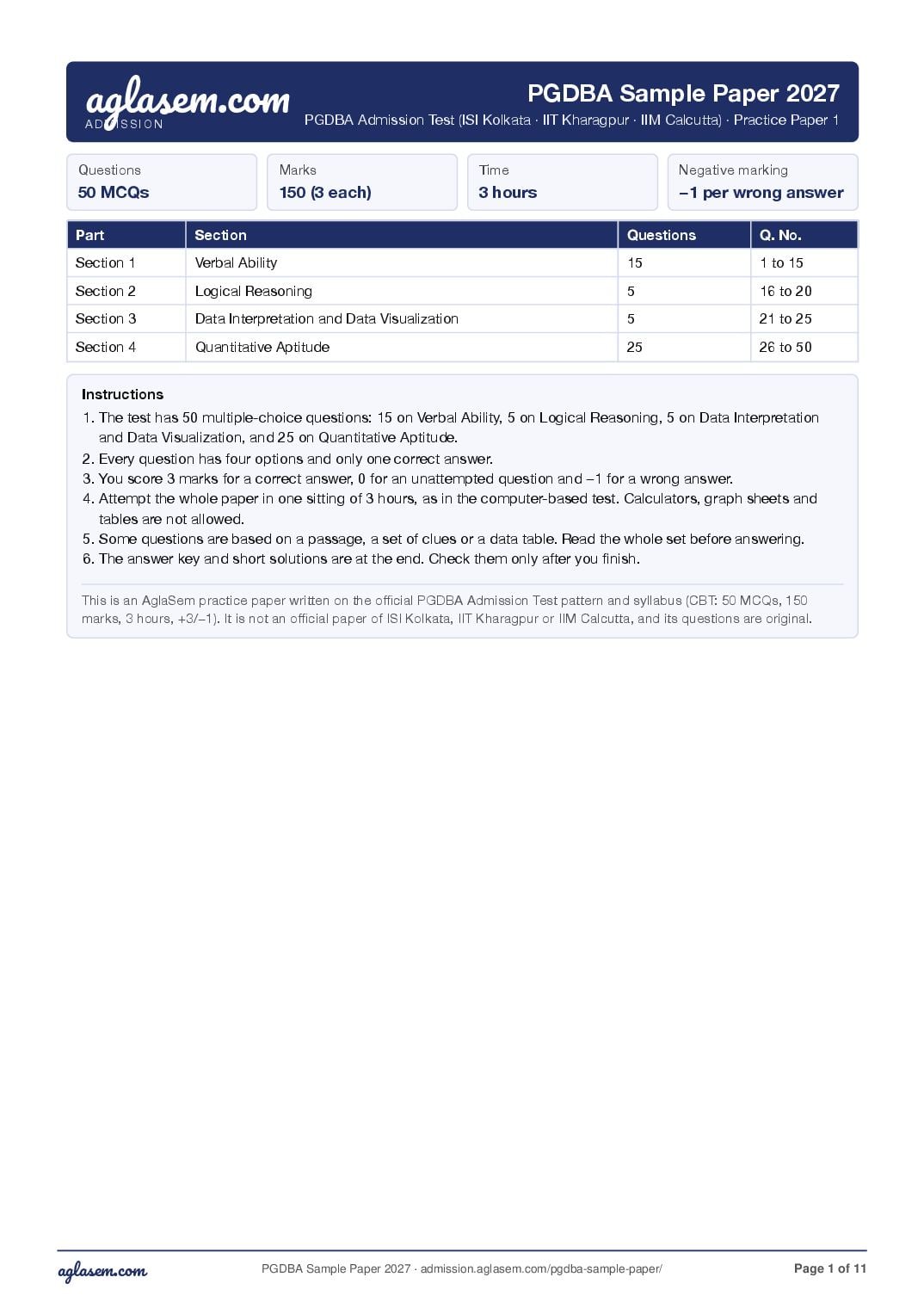
PGDBA Sample Paper 2027
PGDBA Admission Test (ISI Kolkata · IIT Kharagpur · IIM Calcutta) · Practice Paper 1
Questions Marks Time Negative marking
50 MCQs 150 (3 each) 3 hours −1 per wrong answer
Part Section Questions Q. No.
Section 1 Verbal Ability 15 1 to 15
Section 2 Logical Reasoning 5 16 to 20
Section 3 Data Interpretation and Data Visualization 5 21 to 25
Section 4 Quantitative Aptitude 25 26 to 50
Instructions
1. The test has 50 multiple-choice questions: 15 on Verbal Ability, 5 on Logical Reasoning, 5 on Data Interpretation
and Data Visualization, and 25 on Quantitative Aptitude.
2. Every question has four options and only one correct answer.
3. You score 3 marks for a correct answer, 0 for an unattempted question and −1 for a wrong answer.
4. Attempt the whole paper in one sitting of 3 hours, as in the computer-based test. Calculators, graph sheets and
tables are not allowed.
5. Some questions are based on a passage, a set of clues or a data table. Read the whole set before answering.
6. The answer key and short solutions are at the end. Check them only after you finish.
This is an AglaSem practice paper written on the official PGDBA Admission Test pattern and syllabus (CBT: 50 MCQs, 150
marks, 3 hours, +3/−1). It is not an official paper of ISI Kolkata, IIT Kharagpur or IIM Calcutta, and its questions are original.
PGDBA Sample Paper 2027 · admission./pgdba-sample-paper/ Page 1 of 11
Page 2
Verbal Ability
The passage below is followed by five questions. Choose the best answer to each question.
Imagine a screening test for a rare condition that affects one person in a thousand. The test is good: it
correctly flags 99 per cent of people who have the condition, and wrongly flags only 2 per cent of those
who do not. A person tests positive. How worried should she be? Most people, including many trained
professionals, guess that she almost certainly has the condition. The arithmetic says otherwise. In a town
of 100,000, about 100 people have the condition and the test catches 99 of them. But of the 99,900 who
are healthy, 2 per cent, nearly 2,000, are flagged as well. Of roughly 2,100 positive results, fewer than one
in twenty belongs to someone who is actually ill.
The error has a name: base-rate neglect. When we judge a single case, the vivid, specific evidence in front
of us, the positive result, crowds out the dull background fact of how common the condition is to begin
with. The same pattern appears in judgements about professions, crimes and machine failures alike. It is
not that people cannot do the sum; it is that the question, as usually framed, does not invite them to.
That last point suggests a remedy. When the same problem is presented in natural frequencies ('out of
1,000 people, 1 has the condition…') rather than in percentages and conditional probabilities, far more
people reach the right answer. The information is identical; only its packaging differs. Counting imagined
people seems to come more easily to us than multiplying abstract chances.
The lesson matters well beyond medicine. A fraud-detection system that flags suspicious transactions, a
filter that marks e-mails as spam and an algorithm that predicts which machines will fail all face the same
trap whenever the event they hunt for is rare. Even a highly accurate detector will produce mostly false
alarms if genuine cases are scarce enough. Those who design such systems must therefore ask not only
'How accurate is the test?' but also 'How rare is the thing we are looking for?', and those who receive the
alarms deserve to be told the answer to both.
1. The primary purpose of the passage is to:
(A) prove that trained professionals are worse at arithmetic than ordinary people
(B) explain the methods banks use to design their systems for detecting fraud
(C) show that judging a single case requires knowing how common the event is to begin with
(D) argue that medical screening tests are usually inaccurate and should therefore be abandoned
altogether
2. Suppose that in the passage's example the condition affected 1 person in 100 instead of 1 in 1,000,
with the test unchanged. The share of positive results that belong to people who actually have the
condition would then be closest to:
(A) nine in ten (B) one in two
(C) one in twenty (D) one in three
3. As used in the passage, "natural frequencies" refers to:
(A) the number of times a test is repeated on one person
(B) stating information as counts of cases out of a whole group
(C) percentages and conditional probabilities given together
(D) the rate at which a condition occurs naturally in animals
4. With which statement would the author most likely agree?
(A) Base-rate neglect occurs only in medical decisions
(B) Alarm systems for rare events should be designed to raise fewer false alarms than true ones in every
case
(C) Psychologists have shown that people simply cannot do probability sums
(D) A detector's accuracy alone does not tell us how far to trust its alarms
PGDBA Sample Paper 2027 · admission./pgdba-sample-paper/ Page 2 of 11
Page 3
(A) the cost of collecting the information
(B) the way the information is presented
(C) the boxes in which test kits are sent
(D) the amount of information supplied
The passage below is followed by five questions. Choose the best answer to each question.
For much of the twentieth century, the standard story about shared resources was a gloomy one. A
pasture open to all, the argument ran, will be overgrazed, because each herder gains the full benefit of
adding one more animal while bearing only a small share of the damage. Multiply that reasoning across
every herder and the pasture is ruined, even though no one wanted that outcome. The story was applied
to fisheries, forests, groundwater and the atmosphere, and it seemed to leave only two cures: hand the
resource to the state, or divide it into private plots.
Researchers who actually visited villages, irrigation systems and fishing grounds found a messier and
more hopeful picture. In many places, communities had managed common resources for generations
without either a distant government or private ownership; alpine meadows, village forests and irrigation
networks were among the examples studied. These arrangements did not rely on goodwill alone. They
had clear boundaries defining who could use the resource; rules suited to local conditions; ways for users
to take part in changing the rules; monitors who were themselves accountable to the users; graduated
penalties, mild for a first offence and harsher for repeated ones; and cheap, local ways of settling
disputes.
None of this means that the gloomy story is wrong. Where users are strangers, where they cannot talk to
one another, or where the resource is so vast that no group can watch over it, overuse remains a real
danger. The point is rather that the outcome depends on institutions, and that institutions can be
designed. The question 'state or market?' turned out to be too narrow; a third option, self-governance by
the users themselves, had been working quietly all along.
The lesson has been taken up well beyond pastures and fisheries. Open-source software projects, shared
databases and online communities wrestle with the same problems of free-riding and rule-making, and
the most durable of them look surprisingly like the old irrigation societies.
6. According to the "standard story", a pasture open to all is overused because:
(A) the state usually takes over shared land before it can be managed well
(B) each user gains fully from extra use but bears only part of the damage
(C) herders deliberately set out to ruin pastures shared with their rivals
(D) private owners always graze more animals than common users do
7. Which of the following was NOT described as a feature of the successful community arrangements?
(A) Penalties that were equally severe for every offence
(B) Monitors who were accountable to the users
(C) Clear boundaries defining who could use the resource
(D) A role for users in changing the rules
8. The author's attitude towards the "gloomy story" is best described as:
(A) indifference, since the author takes no position on it
(B) accepting that it holds under some conditions while rejecting it as a universal rule
(C) complete acceptance, since only the state or the market can protect a resource
(D) complete rejection, since the author shows that communities never overuse shared resources
PGDBA Sample Paper 2027 · admission./pgdba-sample-paper/ Page 3 of 11
Page 4
(A) A vast ocean fishery used by fleets that never communicate with one another
(B) A village forest managed for generations by its own residents
(C) A mountain meadow with clear rules on who may graze cattle there
(D) An irrigation network whose users elect the officials who monitor it
10. The final paragraph of the passage serves mainly to:
(A) summarise the case for dividing resources into private plots
(B) introduce new evidence suggesting that self-governance of resources usually fails in the end
(C) extend the argument to modern shared resources that are not natural
(D) describe the history of irrigation societies in detail
11. The four sentences (labelled 1, 2, 3 and 4) below, when properly sequenced, form a coherent
paragraph. Choose the most coherent order.
1. As a result, the same bridge may be described as 'safe' by one engineer and 'risky' by another,
without either of them being wrong.
2. Engineers rarely speak of a structure as simply safe or unsafe.
3. Instead, they estimate the probability that it will fail within a given period under the expected loads.
4. Whether that probability is acceptable, however, is a judgement that depends on what is at stake.
(A) 2, 3, 1, 4 (B) 2, 4, 3, 1
(C) 2, 3, 4, 1 (D) 3, 2, 4, 1
12. The four sentences (labelled 1, 2, 3 and 4) below, when properly sequenced, form a coherent
paragraph. Choose the most coherent order.
1. Yet sales of crisps and chocolate kept rising, while the new fruit counter went largely untouched.
2. From then on, they trusted the till receipts more than the questionnaires.
3. A retailer once surveyed its customers and found that most claimed to prefer healthy snacks.
4. The managers concluded that the survey had measured good intentions, not buying habits.
(A) 3, 4, 1, 2 (B) 3, 1, 2, 4
(C) 3, 1, 4, 2 (D) 1, 3, 4, 2
13. The four sentences (labelled 1, 2, 3 and 4) below, when properly sequenced, form a coherent
paragraph. Choose the most coherent order.
1. Bees, for instance, cannot see red, but they can see ultraviolet light, which is invisible to us.
2. A flower that looks dull to a gardener may therefore be a brightly marked landing strip for a bee.
3. Many flowers that look plain to human eyes carry ultraviolet patterns that point towards the nectar.
4. Insects and humans do not see the world in the same colours.
(A) 4, 3, 1, 2 (B) 4, 1, 3, 2
(C) 3, 1, 4, 2 (D) 1, 4, 3, 2
14. Fill in the blank with the most suitable word.
The committee's report was so ______ that even experts struggled to find a single clear
recommendation in it.
(A) convoluted (B) concise
(C) comprehensible (D) lucid
15. Which of the following sentences is grammatically correct?
(A) Each of the analysts have submitted their reports on time.
(B) The figures that was released by the ministry last week shows a decline.
(C) Neither the manager nor the analysts was aware of the error.
(D) Neither the manager nor the analysts were aware of the error.
PGDBA Sample Paper 2027 · admission./pgdba-sample-paper/ Page 4 of 11
Page 5
Logical Reasoning
The following information relates to all five questions on Logical Reasoning.
Five analysts, Asha, Bilal, Chen, Deepa and Eshan, each work for exactly one of five clients (Fintech,
Grocery, Hospital, Insurance and Logistics) and each uses exactly one of five tools (Python, R, SQL, Excel
and Tableau). No two analysts share a client or a tool.
1. Asha works for the Hospital client and uses neither Python, R nor Tableau.
2. The analyst for the Fintech client uses Python.
3. Chen uses SQL.
4. Deepa uses neither R nor Python.
5. Eshan works neither for the Fintech client nor for the Insurance client.
6. The analyst for the Grocery client uses R.
7. Chen does not work for the Insurance client.
16. Who works for the Insurance client?
(A) Chen (B) Eshan
(C) Deepa (D) Bilal
17. Which tool is used for the Logistics client?
(A) Tableau (B) SQL
(C) Excel (D) R
18. Which of the following pairs of analyst and tool is correctly matched?
(A) Chen – R (B) Deepa – SQL
(C) Eshan – R (D) Bilal – Excel
19. If clue 7 were removed, which of the following could no longer be determined with certainty?
(A) The client of Eshan
(B) The tool used by each of Bilal and Eshan
(C) The tool used by Asha
(D) The clients of Chen and Deepa
20. Which of the following statements is true?
(A) The analyst who uses Excel works for the Hospital client
(B) Chen works for the Grocery client
(C) The analyst for the Fintech client is Eshan, who uses Python
(D) The Tableau user works for the Logistics client
PGDBA Sample Paper 2027 · admission./pgdba-sample-paper/ Page 5 of 11
Page 6
Data Interpretation and Data Visualization
The table below shows the quarterly revenue (in ₹ crore) of a company's four product lines in one
year. Answer the next three questions.
Product line Q1 Q2 Q3 Q4
Alpha 40 45 50 65
Beta 60 55 50 45
Gamma 30 36 45 54
Delta 70 70 75 80
21. Which product line had the highest percentage growth in revenue from Q1 to Q4?
(A) Beta (B) Delta
(C) Gamma (D) Alpha
22. The share of Delta in the company's total revenue for the year is closest to:
(A) 37% (B) 28%
(C) 34% (D) 31%
23. Which of the following statements is true?
(A) Gamma's revenue grew by the same percentage from Q1 to Q2 as from Q3 to Q4
(B) Total revenue grew by more than 10% in every quarter
(C) Beta's revenue fell by the same percentage in every quarter
(D) Alpha's revenue for the year was more than Beta's
A survey asked 500 customers of a store for their preferred mode of payment. The results by age
group are given below. Answer the next two questions.
Age group UPI Card Cash Total
18–30 120 40 20 180
31–45 90 60 30 180
46–60 30 40 30 100
Above 60 5 10 25 40
Total 245 150 105 500
24. Of the customers who prefer cash, about what percentage are above 60 years of age?
(A) 63% (B) 24%
(C) 5% (D) 10%
25. A customer is picked at random from those aged 31 to 60. What is the probability that this customer
prefers UPI?
(A) 1/2 (B) 3/7
(C) 12/25 (D) 6/25
PGDBA Sample Paper 2027 · admission./pgdba-sample-paper/ Page 6 of 11
Page 7
Quantitative Aptitude
26. In a survey of 60 students, 30 like cricket, 25 like football and 20 like hockey. 10 like both cricket and
football, 8 like both football and hockey, 9 like both cricket and hockey, and 4 like all three. How many
students like none of the three games?
(A) 12 (B) 8
(C) 4 (D) 0
27. In how many ways can the letters of the word ANALYTICS be arranged so that the vowels A, A and I are
always together?
(A) 30240 (B) 5040
(C) 181440 (D) 15120
28. Machines A, B and C produce 50%, 30% and 20% of a factory's output, and 1%, 2% and 3% of their
products respectively are defective. An item picked at random is found to be defective. The probability
that it was made by machine A is:
(A) 5/17 (B) 1/2
(C) 3/17 (D) 6/17
29. Three different numbers are chosen at random from {1, 2, …, 10}. The probability that the smallest of
them is 3 is:
(A) 21/40 (B) 1/10
(C) 3/10 (D) 7/40
30. The equation x² + kx + 9 = 0 has real and distinct roots if and only if:
(A) −6 < k < 6 (B) k > 6 only
(C) k ≤ −6 or k ≥ 6 (D) k < −6 or k > 6
31. How many integers x satisfy both (x − 2)(x − 7) < 0 and |x − 4| ≤ 2?
(A) 6 (B) 3
(C) 4 (D) 5
32. For what value of k does the system x + 2y = 3 and 3x + ky = 9 have infinitely many solutions?
(A) 6 (B) −6
(C) 9 (D) 3
33. The term independent of x in the expansion of (2x + 1/x²)⁹ is:
(A) 672 (B) 2688
(C) 84 (D) 5376
34. The sum of all three-digit natural numbers divisible by 7 is:
(A) 70343 (B) 70336
(C) 69342 (D) 71435
35. The arithmetic mean and the harmonic mean of two positive numbers are 25 and 16. Their geometric
mean is:
(A) 20.5 (B) 18
(C) 22 (D) 20
36. If A = [[1, 1], [0, 1]], then A¹⁰ equals:
(A) [[1, 10], [0, 1]] (B) [[1, 1024], [0, 1]]
(C) [[1, 1], [0, 1]] (D) [[10, 10], [0, 10]]
PGDBA Sample Paper 2027 · admission./pgdba-sample-paper/ Page 7 of 11
Page 8
(A) x = 6 or x = −1 (B) x = −3 or x = 2
(C) x = 2 or x = 3 (D) x = 3 or x = −2
38. In triangle ABC, AB = 6 cm, AC = 9 cm and BC = 10 cm. The bisector of angle A meets BC at D. The
length of BD is:
(A) 4 cm (B) 6 cm
(C) 5 cm (D) 3.6 cm
39. Two chords AB and CD of a circle intersect at a point P inside the circle. If AP = 4 cm, PB = 6 cm and
CP = 3 cm, then PD is:
(A) 6 cm (B) 2 cm
(C) 4.5 cm (D) 8 cm
40. The equation of the line through (2, 3) that makes equal non-zero intercepts on the coordinate axes is:
(A) x + y = 5 (B) 2x + 3y = 13
(C) x − y + 1 = 0 (D) x + y = 6
41. The length of the tangent drawn from the point (5, 1) to the circle x² + y² + 6x − 4y − 3 = 0 is:
(A) 7 (B) 49
(C) 5 (D) √29
42. The focus of the parabola y² − 8x − 2y + 17 = 0 is:
(A) (4, 1) (B) (0, 1)
(C) (2, 1) (D) (4, −1)
43. The length of the minor axis of an ellipse is equal to the distance between its foci. Its eccentricity is:
(A) 1/3 (B) 1/√2
(C) √3/2 (D) 1/2
44. If sin θ + cos θ = 7/5, then sin 2θ equals:
(A) 49/25 (B) 12/25
(C) 7/25 (D) 24/25
45. From the top of a building 60 m high, the angles of depression of the top and the bottom of a tower are
30° and 60° respectively. The height of the tower is:
(A) 20 m (B) 40 m
(C) 45 m (D) 30 m
46. In triangle ABC, the sides are a = 7, b = 8 and c = 5. The angle A is:
(A) 60° (B) 120°
(C) 90° (D) 45°
47. The value of lim(x→0) (e^(3x) − 1 − 3x)/x² is:
(A) 0 (B) 3
(C) 9/2 (D) 9
48. The function f(x) = ax + 1 for x ≤ 2 and f(x) = x² − b for x > 2 is differentiable at x = 2. Then a + b equals:
(A) 9 (B) 4
(C) −1 (D) −5
49. The shortest distance from the point (0, 3) to the parabola y = x² is:
(A) √2 (B) √11/2
(C) 3 (D) √3
PGDBA Sample Paper 2027 · admission./pgdba-sample-paper/ Page 8 of 11
Page 9
(A) 4/3 (B) 16/3
(C) 8/3 (D) 2
PGDBA Sample Paper 2027 · admission./pgdba-sample-paper/ Page 9 of 11
Page 10
1 C 2 D 3 B 4 D 5 B 6 B 7 A 8 B 9 A 10 C
11 C 12 C 13 B 14 A 15 D 16 C 17 B 18 C 19 D 20 A
21 C 22 C 23 A 24 B 25 B 26 B 27 D 28 A 29 D 30 D
31 C 32 A 33 D 34 B 35 D 36 A 37 D 38 A 39 D 40 A
41 A 42 A 43 B 44 D 45 B 46 A 47 C 48 C 49 B 50 C
Solutions
Verbal Ability
1. (C) The passage builds from the screening example to the general rule that rare events produce mostly false alarms,
so base rates must be considered. It calls the test 'good', so the second option is wrong.
2. (D) In 100,000 people, 1,000 are ill and 990 test positive; of 99,000 healthy people, 2% = 1,980 test positive.
990/(990 + 1,980) = 1/3.
3. (B) The passage contrasts 'out of 1,000 people, 1 has the condition…' with percentages and conditional
probabilities.
4. (D) The last paragraph says designers must ask both how accurate the test is and how rare the event is. The
passage says people can do the sum but are not invited to by the framing.
5. (B) 'The information is identical; only its packaging differs' refers to frequencies versus percentages, i.e.
presentation.
6. (B) The passage: each herder 'gains the full benefit of adding one more animal while bearing only a small share of
the damage'.
7. (A) The passage lists 'graduated penalties, mild for a first offence and harsher for repeated ones', so equal penalties
for every offence is not a feature.
8. (B) 'None of this means that the gloomy story is wrong… overuse remains a real danger' under some conditions, but
the outcome 'depends on institutions'.
9. (A) The passage names strangers who cannot talk to one another and resources too vast to watch over as the
conditions in which overuse remains a danger.
10. (C) It applies the same problems of free-riding and rule-making to open-source projects, shared databases and
online communities.
11. (C) 2 states the idea, 3 ('Instead') gives the alternative, 4 ('that probability') adds that acceptability is a judgement,
and 1 ('As a result') draws the consequence of that judgement.
12. (C) 3 sets up the survey, 1 ('Yet') contrasts actual sales, 4 gives the managers' conclusion and 2 ('From then on')
states the result.
13. (B) 4 is the general opening, 1 ('for instance') illustrates it, 3 links ultraviolet sight to flower patterns and 2
('therefore') concludes.
14. (A) Experts struggling to find a clear recommendation points to a confusing, needlessly complicated report:
convoluted. Lucid, concise and comprehensible all suggest the opposite.
15. (D) With 'neither… nor', the verb agrees with the nearer subject ('analysts', plural): were. 'Each… has' and 'figures
that were… show' are needed in the others.
Logical Reasoning
16. (C) From 1 and 3, Asha uses Excel; then 4 gives Deepa Tableau, so Bilal and Eshan use Python and R. Clues 2 and
6 put them on Fintech and Grocery, and 5 makes Eshan Grocery (R), Bilal Fintech (Python). Clue 7 then gives Chen
Logistics and Deepa Insurance.
17. (B) Chen works for the Logistics client and uses SQL.
PGDBA Sample Paper 2027 · admission./pgdba-sample-paper/ Page 10 of 11
Page 11
Eshan–Grocery–R.
19. (D) Clues 1 to 6 still fix every tool and the clients of Asha, Bilal and Eshan, but Chen and Deepa could then be on
Insurance and Logistics either way.
20. (A) Asha uses Excel and works for the Hospital client. Fintech is Bilal, Chen is on Logistics and the Tableau user
(Deepa) is on Insurance.
Data Interpretation and Data Visualization
21. (C) Growth Q1 to Q4: Alpha 25/40 = 62.5%, Beta −25%, Gamma 24/30 = 80%, Delta 10/70 ≈ 14.3%.
22. (C) Delta = 70 + 70 + 75 + 80 = 295; total = 200 + 206 + 220 + 244 = 870; 295/870 ≈ 33.9%.
23. (A) Gamma: 36/30 = 1.2 and 54/45 = 1.2, both 20%. Beta's falls are 8.3%, 9.1%, 10%; Alpha 200 < Beta 210; total
growth was 3%, 6.8% and 10.9%.
24. (B) Cash users = 20 + 30 + 30 + 25 = 105, of whom 25 are above 60: 25/105 ≈ 23.8%. (63% is the share of the
above-60 group that prefers cash.)
25. (B) Customers aged 31–60 = 180 + 100 = 280, of whom 90 + 30 = 120 prefer UPI: 120/280 = 3/7.
Quantitative Aptitude
26. (B) n(C ∪ F ∪ H) = 30 + 25 + 20 − 10 − 8 − 9 + 4 = 52, so 60 − 52 = 8 like none.
27. (D) Treat AAI as one block: 7 units arrange in 7! = 5040 ways, and the block itself in 3!/2! = 3 ways: 15120.
28. (A) P(defective) = 0.005 + 0.006 + 0.006 = 0.017. By Bayes' theorem, P(A | defective) = 0.005/0.017 = 5/17.
29. (D) 3 must be chosen and the other two must come from {4, …, 10}: ⁷C₂/¹⁰C₃ = 21/120 = 7/40.
30. (D) The discriminant k² − 36 must be positive, so |k| > 6. (k = ±6 gives equal roots.)
31. (C) The first gives 2 < x < 7, i.e. 3, 4, 5, 6; the second gives 2 ≤ x ≤ 6. Common integers: 3, 4, 5, 6.
32. (A) The second equation must be 3 times the first: 3x + 6y = 9, so k = 6.
33. (D) T = ⁹Cᵣ(2x)^(9−r)(x⁻²)ʳ has power 9 − 3r = 0, so r = 3: ⁹C₃ × 2⁶ = 84 × 64 = 5376.
34. (B) They run from 105 to 994: n = (994 − 105)/7 + 1 = 128 terms, sum = 128 × (105 + 994)/2 = 64 × 1099 = 70336.
35. (D) For two positive numbers GM² = AM × HM = 400, so GM = 20. (The numbers are 40 and 10.)
36. (A) A² = [[1, 2], [0, 1]] and in general Aⁿ = [[1, n], [0, 1]] (by induction), so A¹⁰ = [[1, 10], [0, 1]].
37. (D) Singular means the determinant is zero: x(x − 1) − 6 = x² − x − 6 = (x − 3)(x + 2) = 0.
38. (A) By the angle bisector theorem BD/DC = AB/AC = 6/9 = 2/3, so BD = 10 × 2/5 = 4 cm.
39. (D) By the intersecting chords theorem AP × PB = CP × PD: 24 = 3 × PD, so PD = 8 cm.
40. (A) x/a + y/a = 1 through (2, 3) gives a = 5: x + y = 5. x − y + 1 = 0 passes through the point but its intercepts are −1
and 1.
41. (A) Length = √S₁ = √(25 + 1 + 30 − 4 − 3) = √49 = 7.
42. (A) (y − 1)² = 8x − 16 = 8(x − 2): vertex (2, 1) and 4a = 8, so a = 2 and the focus is (2 + 2, 1) = (4, 1).
43. (B) 2b = 2ae gives b = ae. Then b² = a²(1 − e²) gives e² = 1 − e², so e = 1/√2.
44. (D) Squaring: 1 + 2 sin θ cos θ = 49/25, so sin 2θ = 2 sin θ cos θ = 24/25.
45. (B) Distance between them = 60/tan 60° = 20√3 m. The top of the tower is 20√3 × tan 30° = 20 m below the roof,
so the tower is 60 − 20 = 40 m.
46. (A) cos A = (b² + c² − a²)/(2bc) = (64 + 25 − 49)/80 = 1/2, so A = 60°.
47. (C) e^(3x) = 1 + 3x + 9x²/2 + …, so the expression tends to 9/2.
48. (C) Equal derivatives: a = 2x at x = 2, so a = 4. Continuity: 2a + 1 = 4 − b gives 9 = 4 − b, so b = −5. a + b = −1.
49. (B) D² = x² + (x² − 3)². With u = x², D² = u + (u − 3)², least at u = 5/2, giving D² = 5/2 + 1/4 = 11/4, so D = √11/2.
50. (C) They meet at x = ±1. Area = ∫₋₁¹ (2 − 2x²) dx = [2x − 2x³/3]₋₁¹ = 2(2 − 2/3) = 8/3.
PGDBA Sample Paper 2027 · admission./pgdba-sample-paper/ Page 11 of 11
Document Details
| Board / Org | IIM |
| Exam | PGDBA |
| Type | Sample Paper |
| Pages | 11 |
| Language | english |
| Updated | 27 Oct 2026 |