ISI Admission Test 2027 Sample Paper B.Stat B.Math UGA and UGB
Finished viewing? Save it for later —
Download ISI Admission Test 2027 Sample Paper B.Stat B.Math UGA and UGB (PDF · 8 pages)About ISI Admission Test 2027 Sample Paper B.Stat B.Math UGA and UGB
ISI Admission Test 2027 Sample Paper B.Stat B.Math UGA and UGB is available here for free download. Published by ISI for ISI Admission Test, this sample paper can be viewed online or downloaded as a PDF (8 pages). Candidates preparing for ISI Admission Test can use ISI Admission Test 2027 Sample Paper B.Stat B.Math UGA and UGB to understand the exam pattern, the type of questions asked, and the overall difficulty level.
Frequently Asked Questions
How can I download ISI Admission Test 2027 Sample Paper B.Stat B.Math UGA and UGB?
Open this page and click the Download button to save ISI Admission Test 2027 Sample Paper B.Stat B.Math UGA and UGB as a PDF. It is completely free on AglaSem Docs.
Is ISI Admission Test 2027 Sample Paper B.Stat B.Math UGA and UGB free to download?
Yes. ISI Admission Test 2027 Sample Paper B.Stat B.Math UGA and UGB can be viewed online and downloaded as a PDF free of cost on AglaSem Docs.
How many pages does ISI Admission Test 2027 Sample Paper B.Stat B.Math UGA and UGB have?
ISI Admission Test 2027 Sample Paper B.Stat B.Math UGA and UGB contains 8 pages, which you can read online or download together as a single PDF.
Where can I find more ISI Admission Test study material?
You can find more ISI Admission Test question papers, sample papers, syllabus, and answer keys on AglaSem Docs.
ISI Admission Test 2027 Sample Paper B.Stat B.Math UGA and UGB – Text
Read the full text of this sample paper below — useful to quickly search, copy and reference the content online without downloading the PDF.
📄 View text version (8 pages)
Page 1
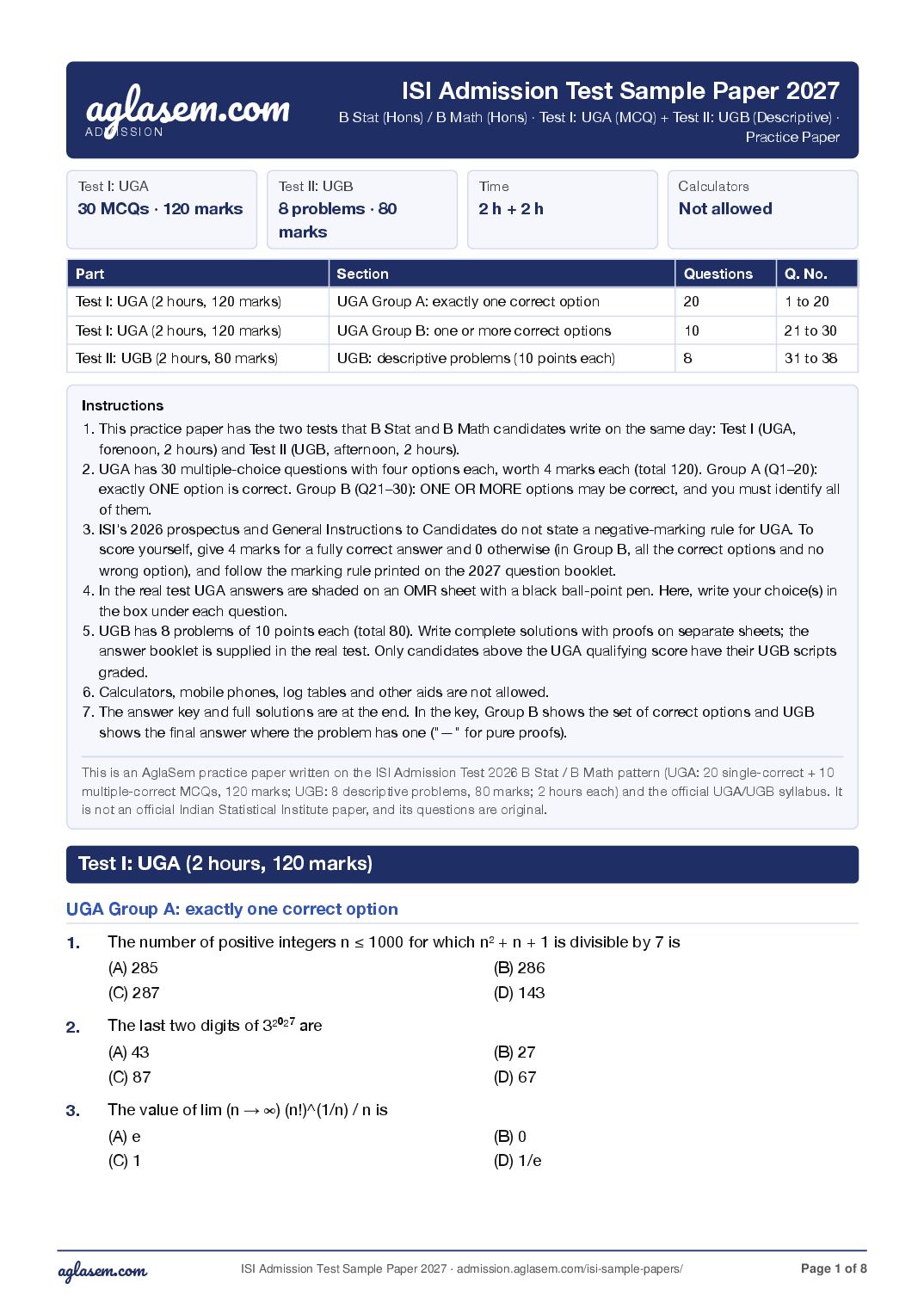
B Stat (Hons) / B Math (Hons) · Test I: UGA (MCQ) + Test II: UGB (Descriptive) ·
ADMISSION
Practice Paper
Test I: UGA Test II: UGB Time Calculators
30 MCQs · 120 marks 8 problems · 80 2h+2h Not allowed
marks
Part Section Questions Q. No.
Test I: UGA (2 hours, 120 marks) UGA Group A: exactly one correct option 20 1 to 20
Test I: UGA (2 hours, 120 marks) UGA Group B: one or more correct options 10 21 to 30
Test II: UGB (2 hours, 80 marks) UGB: descriptive problems (10 points each) 8 31 to 38
Instructions
1. This practice paper has the two tests that B Stat and B Math candidates write on the same day: Test I (UGA,
forenoon, 2 hours) and Test II (UGB, afternoon, 2 hours).
2. UGA has 30 multiple-choice questions with four options each, worth 4 marks each (total 120). Group A (Q1–20):
exactly ONE option is correct. Group B (Q21–30): ONE OR MORE options may be correct, and you must identify all
of them.
3. ISI's 2026 prospectus and General Instructions to Candidates do not state a negative-marking rule for UGA. To
score yourself, give 4 marks for a fully correct answer and 0 otherwise (in Group B, all the correct options and no
wrong option), and follow the marking rule printed on the 2027 question booklet.
4. In the real test UGA answers are shaded on an OMR sheet with a black ball-point pen. Here, write your choice(s) in
the box under each question.
5. UGB has 8 problems of 10 points each (total 80). Write complete solutions with proofs on separate sheets; the
answer booklet is supplied in the real test. Only candidates above the UGA qualifying score have their UGB scripts
graded.
6. Calculators, mobile phones, log tables and other aids are not allowed.
7. The answer key and full solutions are at the end. In the key, Group B shows the set of correct options and UGB
shows the final answer where the problem has one ("—" for pure proofs).
This is an AglaSem practice paper written on the ISI Admission Test 2026 B Stat / B Math pattern (UGA: 20 single-correct + 10
multiple-correct MCQs, 120 marks; UGB: 8 descriptive problems, 80 marks; 2 hours each) and the official UGA/UGB syllabus. It
is not an official Indian Statistical Institute paper, and its questions are original.
Test I: UGA (2 hours, 120 marks)
UGA Group A: exactly one correct option
1. The number of positive integers n ≤ 1000 for which n² + n + 1 is divisible by 7 is
(A) 285 (B) 286
(C) 287 (D) 143
2. The last two digits of 3²⁰²⁷ are
(A) 43 (B) 27
(C) 87 (D) 67
3. The value of lim (n → ∞) (n!)^(1/n) / n is
(A) e (B) 0
(C) 1 (D) 1/e
ISI Admission Test Sample Paper 2027 · admission./isi-sample-papers/ Page 1 of 8
Page 2
(A) (π/8) ln 2 (B) π/8
(C) (π/2) ln 2 (D) (π/4) ln 2
5. The number of real solutions of the equation x² = 2ˣ is
(A) 2 (B) 1
(C) 3 (D) 4
6. The number of ordered triples (a, b, c) of positive integers with abc = 1000 is
(A) 81 (B) 64
(C) 120 (D) 100
7. A triangle has sides 13, 14 and 15. The distance between its incentre and its circumcentre is
(A) 1/2 (B) √65/8
(C) √65/4 (D) 65/64
8. Two numbers a and b are chosen independently and uniformly at random from the interval [0, 1]. The
probability that the equation x² + ax + b = 0 has real roots is
(A) 1/6 (B) 1/4
(C) 1/3 (D) 1/12
9. Let z ≠ 1 be a complex number with z⁷ = 1. Then z/(1 + z²) + z²/(1 + z⁴) + z³/(1 + z⁶) equals
(A) −2 (B) 2
(C) 0 (D) −1
10. Let p(x) = x⁴ + ax³ + bx² + cx + d be a polynomial with real coefficients such that p(1) = 10, p(2) = 20 and
p(3) = 30. Then [p(12) + p(−8)]/10 equals
(A) 2027 (B) 1980
(C) 1990 (D) 1984
11. ₙ ₙ ₙ
Define a₁ = 1 and a ₊₁ = a + 1/a for n ≥ 1. Then the integer part of a₁₀₀ is
(A) 14 (B) 10
(C) 15 (D) 13
12. The number of subsets of {1, 2, …, 10} (including the empty set) that contain no two consecutive
integers is
(A) 89 (B) 512
(C) 144 (D) 233
13. If a, b, c are positive real numbers with a + b + c = 1, then the minimum value of 1/a + 4/b + 9/c is
(A) 14 (B) 36
(C) 49 (D) 18
14. The value of tan²(π/7) + tan²(2π/7) + tan²(3π/7) is
(A) 35 (B) 21
(C) 14 (D) 7
15. Which of the following numbers is the largest?
(A) 4^(1/4) (B) 5^(1/5)
(C) 3^(1/3) (D) 2^(1/2)
16. The locus of the midpoints of the chords of the parabola y² = 4x that pass through its focus is
(A) y² = 2x − 1 (B) y² = 4(x − 1)
(C) y² = x − 1 (D) y² = 2(x − 1)
ISI Admission Test Sample Paper 2027 · admission./isi-sample-papers/ Page 2 of 8
Page 3
(A) 40/3 (B) 44/3
(C) 52/3 (D) 16
18. The number of positive divisors of 10! is
(A) 270 (B) 192
(C) 288 (D) 240
19. Let f : ℝ → ℝ be a continuous function such that f(x + y) = f(x) + f(y) + 2xy for all real x, y, and f(1) = 3.
Then f(3) equals
(A) 15 (B) 12
(C) 9 (D) 18
20. The number of five-digit positive integers whose digits add up to 9 is
(A) 330 (B) 715
(C) 495 (D) 500
UGA Group B: one or more correct options
21. Let p(x) = x⁴ − 4x³ + 6x² − 4x − 15. Then (One or more options may be correct.)
(A) p(x) = 0 has exactly two real roots.
(B) the sum of the real roots of p(x) = 0 is 4.
(C) the product of all four roots of p(x) = 0 is −15.
(D) p(x) > 0 for every x in the interval (−1, 3).
22. ₙ ₙ
For n ≥ 1 let a = (1 + 1/n)ⁿ and b = (1 + 1/n)ⁿ⁺¹. Then (One or more options may be correct.)
ₙ ₙ
(A) b − a → 0 as n → ∞.
ₙ
(B) (a ) is strictly increasing.
ₙ ₙ
(C) a < e < b for every n.
ₙ
(D) (b ) is strictly decreasing.
23. Let A be a 2 × 2 matrix with real entries such that A² = I, the identity matrix. Then (One or more options
may be correct.)
(A) det A = 1 or det A = −1.
(B) A = I or A = −I.
(C) if the trace of A is 0, then det A = −1.
(D) the trace of A is −2, 0 or 2.
24. Let n be a positive integer. Which of the following statements are always true? (One or more options
may be correct.)
(A) n² + n + 41 is prime.
(B) n² + 1 is not divisible by 3.
(C) n⁵ − n is divisible by 30.
(D) if 2ⁿ + 1 is prime, then n is prime.
ISI Admission Test Sample Paper 2027 · admission./isi-sample-papers/ Page 3 of 8
Page 4
(A) f is convex on ℝ.
(B) f is differentiable at every real number.
(C) f′ is differentiable at 0.
(D) f is one-one.
26. In a triangle ABC the sides are a = BC = 7, b = CA = 8 and c = AB = 5. Then (One or more options may
be correct.)
(A) the area of the triangle is 20√3.
(B) the circumradius is 7/2.
(C) the inradius is 2.
(D) ∠A = 60°.
27. Let z be a complex number with |z| = 1 and z ≠ −1. Then (One or more options may be correct.)
(A) the real part of (1 − z)/(1 + z) is 0.
(B) z/(1 + z)² is a real number.
(C) |(1 − z)/(1 + z)| = 1.
(D) (1 + z)/(1 + z̄ ) = z.
28. A fair die is rolled twice. Let E be the event that the sum of the two numbers is 7, F the event that the
first roll shows 4, and G the event that the second roll shows an even number. Then (One or more
options may be correct.)
(A) E and G are independent.
(B) E, F and G are mutually independent.
(C) F and G are independent.
(D) E and F are independent.
29. Let f(x) = x e⁻ˣ for real x. Then (One or more options may be correct.)
(A) f has a point of inflection at x = 2.
(B) for every c with 0 < c < 1/e, the equation f(x) = c has exactly two real solutions.
(C) the maximum value of f on ℝ is 1/e.
(D) ∫₀^∞ f(x) dx = 2.
30. Let x and y be positive real numbers with x + y = 1. Then (One or more options may be correct.)
(A) (x + 1/x)² + (y + 1/y)² ≥ 25/2.
(B) 1/x + 1/y ≥ 4.
(C) x³ + y³ ≥ 1/2.
(D) xy ≤ 1/4.
ISI Admission Test Sample Paper 2027 · admission./isi-sample-papers/ Page 4 of 8
Page 5
UGB: descriptive problems (10 points each)
31. Find all positive integers n such that n · 2ⁿ + 1 is a perfect square. [10 points]
32. Let a, b, c be positive real numbers with abc = 1. Prove that a² + b² + c² ≥ a + b + c. [10 points]
33. Let f : [0, 1] → ℝ be continuous on [0, 1] and differentiable on (0, 1), with f(0) = 0 and f(1) = 1. Prove that
there exist two distinct points a, b in (0, 1) such that f′(a) · f′(b) = 1. [10 points]
34. In a triangle ABC with BC = a, CA = b and AB = c, the median from B is perpendicular to the median
from C. Prove that b² + c² = 5a². Deduce that cos A ≥ 4/5. [10 points]
35. Find the number of subsets S of {1, 2, …, 12} (including the empty set) such that no two elements of S
differ by exactly 2. [10 points]
36. Let P(x) be a polynomial with integer coefficients such that P(a) = P(b) = P(c) = 2 for three distinct
integers a, b, c. Prove that P(n) ≠ 3 for every integer n. [10 points]
37. ₙ ₙ
Define a₁ = √2 and a ₊₁ = √(2 + a ) for n ≥ 1.
ₙ
(a) Prove that a = 2 cos(π/2ⁿ⁺¹) for every n ≥ 1.
ₙ
(b) Find lim (n → ∞) 2ⁿ √(2 − a ). [10 points]
38. A fair coin is tossed repeatedly until two consecutive heads appear for the first time. Let N be the
number of tosses.
ₙ ₖ
(a) Show that P(N = n) = F ₋₁ / 2ⁿ for n ≥ 2, where F₁ = F₂ = 1 and F ₊₁ = F + F ₋₁. ₖ ₖ
(b) Find the expected value of N. [10 points]
ISI Admission Test Sample Paper 2027 · admission./isi-sample-papers/ Page 5 of 8
Page 6
1 B 2 C 3 D 4 A 5 C 6 D 7 B 8 D 9 A 10 D
11 A 12 C 13 B 14 B 15 C 16 D 17 B 18 A 19 A 20 C
21 A,C 22 A,B,C,D 23 A,C,D 24 B,C 25 B,D 26 D 27 A,B,D 28 A,C,D 29 A,B,C 30 A,B,D
31 2, 3 32 — 33 — 34 — 35 441 36 — 37 π/2 38 6
Solutions
UGA Group A: exactly one correct option
1. (B) Check residues mod 7: n² + n + 1 ≡ 0 only for n ≡ 2 (4 + 2 + 1 = 7) and n ≡ 4 (16 + 4 + 1 = 21). Numbers ≤ 1000
with n ≡ 2: 2, 9, …, 996, that is 143 numbers; with n ≡ 4: 4, 11, …, 998, also 143. Total 286.
2. (C) 3¹⁰ = 59049 ≡ 49 (mod 100), so 3²⁰ ≡ 49² = 2401 ≡ 1 (mod 100). As 2027 = 20 × 101 + 7, 3²⁰²⁷ ≡ 3⁷ = 2187 ≡ 87
(mod 100).
3. (D) log of the expression = (1/n) Σ log(k/n) for k = 1 to n, a Riemann sum for ∫₀¹ log x dx = −1. So the limit is e⁻¹ = 1/e.
4. (A) Put x = tan θ: I = ∫₀^(π/4) ln(1 + tan θ) dθ. Replacing θ by π/4 − θ gives 1 + tan(π/4 − θ) = 2/(1 + tan θ), so I =
∫₀^(π/4) [ln 2 − ln(1 + tan θ)] dθ = (π/4) ln 2 − I. Hence I = (π/8) ln 2.
5. (C) x = 2 and x = 4 are solutions. For x < 0, h(x) = x² − 2ˣ is continuous with h(−1) = 1/2 > 0 and h(0) = −1 < 0, and h
is strictly decreasing there (x² decreases, 2ˣ increases), so there is exactly one negative root. For x > 0, ln x/x = ln 2/2
has exactly two solutions since ln x/x increases on (0, e) and decreases on (e, ∞). Total 3.
6. (D) 1000 = 2³ · 5³. The exponents of 2 in a, b, c are non-negative integers adding to 3: ⁵C₂ = 10 ways; similarly 10
ways for the exponents of 5. Total 10 × 10 = 100.
7. (B) s = 21, area = √(21 · 8 · 7 · 6) = 84, r = 84/21 = 4, R = abc/(4 · area) = 2730/336 = 65/8. Euler's formula OI² = R² −
2Rr = 4225/64 − 65 = 65/64, so OI = √65/8.
8. (D) Real roots ⇔ a² ≥ 4b ⇔ b ≤ a²/4. The required probability is the area ∫₀¹ (a²/4) da = 1/12 (note a²/4 ≤ 1
throughout).
9. (A) Since z⁷ = 1, z⁻ᵏ = z⁷⁻ᵏ. Dividing numerator and denominator by zᵏ: z/(1 + z²) = 1/(z⁻¹ + z) = 1/(z + z⁶), z²/(1 + z⁴) =
1/(z² + z⁵), z³/(1 + z⁶) = 1/(z³ + z⁴). Let p = z + z⁶, q = z² + z⁵, r = z³ + z⁴. Then p + q + r = z + z² + … + z⁶ = −1, pq + qr +
rp = 2(z + z² + … + z⁶) = −2 (multiply out and reduce powers mod 7), and pqr = 1. So the sum is 1/p + 1/q + 1/r = (pq +
qr + rp)/(pqr) = −2. (For z = e^(2πi/7), p, q, r are 2cos(2π/7), 2cos(4π/7), 2cos(6π/7), the roots of t³ + t² − 2t − 1 = 0.)
10. (D) q(x) = p(x) − 10x is monic of degree 4 with roots 1, 2, 3, so q(x) = (x − 1)(x − 2)(x − 3)(x − r). Then q(12) = 990(12
− r) and q(−8) = (−9)(−10)(−11)(−8 − r) = 990(8 + r), so q(12) + q(−8) = 990 × 20 = 19800. Hence p(12) + p(−8) = 19800 +
120 − 80 = 19840, and the answer is 1984.
ₙ ₙ ₙ ₖ ₖ
11. (A) Squaring, a ₊₁² = a ² + 2 + 1/a ², so a₁₀₀² = 1 + 2 × 99 + Σ ₌₁⁹⁹ 1/a ² > 199 > 196, giving a₁₀₀ > 14. Also a ² ≥ 2k ₖ
ₖ
− 1, so Σ 1/a ² ≤ Σ 1/(2k − 1) < 1 + ∫₁⁹⁹ dx/(2x − 1) = 1 + (ln 197)/2 < 4. So a₁₀₀² < 203 < 225 and a₁₀₀ < 15. Hence [a₁₀₀]
= 14 (in fact a₁₀₀ ≈ 14.21).
ₙ ₙ
12. (C) Let s be the count for {1, …, n}. A subset either omits n (s ₋₁ ways) or contains n and omits n − 1 (s ₋₂ ways), so ₙ
ₙ ₙ ₙ
s = s ₋₁ + s ₋₂ with s₁ = 2, s₂ = 3. This gives 5, 8, 13, 21, 34, 55, 89, 144, so s₁₀ = 144.
13. (B) By the Cauchy–Schwarz inequality, (a + b + c)(1/a + 4/b + 9/c) ≥ (1 + 2 + 3)² = 36, with equality when a : b : c =
1 : 2 : 3, i.e. a = 1/6, b = 1/3, c = 1/2. So the minimum is 36.
14. (B) tan 7θ = 0 for θ = kπ/7. Writing tan 7θ as a ratio of polynomials in t = tan θ, the numerator is 7t − 35t³ + 21t⁵ − t⁷.
Its non-zero roots are ±tan(kπ/7), k = 1, 2, 3, so u = t² satisfies u³ − 21u² + 35u − 7 = 0 with roots tan²(kπ/7). Their sum
is 21.
15. (C) g(x) = x^(1/x) has log g = ln x / x, whose derivative (1 − ln x)/x² is positive for x < e and negative for x > e. So
among integers the maximum is at 2 or 3: 3^(1/3) vs 2^(1/2) compare as 3² = 9 > 2³ = 8 (raise both to the 6th power).
Also 4^(1/4) = 2^(1/2), and 5^(1/5) < 4^(1/4). So 3^(1/3) is the largest.
16. (D) Points (t², 2t) and (s², 2s) lie on a focal chord iff ts = −1. The midpoint is h = (t² + s²)/2, k = t + s. Then k² = t² + s²
+ 2ts = 2h − 2, so the locus is y² = 2(x − 1) (this also covers the latus rectum, whose midpoint is the focus (1, 0)).
ISI Admission Test Sample Paper 2027 · admission./isi-sample-papers/ Page 6 of 8
Page 7
2[(2 + 8/3) + (9 − 19/3)] = 2[14/3 + 8/3] = 44/3.
18. (A) 10! = 2⁸ · 3⁴ · 5² · 7 (exponent of 2: 5 + 2 + 1 = 8; of 3: 3 + 1 = 4; of 5: 2; of 7: 1). Number of divisors = 9 · 5 · 3 ·
2 = 270.
19. (A) g(x) = f(x) − x² satisfies g(x + y) = g(x) + g(y) and is continuous, so g(x) = cx for a constant c. Then f(x) = x² + cx,
and f(1) = 1 + c = 3 gives c = 2. So f(3) = 9 + 6 = 15.
20. (C) Let the digits be d₁ ≥ 1, d₂, …, d₅ ≥ 0 with sum 9. Put d₁ = e + 1: e + d₂ + … + d₅ = 8 in non-negative integers
(each automatically ≤ 8 ≤ 9). The number of solutions is ¹²C₄ = 495.
UGA Group B: one or more correct options
21. (A,C) Correct options: (A), (C). (A) True: p(x) = (x − 1)⁴ − 16 = ((x − 1)² − 4)((x − 1)² + 4), with real roots 3 and −1 and
non-real roots 1 ± 2i. (B) False: the real roots are 3 and −1, so their sum is 2. (C) True: for a monic quartic the product
of the roots is the constant term, −15 (check: 3 · (−1) · (1 + 2i)(1 − 2i) = −3 · 5). (D) False: for −1 < x < 3, |x − 1| < 2, so (x
− 1)⁴ < 16 and p(x) < 0.
ₙ ₙ ₙ
22. (A,B,C,D) Correct options: (A), (B), (C), (D). (A) True: b − a = a /n < 3/n → 0. (B) True: by AM–GM on the n + 1
ₙ ₙ
numbers 1 + 1/n (n times) and 1: their mean is 1 + 1/(n + 1), so a ₊₁ = (1 + 1/(n + 1))ⁿ⁺¹ > (1 + 1/n)ⁿ = a (strict as the
ₙ ₙ
numbers are not all equal). (C) True: both sequences converge to e (b = a (1 + 1/n)); an increasing sequence stays
ₙ
strictly below its limit and a decreasing one strictly above it. (D) True: 1/b = (1 − 1/(n + 1))ⁿ⁺¹; AM–GM on n + 1 copies
ₙ
of 1 − 1/(n + 1) and one 1 gives (1 − 1/(n + 2))ⁿ⁺² > (1 − 1/(n + 1))ⁿ⁺¹, i.e. 1/b ₊₁ > 1/b . ₙ
23. (A,C,D) Correct options: (A), (C), (D). (A) True: (det A)² = det(A²) = 1. (B) False: A = [[0, 1], [1, 0]] satisfies A² = I. (C)
True: with t = 0 the relation tA = (1 + d)I gives (1 + d)I = O, so d = −1. (D) True: by Cayley–Hamilton, A² − tA + dI = O
with t = tr A, d = det A, so tA = (1 + d)I. If t ≠ 0, A is a scalar matrix with A² = I, so A = ±I and t = ±2; otherwise t = 0.
24. (B,C) Correct options: (B), (C). (A) False: for n = 40 it equals 40 · 41 + 41 = 41². (B) True: n² ≡ 0 or 1 (mod 3), so n² +
1 ≡ 1 or 2 (mod 3). (C) True: n⁵ − n = (n − 1)n(n + 1)(n² + 1) is divisible by 2 and 3 (product of three consecutive integers)
and by 5 (Fermat: n⁵ ≡ n mod 5). (D) False: 2⁴ + 1 = 17 is prime but 4 is not (in fact 2ⁿ + 1 prime forces n to be a power
of 2).
25. (B,D) Correct options: (B), (D). (A) False: f″(x) = −2 < 0 for x < 0, so f is concave on (−∞, 0). (B) True: f(x) = x² for x ≥
0 and −x² for x < 0; away from 0 it is a polynomial, and at 0 the difference quotient f(h)/h = |h| → 0, so f′(0) = 0. In fact f′
(x) = 2|x|. (C) False: f′(x) = 2|x| is not differentiable at 0. (D) True: f′(x) = 2|x| > 0 for x ≠ 0, so f is strictly increasing on ℝ.
26. (D) Correct option: (D). (A) False: area = (1/2)bc sin A = (1/2)(40)(√3/2) = 10√3. (B) False: R = a/(2 sin A) = 7/√3. (C)
False: r = area/s = 10√3/10 = √3. (D) True: cos A = (b² + c² − a²)/(2bc) = (64 + 25 − 49)/80 = 1/2.
27. (A,B,D) Correct options: (A), (B), (D). (A) True: with z̄ = 1/z, the conjugate of w = (1 − z)/(1 + z) is (1 − 1/z)/(1 + 1/z) =
(z − 1)/(z + 1) = −w, so w is purely imaginary (or 0). (B) True: (1 + z)²/z = z + 2 + 1/z = 2 + 2 Re z, which is real and
positive (z ≠ −1), so its reciprocal is real. (C) False: for z = e^(iθ), |(1 − z)/(1 + z)| = |tan(θ/2)|, which is 1 only for θ = ±π/2;
e.g. z = 1 gives 0. (D) True: 1 + z̄ = 1 + 1/z = (z + 1)/z, so (1 + z)/(1 + z̄ ) = z.
28. (A,C,D) Correct options: (A), (C), (D). (A) True: E ∩ G = {(5, 2), (3, 4), (1, 6)} has probability 3/36 = 1/12 = (1/6)(1/2).
(B) False: E ∩ F ∩ G is empty (first 4 and sum 7 force second 3, which is odd), so its probability is 0 ≠ 1/72. (C) True:
the two rolls are independent, so P(F ∩ G) = (1/6)(1/2). (D) True: P(E) = 6/36 = 1/6, P(F) = 1/6 and P(E ∩ F) = P((4, 3)) =
1/36 = P(E)P(F).
29. (A,B,C) Correct options: (A), (B), (C). (A) True: f″(x) = (x − 2)e⁻ˣ changes sign at x = 2. (B) True: f < 0 for x < 0; on (0,
1) f increases from 0 to 1/e and on (1, ∞) it decreases from 1/e towards 0, so each such c is taken once on each piece.
(C) True: f′(x) = (1 − x)e⁻ˣ, so f increases on (−∞, 1) and decreases on (1, ∞); the maximum is f(1) = 1/e. (D) False:
integrating by parts, ∫₀^∞ x e⁻ˣ dx = 1.
30. (A,B,D) Correct options: (A), (B), (D). (A) True: by the QM–AM inequality the left side is at least (x + y + 1/x + 1/y)²/2
≥ (1 + 4)²/2 = 25/2, with equality at x = y = 1/2. (B) True: 1/x + 1/y = (x + y)/(xy) = 1/(xy) ≥ 4. (C) False: x³ + y³ = (x + y)³ −
3xy(x + y) = 1 − 3xy, which equals 1/4 at x = y = 1/2. (D) True: AM–GM: √(xy) ≤ (x + y)/2 = 1/2.
ISI Admission Test Sample Paper 2027 · admission./isi-sample-papers/ Page 7 of 8
Page 8
31. (2, 3) Answer: 2, 3. The required values are n = 2 and n = 3. n = 1 gives 3, not a square. Let n ≥ 2 and n · 2ⁿ + 1 =
k². Then k is odd, say k = 2t + 1, and k² − 1 = 4t(t + 1), so t(t + 1) = n · 2ⁿ⁻². Of t and t + 1 one is odd and the other even;
the even one carries every factor 2 of the right side, so it is a multiple of 2ⁿ⁻², while the odd one divides n and hence is
at most n. Since the two differ by 1, 2ⁿ⁻² ≤ (even one) ≤ (odd one) + 1 ≤ n + 1. But 2ⁿ⁻² > n + 1 for n ≥ 5 (true at n = 5: 8
> 6, and the left side doubles while the right grows by 1), so n ≤ 4. Checking: n = 2 gives 9 = 3², n = 3 gives 25 = 5², n =
4 gives 65 (not a square). So n = 2, 3.
32. (guidance) Let S = a + b + c. By AM–GM, S ≥ 3(abc)^(1/3) = 3. By the QM–AM (or Cauchy–Schwarz) inequality, a²
+ b² + c² ≥ S²/3 = S · (S/3) ≥ S · 1 = S. Hence a² + b² + c² ≥ a + b + c, with equality exactly when a = b = c = 1.
33. (guidance) g(x) = f(x) + x − 1 is continuous with g(0) = −1 < 0 and g(1) = 1 > 0, so by the intermediate value
theorem there is c ∈ (0, 1) with f(c) = 1 − c. By the mean value theorem on [0, c] there is a ∈ (0, c) with f′(a) = (f(c) −
f(0))/c = (1 − c)/c, and on [c, 1] there is b ∈ (c, 1) with f′(b) = (f(1) − f(c))/(1 − c) = c/(1 − c). Then a < c < b, so a ≠ b, and f′
(a)f′(b) = 1.
34. (guidance) Let G be the centroid and use vectors from G: put u = GB and v = GC; then GA = −(u + v) since GA +
GB + GC = 0. The median from B lies along GB and the median from C along GC, so u · v = 0. Now a² = |u − v|² = |u|² +
|v|², b² = |CA|² = |−u − 2v|² = |u|² + 4|v|², c² = |BA|² = |−2u − v|² = 4|u|² + |v|². Adding, b² + c² = 5(|u|² + |v|²) = 5a². Then cos
A = (b² + c² − a²)/(2bc) = 4a²/(2bc) = (2/5)(b² + c²)/(bc) ≥ (2/5) · 2 = 4/5, using b² + c² ≥ 2bc (equality when b = c).
35. (441) Answer: 441. Two numbers differ by 2 only if they have the same parity, so the condition splits into two
independent conditions: on the odd numbers 1, 3, 5, 7, 9, 11 and on the even numbers 2, 4, …, 12. In each chain of six
numbers, consecutive terms of the chain differ by 2, so we need subsets of a 6-term chain with no two consecutive
ₙ ₙ ₙ
terms. As in the no-two-consecutive count, s = s ₋₁ + s ₋₂ with s₁ = 2, s₂ = 3, giving s₆ = 21. The total is 21 × 21 = 441
(confirmed by direct enumeration of all 4096 subsets).
36. (guidance) P(x) − 2 has roots a, b, c, so P(x) − 2 = (x − a)(x − b)(x − c)Q(x), and Q has integer coefficients (divide
successively by monic linear factors). Suppose P(n) = 3 for an integer n. Then (n − a)(n − b)(n − c)Q(n) = 1, a product of
integers, so each factor is ±1. But n − a, n − b, n − c are three distinct integers, and only two integers (1 and −1) have
absolute value 1. Contradiction, so P(n) ≠ 3.
ₙ ₙ
37. (π/2) Answer: π/2. (a) Induction: a₁ = √2 = 2 cos(π/4). If a = 2 cos θ with θ = π/2ⁿ⁺¹, then a ₊₁ = √(2 + 2 cos θ) = √(4
ₙ
cos²(θ/2)) = 2 cos(θ/2) (cos(θ/2) > 0), which is 2 cos(π/2ⁿ⁺²). (b) 2 − a = 2(1 − cos θ) = 4 sin²(θ/2), so √(2 − a ) = 2ₙ
ₙ
sin(π/2ⁿ⁺²). Hence 2ⁿ √(2 − a ) = 2ⁿ⁺¹ sin(π/2ⁿ⁺²) = (π/2) · [sin x / x] with x = π/2ⁿ⁺², which tends to π/2 because sin x / x
→ 1.
38. (6) Answer: 6. (a) Call a string of H, T good if it has no two consecutive H. The number of good strings of length m
ₘ
is F ₊₂ (a good string ends in T after a good string of length m − 1, or in TH after one of length m − 2, so the counts
satisfy the Fibonacci recurrence, with 2 = F₃ for m = 1 and 3 = F₄ for m = 2; the empty string gives 1 = F₂). N = 2 means
HH: 1 = F₁ sequence. For n ≥ 3, N = n means tosses n − 1 and n are H, toss n − 2 is T, and the first n − 3 tosses form a
ₙ ₙ
good string: F ₋₁ choices. Each sequence of n tosses has probability 2⁻ⁿ, so P(N = n) = F ₋₁/2ⁿ. (b) Condition on the
start: if the first toss is T (probability 1/2) we restart after 1 toss; if it is HT (probability 1/4) we restart after 2 tosses; HH
(probability 1/4) ends in 2 tosses. So E = (1/2)(1 + E) + (1/4)(2 + E) + (1/4)(2), i.e. E = 3/2 + (3/4)E, giving E = 6. (Check: Σ
ₙ
n F ₋₁/2ⁿ = 6.)
ISI Admission Test Sample Paper 2027 · admission./isi-sample-papers/ Page 8 of 8
Document Details
| Board / Org | ISI |
| Exam | ISI Admission Test |
| Type | Sample Paper |
| Pages | 8 |
| Language | english |
| Updated | 27 Oct 2026 |