MBOSE Class 10 Question Paper 2020 for Social Science New Course
Finished viewing? Save it for later —
Download MBOSE Class 10 Question Paper 2020 for Social Science New Course (PDF · 15 pages)About MBOSE Class 10 Question Paper 2020 for Social Science New Course
MBOSE Class 10 Question Paper 2020 for Social Science New Course is available here for free download. Published by Meghalaya Board for Class 10, this question paper can be viewed online or downloaded as a PDF (15 pages). Candidates preparing for Class 10 can use MBOSE Class 10 Question Paper 2020 for Social Science New Course to understand the exam pattern, the type of questions asked, and the overall difficulty level.
Frequently Asked Questions
How can I download MBOSE Class 10 Question Paper 2020 for Social Science New Course?
Open this page and click the Download button to save MBOSE Class 10 Question Paper 2020 for Social Science New Course as a PDF. It is completely free on AglaSem Docs.
Is MBOSE Class 10 Question Paper 2020 for Social Science New Course free to download?
Yes. MBOSE Class 10 Question Paper 2020 for Social Science New Course can be viewed online and downloaded as a PDF free of cost on AglaSem Docs.
How many pages does MBOSE Class 10 Question Paper 2020 for Social Science New Course have?
MBOSE Class 10 Question Paper 2020 for Social Science New Course contains 15 pages, which you can read online or download together as a single PDF.
Where can I find more Class 10 study material?
You can find more Class 10 question papers, sample papers, syllabus, and answer keys on AglaSem Docs.
MBOSE Class 10 Question Paper 2020 for Social Science New Course – Text
Read the full text of this question paper below — useful to quickly search, copy and reference the content online without downloading the PDF.
📄 View text version (15 pages)
Page 1
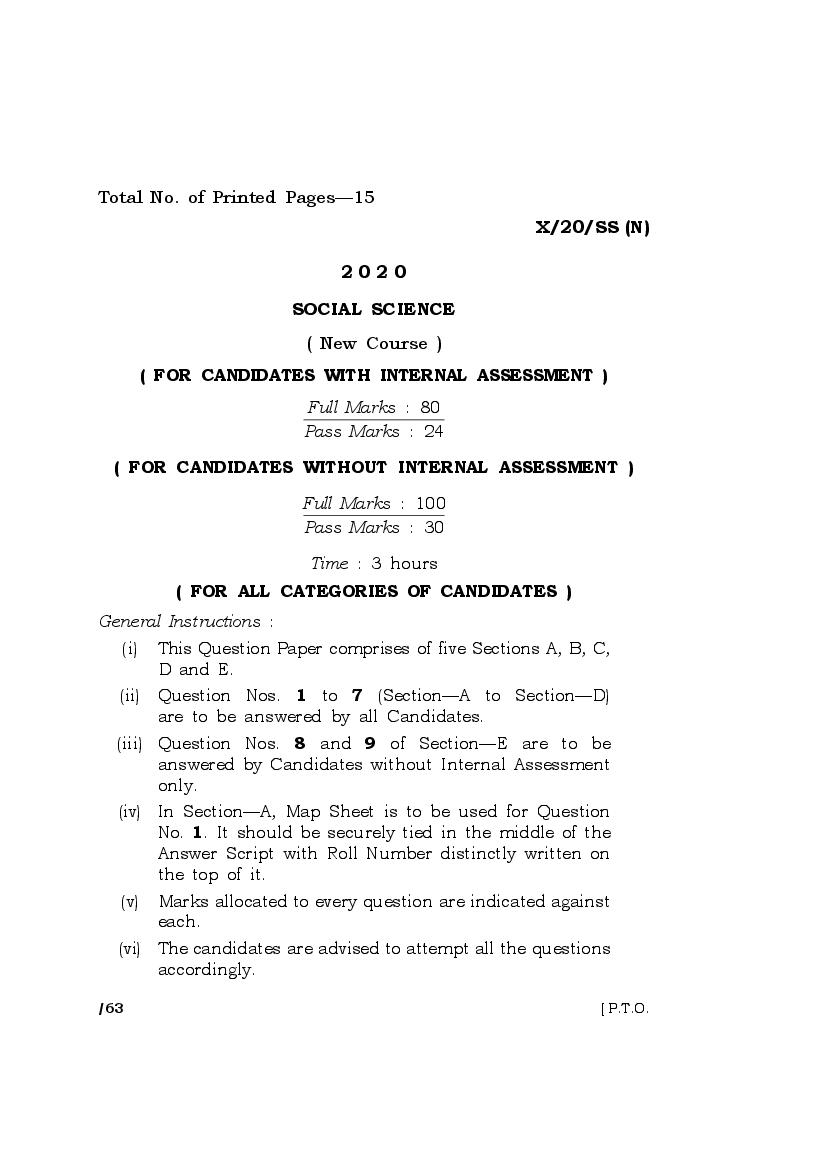
X/20/SS (N)
2020
SOCIAL SCIENCE
( New Course )
( FOR CANDIDATES WITH INTERNAL ASSESSMENT )
Full Marks : 80
Pass Marks : 24
( FOR CANDIDATES WITHOUT INTERNAL ASSESSMENT )
Full Marks : 100
Pass Marks : 30
Time : 3 hours
( FOR ALL CATEGORIES OF CANDIDATES )
General Instructions :
(i) This Question Paper comprises of five Sections A, B, C,
D and E.
(ii) Question Nos. 1 to 7 (Section—A to Section—D)
are to be answered by all Candidates.
(iii) Question Nos. 8 and 9 of Section—E are to be
answered by Candidates without Internal Assessment
only.
(iv) In Section—A, Map Sheet is to be used for Question
No. 1. It should be securely tied in the middle of the
Answer Script with Roll Number distinctly written on
the top of it.
(v) Marks allocated to every question are indicated against
each.
(vi) The candidates are advised to attempt all the questions
accordingly.
/63 [ P.T.O.
Page 2
SECTION—A
( Marks : 4 )
1. In the same outline map of India supplied to you, locate
and label the following (choose any two from Group—I
and Group—II each) :
GROUP—I 1×2=2
(a) The city related to Jallianwala Bagh Tragedy (1919)
(b) The place where the first Indian Jute Mill was set
up in 1917
(c) The place where the English East India Company
set up a printing press
GROUP—II 1×2=2
(a) One major sugarcane-producing State
(b) One software technology park
(c) One oldest artificial port in South India
[ For Visually Handicapped (Blind) Students
only in lieu of the above questions ]
GROUP—I
Answer any two of the following : 1×2=2
(a) What is the name of the city related to Jallianwala
Bagh Tragedy (1919)?
(b) Name the place where the first Indian Jute Mill was
set up in 1917.
(c) Name the place where a printing press was set up
by the English East India Company.
X/20/SS (N)/63 [ Contd.
Page 3
GROUP—II
Answer any two of the following : 1×2=2
(a) Name one major sugarcane-producing State in India.
(b) Name one software technology park in India.
(c) Name the oldest artificial port in South India.
SECTION—B
( Marks : 12 )
2. Choose the most appropriate answer (any twelve) : 1×12=12
(a) The first clear expression of Nationalism in Europe
came with
(i) the French Revolution
(ii) the American Revolution
(iii) the Russian Revolution
(iv) the Industrial Revolution
(b) The reason for Mahatma Gandhi’s fast unto death in
1932 was
(i) the failure of the Civil Disobedience Movement
(ii) the public resort to violence during the Civil
Disobedience Movement
(iii) the clash with Dr. Ambedkar over his demand
for a separate electorate for Dalits
(iv) the failure of the Second Round Table
Conference
X/20/SS (N)/63 [ P.T.O.
Page 4
(c) When and by whom was hand-printing technology
brought to Japan?
(i) The Arab travellers in the 8th century
(ii) The Buddhist missionaries from China in
around AD 768–770
(iii) The Chinese silk merchants in the 6th century
(iv) The Egyptians in the 8th century
(d) People in industrial cities believed that the black
smog created
(i) bad tempers, smoke-related illness and dirty
clothes
(ii) black skies and black vegetables
(iii) air pollution
(iv) serious ecological problems
(e) In which of the following States is the bamboo drip
irrigation system prevalent?
(i) Rajasthan
(ii) Meghalaya
(iii) West Bengal
(iv) Himachal Pradesh
(f) The second largest river island in Asia is
(i) Nongkhnum
(ii) Nongkrem
(iii) Nongkhlaw
(iv) Nongkhyllem
X/20/SS (N)/63 [ Contd.
Page 5
(g) Which of the following is considered to be an
environment-friendly fuel?
(i) Coal
(ii) Petroleum
(iii) Peat
(iv) Natural gas
(h) Which of the following is the parent rock for black
soil?
(i) Granite
(ii) Kankar
(iii) Basalt
(iv) Sand
(i) Who choose(s) the candidates for contesting
elections in India?
(i) Members and supporters of the party
(ii) Top party leadership
(iii) The existing government
(iv) None of the above
(j) The State shall not discriminate against any citizen
of India on the ground of sex under
(i) Article 15(1) of the Constitution
(ii) Article 15(2) of the Constitution
(iii) Article 15(3) of the Constitution
(iv) Article 15(4) of the Constitution
X/20/SS (N)/63 [ P.T.O.
Page 6
(k) When was the report of the State Reorganization
Commission implemented by the Indian
Parliament?
(i) 1956
(ii) 1958
(iii) 1960
(iv) 1965
(l) When was the Rights of Persons with Disabilities
Bill, 2016 passed by the Indian Parliament?
(i) October 2016
(ii) November 2016
(iii) December 2016
(iv) January 2016
(m) On the basis of ownership of enterprises, the
economy is classified into
(i) public and joint sectors
(ii) public and private sectors
(iii) private and joint sectors
(iv) None of the above
(n) Special Economic Zones (SEZs) developed by the
Government of India aimed
(i) to encourage small investors
(ii) to attract foreign companies to invest in India
(iii) to encourage regional development
(iv) None of the above
X/20/SS (N)/63 [ Contd.
Page 7
(o) The organization which lays down standards of
products at the international level is called
(i) ISI
(ii) ISRO
(iii) ISO
(iv) WCF
(p) An asset that the borrower uses as a repayment
guarantee to a lender is termed as a/an
(i) deposit
(ii) advance
(iii) collateral
(iv) All of the above
SECTION—C
( Marks : 24 )
(Short Answer-type Questions)
3. Answer any twelve questions : 2×12=24
(a) State any two factors that led to the rise of the
Nation State in Europe during the 19th century. 2
(b) The business class and industrialists in India first
supported the Civil Disobedience Movement and
then lost interest in it after 1932. Give two reasons
for this change of attitude. 1+1=2
X/20/SS (N)/63 [ P.T.O.
Page 8
(c) Who was Johann Gutenberg? Explain his role in
the history of printing. ½+1½=2
(d) “The abundance of labour in the market affected the
lives of the workers.” Explain this statement in the
light of the 19th century Industrial England. 2
(e) Classify resources on the basis of state of
development. 2
(f) How many districts are there in Meghalaya? Name
the Headquarters of the following : ½+1½=2
(i) East Jaintia Hills
(ii) South-West Khasi Hills
(iii) North Garo Hills
(g) What can be the effects of over-exploitation and
excessive use of water resources? 2
(h) What is the importance of soil? What are the various
forces of nature that contribute in the formation of
soil? 1+1=2
(i) What is referred to as ‘Feminist Movement’? 2
(j) Mention any four among the subjects which have
been transferred from the State List to the
Panchayati Raj Institutions by the Eleventh
Schedule of the Indian Constitution. ½×4=2
X/20/SS (N)/63 [ Contd.
Page 9
(k) There is a need to imbibe the spirit of ‘Unity in
Diversity’ in full measure in India. Explain why. 2
(l) Define political party. Mention any two essential
components of a political party. 1+( 12 12 )=2
(m) Define public sector. Give a few examples of public
sector undertakings. 1+1=2
(n) What are the modern forms of money? Why are they
accepted as a medium of exchange? 1+1=2
(o) Mention the aspirations or developmental goals for
the following : 1+1=2
(i) A landless rural labourer
(ii) An urban unemployed youth
(p) Why were SHGs promoted to provide loans to the
poor in India? 2
SECTION—D
( Marks : 40 )
(Long Answer-type Questions)
PART—I
4. Answer any three questions : 4×3=12
(a) He is considered as the ‘Sword of Italian
Unification’. Who is he? What role did he play in
unifying Italy? 1+3=4
X/20/SS (N)/63 [ P.T.O.
Page 10
(b) “A pinch of salt that shook a mighty nation.” Describe
the importance of ‘Salt Satyagraha’ in the history of
Indian National Movement during the 20th century. 4
(c) In the nineteenth century Europe (Victorian
Britain), some industrialists preferred hand labour
over machines. Explain. 4
(d) The newly emerged cities posed a challenge to the
environment and ecology during the nineteenth
century. Explain the statement by giving example of
Calcutta. 4
(e) Explain how print culture helped the growth of
Nationalism in India. 4
PART—II
5. Answer any three questions : 4×3=12
(a) For the purpose of administration, into how many
types can forests in India be classified? Name them
and describe one of them in detail. ½+1½+2=4
(b) Differentiate between hydroelectricity and thermal
electricity. 2+2=4
(c) It is known as the golden fibre crop in India. Identify
the crop and state the essential geographical
conditions required for the cultivation of this crop.
Name two largest producing States of this crop.
1+2+½+½=4
X/20/SS (N)/63 [ Contd.
Page 11
Or
What is manufacturing? Explain the importance
of manufacturing sector for the development and
prosperity of a nation. 1+3=4
(d) Why are means of transport and communication
called the lifeline of a nation and its economy?
Explain. 4
(e) Essential steps should be taken for community level
disaster preparedness. Outline the practical steps
that need to be taken for. 4
PART—III
6. Answer any two questions : 4×2=8
(a) Movements are of two types—single-issue
movements and multiple-issue movements.
Compare and contrast the two movements. 2+2=4
(b) The Election Commission of India implemented
‘Voters Awareness Observers’. Describe the various
duties of these Awareness Observers to increase the
level of public awareness and participation during
elections in the country. 4
(c) Explain any four legal rights guaranteed to women
in India. 4
(d) Mention the special provisions for persons with
benchmark disabilities. 4
X/20/SS (N)/63 [ P.T.O.
Page 12
PART—IV
7. Answer any two questions : 4×2=8
(a) Why is tertiary sector becoming more important
than other sectors in India? Give four reasons to
support your answer. 1×4=4
(b) Define sex ratio. Describe the reasons for steady
decline in sex ratio in India. 1+3=4
(c) Globalization has helped countries to develop. What
arguments can you give in favour of globalization? 4
(d) Describe some of your duties as a consumer if you
visit a shopping complex in your locality. 4
SECTION—E
( Marks : 20 )
[ For Candidates without Internal Assessment ]
8. Rewrite the following statements by choosing the right
option from those given in the brackets : 1×12=12
(a) In (1865/1866), Venetia was united with the rest of
Italy.
(b) Gandhiji extorted the people of India to exercise
(five/six) virtues.
X/20/SS (N)/63 [ Contd.
Page 13
(c) (Richard Arkwright/James Hargreaves) invented the
spinning jenny in 1770.
(d) Bhangar is the (old/new) alluvial soil.
(e) The Project Tiger was launched in (1973/1974) at
Corbett.
(f) (Article 51A(e)/Article 39(e)) of the Indian Consti-
tution is associated with the dignity of women.
(g) The Communist Party of India–Marxist (CPI–M) was
formed in (1963/1964).
(h) The State List contains (47/61) subjects.
(i) There are (two/three) constituents of money.
(j) (The USA/India) is a founder member of the World
Trade Organization (WTO).
(k) (Per capita income/National income) refers to the
income of all the residents of a country.
(l) India has (6/7) nuclear power stations.
X/20/SS (N)/63 [ P.T.O.
Page 14
9. Answer any eight of the following questions in one word
or in one sentence each : 1×8=8
(a) Give one reason, why Nationalism did not exist in
Europe in the Middle Age.
(b) Mention one reason of Proto-industrialization.
(c) Define urbanization.
(d) Mention one area having integrated iron and steel
plants in India.
(e) Define soil erosion.
(f) Name two types of iron ore.
(g) Give the full form of POCSO.
(h) Name the three tiers of the Panchayati Raj system.
X/20/SS (N)/63 [ Contd.
Page 15
(i) What is called an alliance, or a front or a coalition?
(j) What are economic activities?
(k) Define infant mortality rate.
(l) Name the organization formed by consumer
movement in India.
X/20/SS (N)/63 20K
Document Details
| Board / Org | Meghalaya Board |
| Exam | Class 10 |
| Type | Question Paper |
| Pages | 15 |
| Updated | 30 Apr 2026 |