MBOSE Class 10 Question Paper 2020 for Science and Technology Old Course
Finished viewing? Save it for later —
Download MBOSE Class 10 Question Paper 2020 for Science and Technology Old Course (PDF · 12 pages)About MBOSE Class 10 Question Paper 2020 for Science and Technology Old Course
MBOSE Class 10 Question Paper 2020 for Science and Technology Old Course is available here for free download. Published by Meghalaya Board for Class 10, this question paper can be viewed online or downloaded as a PDF (12 pages). Candidates preparing for Class 10 can use MBOSE Class 10 Question Paper 2020 for Science and Technology Old Course to understand the exam pattern, the type of questions asked, and the overall difficulty level.
Frequently Asked Questions
How can I download MBOSE Class 10 Question Paper 2020 for Science and Technology Old Course?
Open this page and click the Download button to save MBOSE Class 10 Question Paper 2020 for Science and Technology Old Course as a PDF. It is completely free on AglaSem Docs.
Is MBOSE Class 10 Question Paper 2020 for Science and Technology Old Course free to download?
Yes. MBOSE Class 10 Question Paper 2020 for Science and Technology Old Course can be viewed online and downloaded as a PDF free of cost on AglaSem Docs.
How many pages does MBOSE Class 10 Question Paper 2020 for Science and Technology Old Course have?
MBOSE Class 10 Question Paper 2020 for Science and Technology Old Course contains 12 pages, which you can read online or download together as a single PDF.
Where can I find more Class 10 study material?
You can find more Class 10 question papers, sample papers, syllabus, and answer keys on AglaSem Docs.
MBOSE Class 10 Question Paper 2020 for Science and Technology Old Course – Text
Read the full text of this question paper below — useful to quickly search, copy and reference the content online without downloading the PDF.
📄 View text version (12 pages)
Page 1
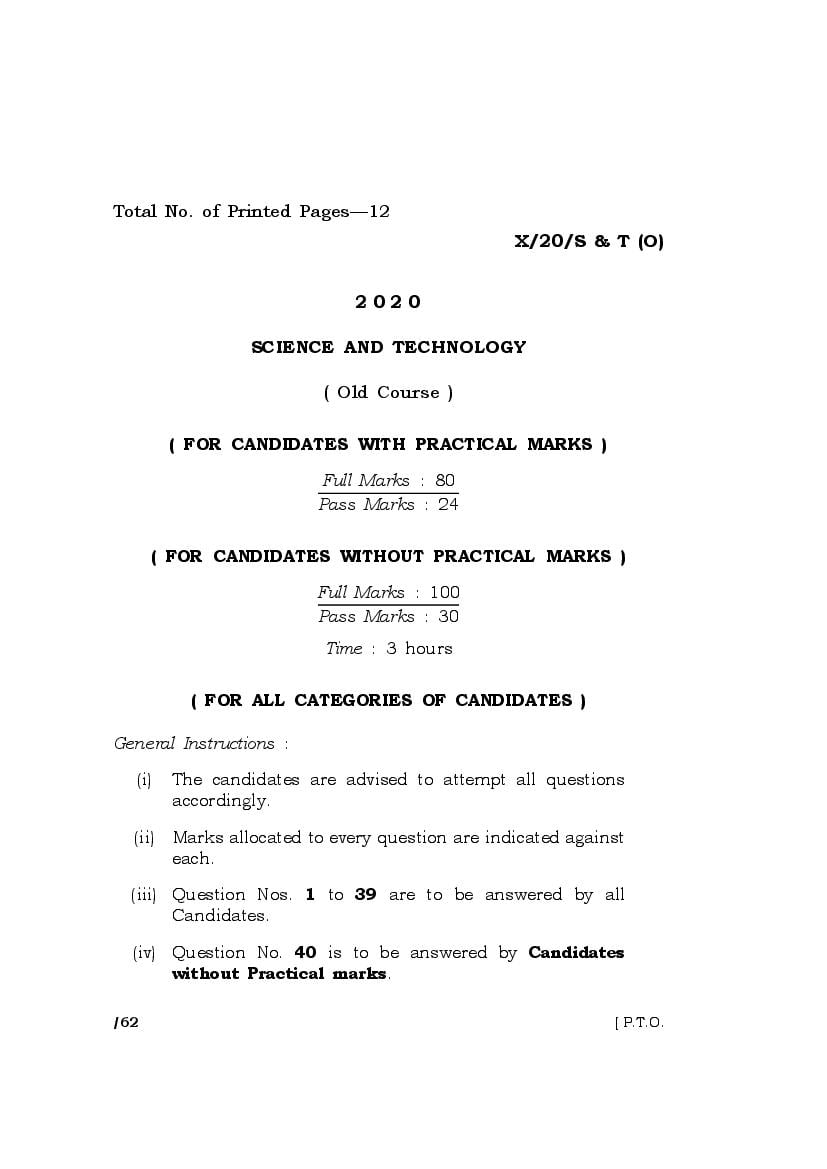
X/20/S & T (O)
2020
SCIENCE AND TECHNOLOGY
( Old Course )
( FOR CANDIDATES WITH PRACTICAL MARKS )
Full Marks : 80
Pass Marks : 24
( FOR CANDIDATES WITHOUT PRACTICAL MARKS )
Full Marks : 100
Pass Marks : 30
Time : 3 hours
( FOR ALL CATEGORIES OF CANDIDATES )
General Instructions :
(i) The candidates are advised to attempt all questions
accordingly.
(ii) Marks allocated to every question are indicated against
each.
(iii) Question Nos. 1 to 39 are to be answered by all
Candidates.
(iv) Question No. 40 is to be answered by Candidates
without Practical marks.
/62 [ P.T.O.
Page 2
SECTION—A
( PHYSICS )
( Marks : 26 )
Choose and write the correct answers from the following : 1×3=3
1. The ray of light which falls on the mirror’s reflecting
surface is
(A) reflected ray
(B) normal
(C) incident ray
(D) refracted ray 1
2. A freely suspended magnet always point in the
(A) east-west direction
(B) north-south direction
(C) east-south direction
(D) north-west direction 1
3. The coil of the electric kettle is made of
(A) copper
(B) tungsten
(C) aluminium
(D) nichrome 1
X/20/S & T (O)/62 [ Contd.
Page 3
Answer the following questions in one word or one sentence
each : 1×3=3
4. What is the speed of light waves in vacuum? 1
5. Define electric power. 1
6. Name two types of electric motor. 1
Answer the following short-answer type questions in 30–40
words each : 2×3=6
7. Either
(a) Give any two differences between real image and
virtual image. 2
Or
(b) State the two laws of refraction of light. 2
8. What is myopia? How can it be corrected? 1+1=2
9. (a) What is the main disadvantage of a series circuit? 1
(b) Resistances of 8 , 10 and 5 are connected in
series. Calculate the equivalent resistance of the
circuit. 1
Answer the following short-answer type questions in 50–60
words each : 3×3=9
10. (a) Name the instrument used to measure (i) electric
current and (ii) potential difference in a circuit. ½+½=1
(b) State the four factors that are responsible for the
formation of a rainbow. ½×4=2
X/20/S & T (O)/62 [ P.T.O.
Page 4
11. (a) What is an electric motor? 1
(b) What are the advantages of alternating current over
direct current? (Give any two points). 1+1=2
12. Either
(a) What is meant by magnetic effect of current? 1
(b) Write any two properties of a magnet. 2
Or
(c) Write the mathematical relationship between the
focal length f and radius of curvature R of a
spherical mirror. 1
(d) The radius of curvature of a spherical mirror is
20 cm. What is its focal length? 2
Answer the following long-answer type questions in 70–80
words : 5
13. Either
(a) Define near point of the eye. 1
(b) What is presbyopia? How can it be corrected? 1½+½=2
(c) Name and explain about any two safety measures
commonly used in electric circuits and appliances. 2
Or
(d) Write about any three characteristics of the
combination of resistors in parallel. 3
(e) What are conductors? Name two conductors. 1+½+½=2
X/20/S & T (O)/62 [ Contd.
Page 5
SECTION—B
( CHEMISTRY )
( Marks : 26 )
Choose and write the correct answers from the following : 1×3=3
14. The reaction H2 + Br2 2HBr is
(A) a reduction reaction
(B) an oxidation reaction
(C) a displacement reaction
(D) a combination reaction 1
15. The organic compounds containing —COOH are called
(A) esters
(B) carboxylic acids
(C) alcohols
(D) aldehydes 1
16. The impurities associated with ore used in metallurgy
are called
(A) flux
(B) slag
(C) gangue
(D) None of these 1
X/20/S & T (O)/62 [ P.T.O.
Page 6
Answer the following questions in one word or one sentence
each : 1×2=2
17. What is the condition necessary for rusting? 1
18. Name two weak acids. ½+½=1
Answer the following short-answer type questions in 30–40
words each : 2×2=4
19. What is combination reaction? Give one example with
the chemical equation. 1+½+½=2
20. Either
(a) Give two uses of methane. 1+1=2
Or
(b) What would be the anode, cathode and electrolyte
in the electro-refining of copper? Name the impurity
formed at the bottom of the container. 1½+½=2
Answer the following short-answer type questions in 50–60
words each : 3×4=12
21. (a) What is an acid salt? Give two examples. 1+½+½=2
(b) What is monobasic acid? 1
22. (a) What do you mean by period and group in the
periodic table? ½+½=1
(b) How does the valency of an element change on
(i) moving down a group and (ii) moving from left to
right in a period? 1+1=2
X/20/S & T (O)/62 [ Contd.
Page 7
23. (a) Define the term ‘ore’. 1
(b) What is meant by concentration of an ore? Name
two methods used for the concentration of ores.
1+½+½=2
24. Either
(a) What is pyrolysis? 1
(b) Write any two uses of sodium hydrogen carbonate. 2
Or
(c) State any two uses of ethanoic acid. 2
(d) Write the structural formula of butane. 1
Answer the following long-answer type questions in 70–80
words each : 5
25. Either
(a) Name any four methods which are commonly used
for refining of impure metals. ½+½+½+½=2
(b) Describe the process of froth floatation. 3
Or
(c) Define the term ‘pH’. Mention one application of pH
in our daily life. 1+1=2
(d) What is neutralisation? Give two applications of
neutralisation. 1+2=3
X/20/S & T (O)/62 [ P.T.O.
Page 8
SECTION—C
( BIOLOGY )
( Marks : 28 )
Choose and write the correct answers from the following : 1×3=3
26. During photosynthesis, oxygen comes from
(A) water
(B) light energy
(C) carbon dioxide
(D) both carbon dioxide and water 1
27. Exchange of gases between alveolar sac and alveolar
capillaries occurs by
(A) osmosis
(B) diffusion
(C) active transport
(D) endocytosis 1
28. Junction of two neurons is called
(A) joint
(B) synapsis
(C) synaptic buttons
(D) synapse 1
X/20/S & T (O)/62 [ Contd.
Page 9
Answer the following questions in one word or one sentence
each : 1×3=3
29. What is holozoic nutrition? 1
30. Name the functional units of lungs and nervous system. 1
31. Name the receiving and pumping chambers of the heart. 1
Answer the following short-answer type questions in 20–30
words each : 2×4=8
32. Define photosynthesis. Write the overall reaction of
photosynthesis. 1+1=2
33. Give any two differences between breathing and
respiration. 2
34. Either
(a) What is geotropism? Name the two types of
geotropism. 1+1=2
Or
(b) Name the organs that help in excretion in
tapeworm, cockroach, earthworm and humans. ½×4=2
35. Mention any two advantages of vegetative reproduction. 2
X/20/S & T (O)/62 [ P.T.O.
Page 10
Answer the following short-answer type questions in 50–60
words each : 3×3=9
36. (a) What is cross-pollination? 1
(b) Give two advantages of cross-pollination. 2
37. Either
(a) Mention any three modes of transmission of HIV. 3
Or
(b) What is variation? 1
(c) Define the following : 1+1=2
(i) Dominant gene
(ii) Recessive gene
38. (a) Name the two steps of breathing mechanism in
humans. ½+½=1
(b) Name four types of respiratory organs found in
animals. ½+½+½+½=2
Answer the following long-answer type questions in 70–80
words : 5
39. Either
(a) Describe the main functions of plant hormones. 1×5=5
Or
(b) Write and explain functions of lymph. 5
X/20/S & T (O)/62 [ Contd.
Page 11
[ For Candidates without Practical Marks ]
( Marks : 20 )
40. I. Answer any three of the following questions : 2×3=6
(a) What is a spectrum? 2
(b) Distinguish between regular and irregular
reflection of light. 2
(c) What is meant by scattering of light? 2
(d) What is an electric fuse? 2
(e) What is solenoid? 2
II. Answer any three of the following questions : 2×3=6
(a) What is an exothermic and an endothermic
reaction? 2
(b) What is rusting? Name two ways of prevention
of rusting. 1+½+½=2
(c) What are alkalis? Name two alkalis. 1+½+½=2
(d) Which process is used for the enrichment of
(i) sulphide ores and (ii) oxide ores? 1+1=2
(e) Give an example of a metal which
(i) is the best conductor of heat
(ii) can be easily cut with a knife 1+1=2
X/20/S & T (O)/62 [ P.T.O.
Page 12
III. Answer any four of the following questions : 2×4=8
(a) What are omnivorous animals? Give two
examples. 1+½+½=2
(b) Differentiate between stock and scion. 1+1=2
(c) (i) Why is urine yellow in colour? 1
(ii) Define dialysis. 1
(d) How does secretion of the endocrine gland
reach the target organs? 2
(e) What is binary fission? Give the names of two
organisms which undergo binary fission.
1+½+½=2
(f) What are homologous organs? Give two
examples. 1+1=2
X/20/S & T (O)/62 20K
Document Details
| Board / Org | Meghalaya Board |
| Exam | Class 10 |
| Type | Question Paper |
| Pages | 12 |
| Updated | 30 Apr 2026 |