DUET 2021 Question Paper M.Phil in CIL and Ph.D in MIL
Finished viewing? Save it for later —
Download DUET 2021 Question Paper M.Phil in CIL and Ph.D in MIL (PDF · 6 pages)About DUET 2021 Question Paper M.Phil in CIL and Ph.D in MIL
DUET 2021 Question Paper M.Phil in CIL and Ph.D in MIL is available here for free download. Published by NTA for DUET, this question paper can be viewed online or downloaded as a PDF (6 pages). Candidates preparing for DUET can use DUET 2021 Question Paper M.Phil in CIL and Ph.D in MIL to understand the exam pattern, the type of questions asked, and the overall difficulty level.
Frequently Asked Questions
How can I download DUET 2021 Question Paper M.Phil in CIL and Ph.D in MIL?
Open this page and click the Download button to save DUET 2021 Question Paper M.Phil in CIL and Ph.D in MIL as a PDF. It is completely free on AglaSem Docs.
Is DUET 2021 Question Paper M.Phil in CIL and Ph.D in MIL free to download?
Yes. DUET 2021 Question Paper M.Phil in CIL and Ph.D in MIL can be viewed online and downloaded as a PDF free of cost on AglaSem Docs.
How many pages does DUET 2021 Question Paper M.Phil in CIL and Ph.D in MIL have?
DUET 2021 Question Paper M.Phil in CIL and Ph.D in MIL contains 6 pages, which you can read online or download together as a single PDF.
Where can I find more DUET study material?
You can find more DUET question papers, sample papers, syllabus, and answer keys on AglaSem Docs.
DUET 2021 Question Paper M.Phil in CIL and Ph.D in MIL – Text
Read the full text of this question paper below — useful to quickly search, copy and reference the content online without downloading the PDF.
📄 View text version (6 pages)
Page 1
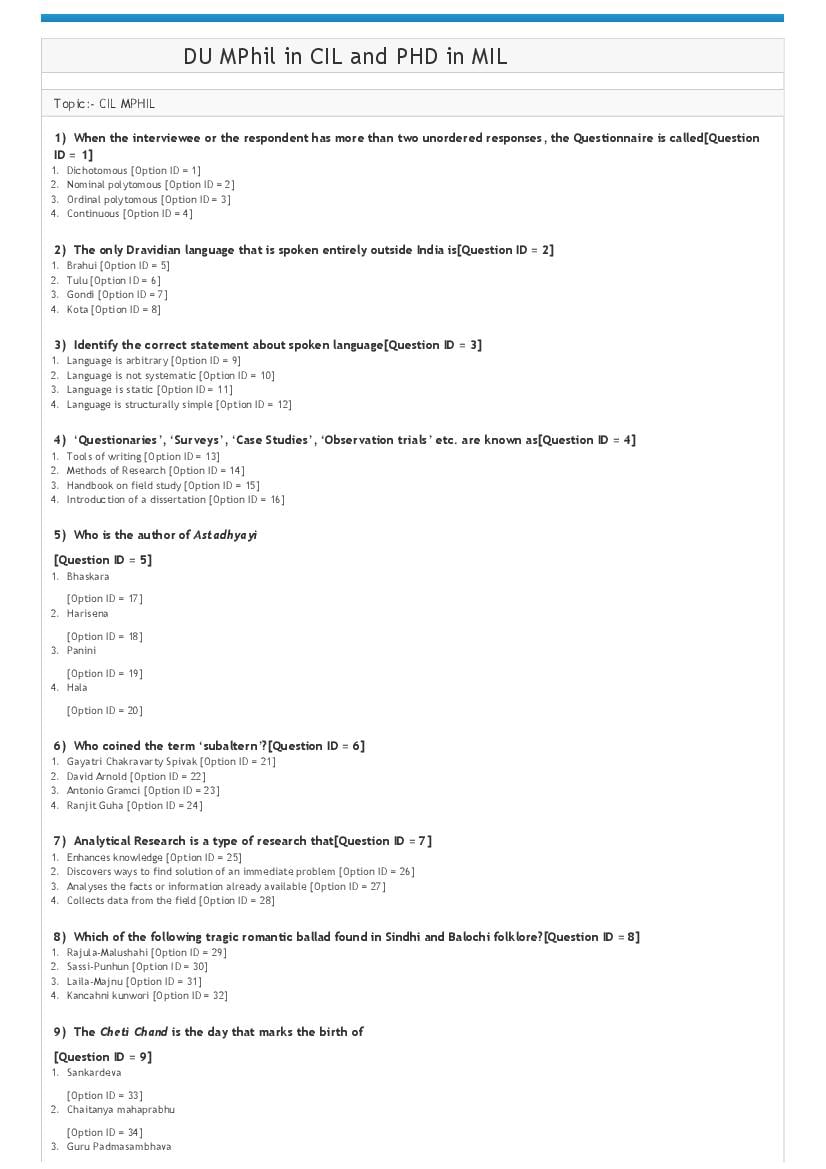
Topic:‐ CIL MPHIL
1) When the interviewee or the respondent has more than two unordered responses, the Questionnaire is called[Question
ID = 1]
1. Dichotomous [Option ID = 1]
2. Nominal polytomous [Option ID = 2]
3. Ordinal polytomous [Option ID = 3]
4. Continuous [Option ID = 4]
2) The only Dravidian language that is spoken entirely outside India is[Question ID = 2]
1. Brahui [Option ID = 5]
2. Tulu [Option ID = 6]
3. Gondi [Option ID = 7]
4. Kota [Option ID = 8]
3) Identify the correct statement about spoken language[Question ID = 3]
1. Language is arbitrary [Option ID = 9]
2. Language is not systematic [Option ID = 10]
3. Language is static [Option ID = 11]
4. Language is structurally simple [Option ID = 12]
4) ‘Questionaries’, ‘Surveys’, ‘Case Studies’, ‘Observation trials’ etc. are known as[Question ID = 4]
1. Tools of writing [Option ID = 13]
2. Methods of Research [Option ID = 14]
3. Handbook on field study [Option ID = 15]
4. Introduction of a dissertation [Option ID = 16]
5) Who is the author of Astadhyayi
[Question ID = 5]
1. Bhaskara
[Option ID = 17]
2. Harisena
[Option ID = 18]
3. Panini
[Option ID = 19]
4. Hala
[Option ID = 20]
6) Who coined the term ‘subaltern’?[Question ID = 6]
1. Gayatri Chakravarty Spivak [Option ID = 21]
2. David Arnold [Option ID = 22]
3. Antonio Gramci [Option ID = 23]
4. Ranjit Guha [Option ID = 24]
7) Analytical Research is a type of research that[Question ID = 7]
1. Enhances knowledge [Option ID = 25]
2. Discovers ways to find solution of an immediate problem [Option ID = 26]
3. Analyses the facts or information already available [Option ID = 27]
4. Collects data from the field [Option ID = 28]
8) Which of the following tragic romantic ballad found in Sindhi and Balochi folklore?[Question ID = 8]
1. Rajula‐Malushahi [Option ID = 29]
2. Sassi‐Punhun [Option ID = 30]
3. Laila‐Majnu [Option ID = 31]
4. Kancahni kunwori [Option ID = 32]
9) The Cheti Chand is the day that marks the birth of
[Question ID = 9]
1. Sankardeva
[Option ID = 33]
2. Chaitanya mahaprabhu
[Option ID = 34]
3. Guru Padmasambhava
Page 2
4. Baba Jhulelal
[Option ID = 36]
10) What is the major intention of ‘multidisciplinary research’?[Question ID = 10]
1. To bring out the holistic approach of research [Option ID = 37]
2. To over simplify the problems of research [Option ID = 38]
3. To create a new trend in research methodology [Option ID = 39]
4. To reduce the emphasis of a single subject in the domain of research [Option ID = 40]
11) An example of ‘clipped form of word’ is
[Question ID = 11]
1. The word ‘breakfast’ indicates the ‘breaking of the fast’ after the night
[Option ID = 41]
2. The word ‘railroad’ consists of two words; rail and road
[Option ID = 42]
3. The English word mob is derived from Latin mobile vulgus
[Option ID = 43]
4. The new word ‘selfie’ refers to the pictures one takes of oneself
[Option ID = 44]
12) The poet of Malayalam literature who received the Jnanapith award in 2020 is________[Question ID = 12]
1. Thakji Shivasankar Pillai [Option ID = 45]
2. Akkitham Achuthan Namboothiri [Option ID = 46]
3. Vennikkulam Gopala Kurup [Option ID = 47]
4. Rafeeq Ahmed [Option ID = 48]
13) Find out the North Dravidian languages[Question ID = 13]
1. Tamil, Malayalam, Kannada, Tulu [Option ID = 49]
2. Telugu, Gondi, Kunda, Kuvi [Option ID = 50]
3. Kurukh, Malto, Brahui [Option ID = 51]
4. Kolami, Naiki, Ollari [Option ID = 52]
14) Identify the correct link.[Question ID = 14]
1. RatanThiyam: Puppet Theatre [Option ID = 53]
2. B.V.Karanth: Jana NatyaManch [Option ID = 54]
3. BadalSarkar: Third Theatre [Option ID = 55]
4. Vijay Tendulkar: Street Theatre [Option ID = 56]
15) What is the earliest available work on Kannada language?[Question ID = 15]
1. Kavirajamarga [Option ID = 57]
2. Astadhyayi [Option ID = 58]
3. Tolkappiyam [Option ID = 59]
4. Rajatarangini [Option ID = 60]
16) What is the meaning of the term ‘research design’?[Question ID = 16]
1. Searching again and again [Option ID = 61]
2. Overall strategy or a framework for research [Option ID = 62]
3. The hypothesis of a research work [Option ID = 63]
4. Following the aim of research [Option ID = 64]
17) Find out the correct statement about 'lingua franca'
[Question ID = 17]
1. Lingua franca is a dead language
[Option ID = 65]
2. Lingua francas are developed recently to communicate
[Option ID = 66]
3. Lingua franca is a common language used by many communities in a particular place
[Option ID = 67]
4. Lingua franca is a language of signs and symbols
[Option ID = 68]
18) The format of a thesis writing is similar to[Question ID = 18]
1. The writing of a dissertation [Option ID = 69]
2. A journalistic writing [Option ID = 70]
3. The format of a monograph [Option ID = 71]
4. The writing of a seminar paper [Option ID = 72]
Page 3
1. A short story by Dalip Kaur Tiwana [Option ID = 73]
2. A poem by Amrita Pritam [Option ID = 74]
3. A letter by Krishna Sobti [Option ID = 75]
4. A song by Kamala Das [Option ID = 76]
20) Research related to abstract ideas or concepts is known as[Question ID = 20]
1. Empirical research [Option ID = 77]
2. Fundamental Research [Option ID = 78]
3. Conceptual Research [Option ID = 79]
4. Qualitative Research [Option ID = 80]
21) ‘Consciousness rising’ is a major concept of[Question ID = 21]
1. Marxism [Option ID = 81]
2. Liberalism [Option ID = 82]
3. Radicalism [Option ID = 83]
4. Post‐modernism [Option ID = 84]
22) Which one of the following is not a stage of dramatic irony?[Question ID = 22]
1. Installation [Option ID = 85]
2. Exploitation [Option ID = 86]
3. Resolution [Option ID = 87]
4. Settings [Option ID = 88]
23) The First‐wave Feminism in the west was occurred during[Question ID = 23]
1. The late 16th century [Option ID = 89]
2. The early 18th century [Option ID = 90]
3. The 18th and the early 19th century [Option ID = 91]
4. The 19th and the early 20th century [Option ID = 92]
24) A Vindication of the Rights of Woman was written by
[Question ID = 24]
1. Mary Shelly
[Option ID = 93]
2. Mary Wollstonecraft
[Option ID = 94]
3. Simone De Beauvoir
[Option ID = 95]
4. Judith Butler
[Option ID = 96]
25) Who coined the term ‘eco‐criticism’?[Question ID = 25]
1. William Rueckert [Option ID = 97]
2. Raymond Williams [Option ID = 98]
3. Rachel Carson [Option ID = 99]
4. Richard Llewellyn [Option ID = 100]
26) Which of the following is an example of metaphor?[Question ID = 26]
1. The world is a stage [Option ID = 101]
2. The stage is like a puppet show [Option ID = 102]
3. We are just like the string puppets controlled by God [Option ID = 103]
4. String puppets look as realistic as a human being [Option ID = 104]
27) Who wrote the “Anatomy of Criticism”?[Question ID = 27]
1. Matthew Arnold [Option ID = 105]
2. Northop Fyre [Option ID = 106]
3. Jacques Derrida [Option ID = 107]
4. Ferdinand de Saussure [Option ID = 108]
28) How many types of Bhavas are there according to Natyashastra?[Question ID = 28]
1. Two types [Option ID = 109]
2. Three types [Option ID = 110]
3. Four types [Option ID = 111]
4. Six types [Option ID = 112]
29) Which Indian aesthetician is credited with creating the dhvani theory?[Question ID = 29]
1. Bharatamuni [Option ID = 113]
2. Anandavardhana [Option ID = 114]
3. Abhinavagupta [Option ID = 115]
4. Kuntaka [Option ID = 116]
Page 4
[Question ID = 30]
1. Two major characters from The Three Musketeers by Alexendre Dumas
[Option ID = 117]
2. Two characters from Waiting for Godot by Samuel Beckett
[Option ID = 118]
3. Plot and character of a tragedy
[Option ID = 119]
4. Thought and diction in a literary work
[Option ID = 120]
31) Identify the correct link between the theoretician and the area of investigation.[Question ID = 31]
1. Jacques Derrida: New Historicism [Option ID = 121]
2. Walter Benjamin: Post‐colonial studies [Option ID = 122]
3. Stephen Greenblatt: Semiotics [Option ID = 123]
4. Roman Jakobson: Linguist [Option ID = 124]
32) Genres today are ____________[Question ID = 32]
1. looked upon as models to be emulated by texts [Option ID = 125]
2. seen in relative terms [Option ID = 126]
3. restricted to literary studies [Option ID = 127]
4. deemed irrelevant [Option ID = 128]
33) Testimonial literature is _________[Question ID = 33]
1. a first‐person written narrative [Option ID = 129]
2. a written rendition of an oral record of first‐hand experiences [Option ID = 130]
3. historical fiction [Option ID = 131]
4. autobiographical writings [Option ID = 132]
34) Find out the correct match in the work and the genre.[Question ID = 34]
1. The Odyssey: novel [Option ID = 133]
2. Persepolis: The Story of a Childhood: Graphic Novel [Option ID = 134]
3. Flowers of Evil: novel [Option ID = 135]
4. Beowulf: play [Option ID = 136]
35) The novel as genre is linked with _________[Question ID = 35]
1. feudal society [Option ID = 137]
2. epic narratives [Option ID = 138]
3. print culture [Option ID = 139]
4. post‐industrial societies [Option ID = 140]
36) Comparative Literature emerged in Europe _____________[Question ID = 36]
1. in the nineteenth century [Option ID = 141]
2. in early twentieth century [Option ID = 142]
3. in mid‐twentieth century [Option ID = 143]
4. in the twenty‐first century [Option ID = 144]
37) In the Natyasastra performance is related to ____________[Question ID = 37]
1. diversion [Option ID = 145]
2. escape [Option ID = 146]
3. purgation of emotions [Option ID = 147]
4. means to wholeness of vision [Option ID = 148]
38) The relation between the desi and the marga traditions in India __________
[Question ID = 38]
1. was always reciprocal
[Option ID = 149]
2. has become reciprocal in recent times
[Option ID = 150]
3. was non‐existent in early times
[Option ID = 151]
4. has become non‐existent recently
[Option ID = 152]
39) Care ethics is a concept brought forward by _________
[Question ID = 39]
1. Pre colonial scholars
[Option ID = 153]
Page 5
[Option ID = 154]
3. Post colonial scholars
[Option ID = 155]
4. Feminists
[Option ID = 156]
40) Indian literature in English may be best be seen as ________[Question ID = 40]
1. Solely representing India in the world [Option ID = 157]
2. belonging to the tradition of British literature [Option ID = 158]
3. a part of Indian literature [Option ID = 159]
4. the Empire writing back [Option ID = 160]
41) Intra‐cultural studies in India focuses today on _______
[Question ID = 41]
1. Influence Studies
[Option ID = 161]
2. Reception Studies
[Option ID = 162]
3. Interdisciplinary studies
[Option ID = 163]
4. Thematic Studies
[Option ID = 164]
42) Translation today is studied as ________________[Question ID = 42]
1. a word‐to‐word copy of the original [Option ID = 165]
2. an act of foreignising the source text [Option ID = 166]
3. an act of domesticating the source text [Option ID = 167]
4. having “an after‐life” in the target culture [Option ID = 168]
43) A History of Indian Literature necessarily has to be[Question ID = 43]
1. an account of discrete histories of literature in Indian languages [Option ID = 169]
2. an integrated account of literary events in different Indian literatures [Option ID = 170]
3. a record of great books in Indian literatures [Option ID = 171]
4. focused on printed texts [Option ID = 172]
44) There is a need to go back to folk expressive traditions today because[Question ID = 44]
1. they are entertaining and colorful [Option ID = 173]
2. they help us go back to our tradition [Option ID = 174]
3. they reveal an alternative knowledge system [Option ID = 175]
4. there is a renewed interest in the field outside India [Option ID = 176]
45) Folk expressive traditions in India___________[Question ID = 45]
1. exist in isolation [Option ID = 177]
2. are often integrated with other so‐called mainstream traditions [Option ID = 178]
3. have almost died out [Option ID = 179]
4. cannot be accessed easily [Option ID = 180]
46) Modern Indian Literature ____________[Question ID = 46]
1. marked a clear break from earlier traditions [Option ID = 181]
2. was radical in its outlook [Option ID = 182]
3. brought in dialogues between forces of radical change and tradition [Option ID = 183]
4. is completely a product of Western influence [Option ID = 184]
47) Which of the following research types focuses on ameliorating the prevailing situations?[Question ID = 47]
1. Fundamental Research [Option ID = 185]
2. Applied Research [Option ID = 186]
3. Action Research [Option ID = 187]
4. Experimental Research [Option ID = 188]
48) Gathering information for a research paper should involve_______[Question ID = 48]
1. a lot of home work [Option ID = 189]
2. lots of fun [Option ID = 190]
3. using an efficient system of taking notes [Option ID = 191]
4. analysing the materials [Option ID = 192]
49) Which pattern of research involves starting a generalization and then gathering evidence in support of the
generalization?[Question ID = 49]
1. Inductive [Option ID = 193]
2. Deductive [Option ID = 194]
Page 6
4. Descriptive [Option ID = 196]
50) A sentence outline adds__________[Question ID = 50]
1. substance to a topic [Option ID = 197]
2. essence to a topic [Option ID = 198]
3. description of the topic [Option ID = 199]
4. analysis of the topic [Option ID = 200]
Document Details
| Board / Org | NTA |
| Exam | DUET |
| Type | Question Paper |
| Pages | 6 |
| Language | english |
| Updated | 30 Apr 2026 |