MBOSE Class 10 Question Paper 2020 for Science and Technology New Course
Finished viewing? Save it for later —
Download MBOSE Class 10 Question Paper 2020 for Science and Technology New Course (PDF · 16 pages)About MBOSE Class 10 Question Paper 2020 for Science and Technology New Course
MBOSE Class 10 Question Paper 2020 for Science and Technology New Course is available here for free download. Published by Meghalaya Board for Class 10, this question paper can be viewed online or downloaded as a PDF (16 pages). Candidates preparing for Class 10 can use MBOSE Class 10 Question Paper 2020 for Science and Technology New Course to understand the exam pattern, the type of questions asked, and the overall difficulty level.
Frequently Asked Questions
How can I download MBOSE Class 10 Question Paper 2020 for Science and Technology New Course?
Open this page and click the Download button to save MBOSE Class 10 Question Paper 2020 for Science and Technology New Course as a PDF. It is completely free on AglaSem Docs.
Is MBOSE Class 10 Question Paper 2020 for Science and Technology New Course free to download?
Yes. MBOSE Class 10 Question Paper 2020 for Science and Technology New Course can be viewed online and downloaded as a PDF free of cost on AglaSem Docs.
How many pages does MBOSE Class 10 Question Paper 2020 for Science and Technology New Course have?
MBOSE Class 10 Question Paper 2020 for Science and Technology New Course contains 16 pages, which you can read online or download together as a single PDF.
Where can I find more Class 10 study material?
You can find more Class 10 question papers, sample papers, syllabus, and answer keys on AglaSem Docs.
MBOSE Class 10 Question Paper 2020 for Science and Technology New Course – Text
Read the full text of this question paper below — useful to quickly search, copy and reference the content online without downloading the PDF.
📄 View text version (16 pages)
Page 1
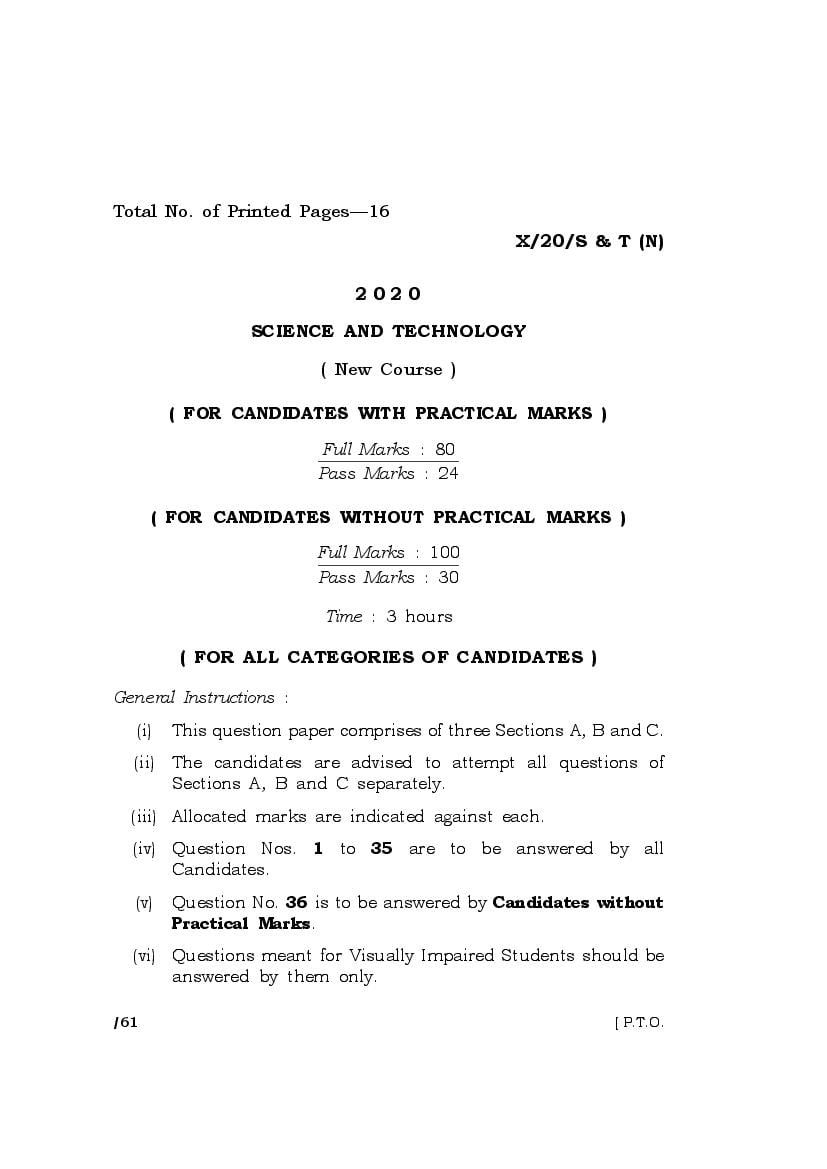
X/20/S & T (N)
2020
SCIENCE AND TECHNOLOGY
( New Course )
( FOR CANDIDATES WITH PRACTICAL MARKS )
Full Marks : 80
Pass Marks : 24
( FOR CANDIDATES WITHOUT PRACTICAL MARKS )
Full Marks : 100
Pass Marks : 30
Time : 3 hours
( FOR ALL CATEGORIES OF CANDIDATES )
General Instructions :
(i) This question paper comprises of three Sections A, B and C.
(ii) The candidates are advised to attempt all questions of
Sections A, B and C separately.
(iii) Allocated marks are indicated against each.
(iv) Question Nos. 1 to 35 are to be answered by all
Candidates.
(v) Question No. 36 is to be answered by Candidates without
Practical Marks.
(vi) Questions meant for Visually Impaired Students should be
answered by them only.
/61 [ P.T.O.
Page 2
SECTION—A
( PHYSICS )
( Marks : 26 )
Choose and write the correct answers from the following : 1×4=4
1. When a newspaper is seen through a lens, its print
appears smaller. The nature of the lens is
(A) convex
(B) concave
(C) double convex
(D) concavo-convex
2. During sunset or sunrise, the sun appears reddish
because
(A) at this time sun is not very hot
(B) sun produces red light at this time
(C) due to longer passage in atmosphere even red light
in the sunlight scatters
(D) None of the above
3. Electrical resistivity of a given metallic wire depends
upon
(A) its length
(B) its thickness
(C) its shape
(D) nature of the material
X/20/S & T (N)/61 [ Contd.
Page 3
4. An electric device which converts electric energy into
mechanical energy is called
(A) electric motor
(B) electric generator
(C) dynamo
(D) transformer
Answer the following short answer-type questions : 2×4=8
5. Distinguish between the inverted image and laterally
inverted image. 2
6. Why is fuse wire always placed in a live circuit? 2
7. An eye specialist prescribes a power + 4·5 D to a
person for his glasses. What is the nature of the
lens and the focal length of the lens? 1+1=2
8. Give two practical applications of electromagnet. 1+1=2
X/20/S & T (N)/61 [ P.T.O.
Page 4
Answer the following short answer-type questions : 3×3=9
Answer either Part—A or Part—B
Part—A
9. (a) An electric bulb of resistance 80 draws a current
of 0·75 A. Find the line voltage. ½+½=1
(b) Distinguish between the terms ‘overloading’ and
‘short circuiting’ as used in domestic circuits. 2
Part—B
(c) A convex lens of focal length 40 cm and a concave
lens of focal length 50 cm are placed in contact with
each other. Calculate (i) the power of the
combination and (ii) focal length of the combination.
1½+1½=3
10. Give three characteristics of a series circuit. 3
11. What is an electromagnet? Draw a circuit diagram to
show how a soft iron piece can be transformed into
electromagnet. ½+2½=3
[ For Visually Impaired Candidates only ]
11. State the differences between electromagnet and
permanent magnet. (Give any three points). 3
X/20/S & T (N)/61 [ Contd.
Page 5
Answer the following long answer-type questions : 5
Answer either Part—A or Part—B
Part—A
12. (a) How can a continuous flow of current be obtained?
What are the sources of energy and name of the
devices required for continuous flow of current? 1+2=3
(b) Give any four characteristics when the object is at
the centre of curvature of concave mirror. ½×4=2
Fig. 1
[ For Visually Impaired Candidates only ]
(b) State two characteristics of image formed in a plane
mirror. 2
Part—B
(c) How can the power of an electric motor be
increased? Explain with any three points. 3
(d) Why is red-coloured light used as universal signal
for danger? 2
X/20/S & T (N)/61 [ P.T.O.
Page 6
SECTION—B
( CHEMISTRY )
( Marks : 26 )
Choose and write the correct answer from the following : 1×3=3
13. Which one of the following processes involves a chemical
reaction?
(A) Storing of oxygen gas under pressure in a gas
cylinder
(B) Liquefaction of air
(C) Keeping petrol in a china dish in the open
(D) Heating copper wire in presence of air at high
temperature
14. An aqueous solution turns red litmus blue. Excess
addition of which of the following solutions would
reverse the change?
(A) Baking powder
(B) Lime
(C) Ammonium hydroxide
(D) Hydrochloric acid
15. Classification of elements helps us to
(A) study elements better in a systematic way
(B) correlate the properties of elements with some
fundamental properties of matter
(C) reveal relationship of various elements with each
other
(D) All of the above
X/20/S & T (N)/61 [ Contd.
Page 7
Answer the following short answer-type questions : 2×3=6
16. (a) Identify—(i) the substance oxidised and (ii) the
substance reduced in the given equation : ½+½=1
H2S(g) + Br2(aq) 2HBr(aq) + S(s)
(b) Ferrous sulphate decomposes with the evolution of
a gas having characteristics odour of burning
sulphur. Identify the type of reaction. 1
17. An element P belongs to the 4th period and group 17
of the long form of the periodic table. Answer the
following questions :
(a) How many valence electrons are there in element P ?
(b) What is the valency of P ?
(c) Name the element.
(d) Write the formula of its compound, when it reacts
with element Q having valency 3+. ½+½+½+½=2
18. (a) What is a homologous series? 1
(b) A special name is assigned to compounds having the
same molecular formula, but different structural
arrangement of atoms. What is that name? ½
(c) Write the IUPAC name of CH3OH. ½
X/20/S & T (N)/61 [ P.T.O.
Page 8
Answer the following short-answer type questions : 3×4=12
19. When an aqueous sodium hydroxide solution is added
to aqueous copper sulphate solution, it forms a bluish
white precipitate of copper hydroxide.
(a) What type of reaction is this? 1
(b) What is the colour of copper sulphate solution? 1
(c) Write a balanced chemical equation to represent the
above reaction. 1
20. (a) Write the chemical formula for washing soda. ½
(b) What happens when washing soda crystals are
exposed to air? ½
(c) Give any two industrial use of washing soda, other
than washing clothes. 2
Answer either Part—A or Part—B
Part—A
21. (a) Why and how are alloys made? ½+1=1½
(b) State any three properties of alloy. 1½
Part—B
(c) Why are covalent compounds generally poor
conductors of electricity? 2
(d) Explain how a single-covalent bond is formed
between two atoms of hydrogen. (Support your
answer by drawing structural diagram). 1
X/20/S & T (N)/61 [ Contd.
Page 9
[ For Visually Impaired Candidates only
in lieu of Question No. 21(d) ]
(d) Allotropy is a property shown by which class of
substances, elements, compounds or mixtures? Give
one example of allotropes of carbon. ½+½=1
22. Name the reaction that is commonly used in the
conversion of—
(a) vegetable oils to fat;
(b) ethanol to ethane;
(c) ethanol to ethanoic. 1+1+1=3
Answer the following long answer-type questions : 5
Answer either Part—A or Part—B
Part—A
23. (a) Name the process of obtaining pure metal from
an impure metal through electrolysis. If you have
to refine copper using this process, mention the
materials used as (i) anode, (ii) cathode and
(iii) electrolyte. ½×4=2
(b) Give the advantages of the above process of refining.
1+1=2
(c) Compound X and aluminium are used to join
railway tracks.
(i) Identify the compound.
(ii) Name the reaction. ½+½=1
X/20/S & T (N)/61 [ P.T.O.
Page 10
Part—B
(d) What happens chemically, when quicklime is added
to water? Give the chemical reaction. 1+1=2
(e) Zinc liberates hydrogen gas when reacted with
dilute hydrochloric acid, whereas copper does not.
Explain why. 1
(f) State the differences between rusting and rust. 1+1=2
SECTION—C
( BIOLOGY )
( Marks : 28 )
Choose and write the correct answer from the following : 1×3=3
24. Artificial removal of nitrogenous waste from the blood is
called
(A) haemoparalysis
(B) dialysis
(C) haemodialysis
(D) haemoprotein
25. Iodine is necessary for the synthesis of which hormone?
(A) Adrenaline
(B) Thyroxine
(C) Auxin
(D) Insulin
X/20/S & T (N)/61 [ Contd.
Page 11
26. Which of the following acts as blueprint of life?
(A) DNA
(B) RNA
(C) Nucleus
(D) Chromosome
Answer the following short answer-type questions : 2×4=8
27. Write any two points of differences between respiration
in plants and animals. 2
28. Draw the structure of a neuron and label the following
on it : 1+½+½=2
(a) Dendrite
(b) Axon
[ For Visually Impaired Candidates only ]
28. What do you mean by bisexual flower? Give two
examples of it. 1+½+½=2
29. In a complete flower, identify the following : ½×4=2
(a) Part that produces pollen grain
(b) Part that transfers male gamets to the female
gamets
(c) Part that is sticky to trap the pollen grain
(d) Part that develops into a fruit
X/20/S & T (N)/61 [ P.T.O.
Page 12
30. Discuss the monohybrid ratio given by Mendel. 2
Answer the following short answer-type questions : 3×4=12
31. In the given diagram of human brain, name the part
labelled A and B and write their functions. (any one for
each) : ½+½+1+1=3
Fig. 2
[ For Visually Impaired Candidates only ]
31. (a) What is excretion? Name two excretory organs in
humans. 1+(½+½)=2
(b) Give functional units of—
(i) kidney;
(ii) nervous system. 1
X/20/S & T (N)/61 [ Contd.
Page 13
32. (a) Give reasons for the following : 1+1=2
(i) The lung alveoli are covered with blood
capillaries
(ii) The wall of trachea is supported by cartilage
rings
(b) Name any two autotropic plants which also show
heterotropic mode of nutrition. ½+½=1
Answer either Part—A or Part—B
Part—A
33. (a) What is vegetative propagation? In which type of
plant is it performed? Name two methods of
vegetative propagation. 1+1+1=3
Part—B
(b) Explain the terms (i) implantation and (ii) placenta.
1+1=2
(c) Name two sexually transmitted diseases caused due
to (i) bacterial infection and (ii) viral infection. ½+½=1
34. Enumerate (in any six points) the basis of Darwin theory
of natural selection. ½×6=3
Answer the following long answer-type questions : 5
Answer either Part—A or Part—B
Part—A
35. (a) Can adrenal be called the ‘stress managing glands’
of the body? Justify your answer by giving four
points. 1×4=4
X/20/S & T (N)/61 [ P.T.O.
Page 14
(b) (i) Name the endocrine gland associated with
brain. ½
(ii) Name the endocrine gland associated with
kidneys. ½
Part—B
(c) (i) Name the pigment present in plant which can
absorb solar energy. ½
(ii) Name the two states of photosynthesis. ½+½=1
(iii) Name the mode of nutrition in amoeba. ½
(d) State the functions of blood vessels of human
circulatory system. 1×3=3
[ For Candidates without Practical Marks ]
36. I. Answer any three of the following questions : 2×3=6
(a) What do you understand by the term
refraction of light? 2
(b) What do you understand by the term
accommodation of eye? 2
(c) What do you understand by the term electric
energy? 2
(d) State the differences between magnetic field
and magnetic field line. 1+1=2
X/20/S & T (N)/61 [ Contd.
Page 15
II. Answer any three of the following questions : 2×3=6
(a) Balance the following equations : 1+1=2
(i) Fe + H2O Fe3O4 + H2
(ii) CuS + HCl CuCl2 + H2S
(b) (i) What is a neutralization reaction? 1
(ii) What do you mean by family of salts? 1
(c) What is functional group? Name the functional
group present in the given compound : 1+1=2
CH3COCH2CH2CH2CH3
(d) (i) What is saponification? 1
(ii) Give the general formula for soap. 1
III. Answer any four of the following questions : 2×4=8
(a) (i) What is respiration? 1
(ii) Where do anaerobic respiration and
aerobic respiration take place? ½+½=1
(b) Name the four main types of heterotropic
nutrition. ½×4=2
(c) State two reasons why the blood of haemophilic
persons clot very slowly or not at all. 2
X/20/S & T (N)/61 [ P.T.O.
Page 16
(d) Name the gland and give one main action of the
following hormones : 1+1=2
(i) Insulin
(ii) Thyroxine
(e) Define the following : 1+1=2
(i) Gene
(ii) Synapse
X/20/S & T (N)/61 20K
Document Details
| Board / Org | Meghalaya Board |
| Exam | Class 10 |
| Type | Question Paper |
| Pages | 16 |
| Updated | 30 Apr 2026 |