UGC NET 2021 Question Paper Performing Arts Dance Drama Theatre
Finished viewing? Save it for later —
Download UGC NET 2021 Question Paper Performing Arts Dance Drama Theatre (PDF · 75 pages)About UGC NET 2021 Question Paper Performing Arts Dance Drama Theatre
UGC NET 2021 Question Paper Performing Arts Dance Drama Theatre is available here for free download. Published by NTA for UGC NET, this question paper can be viewed online or downloaded as a PDF (75 pages). Candidates preparing for UGC NET can use UGC NET 2021 Question Paper Performing Arts Dance Drama Theatre to understand the exam pattern, the type of questions asked, and the overall difficulty level.
Frequently Asked Questions
How can I download UGC NET 2021 Question Paper Performing Arts Dance Drama Theatre?
Open this page and click the Download button to save UGC NET 2021 Question Paper Performing Arts Dance Drama Theatre as a PDF. It is completely free on AglaSem Docs.
Is UGC NET 2021 Question Paper Performing Arts Dance Drama Theatre free to download?
Yes. UGC NET 2021 Question Paper Performing Arts Dance Drama Theatre can be viewed online and downloaded as a PDF free of cost on AglaSem Docs.
How many pages does UGC NET 2021 Question Paper Performing Arts Dance Drama Theatre have?
UGC NET 2021 Question Paper Performing Arts Dance Drama Theatre contains 75 pages, which you can read online or download together as a single PDF.
Where can I find more UGC NET study material?
You can find more UGC NET question papers, sample papers, syllabus, and answer keys on AglaSem Docs.
UGC NET 2021 Question Paper Performing Arts Dance Drama Theatre – Text
Read the full text of this question paper below — useful to quickly search, copy and reference the content online without downloading the PDF.
📄 View text version (74 pages)
Page 1
Topic:‐ GP_Set4_A
1)
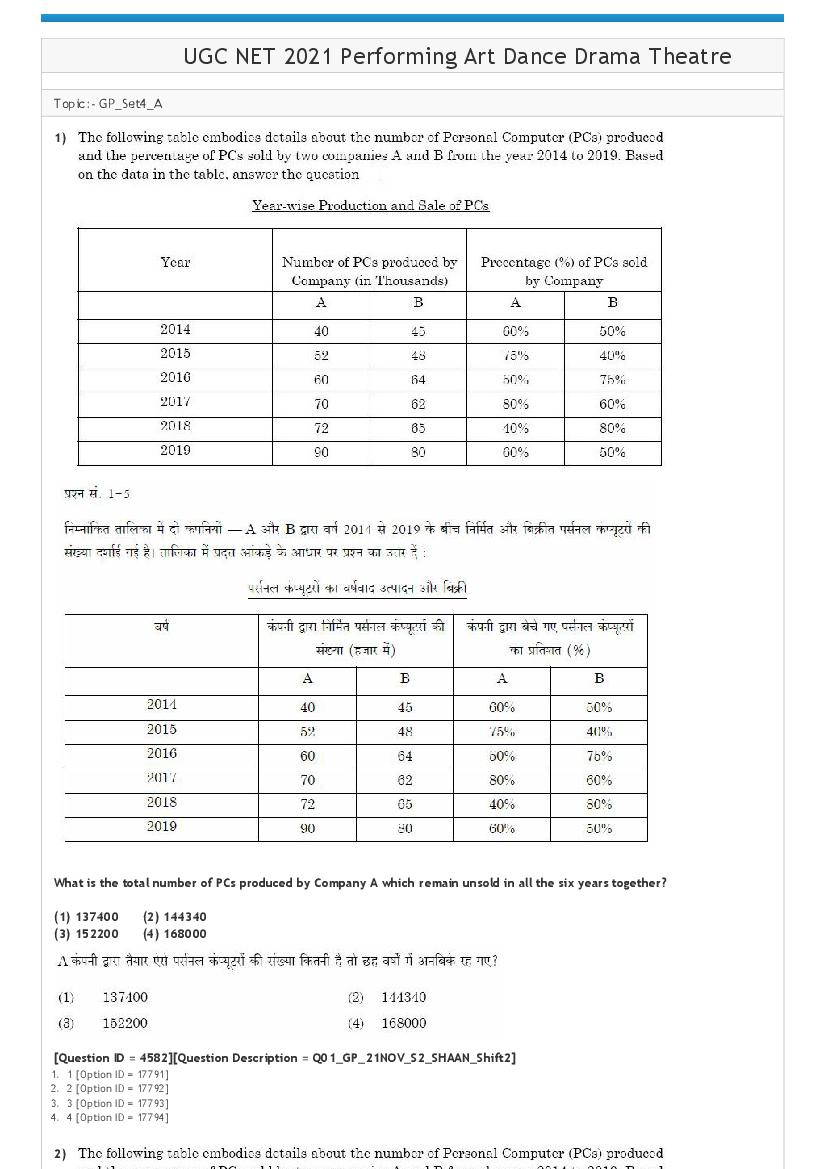
What is the total number of PCs produced by Company A which remain unsold in all the six years together?
(1) 137400 (2) 144340
(3) 152200 (4) 168000
[Question ID = 4582][Question Description = Q01_GP_21NOV_S2_SHAAN_Shift2]
1. 1 [Option ID = 17791]
2. 2 [Option ID = 17792]
3. 3 [Option ID = 17793]
4. 4 [Option ID = 17794]
2)
Page 2
in the year 2015?
(1) 5 : 2 (2) 4 : 1
(3) 5 : 3 (4) 4 : 3
[Question ID = 4583][Question Description = Q02_GP_21NOV_S2_SHAAN_Shift2]
1. 1 [Option ID = 17795]
2. 2 [Option ID = 17796]
3. 3 [Option ID = 17797]
4. 4 [Option ID = 17798]
3)
Page 3
years together?
(1) 68700 (2) 70500
(3) 72100 (4) 73800
[Question ID = 4584][Question Description = Q03_GP_21NOV_S2_SHAAN_Shift2]
1. 1 [Option ID = 17799]
2. 2 [Option ID = 17800]
3. 3 [Option ID = 17801]
4. 4 [Option ID = 17802]
4)
Page 4
2019?
(1) 82.5% (2) 87.5%
(3) 90% (4) 97.5%
[Question ID = 4585][Question Description = Q04_GP_21NOV_S2_SHAAN_Shift2]
1. 1 [Option ID = 17803]
2. 2 [Option ID = 17804]
3. 3 [Option ID = 17805]
4. 4 [Option ID = 17806]
5)
Page 5
in year 2016?
(1) 250%> (2) 200%
(3) 120% (4) 80%
[Question ID = 4586][Question Description = Q05_GP_21NOV_S2_SHAAN_Shift2]
1. 1 [Option ID = 17807]
2. 2 [Option ID = 17808]
3. 3 [Option ID = 17809]
4. 4 [Option ID = 17810]
Topic:‐ GP_Set4_B
1) Which level of teaching is also designated as ‘exploratory understanding’?
(1) Memory level (2) Understanding level
(3) Reflective level (4) Autonomous development level
[Question ID = 4587][Question Description = Q06_GP_21NOV_S2_SHAAN_Shift2]
1. 1 [Option ID = 17811]
2. 2 [Option ID = 17812]
3. 3 [Option ID = 17813]
4. 4 [Option ID = 17814]
2) Identify the characteristics of ‘Field‐independent learner’
(A) Seeks guidance and demonstrations from teacher
(B) Focuses on details of curriculum materials
(C) Likes to compete
(D) Relates concepts to personal experience
(E) Can organize imformation by himself or herself
Choose the correct answer from the options given below :
(1) (A), (B) and (C) only (2) (A), (C) and (D) only
(3) (B), (C) and (E) only (4) (C), (D) and (E) only
Page 6
1. 1 [Option ID = 17815]
2. 2 [Option ID = 17816]
3. 3 [Option ID = 17817]
4. 4 [Option ID = 17818]
3) Match List I with List II
List I List II
(Teaching Method) (Examples)
(A) Monologic teaching method (I) Cybernetics and computer‐aided instruction
(B) Dialogic teaching method (II) Case studies and tutorials
(C) Action based teaching method (III) Team teaching and demonstration
(D) Self study based teaching method (IV) Simulation and role playing
Choose the correct answer from the options given below :
(1) (A)‐(II), (B)‐(III), (C)‐(I), (D)‐(IV) (2) (A)‐(III), (B)‐(II), (C)‐(IV), (D)‐(I)
(3) (A)‐(I), (B)‐(IV), (C)‐(II), (D)‐(III) (4) (A)‐(IV), (B)‐(I), (C)‐(III), (D)‐(II)
[Question ID = 4589][Question Description = Q08_GP_21NOV_S2_SHAAN_Shift2]
1. 1 [Option ID = 17819]
2. 2 [Option ID = 17820]
3. 3 [Option ID = 17821]
4. 4 [Option ID = 17822]
4) Given below are two statements :
Statement I : Engagement in the learning process refers to the amount of time students devote to learning in the classroom.
Statement II : Formative assessment is formal whereas summative assessment is informal.
In the light of the above statements, Choose the correct answer from the options given below :
Page 7
(3) Statement I is true but Statement II is false. (4) Statement I is false but Statement II is true.
[Question ID = 4590][Question Description = Q09_GP_21NOV_S2_SHAAN_Shift2]
1. 1 [Option ID = 17823]
2. 2 [Option ID = 17824]
3. 3 [Option ID = 17825]
4. 4 [Option ID = 17826]
5) Given below are two statements : One is labelled as Assertion A and the other is labelled as Reason R.
Assertion (A) : Teaching support system as provided by ICT based gadgets is intended to optimise learning and interest in
learning material.
Reasons (R) : Any meaningful support in teaching has to be instrumental in augmenting learning conditions and outcomes.
In the light of the above statements, Choose the most appropriate answer from the options given below :
(1) Both (A) and (R) are correct and (R) is the correct explanation of (A). (2) Both (A) and (R) are correct but (R) is NOT
the correct explanation of (A).
(3) (A) is correct but (R) is not correct. (4) (A) is not correct but (R) is correct.
[Question ID = 4591][Question Description = Q10_GP_21NOV_S2_SHAAN_Shift2]
1. 1 [Option ID = 17827]
2. 2 [Option ID = 17828]
3. 3 [Option ID = 17829]
4. 4 [Option ID = 17830]
6) Data of research take the forms of words or pictures with the researcher as the key instrument in which of the following
studies?
(1) Participant observation based Studies (2) Ex Post Facto Studies
(3) Experimental Studies (4) Descriptive survey Studies
Page 8
1. 1 [Option ID = 17831]
2. 2 [Option ID = 17832]
3. 3 [Option ID = 17833]
4. 4 [Option ID = 17834]
7) Identify the characteristic features of ‘Hypothetico‐deductive research’ paradigm :
(A) Researcher is detached from the study to avoid bias
(B) Researcher becomes immersed in the research situation present or past
(C) The researcher seeks to establish relationships and explains causes of changes in measured social facts
(D) Actual settings are the direct source of data
(E) An attempt is made to set up universal context free generalizations.
Choose the correct answer from the options given below :
(1) (A), (B) and (C) only (2) (B), (C) and (D) only
(3) (A), (C) and (E) only (4) (C), (D) and (E) only
[Question ID = 4593][Question Description = Q12_GP_21NOV_S2_SHAAN_Shift2]
1. 1 [Option ID = 17835]
2. 2 [Option ID = 17836]
3. 3 [Option ID = 17837]
4. 4 [Option ID = 17838]
8) Match List I with List II
List I List II
Research Types Goal of Research
(A) Fundamental Research (I) Appraising impact of interventions
(B) Applied Research (II) Amelioration of a given situation
(C) Action of Research (III) Exploring applicability of already established principles
(D) Evaluative Research (IV) Advancing the corpus of knowledge in a field
Choose the correct answer from the options given below :
(1) (A)‐(I), (B)‐(II), (C)‐(III), (D)‐(IV) (2) (A)‐(IV), (B)‐(III), (C)‐(II), (D)‐(I)
(3) (A)‐(III), (B)‐(IV), (C)‐(I), (D)‐(II) (4) (A)‐(II), (B)‐(I), (C)‐(IV), (D)‐(III)
Page 9
1. 1 [Option ID = 17839]
2. 2 [Option ID = 17840]
3. 3 [Option ID = 17841]
4. 4 [Option ID = 17842]
9) Given below are two statements :
Statement I : At every step of research genuineness is to be vouched. Hence the issue of research ethics becomes
germane.
Statement II : ICT application in research is supportive and facilitative rather than mandatory and absolute.
In the light of the above statements, Choose the most appropriate answer from the options given below :
(1) Both Statement I and Statement II are correct. (2) Both Statement I and Statement II are incorrect.
(3) Statement I is correct but Statement II is incorrect. (4) Statement I is incorrect but Statement II is correct.
[Question ID = 4595][Question Description = Q14_GP_21NOV_S2_SHAAN_Shift2]
1. 1 [Option ID = 17843]
2. 2 [Option ID = 17844]
3. 3 [Option ID = 17845]
4. 4 [Option ID = 17846]
10) Given below are two statements : One is labelled as Assertion A and the other is labeled as Reason R.
Assertion (A) : Research Hypothesis (H1) cannot be directly verified.
Reasons (R) : Null Hypothesis (H0) is helpful in making a claim by the researcher that his/her findings are not fortuitous or by
chance.
In the light of the above statements, Choose the most appropriate answer from the options given below :
(1) Both (A) and (R) are correct and (R) is the correct explanation of (A). (2) Both (A) and (R) are correct but (R) is NOT
the correct explanation of (A).
(3) (A) is correct but (R) is not correct. (4) (A) is not correct but (R) is correct.
Page 10
1. 1 [Option ID = 17847]
2. 2 [Option ID = 17848]
3. 3 [Option ID = 17849]
4. 4 [Option ID = 17850]
11) Which type of Communication is most difficult in gearing message to an audience?
(1) Interpersonal Communication (2) Mass Communication
(3) Intrapersonal Communication (4) Group Communication
[Question ID = 4597][Question Description = Q16_GP_21NOV_S2_SHAAN_Shift2]
1. 1 [Option ID = 17851]
2. 2 [Option ID = 17852]
3. 3 [Option ID = 17853]
4. 4 [Option ID = 17854]
12) Given below are two statements :
Statement I : Audience noise is potent when the message is controversial.
Statement II : It is impossible for any communication to convert an audience from one viewpoint to another.
In the light of the above statements, Choose the correct answer from the options given below :
(1) Both Statement I and Statement II are true. (2) Both Statement I and Statement II are false.
(3) Statement I is true but Statement II is false. (4) Statement I is false but Statement II is true.
[Question ID = 4598][Question Description = Q17_GP_21NOV_S2_SHAAN_Shift2]
1. 1 [Option ID = 17855]
2. 2 [Option ID = 17856]
3. 3 [Option ID = 17857]
4. 4 [Option ID = 17858]
13) Given below are two statements : One is labelled as Assertion A and the other is labeled as Reason R.
Assertion (A) : Research has shown that the two‐step flow theory is oversimplified for every field of interest.
Reasons (R) : People tend to make great use of the media now in their respective interest.
In the light of the above statements, Choose the most appropriate answer from the options given below :
(1) Both (A) and (R) are correct and (R) is the correct explanation of (A). (2) Both (A) and (R) are correct but (R) is NOT
the correct explanation of (A).
Page 11
[Question ID = 4599][Question Description = Q18_GP_21NOV_S2_SHAAN_Shift2]
1. 1 [Option ID = 17859]
2. 2 [Option ID = 17860]
3. 3 [Option ID = 17861]
4. 4 [Option ID = 17862]
14) Physical barriers to communication are rapidly disappearing, but psychological obstacles remain owing to which of the
following?
(A) By formal language
(B) By visual presentation
(C) By use of technology
(D) By emotional appeal
(E) By cultural attitude
Choose the correct answer from the options given below :
(1) (A), (D) and (E) only (2) (A), (B) and (C) only
(3) (B), (C) and (D) only (4) (C), (D) and (E) only
[Question ID = 4600][Question Description = Q19_GP_21NOV_S2_SHAAN_Shift2]
1. 1 [Option ID = 17863]
2. 2 [Option ID = 17864]
3. 3 [Option ID = 17865]
4. 4 [Option ID = 17866]
15) Match List I with List II.
Page 12
Elements of Communication Characteristic feature
(A) Source (I) Means used to convey the message
(B) Receiver (II) Set of verbal and nonverbal cues from a source
(C) Message (III) A person who interprets the message
(D) Channel (IV) A person or an event which provides verbal/non verbal cues.
Choose the correct answer from the options given below :
[Question ID = 4601][Question Description = Q20_GP_21NOV_S2_SHAAN_Shift2]
1. 1 [Option ID = 17867]
2. 2 [Option ID = 17868]
3. 3 [Option ID = 17869]
4. 4 [Option ID = 17870]
16) If the selling price is doubled, the profit triples. What would be the profit percentage?
(1) 25% (2) 50%
(3) 100% (4) 125%
[Question ID = 4602][Question Description = Q21_GP_21NOV_S2_SHAAN_Shift2]
1. 1 [Option ID = 17871]
2. 2 [Option ID = 17872]
3. 3 [Option ID = 17873]
4. 4 [Option ID = 17874]
17) Mohan buys a second hand television at a cost of Rs. 7,500 and spends Rs. 500 on its repair. Later on he sells it at a
cost of Rs. 9,000. How much profit he gets in this process?
(1) 7.5% (2) 12.5%
(3) 20% (4) 25%
[Question ID = 4603][Question Description = Q22_GP_21NOV_S2_SHAAN_Shift2]
1. 1 [Option ID = 17875]
2. 2 [Option ID = 17876]
3. 3 [Option ID = 17877]
4. 4 [Option ID = 17878]
Page 13
(1) 8% (2) 16%
(3) 20% (4) 25%
[Question ID = 4604][Question Description = Q23_GP_21NOV_S2_SHAAN_Shift2]
1. 1 [Option ID = 17879]
2. 2 [Option ID = 17880]
3. 3 [Option ID = 17881]
4. 4 [Option ID = 17882]
19) The average age of A, B and C is 25 years. If the average age of A and B is 22 and that of B and C is 23. Then what is
the age of B?
(1) 15 years (2) 20 years
(3) 25 years (4) 30 years
[Question ID = 4605][Question Description = Q24_GP_21NOV_S2_SHAAN_Shift2]
1. 1 [Option ID = 17883]
2. 2 [Option ID = 17884]
3. 3 [Option ID = 17885]
4. 4 [Option ID = 17886]
20) In a cricket match, in the first 20 overs run rate was 4.5. What should be the run rate in the remaining 30 overs to
meet a target of 325?
(1) 6.24 (2) 7.83
(3) 5.94 (4) 8.21
[Question ID = 4606][Question Description = Q25_GP_21NOV_S2_SHAAN_Shift2]
1. 1 [Option ID = 17887]
2. 2 [Option ID = 17888]
3. 3 [Option ID = 17889]
4. 4 [Option ID = 17890]
21) Which of the following statements is true regarding two contrary propositions?
(1) They can both be true (2) The truth of one entails the falsity of the other
(3) They cannot both be false (4) The falsity of one entails the truth of the other
[Question ID = 4610][Question Description = Q29_GP_21NOV_S2_SHAAN_Shift2]
1. 1 [Option ID = 17903]
2. 2 [Option ID = 17904]
3. 3 [Option ID = 17905]
4. 4 [Option ID = 17906]
Page 14
Statement I : An informal fallacy is one that may be identified through mere inspection of the form or structure of an
argument.
Statement II : Formal fallacy is one that can be detected only through analysis of the content of the argument.
In the light of the above statements, Choose the most appropriate answer from the options given below :
(1) Both Statement I and Statement II are correct. (2) Both Statement I and Statement II are incorrect.
(3) Statement I is correct but Statement II is incorrect. (4) Statement I is incorrect but Statement II is correct.
[Question ID = 4611][Question Description = Q30_GP_21NOV_S2_SHAAN_Shift2]
1. 1 [Option ID = 17907]
2. 2 [Option ID = 17908]
3. 3 [Option ID = 17909]
4. 4 [Option ID = 17910]
23) Which of the following statements about blogs in network communication is True?
(1) The content of a blog can be edited by anyone. (2) A blog is a synchronous communication system that allows people
to chat in real‐time.
(3) A blog consists of posts in reverse chronological order. (4) A blog is a history of web pages that you have visited,
maintained by an ISP.
[Question ID = 4612][Question Description = Q31_GP_21NOV_S2_SHAAN_Shift2]
1. 1 [Option ID = 17911]
2. 2 [Option ID = 17912]
3. 3 [Option ID = 17913]
4. 4 [Option ID = 17914]
24) Identify the correct order of the following INTEL processors in the increasing order of speed.
(A) 80486
(B) 8085
(C) Dual Core
(D) Pentium‐III
Choose the correct answer from the options given below :
(1) (A), (B), (C), (D) (2) (B), (A), (D), (C)
(3) (A), (B), (D), (C) (4) (A), (C), (D), (B)
Page 15
1. 1 [Option ID = 17915]
2. 2 [Option ID = 17916]
3. 3 [Option ID = 17917]
4. 4 [Option ID = 17918]
25) Given below are two statements :
Statement I : Bus, Ring, Star, and Mesh are types of network protocols.
Statement II : A short‐range radio communication standard that transmits data over short distances upto approximately 30
feet is known as Bluetooth.
In the light of the above statements, Choose the correct answer from the options given below :
(1) Both Statement I and Statement II are true. (2) Both Statement I and Statement II are false.
(3) Statement I is true but Statement II is false. (4) Statement I is false but Statement II is true.
[Question ID = 4614][Question Description = Q33_GP_21NOV_S2_SHAAN_Shift2]
1. 1 [Option ID = 17919]
2. 2 [Option ID = 17920]
3. 3 [Option ID = 17921]
4. 4 [Option ID = 17922]
26) Which of the following group of statements in the context of Information Technology (IT) is correct?
(A) Mouse, Keyboard, and Plotter are all input devices.
(B) Unix, Windows, and Linux are all operating systems.
(C) Register, Cache Memory, and Hard Disk are all memory modules.
(D) Montior, Printer, and Scanner are all output devices.
Choose the correct answer from the options given below :
(1) (A) and (B) only (2) (A) and (D) only
(3) (C) and (D) only (4) (B) and (C) only
Page 16
1. 1 [Option ID = 17923]
2. 2 [Option ID = 17924]
3. 3 [Option ID = 17925]
4. 4 [Option ID = 17926]
27) Match List I with List II
List I List II
(Computer Terms) (Description)
(A) Processor (I) Part that runs executable programs
(B) RAM (II) Part that stores files permanently
(C) Hard Disk (III) Part that stores instructions and data temporarily for use
(D) Compiler (IV) Part that translates source program to executable program
Choose the correct answer from the options given below :
(1) (A)‐(I), (B)‐(III), (C)‐(II), (D)‐(IV) (2) (A)‐(IV), (B)‐(III), (C)‐(II), (D)‐(I)
(3) (A)‐(II), (B)‐(I), (C)‐(III), (D)‐(IV) (4) (A)‐(I), (B)‐(II), (C)‐(IV), (D)‐(III)
[Question ID = 4616][Question Description = Q35_GP_21NOV_S2_SHAAN_Shift2]
1. 1 [Option ID = 17927]
2. 2 [Option ID = 17928]
3. 3 [Option ID = 17929]
4. 4 [Option ID = 17930]
28) A coal fired thermal power plant has an efficiency of 35%. The electricity from the power plant is used entirely for
lighting purposes with average efficiency of 20%. What is the overall efficiency of conversion form coal to lighting?
(1) 15% (2) 55%
(3) 70% (4) 7%
Page 17
1. 1 [Option ID = 17931]
2. 2 [Option ID = 17932]
3. 3 [Option ID = 17933]
4. 4 [Option ID = 17934]
29) As per Sustainable Development Goal 3, one of the targets is to reduce under‐5 mortality per 1000 live births to at
least as low as
(1) 50 (2) 40
(3) 25> (4) 15
[Question ID = 4619][Question Description = Q38_GP_21NOV_S2_SHAAN_Shift2]
1. 1 [Option ID = 17939]
2. 2 [Option ID = 17940]
3. 3 [Option ID = 17941]
4. 4 [Option ID = 17942]
30) In a polluted urban area, which of the following constituents of photochemical smog has the least concentration (parts
per billion by volume)?
(1) CO Carbon monoxide (2) Nitrogen dioxide
(3) Hydrocarbons (without methane) (4) Ozone
[Question ID = 4620][Question Description = Q39_GP_21NOV_S2_SHAAN_Shift2]
1. 1 [Option ID = 17943]
2. 2 [Option ID = 17944]
3. 3 [Option ID = 17945]
4. 4 [Option ID = 17946]
31) For drinking and irrigation purposes, the availability of suitable water out of earth’s total water supplies is about less
than
(1) 1% (2) 5%
(3) 6% (4) 10%
[Question ID = 4621][Question Description = Q40_GP_21NOV_S2_SHAAN_Shift2]
1. 1 [Option ID = 17947]
2. 2 [Option ID = 17948]
3. 3 [Option ID = 17949]
4. 4 [Option ID = 17950]
32) The Indian council of Social Science Research was established for :
(A) strengthening different disciplines
(B) promoting researches in social science
(C) enhancing quality of social science as a discipline
(D) providing a platform for discussion on social scientists’ concerns
(E) supporting seminars and conferences organized by Universities
Page 18
(1) (A) and (C) only (2) (B) and (C) only
(3) (A) and (B) only (4) (B) and (D) only
[Question ID = 4622][Question Description = Q41_GP_21NOV_S2_SHAAN_Shift2]
1. 1 [Option ID = 17951]
2. 2 [Option ID = 17952]
3. 3 [Option ID = 17953]
4. 4 [Option ID = 17954]
33) The first regulatory body in higher education in India was set up under the rubric of :
(1) UGC (2) MCI
(3) BCI (4) AICTE
[Question ID = 4623][Question Description = Q42_GP_21NOV_S2_SHAAN_Shift2]
1. 1 [Option ID = 17955]
2. 2 [Option ID = 17956]
3. 3 [Option ID = 17957]
4. 4 [Option ID = 17958]
34) Who among the following was the Chairman of University Education Commission (1948)?
(1) Dr. D.S. Kothari (2) Maulana Abul Kalam Azad
(3) Dr. Zakir Hussain (4) Dr. S. Radhakrishnan
[Question ID = 4624][Question Description = Q43_GP_21NOV_S2_SHAAN_Shift2]
1. 1 [Option ID = 17959]
2. 2 [Option ID = 17960]
3. 3 [Option ID = 17961]
4. 4 [Option ID = 17962]
35) For maintenance of standards of teaching examination and research and coordination of University Education which of
the following section of UGC act should be referred to?
(1) Section 28 (2) Section 25
(3) Section 15 (4) Section 12
Page 19
1. 1 [Option ID = 17963]
2. 2 [Option ID = 17964]
3. 3 [Option ID = 17965]
4. 4 [Option ID = 17966]
36) The NEP 2020 prioritises the increase in the GER in preschool to secondary level by 100% by the year
(1) 2025 (2) 2030
(3) 2035 (4) 2040
[Question ID = 4626][Question Description = Q45_GP_21NOV_S2_SHAAN_Shift2]
1. 1 [Option ID = 17967]
2. 2 [Option ID = 17968]
3. 3 [Option ID = 17969]
4. 4 [Option ID = 17970]
37)
[Question ID = 4627][Question Description = Q26_GP_21NOV_S2_SHAAN_Shift2]
1. 1 [Option ID = 17971]
2. 2 [Option ID = 17972]
3. 3 [Option ID = 17973]
4. 4 [Option ID = 17974]
38)
[Question ID = 4628][Question Description = Q27_GP_21NOV_S2_SHAAN_Shift2]
1. 1 [Option ID = 17975]
2. 2 [Option ID = 17976]
3. 3 [Option ID = 17977]
4. 4 [Option ID = 17978]
39)
Page 20
1. 1 [Option ID = 17979]
2. 2 [Option ID = 17980]
3. 3 [Option ID = 17981]
4. 4 [Option ID = 17982]
40)
[Question ID = 4630][Question Description = Q37_GP_21NOV_S2_SHAAN_Shift2]
1. 1 [Option ID = 17983]
2. 2 [Option ID = 17984]
3. 3 [Option ID = 17985]
4. 4 [Option ID = 17986]
Topic:‐ GP_Set4_C
1) Read the passage carefully and answer the question that follow:
How much time should you allot for group work? It depends on task complexity, but you must make some more refined
estimates as well. You need to determine the time to devote to group work and time to devote to all groups coming
together to share their contributions. This latter time may be used for group reports, a whole‐class discussion, debriefing to
relate the work experiences of each group to the end product, or some combination of these tasks. Group work can easily
get out of hand in the excitement, controversy, and natural dialogue that can come from passionate discussion. This
possibility requires you to place limits on each stage of the cooperative learning activity, so one stage does not take time
from another and leave the task disjointed and incomplete in your learners’ minds. Most time naturally will be devoted to
the work of individual groups, during which the major portion of the end product will be completed. Individual group work
normally will consume 60% to 80% of the time devoted to the cooperative learning activity. The remaining time must be
divided among individual group presentations and/or whole class discussion and debriefing that places the group work into
the perspective of a single end product. If you plan both group reports and whole class discussion for the same day, be
aware that the discussion probably will get squeezed into a fraction of the time required to make it meaningful. To avoid
this, the group discussion or debriefing for the following class day may be so scheduled so that class members have ample
time to reflect on their group reports and to pull together their own thoughts about the colloborative process, which may or
may not have occured as intended. Providing 15 or 20 minutes at the begining of class the next day is usually enough time
for students to have acquired the proper distance to reflect meaningfully on their experiences of the day before‐and to
learn from them.
What is the main determinant of time allocation in cooperative learning?
(1) Time devoted to group work (2) Time devoted to all groups
(3) Time devoted to presentation of reports (4) Complexity and the number of tasks involved
Page 21
1. 1
[Option ID = 17987]
2. 2
[Option ID = 17988]
3. 3
[Option ID = 17989]
4. 4
[Option ID = 17990]
2) Read the passage carefully and answer the question that follow:
How much time should you allot for group work? It depends on task complexity, but you must make some more refined
estimates as well. You need to determine the time to devote to group work and time to devote to all groups coming
together to share their contributions. This latter time may be used for group reports, a whole‐class discussion, debriefing to
relate the work experiences of each group to the end product, or some combination of these tasks. Group work can easily
get out of hand in the excitement, controversy, and natural dialogue that can come from passionate discussion. This
possibility requires you to place limits on each stage of the cooperative learning activity, so one stage does not take time
from another and leave the task disjointed and incomplete in your learners’ minds. Most time naturally will be devoted to
the work of individual groups, during which the major portion of the end product will be completed. Individual group work
normally will consume 60% to 80% of the time devoted to the cooperative learning activity. The remaining time must be
divided among individual group presentations and/or whole class discussion and debriefing that places the group work into
the perspective of a single end product. If you plan both group reports and whole class discussion for the same day, be
aware that the discussion probably will get squeezed into a fraction of the time required to make it meaningful. To avoid
this, the group discussion or debriefing for the following class day may be so scheduled so that class members have ample
time to reflect on their group reports and to pull together their own thoughts about the colloborative process, which may or
may not have occured as intended. Providing 15 or 20 minutes at the begining of class the next day is usually enough time
for students to have acquired the proper distance to reflect meaningfully on their experiences of the day before‐and to
learn from them.
What can disrupt group work?
(1) Difficulty of task (2) A whole class discussion
(3) Discussions which involve emotions (4) Arguments on various points
Page 22
1. 1
[Option ID = 17991]
2. 2
[Option ID = 17992]
3. 3
[Option ID = 17993]
4. 4
[Option ID = 17994]
3) Read the passage carefully and answer the question that follow:
How much time should you allot for group work? It depends on task complexity, but you must make some more refined
estimates as well. You need to determine the time to devote to group work and time to devote to all groups coming
together to share their contributions. This latter time may be used for group reports, a whole‐class discussion, debriefing to
relate the work experiences of each group to the end product, or some combination of these tasks. Group work can easily
get out of hand in the excitement, controversy, and natural dialogue that can come from passionate discussion. This
possibility requires you to place limits on each stage of the cooperative learning activity, so one stage does not take time
from another and leave the task disjointed and incomplete in your learners’ minds. Most time naturally will be devoted to
the work of individual groups, during which the major portion of the end product will be completed. Individual group work
normally will consume 60% to 80% of the time devoted to the cooperative learning activity. The remaining time must be
divided among individual group presentations and/or whole class discussion and debriefing that places the group work into
the perspective of a single end product. If you plan both group reports and whole class discussion for the same day, be
aware that the discussion probably will get squeezed into a fraction of the time required to make it meaningful. To avoid
this, the group discussion or debriefing for the following class day may be so scheduled so that class members have ample
time to reflect on their group reports and to pull together their own thoughts about the colloborative process, which may or
may not have occured as intended. Providing 15 or 20 minutes at the begining of class the next day is usually enough time
for students to have acquired the proper distance to reflect meaningfully on their experiences of the day before‐and to
learn from them.
A major chunk of time in cooperative learning is devoted to which of the following?
(1) Individual group presentation (2) Whole class discussion
(3) Individual group work (4) Debriefing
Page 23
1. 1
[Option ID = 17995]
2. 2
[Option ID = 17996]
3. 3
[Option ID = 17997]
4. 4
[Option ID = 17998]
4) Read the passage carefully and answer the question that follow:
How much time should you allot for group work? It depends on task complexity, but you must make some more refined
estimates as well. You need to determine the time to devote to group work and time to devote to all groups coming
together to share their contributions. This latter time may be used for group reports, a whole‐class discussion, debriefing to
relate the work experiences of each group to the end product, or some combination of these tasks. Group work can easily
get out of hand in the excitement, controversy, and natural dialogue that can come from passionate discussion. This
possibility requires you to place limits on each stage of the cooperative learning activity, so one stage does not take time
from another and leave the task disjointed and incomplete in your learners’ minds. Most time naturally will be devoted to
the work of individual groups, during which the major portion of the end product will be completed. Individual group work
normally will consume 60% to 80% of the time devoted to the cooperative learning activity. The remaining time must be
divided among individual group presentations and/or whole class discussion and debriefing that places the group work into
the perspective of a single end product. If you plan both group reports and whole class discussion for the same day, be
aware that the discussion probably will get squeezed into a fraction of the time required to make it meaningful. To avoid
this, the group discussion or debriefing for the following class day may be so scheduled so that class members have ample
time to reflect on their group reports and to pull together their own thoughts about the colloborative process, which may or
may not have occured as intended. Providing 15 or 20 minutes at the begining of class the next day is usually enough time
for students to have acquired the proper distance to reflect meaningfully on their experiences of the day before‐and to
learn from them.
The members of cooperative learning team should be given enough time to
(1) reflect (2) discuss
(3) ask questions (4) present new ideas
Page 24
1. 1
[Option ID = 17999]
2. 2
[Option ID = 18000]
3. 3
[Option ID = 18001]
4. 4
[Option ID = 18002]
5) Read the passage carefully and answer the question that follow:
How much time should you allot for group work? It depends on task complexity, but you must make some more refined
estimates as well. You need to determine the time to devote to group work and time to devote to all groups coming
together to share their contributions. This latter time may be used for group reports, a whole‐class discussion, debriefing to
relate the work experiences of each group to the end product, or some combination of these tasks. Group work can easily
get out of hand in the excitement, controversy, and natural dialogue that can come from passionate discussion. This
possibility requires you to place limits on each stage of the cooperative learning activity, so one stage does not take time
from another and leave the task disjointed and incomplete in your learners’ minds. Most time naturally will be devoted to
the work of individual groups, during which the major portion of the end product will be completed. Individual group work
normally will consume 60% to 80% of the time devoted to the cooperative learning activity. The remaining time must be
divided among individual group presentations and/or whole class discussion and debriefing that places the group work into
the perspective of a single end product. If you plan both group reports and whole class discussion for the same day, be
aware that the discussion probably will get squeezed into a fraction of the time required to make it meaningful. To avoid
this, the group discussion or debriefing for the following class day may be so scheduled so that class members have ample
time to reflect on their group reports and to pull together their own thoughts about the colloborative process, which may or
may not have occured as intended. Providing 15 or 20 minutes at the begining of class the next day is usually enough time
for students to have acquired the proper distance to reflect meaningfully on their experiences of the day before‐and to
learn from them.
The most appropriate caption for the passage will be :
(1) Guidelines for cooperative learning (2) Procedure for cooperative learning
(3) Precaution in the conduct of cooperative learning (4) Limitations of cooperative learning
Page 25
1. 1
[Option ID = 18003]
2. 2
[Option ID = 18004]
3. 3
[Option ID = 18005]
4. 4
[Option ID = 18006]
Topic:‐ Drama_A
1) Which among the following is the first Indian English play?
िन निलिखत म से कौन सा नाटक पहला भारतीय अंगेजी नाटक है ?
[Question ID = 6610][Question Description = S2_qSNz_PG_PDT_Q01]
1. Is this civilization?/इज िदस िसिवलाइजेशन [Option ID = 25903]
2. Damage/डेमज े [Option ID = 25904]
3. The Persecuted/द परसी यूटड े [Option ID = 25905]
4. Sextet/से सटेट [Option ID = 25906]
2) Who said, "Unteachable" discipline ‐ and one of the first in Theatre curricula ‐ playwrighting?
िन निलिखत म से ये िकसने कहा था िक ना यलेखन 'अन यापनीय' िवषय है और ना य सािह य पा यकम का सबसे पहला िवषय है ?
[Question ID = 6611][Question Description = S2_qSNz_PG_PDT_Q02]
1. Palti P. Gillespie/प ती पी. िजिल पी [Option ID = 25907]
2. Michael Wright/माइकल राइट [Option ID = 25908]
3. Michael M. O'Hara/माइकल एम. ओ हारा [Option ID = 25909]
4. Oscar G. Brockett/ऑ कर जी बोकेट [Option ID = 25910]
3) Who wrote the book "Modern Acting"?
'मॉडन एि टंग' पु तक क रचना िकसने क ?
[Question ID = 6612][Question Description = S2_qSNz_PG_PDT_Q03]
1. H. Chalmers/एच. चालमस [Option ID = 25911]
2. S. Cheyney/एस. चेनेय [Option ID = 25912]
3. H. Clurman/एच. लरमैन [Option ID = 25913]
4. L. I. E. Coger/एल. आई. ई. कोजर (कोगर) [Option ID = 25914]
4) Who is the father of mobile theatre in Assam?
असम म चलंत (गितशील) नाटक के जनक कौन थे ?
[Question ID = 6613][Question Description = S2_qSNz_PG_PDT_Q04]
1. Barul Islam/बा ल इ लाम [Option ID = 25915]
2. Shafi Inamdar/शफ इनामदार [Option ID = 25916]
3. Achyut Lahar/अ युत लहर [Option ID = 25917]
4. Lokendra Arambam/लोके द अरमबम [Option ID = 25918]
5) Who wrote the play Narmedh?
नरमेध नाटक के रचियता कौन थे ?
[Question ID = 6614][Question Description = S2_qSNz_PG_PDT_Q05]
1. Satyadev Dubey/स यदेव दुबे [Option ID = 25919]
2. Badal Sircar/बादल सरकार [Option ID = 25920]
3. Giriraj Kishore/िग रराज िकशोर [Option ID = 25921]
4. Nandkishore Acharya/न दिकशोर आचाय [Option ID = 25922]
6) The 'Azhar Ka Khab' is based on which play?
'अजहर का वाब' िकस नाटक पर आधा रत है ?
Page 26
1. Enemy of the People./एिनिम आफ द पीपल [Option ID = 25923]
2. Arms and the Man./आ स ए ड द मैन [Option ID = 25924]
3. Pygmalian./िपगमैिलयन [Option ID = 25925]
4. A Street Car Named Desire./अ टीट कार ने ड िडजायर [Option ID = 25926]
7) Who wrote the play 'Parashuram Vijaya'?
'परशूराम िवजय' नाटक क रचना िकसने क थी ?
[Question ID = 6616][Question Description = S2_qSNz_PG_PDT_Q07]
1. Shahaji/शाहजी [Option ID = 25927]
2. Gajapati Kapilendra Deva/गजपि किपले द दे व [Option ID = 25928]
3. Raja Raja Narendra/राजा राजा नरे द [Option ID = 25929]
4. Jayapa Senani/जयपा सेनानी [Option ID = 25930]
8) Which among the following elements is NOT used by Brechtian Actor?
बे त के अिभनेता ने िन निलिखत म से िकस त व का उपयोग नह िकया है ?
[Question ID = 6617][Question Description = S2_qSNz_PG_PDT_Q08]
1. Mime/मूक अिभनय (माइम) [Option ID = 25931]
2. Bound script/चु त आलेख (बाउंड ि क ट) [Option ID = 25932]
3. Songs/गीत [Option ID = 25933]
4. Masks/मुखौटा (मा क) [Option ID = 25934]
9) In which play of Mahākavi Bhāsa, the episode of 'Slaying of Bāli' appears?
महाकिव भास के िकस नाटक म 'बाली वध' का वृ ा त पकट होता है ?
[Question ID = 6618][Question Description = S2_qSNz_PG_PDT_Q09]
1. Pratimānāṭakam/पितमानाटकम् [Option ID = 25935]
2. Avimäraka/अिवमारक [Option ID = 25936]
3. Pancharātram/पंचरातम् [Option ID = 25937]
4. Abhiskekanāṭakam/अिभषेक नाटकम् [Option ID = 25938]
10) It is a minor or sub‐plot, which runs parallel to the principal plot, according to Sanskrit Dramaturgy.
सं कृत ना यशा तानुसार यह एक लघु या उपकथानक है जो मु य कथानक के समा तर चलता है
[Question ID = 6619][Question Description = S2_qSNz_PG_PDT_Q10]
1. Prekṣaṇaka/पे णक [Option ID = 25939]
2. Prasthāna/प थान [Option ID = 25940]
3. Patākā/पताका [Option ID = 25941]
4. Pravṛttaka/पवृ क [Option ID = 25942]
11) Which stock character of Commedia dell'arte, is a trickster and insufferable soldier, usually from Spain, who constantly
boasts of his victories in war and love, but is always discovered to be a pathetic coward and terrified of women?
कोमेिदया देलात का कौन सा ढ़ पात पेन का एक धोखेबाज और असहनीय सैिनक है, जो िनर तर यु े म अपनी िवजयगाथाओं क ड ग मारता है, पर
और पम
हमेशा दयनीय, कायर एवं ि तय से डरा हआ पाया जाता है ?
[Question ID = 6620][Question Description = S2_qSNz_PG_PDT_Q11]
1. Harlequin/हारले युन [Option ID = 25943]
2. Capitano/कैपीटानो [Option ID = 25944]
3. Arlecchino/आरलेचीनो [Option ID = 25945]
4. Brighella/बृघलो [Option ID = 25946]
12) In the Prologue of Greek Old Comedy, a "happy idea" was put forth, then the merits of the idea were argued and
debated. What are we referring to?
पाचीन यूनानी कामदी (ओ ड कामेडी) के प तावना म एक ('हैपी आयिडया') खुश करने वाला िवचार प तािवत िकया गया था, त प ात् इस िवचार क गुणव ा पर
तक एवं िवचार िकया गया था हम िकसका उ लेख कर रहे है ?
[Question ID = 6621][Question Description = S2_qSNz_PG_PDT_Q12]
1. Dithyramb/उ सव गीत [Option ID = 25947]
2. Komos/कोमोस [Option ID = 25948]
3. Stasimon/उ र गान ( तासीमोन) [Option ID = 25949]
4. Agon/(एगौन) ना य िववाद [Option ID = 25950]
13) What is the title that Stanislavski gave to his system?
टािन लाव क ने अपने िस टम को या नाम िदया है ?
[Question ID = 6622][Question Description = S2_qSNz_PG_PDT_Q13]
Page 27
2. The Elementary Grammar of Dramatic Art/द एिलमटी गामर ऑफ़ डामेिटक आट [Option ID = 25952]
3. The Basic Steps in Acting/द बेिसक टे स इन एि टंग [Option ID = 25953]
4. The Codification of Actor's Art/द कोिडिफकेशन ऑफ़ ए टस आट [Option ID = 25954]
14) Which among the following is NOT a form of scenery?
िन निलिखत म से कौन य िवधान (सीनरी) का प नह है :
[Question ID = 6623][Question Description = S2_qSNz_PG_PDT_Q14]
1. Box setting/बॉ स सेिटंग [Option ID = 25955]
2. Drop‐and‐Wing setting/डॉप‐एंड‐िवंग सेिटंग [Option ID = 25956]
3. Unit setting/यूिनट सेिटंग [Option ID = 25957]
4. Balance setting/बैलस सेिटंग [Option ID = 25958]
15) Which among the following is NOT a type of Cyclorama?
िन निलिखत म से कौन साइ लोराम (िसक) का पा प नह है ?
[Question ID = 6624][Question Description = S2_qSNz_PG_PDT_Q15]
1. C‐Cyc/सी‐िसक [Option ID = 25959]
2. Linnebach Cyc/िलनबैक िसक [Option ID = 25960]
3. Tab Cyc/टै ब िसक [Option ID = 25961]
4. Trip Cyc/िटप िसक [Option ID = 25962]
16) Which is the chemical base used with hydrochloric acid to produce 'smoke effects'?
' मोक इफे ट' उ प न करने के िलए हाइडो लो रक अ ल के साथ कौन सा रासायिनक पदाथ उपयोग म लाया जाता है
[Question ID = 6625][Question Description = S2_qSNz_PG_PDT_Q16]
1. Ammonia/अमोिनया [Option ID = 25963]
2. Hydrogen/हाइडोजन [Option ID = 25964]
3. Sulphur/स फर [Option ID = 25965]
4. Potassium/पोटािशयम [Option ID = 25966]
17) Which among the following is NOT a play penned by Eugene Ionesco?
िन निलिखत म से कौन‐सा यूजीन आयोने को ारा िलिखत नाटक नह है ?
[Question ID = 6626][Question Description = S2_qSNz_PG_PDT_Q17]
1. The Bald Prima Donna/िद बा ड पाइमा डोना [Option ID = 25967]
2. Hunger and Thirst/हंगर एंड थ ट [Option ID = 25968]
3. The Killer/िद िकलर [Option ID = 25969]
4. Happy Days/है पी डेज [Option ID = 25970]
18) A Restoration Comedy which is gay, witty, sophisticated, and usually set against a background of aristocratic or well‐to‐
do society. Which comedy are we referring to?
एक रे टोरेशन कॉमेदी जो िवनोदी, बुि म ापूण, प र कृत है और सामा यतः अिभजातवग य या धनी समाज क पृ भूिम म आधा रत होती है हम कौन‐सी कामेडी
का उ लेख कर रहे ह ?
[Question ID = 6627][Question Description = S2_qSNz_PG_PDT_Q18]
1. Comedy of Manners/कॉमेडी ऑफ़ मैनस [Option ID = 25971]
2. Comedy of Humours/कॉमेडी ऑफ़ म ू स [Option ID = 25972]
3. Comedy of Intrigue/कॉमेडी ऑफ़ इंिटग [Option ID = 25973]
4. Comedy of Sensibility/कॉमेडी ऑफ़ सिसिबिलटी [Option ID = 25974]
19) In a play by William Shakespeare, Petruchio in a speech beginning, "Thus have I politically begun my reign." tells how
he is going to continue treating Katharine. The images of the discomfort he expects to cause her to give him considerable
pleasure. Which play is being referred to?
िविलयम शे सिपयर के एक नाटक म, पेट ूिसय " इस पकार मने राजनीितक प से अपना शासन आरंभ िकया है" श द से शु हए अपने भाषण म बताता है िक
कैथरीन से वह कैसा यवहार जारी रखेगा उन तकलीफ जो वह उसे देना चाहता है, क छिवयाँ उसे पया आंनद देती ह यहाँ कौन से नाटक का उ लेख िकया जा
रहा है ?
[Question ID = 6628][Question Description = S2_qSNz_PG_PDT_Q19]
1. Romeo and Juliet/रोिमयो एंड जुिलएट [Option ID = 25975]
2. Taming of the Shrew/िद टेिमंग ऑफ़ िद शु [Option ID = 25976]
3. King Lear/िकंग िलयर [Option ID = 25977]
4. As you like it/एज यू लाइक इट [Option ID = 25978]
20) Who among the following advocated the theory of acting in which it is argued that great actors do not experience the
emotions they are displaying?
इनम से िक ह ने अिभ य के उस िस ा त का समथन िकया है िजसम यह दावा िकया जाता है िक महान अिभनेता िजन भावनाओं को अिभ य करते है उन
भावनाओं का अनुभव नह करते ?
[Question ID = 6629][Question Description = S2_qSNz_PG_PDT_Q20]
Page 28
2. Denis Diderot/डेिनस डाइडरोट [Option ID = 25980]
3. C. S. Stanislavsky/सी.एस. तािन ला क [Option ID = 25981]
4. Mikhail Shchepkin/िमखाइल केपिकन [Option ID = 25982]
21) Which three among the following are professional actors and actor managers associated with Commedia dell'arte?
A. Luchino Visconti
B. Glan Ciacomo Colli
C. Giovan Battista Guarini
D. Olly Crick
E. Flaminio Scala
Choose the correct answer from the options given below:
िन निलिखत म से कौन से तीन यवसाियक अिभनेता एवं अिभनय ‐ पबंधक कोमेिदया देतात से संबंध है :
A. लूचीनो िवसकौ टी
B. यान याकोमो कोती
C. िजयोवान बि ता गूआरीनी
D. ओली िकक
E. लामीनो काला
नीचे िदए गए िवक प म से सही उ र का चयन क िजए :
[Question ID = 6630][Question Description = S2_qSNz_PG_PDT_Q21]
1. B, C and D only/केवल B, C और D [Option ID = 25983]
2. A, D and E only/केवल A, D और E [Option ID = 25984]
3. B, D and E only/केवल B, D और E [Option ID = 25985]
4. A, B and C only/केवल A, B और C [Option ID = 25986]
22) In which way the female bodies are known when the text is masculine property, which reference to a feminist point of
view:
A. Represented
B. Gestural reconstruction
C. Objectified
D. Improvisation
E. Sexualized
Choose the correct answer from the options given below:
नारीवादी ि कोण से शा त पु ष स पि है िजसम नारी शरीर को ‐
A. िचितत िकया जाता है
B. मुद ाओं का पुनिनमाण िकया जाता है
C. मूत प िदया जाता है
D. ता कािलक भाषण
E. कामुक बनाया जाता है
नीचे िदए गए िवक प म से सही उ र का चयन क िजए :
[Question ID = 6631][Question Description = S2_qSNz_PG_PDT_Q22]
1. A and B only/केवल A और B [Option ID = 25987]
2. B and C only/केवल B और C [Option ID = 25988]
3. A, C and E only/केवल A, C और E [Option ID = 25989]
4. A, B, C and D/केवल A, B, C और D [Option ID = 25990]
23) Identify from the following, three requisites for Human Sound (Voice) Production.
A. Body capable of vibration ‐ Paired vocal bands
B. Energy applied to body ‐ Air (breath)
C. Body capable of vibration ‐ Reeds, skins, strings
D. Medium for transmission‐ Air
Page 29
Choose the correct answer from the options given below:
िन निलिखत म से मानव विन उ पादन क तीन आव यकताओं को पहचािनए :
A. क पन के िलए समथ शरीर ‐ युगल वर तंत (पेअरड वोकल ब स)
B. शरीर पर पयु शि ‐ सांस
C. कंपन के िलए समथ शरीर ‐ नड़, चम, तार
D. संचारण का मा यम ‐ हवा
E. संचारण का मा यम ‐ हवा, पानी
नीचे िदए गए िवक प म से सही उ र का चयन क िजए :
[Question ID = 6632][Question Description = S2_qSNz_PG_PDT_Q23]
1. A, B and C only/केवल A, B और C [Option ID = 25991]
2. B, C and D only/केवल B, C और D [Option ID = 25992]
3. C, D and E only/केवल C, D और E [Option ID = 25993]
4. A, B and D only/केवल A, B और D [Option ID = 25994]
24) Which of the following are wrongly matched?
A. Swang ‐ Rangla
B. Jatra ‐ Vivek
C. Yakshagana ‐ Oddalya
D. Bhand Pathar ‐ Maskara
E. Bhavai ‐ Karyal
Choose the correct answer from the options given below:
िन निलिखत म से कौन गलत सुमेिलत है ?
A. वांग ‐ रंगला
B. जाता ‐ िववेक
C. य गान ‐ उ ा य
D. भांड पाथर ‐ मसकारा
E. भवई ‐ करयाल
नीचे िदए गए िवक प म से सही उ र का चयन क िजए :
[Question ID = 6633][Question Description = S2_qSNz_PG_PDT_Q24]
1. A and B only/केवल A और B [Option ID = 25995]
2. A and C only/केवल A और C [Option ID = 25996]
3. A and D only/केवल A और D [Option ID = 25997]
4. A and E only/केवल A और E [Option ID = 25998]
25) In which way did the rise of IPTA bring some life to the theatre in India during 1943‐44?
A. It made a significant effort to bring drama and theatre closer to common people
B. Western outlook
C. Narrow, Sectarian attitude
D. Entertainment to Englishmen
E. Its approach to form and technique
Choose the correct answer from the options given below:
1943‐44 के दौरान इपटा (IPTA) का उदय भारत के रंगमंच म कुछ पाण लेकर आया य िक:
A. उसने नाटक और रंगमंच को सामा य लोग के पास लाने का साथक पयास िकया
B. पि मी ि कोण
C. संक ण सांपदाियक मनोवृि
D. अंगेजो का मनोरंजन
Page 30
नीचे िदए गए िवक प म से सही उ र चुन :
[Question ID = 6634][Question Description = S2_qSNz_PG_PDT_Q25]
1. B and C only/केवल B और C [Option ID = 25999]
2. C and D only/केवल C और D [Option ID = 26000]
3. A and E only/केवल A और E [Option ID = 26001]
4. B and D only/केवल B और D [Option ID = 26002]
26) Which among the following are three plays written by Bhavabhuti, the Sanskrit playwright?
A. Avimāraka
B. Mālati Mādhava
C. Mahāveercharita
D. Uttar Rāmacharita
E. Pancharātra
Choose the correct answer from the options given below:
िन निलिखत म से कौन से तीन नाटक सं कृत के नाटककार भवभूित ारा रिचत ह ?
A. अिवमारक
B. मालतीमाधव
C. महावीरच रत
D. उ ररामच रत
E. पंचरात
नीचे िदए गए िवक प म से सही उ र का चयन क िजए :
[Question ID = 6635][Question Description = S2_qSNz_PG_PDT_Q26]
1. A, D and E only/केवल E, A और D [Option ID = 26003]
2. B, C and D only/केवल B, C और D [Option ID = 26004]
3. C, D and E only/केवल C, D और E [Option ID = 26005]
4. A, C and E only/केवल C, E और A [Option ID = 26006]
27) Which among the following are wrongly matched?
A. Kavalam Narayana Panicker ‐ Karim Kutty
B. Habib Tanvir ‐ Charan Das Chor
C. Sarveshwar Dayal Saxena ‐ Mahanirvan
D. Mani Madhukar ‐ Rasgandharva
E. Satish Alekar ‐ Leela
Choose the correct answer from the options given below:
िन निलिखत म से कौन गलत सुमेिलत ह ?
A. कवालम नारायण पािनकर
B. हबीब तनवीर ‐ चरन दास चोर
C. सव र दयाल स सेना ‐ महािनरवाण
D. मिण मधुकर ‐ रस ग धव
E. सतीश अलेकर ‐लीला
नीचे िदए गए िवक प म से सही उ र का चयन िकिजए :
[Question ID = 6636][Question Description = S2_qSNz_PG_PDT_Q27]
1. A and C only/केवल A और C [Option ID = 26007]
2. C and E only/केवल C और E [Option ID = 26008]
3. A and E only/केवल E और A [Option ID = 26009]
4. C and D only/केवल C और D [Option ID = 26010]
28) Identify three weight bearing elements connected with a pillar in the Vikrishta Madhyam Nātyagruha:
A. Vyāla
Page 31
C. Sālabhañjikā
D. Yavanikā
E. Sañjavana
Choose the correct answer from the options given below:
िवकृ म यम ना यगृह म त भ से जुड़े तीन भारवाही त व क पहचान कर :
A. याल
B. ार
C. शालमंिजका
D. यविनका
E. संजवन
नीचे िदए गए िवक प म से सही उ र का चयन क िजए :
[Question ID = 6637][Question Description = S2_qSNz_PG_PDT_Q28]
1. A, C and D only/केवल D, A और C [Option ID = 26011]
2. A, C and E only/केवल A, C और E [Option ID = 26012]
3. A, B and D only/केवल B, D और A [Option ID = 26013]
4. B, C and E only/केवल C, E और B [Option ID = 26014]
29) Which are the salient points of Ratan Thiyam's Chorus Repertory Company?
A. Creation of plays that were about style rather than context
B. To evolve 'an Indigeneous theatrical idiom'
C. Superficial and uniformed use of the traditional performing arts
D. Employing the art and culture of Manipur
Choose the correct answer from the options given below:
र न िथयाम के वृ दगान रेपटरी कंपनी के मु य अंश है :
A. ऐसे नाटक का िनमाण जो पसंग नह बि क शैली के स ब ध म थी
B. एक वदेशी रंगमंचीय मुहावरे को िवकिसत करते ह
C. पारंप रक पदशना मक कला का आभासी और असूिचत पयोग
D. मिणपुर के कला और सं कृित का पयोग करना
नीचे िदए गए िवक प म से सही उ र का चयन क िजए :
[Question ID = 6638][Question Description = S2_qSNz_PG_PDT_Q29]
1. A and C only/केवल A और C [Option ID = 26015]
2. A and B only/केवल A और B [Option ID = 26016]
3. A, B and C only/केवल A, B और C [Option ID = 26017]
4. B and D only/केवल B और D [Option ID = 26018]
30) Which among the following are the distinct characteristic features of Farce and not of Tragi‐comedy?
A. Serious and leads to the expectation of catastrophe
B. "Stuffed" with improbable events and farfetched coincidences
C. Depends on quick tempo and flawless timing by the actors
D. Ends solemly or at least not fatally
E. Audience is not allowed time to think things through
Choose the correct answer from the options given below:
िन निलिखत म से कौन‐सी तीन िवशेषताएं फ़ास क ह और टेजी‐कॉमेडी क नह है ?
A. गंभीर और अनथ क आशंका क ओर ले जाता है
B. असंभा य घटनाओं और अ वाभािवक संयोगो से " ट ड" होता है
C. कलाकार ु लय और सटीक कालसमंजन (टाइिमंग) पर िनभर करता है
ारा दत
Page 32
E. दशक को घटनाओं को पूरी तरह समझने का समय नह िमलता
नीचे िदए गए िवक प म से सही उ र का चयन क िजए :
[Question ID = 6639][Question Description = S2_qSNz_PG_PDT_Q30]
1. A, B and D only/केवल A, B और D [Option ID = 26019]
2. B, C and D only/केवल B, C और D [Option ID = 26020]
3. B, C and E only/केवल B, C और E [Option ID = 26021]
4. C, D and E only/केवल C, D और E [Option ID = 26022]
31) Which among the following are the three distinct characteristics of Epic theatre and not of Dramatic theatre?
A. Narrative in curves
B. Each scene for itself
C. Forces spectator to take decisions
D. One scene makes another
E. Provides spectator with sensation
Choose the correct answer from the options given below:
िन निलिखत म से कौन‐सी तीन िवशेषताएं एिपक िथएटर क ह और डामेिटक िथएटर क नह ह ?
A. वृ ा मक वणन
B. प येक य अपने म पूण
C. दशक को िनणय लेने हेतु बा य करता है
D. एक य दूसरे का िनमाण करता ह
E. दशक म उ ज
े ना उ प न करता है
नीचे िदए गए िवक प म से सही उ र चुन :
[Question ID = 6640][Question Description = S2_qSNz_PG_PDT_Q31]
1. A, B and C only/केवल A, B और C [Option ID = 26023]
2. A, C and E only/केवल A, C और E [Option ID = 26024]
3. B, D and E only/केवल B, D और E [Option ID = 26025]
4. A, C and D only/केवल A, C और D [Option ID = 26026]
32) Identify from the following, organs of our breathing apparatus which function actively in the production of voice and
speech.
A. The abdominal and intercostal muscles
B. The liver and the gall bladder
C. The diaphragm and the lungs
D. The kidneys and urinary bladder
E. The bronchial tubes and the trachea
Choose the correct answer from the options given below:
िन निलिखत सन उपकरण के अंगो म से वाणी और बोली उ प न करने म सकीय अंगो को िचि हत क िजए :
A. उदरीय और अंतरापशुक पेिशयाँ
B. यकृत और िप ाशय
C. म यपट और फेफड़ा
D. गुदा और मूताशय
E. ासनली और ासपणाल
नीचे िदए गए िवक प म से सही उ र का चयन क िजए :
[Question ID = 6641][Question Description = S2_qSNz_PG_PDT_Q32]
1. A, B and D only/केवल A, B और D [Option ID = 26027]
2. A, C and E only/केवल A, C और E [Option ID = 26028]
3. A, B and E only/केवल A, B और E [Option ID = 26029]
4. C, D and E only/केवल C, D और E [Option ID = 26030]
33) Match List I with List II
Page 33
A. Alexander Tairov I. 'Acting is Action‐ and Dance is the poetry of Action'
B. Gordan Craig II. Synthetic Theatre
C. Antonin Artaud III. The Third Theatre
D. Eugenio Barba IV. The Theatre of Ecstasy
Choose the correct answer from the options given below:
सूची ‐I को सूची ‐II से सुमेिलत क िजए :
सूची ‐I सूची ‐II
A. अले जा डर I. अिभनय िकया मक अिभ यि है और नृ य िकया क का या मक
टायरोव अिभ यि है
B. गोडन फ े ग II. िस थेिटक िथएटर
C. अंतोिनन आत द III. द थड िथएटर
D. यूिजिनओ बाबा IV. द िथएटर ऑफ़ ए सटेिस
नीचे िदए गए िवक प म से सही उ र चुिनए :
[Question ID = 6642][Question Description = S2_qSNz_PG_PDT_Q33]
1. A ‐ II, B ‐ I, C ‐ IV, D ‐ III [Option ID = 26031]
2. A ‐ IV, B ‐ II, C ‐ III, D ‐ I [Option ID = 26032]
3. A ‐ III, B ‐ IV, C ‐ I, D ‐ II [Option ID = 26033]
4. A ‐ II, B ‐ IV, C ‐ I, D ‐ III [Option ID = 26034]
34) Match List I with List II
List I List II
A. Aristophanes I. Trachiniae
B. Seneca II. Seven against Thebes
C. Aeschylus III. Hercules Furens
D. Sophocles IV. Plutus
Choose the correct answer from the options given below:
सूची ‐I को सूची ‐II से सुमेिलत क िजए :
सूची ‐I सूची ‐II
A. ए र टोफेिनस I. टिे कनीये
B. सेनेका II. सेवन अगे ट थी स
C. एसकायलस III. हर यूलस फुरे स
D. सोफोि लस IV. लुटस
नीचे िदए गए िवक प म से सही उ र चुिनए :
[Question ID = 6643][Question Description = S2_qSNz_PG_PDT_Q34]
1. A ‐ III, B ‐ II, C ‐ I, D ‐ IV [Option ID = 26035]
2. A ‐ II, B ‐ III, C ‐ IV, D ‐ I [Option ID = 26036]
3. A ‐ IV, B ‐ III, C ‐ II, D ‐ I [Option ID = 26037]
4. A ‐ IV, B ‐ I, C ‐ II, D ‐ III [Option ID = 26038]
35) Match List I with List II
List I List II
A. Ācharya Chudāmaṇi I. Kulashekhar Verman
B. Tapti Sāmvaraṇa II. Vatsarāja
C. Tripurdāha III. Shaktibhadra
D. Prabuddha Rauhiṇeya IV. Rāmabhadramuni
Choose the correct answer from the options given below:
सूची ‐I को सूची ‐II से सुमेिलत क िजए :
सूची ‐I सूची ‐II
A. आचाय चूड़ामिण I. कुलशेखर बमन
B. त ी संवरण II. व सराज
C. ितपुरदाह III. शि भद
D. पबु य रौिह य IV. रामभदमुिन
नीचे िदए गए िवक प म से सही उ र चुिनए :
[Question ID = 6644][Question Description = S2_qSNz_PG_PDT_Q35]
1. A ‐ IV, B ‐ II, C ‐ III, D ‐ I [Option ID = 26039]
2. A ‐ I, B ‐ III, C ‐ IV, D ‐ II [Option ID = 26040]
3. A ‐ II, B ‐ IV, C ‐ I, D ‐ III [Option ID = 26041]
4. A ‐ III, B ‐ I, C ‐ II, D ‐ IV [Option ID = 26042]
Page 34
List I List II
A. Cole, Toby and Chinoy I. My Life in Russian Theatre
B. Nemirovich Danchenko II. The Theatre and its Double
C. John Willett III. Directors on Directing
D. Antonian Artaud IV. The Theatre of Bertolt Brecht
Choose the correct answer from the options given below:
सूची ‐I को सूची ‐II से सुमेिलत क िजए :
सूची ‐I सूची ‐II
A. कोले, टॉबी और िचनॉय I. द लाइफ इन रिसयन िथएटर
B. निमरािवच डा से को II. द िथएटर एंड इ स डबल
C. जॉन िवलेट III. डायरे टस ऑन डायरेि टंग
D. अ तोिनया आत द IV. द िथएटर ऑफ बट ट बे त
नीचे िदए गए िवक प म से सही उ र चुिनए :
[Question ID = 6645][Question Description = S2_qSNz_PG_PDT_Q36]
1. A ‐ IV, B ‐ I, C ‐ II, D ‐ III [Option ID = 26043]
2. A ‐ I, B ‐ II, C ‐ III, D ‐ IV [Option ID = 26044]
3. A ‐ II, B ‐ IV, C ‐ III, D ‐ I [Option ID = 26045]
4. A ‐ III, B ‐ I, C ‐ IV, D ‐ II [Option ID = 26046]
37) Match List I with List II
List I List II
A. Oranaments that to be fixed by piercing the limbs I. Āropya
B. Oranaments that to be tied up II. Prakṣepya
C. Oranaments that to be worn III. Bandhaniya
D. Oranaments that to be put round IV. Āvedhya
Choose the correct answer from the options given below:
सूची ‐I को सूची ‐II से सुमेिलत क िजए :
सूची ‐I सूची ‐II
A. शरीर को बांध कर पहनाए जानेवाले आभूषण I. आरो य
B. शरीर पर ऊपर बांधे जानेवाले आभूषण II. प े य
C. पहने जाने वाले आभूषण III. ब धनीय
D. ऊपर से बांधे जाने वाले आभूषण IV. आव य
नीचे िदए गए िवक प म से सही उ र चुिनए :
[Question ID = 6646][Question Description = S2_qSNz_PG_PDT_Q37]
1. A ‐ III, B ‐ II, C ‐ I, D ‐ IV [Option ID = 26047]
2. A ‐ IV, B ‐ III, C ‐ II, D ‐ I [Option ID = 26048]
3. A ‐ I, B ‐ IV, C ‐ III, D ‐ II [Option ID = 26049]
4. A ‐ II, B ‐ I, C ‐ IV, D ‐ III [Option ID = 26050]
38) Arrange the following characters of Shakespeare's play 'Twelfth Night' in the order of their appearance in the script.
A. Valentine
B. Maria
C. Viola
D. Duke Orsino
E. Curio
Choose the correct answer from the options given below
शे सिपयर के नाटक 'टवै फत नाइट' के इन च रत (पात ) क रचना म उनके आिवभाव के कम अनुसार यवि थत क िजए :
A. वैल टाइन
B. मा रया
C. िवयोला
D. यूक ओरसीनो
Page 35
नीचे िदए गए िवक प म से सही उ र का चयन क िजए :
[Question ID = 6647][Question Description = S2_qSNz_PG_PDT_Q38]
1. D, E, A, C, B [Option ID = 26051]
2. E, D, C, B, A [Option ID = 26052]
3. A, B, C, E, D [Option ID = 26053]
4. C, D, E, B, A [Option ID = 26054]
39) Arrange the following theatre groups according to their geographical locations from South to North.
A.The Phoenix Players
B.Bhasa Centre for Performing Arts
C.Adi Shakti Theatre Group
D.Aneek Theatre Group
Choose the correct answer from the options given below
रंगमंच के िन निलिखत समूह को उनके भौगोिलक थान के अनुसार दि ण से उ र के कम म लगाएं :
A. द िफिन स लेयस
B. भास सटर फॉर परफािमग आ स
C. आिदशि िथएटर गप
ु
D. अनीक िथएटर गप
ु
नीचे िदए गए िवक प म से सही उ र का चयन क िजए :
[Question ID = 6648][Question Description = S2_qSNz_PG_PDT_Q39]
1. C, A, B, D [Option ID = 26055]
2. B, C, D, A [Option ID = 26056]
3. A, B, C, D [Option ID = 26057]
4. C, B, A, D [Option ID = 26058]
40) Arrange the following parts of the counterweight system from top to bottom, in context of various parts of Proscenium
stage.
A. Turn Buckles
B. Head Block
C. Counterweight
D. Counterweight Arbor
Choose the correct answer from the options given below
काउंटर वेट िस टम के िन निलिखत भाग को ऊपर से नीचे के कम म पीसीिनयम टेज के िविभ न भाग के स दभ म यवि थत कर :
A. टन बक स
B. हेड लॉक
C. काउंटर वेट
D. काउंटर वेट आरबोर
नीचे िदए गए िवक प म से सही उ र का चयन क िजए :
[Question ID = 6649][Question Description = S2_qSNz_PG_PDT_Q40]
1. B, A, C, D [Option ID = 26059]
2. D, B, C, A [Option ID = 26060]
3. C, B, A, D [Option ID = 26061]
4. B, A, D, C [Option ID = 26062]
41) Arrange the following theatre groups according to their geographical locations from North to South.
A. The Tadpole Company
B. Motley Theatre
C. Samhara
D. Koothu‐P‐Pattarai
Choose the correct answer from the options given below
Page 36
A. द टेडपोल कंपनी
B. मोटले िथएटर
C. संहार
D. कूतू ‐ पी ‐ प राई
नीचे िदए गए िवक प म से सही उ र का चयन क िजए :
[Question ID = 6650][Question Description = S2_qSNz_PG_PDT_Q41]
1. C, D, A, B [Option ID = 26063]
2. B, C, D, A [Option ID = 26064]
3. D, C, B, A [Option ID = 26065]
4. A, B, C, D [Option ID = 26066]
42) Choose the correct sequence of the following Sandhi‐Junctures of Plot construction.
A. Nirvahaṇa‐sandhi
B. Pratimukha‐sandhi
C. Vimarsha‐sandhi
D. Mukha‐sandhi
E. Garbha‐sandhi
Choose the correct answer from the options given below
कथानक िनमाण के िन नांिकत संयोजन के सही कम का चयन क िजए :
A. िनवाण संिध
B. पितमुख सि ध
C. िवमश सि ध
D. मुख सि ध
E. गभ सि ध
नीचे िदए गए िवक प म से सही उ र का चयन क िजए :
[Question ID = 6651][Question Description = S2_qSNz_PG_PDT_Q42]
1. B, E, C, A, D [Option ID = 26067]
2. D, B, E, C, A [Option ID = 26068]
3. E, C, A, D, B [Option ID = 26069]
4. A, D, B, E, C [Option ID = 26070]
43) Given below are two statements, one is labelled as Assertion A and the other is labelled as Reason R
Assertion A : In his production of Moliere's 'Don Juan', Meyerhold removed the front curtains and the footlights and built a
semi‐circular proscenium with stage and auditorium lit, so that it resembled a vast ballroom.
Reason R : The whole production was regarded as a triumph of theatricality, as well as a challenge to the Moscow Art
Theatre.
In light of the above statements, choose the correct answer from the options given below
नीचे दो कथन िदए गए ह : एक अिभकथन (A) के प म िलिखत है तो दूसरा उसके कारण (R) के पम:
अिभकथन (A) : मेयरहॉ द ने मोिलयर के नाटक 'डॉन जुआन ' क प तुित के समय सामने के पद तथा पाददीप को हटा िदया तथा एक अध वृ ाकार पोसेिनयम
का िनमाण कर रंगमंच और पे ागृह म रोशनी कर दी तािक यह वृहत बाल म जै स ा पतीत हो
कारण (R) : स पूण प तुित को नाटक यता (िथएटी के िलए) क जीत माना गया तथा इसने मॉ को आट िथएटर के सम एक चुनौती प तुत क
उपरो कथन के आलोक म, नीचे िदए गए िवक प म से सबसे उपयु उ र का चयन क िजए :
[Question ID = 6652][Question Description = S2_qSNz_PG_PDT_Q43]
1. Both A and R are true and R is the correct explanation of A/(A) और (R) दोन स य ह और (R), (A) क सही या या है [Option ID = 26071]
2. Both A and R are true but R is NOT the correct explanation of A/(A) और (R) दोन स य ह पर तु (R), (A) क सही या या नह है [Option ID = 26072]
3. A is true but R is false/(A) स य है पर तु (R) अस य है [Option ID = 26073]
4. A is false but R is true/(A) अस य है पर तु (R) स य है [Option ID = 26074]
44) Given below are two statements
Page 37
prose for the lowly.
Statement II: In 'Twelfth Night', sea captains spoke in prose, and the Countess Olivia spoke blank verse.
In light of the above statements, choose the correct answer from the options given below
नीचे दो कथन िदए गए ह :
कथन ‐ I : शे सिपयर ने प और ग को िमिशत िकया तथा इस िनयम क अनदेखी क िक प को कुलीनवग के िलए और ग को िनचले तबक के िलए
सुरि त रखना चािहए
कथन ‐ II : ' वे थ नाइट' म समुदी क ान ग म बोलते ह और काउटेस ओलीिवया ल क वस (िवशेष छंद) म बोलती है
उपरो कथन के आलोक म, नीचे िदए गए िवक प म से सबसे उपयु उ र का चयन क िजए :
[Question ID = 6653][Question Description = S2_qSNz_PG_PDT_Q44]
1. Both Statement I and Statement II are true/कथन I और II दोन स य ह [Option ID = 26075]
2. Both Statement I and Statement II are false/कथन I और II दोन अस य ह [Option ID = 26076]
3. Statement I is true but Statement II is false/कथन I स य है , िक तु कथन II अस य है [Option ID = 26077]
4. Statement I is false but Statement II is true/कथन I अस य है , िक तु कथन II स य है [Option ID = 26078]
45) Given below are two statements
Statement I: The Elizabethan dramatist adhered to the classic unities and the dictums of Aristotle and Horace.
Statement II: Elizabethan playwrights showed violent action on the stage, instead of merely talking about it.
In light of the above statements, choose the correct answer from the options given below
नीचे दो कथन िदए गए ह :
कथन ‐ I : एिलजाबेथ युग के नाटककार ने अर तु और होरेस क शा तीय अि वितय और अ युि य का पालन िकया है
कथन ‐ II : एिलजाबेथ युग के नाटककार ने िहंसक कृ य क केवल बात करने के बजाय उ ह मंच पर िदखाया
उपरो कथन के आलोक म, नीचे िदए गए िवक प म से सबसे उपयु उ र का चयन क िजए :
[Question ID = 6654][Question Description = S2_qSNz_PG_PDT_Q45]
1. Both Statement I and Statement II are true/कथन I और II दोन स य ह [Option ID = 26079]
2. Both Statement I and Statement II are false/कथन I और II दोन अस य ह [Option ID = 26080]
3. Statement I is true but Statement II is false/कथन I स य है , िक तु कथन II अस य है [Option ID = 26081]
4. Statement I is false but Statement II is true/कथन I अस य है , िक तु कथन II स य है [Option ID = 26082]
Topic:‐ Drama_B
1) Read the passage given below and answer the questions
What is Applied Drama/Theatre?
The term 'applied drama' and 'applied theatre' gained currency during the 1990s, finding particular favour with academics,
theatre practitioners and policy‐makers who have used them as a kind of shorthand to describe forms of dramatic activity
that primarily exist outside conventional mainstream theatre institutions, and which are specifically intended to benefit
individuals, communities and societies. Included in the portmanteau of applied drama/theatre are practices as diverse as,
for example, drama education and theatre in education, theatre in health education, theatre for development, theatre in
prisons, community theatre, heritage theatre and reminiscence theatre. Each of these forms of theatre has its own
theories, debates and highly specialised practices which often are rather different from one another. They also draw on
research in different branches of philosophy and the social sciences, notably cultural studies, cultural geography, education,
psychology, sociology and anthropology, as well as contributing to research in drama, theatre and performance studies. In
other words, applied drama and theatre are interdisciplinary and hybrid practices. Drama practitioners have been working
in educational, therapeutic and community settings for many years, but the emergence of the terms 'applied drama',
'applied theatre', and sometimes 'applied performance' signals a renewed interest in the professionalisation of these fields
and in reviewing common theoretical and political concerns which accompany their various practices.
Because applied drama and applied theatre are relatively new terms, there is no real consensus about how they are used.
Descriptions of higher education courses in applied drama and theatre reveal different inflections and interpretations. The
Central School of Speech and Drama in London describes the practice of applied theatre as 'intervention, communication,
development, empowerment and expression when working with individuals or specific communities.' This tone is echoed by
the Drama Department at the University of Manchester, where there is a further emphasis on the politics of space and
dispossession in their commitment to apply theatre to 'non‐traditional spaces and marginalised communities'. In Australia, the
international online journal Applied Theatre Researcher is more politically eclectic, describing applied theatre as 'theatre
and drama in non‐traditional contexts‐ theatre in the community, theatre in lifelong education and learning'. The New
Zealand Ministry of Education is more policy‐driven, claiming that applied theatre is 'part of the wider discipline of Drama in
Education' and that it involves work 'in business, corporate and community settings'. What is evident here is not only the
Page 38
dramatic practices with which they are accompanied.
One of the common features of these many different facets of applied drama‐theatre is, as Judith Ackroyd has pointed out,
its intentionality‐ specifically an aspiration to use drama to improve the lives of individuals and create better societies.
Ackroyd, who includes both process‐oriented and performance practices in her description of applied theatre, helpfully
sums up the common beliefs of many different practitioners in the field.
ग ांश पिढ़ए और नीचे िदए गए प के उ र दीिजए:
अनुपयु नाटक / रंगमंच या है ?
'अनुपयु नाटक' और 'अनुपयु रंगमंच' श द 1990 के दशक म अिधक पचलन म आए और शै िणक व रंगमंच से संबंिधत िव ान और नीित ‐ िनमा ताओं के
बीच लोक िपय हए िज होन मु यतः पारंप रक मु यधारा के रंगमंचीय सं थान से बाहर क ना य गितिविधय के प का वणन करने के िलए एक पकार क
आशुिलिप के प म इन का पयोग िकया और जो िवशेष प से यि य , समुदाय व समाज को लाभाि वत करते ह अनुपयु ना य/रंगमंच के संपृ श द म
िविवध वृि यां शािमल ह, उदाहरण के प म िश ा म ना य िश ा व रंगमंच, वा य िश ा म रंगमंच, िवकास हेतु रंगमंच, कारागार म रंगमंच, सामुदाियक रंगमंच,
िवरासत रंगमंच और सं मरण रंगमंच रंगमंच के इन प म से प येक के अपने िस ांत, वाद िववाद और अ यिधक िविश वृि यां ह जो बहधा एक दूसरे से िभ न ह
वे दशन और सामािजक िव ान , िजनम सां कृितक अ ययन , सां कृितक भूगोल, िश ा, मनोिव ान, समाज शा त और नृिव ान उ लेखनीय ह , क िविभ न
शाखाओं म शोध से पा करते ह और साथ ही नाटक, रंगमंच और पदशन अ ययन म शोध म योगदान करते ह दूसरे श द म अनुपयु नाटक और रंगमंच अंतः
िवषयी व िमिशत वृि यां है ना य कम अनेक वष से शै िणक, िचिक सीय और सामुदाियक प रवेश म कायरत ह पर तु 'अनुपयु नाटक', 'अनुपयु रंगमंच'
और कभी कभी 'अनुपयु पदशन' जैसे श द का उदय इन ेत के यवसायीकरण और इन िविभ न वृि य से संबंिधत एक सामान सै ांितक और राजनीितक
सरोकार म नए िसरे से िच का संकत े है
चूिं क अनुपयु नाटक व अनुपयु रंगमंच अपे ाकृत नए श द ह, अतः इस बारे म कोई वा तिवक आम सहमित नह है िक इनका कैसे पयोग िकया जाए
अनुपयु नाटक व रंगमंच म उ च िश ा पा यकम के िववरण िभ न प रचनाएं और या याएं पदिशत करते ह लंदन ि थत से टल कूल ऑफ़ पीच एंड डामा
अनुपयु रंगमंच क वृि का ' यि य अथवा िविश समुदाय के साथ काय करते समय ह त ेप, स पेषण, िवकास, सशि करण और अिभ यि के प म
वणन करता है मांचे टर िव िव ालय का नाटक िवभाग भी इसी को पित विनत करता है जहाँ 'गैर पार प रक थान और सीमांतीकृत समुदाय के िलए रंगमंच को
लागु करने क उनक वचनब ता म थान ( पेस) और वंचना क राजनीित पर और यादा बल िदया गया है ऑ टेिलया म अंतरा ीय ऑन लाइन जनल 'ए लाइड
िथएटर रसचर' राजनीितक प से अिधक उदार है, जब वह अनुपयु नाटक का 'गैर पारंप रक संदभ म ‐ समुदाय म रंगमंच, यापार व उ ोग म रंगमंच, राजनीितक
वाद‐िववाद और िकया के रंगमंच, जीवन पय त िश ा व िव ाजन म रंगमंच के प म वणन करता है यूजीलड का िश ा मंतालय अिधक नीित चिलत है जब वह
दावा करता है िक अनुपयु रंगमंच िश ा म नाटक के बृह र िवषय का अंग है और इसम ' यापार, कारपोरेट और सामुदाियक प रवेश' म काय करना शािमल है यहां
यह प है िक केवल अनुपयु नाटक से जुड़े सं थान और किमय क मा यता और आकां ाए िभ न िभ न ह अिपतु उनके साथ जुडी ना य वृि य क रज भी
अ यिधक िव तृत है
जैसािक जूिडथ एकॉयड ने इंिगत िकया है, अनुपयु नाटक / रंगमंच के इन अनेक िभ न ‐ िभ न प क एक समान िविश ता, इसक अंतरा ीयता है
िवशेषकर यि य के जीवन म सुधार व बेहतर समाज क रचना म नाटक का पयोग करने क अिभलाषा एकॉयड ने अनुपयु रंगमंच के अपने वणन म पिकया
उ मुख और पदशना मक वृि य , दोन को शािमल िकया है उ ह ने इस ेत के अनेक िभ न यवसाियक क एक समान धारणाओं का सार भी प तुत िकया है
From which year, applied drama and applied theatre gained currency?
अनुपयु नाटक व अनुपयु रंगमंच िकस वष से अिधक पचलन म आए ?
[Question ID = 6655][Question Description = S2_qSNz_PG_PDT_Q46]
1. 1985/1985 [Option ID = 26083]
2. 1995/1995 [Option ID = 26084]
3. 1990/1990 [Option ID = 26085]
4. 2000/2000 [Option ID = 26086]
2) Read the passage given below and answer the questions
What is Applied Drama/Theatre?
The term 'applied drama' and 'applied theatre' gained currency during the 1990s, finding particular favour with academics,
theatre practitioners and policy‐makers who have used them as a kind of shorthand to describe forms of dramatic activity
that primarily exist outside conventional mainstream theatre institutions, and which are specifically intended to benefit
individuals, communities and societies. Included in the portmanteau of applied drama/theatre are practices as diverse as,
for example, drama education and theatre in education, theatre in health education, theatre for development, theatre in
prisons, community theatre, heritage theatre and reminiscence theatre. Each of these forms of theatre has its own
theories, debates and highly specialised practices which often are rather different from one another. They also draw on
research in different branches of philosophy and the social sciences, notably cultural studies, cultural geography, education,
psychology, sociology and anthropology, as well as contributing to research in drama, theatre and performance studies. In
other words, applied drama and theatre are interdisciplinary and hybrid practices. Drama practitioners have been working
in educational, therapeutic and community settings for many years, but the emergence of the terms 'applied drama',
'applied theatre', and sometimes 'applied performance' signals a renewed interest in the professionalisation of these fields
and in reviewing common theoretical and political concerns which accompany their various practices.
Because applied drama and applied theatre are relatively new terms, there is no real consensus about how they are used.
Descriptions of higher education courses in applied drama and theatre reveal different inflections and interpretations. The
Central School of Speech and Drama in London describes the practice of applied theatre as 'intervention, communication,
development, empowerment and expression when working with individuals or specific communities.' This tone is echoed by
Page 39
dispossession in their commitment to apply theatre to 'non‐traditional spaces and marginalised communities'. In Australia, the
international online journal Applied Theatre Researcher is more politically eclectic, describing applied theatre as 'theatre
and drama in non‐traditional contexts‐ theatre in the community, theatre in lifelong education and learning'. The New
Zealand Ministry of Education is more policy‐driven, claiming that applied theatre is 'part of the wider discipline of Drama in
Education' and that it involves work 'in business, corporate and community settings'. What is evident here is not only the
different values and aspirations of the institutions and practitioners involved in applied drama but the wide range of
dramatic practices with which they are accompanied.
One of the common features of these many different facets of applied drama‐theatre is, as Judith Ackroyd has pointed out,
its intentionality‐ specifically an aspiration to use drama to improve the lives of individuals and create better societies.
Ackroyd, who includes both process‐oriented and performance practices in her description of applied theatre, helpfully
sums up the common beliefs of many different practitioners in the field.
ग ांश पिढ़ए और नीचे िदए गए प के उ र दीिजए:
अनुपयु नाटक / रंगमंच या है ?
'अनुपयु नाटक' और 'अनुपयु रंगमंच' श द 1990 के दशक म अिधक पचलन म आए और शै िणक व रंगमंच से संबंिधत िव ान और नीित ‐ िनमा ताओं के
बीच लोक िपय हए िज होन मु यतः पारंप रक मु यधारा के रंगमंचीय सं थान से बाहर क ना य गितिविधय के प का वणन करने के िलए एक पकार क
आशुिलिप के प म इन का पयोग िकया और जो िवशेष प से यि य , समुदाय व समाज को लाभाि वत करते ह अनुपयु ना य/रंगमंच के संपृ श द म
िविवध वृि यां शािमल ह, उदाहरण के प म िश ा म ना य िश ा व रंगमंच, वा य िश ा म रंगमंच, िवकास हेतु रंगमंच, कारागार म रंगमंच, सामुदाियक रंगमंच,
िवरासत रंगमंच और सं मरण रंगमंच रंगमंच के इन प म से प येक के अपने िस ांत, वाद िववाद और अ यिधक िविश वृि यां ह जो बहधा एक दूसरे से िभ न ह
वे दशन और सामािजक िव ान , िजनम सां कृितक अ ययन , सां कृितक भूगोल, िश ा, मनोिव ान, समाज शा त और नृिव ान उ लेखनीय ह , क िविभ न
शाखाओं म शोध से पा करते ह और साथ ही नाटक, रंगमंच और पदशन अ ययन म शोध म योगदान करते ह दूसरे श द म अनुपयु नाटक और रंगमंच अंतः
िवषयी व िमिशत वृि यां है ना य कम अनेक वष से शै िणक, िचिक सीय और सामुदाियक प रवेश म कायरत ह पर तु 'अनुपयु नाटक', 'अनुपयु रंगमंच'
और कभी कभी 'अनुपयु पदशन' जैसे श द का उदय इन ेत के यवसायीकरण और इन िविभ न वृि य से संबंिधत एक सामान सै ांितक और राजनीितक
सरोकार म नए िसरे से िच का संकत े है
चूिं क अनुपयु नाटक व अनुपयु रंगमंच अपे ाकृत नए श द ह, अतः इस बारे म कोई वा तिवक आम सहमित नह है िक इनका कैसे पयोग िकया जाए
अनुपयु नाटक व रंगमंच म उ च िश ा पा यकम के िववरण िभ न प रचनाएं और या याएं पदिशत करते ह लंदन ि थत से टल कूल ऑफ़ पीच एंड डामा
अनुपयु रंगमंच क वृि का ' यि य अथवा िविश समुदाय के साथ काय करते समय ह त ेप, स पेषण, िवकास, सशि करण और अिभ यि के प म
वणन करता है मांचे टर िव िव ालय का नाटक िवभाग भी इसी को पित विनत करता है जहाँ 'गैर पार प रक थान और सीमांतीकृत समुदाय के िलए रंगमंच को
लागु करने क उनक वचनब ता म थान ( पेस) और वंचना क राजनीित पर और यादा बल िदया गया है ऑ टेिलया म अंतरा ीय ऑन लाइन जनल 'ए लाइड
िथएटर रसचर' राजनीितक प से अिधक उदार है, जब वह अनुपयु नाटक का 'गैर पारंप रक संदभ म ‐ समुदाय म रंगमंच, यापार व उ ोग म रंगमंच, राजनीितक
वाद‐िववाद और िकया के रंगमंच, जीवन पय त िश ा व िव ाजन म रंगमंच के प म वणन करता है यूजीलड का िश ा मंतालय अिधक नीित चिलत है जब वह
दावा करता है िक अनुपयु रंगमंच िश ा म नाटक के बृह र िवषय का अंग है और इसम ' यापार, कारपोरेट और सामुदाियक प रवेश' म काय करना शािमल है यहां
यह प है िक केवल अनुपयु नाटक से जुड़े सं थान और किमय क मा यता और आकां ाए िभ न िभ न ह अिपतु उनके साथ जुडी ना य वृि य क रज भी
अ यिधक िव तृत है
जैसािक जूिडथ एकॉयड ने इंिगत िकया है, अनुपयु नाटक / रंगमंच के इन अनेक िभ न ‐ िभ न प क एक समान िविश ता, इसक अंतरा ीयता है
िवशेषकर यि य के जीवन म सुधार व बेहतर समाज क रचना म नाटक का पयोग करने क अिभलाषा एकॉयड ने अनुपयु रंगमंच के अपने वणन म पिकया
उ मुख और पदशना मक वृि य , दोन को शािमल िकया है उ ह ने इस ेत के अनेक िभ न यवसाियक क एक समान धारणाओं का सार भी प तुत िकया है
According to the passage, applied drama and theatre practices include:
ग ांश के अनुसार अनुपयु नाटक व रंगमंच वृि य म शािमल है :
[Question ID = 6656][Question Description = S2_qSNz_PG_PDT_Q47]
1. Drama education and theatre in education./ना य िश ा व िश ा म रंगमंच [Option ID = 26087]
2. Street theatre/नु कड नाटक ( टीट िथएटर) [Option ID = 26088]
3. Children theatre/बाल रंगमंच [Option ID = 26089]
4. Street theatre and happenings/नु कड नाटक व घटनाएं [Option ID = 26090]
3) Read the passage given below and answer the questions
What is Applied Drama/Theatre?
The term 'applied drama' and 'applied theatre' gained currency during the 1990s, finding particular favour with academics,
theatre practitioners and policy‐makers who have used them as a kind of shorthand to describe forms of dramatic activity
that primarily exist outside conventional mainstream theatre institutions, and which are specifically intended to benefit
individuals, communities and societies. Included in the portmanteau of applied drama/theatre are practices as diverse as,
for example, drama education and theatre in education, theatre in health education, theatre for development, theatre in
prisons, community theatre, heritage theatre and reminiscence theatre. Each of these forms of theatre has its own
theories, debates and highly specialised practices which often are rather different from one another. They also draw on
research in different branches of philosophy and the social sciences, notably cultural studies, cultural geography, education,
psychology, sociology and anthropology, as well as contributing to research in drama, theatre and performance studies. In
other words, applied drama and theatre are interdisciplinary and hybrid practices. Drama practitioners have been working
in educational, therapeutic and community settings for many years, but the emergence of the terms 'applied drama',
'applied theatre', and sometimes 'applied performance' signals a renewed interest in the professionalisation of these fields
Page 40
Because applied drama and applied theatre are relatively new terms, there is no real consensus about how they are used.
Descriptions of higher education courses in applied drama and theatre reveal different inflections and interpretations. The
Central School of Speech and Drama in London describes the practice of applied theatre as 'intervention, communication,
development, empowerment and expression when working with individuals or specific communities.' This tone is echoed by
the Drama Department at the University of Manchester, where there is a further emphasis on the politics of space and
dispossession in their commitment to apply theatre to 'non‐traditional spaces and marginalised communities'. In Australia, the
international online journal Applied Theatre Researcher is more politically eclectic, describing applied theatre as 'theatre
and drama in non‐traditional contexts‐ theatre in the community, theatre in lifelong education and learning'. The New
Zealand Ministry of Education is more policy‐driven, claiming that applied theatre is 'part of the wider discipline of Drama in
Education' and that it involves work 'in business, corporate and community settings'. What is evident here is not only the
different values and aspirations of the institutions and practitioners involved in applied drama but the wide range of
dramatic practices with which they are accompanied.
One of the common features of these many different facets of applied drama‐theatre is, as Judith Ackroyd has pointed out,
its intentionality‐ specifically an aspiration to use drama to improve the lives of individuals and create better societies.
Ackroyd, who includes both process‐oriented and performance practices in her description of applied theatre, helpfully
sums up the common beliefs of many different practitioners in the field.
ग ांश पिढ़ए और नीचे िदए गए प के उ र दीिजए:
अनुपयु नाटक / रंगमंच या है ?
'अनुपयु नाटक' और 'अनुपयु रंगमंच' श द 1990 के दशक म अिधक पचलन म आए और शै िणक व रंगमंच से संबंिधत िव ान और नीित ‐ िनमा ताओं के
बीच लोक िपय हए िज होन मु यतः पारंप रक मु यधारा के रंगमंचीय सं थान से बाहर क ना य गितिविधय के प का वणन करने के िलए एक पकार क
आशुिलिप के प म इन का पयोग िकया और जो िवशेष प से यि य , समुदाय व समाज को लाभाि वत करते ह अनुपयु ना य/रंगमंच के संपृ श द म
िविवध वृि यां शािमल ह, उदाहरण के प म िश ा म ना य िश ा व रंगमंच, वा य िश ा म रंगमंच, िवकास हेतु रंगमंच, कारागार म रंगमंच, सामुदाियक रंगमंच,
िवरासत रंगमंच और सं मरण रंगमंच रंगमंच के इन प म से प येक के अपने िस ांत, वाद िववाद और अ यिधक िविश वृि यां ह जो बहधा एक दूसरे से िभ न ह
वे दशन और सामािजक िव ान , िजनम सां कृितक अ ययन , सां कृितक भूगोल, िश ा, मनोिव ान, समाज शा त और नृिव ान उ लेखनीय ह , क िविभ न
शाखाओं म शोध से पा करते ह और साथ ही नाटक, रंगमंच और पदशन अ ययन म शोध म योगदान करते ह दूसरे श द म अनुपयु नाटक और रंगमंच अंतः
िवषयी व िमिशत वृि यां है ना य कम अनेक वष से शै िणक, िचिक सीय और सामुदाियक प रवेश म कायरत ह पर तु 'अनुपयु नाटक', 'अनुपयु रंगमंच'
और कभी कभी 'अनुपयु पदशन' जैसे श द का उदय इन ेत के यवसायीकरण और इन िविभ न वृि य से संबंिधत एक सामान सै ांितक और राजनीितक
सरोकार म नए िसरे से िच का संकत े है
चूिं क अनुपयु नाटक व अनुपयु रंगमंच अपे ाकृत नए श द ह, अतः इस बारे म कोई वा तिवक आम सहमित नह है िक इनका कैसे पयोग िकया जाए
अनुपयु नाटक व रंगमंच म उ च िश ा पा यकम के िववरण िभ न प रचनाएं और या याएं पदिशत करते ह लंदन ि थत से टल कूल ऑफ़ पीच एंड डामा
अनुपयु रंगमंच क वृि का ' यि य अथवा िविश समुदाय के साथ काय करते समय ह त ेप, स पेषण, िवकास, सशि करण और अिभ यि के प म
वणन करता है मांचे टर िव िव ालय का नाटक िवभाग भी इसी को पित विनत करता है जहाँ 'गैर पार प रक थान और सीमांतीकृत समुदाय के िलए रंगमंच को
लागु करने क उनक वचनब ता म थान ( पेस) और वंचना क राजनीित पर और यादा बल िदया गया है ऑ टेिलया म अंतरा ीय ऑन लाइन जनल 'ए लाइड
िथएटर रसचर' राजनीितक प से अिधक उदार है, जब वह अनुपयु नाटक का 'गैर पारंप रक संदभ म ‐ समुदाय म रंगमंच, यापार व उ ोग म रंगमंच, राजनीितक
वाद‐िववाद और िकया के रंगमंच, जीवन पय त िश ा व िव ाजन म रंगमंच के प म वणन करता है यूजीलड का िश ा मंतालय अिधक नीित चिलत है जब वह
दावा करता है िक अनुपयु रंगमंच िश ा म नाटक के बृह र िवषय का अंग है और इसम ' यापार, कारपोरेट और सामुदाियक प रवेश' म काय करना शािमल है यहां
यह प है िक केवल अनुपयु नाटक से जुड़े सं थान और किमय क मा यता और आकां ाए िभ न िभ न ह अिपतु उनके साथ जुडी ना य वृि य क रज भी
अ यिधक िव तृत है
जैसािक जूिडथ एकॉयड ने इंिगत िकया है, अनुपयु नाटक / रंगमंच के इन अनेक िभ न ‐ िभ न प क एक समान िविश ता, इसक अंतरा ीयता है
िवशेषकर यि य के जीवन म सुधार व बेहतर समाज क रचना म नाटक का पयोग करने क अिभलाषा एकॉयड ने अनुपयु रंगमंच के अपने वणन म पिकया
उ मुख और पदशना मक वृि य , दोन को शािमल िकया है उ ह ने इस ेत के अनेक िभ न यवसाियक क एक समान धारणाओं का सार भी प तुत िकया है
Match List I with List II
List I List II
A. The Central School of Speech and Drama I. Intentionality
B. University of Manchester, Drama Department II. Non‐traditional contexts
C. Applied Theatre Researcher III. Politics of space
D. Judith Ackroyd IV. Intervention
Choose the correct answer from the options given below:
सूची ‐I को सूची ‐II से सुमेिलत क िजए :
सूची ‐I सूची ‐II
A. से टल कूल ऑफ पीच एंड डामा I. अिभपाय
B. मांचे टर िव िव ालय ना य िवभाग II. गैर ‐ पारंप रक संदभ
C. अनुपयु रंगमंच शोधाथ III. थान ( पेस) क राजनीित
D. जूिडथ एकॉयड IV. ह त ेप
नीचे िदए गए िवक प म से सही उ र चुिनए :
[Question ID = 6657][Question Description = S2_qSNz_PG_PDT_Q48]
Page 41
2. A ‐ IV, B ‐ III, C ‐ II, D ‐ I/A ‐ IV, B ‐ III, C ‐ II, D ‐ I [Option ID = 26092]
3. A ‐ II, B ‐ III, C ‐ IV, D ‐ I/A ‐ II, B ‐ III, C ‐ IV, D ‐ I [Option ID = 26093]
4. A ‐ III, B ‐ IV, C ‐ I, D ‐ II/A ‐ III, B ‐ IV, C ‐ I, D ‐ II [Option ID = 26094]
4) Read the passage given below and answer the questions
What is Applied Drama/Theatre?
The term 'applied drama' and 'applied theatre' gained currency during the 1990s, finding particular favour with academics,
theatre practitioners and policy‐makers who have used them as a kind of shorthand to describe forms of dramatic activity
that primarily exist outside conventional mainstream theatre institutions, and which are specifically intended to benefit
individuals, communities and societies. Included in the portmanteau of applied drama/theatre are practices as diverse as,
for example, drama education and theatre in education, theatre in health education, theatre for development, theatre in
prisons, community theatre, heritage theatre and reminiscence theatre. Each of these forms of theatre has its own
theories, debates and highly specialised practices which often are rather different from one another. They also draw on
research in different branches of philosophy and the social sciences, notably cultural studies, cultural geography, education,
psychology, sociology and anthropology, as well as contributing to research in drama, theatre and performance studies. In
other words, applied drama and theatre are interdisciplinary and hybrid practices. Drama practitioners have been working
in educational, therapeutic and community settings for many years, but the emergence of the terms 'applied drama',
'applied theatre', and sometimes 'applied performance' signals a renewed interest in the professionalisation of these fields
and in reviewing common theoretical and political concerns which accompany their various practices.
Because applied drama and applied theatre are relatively new terms, there is no real consensus about how they are used.
Descriptions of higher education courses in applied drama and theatre reveal different inflections and interpretations. The
Central School of Speech and Drama in London describes the practice of applied theatre as 'intervention, communication,
development, empowerment and expression when working with individuals or specific communities.' This tone is echoed by
the Drama Department at the University of Manchester, where there is a further emphasis on the politics of space and
dispossession in their commitment to apply theatre to 'non‐traditional spaces and marginalised communities'. In Australia, the
international online journal Applied Theatre Researcher is more politically eclectic, describing applied theatre as 'theatre
and drama in non‐traditional contexts‐ theatre in the community, theatre in lifelong education and learning'. The New
Zealand Ministry of Education is more policy‐driven, claiming that applied theatre is 'part of the wider discipline of Drama in
Education' and that it involves work 'in business, corporate and community settings'. What is evident here is not only the
different values and aspirations of the institutions and practitioners involved in applied drama but the wide range of
dramatic practices with which they are accompanied.
One of the common features of these many different facets of applied drama‐theatre is, as Judith Ackroyd has pointed out,
its intentionality‐ specifically an aspiration to use drama to improve the lives of individuals and create better societies.
Ackroyd, who includes both process‐oriented and performance practices in her description of applied theatre, helpfully
sums up the common beliefs of many different practitioners in the field.
ग ांश पिढ़ए और नीचे िदए गए प के उ र दीिजए:
अनुपयु नाटक / रंगमंच या है ?
'अनुपयु नाटक' और 'अनुपयु रंगमंच' श द 1990 के दशक म अिधक पचलन म आए और शै िणक व रंगमंच से संबंिधत िव ान और नीित ‐ िनमा ताओं के
बीच लोक िपय हए िज होन मु यतः पारंप रक मु यधारा के रंगमंचीय सं थान से बाहर क ना य गितिविधय के प का वणन करने के िलए एक पकार क
आशुिलिप के प म इन का पयोग िकया और जो िवशेष प से यि य , समुदाय व समाज को लाभाि वत करते ह अनुपयु ना य/रंगमंच के संपृ श द म
िविवध वृि यां शािमल ह, उदाहरण के प म िश ा म ना य िश ा व रंगमंच, वा य िश ा म रंगमंच, िवकास हेतु रंगमंच, कारागार म रंगमंच, सामुदाियक रंगमंच,
िवरासत रंगमंच और सं मरण रंगमंच रंगमंच के इन प म से प येक के अपने िस ांत, वाद िववाद और अ यिधक िविश वृि यां ह जो बहधा एक दूसरे से िभ न ह
वे दशन और सामािजक िव ान , िजनम सां कृितक अ ययन , सां कृितक भूगोल, िश ा, मनोिव ान, समाज शा त और नृिव ान उ लेखनीय ह , क िविभ न
शाखाओं म शोध से पा करते ह और साथ ही नाटक, रंगमंच और पदशन अ ययन म शोध म योगदान करते ह दूसरे श द म अनुपयु नाटक और रंगमंच अंतः
िवषयी व िमिशत वृि यां है ना य कम अनेक वष से शै िणक, िचिक सीय और सामुदाियक प रवेश म कायरत ह पर तु 'अनुपयु नाटक', 'अनुपयु रंगमंच'
और कभी कभी 'अनुपयु पदशन' जैसे श द का उदय इन ेत के यवसायीकरण और इन िविभ न वृि य से संबंिधत एक सामान सै ांितक और राजनीितक
सरोकार म नए िसरे से िच का संकत े है
चूिं क अनुपयु नाटक व अनुपयु रंगमंच अपे ाकृत नए श द ह, अतः इस बारे म कोई वा तिवक आम सहमित नह है िक इनका कैसे पयोग िकया जाए
अनुपयु नाटक व रंगमंच म उ च िश ा पा यकम के िववरण िभ न प रचनाएं और या याएं पदिशत करते ह लंदन ि थत से टल कूल ऑफ़ पीच एंड डामा
अनुपयु रंगमंच क वृि का ' यि य अथवा िविश समुदाय के साथ काय करते समय ह त ेप, स पेषण, िवकास, सशि करण और अिभ यि के प म
वणन करता है मांचे टर िव िव ालय का नाटक िवभाग भी इसी को पित विनत करता है जहाँ 'गैर पार प रक थान और सीमांतीकृत समुदाय के िलए रंगमंच को
लागु करने क उनक वचनब ता म थान ( पेस) और वंचना क राजनीित पर और यादा बल िदया गया है ऑ टेिलया म अंतरा ीय ऑन लाइन जनल 'ए लाइड
िथएटर रसचर' राजनीितक प से अिधक उदार है, जब वह अनुपयु नाटक का 'गैर पारंप रक संदभ म ‐ समुदाय म रंगमंच, यापार व उ ोग म रंगमंच, राजनीितक
वाद‐िववाद और िकया के रंगमंच, जीवन पय त िश ा व िव ाजन म रंगमंच के प म वणन करता है यूजीलड का िश ा मंतालय अिधक नीित चिलत है जब वह
दावा करता है िक अनुपयु रंगमंच िश ा म नाटक के बृह र िवषय का अंग है और इसम ' यापार, कारपोरेट और सामुदाियक प रवेश' म काय करना शािमल है यहां
यह प है िक केवल अनुपयु नाटक से जुड़े सं थान और किमय क मा यता और आकां ाए िभ न िभ न ह अिपतु उनके साथ जुडी ना य वृि य क रज भी
अ यिधक िव तृत है
जैसािक जूिडथ एकॉयड ने इंिगत िकया है, अनुपयु नाटक / रंगमंच के इन अनेक िभ न ‐ िभ न प क एक समान िविश ता, इसक अंतरा ीयता है
िवशेषकर यि य के जीवन म सुधार व बेहतर समाज क रचना म नाटक का पयोग करने क अिभलाषा एकॉयड ने अनुपयु रंगमंच के अपने वणन म पिकया
उ मुख और पदशना मक वृि य , दोन को शािमल िकया है उ ह ने इस ेत के अनेक िभ न यवसाियक क एक समान धारणाओं का सार भी प तुत िकया है
Page 42
A. Interdisciplinary
B. Hybrid practices
C. Interdisciplinary and Transdisciplinary
D. Transdisciplinary and Hybrid practices
E. Intertextual
Choose the correct answer from the options given below:
ग ांश के अनुसार अनुपयु नाटक व रंगमंच या है ?
A. अ तः िवषयी
B. िमिशत वृि यां
C. अंतः िवषयी व परा ‐ िवषयी
D. अंतः िवषयी व िमिशत वृि यां
E. अंतः पाठ
नीचे िदए गए िवक प म से सही उ र का चयन क िजए :
[Question ID = 6658][Question Description = S2_qSNz_PG_PDT_Q49]
1. B and C only/केवल B और C [Option ID = 26095]
2. C and D only/केवल C और D [Option ID = 26096]
3. D and E only/केवल D और E [Option ID = 26097]
4. A and B only/केवल A और B [Option ID = 26098]
5) Read the passage given below and answer the questions
What is Applied Drama/Theatre?
The term 'applied drama' and 'applied theatre' gained currency during the 1990s, finding particular favour with academics,
theatre practitioners and policy‐makers who have used them as a kind of shorthand to describe forms of dramatic activity
that primarily exist outside conventional mainstream theatre institutions, and which are specifically intended to benefit
individuals, communities and societies. Included in the portmanteau of applied drama/theatre are practices as diverse as,
for example, drama education and theatre in education, theatre in health education, theatre for development, theatre in
prisons, community theatre, heritage theatre and reminiscence theatre. Each of these forms of theatre has its own
theories, debates and highly specialised practices which often are rather different from one another. They also draw on
research in different branches of philosophy and the social sciences, notably cultural studies, cultural geography, education,
psychology, sociology and anthropology, as well as contributing to research in drama, theatre and performance studies. In
other words, applied drama and theatre are interdisciplinary and hybrid practices. Drama practitioners have been working
in educational, therapeutic and community settings for many years, but the emergence of the terms 'applied drama',
'applied theatre', and sometimes 'applied performance' signals a renewed interest in the professionalisation of these fields
and in reviewing common theoretical and political concerns which accompany their various practices.
Because applied drama and applied theatre are relatively new terms, there is no real consensus about how they are used.
Descriptions of higher education courses in applied drama and theatre reveal different inflections and interpretations. The
Central School of Speech and Drama in London describes the practice of applied theatre as 'intervention, communication,
development, empowerment and expression when working with individuals or specific communities.' This tone is echoed by
the Drama Department at the University of Manchester, where there is a further emphasis on the politics of space and
dispossession in their commitment to apply theatre to 'non‐traditional spaces and marginalised communities'. In Australia, the
international online journal Applied Theatre Researcher is more politically eclectic, describing applied theatre as 'theatre
and drama in non‐traditional contexts‐ theatre in the community, theatre in lifelong education and learning'. The New
Zealand Ministry of Education is more policy‐driven, claiming that applied theatre is 'part of the wider discipline of Drama in
Education' and that it involves work 'in business, corporate and community settings'. What is evident here is not only the
different values and aspirations of the institutions and practitioners involved in applied drama but the wide range of
dramatic practices with which they are accompanied.
One of the common features of these many different facets of applied drama‐theatre is, as Judith Ackroyd has pointed out,
its intentionality‐ specifically an aspiration to use drama to improve the lives of individuals and create better societies.
Ackroyd, who includes both process‐oriented and performance practices in her description of applied theatre, helpfully
sums up the common beliefs of many different practitioners in the field.
ग ांश पिढ़ए और नीचे िदए गए प के उ र दीिजए:
अनुपयु नाटक / रंगमंच या है ?
'अनुपयु नाटक' और 'अनुपयु रंगमंच' श द 1990 के दशक म अिधक पचलन म आए और शै िणक व रंगमंच से संबंिधत िव ान और नीित ‐ िनमा ताओं के
Page 43
आशुिलिप के प म इन का पयोग िकया और जो िवशेष प से यि य , समुदाय व समाज को लाभाि वत करते ह अनुपयु ना य/रंगमंच के संपृ श द म
िविवध वृि यां शािमल ह, उदाहरण के प म िश ा म ना य िश ा व रंगमंच, वा य िश ा म रंगमंच, िवकास हेतु रंगमंच, कारागार म रंगमंच, सामुदाियक रंगमंच,
िवरासत रंगमंच और सं मरण रंगमंच रंगमंच के इन प म से प येक के अपने िस ांत, वाद िववाद और अ यिधक िविश वृि यां ह जो बहधा एक दूसरे से िभ न ह
वे दशन और सामािजक िव ान , िजनम सां कृितक अ ययन , सां कृितक भूगोल, िश ा, मनोिव ान, समाज शा त और नृिव ान उ लेखनीय ह , क िविभ न
शाखाओं म शोध से पा करते ह और साथ ही नाटक, रंगमंच और पदशन अ ययन म शोध म योगदान करते ह दूसरे श द म अनुपयु नाटक और रंगमंच अंतः
िवषयी व िमिशत वृि यां है ना य कम अनेक वष से शै िणक, िचिक सीय और सामुदाियक प रवेश म कायरत ह पर तु 'अनुपयु नाटक', 'अनुपयु रंगमंच'
और कभी कभी 'अनुपयु पदशन' जैसे श द का उदय इन ेत के यवसायीकरण और इन िविभ न वृि य से संबंिधत एक सामान सै ांितक और राजनीितक
सरोकार म नए िसरे से िच का संकत े है
चूिं क अनुपयु नाटक व अनुपयु रंगमंच अपे ाकृत नए श द ह, अतः इस बारे म कोई वा तिवक आम सहमित नह है िक इनका कैसे पयोग िकया जाए
अनुपयु नाटक व रंगमंच म उ च िश ा पा यकम के िववरण िभ न प रचनाएं और या याएं पदिशत करते ह लंदन ि थत से टल कूल ऑफ़ पीच एंड डामा
अनुपयु रंगमंच क वृि का ' यि य अथवा िविश समुदाय के साथ काय करते समय ह त ेप, स पेषण, िवकास, सशि करण और अिभ यि के प म
वणन करता है मांचे टर िव िव ालय का नाटक िवभाग भी इसी को पित विनत करता है जहाँ 'गैर पार प रक थान और सीमांतीकृत समुदाय के िलए रंगमंच को
लागु करने क उनक वचनब ता म थान ( पेस) और वंचना क राजनीित पर और यादा बल िदया गया है ऑ टेिलया म अंतरा ीय ऑन लाइन जनल 'ए लाइड
िथएटर रसचर' राजनीितक प से अिधक उदार है, जब वह अनुपयु नाटक का 'गैर पारंप रक संदभ म ‐ समुदाय म रंगमंच, यापार व उ ोग म रंगमंच, राजनीितक
वाद‐िववाद और िकया के रंगमंच, जीवन पय त िश ा व िव ाजन म रंगमंच के प म वणन करता है यूजीलड का िश ा मंतालय अिधक नीित चिलत है जब वह
दावा करता है िक अनुपयु रंगमंच िश ा म नाटक के बृह र िवषय का अंग है और इसम ' यापार, कारपोरेट और सामुदाियक प रवेश' म काय करना शािमल है यहां
यह प है िक केवल अनुपयु नाटक से जुड़े सं थान और किमय क मा यता और आकां ाए िभ न िभ न ह अिपतु उनके साथ जुडी ना य वृि य क रज भी
अ यिधक िव तृत है
जैसािक जूिडथ एकॉयड ने इंिगत िकया है, अनुपयु नाटक / रंगमंच के इन अनेक िभ न ‐ िभ न प क एक समान िविश ता, इसक अंतरा ीयता है
िवशेषकर यि य के जीवन म सुधार व बेहतर समाज क रचना म नाटक का पयोग करने क अिभलाषा एकॉयड ने अनुपयु रंगमंच के अपने वणन म पिकया
उ मुख और पदशना मक वृि य , दोन को शािमल िकया है उ ह ने इस ेत के अनेक िभ न यवसाियक क एक समान धारणाओं का सार भी प तुत िकया है
Trace the odd one out.
िन निलिखत म से िवषम (ऑड) को ढूंढे :
[Question ID = 6659][Question Description = S2_qSNz_PG_PDT_Q50]
1. Applied drama/अनुपयु नाटक [Option ID = 26099]
2. Applied arts/अनुपयु कला [Option ID = 26100]
3. Applied theatre/अनुपयु रंगमंच [Option ID = 26101]
4. Applied performance/अनुपयु पदशन [Option ID = 26102]
Topic:‐ CD_A
1) Which one of the following is a rod puppet theatre of Java?
िन निलिखत म से कौन जावा का एक रॉड पपेट िथएटर (छड़ी कठपुतली रंगम च ) है ?
[Question ID = 6660][Question Description = S2_qSNz_PG_PAC_Q01]
1. Wayang golek/वयांग गोलेक [Option ID = 26103]
2. Wayang kulit/वयांग कुिलत [Option ID = 26104]
3. Wayang krveil/वयांग क ु ए िल[Option ID = 26105]
4. Wayang gung/वयांग गुगं [Option ID = 26106]
2) Which among the following is the original name of Bhishma?
िन निलिखत म से भी म का मूल नाम कौन सा है ?
[Question ID = 6661][Question Description = S2_qSNz_PG_PAC_Q02]
1. Satyavrat/स यवत [Option ID = 26107]
2. Devavrat/देवव त [Option ID = 26108]
3. Gautam/गौतम [Option ID = 26109]
4. Gyanvrat/ ानवत [Option ID = 26110]
3) Brihadaranyaka Upanishad is associated with which of the following Vedas?
वृहदार यक उपिनषद िन निलिखत म से िकस वेद से संबंिधत है ?
[Question ID = 6662][Question Description = S2_qSNz_PG_PAC_Q03]
1. Samveda/सामवेद [Option ID = 26111]
2. Rigveda/ऋगवेद [Option ID = 26112]
3. Krishna Yajurveda/कृ ण यजुवद [Option ID = 26113]
4. Shukla Yajurveda/शु ल यजुवद [Option ID = 26114]
4) Who was popularly known as Indrajit?
िन निलिखत म से कौन इ दजीत के प म लोकिपय था
[Question ID = 6663][Question Description = S2_qSNz_PG_PAC_Q04]
1. Meghnad/मेघनाद [Option ID = 26115]
2. Devraj Indra/देवराज इ द [Option ID = 26116]
3. Kumbhakaran/कु भकरण [Option ID = 26117]
4. Vibhisan/िवभीषण [Option ID = 26118]
Page 44
िन निलिखत म से कौन बां लादेश क एक लोक कला है ?
[Question ID = 6664][Question Description = S2_qSNz_PG_PAC_Q05]
1. Nadagam/नाडगम [Option ID = 26119]
2. Kunqui/कुक
ं [Option ID = 26120]
3. Cham/चैम [Option ID = 26121]
4. Kavigan/किवगन [Option ID = 26122]
6) Which of the following is a dance form of Bangladesh?
िन निलिखत म से कौन बां लादेश के नृ य का एक पकार है ?
[Question ID = 6665][Question Description = S2_qSNz_PG_PAC_Q06]
1. Cham/चैम [Option ID = 26123]
2. Bangsawan/बंगसावन [Option ID = 26124]
3. Bounach/बाउनच [Option ID = 26125]
4. Angura/अंगरू ा [Option ID = 26126]
7) Which of the following is NOT a theatre form?
िन निलिखत म से कौन रंगम च का एक पकार नह है ?
[Question ID = 6666][Question Description = S2_qSNz_PG_PAC_Q07]
1. Noh/नोह [Option ID = 26127]
2. Butoh/बुटोह [Option ID = 26128]
3. Cai Luong/काई लुओंग [Option ID = 26129]
4. Cheo/चीओ [Option ID = 26130]
8) Which folk dance of Haryana rooted back to the days of Mahabharat?
ह रयाणा के िकस लोकनृ य क जड़े महाभारत काल म ह ?
[Question ID = 6667][Question Description = S2_qSNz_PG_PAC_Q08]
1. Dhamal dance/धमाल नृ य [Option ID = 26131]
2. Chhathi dance/छठी नृ य [Option ID = 26132]
3. Khoria dance/खोिडया नृ य [Option ID = 26133]
4. Ghoomar dance/घूमर नृ य [Option ID = 26134]
9) Which one is NOT the Adivasi/Tribes of Jharkhand?
िन निलिखत म से कौन झारखंड के आिदवासी/जनजाित नह है ?
[Question ID = 6668][Question Description = S2_qSNz_PG_PAC_Q09]
1. Mundas/मुड ं ा [Option ID = 26135]
2. Santhals/संथाल [Option ID = 26136]
3. Oraon/ओराओं [Option ID = 26137]
4. Paite/पैटे [Option ID = 26138]
10) Devarattan folk dance is still preserved in which district of Tamil Nadu?
देवर म लोक नृ य आजभी तिमलनाडु के िकस िजले म प ररि त है ?
[Question ID = 6669][Question Description = S2_qSNz_PG_PAC_Q10]
1. Tanjavur/तंजावुर [Option ID = 26139]
2. Chidambaram/िचदंबरम [Option ID = 26140]
3. Madurai/मदुरै [Option ID = 26141]
4. Pannanalur/प नानालूर [Option ID = 26142]
11) Which typical dance is connected with the death ceremonies of Bhotiya Tribes of Uttarakhand?
िन निलिखत म से कौन सा प पी नृ य उ राखंड क भोिटया जनजाित के मृ यु समारोह से संबंिधत है ?
[Question ID = 6670][Question Description = S2_qSNz_PG_PAC_Q11]
1. Barada Nati/बारदा नटी [Option ID = 26143]
2. Dhurang and Dhuring/धुरांग व धु रंग [Option ID = 26144]
3. Langvir Nritya/लांगवीर नृ य [Option ID = 26145]
4. Pandav Nritya/पांडव नृ य [Option ID = 26146]
12) Who from the following was NOT an actor in 'Ancient Indian Theatre'?
िन निलिखत म से कौन पाचीन भारतीय रंगम च म एक अिभनेता नह था ?
[Question ID = 6671][Question Description = S2_qSNz_PG_PAC_Q12]
1. Sailusa/सैलसु ा [Option ID = 26147]
2. Sailalin/सैलािलन [Option ID = 26148]
3. Bhima/भीम [Option ID = 26149]
4. Kusilava/कुसीलव [Option ID = 26150]
Page 45
by the subject, the medium and the mode of imitation. Who advocated for imitation through such a comment?
नक़ल मात फोटोगािफक पित पण नह है अिपतु यह क पना के मा यम से एक पकार क पुनः प तुित है जो क ा, नक़ल के मा यम और पकार से शािसत होता
है इस तरह क िट पणी के मा यम से िक ह ने नक़ल के प म व य िदया था :
[Question ID = 6672][Question Description = S2_qSNz_PG_PAC_Q13]
1. Plato/ लेटो [Option ID = 26151]
2. Socrates/सुकरात [Option ID = 26152]
3. Aristotle/अर तू [Option ID = 26153]
4. Cronce/क चे [Option ID = 26154]
14) Two square areas on either side of the raṅgapītha, each having four pillars, one in each of its corners, forming
additional acting area as interpreted by Prof. Goverdhan Panchal, are known as:
रंगपीठ के दोन ओर दो वगाकार ेत िजनम से प येक म चार तंभ ह . इसके प येक कोन म एक तंभ लगे ह िजससे पो गोवधन पांचाल के श द म अित र
अिभनय ेत बन जाता है इसे या कहा जाता है :
[Question ID = 6673][Question Description = S2_qSNz_PG_PAC_Q14]
1. Maṭtavilāsa/म िवलास [Option ID = 26155]
2. Maṇdapa/म डप [Option ID = 26156]
3. Maṇdala/म डल [Option ID = 26157]
4. Maṭtavāraṇī/म वारणी [Option ID = 26158]
15) According to Nātyaśāstra, when the meaning of a sentence or the sentence itself is indicated first by the sattva and
gestures, and then a verbal representation is made, it is called:
ना यशा त के अनुसार, िजस वा य या उसके अथ को पहले साि वक तथा शारी रक चे ाओं ारा अिभ य कर चुकने पर पुनः श द से उसी बात को कह कर
दोहराना कहलाता है :
[Question ID = 6674][Question Description = S2_qSNz_PG_PAC_Q15]
1. Svagata/ वगत [Option ID = 26159]
2. Sūchā/सूचा [Option ID = 26160]
3. Suchya/सू य [Option ID = 26161]
4. Sattaka/स क [Option ID = 26162]
16) Bharata has used the word 'Shobhāhetu' for beautification in which context?
भारत ने स दय करण के िलए शोभाहेतु श द का पयोग िकस संदभ म िकया है :
[Question ID = 6675][Question Description = S2_qSNz_PG_PAC_Q16]
1. Vrutti/वृि [Option ID = 26163]
2. Nritta/नृ [Option ID = 26164]
3. Kāvya/का य [Option ID = 26165]
4. Pravrutti/पवृि [Option ID = 26166]
17) The Art which transmits the simplest feelings of common life accessible to all men in the whole world is the universal
art the example of which is Moliere's Comedies. Who said this in the context of Art as Communication?
सावभौिमक कला वह कला है जो साधारण लोग क अित सामा य भावनाओं को िव के सभी लोग के िलए सुग य बना दे इसका उदहारण मोलीरीस कामेडीज है
स पेषण के प म कला के संदभ म यह िक ह ने कहा है ?
[Question ID = 6676][Question Description = S2_qSNz_PG_PAC_Q17]
1. Morris Weitz/मो रस िव स [Option ID = 26167]
2. Leo Tolstoy/िलयो टा सटाय [Option ID = 26168]
3. Eugene Veron/यूिजन वेरान [Option ID = 26169]
4. Joyce Cary/जायैस केरी [Option ID = 26170]
18) The absence of scenic devices to indicate or suggest the place of the dramatic action on the stage, necessitates
another kind of technique, which Bharata descibes by 'Imaginary Division of the Stage', is technically known as:
मंच पर नाटक य अिभनय के थान को सूिचत या प तािवत करने के िलए नाटक य उपकरण के अभाव म िकसी अ य पकार क कायपणाली क आव यकता होती
है भरत िजसका वणन 'मंच का का पिनक िवभाजन' के प म करते है, तकनीक प से जाना जाता है ‐
[Question ID = 6677][Question Description = S2_qSNz_PG_PAC_Q18]
1. Nepathya‐Vidhāna/नेप य िवधान [Option ID = 26171]
2. Kakṣyā‐Vidhāna/क या िवधान [Option ID = 26172]
3. Apvāritaka/अपवा रतक [Option ID = 26173]
4. Lakshaṇa‐Vidhāna/ल ण‐िवधान [Option ID = 26174]
19) 'He strongly believed that the art experience is unique, which can not be explained through any kind of perception‐
true, false, doubt or resemblance. He conveyed this idea by the analogy of a picture of a horse.' Who is he?
Page 46
नह जा सकता उ ह ने इस िवचार को घोड़े के िचत सा यता के मा यम से य िकया है वे कौन ह ?
[Question ID = 6678][Question Description = S2_qSNz_PG_PAC_Q19]
1. Bharatamuni/भरतमुिन [Option ID = 26175]
2. Bhatta Lollața/भ लो लट [Option ID = 26176]
3. Sri Śaṅkuka/शी शंकक
ु [Option ID = 26177]
4. Abhinavagupta/अिभनवगु [Option ID = 26178]
20) According to Nātyashastra, offense against the King or the teacher, a view of wild beasts, a stormy day, dark night,
deserted house are the Vibhāva, which give rise to the following Sthayi Bhāva:
ना यशा त के अनुसार राजा या गु जन के पित अपराध करने, िहंसक ज तुदशन, तूफानी िदन तथा अंधेरी रात सुनसान घर गृह वे िवभाव है जो िन निलिखत
थायी भाव को उ प न करत ह ‐
[Question ID = 6679][Question Description = S2_qSNz_PG_PAC_Q20]
1. Krodha‐ Wrath/कोध [Option ID = 26179]
2. Utsāha‐ Vigor/उ साह [Option ID = 26180]
3. Bhaya‐ Fear/भय [Option ID = 26181]
4. Jugupsa‐ Disgust/जुगु सा [Option ID = 26182]
21) Who, among the following, were the rulers who patronised music?
A. Aurangzeb
B. Chandragupta
C. Samudragupta
D. Mohammad Ghazni
Choose the correct answer from the options given below:
िन निलिखत म से िकन दो शासक ने संगीत को संर ण िदया ?
A. औरंगजेब
B. च दगु
C. समुदगु
D. मोह मद गज़नी
नीचे िदए गए िवक प म से सही उ र का चयन क िजए :
[Question ID = 6680][Question Description = S2_qSNz_PG_PAC_Q21]
1. A and B/केवल A और B [Option ID = 26183]
2. B and C/केवल B और C [Option ID = 26184]
3. C and D/केवल C और D [Option ID = 26185]
4. A and D/केवल A और D [Option ID = 26186]
22) Who were the parents of Abhimanyu?
A. Arjun
B. Bheema
C. Draupadi
D. Subhadra
Choose the correct answer from the options given below:
अिभम यु के माता ‐ िपता कौन थे ?
A. अजुन
B. भीम
C. दौपदी
D. सुभदा
नीचे िदए गए िवक प म से सही उ र का चयन क िजए :
[Question ID = 6681][Question Description = S2_qSNz_PG_PAC_Q22]
Page 47
2. A and D only/केवल A और D [Option ID = 26188]
3. B and C only/केवल B और C [Option ID = 26189]
4. B and D only/केवल B और D [Option ID = 26190]
23) Who were the parents of Ghatotkach?
A. Bheema
B. Arjun
C. Draupadi
D. Hidimba
Choose the correct answer from the options given below:
घटो कच के माता ‐ िपता कौन थे?
A. भीम
B. अजुन
C. दौपदी
D. िहिड बा
नीचे िदए गए िवक प म से सही उ र का चयन क िजए :
[Question ID = 6682][Question Description = S2_qSNz_PG_PAC_Q23]
1. A and C only/केवल A और C [Option ID = 26191]
2. B and D only/केवल B और D [Option ID = 26192]
3. B and C only/केवल B और C [Option ID = 26193]
4. A and D only/केवल A और D [Option ID = 26194]
24) Who two donated a village to the puppeteer?
A. Viparula Kondapa
B. Gandapa
C. Neelkantha Pandit
D. Balijas
Choose the correct answer from the options given below:
िन निलिखत म से कौन से दो यि य ने कठपुतली कलाकार को एक गाम दान िकया था ?
A. िव प ला क ड पा
B. ग ड पा
C. नीलकांत पंिडत
D. बालीजास
नीचे िदए गए िवक प म से सही उ र का चयन क िजए :
[Question ID = 6683][Question Description = S2_qSNz_PG_PAC_Q24]
1. A and B/केवल A और B [Option ID = 26195]
2. A and C/केवल A और C [Option ID = 26196]
3. A and D/केवल A और D [Option ID = 26197]
4. B and C/केवल B और C [Option ID = 26198]
25) Which Ragas are used for beginning and ending of a puppet show?
A. Nata
B. Shivaranjani
C. Mukhari
D. Surati
Choose the correct answer from the options given below:
कठपुतली पदशन को आरंभ और समा करने के िलए िकन राग का पयोग िकया जाता है ?
A. नाट
Page 48
C. मुखरी
D. सुरित
नीचे िदए गए िवक प म से सही उ र का चयन क िजए :
[Question ID = 6684][Question Description = S2_qSNz_PG_PAC_Q25]
1. A and D only/केवल A और D [Option ID = 26199]
2. A and B only/केवल A और B [Option ID = 26200]
3. A and C only/केवल A और C [Option ID = 26201]
4. C and D only/केवल C और D [Option ID = 26202]
26) Which two of the following are theatre forms of Korea?
A. P'ansori
B. Shimp'aguk
C. Shinguk
D. Shinpa
Choose the correct answer from the options given below:
िन नांिकत म से कौन दो को रया के पह?
A. पी' आ सोरी
B. िसंप ' आगुक
C. िशंगक
ु
D. िश पा
नीचे िदए गए िवक प म से सही उ र का चयन क िजए :
[Question ID = 6685][Question Description = S2_qSNz_PG_PAC_Q26]
1. A and B/केवल A और B [Option ID = 26203]
2. A and C/केवल A और C [Option ID = 26204]
3. B and C/केवल B और C [Option ID = 26205]
4. B and D/केवल B और D [Option ID = 26206]
27) Which two, of the following, are the dances of Bali?
A. Gambuh
B. Sarugaku
C. Legong
D. Shinguk
Choose the correct answer from the options given below:
िन नांिकत म से कौन दो बाली के नृ य ह ?
A. ग बुह
B. सा गाकु
C. लेग ग
D. िसंगक
ु
नीचे िदए गए िवक प म से सही उ र का चयन क िजए :
[Question ID = 6686][Question Description = S2_qSNz_PG_PAC_Q27]
1. A and B/केवल A और B [Option ID = 26207]
2. A and C/केवल A और C [Option ID = 26208]
3. B and C/केवल B और C [Option ID = 26209]
4. B and D/केवल B और D [Option ID = 26210]
28) Which two, of the following, are the dance forms of Japan?
A. Kagura
B. Sinakulo
C. Shinpa
Page 49
Choose the correct answer from the options given below:
िन निलिखत म से कौन दो जापान के नृ य के पकार नह ह ?
A. कागुरा
B. िसनाकुलो
C. िश पा
D. टोपग
नीचे िदए गए िवक प म से सही उ र का चयन क िजए :
[Question ID = 6687][Question Description = S2_qSNz_PG_PAC_Q28]
1. A and B/केवल A और B [Option ID = 26211]
2. A and C/केवल A और C [Option ID = 26212]
3. B and C/केवल B और C [Option ID = 26213]
4. B and D/केवल B और D [Option ID = 26214]
29) Which among the following are the three governing factors associated with Imitation, according to Aristotle?
A. Subject
B. Beauty
C. Medium
D. Intuition
E. Manner
Choose the correct answer from the options given below:
अर तू के अनुसार अनुकरण से संबंिधत तीन शासी त व इनम से कौन कौन से ह ?
A. िवषय
B. स दय
C. मा यम
D. अंत ान
E. आचरण
नीचे िदए गए िवक प म से सही उ र का चयन क िजए :
[Question ID = 6688][Question Description = S2_qSNz_PG_PAC_Q29]
1. A, C and D/केवल D, A, C [Option ID = 26215]
2. A, C and E/केवल A, C, E [Option ID = 26216]
3. A, B and D/केवल B, D, A [Option ID = 26217]
4. B, C and E/केवल C, E, B [Option ID = 26218]
30) Which among the following are the three Vyabhicharis, belonging to Veer Rasa, according to Nātyashāstra?
A. Dhruti‐ Poise
B. Trāsa‐ Turbulence
C. Mati‐ Learning
D. Glāni‐ Exhaustion
E. Garva‐ Arrogance
Choose the correct answer from the options given below:
ना यशा तानुसार इनम से कौन से तीन यिभचारी वीर रस से संबंिधत ह ?
A. धृित
B. तास
C. गित
D. लािन
E. गव
Page 50
[Question ID = 6689][Question Description = S2_qSNz_PG_PAC_Q30]
1. A, B and D/केवल B, D और A [Option ID = 26219]
2. B, C and E/केवल C, E और B [Option ID = 26220]
3. A, C and D/केवल D, A और C [Option ID = 26221]
4. A, C and E/केवल A, C और E [Option ID = 26222]
31) Which among the following are the three Atodyas according to Nātyashāstra?
A. धैवत dhaivata
B. अवन avanaddha
C. घन ghana
D. सुिषर sushira
E. गांधार gandhār
Choose the correct answer from the options given below:
नाटयशा तानुसार इनम से तीन आता कौन ‐ कौन से ह ?
A. धैवत
B. अवन
C. घन
D. सुिषर
E. गांधार
नीचे िदए गए िवक प म से सही उ र का चयन क िजए :
[Question ID = 6690][Question Description = S2_qSNz_PG_PAC_Q31]
1. A, B and E/केवल E, A और B [Option ID = 26223]
2. B, C and D/केवल B, C और D [Option ID = 26224]
3. C, D and E/केवल C, D और E [Option ID = 26225]
4. A, D and E/केवल D, E और A [Option ID = 26226]
32) According to Nātyashāstra, which are the three characteristics of Nātyadharmi?
A.अितवा यिकयोयेतम॒ ‐ Exaggerated dialogues and actions
B. लीला अंगहार अिभनयं ‐ Acting with graceful aṅghārās
C. वर अलंकार सं य ु ॒ ं ‐ Conventional enunciation
D. नाना ती पु ष‐आशयम॒ ‐ Depends on men and women of different types
E. शु म॒‐ अिवकृतं॒ ‐ Simple and not artificial
Choose the correct answer from the options given below:
ना यशा त के अनुसार ना यधम के इनम से तीन िविश ताएं कौन ‐ कौन सी ह ?
A. असामा य वा यावली तथा िकयाय
B. लीला से यु अंगहारो तथा ल ण से यु नृ य
C. वर तथा अलंकार क सु यवि थत योजना हो
D. िविभ न पु ष तथा ती पात ह
E. सादगी और िबना बाहरी िदखावट वाला
नीचे िदए गए िवक प म से सही उ र का चयन क िजए :
[Question ID = 6691][Question Description = S2_qSNz_PG_PAC_Q32]
1. A, B and C/केवल A, B और C [Option ID = 26227]
2. B, C and D/केवल B, C और D [Option ID = 26228]
3. C, D and E/केवल C, D और E [Option ID = 26229]
4. A, D and E/केवल D, E और A [Option ID = 26230]
33) Which, among the following are the three Rupakas that have innovative plot or story?
A. Prakaraṇa
B. Nātak
Page 51
D. Vyāyoga
E. Bhāṇa
Choose the correct answer from the options given below:
इनम से कौन कौन से तीन पक म उ पा कथाव तु या कहानी है ?
A. पकरण
B. नाटक
C. पहसन
D. यायोग
E. भाण
नीचे िदए गए िवक प म से सही उ र का चयन क िजए :
[Question ID = 6692][Question Description = S2_qSNz_PG_PAC_Q33]
1. B, C and E/केवल B, C और E [Option ID = 26231]
2. A, C and D/केवल A, C और D [Option ID = 26232]
3. A, C and E/केवल A, C और E [Option ID = 26233]
4. A, B and D/केवल A, B और D [Option ID = 26234]
34) Match List I with List II
List I List II
A. Brahmacharyasram I. Devoting to religious pursuits
B. Grihasthasram II. In quest of Moksha
C. Vanaprashthasram III. Rearing a family
D. Sannyasasram IV. Educational stage
Choose the correct answer from the options given below:
सूची ‐I को सूची ‐II से सुमेिलत क िजए :
सूची ‐I सूची ‐II
A. ब चयाशम I. धािमक काय के िलए समिपत
B. गृह थाशम II. मो क साधना
C. वानप थाशम III. प रवार का भरण ‐ पोषण
D. स यासाशम IV. शै िणक अव था
नीचे िदए गए िवक प म से सही उ र चुिनए :
[Question ID = 6693][Question Description = S2_qSNz_PG_PAC_Q34]
1. A ‐ I, B ‐ II, C ‐ III, D ‐ IV [Option ID = 26235]
2. A ‐ IV, B ‐ III, C ‐ I, D ‐ II [Option ID = 26236]
3. A ‐ II, B ‐ I, C ‐ IV, D ‐ III [Option ID = 26237]
4. A ‐ III, B ‐ IV, C ‐ II, D ‐ I [Option ID = 26238]
35) Match List I with List II
List I List II
A. Tuong I. Java
B. Bedaya II. Philippines
C. Kyogen III. Vietnam
D. Sinakulo IV. Japan
Choose the correct answer from the options given below:
सूची ‐I को सूची ‐II से सुमेिलत क िजए :
सूची ‐I सूची ‐II
A. टु ओ ं ग I. जावा
B. बेडाया II. िफलीपीन
C. योजेन III. िवयतनाम
D. िसनाकुलो IV. जापान
नीचे िदए गए िवक प म से सही उ र चुिनए :
[Question ID = 6694][Question Description = S2_qSNz_PG_PAC_Q35]
1. A ‐ I, B ‐ II, C ‐ III, D ‐ IV [Option ID = 26239]
2. A ‐ II, B ‐ IV, C ‐ I, D ‐ III [Option ID = 26240]
3. A ‐ III, B ‐ I, C ‐ IV, D ‐ II [Option ID = 26241]
Page 52
36) Match List I with List II
List I List II
A. It deals with three types of Kapaṭa, Vidrava and Śringara. I. Vithi
B. It has thirteen limbs or parts with which it is built. II.Prakaraṇa
C. Its principal character is a brahmin, a family priest, a merchant or a royal councilor. III.Samavakāra
D. It is a one‐act play whose hero does not happen to be a God, nor a King or a celebrated sage.IV. Vyāyoga
Choose the correct answer from the options given below:
सूची ‐I को सूची ‐II से सुमेिलत क िजए :
सूची ‐I सूची ‐II
A. वह तीन पकार के कपट, िवदरावा और शग ंृ ार से संबि धत है I. वीथी
B. इसके तेरह अंग है िजससे वह बनाया गया है II. पकरण
C. इसका मु य च रत एक बा ण प रवार का पुजारी, एक यापारी और सही सलाहकार है III. समवकार
D. वह एक एकांक य नाटक है िजसका नायक न तो भगवान है ना राजा और ना ही जाना माना साधु हैIV. यायोग
नीचे िदए गए िवक प म से सही उ र चुिनए :
[Question ID = 6695][Question Description = S2_qSNz_PG_PAC_Q36]
1. A ‐ II, B ‐ IV, C ‐ I, D ‐ III [Option ID = 26243]
2. A ‐ III, B ‐ I, C ‐ II, D ‐ IV [Option ID = 26244]
3. A ‐ IV, B ‐ II, C ‐ III, D ‐ I [Option ID = 26245]
4. A ‐ I, B ‐ III, C ‐ IV, D ‐ II [Option ID = 26246]
37) Match List I with List II
List I List II
A. It belongs to those people who are fond of music and dance and they like
I. Āvanti Pravṛtti
graceful presentation.
B. It belongs to that region, the females of which have curly hair. II. Dākṣinātyā Pravṛtti
C. The people of this region welcome the impact of full‐blooded dialogue
III. Panchāli Pravṛtti
gracefully delivered and appreciate wordy rhetoric.
D. It belongs to those people, for whom violent and grand action has the best IV. Oḍhra‐māgadhi Pravṛtti
appeal.
Choose the correct answer from the options given below:
सूची ‐I को सूची ‐II से सुमेिलत क िजए :
सूची ‐I सूची ‐II
A. यह उन लोग से स बि धत है जो संगीत एवं नृ य म गहरी िच रखते I. आव ती
ह और लािल यपूण प तुितयाँ पसंद करते ह पवृि
II. दि णा या
B. यह उस ेत से स बि धत है जहाँ क मिहलाओं के बाल घुग
ं राले होते ह
पवृि
C. इस ेत के लोग पूण ऊजि वत संवाद के पभाव का वागत करते ह III. पा चाली
और श दशः वि मता क पशंसा करते ह पवृि
D. यह उन लोग से स बि धत है िजनको िहंसक और बड़े काय पस द होते IV. औड ‐
ह मागधी पवृि
नीचे िदए गए िवक प म से सही उ र चुिनए :
[Question ID = 6696][Question Description = S2_qSNz_PG_PAC_Q37]
1. A ‐ II, B ‐ I, C ‐ IV, D ‐ III [Option ID = 26247]
2. A ‐ III, B ‐ II, C ‐ I, D ‐ IV [Option ID = 26248]
3. A ‐ IV, B ‐ III, C ‐ II, D ‐ I [Option ID = 26249]
4. A ‐ I, B ‐ IV, C ‐ III, D ‐ II [Option ID = 26250]
38) Match List I with List II
List I List II
A. Art is the thesis, Religion is anti‐thesis and Philosophy is synthesis. I. Plato
B. Art awakens, nourishes and strengthens the feelings and passions which constitute an irrational aspect of II.Aristotle
the human soul.
C. The function of tragedy is not only to arouse the feelings of pity or fear but also to accomplish their
III. Tolstoy
catharsis.
D. The concept of Religious Perception of Age. IV. Hegel
Choose the correct answer from the options given below:
Page 53
सूची ‐I सूची ‐II
A. कला शोध पब ध है धम पितप है और दशन सं ेषण है I. लेटो
B. कला मानव के भावनाएं एवं मनोभाव जो अिववेक ि कोण को संघिटत II.
करती है, को जगाती है, िवकिसत और बलशाली बनाती है अर तु
C. तासदी का काय केवल मात दया और भय क भावनाओं को उ ीिपत करना ही III.
नह है बि क उनके भावो नयन को िन पािदत करना है टॉल टॉय
IV.
D. युग के धािमक अवबोधन क संक पना है
हीगल
नीचे िदए गए िवक प म से सही उ र चुिनए :
[Question ID = 6697][Question Description = S2_qSNz_PG_PAC_Q38]
1. A ‐ II, B ‐ III, C ‐ IV, D ‐ I [Option ID = 26251]
2. A ‐ III, B ‐ IV, C ‐ I, D ‐ II [Option ID = 26252]
3. A ‐ IV, B ‐ I, C ‐ II, D ‐ III [Option ID = 26253]
4. A ‐ I, B ‐ II, C ‐ III, D ‐ IV [Option ID = 26254]
39) Indicate the correct order of Indian folk dances from North to South of India.
A. Dalkhai
B. Karyala
C. Koliyattam
D. Kummi
Choose the correct answer from the options given below
िन निलिखत भारतीय लोक नृ य के भारत म उ र से दि ण का सही कम इंिगत क िजए :
A. डलखाई
B. करयाल
C. कोिलया म
D. कु मी
नीचे िदए गए िवक प म से सही उ र का चयन क िजए :
[Question ID = 6698][Question Description = S2_qSNz_PG_PAC_Q39]
1. A, C, B, D [Option ID = 26255]
2. B, A, C, D [Option ID = 26256]
3. B, A, D, C [Option ID = 26257]
4. A, B, D, C [Option ID = 26258]
40) Indicate the correct sequence of the following folk dances of India from South to north.
A. Kajri
B. Gond
C. Rouf
D. Kai Kotti Kali
Choose the correct answer from the options given below
भारत के िन निलिखत लोक नृ य को दि ण से उ र क ओर के सही कम म लगाएं :
A. कजरी
B. ग ड
C. राऊफ
D. काई को ीकली
नीचे िदए गए िवक प म से सही उ र का चयन क िजए :
[Question ID = 6699][Question Description = S2_qSNz_PG_PAC_Q40]
1. D, B, A, C [Option ID = 26259]
2. A, C, B, D [Option ID = 26260]
3. C, A, D, B [Option ID = 26261]
4. B, D, A, C [Option ID = 26262]
41) Indicate the correct order of the following from head to toe of Kathakali aharya abhinaya.
Page 54
B. Hastakadam
C. Chutti
D. Kiritam
E. Padiyaranja
Choose the correct answer from the options given below
िन निलिखत म से क थकली आहाय अिभनय के िसर से पैर तक के सही कम को इंिगत क िजए :
A. तोडा
B. ह तकदम
C. चु
D. िकरीटम
E. पिडयारंज
नीचे िदए गए िवक प म से सही उ र का चयन किजए :
[Question ID = 6700][Question Description = S2_qSNz_PG_PAC_Q41]
1. A, C, D, B, E [Option ID = 26263]
2. A, E, C, D, B [Option ID = 26264]
3. D, A, C, B, E [Option ID = 26265]
4. B, A, D, C, E [Option ID = 26266]
42) Choose the correct sequence of the following items of Poorvaranga.
A. Raṅgadvāra
B. Chāri
C. Prarochanā
D. Nāndi
E. Trigata
Choose the correct answer from the options given below
िन निलिखत पूवागो के पकार के सही कम को चुिनए :
A. रंग ार
B. चारी
C. परोचना
D. ना दी
E. ितगत
नीचे िदए गए िवक प म से सही उ र का चयन क िजए :
[Question ID = 6701][Question Description = S2_qSNz_PG_PAC_Q42]
1. E, B, C, A, D [Option ID = 26267]
2. A, C, D, B, E [Option ID = 26268]
3. B, D, E, C, A [Option ID = 26269]
4. D, A, B, E, C [Option ID = 26270]
43) Choose the correct sequence of the following aspects of 'ekādash sangraha'.
A. Vṛitti
B. Rasa
C. Abhinaya
D. Bhāva
E. Dharmi
Choose the correct answer from the options given below
'एकादश संगह' के िन नांिकत प के सही कम को चुिनए :
Page 55
B. रस
C. अिभनय
D. भाव
E. धम (धम )
नीचे िदए गए िवक प म से सही उ र का चयन क िजए :
[Question ID = 6702][Question Description = S2_qSNz_PG_PAC_Q43]
1. E, B, A, C, D [Option ID = 26271]
2. D, A, E, B, C [Option ID = 26272]
3. C, E, D, A, B [Option ID = 26273]
4. B, D, C, E, A [Option ID = 26274]
44) Given below are two statements, one is labelled as Assertion A and the other is labelled as Reason R
Assertion A: Ben Johnson pointedly says that imitation is not 'slavish copying'; in art it acquires the character of an ideal or
perfection, which Aristotle had contemplated.
Reason R: Aristotle recognises imitation and includes the concept in his definition of tragedy. In his sense, imitation is 'ideal
action or ideal characters', creating which, the art brings perfection to the imperfect nature.
In light of the above statements, choose the most appropriate answer from the options given below
नीचे दो कथन िदए गए ह : एक अिभकथन (A) के प म िलिखत है तो दूसरा उसके कारण (R) के पम:
अिभकथन (A) : बेन जॉनसन िनिद प से कहते ह िक अनुकरण, य का य आचरण नह है, कला म यह आदश क चा रितक िवशेषता या पूणता उपािजत
करता है िजसे अर तू ने यान थ िकया था
कारण (R) : अर तू अनुकरण को मा यता पदान करते ह और इस संक पना को दुःखा त नाटक क प रभाषा म सि मिलत करते ह उनक मित के अनुसार
'अनुकरण' आदश िकया अथवा आदश च रत है िजसक रचना से कला अपूण पकृित को पराका ा तक ले आती है
उपरो कथन के आलोक म, नीचे िदए गए िवक प म से सबसे उपयु उ र का चयन क िजए :
[Question ID = 6703][Question Description = S2_qSNz_PG_PAC_Q44]
1. Both A and R are correct and R is the correct explanation of A/(A) और (R) दोन सही ह और (R), (A) क सही या या है [Option ID = 26275]
2. Both A and R are correct but R is NOT the correct explanation of A/(A) और (R) दोन सही ह पर तु (R), (A) क सही या या नह है [Option ID = 26276]
3. A is correct but R is not correct/(A) सही है पर तु (R) सही नह है [Option ID = 26277]
4. A is not correct but R is correct/(A) सही नह है पर तु (R) सही है [Option ID = 26278]
45) Given below are two statements, one is labelled as Assertion A and the other is labelled as Reason R
Assertion A: The primary construction materials in India from the earliest times have been bricks and wood in secular as well
as religious buildings and not stones.
Reason R: Bharata has said that the theatres were to be constructed with bricks and wood. The walls were to be made of
bricks. There is a total absence of the mention of the stone by the Nātyashāstra in the construction of the theatres even for
the King's Theatre.
In light of the above statements, choose the correct answer from the options given below
नीचे दो कथन िदए गए ह : एक अिभकथन (A) के प म िलिखत है तो दूसरा उसके कारण (R) के पम:
अिभकथन (A) : पाचीन काल से ही भारत म िनमाण क पाथिमक व तु ओ ं म धमिनरपे और धािमक इमारत (भवन ) के िनमाण के िलए ईट एवं लकड़ी का पयोग
िकया जाता था प थर का नह
कारण (R) : भरत ने कहा था िक ना यशालाओं क रचना ईं ट और लकड़ी से होनी चािहए दीवार का िनमाण ईं ट से होना चािहए ना यशा त म ना यशालाओं के
िनमाण म, चाहे वो राजाओं क ना यशाला य न ह , प थर के पयोग का उ लेख िबलकुल भी नह है
उपरो कथन के आलोक म, नीचे िदए गए िवक प म से सबसे उपयु उ र का चयन क िजए :
[Question ID = 6704][Question Description = S2_qSNz_PG_PAC_Q45]
1. Both A and R are true and R is the correct explanation of A/(A) और (R) दोन स य ह और (R), (A) क सही या या है [Option ID = 26279]
2. Both A and R are true but R is NOT the correct explanation of A/(A) और (R) दोन स य ह पर तु (R), (A) क सही या या नह है [Option ID = 26280]
3. A is true but R is false/(A) स य है, लेिकन (R) अस य है [Option ID = 26281]
4. A is false but R is true/(A) अस य है, लेिकन (R) स य है [Option ID = 26282]
Topic:‐ CD_B
1) Read the passage given below and answer the questions that follow‐
Krishna is the favourite god of the common people. In the Bhagavata Purana, Krishna himself says that he is of humble origin
and is worshipped mostly by the common people. Indian folk art and literature are permeated with Krishna love. The
Page 56
The folk theatre in Maharashtra is deeply influenced by the cult of Krishna whose impact has been felt in the region since
the beginning of the Christian era or perhaps even earlier. A Satavahana inscription of Naneghat opens with a benedictory
verse to Vasudeva and Sankarshana and we know of at least two kings of the dynasty bearing the name of Krishna. Vitthal of
Pandharpur, an ancient deity of Maharashtra, is nothing but a local version of Vishnu‐Krishna. In the premises of his temple
there is a shrine of Rukmini in which we find the images of Radha and Satyabhama. Two powerful sects in the region, the
Mahanubhav and the Varakari, worship Krishna with great devotion. Krishna's links with Maharashtra are through Rukmini,
the beautiful princess of Vidarbha, who married him defying her brother.
In the collection of Maharashtrian Prakrit folk verses or Gathas by Hala Satavahana of Paithana, the Krishna myth finds its
rich expression. The first literary reference to Radha is found in one of the enchanting Gathas composed by the
Maharashtrian folk poets. The Ras dance too is mentioned. Its enactment by the folk actors who are mentioned in
the Gathas cannot be ruled out. In these Gathas many scholars try to seek the origin of the Lavani songs to which the
dancers perform on the Tamasha stage.
ग ांश को पिढ़ए और नीचे िदए गए प के उ र दीिजए :
कृ ण, सामा य जन के िपय भगवान ह भागवत पुराण म कृ ण ने वयं कहा है िक वे साधारण कुल के ह और साधारण लोग ारा पूजे जाते ह भारतीय लोक‐
कला और सािह य कृ ण‐जनशुित के साथ या ह गामीण ेत म अ तन पाचीन पर पराओं का प लवनअिवि छ न है
महारा का लोक रंगम च कृ ण क उपासना से अ यिधक पभािवत है िजसका असर ईसवी सन् के पार भ या शायद उससे भी पहले इस ेत म अनुभव िकया गया
है नानेघाट का सातवाहन अिभलेख का पार भ वासुदेव और संकषण के पित मांगिलक ोक से होता है और हम कम से कम वंश के दो राजाओं को कृ ण का नाम
रखने वाले के प म जानते ह महारा के पाचीन देवता िव ल और प ढरपुर और कुछ नह अिपतु िव णु और कृ ण के लोक पा तर ह उनके मि दर के प रसर
म ि मणी क वेिदका है िजसमे हम राधा और स यभामा क पितमा पाते ह इस ेत के दो शि शाली संपदाय महानुभव और वारकरी कृ ण को अ यिधक श ा से
पूजत ह िवदभ क सु दर राजकुमारी िजसने अपने भाई क अव ा कर उनसे िववाह िकया, कृ ण महारा से इस पकार जुड़ते ह
पैठण के हाला सातवाहन के ारा महारा क पकृत‐लोक‐ ोक अथवा गाथा के संगह म शीकृ ण‐िमथक शे अिभ यि पा करता है महारा के लोक‐
किवय ारा रिचत मोहक गाथाओं म से एक म राधा का पथम सािहि यक स दभ पाया गया रास‐नृ य क भी चचा है लोक अिभनेताओं ारा इसका अिभनय
िजनका वणन गाथाओं म है को उपेि त नह िकया जा सकता है इन गाथाओं म कई िव ान् लावणी गीत के उ म को ढूँढने क कोिशश करते ह िजसपर नतक /
नतिकयाँ तमाशा म च पर पदशन करते ह
Which among the following is a folk theatre influenced by Krishna in Maharashtra?
महारा म कृ ण के ारा पभािवत लोक रंगम च िन निलिखत म कौन है ?
[Question ID = 6705][Question Description = S2_qSNz_PG_PAC_Q46]
1. Tamasha/तमाशा [Option ID = 26283]
2. Chhau/छाउ [Option ID = 26284]
3. Gambhira/ग भीरा [Option ID = 26285]
4. Burrakatha/बुराकथा [Option ID = 26286]
2) Read the passage given below and answer the questions that follow‐
Krishna is the favourite god of the common people. In the Bhagavata Purana, Krishna himself says that he is of humble origin
and is worshipped mostly by the common people. Indian folk art and literature are permeated with Krishna love. The
ancient tradition still continues to flourish in the rural areas.
The folk theatre in Maharashtra is deeply influenced by the cult of Krishna whose impact has been felt in the region since
the beginning of the Christian era or perhaps even earlier. A Satavahana inscription of Naneghat opens with a benedictory
verse to Vasudeva and Sankarshana and we know of at least two kings of the dynasty bearing the name of Krishna. Vitthal of
Pandharpur, an ancient deity of Maharashtra, is nothing but a local version of Vishnu‐Krishna. In the premises of his temple
there is a shrine of Rukmini in which we find the images of Radha and Satyabhama. Two powerful sects in the region, the
Mahanubhav and the Varakari, worship Krishna with great devotion. Krishna's links with Maharashtra are through Rukmini,
the beautiful princess of Vidarbha, who married him defying her brother.
In the collection of Maharashtrian Prakrit folk verses or Gathas by Hala Satavahana of Paithana, the Krishna myth finds its
rich expression. The first literary reference to Radha is found in one of the enchanting Gathas composed by the
Maharashtrian folk poets. The Ras dance too is mentioned. Its enactment by the folk actors who are mentioned in
the Gathas cannot be ruled out. In these Gathas many scholars try to seek the origin of the Lavani songs to which the
dancers perform on the Tamasha stage.
ग ांश को पिढ़ए और नीचे िदए गए प के उ र दीिजए :
कृ ण, सामा य जन के िपय भगवान ह भागवत पुराण म कृ ण ने वयं कहा है िक वे साधारण कुल के ह और साधारण लोग ारा पूजे जाते ह भारतीय लोक‐
कला और सािह य कृ ण‐जनशुित के साथ या ह गामीण ेत म अ तन पाचीन पर पराओं का प लवनअिवि छ न है
महारा का लोक रंगम च कृ ण क उपासना से अ यिधक पभािवत है िजसका असर ईसवी सन् के पार भ या शायद उससे भी पहले इस ेत म अनुभव िकया गया
है नानेघाट का सातवाहन अिभलेख का पार भ वासुदेव और संकषण के पित मांगिलक ोक से होता है और हम कम से कम वंश के दो राजाओं को कृ ण का नाम
रखने वाले के प म जानते ह महारा के पाचीन देवता िव ल और प ढरपुर और कुछ नह अिपतु िव णु और कृ ण के लोक पा तर ह उनके मि दर के प रसर
म ि मणी क वेिदका है िजसमे हम राधा और स यभामा क पितमा पाते ह इस ेत के दो शि शाली संपदाय महानुभव और वारकरी कृ ण को अ यिधक श ा से
Page 57
पैठण के हाला सातवाहन के ारा महारा क पकृत‐लोक‐ ोक अथवा गाथा के संगह म शीकृ ण‐िमथक शे अिभ यि पा करता है महारा के लोक‐
किवय ारा रिचत मोहक गाथाओं म से एक म राधा का पथम सािहि यक स दभ पाया गया रास‐नृ य क भी चचा है लोक अिभनेताओं ारा इसका अिभनय
िजनका वणन गाथाओं म है को उपेि त नह िकया जा सकता है इन गाथाओं म कई िव ान् लावणी गीत के उ म को ढूँढने क कोिशश करते ह िजसपर नतक /
नतिकयाँ तमाशा म च पर पदशन करते ह
According to the passage, which of the following statements is NOT true?
ग ांश के अनुसार कौन कथन स य नह है ?
[Question ID = 6706][Question Description = S2_qSNz_PG_PAC_Q47]
1. The Krishna tradition is a major tradition in urban areas only in India./कृ ण‐पर परा केवल भारत म शहरी भाग म एक बड़ी पथा है [Option ID = 26287]
2. Bhagavat Purana states that Krishna is worshipped by ordinary people./भागवत पुराण कहता है िक कृ ण केवल साधारण लोग ारा पूजे जाते ह [Option ID = 26288]
3. Krishna theme influenced the Indian Folk art./कृ ण पकरण ने भारतीय लोक कला को पभािवत िकया [Option ID = 26289]
4. Krishna is of humble origin./कृ ण एक साधारण वंश के थे [Option ID = 26290]
3) Read the passage given below and answer the questions that follow‐
Krishna is the favourite god of the common people. In the Bhagavata Purana, Krishna himself says that he is of humble origin
and is worshipped mostly by the common people. Indian folk art and literature are permeated with Krishna love. The
ancient tradition still continues to flourish in the rural areas.
The folk theatre in Maharashtra is deeply influenced by the cult of Krishna whose impact has been felt in the region since
the beginning of the Christian era or perhaps even earlier. A Satavahana inscription of Naneghat opens with a benedictory
verse to Vasudeva and Sankarshana and we know of at least two kings of the dynasty bearing the name of Krishna. Vitthal of
Pandharpur, an ancient deity of Maharashtra, is nothing but a local version of Vishnu‐Krishna. In the premises of his temple
there is a shrine of Rukmini in which we find the images of Radha and Satyabhama. Two powerful sects in the region, the
Mahanubhav and the Varakari, worship Krishna with great devotion. Krishna's links with Maharashtra are through Rukmini,
the beautiful princess of Vidarbha, who married him defying her brother.
In the collection of Maharashtrian Prakrit folk verses or Gathas by Hala Satavahana of Paithana, the Krishna myth finds its
rich expression. The first literary reference to Radha is found in one of the enchanting Gathas composed by the
Maharashtrian folk poets. The Ras dance too is mentioned. Its enactment by the folk actors who are mentioned in
the Gathas cannot be ruled out. In these Gathas many scholars try to seek the origin of the Lavani songs to which the
dancers perform on the Tamasha stage.
ग ांश को पिढ़ए और नीचे िदए गए प के उ र दीिजए :
कृ ण, सामा य जन के िपय भगवान ह भागवत पुराण म कृ ण ने वयं कहा है िक वे साधारण कुल के ह और साधारण लोग ारा पूजे जाते ह भारतीय लोक‐
कला और सािह य कृ ण‐जनशुित के साथ या ह गामीण ेत म अ तन पाचीन पर पराओं का प लवनअिवि छ न है
महारा का लोक रंगम च कृ ण क उपासना से अ यिधक पभािवत है िजसका असर ईसवी सन् के पार भ या शायद उससे भी पहले इस ेत म अनुभव िकया गया
है नानेघाट का सातवाहन अिभलेख का पार भ वासुदेव और संकषण के पित मांगिलक ोक से होता है और हम कम से कम वंश के दो राजाओं को कृ ण का नाम
रखने वाले के प म जानते ह महारा के पाचीन देवता िव ल और प ढरपुर और कुछ नह अिपतु िव णु और कृ ण के लोक पा तर ह उनके मि दर के प रसर
म ि मणी क वेिदका है िजसमे हम राधा और स यभामा क पितमा पाते ह इस ेत के दो शि शाली संपदाय महानुभव और वारकरी कृ ण को अ यिधक श ा से
पूजत ह िवदभ क सु दर राजकुमारी िजसने अपने भाई क अव ा कर उनसे िववाह िकया, कृ ण महारा से इस पकार जुड़ते ह
पैठण के हाला सातवाहन के ारा महारा क पकृत‐लोक‐ ोक अथवा गाथा के संगह म शीकृ ण‐िमथक शे अिभ यि पा करता है महारा के लोक‐
किवय ारा रिचत मोहक गाथाओं म से एक म राधा का पथम सािहि यक स दभ पाया गया रास‐नृ य क भी चचा है लोक अिभनेताओं ारा इसका अिभनय
िजनका वणन गाथाओं म है को उपेि त नह िकया जा सकता है इन गाथाओं म कई िव ान् लावणी गीत के उ म को ढूँढने क कोिशश करते ह िजसपर नतक /
नतिकयाँ तमाशा म च पर पदशन करते ह
Given below are two statements, one is labelled as Assertion A and the other is labelled as Reason R
Assertion A: It is significant that a large number of Lavani's depict Krishna of the Mahabharata.
Reason R: Scholars look for the origin of the Lavani songs in the inscription of Naneghat.
In light of the above statements, choose the correct answer from the options given below
नीचे दो कथन िदए गए ह : एक अिभकथन (A) के प म िलिखत है तो दूसरा उसके कारण (R) के पम:
अिभकथन (A) : यह मह वपूण है िक लावणी का बृहसं यक दल महाभारत के कृ ण का िचतण करता है
कारण (R) : िव ान् नानेघाट के अिभलेख म लावणी गीत के उ म तलाशते ह
उपरो कथन के आलोक म, नीचे िदए गए िवक प म से सबसे उपयु उ र का चयन क िजए :
[Question ID = 6707][Question Description = S2_qSNz_PG_PAC_Q48]
Page 58
2. Both A and R are true but R is NOT the correct explanation of A/(A) और (R) दोन स य ह पर तु (R), (A) क सही या या नह है [Option ID = 26292]
3. A is true but R is false/(A) स य है . लेिकन (R) अस य है [Option ID = 26293]
4. A is false but R is true/(A) अस य है, लिकन (R) स य है [Option ID = 26294]
4) Read the passage given below and answer the questions that follow‐
Krishna is the favourite god of the common people. In the Bhagavata Purana, Krishna himself says that he is of humble origin
and is worshipped mostly by the common people. Indian folk art and literature are permeated with Krishna love. The
ancient tradition still continues to flourish in the rural areas.
The folk theatre in Maharashtra is deeply influenced by the cult of Krishna whose impact has been felt in the region since
the beginning of the Christian era or perhaps even earlier. A Satavahana inscription of Naneghat opens with a benedictory
verse to Vasudeva and Sankarshana and we know of at least two kings of the dynasty bearing the name of Krishna. Vitthal of
Pandharpur, an ancient deity of Maharashtra, is nothing but a local version of Vishnu‐Krishna. In the premises of his temple
there is a shrine of Rukmini in which we find the images of Radha and Satyabhama. Two powerful sects in the region, the
Mahanubhav and the Varakari, worship Krishna with great devotion. Krishna's links with Maharashtra are through Rukmini,
the beautiful princess of Vidarbha, who married him defying her brother.
In the collection of Maharashtrian Prakrit folk verses or Gathas by Hala Satavahana of Paithana, the Krishna myth finds its
rich expression. The first literary reference to Radha is found in one of the enchanting Gathas composed by the
Maharashtrian folk poets. The Ras dance too is mentioned. Its enactment by the folk actors who are mentioned in
the Gathas cannot be ruled out. In these Gathas many scholars try to seek the origin of the Lavani songs to which the
dancers perform on the Tamasha stage.
ग ांश को पिढ़ए और नीचे िदए गए प के उ र दीिजए :
कृ ण, सामा य जन के िपय भगवान ह भागवत पुराण म कृ ण ने वयं कहा है िक वे साधारण कुल के ह और साधारण लोग ारा पूजे जाते ह भारतीय लोक‐
कला और सािह य कृ ण‐जनशुित के साथ या ह गामीण ेत म अ तन पाचीन पर पराओं का प लवनअिवि छ न है
महारा का लोक रंगम च कृ ण क उपासना से अ यिधक पभािवत है िजसका असर ईसवी सन् के पार भ या शायद उससे भी पहले इस ेत म अनुभव िकया गया
है नानेघाट का सातवाहन अिभलेख का पार भ वासुदेव और संकषण के पित मांगिलक ोक से होता है और हम कम से कम वंश के दो राजाओं को कृ ण का नाम
रखने वाले के प म जानते ह महारा के पाचीन देवता िव ल और प ढरपुर और कुछ नह अिपतु िव णु और कृ ण के लोक पा तर ह उनके मि दर के प रसर
म ि मणी क वेिदका है िजसमे हम राधा और स यभामा क पितमा पाते ह इस ेत के दो शि शाली संपदाय महानुभव और वारकरी कृ ण को अ यिधक श ा से
पूजत ह िवदभ क सु दर राजकुमारी िजसने अपने भाई क अव ा कर उनसे िववाह िकया, कृ ण महारा से इस पकार जुड़ते ह
पैठण के हाला सातवाहन के ारा महारा क पकृत‐लोक‐ ोक अथवा गाथा के संगह म शीकृ ण‐िमथक शे अिभ यि पा करता है महारा के लोक‐
किवय ारा रिचत मोहक गाथाओं म से एक म राधा का पथम सािहि यक स दभ पाया गया रास‐नृ य क भी चचा है लोक अिभनेताओं ारा इसका अिभनय
िजनका वणन गाथाओं म है को उपेि त नह िकया जा सकता है इन गाथाओं म कई िव ान् लावणी गीत के उ म को ढूँढने क कोिशश करते ह िजसपर नतक /
नतिकयाँ तमाशा म च पर पदशन करते ह
Which among the following are integrated Gathas?
A. Mention of Radha
B. Mention of Ravana
C. Mention of Rama
D. Mention of Rasa
Choose the correct answer from the options given below:
िन निलिखत म से कौन संघिटत गाथाएँ है ?
A. राधा का उ लेख
B. रावण का उ लेख
C. राम का उ लेख
D. रस का उ लेख
नीचे िदए गए िवक प म से सही उ र का चयन क िजए :
[Question ID = 6708][Question Description = S2_qSNz_PG_PAC_Q49]
1. A and B only/केवल A और B [Option ID = 26295]
2. A and D only/केवल A और D [Option ID = 26296]
3. B and C only/केवल B और C [Option ID = 26297]
4. B and D only/केवल B और D [Option ID = 26298]
5) Read the passage given below and answer the questions that follow‐
Krishna is the favourite god of the common people. In the Bhagavata Purana, Krishna himself says that he is of humble origin
Page 59
ancient tradition still continues to flourish in the rural areas.
The folk theatre in Maharashtra is deeply influenced by the cult of Krishna whose impact has been felt in the region since
the beginning of the Christian era or perhaps even earlier. A Satavahana inscription of Naneghat opens with a benedictory
verse to Vasudeva and Sankarshana and we know of at least two kings of the dynasty bearing the name of Krishna. Vitthal of
Pandharpur, an ancient deity of Maharashtra, is nothing but a local version of Vishnu‐Krishna. In the premises of his temple
there is a shrine of Rukmini in which we find the images of Radha and Satyabhama. Two powerful sects in the region, the
Mahanubhav and the Varakari, worship Krishna with great devotion. Krishna's links with Maharashtra are through Rukmini,
the beautiful princess of Vidarbha, who married him defying her brother.
In the collection of Maharashtrian Prakrit folk verses or Gathas by Hala Satavahana of Paithana, the Krishna myth finds its
rich expression. The first literary reference to Radha is found in one of the enchanting Gathas composed by the
Maharashtrian folk poets. The Ras dance too is mentioned. Its enactment by the folk actors who are mentioned in
the Gathas cannot be ruled out. In these Gathas many scholars try to seek the origin of the Lavani songs to which the
dancers perform on the Tamasha stage.
ग ांश को पिढ़ए और नीचे िदए गए प के उ र दीिजए :
कृ ण, सामा य जन के िपय भगवान ह भागवत पुराण म कृ ण ने वयं कहा है िक वे साधारण कुल के ह और साधारण लोग ारा पूजे जाते ह भारतीय लोक‐
कला और सािह य कृ ण‐जनशुित के साथ या ह गामीण ेत म अ तन पाचीन पर पराओं का प लवनअिवि छ न है
महारा का लोक रंगम च कृ ण क उपासना से अ यिधक पभािवत है िजसका असर ईसवी सन् के पार भ या शायद उससे भी पहले इस ेत म अनुभव िकया गया
है नानेघाट का सातवाहन अिभलेख का पार भ वासुदेव और संकषण के पित मांगिलक ोक से होता है और हम कम से कम वंश के दो राजाओं को कृ ण का नाम
रखने वाले के प म जानते ह महारा के पाचीन देवता िव ल और प ढरपुर और कुछ नह अिपतु िव णु और कृ ण के लोक पा तर ह उनके मि दर के प रसर
म ि मणी क वेिदका है िजसमे हम राधा और स यभामा क पितमा पाते ह इस ेत के दो शि शाली संपदाय महानुभव और वारकरी कृ ण को अ यिधक श ा से
पूजत ह िवदभ क सु दर राजकुमारी िजसने अपने भाई क अव ा कर उनसे िववाह िकया, कृ ण महारा से इस पकार जुड़ते ह
पैठण के हाला सातवाहन के ारा महारा क पकृत‐लोक‐ ोक अथवा गाथा के संगह म शीकृ ण‐िमथक शे अिभ यि पा करता है महारा के लोक‐
किवय ारा रिचत मोहक गाथाओं म से एक म राधा का पथम सािहि यक स दभ पाया गया रास‐नृ य क भी चचा है लोक अिभनेताओं ारा इसका अिभनय
िजनका वणन गाथाओं म है को उपेि त नह िकया जा सकता है इन गाथाओं म कई िव ान् लावणी गीत के उ म को ढूँढने क कोिशश करते ह िजसपर नतक /
नतिकयाँ तमाशा म च पर पदशन करते ह
Which two wings, among the following, are worshippers of Krishna in Maharashtra?
A. Satavahana
B. Mahanubhav
C. Vidarbha
D. Varkari
Choose the correct answer from the options given below:
महारा म कृ ण‐पूजक के िन निलिखत म कौन दो प ह?
A. सातवाहन
B. महानुभव
C. िवदभ
D. वारकरी
नीचे िदए गए िवक प म से सही उ र चुन :
[Question ID = 6709][Question Description = S2_qSNz_PG_PAC_Q50]
1. B and C/केवल B और C [Option ID = 26299]
2. A and B/केवल A और B [Option ID = 26300]
3. B and D/केवल B और D [Option ID = 26301]
4. A and D/केवल A और D [Option ID = 26302]
Topic:‐ Dance_A
1) Which are the two types of Nritya described in Nartan Nirnay?
नतन िनणय नृ त को कौनसे दो पकार म िवभ करता है ?
[Question ID = 6710][Question Description = S2_qSNz_PG_DAN_Q01]
1. Tandav and Lasya/ता डव और ला य [Option ID = 26303]
2. Bandha and Anibandha/बंध और अिनबंध [Option ID = 26304]
3. Vishama and Vikata/िवषम और िवकट [Option ID = 26305]
4. Nibaddha and Anibaddha/िनब और अिनब [Option ID = 26306]
Page 60
भास के नाटक म राजा उदयन कौन सा संगीत वा बजाते ह ?
[Question ID = 6711][Question Description = S2_qSNz_PG_DAN_Q02]
1. Tanpura/तानपुरा [Option ID = 26307]
2. Lute/ यूट [Option ID = 26308]
3. Sitar/िसतार [Option ID = 26309]
4. Sarod/सरोद [Option ID = 26310]
3) Which of the following is NOT an aspect of Manipuri dance?
िन निलिखत म से कौन मिणपुरी नृ य का एक प नह है ?
[Question ID = 6712][Question Description = S2_qSNz_PG_DAN_Q03]
1. Raasa Leela/रासलीला [Option ID = 26311]
2. Krishna Tandava/कृ ण ता डव [Option ID = 26312]
3. Sankirtana/संक तन [Option ID = 26313]
4. Padam/पदम् [Option ID = 26314]
4) Which Shabdam is performed in Kucchipudi repertoire?
कुिचपुड़ी रंगपटल म कौन श दम् पदिशत िकया जाता है ?
[Question ID = 6713][Question Description = S2_qSNz_PG_DAN_Q04]
1. Hamsa shabdam/हंसश दम् [Option ID = 26315]
2. Manduka shabdam/म डूकश दम् [Option ID = 26316]
3. Simha shabdam/िसंह श दम् [Option ID = 26317]
4. Mriga shabdam/मृगश दम् [Option ID = 26318]
5) What is the dance of invocation called in Odissi dance style?
ओिडशी नृ य शैली म आ ान का नृ य िकसे कहते ह ?
[Question ID = 6714][Question Description = S2_qSNz_PG_DAN_Q05]
1. Pallavi/प लवी [Option ID = 26319]
2. Mangalacharan/मंगलाचरण [Option ID = 26320]
3. Ashtapadi/अ पदी [Option ID = 26321]
4. Mokshya/मो [Option ID = 26322]
6) Which one is NOT an element of Kathakali?
िन निलिखत म कौन कथकली का अवयव नह है ?
[Question ID = 6715][Question Description = S2_qSNz_PG_DAN_Q06]
1. Chutty/चु ी [Option ID = 26323]
2. Kalasam/कलासम [Option ID = 26324]
3. Sopanam/सोपानम् [Option ID = 26325]
4. Tarchasi/तरचसी [Option ID = 26326]
7) What is the basic stance of Bharatanatyam?
भरतना यम् का आधारभूत म डल या है ?
[Question ID = 6716][Question Description = S2_qSNz_PG_DAN_Q07]
1. Sthanaka mandalam/ थानक म डलम् [Option ID = 26327]
2. Ayata mandalam/आयत म डलम् [Option ID = 26328]
3. Swastika mandalam/ वाि तक म डलम् [Option ID = 26329]
4. Alidha mandalam/आलीढ़ म डलम् [Option ID = 26330]
8) How many zonal centres are established by the Ministry of Culture, Government of India?
भारत सरकार के सं कृित मंतालय ारा िकतने जोनल के द थािपत िकए गए ह ?
[Question ID = 6717][Question Description = S2_qSNz_PG_DAN_Q08]
1. 4/4 [Option ID = 26331]
2. 5/5 [Option ID = 26332]
3. 6/6 [Option ID = 26333]
4. 7/7 [Option ID = 26334]
9) Identify the correct match.
सही यु म क पहचान क िजए
[Question ID = 6718][Question Description = S2_qSNz_PG_DAN_Q09]
1. Rabindra Bharati and Kolkata/रिब द भारती और कोलकाता [Option ID = 26335]
2. Nrityagram and Hyderabad/नृ यगाम और हैदराबाद [Option ID = 26336]
3. JNMDA and Mizoram/जे एन एम डी ए और िमजोरम [Option ID = 26337]
4. Kalakshetra and Bhubaneshwar/कला त े और भुवने र [Option ID = 26338]
10) What is the name of the solo presentation of Kumudini Lakhia, dwelling between the traditional and the new?
कुमिु दनी लिखया क उस एकल प तुित का या नाम है जो परंपरा और नवीन के म य ठहरती है ?
Page 61
1. Dvandva/ [Option ID = 26339]
2. Dhabkar/धबकार [Option ID = 26340]
3. Dvaita/ ैत [Option ID = 26341]
4. Duvidha/दुिवधा [Option ID = 26342]
11) Which production of Chandralekha has incorporated movements from Kalaripayettu?
च दलेखा क िकस प तुित म कला रपेये से अंगलीलाओं को िलया गया है ?
[Question ID = 6720][Question Description = S2_qSNz_PG_DAN_Q11]
1. Sharira/शरीर [Option ID = 26343]
2. Mahakal/महाकाल [Option ID = 26344]
3. Angika/अंिगक [Option ID = 26345]
4. Angaja/अंगज [Option ID = 26346]
12) Which drama of Narendra Sharma utilised or employed the Chhau movements?
नरे द शमा के िकस नाटक म छाऊ गितय का पयोग अथवा िनयोजन िकया गया है ?
[Question ID = 6721][Question Description = S2_qSNz_PG_DAN_Q12]
1. Antim Adhyay/अंितम अ याय [Option ID = 26347]
2. Flying Cranes/ लाईंग क े स[Option ID = 26348]
3. Conference/का फ स [Option ID = 26349]
4. Atah Kim/अतह िकम [Option ID = 26350]
13) Which apex body for school curriculum has established dance training in schools in India?
िव ालयीन पा यकम हेतु िकस सव च िनकाय ने भारत म िव ालय म नृ य‐पिश ण को थािपत िकया ?
[Question ID = 6722][Question Description = S2_qSNz_PG_DAN_Q13]
1. National Board of Education/नेशनल बोड ऑफ़ एजुकश े न [Option ID = 26351]
2. Indian School of Education/इंिडयन कूल ऑफ एजुकशे न [Option ID = 26352]
3. National Council for Educational Research and Training/नेशनल कॉि सल फॉर एजुकश
े नल रसच एंड टिे नंग [Option ID = 26353]
4. State Examinations Board/ टेट ए जािमनेशस
ं बोड [Option ID = 26354]
14) In which course, dance is introduced as a subject recently?
िकस पा यकम म नृ य को हाल ही म एक िवषय के प म सि निव िकया गया है ?
[Question ID = 6723][Question Description = S2_qSNz_PG_DAN_Q14]
1. Bachelor of Arts/बैचेलर ऑफ़ आ स [Option ID = 26355]
2. Bachelor of Mass Media/बैचेलर ऑफ़ मास मीिडया [Option ID = 26356]
3. Bachelor of Mass Communication/बैचेलर ऑफ़ मास क यूिनकेशन [Option ID = 26357]
4. Bachelor of Education/बैचेलर ऑफ़ एजुकश
े न [Option ID = 26358]
15) Who are the architects of the world's largest built contemporary dance building of Laban Conservative of Music and
Dance?
संगीत और नृ य के लाबान कंजविट स के िव के सबसे बड़े बने हए समकालीन नृ य भवन के िश पकार कौन ह ?
[Question ID = 6724][Question Description = S2_qSNz_PG_DAN_Q15]
1. Herzog and Laing O'Rourke/हजोग एंड ल गो रॉक [Option ID = 26359]
2. Herzog and Pierre de Meuron/हजोग एंड डी मोरॉन [Option ID = 26360]
3. Herzog and Davis Langdon/हजोग एंड डेिवस लगडॉन [Option ID = 26361]
4. Herzog and Macdonald/हजोग एंड मै डोना ड [Option ID = 26362]
16) To which language does the word 'Ballet' belong?
'बैल'े श द िकस भाषा से संबि धत है ?
[Question ID = 6725][Question Description = S2_qSNz_PG_DAN_Q16]
1. Italian/इटािलयन [Option ID = 26363]
2. French/फ च [Option ID = 26364]
3. Spanish/ पेिनश [Option ID = 26365]
4. English/इंि लश (अंगज
े ी) [Option ID = 26366]
17) During which King did the French Court Ballet reach its peak?
ँ ा?
िकस राजा के शासनकाल म फ च कोट बैले अपनी िशखर पर पहच
[Question ID = 6726][Question Description = S2_qSNz_PG_DAN_Q17]
1. Louis XIII/लुई XIII [Option ID = 26367]
2. Louis XIV/लुई XIV [Option ID = 26368]
3. Henry VIII/हेनरी VIII [Option ID = 26369]
4. Henry VI/हेनरी VI [Option ID = 26370]
18) Which among the following characters is NOT present in The Swan Lake?
'द वान लेक' म िन निलिखत म से कौन सा पात उपि थत नह है ?
[Question ID = 6727][Question Description = S2_qSNz_PG_DAN_Q18]
Page 62
2. Prince Siegfried/िपस
ं सीगफाइड [Option ID = 26372]
3. Odile/ओडीली [Option ID = 26373]
4. Carabosse/काराबोसे [Option ID = 26374]
19) Who trained the German dancer Hanya Holm, who settled in America?
जमन नृ यांगना हा या हो म, जो अमरीका म आवािसत हई, को िकसने पिशि त िकया था ?
[Question ID = 6728][Question Description = S2_qSNz_PG_DAN_Q19]
1. Mary Wingman/मेरी िवगमैन [Option ID = 26375]
2. Maud Allan/मौड़ एलन [Option ID = 26376]
3. Rudolf von Laban/ डो फ लाबन [Option ID = 26377]
4. Kurt Jooss/कुट जोस [Option ID = 26378]
20) Who introduced the theory of 'Fall and Recovery' in American Modern Dance?
अमरीकन आधुिनक नृ य म 'फाल और रकवरी' िस ा त को िकसने (प तािवत) समािव िकया था ?
[Question ID = 6729][Question Description = S2_qSNz_PG_DAN_Q20]
1. Doris Humphrey/डो रस हमफी [Option ID = 26379]
2. Helen Tamiris/हेलन
े तमी रस [Option ID = 26380]
3. Isadora Duncan/इसाडोरा डंकन [Option ID = 26381]
4. Martha Graham/माथा गाहम [Option ID = 26382]
21) Who among these worked in collaboration with Martha Graham?
A. Isamu Noguchi
B. John Cage
C. Charles Weidman
D. Louis Horst
Choose the correct answer from the options given below:
िन निलिखत म से िकस िकस ने माथा गाहम के सहयोग से काम िकया था ?
A. इशामू नोगूची
B. जॉन केज
C. चा स वीडमैन
D. लूई हो ट
नीचे िदए गए िवक प म से सही उ र चुन :
[Question ID = 6730][Question Description = S2_qSNz_PG_DAN_Q21]
1. A and B only/केवल A और B [Option ID = 26383]
2. A and D only/केवल A और D [Option ID = 26384]
3. B and C only/केवल B और C [Option ID = 26385]
4. B and D only/केवल B और D [Option ID = 26386]
22) With which two personalities did Astad Deboo collaborate?
A. Pina Bausch
B. Jose Limon
C. Katherine Dunham
D. Anna Pavlova
Choose the correct answer from the options given below:
िन निलिखत म से िकन दो यि य के साथ अ तद देबू म सहयोग थािपत िकया ?
A. पीना बौश
B. जोस िलमोन
C. कैथरीन डनहम
D. ए ना पावलोवा
नीचे िदए गए िवक प म से सही उ र का चयन क िजए :
[Question ID = 6731][Question Description = S2_qSNz_PG_DAN_Q22]
Page 63
2. A and C/केवल A और C [Option ID = 26388]
3. B and C/केवल B और C [Option ID = 26389]
4. C and D/केवल C और D [Option ID = 26390]
23) Where, among these, are the two centers of ballet in Russia?
A. Ulan‐Ude
B. St. Petersburg
C. Moscow
D. Irkutsk
Choose the correct answer from the options given below:
स म िन निलिखत म से कौन से दो बैले के कद ह ?
A. उलन‐उदे
B. से ट पीटसबग
C. मॉ को
D. इरकुट क
नीचे िदए गए िवक प म से सही उ र का चयन क िजए :
[Question ID = 6732][Question Description = S2_qSNz_PG_DAN_Q23]
1. A and B/केवल A और B [Option ID = 26391]
2. B and D/केवल B और D [Option ID = 26392]
3. B and C/केवल B और C [Option ID = 26393]
4. A and D/केवल A और D [Option ID = 26394]
24) Laban dance combined 8 parts together to create a movement. Find any two of them out of the following.
A. Stretch
B. Glide
C. Float
D. Jump
Choose the correct answer from the options given below:
लोबान नृ य‐प ित म आठ अंगो के ारा मूवमट (गित) उ प न क जाती है िन निलिखत म से िक ह दो का चयन कर:
A. टेच (िखंचाव)
B. लाइड (िफसलना)
C. लोट (तैरना)
D. ज प (कूदना)
नीचे िदए गए िवक प म से सही उ र का चयन क िजए :
[Question ID = 6733][Question Description = S2_qSNz_PG_DAN_Q24]
1. A and B/केवल A और B [Option ID = 26395]
2. B and C/केवल B और C [Option ID = 26396]
3. C and D/केवल C और D [Option ID = 26397]
4. A and D/केवल A और D [Option ID = 26398]
25) Which two are the dance‐dramas written by Tagore?
A. Tasher Desh
B. Shapmochan
C. Chitrangada
D. Chandalika
Choose the correct answer from the options given below:
िन निलिखत म से टैगोर ने कौन सी दो नृ य‐नािटकाएँ िलखी ह ?
A. ताशेर देश
Page 64
C. िचतांगदा
D. च डािलका
नीचे िदए गए िवक प म से सही उ र का चयन क िजए :
[Question ID = 6734][Question Description = S2_qSNz_PG_DAN_Q25]
1. A and C/केवल A और C [Option ID = 26399]
2. B and D/केवल B और D [Option ID = 26400]
3. C and D/केवल C और D [Option ID = 26401]
4. A and D/केवल A और D [Option ID = 26402]
26) Which of these are the productions of Mrinalini Sarabhai?
A. Manushya
B. Lilavati
C. Curse of Durvasa
D. Dhabkar
Choose the correct answer from the options given below:
िन निलिखत म से मृणािलनी साराभाई क कौन सी प तुितयां ह ?
A. मनु य
B. लीलावती
C. कस ऑफ़ दुवासा
D. धबकार
नीचे िदए गए िवक प म से सही उ र का चयन क िजए :
[Question ID = 6735][Question Description = S2_qSNz_PG_DAN_Q26]
1. B and D only/केवल B और D [Option ID = 26403]
2. A and D only/केवल A और D [Option ID = 26404]
3. A and C only/केवल A और C [Option ID = 26405]
4. C and D only/केवल C और D [Option ID = 26406]
27) Which among the following are productions of Daksha Sheth?
A. Yagna
B. Winds of Shiva
C. Falling Angels
D. Sensuality
Choose the correct answer from the options given below:
िन निलिखत म से कौन सी प तुितयां द ा शेठ क ह ?
A. य
B. िवं स ऑफ़ िशवा
C. फािलंग एंजे स
D. से सुएिलटी
नीचे िदए गए िवक प म से सही उ र का चयन क िजए :
[Question ID = 6736][Question Description = S2_qSNz_PG_DAN_Q27]
1. B and D only/केवल B और D [Option ID = 26407]
2. A and C only/केवल A और C [Option ID = 26408]
3. A and D only/केवल A और D [Option ID = 26409]
4. B and C only/केवल B और C [Option ID = 26410]
28) Which statements are true for the Sattriya Dance?
A. The Sutradhara is most important in a dramatic performance.
B. Only Lasya elements are prominent.
C. Dance dramas are performed in Sattras.
Page 65
Choose the correct answer from the options given below:
सतीय नृ य के िलए िन निलिखत म से कौन कथन स य ह ?
A. नाटक य पदशन म सूतधार सबसे अिधक मह वपूण है
B. केवल ला य त व ही िविश ह
C. नृ य ना य का पदशन स म होता है
D. स धािमक मठ ह जो शैववाद पढ़ाते ह
नीचे िदए गए िवक प म से सही उ र का चयन क िजए :
[Question ID = 6737][Question Description = S2_qSNz_PG_DAN_Q28]
1. A and B only/केवल A और B [Option ID = 26411]
2. A and D only/केवल A और D [Option ID = 26412]
3. A and C only/केवल A और C [Option ID = 26413]
4. C and D only/केवल C और D [Option ID = 26414]
29) Which are the two instruments played for Mohini Attam?
A. Pung
B. Edakka
C. Pakhawaj
D. Mridangam
Choose the correct answer from the options given below:
मोिहनी अ म के िलए बजाए जाने वाले दो वा य त कौन ह ?
A. पुग
ं
B. एड का
C. पखावज
D. मृदंगम्
नीचे िदए गए िवक प म से सही उ र का चयन क िजए :
[Question ID = 6738][Question Description = S2_qSNz_PG_DAN_Q29]
1. A and C/केवल A और C [Option ID = 26415]
2. B and D/केवल B और D [Option ID = 26416]
3. A and D/केवल A और D [Option ID = 26417]
4. B and C/केवल B और C [Option ID = 26418]
30) Identify the two correct matches.
A. Tanjore Quartet ‐ Varnams
B. Kshetrayya ‐ Shabdams
C. Annamacharya ‐ Kirtanam
D. Dharmapuri Subbarayar ‐ Jatiswaram
Choose the correct answer from the options given below:
दो सही िमलान क पहचान क िजए:
A. तंजौर वॉटट ‐ वणम्
B. ेत या ‐ श दम्
C. अ णामाचाय ‐ क तनम्
D. धमपुरी सु बरायर ‐ जाित वरम्
नीचे िदए गए िवक प म से सही उ र का चयन क िजए :
[Question ID = 6739][Question Description = S2_qSNz_PG_DAN_Q30]
1. A and B only/केवल A और B [Option ID = 26419]
2. A and C only/केवल A और C [Option ID = 26420]
3. A and D only/केवल A और D [Option ID = 26421]
4. B and C only/केवल B और C [Option ID = 26422]
Page 66
A. Siddhendra Yogi
B. Sankara Deva
C. Swati Tirunal
D. Tirtha Narayana
Choose the correct answer from the options given below:
कुचीपुड़ी के दो पथ‐पदशक क पहचान क िजए:
A. िस े द योगी
B. शंकर देव
C. वाित ित णाल
D. तीथ नारायण
नीचे िदए गए िवक प म से सही उ र का चयन क िजए :
[Question ID = 6740][Question Description = S2_qSNz_PG_DAN_Q31]
1. A and D/केवल A और D [Option ID = 26423]
2. B and D/केवल B और D [Option ID = 26424]
3. A and B/केवल A और B [Option ID = 26425]
4. C and D/केवल C और D [Option ID = 26426]
32) How does the Abhinaya Darpanam describe the audience (sabha)?
A. Vidvad Bhramara Shobhita ‐ (as the bees)
B. Kalpataru ‐ (as wishing tree)
C. Pushpasamskara ‐ (like flowers)
D. Sarasagunayuto ‐ (having pleasing virtues)
Choose the correct answer from the options given below:
अिभनय दपणम म सभा का वणन कैसे िकया गया है ?
A. िव द भमर शोिभत (मधुमिखय क भांित)
B. क पत (कामना वृ )
C. पु पसं कार (पु प क भांित)
D. सरसगुणयुतो (सरस गुण वाले)
नीचे िदए गए िवक प म से सही उ र का चयन क िजए :
[Question ID = 6741][Question Description = S2_qSNz_PG_DAN_Q32]
1. A and B only/केवल A और B [Option ID = 26427]
2. B and C only/केवल B और C [Option ID = 26428]
3. C and D only/केवल C और D [Option ID = 26429]
4. A and D only/केवल A और D [Option ID = 26430]
33) Match List I with List II
List I List II
A. Tanz Theater I. Ballet Costume
B. Chance Theory II. Japanese Modern Dance
C. Tutu III. Dance Theatre of Germany
D. Butoh IV. Merce Cunningham
Choose the correct answer from the options given below:
सूची ‐I को सूची ‐II से सुमेिलत क िजए :
सूची ‐I सूची ‐II
A. तंज िथयेटर I. बैले प रधान
B. चांस िथयोरी II. जापानी माडन डांस
C. टूटू III. डाँस िथयेटर ऑफ़ जमनी
D. बूतोह IV. मस किनंगहम
नीचे िदए गए िवक प म से सही उ र चुिनए :
Page 67
1. A ‐ III, B ‐ IV, C ‐ I, D ‐ II [Option ID = 26431]
2. A ‐ I, B ‐ II, C ‐ IV, D ‐ III [Option ID = 26432]
3. A ‐ II, B ‐ I, C ‐ III, D ‐ IV [Option ID = 26433]
4. A ‐ IV, B ‐ III, C ‐ II, D ‐ I [Option ID = 26434]
34) Match List I with List II
List I List II
A. Avinash Pasricha I. Manipuri Dancer
B. Leela Venkatraman II. Music Composer and Singer
C. Ashit Desai III. Art Critic
D. Darshana Jhaveri IV. Dance Photography
Choose the correct answer from the options given below:
सूची ‐I को सूची ‐II से सुमेिलत क िजए :
सूची ‐I सूची ‐II
A. अिवनाश परीचा I. मिणपुरी नतक
B. लीला वकटरामन II. संगीतकार और गायक
C. आिशत देसाई III. कला‐समी क
D. दशन झावेरी IV. नृ य‐छायािचतण
नीचे िदए गए िवक प म से सही उ र चुिनए :
[Question ID = 6743][Question Description = S2_qSNz_PG_DAN_Q34]
1. A ‐ IV, B ‐ III, C ‐ II, D ‐ I [Option ID = 26435]
2. A ‐ II, B ‐ III, C ‐ IV, D ‐ I [Option ID = 26436]
3. A ‐ III, B ‐ II, C ‐ I, D ‐ IV [Option ID = 26437]
4. A ‐ I, B ‐ II, C ‐ III, D ‐ IV [Option ID = 26438]
35) Match List I with List II
List I List II
A. Choreography relating to preservation of the wildlife in Manipur I. Sri
B. Choreography of Chandralekha based on Dasabhuja II. Antim Adhyay
C. Choreography of Astad Deboo with the street children III. Keibul Lamjao
D. Choreography of Narendra Sharma on the theme of death IV. Breaking Boundaries
Choose the correct answer from the options given below:
सूची ‐I को सूची ‐II से सुमेिलत क िजए :
सूची ‐I सूची ‐II
A. मिणपुर म व य जीवन के संर ण संबंधी नृ य रचना I. शी
B. च दलेखा क दसाभुज पर आधा रत नृ य रचना II. अंितम अ याय
C. बेसहारा ब च के साथ अ ताद देबू क नृ य रचना III. केइबुल लामजाओ
D. मृ यु के क य पर नरे द शमा क नृ य रचना IV. बेिकंग बाउंडरीज
नीचे िदए गए िवक प म से सही उ र चुिनए :
[Question ID = 6744][Question Description = S2_qSNz_PG_DAN_Q35]
1. A ‐ I, B ‐ IV, C ‐ II, D ‐ III [Option ID = 26439]
2. A ‐ II, B ‐ III, C ‐ I, D ‐ IV [Option ID = 26440]
3. A ‐ IV, B ‐ II, C ‐ III, D ‐ I [Option ID = 26441]
4. A ‐ III, B ‐ I, C ‐ IV, D ‐ II [Option ID = 26442]
36) Match List I with List II
List I List II
A. Thanil Singh I. Kuchipudi
B. Raja Reddy II. Chhau
C. Gopal Prasad Dubey III. Odissi
D. Mayadhar Raut IV. Manipuri
Choose the correct answer from the options given below:
सूची ‐I को सूची ‐II से सुमेिलत क िजए :
सूची ‐I सूची ‐II
A. थिनल िसंह I. कुिचपुड़ी
B. राजा रे डी II. छाऊ
C. गोपाल पसाद दुबे III. ओिडसी
D. मायाधर राऊत IV. मिणपुरी
Page 68
[Question ID = 6745][Question Description = S2_qSNz_PG_DAN_Q36]
1. A ‐ I, B ‐ II, C ‐ III, D ‐ IV [Option ID = 26443]
2. A ‐ IV, B ‐ I, C ‐ II, D ‐ III [Option ID = 26444]
3. A ‐ II, B ‐ III, C ‐ IV, D ‐ I [Option ID = 26445]
4. A ‐ III, B ‐ IV, C ‐ I, D ‐ II [Option ID = 26446]
37) Match List I with List II
List I List II
A. Bhava Prakash I. Bhanudatta
B. Rasa Manjari II. Pundarika
C. Nritta Ratnavali III. Sharadatanaya
D. Nartan Nirnay IV. Jayasenapati
Choose the correct answer from the options given below:
सूची ‐I को सूची ‐II से सुमेिलत क िजए :
सूची ‐I सूची ‐II
A. भाव पकाश I. भानुद
B. रस मंजरी II. पुड
ं रीक
C. नृ र नाविल III. शारदातनय
D. नतन िनणय IV. जयसेनापित
नीचे िदए गए िवक प म से सही उ र चुिनए :
[Question ID = 6746][Question Description = S2_qSNz_PG_DAN_Q37]
1. A ‐ II, B ‐ I, C ‐ III, D ‐ IV [Option ID = 26447]
2. A ‐ II, B ‐ III, C ‐ IV, D ‐ I [Option ID = 26448]
3. A ‐ III, B ‐ I, C ‐ IV, D ‐ II [Option ID = 26449]
4. A ‐ III, B ‐ I, C ‐ II, D ‐ IV [Option ID = 26450]
38) Indicate the chronological order of the following dancers.
A. Daksha Sheth
B. Ishira Parekh
C. Madame Menaka
D. Kumudini Lakhia
Choose the correct answer from the options given below
िन निलिखत नतिकय को कालकमानुसार संकेितत क िजए :
A. द ा सेठ
B. ईिशरा पारेख
C. मैडम मेनका
D. कुमिु दनी लािखया
नीचे िदए गए िवक प म से सही उ र का चयन क िजए :
[Question ID = 6747][Question Description = S2_qSNz_PG_DAN_Q38]
1. D, C, B, A [Option ID = 26451]
2. C, B, A, D [Option ID = 26452]
3. C, D, A, B [Option ID = 26453]
4. B, D, A, C [Option ID = 26454]
39) Find the correct sequence of the following art organisations of India from North to South.
A. Nrityagram
B. Bharat Bhavana
C. Kathak Kendra
D. Kalakshetra
Choose the correct answer from the options given below
भारत के िन निलिखत कला संगठन के उ र से दि ण के सही कम का पता लगाएं :
Page 69
B. भारत भवन
C. क थक के द
D. कला त
े
नीचे िदए गए िवक प म से सही उ र का चयन क िजए :
[Question ID = 6748][Question Description = S2_qSNz_PG_DAN_Q39]
1. C, B, A, D [Option ID = 26455]
2. A, B, C, D [Option ID = 26456]
3. B, A, D, C [Option ID = 26457]
4. D, A, C, B [Option ID = 26458]
40) Indicate the ascending order of the matras of Jaatis.
A. Mishram
B. Tishram
C. Chatushram
D. Khandam
Choose the correct answer from the options given below
जाित क मात ाओं का आरोही कम संकेितत क िजए :
A. िमशम्
B. ितशाम्
C. चतुशम्
D. ख डम्
नीचे िदए गए िवक प म से सही उ र का चयन क िजए :
[Question ID = 6749][Question Description = S2_qSNz_PG_DAN_Q40]
1. C, A, B, D [Option ID = 26459]
2. A, C, B, D [Option ID = 26460]
3. B, C, A, D [Option ID = 26461]
4. C, D, A, B [Option ID = 26462]
41) Identify the order of these ornaments from head to toe of Bharata Natyam dance style.
A. Chengala
B. Chutti
C. Jhumiki matal
D. Odyanam
Choose the correct answer from the options given below
भरतना यम् नृ य शैली के िसर से लेकर पैर के अंगूठे तक के इन आभूषण के कम को पहचािनए :
A. चगला
B. चु ी
C. झुमक मतल
D. ओिडयानम्
नीचे िदए गए िवक प म से सही उ र का चयन क िजए :
[Question ID = 6750][Question Description = S2_qSNz_PG_DAN_Q41]
1. C, D, A, B [Option ID = 26463]
2. B, C, D, A [Option ID = 26464]
3. A, C, D, B [Option ID = 26465]
4. D, A, B, C [Option ID = 26466]
42) Identify the correct order of the Shirobhedas according to Abhinayadarpanam.
A. Utkshiptam
B. Alolitam
Page 70
D. Parivahitam
Choose the correct answer from the options given below
अिभनय दपणम के अनुसार िशरोभेद का सही कम िलख :
A. उि म
B. आलोिलतम
C. उ ािहतम
D. प रवािहतम
नीचे िदए गए िवक प म से सही उ र का चयन क िजए :
[Question ID = 6751][Question Description = S2_qSNz_PG_DAN_Q42]
1. A, C, B, D [Option ID = 26467]
2. A, D, C, B [Option ID = 26468]
3. C, B, A, D [Option ID = 26469]
4. B, C, D, A [Option ID = 26470]
43) Given below are two statements, one is labelled as Assertion A and the other is labelled as Reason R
Assertion A : As far as most of America was concerned, there was no such thing as serious as dance in the 19th century and
the little that did exist clearly was less exhilarating.
Reason R : To produce great dance in America, it was necessary to start from the beginning since ballet was an imported art
here.
In light of the above statements, choose the correct answer from the options given below
नीचे दो कथन िदए गए ह : एक अिभकथन (A) के प म िलिखत है तो दूसरा उसके कारण (R) के पम:
अिभकथन (A) : जहाँ तक अिधकतर अमरीका का संबंध है, उ नीसव शता दी म वहाँ गंभीर नृ य जै स ा कुछ भी नह था यिद थोड़ा बहत कुछ था भी वह प प
से कम रोमांचकारी था
कारण (R) : अमरीका म अ य तरीय नृ यकला प तुत करने के िलए पार भ से आरंभ करना आव यक था य िक यहाँ बैले एक आयाितत कला थी
उपरो कथन के आलोक म, नीचे िदए गए िवक प म से सबसे उपयु उ र का चयन क िजए :
[Question ID = 6752][Question Description = S2_qSNz_PG_DAN_Q43]
1. Both A and R are true and R is the correct explanation of A/(A) और (R) दोन स य ह और (R), (A) क सही या या है [Option ID = 26471]
2. Both A and R are true but R is NOT the correct explanation of A/(A) और (R) दोन स य ह पर तु (R), (A) क सही या या नह है [Option ID = 26472]
3. A is true but R is false/(A) स य है पर तु (R) अस य है [Option ID = 26473]
4. A is false but R is true/(A) अस य है पर तु (R) स य है [Option ID = 26474]
44) Given below are two statements, one is labelled as Assertion A and the other is labelled as Reason R
Assertion A: Executing the choreography, which sometimes is gestural and sometimes abstract, they become
personifications, not only of the specific human beings whose words they amplify but of humanity itself.
Reason R: Nobody is simply performing steps: The dancers invest every action, no matter how simple or how athletic, with
emotional intensity.
In light of the above statements, choose the correct answer from the options given below
नीचे दो कथन िदए गए ह : एक अिभकथन (A) के प म िलिखत है तो दूसरा उसके कारण (R) के पम:
अिभकथन (A) : नृ य रचना को िन पािदत करते हए जो कभी मौिदक और कभी अमूत होती है, वे न केवल उन िविश मनु य के मानवीकृत प होते ह िजनके
श द को वे िव तार देते ह अिपतु वे वयं मानवता के प बन जाते ह
कारण (R) : कोई भी मात पद संचालन नह कर रहा होता है; नतक प येक िकया म, भले ही वह िकतनी ही सरल अथवा शमसा य हो, भावा मक तीवता का िनवेश
करते ह
उपरो कथन के आलोक म, नीचे िदए गए िवक प म से सबसे उपयु उ र का चयन क िजए :
[Question ID = 6753][Question Description = S2_qSNz_PG_DAN_Q44]
1. Both A and R are true and R is the correct explanation of A/(A) और (R) दोन स य ह और (R), (A) क सही या या है [Option ID = 26475]
2. Both A and R are true but R is NOT the correct explanation of A/(A) और (R) दोन स य ह पर तु (R), (A) क सही या या नह है [Option ID = 26476]
3. A is true but R is false/(A) स य है पर तु (R) अस य है [Option ID = 26477]
4. A is false but R is true/(A) अस य है पर तु (R) स य है [Option ID = 26478]
45) Given below are two statements, one is labelled as Assertion A and the other is labelled as Reason R
Assertion A : The lines of Gita Govinda vibrate with rhythm and music, that match the dancing feet for generations.
Page 71
possibilities inherent in the text for stage representation till today.
In light of the above statements, choose the correct answer from the options given below
नीचे दो कथन िदए गए ह : एक अिभकथन (A) के प म िलिखत है तो दूसरा उसके कारण (R) के पम:
अिभकथन (A) : गीत गोिव द क पंि यां लय और संगीत के साथ पंिदत होती ह जो पीिढ़य तक नृ य कर रहे कदम से सुमेिलत होता रहेगा
कारण (R) : जयदेव अपने गीत के मंचन के िलए ग थ म अ तिनिहत नाटक य संभावनाओं क यापक रज पदान करते हए आज भी नतक क अिधकतम सुिवधा
हेतु नृ य रचना आकिषत करते ह
उपरो कथन के आलोक म, नीचे िदए गए िवक प म से सबसे उपयु उ र का चयन क िजए :
[Question ID = 6754][Question Description = S2_qSNz_PG_DAN_Q45]
1. Both A and R are true and R is the correct explanation of A/(A) और (R) दोन स य ह और (R), (A) क सही या या है [Option ID = 26479]
2. Both A and R are true but R is NOT the correct explanation of A/(A) और (R) दोन स य ह पर तु (R), (A) क सही या या नह है [Option ID = 26480]
3. A is true but R is false/(A) स य है पर तु (R) अस य है [Option ID = 26481]
4. A is false but R is true/(A) अस य है पर तु (R) स य है [Option ID = 26482]
Topic:‐ Dance_B
1) Read the passage below and answer the questions
T h e Harivamsha describes Krishna as a presiding deity of the Chalikya Gandharva style of dramatic representation.
While Ras is Krishna theatre on the folk level, Chalikya Gandharva is its sophisticated, elite version. Ras is associated with
the cowherd settlements in the Vrindavana forests, while Chalikya Gandharva was the elegant theatrical form of the royal
Vrishni court of Dwaraka. The former was danced by the simple Gopa girls and the latter by the dancers at the royal court.
However, both were manifestations of the same Krishna theatre. The eighty‐ninth chapter of Harivamsha describes
how Hallisaka is performed in the Chalikya style. This will help us in understanding the elite aspect of the Krishna theatre.
First, a dancer, beautifully attired, enters the stage and scatters the flowers in her hand. If she happens to sing a
benedictory verse delineated by gestures, the orchestra remains silent. The song sequence was a contribution of Rambha
who is aptly described in the context as Sabhinayarthatajnya, skilled in translating the meaning of the song through
gestures and acting.
Then enters the group of dancers who perform various dance formations known as pindibandhas. I n gulma they dance
collectively, in srinkhala they hold hands and form a chain, in latabandha arms are put around each other's waists to form a
creeper‐like spectacle and ultimately they individually exhibit their skill which is called bhedyaka. These skillful patterns
were supposedly executed by Urvashi, Hema, Misrakeshi, Tilottama, Menaka and other Apsaras.
िन निलिखत ग ांश को यानपूवक पढ़कर नीचे िदए गए प के उ र दीिजए :
ह रवंश म कृ ण का वणन नाटक य िन पण क चािल य गंधव शैली के अिध ात देवता के प म िकया गया है जबिक लोक तर पर रास कृ ण ना य है
चािल य गंधव इसका प र कृत, संभांत प है रास वृदं ावन वन के वाल क बि तय से संब है जबिक चािल य ग धव ारका के वृि ण राजदरबार का सु िचपूण
प है पहले प म सरल गोिपयां नृ य करती थी और दूसरे म राजदरबार के नतक नतिकयां तथािप दोन एक ही कृ ण ना य के आिवभाव थे ह रवंश के नवासीव
अ याय म वणन है िक ‐ चािल य शैली म हि लसक कैसे िकया जाता है इससे हम कृ ण ना य के संभांत च को समझने म सहायता िमलेगी
पथम, स दयपूवक प रधान धारण िकए एक नतक मंच पर पवेश करती है और अपने हाथ म िलए फूल को िबखेर देती है यिद वह भंिगमाओं के िन पण के साथ
आशीवचन के छ द का गायन करती है, तो वा वृ द मौन रहता है गीत अनुकम र भा का योगदान था िजसका इस स दभ म सही ही सािभनयाथात गीत के अथ
को भंिगमाओं व अिभनय के मा यम से अनुिदत करने म पारंगत, के प म वणन िकया गया है
त प ात, नतक का एक समूह पवेश करता है जो िप डीबंध के प म ात िविभ न नृ य रचनाओं का पदशन करता है गु म म से सामूिहक नृ य करते ह, शख ंृ ला
ंृ ला बनाते ह, लताबंध म एक दूसरे क किटय पर हाथ रख कर एक िवसप जै स ा य प तुत करते ह और अंततोग वा वे अलग ‐ अलग
म वे हाथ थामे हए एक शख
अपने कौशल का पदशन करते ह िजसे भे क कहा जाता है ऐसा माना जाता है िक इन कुशल रचनाओं का ऊवशी, हेमा, िमसकेशी, ितलो मा, मेनका व अ य
अ सराओं ने पदशन िकया था
Which of the following statements describe Chalikya?
A. Chalikya Gandharva is danced by Gopa girls.
B. Chalikya Gandharva is performed in the court of Dwaraka.
C. Chalikya Gandharva is a Krishna Theatre on the folk level.
D. Chalikya Gandharva is a well‐designed theatrical form.
Choose the correct answer from the options given below:
िन निलिखत म से कौन से कथन चािल य का वणन करते ह ?
A. चािल य गंधव म गोिपयां नृ य करती ह
Page 72
C. चािल य गंधव लोक तर का कृ ण ना य है
D. चािल य गंधव एक भली ‐ भांित अिभकि पत रंगमंचीय प है
नीचे िदए गए िवक प म से सही उ र का चयन क िजए :
[Question ID = 6755][Question Description = S2_qSNz_PG_DAN_Q46]
1. A and C only/केवल A और C [Option ID = 26483]
2. B and D only/केवल B और D [Option ID = 26484]
3. A and B only/केवल A और B [Option ID = 26485]
4. C and D only/केवल C और D [Option ID = 26486]
2) Read the passage below and answer the questions
T h e Harivamsha describes Krishna as a presiding deity of the Chalikya Gandharva style of dramatic representation.
While Ras is Krishna theatre on the folk level, Chalikya Gandharva is its sophisticated, elite version. Ras is associated with
the cowherd settlements in the Vrindavana forests, while Chalikya Gandharva was the elegant theatrical form of the royal
Vrishni court of Dwaraka. The former was danced by the simple Gopa girls and the latter by the dancers at the royal court.
However, both were manifestations of the same Krishna theatre. The eighty‐ninth chapter of Harivamsha describes
how Hallisaka is performed in the Chalikya style. This will help us in understanding the elite aspect of the Krishna theatre.
First, a dancer, beautifully attired, enters the stage and scatters the flowers in her hand. If she happens to sing a
benedictory verse delineated by gestures, the orchestra remains silent. The song sequence was a contribution of Rambha
who is aptly described in the context as Sabhinayarthatajnya, skilled in translating the meaning of the song through
gestures and acting.
Then enters the group of dancers who perform various dance formations known as pindibandhas. I n gulma they dance
collectively, in srinkhala they hold hands and form a chain, in latabandha arms are put around each other's waists to form a
creeper‐like spectacle and ultimately they individually exhibit their skill which is called bhedyaka. These skillful patterns
were supposedly executed by Urvashi, Hema, Misrakeshi, Tilottama, Menaka and other Apsaras.
िन निलिखत ग ांश को यानपूवक पढ़कर नीचे िदए गए प के उ र दीिजए :
ह रवंश म कृ ण का वणन नाटक य िन पण क चािल य गंधव शैली के अिध ात देवता के प म िकया गया है जबिक लोक तर पर रास कृ ण ना य है
चािल य गंधव इसका प र कृत, संभांत प है रास वृदं ावन वन के वाल क बि तय से संब है जबिक चािल य ग धव ारका के वृि ण राजदरबार का सु िचपूण
प है पहले प म सरल गोिपयां नृ य करती थी और दूसरे म राजदरबार के नतक नतिकयां तथािप दोन एक ही कृ ण ना य के आिवभाव थे ह रवंश के नवासीव
अ याय म वणन है िक ‐ चािल य शैली म हि लसक कैसे िकया जाता है इससे हम कृ ण ना य के संभांत च को समझने म सहायता िमलेगी
पथम, स दयपूवक प रधान धारण िकए एक नतक मंच पर पवेश करती है और अपने हाथ म िलए फूल को िबखेर देती है यिद वह भंिगमाओं के िन पण के साथ
आशीवचन के छ द का गायन करती है, तो वा वृ द मौन रहता है गीत अनुकम र भा का योगदान था िजसका इस स दभ म सही ही सािभनयाथात गीत के अथ
को भंिगमाओं व अिभनय के मा यम से अनुिदत करने म पारंगत, के प म वणन िकया गया है
त प ात, नतक का एक समूह पवेश करता है जो िप डीबंध के प म ात िविभ न नृ य रचनाओं का पदशन करता है गु म म से सामूिहक नृ य करते ह, शख ंृ ला
ंृ ला बनाते ह, लताबंध म एक दूसरे क किटय पर हाथ रख कर एक िवसप जै स ा य प तुत करते ह और अंततोग वा वे अलग ‐ अलग
म वे हाथ थामे हए एक शख
अपने कौशल का पदशन करते ह िजसे भे क कहा जाता है ऐसा माना जाता है िक इन कुशल रचनाओं का ऊवशी, हेमा, िमसकेशी, ितलो मा, मेनका व अ य
अ सराओं ने पदशन िकया था
Which form is connected to the cowherd settlements in the Vrindavana?
िन निलिखत म से कौन सा प वृदं ावन म वाल क बि तय से संबंिधत है ?
[Question ID = 6756][Question Description = S2_qSNz_PG_DAN_Q47]
1. Chalikya/चािल य [Option ID = 26487]
2. Ras/रास [Option ID = 26488]
3. Hallisaka/हि लसक [Option ID = 26489]
4. Pindibandha/िप डी बंध [Option ID = 26490]
3) Read the passage below and answer the questions
T h e Harivamsha describes Krishna as a presiding deity of the Chalikya Gandharva style of dramatic representation.
While Ras is Krishna theatre on the folk level, Chalikya Gandharva is its sophisticated, elite version. Ras is associated with
the cowherd settlements in the Vrindavana forests, while Chalikya Gandharva was the elegant theatrical form of the royal
Vrishni court of Dwaraka. The former was danced by the simple Gopa girls and the latter by the dancers at the royal court.
However, both were manifestations of the same Krishna theatre. The eighty‐ninth chapter of Harivamsha describes
how Hallisaka is performed in the Chalikya style. This will help us in understanding the elite aspect of the Krishna theatre.
First, a dancer, beautifully attired, enters the stage and scatters the flowers in her hand. If she happens to sing a
benedictory verse delineated by gestures, the orchestra remains silent. The song sequence was a contribution of Rambha
who is aptly described in the context as Sabhinayarthatajnya, skilled in translating the meaning of the song through
gestures and acting.
Then enters the group of dancers who perform various dance formations known as pindibandhas. I n gulma they dance
Page 73
creeper‐like spectacle and ultimately they individually exhibit their skill which is called bhedyaka. These skillful patterns
were supposedly executed by Urvashi, Hema, Misrakeshi, Tilottama, Menaka and other Apsaras.
िन निलिखत ग ांश को यानपूवक पढ़कर नीचे िदए गए प के उ र दीिजए :
ह रवंश म कृ ण का वणन नाटक य िन पण क चािल य गंधव शैली के अिध ात देवता के प म िकया गया है जबिक लोक तर पर रास कृ ण ना य है
चािल य गंधव इसका प र कृत, संभांत प है रास वृदं ावन वन के वाल क बि तय से संब है जबिक चािल य ग धव ारका के वृि ण राजदरबार का सु िचपूण
प है पहले प म सरल गोिपयां नृ य करती थी और दूसरे म राजदरबार के नतक नतिकयां तथािप दोन एक ही कृ ण ना य के आिवभाव थे ह रवंश के नवासीव
अ याय म वणन है िक ‐ चािल य शैली म हि लसक कैसे िकया जाता है इससे हम कृ ण ना य के संभांत च को समझने म सहायता िमलेगी
पथम, स दयपूवक प रधान धारण िकए एक नतक मंच पर पवेश करती है और अपने हाथ म िलए फूल को िबखेर देती है यिद वह भंिगमाओं के िन पण के साथ
आशीवचन के छ द का गायन करती है, तो वा वृ द मौन रहता है गीत अनुकम र भा का योगदान था िजसका इस स दभ म सही ही सािभनयाथात गीत के अथ
को भंिगमाओं व अिभनय के मा यम से अनुिदत करने म पारंगत, के प म वणन िकया गया है
त प ात, नतक का एक समूह पवेश करता है जो िप डीबंध के प म ात िविभ न नृ य रचनाओं का पदशन करता है गु म म से सामूिहक नृ य करते ह, शख ंृ ला
ंृ ला बनाते ह, लताबंध म एक दूसरे क किटय पर हाथ रख कर एक िवसप जै स ा य प तुत करते ह और अंततोग वा वे अलग ‐ अलग
म वे हाथ थामे हए एक शख
अपने कौशल का पदशन करते ह िजसे भे क कहा जाता है ऐसा माना जाता है िक इन कुशल रचनाओं का ऊवशी, हेमा, िमसकेशी, ितलो मा, मेनका व अ य
अ सराओं ने पदशन िकया था
What is the meaning of Sabhinayarthatajnya, according to the passage?
ग ांश के अनुसार सािभनयाथात का या अथ है :
[Question ID = 6757][Question Description = S2_qSNz_PG_DAN_Q48]
1. Beautifully attired/स दयपूवक प रधान धारण िकए हए [Option ID = 26491]
2. Scattering flowers on the stage/मंच पर फूल को िबखेरना [Option ID = 26492]
3. Acting out the meaning with gestures/अथ को भंिगमाओं के साथ अिभनीत करना [Option ID = 26493]
4. The song sequence/गीत अनुकम [Option ID = 26494]
4) Read the passage below and answer the questions
T h e Harivamsha describes Krishna as a presiding deity of the Chalikya Gandharva style of dramatic representation.
While Ras is Krishna theatre on the folk level, Chalikya Gandharva is its sophisticated, elite version. Ras is associated with
the cowherd settlements in the Vrindavana forests, while Chalikya Gandharva was the elegant theatrical form of the royal
Vrishni court of Dwaraka. The former was danced by the simple Gopa girls and the latter by the dancers at the royal court.
However, both were manifestations of the same Krishna theatre. The eighty‐ninth chapter of Harivamsha describes
how Hallisaka is performed in the Chalikya style. This will help us in understanding the elite aspect of the Krishna theatre.
First, a dancer, beautifully attired, enters the stage and scatters the flowers in her hand. If she happens to sing a
benedictory verse delineated by gestures, the orchestra remains silent. The song sequence was a contribution of Rambha
who is aptly described in the context as Sabhinayarthatajnya, skilled in translating the meaning of the song through
gestures and acting.
Then enters the group of dancers who perform various dance formations known as pindibandhas. I n gulma they dance
collectively, in srinkhala they hold hands and form a chain, in latabandha arms are put around each other's waists to form a
creeper‐like spectacle and ultimately they individually exhibit their skill which is called bhedyaka. These skillful patterns
were supposedly executed by Urvashi, Hema, Misrakeshi, Tilottama, Menaka and other Apsaras.
िन निलिखत ग ांश को यानपूवक पढ़कर नीचे िदए गए प के उ र दीिजए :
ह रवंश म कृ ण का वणन नाटक य िन पण क चािल य गंधव शैली के अिध ात देवता के प म िकया गया है जबिक लोक तर पर रास कृ ण ना य है
चािल य गंधव इसका प र कृत, संभांत प है रास वृदं ावन वन के वाल क बि तय से संब है जबिक चािल य ग धव ारका के वृि ण राजदरबार का सु िचपूण
प है पहले प म सरल गोिपयां नृ य करती थी और दूसरे म राजदरबार के नतक नतिकयां तथािप दोन एक ही कृ ण ना य के आिवभाव थे ह रवंश के नवासीव
अ याय म वणन है िक ‐ चािल य शैली म हि लसक कैसे िकया जाता है इससे हम कृ ण ना य के संभांत च को समझने म सहायता िमलेगी
पथम, स दयपूवक प रधान धारण िकए एक नतक मंच पर पवेश करती है और अपने हाथ म िलए फूल को िबखेर देती है यिद वह भंिगमाओं के िन पण के साथ
आशीवचन के छ द का गायन करती है, तो वा वृ द मौन रहता है गीत अनुकम र भा का योगदान था िजसका इस स दभ म सही ही सािभनयाथात गीत के अथ
को भंिगमाओं व अिभनय के मा यम से अनुिदत करने म पारंगत, के प म वणन िकया गया है
त प ात, नतक का एक समूह पवेश करता है जो िप डीबंध के प म ात िविभ न नृ य रचनाओं का पदशन करता है गु म म से सामूिहक नृ य करते ह, शख ंृ ला
ंृ ला बनाते ह, लताबंध म एक दूसरे क किटय पर हाथ रख कर एक िवसप जै स ा य प तुत करते ह और अंततोग वा वे अलग ‐ अलग
म वे हाथ थामे हए एक शख
अपने कौशल का पदशन करते ह िजसे भे क कहा जाता है ऐसा माना जाता है िक इन कुशल रचनाओं का ऊवशी, हेमा, िमसकेशी, ितलो मा, मेनका व अ य
अ सराओं ने पदशन िकया था
Match List I with List II
List I List II
A. Gulma I. Dance while holding hands and forming a chain
Page 74
C. Latabandha III. Dance in a group
D. Bhedyaka IV. Solo skillful dancing
Choose the correct answer from the options given below:
सूची ‐I को सूची ‐II से सुमेिलत क िजए :
सूची ‐I सूची ‐II
A. गु म I. हाथ को पकड़े हए एक शख
ंृ ला क रचना करते हए नृ य करना
B. शृखं ला II. किटय को पकड़े हए एक िवसप जै स ी रचना
C. लताबंध III. सामूिहक नृ य
D. भे क IV. एकल कुशल नृ य
नीचे िदए गए िवक प म से सही उ र चुिनए :
[Question ID = 6758][Question Description = S2_qSNz_PG_DAN_Q49]
1. A ‐ III, B ‐ I, C ‐ II, D ‐ IV/A ‐ III, B ‐ I, C ‐ II, D ‐ IV [Option ID = 26495]
2. A ‐ I, B ‐ II, C ‐ III, D ‐ IV/A ‐ I, B ‐ II, C ‐ III, D ‐ IV [Option ID = 26496]
3. A ‐ II, B ‐ IV, C ‐ I, D ‐ III/A ‐ II, B ‐ IV, C ‐ I, D ‐ III [Option ID = 26497]
4. A ‐ IV, B ‐ III, C ‐ II, D ‐ I/A ‐ IV, B ‐ III, C ‐ II, D ‐ I [Option ID = 26498]
5) Read the passage below and answer the questions
T h e Harivamsha describes Krishna as a presiding deity of the Chalikya Gandharva style of dramatic representation.
While Ras is Krishna theatre on the folk level, Chalikya Gandharva is its sophisticated, elite version. Ras is associated with
the cowherd settlements in the Vrindavana forests, while Chalikya Gandharva was the elegant theatrical form of the royal
Vrishni court of Dwaraka. The former was danced by the simple Gopa girls and the latter by the dancers at the royal court.
However, both were manifestations of the same Krishna theatre. The eighty‐ninth chapter of Harivamsha describes
how Hallisaka is performed in the Chalikya style. This will help us in understanding the elite aspect of the Krishna theatre.
First, a dancer, beautifully attired, enters the stage and scatters the flowers in her hand. If she happens to sing a
benedictory verse delineated by gestures, the orchestra remains silent. The song sequence was a contribution of Rambha
who is aptly described in the context as Sabhinayarthatajnya, skilled in translating the meaning of the song through
gestures and acting.
Then enters the group of dancers who perform various dance formations known as pindibandhas. I n gulma they dance
collectively, in srinkhala they hold hands and form a chain, in latabandha arms are put around each other's waists to form a
creeper‐like spectacle and ultimately they individually exhibit their skill which is called bhedyaka. These skillful patterns
were supposedly executed by Urvashi, Hema, Misrakeshi, Tilottama, Menaka and other Apsaras.
िन निलिखत ग ांश को यानपूवक पढ़कर नीचे िदए गए प के उ र दीिजए :
ह रवंश म कृ ण का वणन नाटक य िन पण क चािल य गंधव शैली के अिध ात देवता के प म िकया गया है जबिक लोक तर पर रास कृ ण ना य है
चािल य गंधव इसका प र कृत, संभांत प है रास वृदं ावन वन के वाल क बि तय से संब है जबिक चािल य ग धव ारका के वृि ण राजदरबार का सु िचपूण
प है पहले प म सरल गोिपयां नृ य करती थी और दूसरे म राजदरबार के नतक नतिकयां तथािप दोन एक ही कृ ण ना य के आिवभाव थे ह रवंश के नवासीव
अ याय म वणन है िक ‐ चािल य शैली म हि लसक कैसे िकया जाता है इससे हम कृ ण ना य के संभांत च को समझने म सहायता िमलेगी
पथम, स दयपूवक प रधान धारण िकए एक नतक मंच पर पवेश करती है और अपने हाथ म िलए फूल को िबखेर देती है यिद वह भंिगमाओं के िन पण के साथ
आशीवचन के छ द का गायन करती है, तो वा वृ द मौन रहता है गीत अनुकम र भा का योगदान था िजसका इस स दभ म सही ही सािभनयाथात गीत के अथ
को भंिगमाओं व अिभनय के मा यम से अनुिदत करने म पारंगत, के प म वणन िकया गया है
त प ात, नतक का एक समूह पवेश करता है जो िप डीबंध के प म ात िविभ न नृ य रचनाओं का पदशन करता है गु म म से सामूिहक नृ य करते ह, शख ंृ ला
ंृ ला बनाते ह, लताबंध म एक दूसरे क किटय पर हाथ रख कर एक िवसप जै स ा य प तुत करते ह और अंततोग वा वे अलग ‐ अलग
म वे हाथ थामे हए एक शख
अपने कौशल का पदशन करते ह िजसे भे क कहा जाता है ऐसा माना जाता है िक इन कुशल रचनाओं का ऊवशी, हेमा, िमसकेशी, ितलो मा, मेनका व अ य
अ सराओं ने पदशन िकया था
Who among these is NOT an Apsara?
िन निलिखत म से कौन अ सरा नह है ?
[Question ID = 6759][Question Description = S2_qSNz_PG_DAN_Q50]
1. Chandika/चंिडका [Option ID = 26499]
2. Tilottama/ितलो मा [Option ID = 26500]
3. Misrakeshi/िमसकेशी [Option ID = 26501]
4. Menaka/मेनका [Option ID = 26502]
Document Details
| Board / Org | NTA |
| Exam | UGC NET |
| Type | Question Paper |
| Pages | 75 |
| Updated | 22 Jul 2026 |