UGC NET 2021 Question Paper Philosophy Shift 1
Finished viewing? Save it for later —
Download UGC NET 2021 Question Paper Philosophy Shift 1 (PDF · 58 pages)About UGC NET 2021 Question Paper Philosophy Shift 1
UGC NET 2021 Question Paper Philosophy Shift 1 is available here for free download. Published by NTA for UGC NET, this question paper can be viewed online or downloaded as a PDF (58 pages). Candidates preparing for UGC NET can use UGC NET 2021 Question Paper Philosophy Shift 1 to understand the exam pattern, the type of questions asked, and the overall difficulty level.
Frequently Asked Questions
How can I download UGC NET 2021 Question Paper Philosophy Shift 1?
Open this page and click the Download button to save UGC NET 2021 Question Paper Philosophy Shift 1 as a PDF. It is completely free on AglaSem Docs.
Is UGC NET 2021 Question Paper Philosophy Shift 1 free to download?
Yes. UGC NET 2021 Question Paper Philosophy Shift 1 can be viewed online and downloaded as a PDF free of cost on AglaSem Docs.
How many pages does UGC NET 2021 Question Paper Philosophy Shift 1 have?
UGC NET 2021 Question Paper Philosophy Shift 1 contains 58 pages, which you can read online or download together as a single PDF.
Where can I find more UGC NET study material?
You can find more UGC NET question papers, sample papers, syllabus, and answer keys on AglaSem Docs.
UGC NET 2021 Question Paper Philosophy Shift 1 – Text
Read the full text of this question paper below — useful to quickly search, copy and reference the content online without downloading the PDF.
📄 View text version (58 pages)
Page 1
Topic:‐ GP_Set2_C
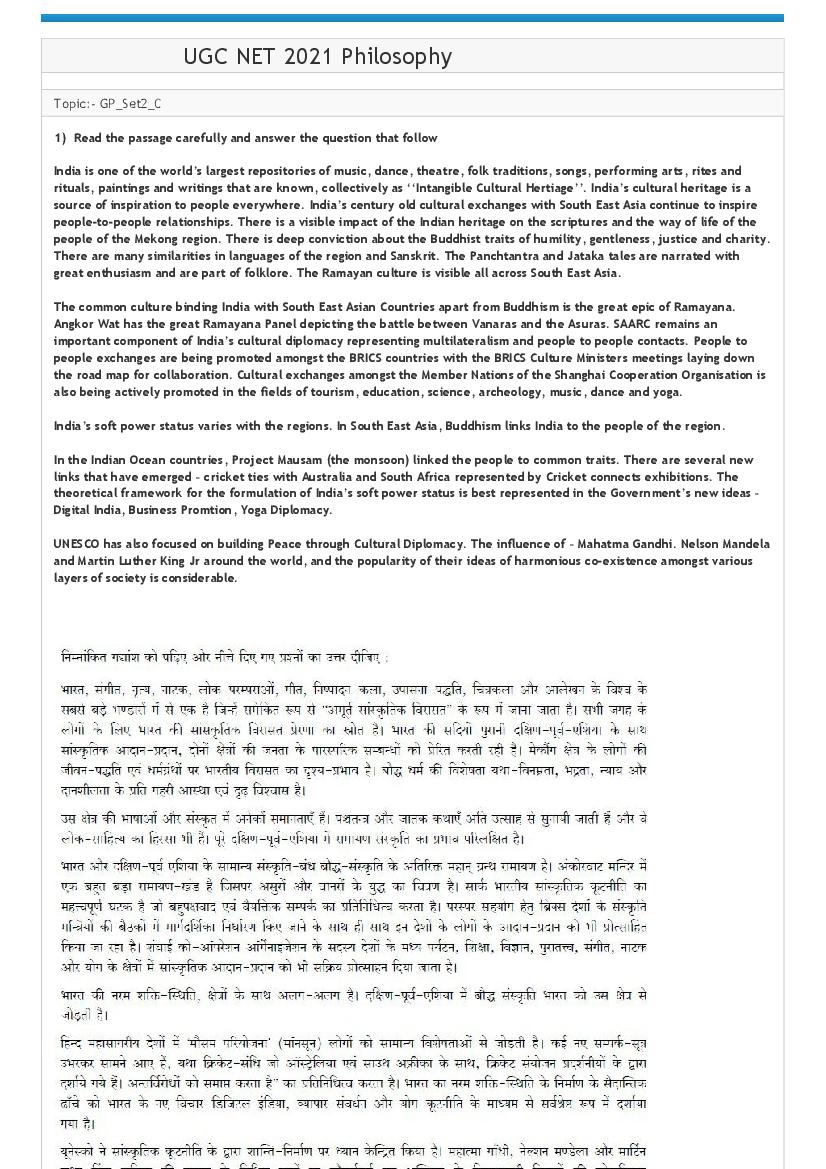
1) Read the passage carefully and answer the question that follow
India is one of the world’s largest repositories of music, dance, theatre, folk traditions, songs, performing arts, rites and
rituals, paintings and writings that are known, collectively as ‘‘Intangible Cultural Hertiage’’. India’s cultural heritage is a
source of inspiration to people everywhere. India’s century old cultural exchanges with South East Asia continue to inspire
people‐to‐people relationships. There is a visible impact of the Indian heritage on the scriptures and the way of life of the
people of the Mekong region. There is deep conviction about the Buddhist traits of humility, gentleness, justice and charity.
There are many similarities in languages of the region and Sanskrit. The Panchtantra and Jataka tales are narrated with
great enthusiasm and are part of folklore. The Ramayan culture is visible all across South East Asia.
The common culture binding India with South East Asian Countries apart from Buddhism is the great epic of Ramayana.
Angkor Wat has the great Ramayana Panel depicting the battle between Vanaras and the Asuras. SAARC remains an
important component of India’s cultural diplomacy representing multilateralism and people to people contacts. People to
people exchanges are being promoted amongst the BRICS countries with the BRICS Culture Ministers meetings laying down
the road map for collaboration. Cultural exchanges amongst the Member Nations of the Shanghai Cooperation Organisation is
also being actively promoted in the fields of tourism, education, science, archeology, music, dance and yoga.
India’s soft power status varies with the regions. In South East Asia, Buddhism links India to the people of the region.
In the Indian Ocean countries, Project Mausam (the monsoon) linked the people to common traits. There are several new
links that have emerged – cricket ties with Australia and South Africa represented by Cricket connects exhibitions. The
theoretical framework for the formulation of India’s soft power status is best represented in the Government’s new ideas –
Digital India, Business Promtion, Yoga Diplomacy.
UNESCO has also focused on building Peace through Cultural Diplomacy. The influence of – Mahatma Gandhi. Nelson Mandela
and Martin Luther King Jr around the world, and the popularity of their ideas of harmonious co‐existence amongst various
layers of society is considerable.
Page 2
(A) Ramayan
(B) Multilateral engagements
(C) Business Promotion
(D) People to people contacts
Choose the correct answer from the options given below :
(1) (A) and (D) only (2) (A), (C) and (D) only
(3) (B), (C) and (D) only (4) (B) and (D) only
[Question ID = 3557][Question Description = Q46_GP_20NOV_S2_SHAAN_Shift2]
1. 1
[Option ID = 13691]
2. 2
[Option ID = 13692]
3. 3
[Option ID = 13693]
4. 4
[Option ID = 13694]
2) Read the passage carefully and answer the question that follow
India is one of the world’s largest repositories of music, dance, theatre, folk traditions, songs, performing arts, rites and
rituals, paintings and writings that are known, collectively as ‘‘Intangible Cultural Hertiage’’. India’s cultural heritage is a
source of inspiration to people everywhere. India’s century old cultural exchanges with South East Asia continue to inspire
people‐to‐people relationships. There is a visible impact of the Indian heritage on the scriptures and the way of life of the
Page 3
There are many similarities in languages of the region and Sanskrit. The Panchtantra and Jataka tales are narrated with
great enthusiasm and are part of folklore. The Ramayan culture is visible all across South East Asia.
The common culture binding India with South East Asian Countries apart from Buddhism is the great epic of Ramayana.
Angkor Wat has the great Ramayana Panel depicting the battle between Vanaras and the Asuras. SAARC remains an
important component of India’s cultural diplomacy representing multilateralism and people to people contacts. People to
people exchanges are being promoted amongst the BRICS countries with the BRICS Culture Ministers meetings laying down
the road map for collaboration. Cultural exchanges amongst the Member Nations of the Shanghai Cooperation Organisation is
also being actively promoted in the fields of tourism, education, science, archeology, music, dance and yoga.
India’s soft power status varies with the regions. In South East Asia, Buddhism links India to the people of the region.
In the Indian Ocean countries, Project Mausam (the monsoon) linkded the people to common traits. There are several new
links that have emerged – cricket ties with Australia and South Africa represented by Cricket connects exhibitions. The
theoretical framework for the formulation of India’s soft power status is best represented in the Government’s new ideas –
Digital India, Business Promtion, Yoga Diplomacy.
UNESCO has also focused on building Peace through Cultural Diplomacy. The influence of – Mahatma Gandhi. Nelson Mandela
and Martin Luther King Jr around the world, and the popularity of their ideas of harmonious co‐existence amongst various
layers of society is considerable.
The common thread binding India and South East Asian Countries is/are
(A) Buddist tenets
(B) Yoga
(C) Cricket
(D) Ramayan
(E) Sanskrit
Choose the correct answer from the options given below :
Page 4
(3) (A) and (D) only (4) (A), (B), (D) and (E) only
[Question ID = 3558][Question Description = Q47_GP_20NOV_S2_SHAAN_Shift2]
1. 1 [Option ID = 13695]
2. 2 [Option ID = 13696]
3. 3 [Option ID = 13697]
4. 4 [Option ID = 13698]
3) Read the passage carefully and answer the question that follow
India is one of the world’s largest repositories of music, dance, theatre, folk traditions, songs, performing arts, rites and
rituals, paintings and writings that are known, collectively as ‘‘Intangible Cultural Hertiage’’. India’s cultural heritage is a
source of inspiration to people everywhere. India’s century old cultural exchanges with South East Asia continue to inspire
people‐to‐people relationships. There is a visible impact of the Indian heritage on the scriptures and the way of life of the
people of the Mekong region. There is deep conviction about the Buddhist traits of humility, gentleness, justice and charity.
There are many similarities in languages of the region and Sanskrit. The Panchtantra and Jataka tales are narrated with
great enthusiasm and are part of folklore. The Ramayan culture is visible all across South East Asia.
The common culture binding India with South East Asian Countries apart from Buddhism is the great epic of Ramayana.
Angkor Wat has the great Ramayana Panel depicting the battle between Vanaras and the Asuras. SAARC remains an
important component of India’s cultural diplomacy representing multilateralism and people to people contacts. People to
people exchanges are being promoted amongst the BRICS countries with the BRICS Culture Ministers meetings laying down
the road map for collaboration. Cultural exchanges amongst the Member Nations of the Shanghai Cooperation Organisation is
also being actively promoted in the fields of tourism, education, science, archeology, music, dance and yoga.
India’s soft power status varies with the regions. In South East Asia, Buddhism links India to the people of the region.
In the Indian Ocean countries, Project Mausam (the monsoon) linkded the people to common traits. There are several new
links that have emerged – cricket ties with Australia and South Africa represented by Cricket connects exhibitions. The
theoretical framework for the formulation of India’s soft power status is best represented in the Government’s new ideas –
Digital India, Business Promtion, Yoga Diplomacy.
UNESCO has also focused on building Peace through Cultural Diplomacy. The influence of – Mahatma Gandhi. Nelson Mandela
and Martin Luther King Jr around the world, and the popularity of their ideas of harmonious co‐existence amongst various
layers of society is considerable.
Page 5
(1) Digital India (2) Skill India
(3) Business Promotion (4) Yoga Diplomacy
[Question ID = 3559][Question Description = Q48_GP_20NOV_S2_SHAAN_Shift2]
1. 1 [Option ID = 13699]
2. 2 [Option ID = 13700]
3. 3 [Option ID = 13701]
4. 4 [Option ID = 13702]
4) Read the passage carefully and answer the question that follow
India is one of the world’s largest repositories of music, dance, theatre, folk traditions, songs, performing arts, rites and
rituals, paintings and writings that are known, collectively as ‘‘Intangible Cultural Hertiage’’. India’s cultural heritage is a
source of inspiration to people everywhere. India’s century old cultural exchanges with South East Asia continue to inspire
people‐to‐people relationships. There is a visible impact of the Indian heritage on the scriptures and the way of life of the
people of the Mekong region. There is deep conviction about the Buddhist traits of humility, gentleness, justice and charity.
There are many similarities in languages of the region and Sanskrit. The Panchtantra and Jataka tales are narrated with
great enthusiasm and are part of folklore. The Ramayan culture is visible all across South East Asia.
The common culture binding India with South East Asian Countries apart from Buddhism is the great epic of Ramayana.
Angkor Wat has the great Ramayana Panel depicting the battle between Vanaras and the Asuras. SAARC remains an
important component of India’s cultural diplomacy representing multilateralism and people to people contacts. People to
people exchanges are being promoted amongst the BRICS countries with the BRICS Culture Ministers meetings laying down
the road map for collaboration. Cultural exchanges amongst the Member Nations of the Shanghai Cooperation Organisation is
also being actively promoted in the fields of tourism, education, science, archeology, music, dance and yoga.
India’s soft power status varies with the regions. In South East Asia, Buddhism links India to the people of the region.
In the Indian Ocean countries, Project Mausam (the monsoon) linkded the people to common traits. There are several new
links that have emerged – cricket ties with Australia and South Africa represented by Cricket connects exhibitions. The
theoretical framework for the formulation of India’s soft power status is best represented in the Government’s new ideas –
Digital India, Business Promtion, Yoga Diplomacy.
UNESCO has also focused on building Peace through Cultural Diplomacy. The influence of – Mahatma Gandhi. Nelson Mandela
and Martin Luther King Jr around the world, and the popularity of their ideas of harmonious co‐existence amongst various
layers of society is considerable.
Page 6
(A) Archeology
(B) Folklore
(C) Tourism
(D) Yoga
(E) Education
Choose the correct answer from the options given below :
(1) (A), (C), (D) and (E) only (2) (A), (B), (C) and (E) only
(3) (A), (B) and (E) only (4) (B), (C), (D) and (E) only
[Question ID = 3560][Question Description = Q49_GP_20NOV_S2_SHAAN_Shift2]
Page 7
2. 2 [Option ID = 13704]
3. 3 [Option ID = 13705]
4. 4 [Option ID = 13706]
5) Read the passage carefully and answer the question that follow
India is one of the world’s largest repositories of music, dance, theatre, folk traditions, songs, performing arts, rites and
rituals, paintings and writings that are known, collectively as ‘‘Intangible Cultural Hertiage’’. India’s cultural heritage is a
source of inspiration to people everywhere. India’s century old cultural exchanges with South East Asia continue to inspire
people‐to‐people relationships. There is a visible impact of the Indian heritage on the scriptures and the way of life of the
people of the Mekong region. There is deep conviction about the Buddhist traits of humility, gentleness, justice and charity.
There are many similarities in languages of the region and Sanskrit. The Panchtantra and Jataka tales are narrated with
great enthusiasm and are part of folklore. The Ramayan culture is visible all across South East Asia.
The common culture binding India with South East Asian Countries apart from Buddhism is the great epic of Ramayana.
Angkor Wat has the great Ramayana Panel depicting the battle between Vanaras and the Asuras. SAARC remains an
important component of India’s cultural diplomacy representing multilateralism and people to people contacts. People to
people exchanges are being promoted amongst the BRICS countries with the BRICS Culture Ministers meetings laying down
the road map for collaboration. Cultural exchanges amongst the Member Nations of the Shanghai Cooperation Organisation is
also being actively promoted in the fields of tourism, education, science, archeology, music, dance and yoga.
India’s soft power status varies with the regions. In South East Asia, Buddhism links India to the people of the region.
In the Indian Ocean countries, Project Mausam (the monsoon) linkded the people to common traits. There are several new
links that have emerged – cricket ties with Australia and South Africa represented by Cricket connects exhibitions. The
theoretical framework for the formulation of India’s soft power status is best represented in the Government’s new ideas –
Digital India, Business Promtion, Yoga Diplomacy.
UNESCO has also focused on building Peace through Cultural Diplomacy. The influence of – Mahatma Gandhi. Nelson Mandela
and Martin Luther King Jr around the world, and the popularity of their ideas of harmonious co‐existence amongst various
layers of society is considerable.
The passage highlights
Page 8
(2) The role of culture for peace and harmonious relations with other countries
(3) India’s cultural hegemony
(4) India’s relations with BRICS countries
[Question ID = 3561][Question Description = Q50_GP_20NOV_S2_SHAAN_Shift2]
1. 1 [Option ID = 13707]
2. 2 [Option ID = 13708]
3. 3 [Option ID = 13709]
4. 4 [Option ID = 13710]
Topic:‐ GP_Set2_A
1)
Page 9
company?
(1) 119 : 145 (2) 116 : 135
(3) 119 : 135 (4) 119 : 130
[Question ID = 3562][Question Description = Q01_GP_20NOV_S2_SHAAN_Shift2]
1. 1 [Option ID = 13711]
2. 2 [Option ID = 13712]
3. 3 [Option ID = 13713]
4. 4 [Option ID = 13714]
2)
If 35% of the PCs sold by Company HP during November were sold at a discount, then how many PCs of Company HP during
that month were sold without a discount?
(1) 882 (2) 1635
(3) 1638 (4) 885
Page 10
1. 1 [Option ID = 13715]
2. 2 [Option ID = 13716]
3. 3 [Option ID = 13717]
4. 4 [Option ID = 13718]
3)
If the dealer earned a profit of Rs. 433 on each PC sold of Company DELL during October, then what was his total profit
earned on the PCs of that company during the same month?
(1) 6,49,900 (2) 6,45,900
(3) 6,49,400 (4) 6,49,500
[Question ID = 3564][Question Description = Q03_GP_20NOV_S2_SHAAN_Shift2]
Page 11
2. 2 [Option ID = 13720]
3. 3 [Option ID = 13721]
4. 4 [Option ID = 13722]
4)
The number of PCs sold of Company HP during July is approximately what percent (%) of the number of PCs sold of Company
HP during December?
(1) 110% (2) 140%
(3) 150% (4) 130%
[Question ID = 3565][Question Description = Q04_GP_20NOV_S2_SHAAN_Shift2]
1. 1 [Option ID = 13723]
2. 2 [Option ID = 13724]
3. 3 [Option ID = 13725]
4. 4 [Option ID = 13726]
5)
Page 12
(1) 10000 (2) 15000
(3) 10500 (4) 9500
[Question ID = 3566][Question Description = Q05_GP_20NOV_S2_SHAAN_Shift2]
1. 1
[Option ID = 13727]
2. 2
[Option ID = 13728]
3. 3
[Option ID = 13729]
4. 4
[Option ID = 13730]
Page 13
1) In which level of teaching promotion of critical thinking is the hall mark?
(1) Memory level (2) Understanding level
(3) Reflective level (4) Autonomous development level
[Question ID = 3567][Question Description = Q06_GP_20NOV_S2_SHAAN_Shift2]
1. 1 [Option ID = 13731]
2. 2 [Option ID = 13732]
3. 3 [Option ID = 13733]
4. 4 [Option ID = 13734]
2) The key behaviour of an effective teacher is marked by which of the following features? (A) Structuring (B) Teacher
task orientation (C) Instructional Variety (D) Lesson clarity (E) Probing Choose the correct answer from the options given
below :
(1) (A), (B) and (C) only (2) (A), (C) and (D) only
(3) (B), (C) and (D) only (4) (C), (D) and (E) only
[Question ID = 3568][Question Description = Q07_GP_20NOV_S2_SHAAN_Shift2]
1. 1
[Option ID = 13735]
2. 2
[Option ID = 13736]
3. 3
[Option ID = 13737]
4. 4
[Option ID = 13738]
3) Match List I with List II gives their characteristic features.
List I List II
(Modes of Evaluation) (Characteristic Features)
(A) Formative Evaluation (I) Compares one student with another student
(B) Summative Evaluation (II) Compares the progress of a student against prespecified standards
(C) Criterion‐referenced Evaluation (III) Used primarily for motivational and monitoring purposes of learning
(D) Norm‐referenced Evaluation (IV) Used primarily for gradation of progress made
Choose the correct answer from the options given below :
(1) (A)‐(IV), (B)‐(III), (C)‐(I), (D)‐(II) (2) (A)‐(III), (B)‐(IV), (C)‐(II), (D)‐(I)
Page 14
[Question ID = 3569][Question Description = Q08_GP_20NOV_S2_SHAAN_Shift2]
1. 1 [Option ID = 13739]
2. 2 [Option ID = 13740]
3. 3 [Option ID = 13741]
4. 4 [Option ID = 13742]
4) Given below are two statements :
Statement I : One of the basic principles of progressive view of teaching is that education should be life itself rather than a
preparation for living.
Statement II : According to reconstructionist view of education the new social order must be ‘genuinely democratic’.
In the light of the above statements, Choose the correct answer from the options given below :
(1) Both Statement I and Statement II are true. (2) Both Statement I and Statement II are false.
(3) Statement I is true but Statement II is false. (4) Statement I is false but Statement II is true.
[Question ID = 3570][Question Description = Q09_GP_20NOV_S2_SHAAN_Shift2]
1. 1 [Option ID = 13743]
2. 2 [Option ID = 13744]
3. 3 [Option ID = 13745]
4. 4 [Option ID = 13746]
5) Given below are two statements : One is labeled as Assertion A and the other is labeled as Reason R.
Assertion (A) : ‘Teaching’ involves critical and creative interchanges between teacher and learner and hence it is different
from ‘instruction’ and ‘training’.
Page 15
In the light of the above statements, Choose the most appropriate answer from the options given below :
(1) Both (A) and (R) are correct and (R) is the correct explanation of (A). (2) Both (A) and (R) are correct but (R) is NOT
the correct explanation of (A).
(3) (A) is correct but (R) is not correct. (4) (A) is not correct but (R) is correct.
[Question ID = 3571][Question Description = Q10_GP_20NOV_S2_SHAAN_Shift2]
1. 1 [Option ID = 13747]
2. 2 [Option ID = 13748]
3. 3 [Option ID = 13749]
4. 4 [Option ID = 13750]
6) In which of the following researches, attempts are made to establish context‐free generalizations?
(1) Phenomenology (2) Grounded theory
(3) Symbolic interactionism (4) Experimental Studies
[Question ID = 3572][Question Description = Q11_GP_20NOV_S2_SHAAN_Shift2]
1. 1 [Option ID = 13751]
2. 2 [Option ID = 13752]
3. 3 [Option ID = 13753]
4. 4 [Option ID = 13754]
7) Identify the main features of ‘qualitative research’ from the following :
(A) It is concerned with understanding the phenomena from the participant’s perspective
(B) It assumes that there are social facts with a single objective reality
(C) Researcher becomes immersed in the situation, present or past
(D) Researcher is detached from the study to avoid bias
(E) There is greater flexibility in both the methods and research process
Choose the correct answer from the options given below :
(1) (A), (C) and (E) only (2) (A), (B) and (C) only
(3) (B), (C) and (D) only (4) (C), (D) and (E) only
Page 16
1. 1 [Option ID = 13755]
2. 2 [Option ID = 13756]
3. 3 [Option ID = 13757]
4. 4 [Option ID = 13758]
8) Match List I with List II :
List I List II
Methods of research Features emphasized
(A) Experimental (I) Primary and secondary sources tapped with emphasis on internal criticism
(B) ExPost Facto (II) Status of facts and conditions are ascertained
(C) Descriptive (III) A variable is manipulated to see its effect on other variable
(D) Historical (IV) The differences are noted and factors causal or otherwise are determined
Choose the correct answer from the options given below :
(1) (A)‐(I), (B)‐(II), (C)‐(III), (D)‐(IV) (2) (A)‐(II), (B)‐(I), (C)‐(IV), (D)‐(III)
(3) (A)‐(III), (B)‐(IV), (C)‐(II), (D)‐(I) (4) (A)‐(IV), (B)‐(III), (C)‐(I), (D)‐(II)
[Question ID = 3574][Question Description = Q13_GP_20NOV_S2_SHAAN_Shift2]
1. 1 [Option ID = 13759]
2. 2 [Option ID = 13760]
3. 3 [Option ID = 13761]
4. 4 [Option ID = 13762]
9) Given below are two statements :
Statement I : Data analysis in research being a technical job, ‘research ethics’ does not matter.
Statement II : ICT is helpful almost at all stages of research.
In the light of the above statements, Choose the correct answer from the options given below :
(1) Both Statement I and Statement II are true. (2) Both Statement I and Statement II are false.
(3) Statement I is true but Statement II is false. (4) Statement I is false but Statement II is true.
Page 17
1. 1 [Option ID = 13763]
2. 2 [Option ID = 13764]
3. 3 [Option ID = 13765]
4. 4 [Option ID = 13766]
10) Given below are two statements : One is labeled as Assertion A and the other is labeled as Reason R.
Assertion (A) : When Null Hypothesis (H0) is rejected, researcher’s hypothesis (H1) is accepted.
Reason (R) : Null Hypothesis (H0) is a chance hypothesis and as such (H1) being true, the researcher’s hypothesis lies in the
domain of acceptability.
In the light of the above statements, Choose the most appropriate answer from the options given below :
(1) Both (A) and (R) are correct and (R) is the correct explanation of (A). (2) Both (A) and (R) are correct but (R) is NOT
the correct explanation of (A).
(3) (A) is correct but (R) is not correct. (4) (A) is not correct but (R) is correct.
[Question ID = 3576][Question Description = Q15_GP_20NOV_S2_SHAAN_Shift2]
1. 1 [Option ID = 13767]
2. 2 [Option ID = 13768]
3. 3 [Option ID = 13769]
4. 4 [Option ID = 13770]
11) Which of the following is an exclusive example of Non‐verbal cue that includes the pitch, rate, volume and use of
pauses?
(1) Linear Model of Communication (2) Interactional Model
(3) Non‐Verbal Cues (4) Para‐Language
[Question ID = 3577][Question Description = Q16_GP_20NOV_S2_SHAAN_Shift2]
1. 1 [Option ID = 13771]
2. 2 [Option ID = 13772]
3. 3 [Option ID = 13773]
4. 4 [Option ID = 13774]
Page 18
Assertion (A) : In the context of communication, the perceptual process creates, semantic‐noise also called word‐noise.
Reason (R) : The various meanings either cannotative or denotative are sources of semantic noise.
In the light of the above statements, Choose the most appropriate answer from the options given below :
(1) Both (A) and (R) are correct and (R) is the correct explanation of (A).
(2) Both (A) and (R) are correct but (R) is NOT the correct explanation of (A).
(3) (A) is correct but (R) is not correct.
(4) (A) is not correct but (R) is correct.
[Question ID = 3578][Question Description = Q17_GP_20NOV_S2_SHAAN_Shift2]
1. 1
[Option ID = 13775]
2. 2
[Option ID = 13776]
3. 3
[Option ID = 13777]
4. 4
[Option ID = 13778]
13) Given below are two statements :
Statement I : Appropriate word choice is an essential of effective oral communication.
Statement II : Facial expression and postures fall under visual communication.
In the light of the above statements, Choose the correct answer from the options given below :
(1) Both Statement I and Statement II are true. (2) Both Statement I and Statement II are false.
(3) Statement I is true but Statement II is false. (4) Statement I is false but Statement II is true.
Page 19
1. 1 [Option ID = 13779]
2. 2 [Option ID = 13780]
3. 3 [Option ID = 13781]
4. 4 [Option ID = 13782]
14) Identify the barriers to communication from the list given below :
(A) Time and distance
(B) By‐passed instructions
(C) Encoding of thoughts and ideas
(D) Decoding of thoughts and ideas
(E) Logical sequence
Choose the correct answer from the options given below :
(1) (A) and (B) only (2) (B) and (C) only
(3) (C) and (D) only (4) (D) and (E) only
[Question ID = 3580][Question Description = Q19_GP_20NOV_S2_SHAAN_Shift2]
1. 1
[Option ID = 13783]
2. 2
[Option ID = 13784]
3. 3
[Option ID = 13785]
4. 4
[Option ID = 13786]
15) Match List I with List II :
List I List II
Types of Communication Main features
(A) Downward Communication (I) Grows primarily to meet organizational/member’s need for communication
(B) Upward Communication (II) It forms a useful link in decision making for task coordination
(C) Horizontal Communication (III) Provides management with feedback about current issues and problems
(D) Grapevine Communication (IV) It is the most common communication system in an organization
Choose the correct answer from the options given below :
(1) (A)‐(I), (B)‐(II), (C)‐(IV), (D)‐(III) (2) (A)‐(II), (B)‐(I), (C)‐(III), (D)‐(IV)
(3) (A)‐(III), (B)‐(IV), (C)‐(I), (D)‐(II) (4) (A)‐(IV), (B)‐(III), (C)‐(II), (D)‐(I)
Page 20
1. 1 [Option ID = 13787]
2. 2 [Option ID = 13788]
3. 3 [Option ID = 13789]
4. 4 [Option ID = 13790]
16) If the cost price is 25% of selling price, then what is the profit percentage?
(1) 100 (2) 200
(3) 300 (4) 400
[Question ID = 3582][Question Description = Q21_GP_20NOV_S2_SHAAN_Shift2]
1. 1 [Option ID = 13791]
2. 2 [Option ID = 13792]
3. 3 [Option ID = 13793]
4. 4 [Option ID = 13794]
17) A seller mixes 26 kg rice of a price of Rs. 20/kg, with 30 kg of different variety rice of a price of Rs. 36/kg. He sells
both the mixed rices at Rs. 30/kg. What will be the profit in percentage?
(1) 5% (2) 10%
(3) 15% (4) 20%
[Question ID = 3583][Question Description = Q22_GP_20NOV_S2_SHAAN_Shift2]
1. 1 [Option ID = 13795]
2. 2 [Option ID = 13796]
3. 3 [Option ID = 13797]
4. 4 [Option ID = 13798]
18) A milk man purchases milk at Rs. X per litre and sells it at Rs. 2X per litre. Still he mixes 2 litres of water with every 6
litre of pure milk. What is his profit percentage?
(1) 33.33 (2) 66.66
(3) 133.33 (4) 166.66
[Question ID = 3584][Question Description = Q23_GP_20NOV_S2_SHAAN_Shift2]
1. 1 [Option ID = 13799]
2. 2 [Option ID = 13800]
3. 3 [Option ID = 13801]
Page 21
19) The average monthly income of P and Q is Rs. 5,050/‐. The average montly income of Q and R is Rs. 6,250/‐ and that
of P and R is Rs. 5,200. What will be the monthly income of P?
(1) Rs. 3,000/‐ (2) Rs. 3,500/‐
(3) Rs. 4,000/‐ (4) Rs. 4,500/‐
[Question ID = 3585][Question Description = Q24_GP_20NOV_S2_SHAAN_Shift2]
1. 1 [Option ID = 13803]
2. 2 [Option ID = 13804]
3. 3 [Option ID = 13805]
4. 4 [Option ID = 13806]
20) The average of 4 terms is 20, and the first term is 1/3rd of sum of the remaining 3 terms. What will be the value of
first term?
(1) 15 (2) 20
(3) 25 (4) 30
[Question ID = 3586][Question Description = Q25_GP_20NOV_S2_SHAAN_Shift2]
1. 1 [Option ID = 13807]
2. 2 [Option ID = 13808]
3. 3 [Option ID = 13809]
4. 4 [Option ID = 13810]
21)
Page 22
1. 1 [Option ID = 13811]
2. 2 [Option ID = 13812]
3. 3 [Option ID = 13813]
4. 4 [Option ID = 13814]
22)
[Question ID = 3588][Question Description = Q27_GP_20NOV_S2_SHAAN_Shift2]
1. 1 [Option ID = 13815]
2. 2 [Option ID = 13816]
Page 23
4. 4 [Option ID = 13818]
23)
[Question ID = 3589][Question Description = Q28_GP_20NOV_S2_SHAAN_Shift2]
1. 1 [Option ID = 13819]
2. 2 [Option ID = 13820]
3. 3 [Option ID = 13821]
4. 4 [Option ID = 13822]
24) ‘‘All radically egalitarian societies are societies that do not preserve individual liberties’’.
Which of the following statements is true with reference to the above statement?
(1) ‘‘No radically egalitarian societies are societies that preserve individual liberties’’ is obverse of the given statement and
it is logically equivalent.
(2) ‘‘No radically egalitarian societies are societies that preserve individual liberties’’ is obverse of the given statement and
it is not logically equivalent.
(3) ‘‘Some radically egalitarian societies are societies that preserve individual liberties’’ is converse of the given statement
and it is logically equivalent.
(4) ‘‘Some radically egalitarian societies are not societies that preserve individual liberties’’ is converse of the given
statement and it is logically equivalent.
Page 24
1. 1 [Option ID = 13823]
2. 2 [Option ID = 13824]
3. 3 [Option ID = 13825]
4. 4 [Option ID = 13826]
25) Two propositions are contradictories if :
(1) One is denial or negation of the other
(2) If they can both be true but cannot both be false
(3) If they have different subject and predicate term and differ from each other in both quality and quantity
(4) If they have the same subject and predicate terms but differ from each other only in quantity but not in quality
[Question ID = 3591][Question Description = Q30_GP_20NOV_S2_SHAAN_Shift2]
1. 1 [Option ID = 13827]
2. 2 [Option ID = 13828]
3. 3 [Option ID = 13829]
4. 4 [Option ID = 13830]
26) What is the binary equivalent of the decimal number 67.625?
(1) 1000010.110 (2) 1000011.110
(3) 1000010.101 (4) 1000011.101
[Question ID = 3592][Question Description = Q31_GP_20NOV_S2_SHAAN_Shift2]
1. 1
[Option ID = 13831]
2. 2
[Option ID = 13832]
3. 3
[Option ID = 13833]
4. 4
[Option ID = 13834]
27) Identify the correct order of the following different types of computer components ranked from fastest to slowest in
terms of access time.
(A) RAM
(B) Optical Drive
(C) CPU Cache
(D) SSD
Choose the correct answer from the options given below :
(1) (B), (D), (A), (C) (2) (C), (D), (A), (B)
(3) (A), (B), (C), (D) (4) (C), (A), (D), (B)
Page 25
1. 1 [Option ID = 13835]
2. 2 [Option ID = 13836]
3. 3 [Option ID = 13837]
4. 4 [Option ID = 13838]
28) Given below are two statements :
Statement I : The abbreviation ‘MOOC’ stands for ‘Massive Open Online Courses’.
Statement II : The abbreviation ‘SWAYAM’ stands for ‘Study Webs of Active‐Learning for Young Academic Minds’,
In the light of the above statements, Choose the correct answer from the options given below :
(1) Both Statement I and Statement II are true. (2) Both Statement I and Statement II are false.
(3) Statement I is true but Statement II is false. (4) Statement I is false but Statement II is true.
[Question ID = 3594][Question Description = Q33_GP_20NOV_S2_SHAAN_Shift2]
1. 1 [Option ID = 13839]
2. 2 [Option ID = 13840]
3. 3 [Option ID = 13841]
4. 4 [Option ID = 13842]
29) Which of the following statements are related to the role of ICT in citizen services?
(A) Access to public documents
(B) On‐line payments
(C) Better medical education across the country
Choose the correct answer from the options given below :
(1) (A), (B) and (C) (2) (A) and (C) only
(3) (B) and (C) only (4) (A) and (B) only
Page 26
1. 1 [Option ID = 13843]
2. 2 [Option ID = 13844]
3. 3 [Option ID = 13845]
4. 4 [Option ID = 13846]
30) Match List I with List II :
List I List II
(Computer Terms) (Description)
(A) HTML (I) Semantic Web
(B) Web 2.0 (II) Use of Internet to make phone calls
(C) Web 3.0 (III) Language used to create web pages
(D) VOIP (IV) Collaborative web
Choose the correct answer from the options given below :
(1) (A)‐(III), (B)‐(IV), (C)‐(I), (D)‐(II) (2) (A)‐(III), (B)‐(I), (C)‐(IV), (D)‐(II)
(3) (A)‐(II), (B)‐(IV), (C)‐(I), (D)‐(III) (4) (A)‐(IV), (B)‐(III), (C)‐(I), (D)‐(II)
[Question ID = 3596][Question Description = Q35_GP_20NOV_S2_SHAAN_Shift2]
1. 1 [Option ID = 13847]
2. 2 [Option ID = 13848]
3. 3 [Option ID = 13849]
4. 4 [Option ID = 13850]
31) Given below are two statements :
Statement I : Noise Pollution has an adverse impact on hearing ability as well as psychological well being of a person.
Statement II : Human perception of noise levels is linear.
In the light of the above statements, Choose the correct answer from the options given below :
(1) Both Statement I and Statement II are true. (2) Both Statement I and Statement II are false.
(3) Statement I is true but Statement II is false. (4) Statement I is false but Statement II is true.
Page 27
1. 1 [Option ID = 13851]
2. 2 [Option ID = 13852]
3. 3 [Option ID = 13853]
4. 4 [Option ID = 13854]
32) Which country is in the process of setting up the largest integrated solar‐wind energy park of 30 GW capacity?
(1) China (2) India
(3) Australia (4) Saudi Arabia
[Question ID = 3598][Question Description = Q37_GP_20NOV_S2_SHAAN_Shift2]
1. 1 [Option ID = 13855]
2. 2 [Option ID = 13856]
3. 3 [Option ID = 13857]
4. 4 [Option ID = 13858]
33) Given below are two statements : One is labeled as Assertion A and the other is labeled as Reason R.
Assertion (A) : There has to be an integrated approach to achieve the targets of Sustainable Development Goals (SDGs).
Reason (R) : Many of the SDGs are interconnected.
In the light of the above statements, Choose the most appropriate answer from the options given below :
(1) Both (A) and (R) are correct and (R) is the correct explanation of (A).
(2) Both (A) and (R) are correct but (R) is NOT the correct explanation of (A).
(3) (A) is correct but (R) is not correct.
(4) (A) is not correct but (R) is correct.
[Question ID = 3599][Question Description = Q38_GP_20NOV_S2_SHAAN_Shift2]
1. 1
[Option ID = 13859]
2. 2
Page 28
3. 3
[Option ID = 13861]
4. 4
[Option ID = 13862]
34) Given below are two statements : One is labeled as Assertion A and the other is labeled as Reason R.
Assertion (A) : Mankind’s interaction with Earth has led to a highly complex and diverse ecosystem to an increasingly
degraded environment.
Reason (R) : Many of the changes taking place in Earth’s environment are irreversible.
In the light of the above statements, Choose the most appropriate answer from the options given below :
(1) Both (A) and (R) are true and (R) is the correct explanation of (A).
(2) Both (A) and (R) are true but (R) is NOT the correct explanation of (A).
(3) (A) is true but (R) is false.
(4) (A) is false but (R) is true.
[Question ID = 3600][Question Description = Q39_GP_20NOV_S2_SHAAN_Shift2]
1. 1
[Option ID = 13863]
2. 2
[Option ID = 13864]
3. 3
[Option ID = 13865]
4. 4
[Option ID = 13866]
35) What percentage of India’s land is vulnerable to earthquakes?
(1) ~ 57% (2) ~ 42%
(3) ~ 37% (4) ~ 28%
[Question ID = 3601][Question Description = Q40_GP_20NOV_S2_SHAAN_Shift2]
1. 1 [Option ID = 13867]
2. 2 [Option ID = 13868]
3. 3 [Option ID = 13869]
4. 4 [Option ID = 13870]
Page 29
(1) Monocultural values (2) Multicultural values
(3) Regionalisation (4) Self centredness
[Question ID = 3602][Question Description = Q41_GP_20NOV_S2_SHAAN_Shift2]
1. 1 [Option ID = 13871]
2. 2 [Option ID = 13872]
3. 3 [Option ID = 13873]
4. 4 [Option ID = 13874]
37) CBCS stands for
(1) Choice Based Central Schemes (2) Choice Based Credit System
(3) Central Board of Credit Schemes (4) Credit Board of Central Sponsors
[Question ID = 3603][Question Description = Q42_GP_20NOV_S2_SHAAN_Shift2]
1. 1 [Option ID = 13875]
2. 2 [Option ID = 13876]
3. 3 [Option ID = 13877]
4. 4 [Option ID = 13878]
38) COVID‐19 acronym stands for
(1) Corona Virus Disease 2019
(2) Corona Virus Disease strain 19
(3) Corona Virus Disaster 2019
(4) Corona Virus Disease 2020
[Question ID = 3604][Question Description = Q43_GP_20NOV_S2_SHAAN_Shift2]
1. 1
[Option ID = 13879]
2. 2
[Option ID = 13880]
3. 3
[Option ID = 13881]
4. 4
[Option ID = 13882]
39) NITI Aayog is
(1) National Institution for Transforming India (2) National Institute of Technology Integration
(3) National Institute of Technological Innovation (4) National Institute of Transformation and Innovation
Page 30
1. 1 [Option ID = 13883]
2. 2 [Option ID = 13884]
3. 3 [Option ID = 13885]
4. 4 [Option ID = 13886]
40) Match List I with List II :
List I List II
(Days Celebrated) (When)
(A) Earth Day (I) 24 January
(B) UNO Day (II) 5th June
(C) Environment Day (III) 24th October
(D) International Day of Education (IV) 22nd April
Choose the correct answer from the options given below :
(1) (A)‐(I), (B)‐(III), (C)‐(II), (D)‐(IV) (2) (A)‐(IV), (B)‐(III), (C)‐(I), (D)‐(II)
(3) (A)‐(II), (B)‐(IV), (C)‐(I), (D)‐(III) (4) (A)‐(IV), (B)‐(III), (C)‐(II), (D)‐(I)
[Question ID = 3606][Question Description = Q45_GP_20NOV_S2_SHAAN_Shift2]
1. 1 [Option ID = 13887]
2. 2 [Option ID = 13888]
3. 3 [Option ID = 13889]
4. 4 [Option ID = 13890]
Topic:‐ 3 Philosophy_B
1) Read the passage and answer the following questions:‐
In one sense it must be admitted that we can never prove the existence of things other than ourselves and our
experiences. No logical absurdity results from the hypothesis that the world consists of myself and my thoughts and feelings
and sensations, and that everything else is mere fancy. In dreams a very complicated world may seem to be present, and
yet on waking we find it was a delusion; that is to say, we find that the sense‐data in the dream do not appear to have
corresponded with such physical objects as we should naturally infer from our sense‐data. (It is true that, when the physical
world is assumed, it is possible to find physical causes for the sense‐data in dreams: a doorbanging, for instance, may cause
us to dream of a naval engagement. But although, in this case, there is a physical cause for the sense‐data, there is not a
physical object corresponding to the sense‐data in the way in which an actual naval battle would correspond.) There is no
logical impossibility in the supposition that the whole of life is a dream, in which we ourselves create all the objects that
come before us. But although this is not logically impossible, there is no reason whatever to suppose that it is true; and it is,
in fact, a less simple hypothesis, viewed as a means of accounting for the facts of our own life, than the common‐sense
hypothesis that there really are objects independent of us, whose action on us causes our sensations.
Page 31
एक अथ म इसे अव य वीकार िकया जाना चािहए िक हम वयं और अपने अनुभव के अित र िकसी व तु के अि त व को पमािणत नह कर सकते ह इस
पा क पना िक जगत मुझसे और मेरे िवचार और भावनाओं और संवेदनाओं से बना है, और बाक सब कुछ मात क पना है, से कोई तािकक बेतुकापन नह
िनकलता है सपन म एक बहत ही जिटल संसार पतीत हो सकता है, और िफर भी जागने पर हम पाते ह िक वह एक भम था; अथात, हम पाते ह िक व न म जो
चेतना ‐ त य है वह भौितक व तु ओ ं से मेल नह खाता है, जै स ा िक हम वाभािवक प से अपने चेतना ‐ त य से अनुमान लगाना चािहए (यह सच है िक, जब
भौितक दुिनया क क पना क जाती है, तो सपन म चेतना ‐ त य के भौितक कारण का पता लगाना संभव है: उदाहरण के िलए, एक दरवाजा खटखटाने से हम
नौसैना मुठभेड़ का सपना देखने को िमल सकता है लेिकन हालांिक, इस मामले म , चेतना ‐ त य के िलए एक भौितक कारण है, िजस तरह से एक वा तिवक
नौसैना यु के अनु प होगा, उस तरह से चेतना ‐ त य के अनु प कोई भौितक व तु नह है) इस अनुमान म कोई तािकक असंभवता नह है िक पूरा जीवन ही
एक सपना है, िजसम हम अपने सामने आने वाली सभी व तु ओ ं को खुद बनाते ह लेिकन य िप यह तािकक प से असंभव नह है, िफर भी यह मानने का कोई
कारण नह है िक यह सच है; और यह, वा तव म, एक कम सरल प रक पना है, िजसे हमारे अपने जीवन के त य क गणना के िलए एक साधन के प म देखा
जाता है, जबिक सामा य ान क प रक पना क तुलना म वा तव म हमसे वतंत व तुएं ह, िजनक कारवाई हमारी संवेदनाओं का कारण बनती है
The view that “the hypothesis that the world consists of myself and my thoughts and feelings and sensations, and that
everything else is mere fancy.” is compatible with which of the following doctrine/s?
A. Solipsism
B. Idealism
C. Phenomenalism
D. Naïve Realism
यह िवचार िन निलिखत म से िकन‐िकन िस ांत के अनु प नह है िक " यह पा क पना िक जगत मुझसे और मेरे िवचार और भाव और संवेदनाओं से बना है
और यह िक अ य बात क पना मात ह "?
A.अहं मात वाद
B. प यय वाद
C. य पपंच वाद
D.सहज यथाथवाद
[Question ID = 5940][Question Description = S2_qSNz_PG_PHL_Q91]
1. A, B and D only/केवल A, B और D [Option ID = 23223]
2. A, B and C only/केवल A, B और C [Option ID = 23224]
3. B, C and D only/केवल B, C और D [Option ID = 23225]
4. A, C and D only/केवल A, C और D [Option ID = 23226]
2) Read the passage and answer the following questions:‐
In one sense it must be admitted that we can never prove the existence of things other than ourselves and our
experiences. No logical absurdity results from the hypothesis that the world consists of myself and my thoughts and feelings
and sensations, and that everything else is mere fancy. In dreams a very complicated world may seem to be present, and
yet on waking we find it was a delusion; that is to say, we find that the sense‐data in the dream do not appear to have
corresponded with such physical objects as we should naturally infer from our sense‐data. (It is true that, when the physical
world is assumed, it is possible to find physical causes for the sense‐data in dreams: a doorbanging, for instance, may cause
us to dream of a naval engagement. But although, in this case, there is a physical cause for the sense‐data, there is not a
physical object corresponding to the sense‐data in the way in which an actual naval battle would correspond.) There is no
logical impossibility in the supposition that the whole of life is a dream, in which we ourselves create all the objects that
come before us. But although this is not logically impossible, there is no reason whatever to suppose that it is true; and it is,
in fact, a less simple hypothesis, viewed as a means of accounting for the facts of our own life, than the common‐sense
hypothesis that there really are objects independent of us, whose action on us causes our sensations.
िन निलिखत ग ांश को यानपूवक पढ़कर उसके आधार पर पूछे गए प के उ र दीिजए :
एक अथ म इसे अव य वीकार िकया जाना चािहए िक हम वयं और अपने अनुभव के अित र िकसी व तु के अि त व को पमािणत नह कर सकते ह इस
पा क पना िक जगत मुझसे और मेरे िवचार और भावनाओं और संवेदनाओं से बना है, और बाक सब कुछ मात क पना है, से कोई तािकक बेतुकापन नह
िनकलता है सपन म एक बहत ही जिटल संसार पतीत हो सकता है, और िफर भी जागने पर हम पाते ह िक वह एक भम था; अथात, हम पाते ह िक व न म जो
चेतना ‐ त य है वह भौितक व तु ओ ं से मेल नह खाता है, जै स ा िक हम वाभािवक प से अपने चेतना ‐ त य से अनुमान लगाना चािहए (यह सच है िक, जब
भौितक दुिनया क क पना क जाती है, तो सपन म चेतना ‐ त य के भौितक कारण का पता लगाना संभव है: उदाहरण के िलए, एक दरवाजा खटखटाने से हम
नौसैना मुठभेड़ का सपना देखने को िमल सकता है लेिकन हालांिक, इस मामले म , चेतना ‐ त य के िलए एक भौितक कारण है, िजस तरह से एक वा तिवक
नौसैना यु के अनु प होगा, उस तरह से चेतना ‐ त य के अनु प कोई भौितक व तु नह है) इस अनुमान म कोई तािकक असंभवता नह है िक पूरा जीवन ही
एक सपना है, िजसम हम अपने सामने आने वाली सभी व तु ओ ं को खुद बनाते ह लेिकन य िप यह तािकक प से असंभव नह है, िफर भी यह मानने का कोई
कारण नह है िक यह सच है; और यह, वा तव म, एक कम सरल प रक पना है, िजसे हमारे अपने जीवन के त य क गणना के िलए एक साधन के प म देखा
जाता है, जबिक सामा य ान क प रक पना क तुलना म वा तव म हमसे वतंत व तुएं ह, िजनक कारवाई हमारी संवेदनाओं का कारण बनती है
Which of the following philosopher/s could possibly be attributed with the view – “In one sense it must be admitted that we
can never prove the existence of things other than ourselves and our experiences.”? Consider the following options and
Page 32
A. Berkley
B. Descartes
C. Hume
D. Locke
Choose the most appropriate answer from the options given below:
िन निलिखत म से कौन कौन से दाशिनक का स ब ध संभवतः इस िवचार से हो सकता है िक "एक अथ म इसे अव य वीकार िकया जाना चािहए िक हम वयं
और अपने अनुभव के अित र िकसी व तु के अि त व को पमािणत नह कर सकते ह "?
A.बकले
B.देकात
C. ूम
D.लॉक
नीचे िदए गए िवक प म से सही उ र चुन :
[Question ID = 5941][Question Description = S2_qSNz_PG_PHL_Q92]
1. A, B and D only/केवल A, B और D [Option ID = 23227]
2. A, B and C only/केवल A, B और C [Option ID = 23228]
3. B, C and D only/केवल B, C और D [Option ID = 23229]
4. A, C and D only/केवल A, C और D [Option ID = 23230]
3) Read the passage and answer the following questions:‐
In one sense it must be admitted that we can never prove the existence of things other than ourselves and our
experiences. No logical absurdity results from the hypothesis that the world consists of myself and my thoughts and feelings
and sensations, and that everything else is mere fancy. In dreams a very complicated world may seem to be present, and
yet on waking we find it was a delusion; that is to say, we find that the sense‐data in the dream do not appear to have
corresponded with such physical objects as we should naturally infer from our sense‐data. (It is true that, when the physical
world is assumed, it is possible to find physical causes for the sense‐data in dreams: a doorbanging, for instance, may cause
us to dream of a naval engagement. But although, in this case, there is a physical cause for the sense‐data, there is not a
physical object corresponding to the sense‐data in the way in which an actual naval battle would correspond.) There is no
logical impossibility in the supposition that the whole of life is a dream, in which we ourselves create all the objects that
come before us. But although this is not logically impossible, there is no reason whatever to suppose that it is true; and it is,
in fact, a less simple hypothesis, viewed as a means of accounting for the facts of our own life, than the common‐sense
hypothesis that there really are objects independent of us, whose action on us causes our sensations.
िन निलिखत ग ांश को यानपूवक पढ़कर उसके आधार पर पूछे गए प के उ र दीिजए :
एक अथ म इसे अव य वीकार िकया जाना चािहए िक हम वयं और अपने अनुभव के अित र िकसी व तु के अि त व को पमािणत नह कर सकते ह इस
पा क पना िक जगत मुझसे और मेरे िवचार और भावनाओं और संवेदनाओं से बना है, और बाक सब कुछ मात क पना है, से कोई तािकक बेतुकापन नह
िनकलता है सपन म एक बहत ही जिटल संसार पतीत हो सकता है, और िफर भी जागने पर हम पाते ह िक वह एक भम था; अथात, हम पाते ह िक व न म जो
चेतना ‐ त य है वह भौितक व तु ओ ं से मेल नह खाता है, जै स ा िक हम वाभािवक प से अपने चेतना ‐ त य से अनुमान लगाना चािहए (यह सच है िक, जब
भौितक दुिनया क क पना क जाती है, तो सपन म चेतना ‐ त य के भौितक कारण का पता लगाना संभव है: उदाहरण के िलए, एक दरवाजा खटखटाने से हम
नौसैना मुठभेड़ का सपना देखने को िमल सकता है लेिकन हालांिक, इस मामले म , चेतना ‐ त य के िलए एक भौितक कारण है, िजस तरह से एक वा तिवक
नौसैना यु के अनु प होगा, उस तरह से चेतना ‐ त य के अनु प कोई भौितक व तु नह है) इस अनुमान म कोई तािकक असंभवता नह है िक पूरा जीवन ही
एक सपना है, िजसम हम अपने सामने आने वाली सभी व तु ओ ं को खुद बनाते ह लेिकन य िप यह तािकक प से असंभव नह है, िफर भी यह मानने का कोई
कारण नह है िक यह सच है; और यह, वा तव म, एक कम सरल प रक पना है, िजसे हमारे अपने जीवन के त य क गणना के िलए एक साधन के प म देखा
जाता है, जबिक सामा य ान क प रक पना क तुलना म वा तव म हमसे वतंत व तुएं ह, िजनक कारवाई हमारी संवेदनाओं का कारण बनती है
From the last sentence of the paragraph what could be possibly inferred about the overall philosophical position of the
author?
इस ग ांश के अंितम वा य से लेखक के दाशिनक िवचार के बारे म या अनुमान िकया जा सकता है ?
[Question ID = 5942][Question Description = S2_qSNz_PG_PHL_Q93]
1. The author is arguing against scepticism in favour of possibility of knowledge/लेखक ान क स भावना के प म संशयवाद के िव तक दे रहा है . [Option ID =
23231]
2. The author is arguing against realism in favor of idealism/लेखक प ययवाद के प म यथाथवाद के िव तक दे रहा है . [Option ID = 23232]
3. The author is arguing in favor of scepticism/लेखक संशयवाद के प म तक दे रहा है . [Option ID = 23233]
4. The author is merely suggesting that skeptic’s position is insurmountable/लेखक केवल यह सुझाव दे रहा है िक संशय वादी क ि थित दुल य है . [Option ID = 23234]
4) Read the passage and answer the following questions:‐
In one sense it must be admitted that we can never prove the existence of things other than ourselves and our
experiences. No logical absurdity results from the hypothesis that the world consists of myself and my thoughts and feelings
Page 33
yet on waking we find it was a delusion; that is to say, we find that the sense‐data in the dream do not appear to have
corresponded with such physical objects as we should naturally infer from our sense‐data. (It is true that, when the physical
world is assumed, it is possible to find physical causes for the sense‐data in dreams: a doorbanging, for instance, may cause
us to dream of a naval engagement. But although, in this case, there is a physical cause for the sense‐data, there is not a
physical object corresponding to the sense‐data in the way in which an actual naval battle would correspond.) There is no
logical impossibility in the supposition that the whole of life is a dream, in which we ourselves create all the objects that
come before us. But although this is not logically impossible, there is no reason whatever to suppose that it is true; and it is,
in fact, a less simple hypothesis, viewed as a means of accounting for the facts of our own life, than the common‐sense
hypothesis that there really are objects independent of us, whose action on us causes our sensations.
िन निलिखत ग ांश को यानपूवक पढ़कर उसके आधार पर पूछे गए प के उ र दीिजए :
एक अथ म इसे अव य वीकार िकया जाना चािहए िक हम वयं और अपने अनुभव के अित र िकसी व तु के अि त व को पमािणत नह कर सकते ह इस
पा क पना िक जगत मुझसे और मेरे िवचार और भावनाओं और संवेदनाओं से बना है, और बाक सब कुछ मात क पना है, से कोई तािकक बेतुकापन नह
िनकलता है सपन म एक बहत ही जिटल संसार पतीत हो सकता है, और िफर भी जागने पर हम पाते ह िक वह एक भम था; अथात, हम पाते ह िक व न म जो
चेतना ‐ त य है वह भौितक व तु ओ ं से मेल नह खाता है, जै स ा िक हम वाभािवक प से अपने चेतना ‐ त य से अनुमान लगाना चािहए (यह सच है िक, जब
भौितक दुिनया क क पना क जाती है, तो सपन म चेतना ‐ त य के भौितक कारण का पता लगाना संभव है: उदाहरण के िलए, एक दरवाजा खटखटाने से हम
नौसैना मुठभेड़ का सपना देखने को िमल सकता है लेिकन हालांिक, इस मामले म , चेतना ‐ त य के िलए एक भौितक कारण है, िजस तरह से एक वा तिवक
नौसैना यु के अनु प होगा, उस तरह से चेतना ‐ त य के अनु प कोई भौितक व तु नह है) इस अनुमान म कोई तािकक असंभवता नह है िक पूरा जीवन ही
एक सपना है, िजसम हम अपने सामने आने वाली सभी व तु ओ ं को खुद बनाते ह लेिकन य िप यह तािकक प से असंभव नह है, िफर भी यह मानने का कोई
कारण नह है िक यह सच है; और यह, वा तव म, एक कम सरल प रक पना है, िजसे हमारे अपने जीवन के त य क गणना के िलए एक साधन के प म देखा
जाता है, जबिक सामा य ान क प रक पना क तुलना म वा तव म हमसे वतंत व तुएं ह, िजनक कारवाई हमारी संवेदनाओं का कारण बनती है
The argument –“There is no logical impossibility in the supposition that the whole of life is a dream, in which we ourselves
create all the objects that come before us.” is also presented in which of the following text of Philosophy?
दशन शा त क िकस पु तक म भी यह तक है िक‐‐"यह मानने म कोई तािकक अस भा यता नह है िक स पूण जीवन एक व न है िजसम हम वयं उन सभी
व तु ओ ं का सृजन करते ह हमारे सम आते ह ."
[Question ID = 5943][Question Description = S2_qSNz_PG_PHL_Q94]
1. Discourse on Method/िड कोस ऑन मेथड [Option ID = 23235]
2. An Essay Concerning Human Understanding/ऐन एसे क सिनग म ु न अंडर टिडंग [Option ID = 23236]
3. A Treatise of Human Nature/अ टीटीज ऑफ़ म ू न नेचर [Option ID = 23237]
4. A Critique of Pure Reason/अ िकटीक ऑफ़ योर रीजन [Option ID = 23238]
5) Read the passage and answer the following questions:‐
In one sense it must be admitted that we can never prove the existence of things other than ourselves and our
experiences. No logical absurdity results from the hypothesis that the world consists of myself and my thoughts and feelings
and sensations, and that everything else is mere fancy. In dreams a very complicated world may seem to be present, and
yet on waking we find it was a delusion; that is to say, we find that the sense‐data in the dream do not appear to have
corresponded with such physical objects as we should naturally infer from our sense‐data. (It is true that, when the physical
world is assumed, it is possible to find physical causes for the sense‐data in dreams: a doorbanging, for instance, may cause
us to dream of a naval engagement. But although, in this case, there is a physical cause for the sense‐data, there is not a
physical object corresponding to the sense‐data in the way in which an actual naval battle would correspond.) There is no
logical impossibility in the supposition that the whole of life is a dream, in which we ourselves create all the objects that
come before us. But although this is not logically impossible, there is no reason whatever to suppose that it is true; and it is,
in fact, a less simple hypothesis, viewed as a means of accounting for the facts of our own life, than the common‐sense
hypothesis that there really are objects independent of us, whose action on us causes our sensations.
िन निलिखत ग ांश को यानपूवक पढ़कर उसके आधार पर पूछे गए प के उ र दीिजए :
एक अथ म इसे अव य वीकार िकया जाना चािहए िक हम वयं और अपने अनुभव के अित र िकसी व तु के अि त व को पमािणत नह कर सकते ह इस
पा क पना िक जगत मुझसे और मेरे िवचार और भावनाओं और संवेदनाओं से बना है, और बाक सब कुछ मात क पना है, से कोई तािकक बेतुकापन नह
िनकलता है सपन म एक बहत ही जिटल संसार पतीत हो सकता है, और िफर भी जागने पर हम पाते ह िक वह एक भम था; अथात, हम पाते ह िक व न म जो
चेतना ‐ त य है वह भौितक व तु ओ ं से मेल नह खाता है, जै स ा िक हम वाभािवक प से अपने चेतना ‐ त य से अनुमान लगाना चािहए (यह सच है िक, जब
भौितक दुिनया क क पना क जाती है, तो सपन म चेतना ‐ त य के भौितक कारण का पता लगाना संभव है: उदाहरण के िलए, एक दरवाजा खटखटाने से हम
नौसैना मुठभेड़ का सपना देखने को िमल सकता है लेिकन हालांिक, इस मामले म , चेतना ‐ त य के िलए एक भौितक कारण है, िजस तरह से एक वा तिवक
नौसैना यु के अनु प होगा, उस तरह से चेतना ‐ त य के अनु प कोई भौितक व तु नह है) इस अनुमान म कोई तािकक असंभवता नह है िक पूरा जीवन ही
एक सपना है, िजसम हम अपने सामने आने वाली सभी व तु ओ ं को खुद बनाते ह लेिकन य िप यह तािकक प से असंभव नह है, िफर भी यह मानने का कोई
कारण नह है िक यह सच है; और यह, वा तव म, एक कम सरल प रक पना है, िजसे हमारे अपने जीवन के त य क गणना के िलए एक साधन के प म देखा
जाता है, जबिक सामा य ान क प रक पना क तुलना म वा तव म हमसे वतंत व तुएं ह, िजनक कारवाई हमारी संवेदनाओं का कारण बनती है
The statement – “there is a physical cause for the sense‐data” is compatible with which of the following philosophical
position/s?
Page 34
B. Representative Realism
C. Idealism
D. Solipsism
Choose the correct answer from the options given below:
यह कथन िन निलिखत दाशिनक िवचार के अनु प है िक‐" इि दय ‐ द के भौितक कारण होते ह "
A. सहज यथाथवाद
B. पितिनधाना मक यथाथवाद
C.प ययवाद
D.अहंमातवाद
नीचे िदए गए िवक प म से सही उ र चुन :
[Question ID = 5944][Question Description = S2_qSNz_PG_PHL_Q95]
1. A and C only/केवल A और C [Option ID = 23239]
2. A and B only/केवल A और B [Option ID = 23240]
3. B and D only/केवल B और D [Option ID = 23241]
4. C and D only/केवल C और D [Option ID = 23242]
Topic:‐ 3 Philosophy_C
1) Read the passage and answer the following questions:
All the objects of human reason or enquiry may naturally be divided into two kinds, which are Relations of Ideas, and
Matters of Fact. Of the first kind are the sciences of Geometry, Algebra, and Arithmetic; and in short, every affirmation
which is either intuitively or demonstratively certain. That the square of hypotenuse is equal to the squares of the two sides
is a proposition which expresses a relation between these figures. That three times five is equal to the half of thirty,
expresses a relation between these numbers. Propositions of this kind are discoverable by the mere operation of thought,
without dependence on what is anywhere existent in the universe. Though there never was a circle or triangle in nature,
the truths demonstrated by Euclid would forever retain their certainty and evidence. Matters of fact, which are the second
objects of human reason, are not ascertained in the same manner; nor is our evidence of their truth, however great, of a
like nature with the foregoing. The contrary of every matter of fact is still possible; because it can never imply a
contradiction, and is conceived by the mind with the same facility and distinctness, as if ever so conformable to reality.
That the sun will not rise tomorrow is no less intelligible a proposition, and implies no more contradiction than the
affirmation, that it will rise. We should in vain, therefore, attempt to demonstrate its falsehood.
िन निलिखत ग ांश को यानपूवक पढ़कर उसके आधार पर पूछे गए प के उ र दीिजए :
मानव बुि या गवेषणा के सभी िवषय को दो पकार म बांटा जा सकता है ‐प यय के स ब ध और व तु ि थित . पहले पकार के अंतगत यािमित ,बीजगिणत
और अंक गिणत सं ेपतः प येक पित ान जो या तो अ तः प ा मक या िन पणा मक प से िनि त ह , आते ह .कण का वग दो भु ज ाओं के वग के बराबर होता
है ‐यह एक ऐसा तक वा य है जो इन आकृितय के बीच स ब ध को अिभ य करता है .पांच का तीन गुना तीस के आधे के बराबर होता है ‐यह इन सं याओं के
बीच स ब ध को अिभ य करता है .इस पकार के तक वा य क खोज केवल ऐसी िवचार संिकया ारा ही क जा सकती है जो ब ा ड के िकसी भी अि त व पर
िनभर नह करते ह .य िप पकृित म कह भी वृ या ितभुज नह है ,िफर भी यूि लड ारा दशाए गए स य हमेशा अपनी िनि तता और सा य बनाए रखगे . व तु
ि थित जो मानव बुि के दुसरे िवषय ह, को इसी पकार िनि त नह िकया जाता है , न ही उनक स यता का हमारे पास सा य है .चाहे िजतना भी महान हो
,...........................िकसी भी व तु ि थित का िवलोम अिभ भी संभव है ; य िक इसम िवरोधाभास का पुट नह हो सकता है ,और मन इसे उतनी ही
सुगमता और प ता से गहण करता है मानो हमेशा यथाथ के साथ सहज हो . यह त य िक कल सूय दय नह होगा ‐यह तक वा य इस पित ान िक कल सूय दय
होगा ‐‐से कम सुगा और अिधक िवरोधाभासी नह है.अतः हम यथ ही इसके झूठप े न को दशाने का पयास करना चािहए .
Given below are two statements, one is labelled as Assertion A and the other is labelled as Reason R
Assertion A : Though there never was a circle or triangle in nature, the truths demonstrated by Euclid would forever retain
their certainty and evidence.
Reason R : Propositions of this kind are discoverable by the mere operation of thought, without dependence on what is
anywhere existent in the universe.
In light of the above statements, choose the correct answer from the options given below
नीचे दो कथन िदए गए ह : एक को अिभकथन (A) और दूसरे को तक (R) कहा गया है
अिभकथन (A) :य िप पकृित म कह भी वृ या ितभुज नह है ,िफर भी यूि लड ारा दशाए गए स य हमेशा अपनी िनि तता और सा य बनाए रखगे .
तक (R) :इस पकार के तक वा य क खोज केवल ऐसी िवचार संिकया ारा ही क जा सकती है जो ब ा ड के िकसी भी अि त व पर िनभर नह करते ह
उपयु कथन के आलोक म िन नांिकत िवक प म से सही उ र चुन :
Page 35
1. Both A and R are true and R is the correct explanation of A/(A) और (R) दोन सही ह और (R), (A) क सही या या है [Option ID = 23243]
2. Both A and R are true but R is NOT the correct explanation of A/(A) और (R) दोन सही ह पर तु (R), (A) क सही या या नह है [Option ID = 23244]
3. A is true but R is false/(A) सही है पर तु (R) सही नह ह [Option ID = 23245]
4. A is false but R is true/(A) सही नह है पर तु (R) सही ह [Option ID = 23246]
2) Read the passage and answer the following questions:
All the objects of human reason or enquiry may naturally be divided into two kinds, which are Relations of Ideas, and
Matters of Fact. Of the first kind are the sciences of Geometry, Algebra, and Arithmetic; and in short, every affirmation
which is either intuitively or demonstratively certain. That the square of hypotenuse is equal to the squares of the two sides
is a proposition which expresses a relation between these figures. That three times five is equal to the half of thirty,
expresses a relation between these numbers. Propositions of this kind are discoverable by the mere operation of thought,
without dependence on what is anywhere existent in the universe. Though there never was a circle or triangle in nature,
the truths demonstrated by Euclid would forever retain their certainty and evidence. Matters of fact, which are the second
objects of human reason, are not ascertained in the same manner; nor is our evidence of their truth, however great, of a
like nature with the foregoing. The contrary of every matter of fact is still possible; because it can never imply a
contradiction, and is conceived by the mind with the same facility and distinctness, as if ever so conformable to reality.
That the sun will not rise tomorrow is no less intelligible a proposition, and implies no more contradiction than the
affirmation, that it will rise. We should in vain, therefore, attempt to demonstrate its falsehood.
िन निलिखत ग ांश को यानपूवक पढ़कर उसके आधार पर पूछे गए प के उ र दीिजए :
मानव बुि या गवेषणा के सभी िवषय को दो पकार म बांटा जा सकता है ‐प यय के स ब ध और व तु ि थित . पहले पकार के अंतगत यािमित ,बीजगिणत
और अंक गिणत सं ेपतः प येक पित ान जो या तो अ तः प ा मक या िन पणा मक प से िनि त ह , आते ह .कण का वग दो भु ज ाओं के वग के बराबर होता
है ‐यह एक ऐसा तक वा य है जो इन आकृितय के बीच स ब ध को अिभ य करता है .पांच का तीन गुना तीस के आधे के बराबर होता है ‐यह इन सं याओं के
बीच स ब ध को अिभ य करता है .इस पकार के तक वा य क खोज केवल ऐसी िवचार संिकया ारा ही क जा सकती है जो ब ा ड के िकसी भी अि त व पर
िनभर नह करते ह .य िप पकृित म कह भी वृ या ितभुज नह है ,िफर भी यूि लड ारा दशाए गए स य हमेशा अपनी िनि तता और सा य बनाए रखगे . व तु
ि थित जो मानव बुि के दुसरे िवषय ह, को इसी पकार िनि त नह िकया जाता है , न ही उनक स यता का हमारे पास सा य है .चाहे िजतना भी महान हो
,...........................िकसी भी व तु ि थित का िवलोम अिभ भी संभव है ; य िक इसम िवरोधाभास का पुट नह हो सकता है ,और मन इसे उतनी ही
सुगमता और प ता से गहण करता है मानो हमेशा यथाथ के साथ सहज हो . यह त य िक कल सूय दय नह होगा ‐यह तक वा य इस पित ान िक कल सूय दय
होगा ‐‐से कम सुगा और अिधक िवरोधाभासी नह है.अतः हम यथ ही इसके झूठप े न को दशाने का पयास करना चािहए .
As per the perspective of the passage, Knowledge in empirical sceinces would fall under which of the following kinds?
इस ग ांश के प रपे य म इि दयानुभािवक िव ान म ान िन निलिखत म से िकस पकार के िवषय के अंतगत आएगा ?
[Question ID = 5946][Question Description = S2_qSNz_PG_PHL_Q97]
1. Matters of fact/व तु ि थित [Option ID = 23247]
2. relations of ideas/प यय का स ब ध [Option ID = 23248]
3. Transcendental knoweldge/अनुभवातीत ान [Option ID = 23249]
4. Pure speculation/शु प रक पना [Option ID = 23250]
3) Read the passage and answer the following questions:
All the objects of human reason or enquiry may naturally be divided into two kinds, which are Relations of Ideas, and
Matters of Fact. Of the first kind are the sciences of Geometry, Algebra, and Arithmetic; and in short, every affirmation
which is either intuitively or demonstratively certain. That the square of hypotenuse is equal to the squares of the two sides
is a proposition which expresses a relation between these figures. That three times five is equal to the half of thirty,
expresses a relation between these numbers. Propositions of this kind are discoverable by the mere operation of thought,
without dependence on what is anywhere existent in the universe. Though there never was a circle or triangle in nature,
the truths demonstrated by Euclid would forever retain their certainty and evidence. Matters of fact, which are the second
objects of human reason, are not ascertained in the same manner; nor is our evidence of their truth, however great, of a
like nature with the foregoing. The contrary of every matter of fact is still possible; because it can never imply a
contradiction, and is conceived by the mind with the same facility and distinctness, as if ever so conformable to reality.
That the sun will not rise tomorrow is no less intelligible a proposition, and implies no more contradiction than the
affirmation, that it will rise. We should in vain, therefore, attempt to demonstrate its falsehood.
िन निलिखत ग ांश को यानपूवक पढ़कर उसके आधार पर पूछे गए प के उ र दीिजए :
मानव बुि या गवेषणा के सभी िवषय को दो पकार म बांटा जा सकता है ‐प यय के स ब ध और व तु ि थित . पहले पकार के अंतगत यािमित ,बीजगिणत
और अंक गिणत सं ेपतः प येक पित ान जो या तो अ तः प ा मक या िन पणा मक प से िनि त ह , आते ह .कण का वग दो भु ज ाओं के वग के बराबर होता
है ‐यह एक ऐसा तक वा य है जो इन आकृितय के बीच स ब ध को अिभ य करता है .पांच का तीन गुना तीस के आधे के बराबर होता है ‐यह इन सं याओं के
बीच स ब ध को अिभ य करता है .इस पकार के तक वा य क खोज केवल ऐसी िवचार संिकया ारा ही क जा सकती है जो ब ा ड के िकसी भी अि त व पर
िनभर नह करते ह .य िप पकृित म कह भी वृ या ितभुज नह है ,िफर भी यूि लड ारा दशाए गए स य हमेशा अपनी िनि तता और सा य बनाए रखगे . व तु
ि थित जो मानव बुि के दुसरे िवषय ह, को इसी पकार िनि त नह िकया जाता है , न ही उनक स यता का हमारे पास सा य है .चाहे िजतना भी महान हो
Page 36
सुगमता और प ता से गहण करता है मानो हमेशा यथाथ के साथ सहज हो . यह त य िक कल सूय दय नह होगा ‐यह तक वा य इस पित ान िक कल सूय दय
होगा ‐‐से कम सुगा और अिधक िवरोधाभासी नह है.अतः हम यथ ही इसके झूठप े न को दशाने का पयास करना चािहए .
According to the given passage Geometry is concerned with:
िदए गए ग ांश के अनुसार यािमित िकससे स बंिधत है :
[Question ID = 5947][Question Description = S2_qSNz_PG_PHL_Q98]
1. Matters of fact/व तु ि थित [Option ID = 23251]
2. Relations of Ideas/प यय के स ब ध [Option ID = 23252]
3. Both matters of fact and relations of ideas/व तु ि थित और प यय के स ब ध दोन [Option ID = 23253]
4. Relations between facts/त य के बीच स ब ध [Option ID = 23254]
4) Read the passage and answer the following questions:
All the objects of human reason or enquiry may naturally be divided into two kinds, which are Relations of Ideas, and
Matters of Fact. Of the first kind are the sciences of Geometry, Algebra, and Arithmetic; and in short, every affirmation
which is either intuitively or demonstratively certain. That the square of hypotenuse is equal to the squares of the two sides
is a proposition which expresses a relation between these figures. That three times five is equal to the half of thirty,
expresses a relation between these numbers. Propositions of this kind are discoverable by the mere operation of thought,
without dependence on what is anywhere existent in the universe. Though there never was a circle or triangle in nature,
the truths demonstrated by Euclid would forever retain their certainty and evidence. Matters of fact, which are the second
objects of human reason, are not ascertained in the same manner; nor is our evidence of their truth, however great, of a
like nature with the foregoing. The contrary of every matter of fact is still possible; because it can never imply a
contradiction, and is conceived by the mind with the same facility and distinctness, as if ever so conformable to reality.
That the sun will not rise tomorrow is no less intelligible a proposition, and implies no more contradiction than the
affirmation, that it will rise. We should in vain, therefore, attempt to demonstrate its falsehood.
िन निलिखत ग ांश को यानपूवक पढ़कर उसके आधार पर पूछे गए प के उ र दीिजए :
मानव बुि या गवेषणा के सभी िवषय को दो पकार म बांटा जा सकता है ‐प यय के स ब ध और व तु ि थित . पहले पकार के अंतगत यािमित ,बीजगिणत
और अंक गिणत सं ेपतः प येक पित ान जो या तो अ तः प ा मक या िन पणा मक प से िनि त ह , आते ह .कण का वग दो भु ज ाओं के वग के बराबर होता
है ‐यह एक ऐसा तक वा य है जो इन आकृितय के बीच स ब ध को अिभ य करता है .पांच का तीन गुना तीस के आधे के बराबर होता है ‐यह इन सं याओं के
बीच स ब ध को अिभ य करता है .इस पकार के तक वा य क खोज केवल ऐसी िवचार संिकया ारा ही क जा सकती है जो ब ा ड के िकसी भी अि त व पर
िनभर नह करते ह .य िप पकृित म कह भी वृ या ितभुज नह है ,िफर भी यूि लड ारा दशाए गए स य हमेशा अपनी िनि तता और सा य बनाए रखगे . व तु
ि थित जो मानव बुि के दुसरे िवषय ह, को इसी पकार िनि त नह िकया जाता है , न ही उनक स यता का हमारे पास सा य है .चाहे िजतना भी महान हो
,...........................िकसी भी व तु ि थित का िवलोम अिभ भी संभव है ; य िक इसम िवरोधाभास का पुट नह हो सकता है ,और मन इसे उतनी ही
सुगमता और प ता से गहण करता है मानो हमेशा यथाथ के साथ सहज हो . यह त य िक कल सूय दय नह होगा ‐यह तक वा य इस पित ान िक कल सूय दय
होगा ‐‐से कम सुगा और अिधक िवरोधाभासी नह है.अतः हम यथ ही इसके झूठप े न को दशाने का पयास करना चािहए .
As per the perspective of the passage, the nature of reasoning concerning matters of fact are based on:
इस ग ांश के प रपे य के अनुसार व तु ि थित से स बंिधत तक क पकृित िकसपर आधा रत है :
[Question ID = 5948][Question Description = S2_qSNz_PG_PHL_Q99]
1. Perception only/केवल प य [Option ID = 23255]
2. Inference only/केवल अनुमान [Option ID = 23256]
3. Both perception and inference/प य और अनुमान दोन [Option ID = 23257]
4. Relation of cause and effect only/कारण और काय के बीच स ब ध मात [Option ID = 23258]
5) Read the passage and answer the following questions:
All the objects of human reason or enquiry may naturally be divided into two kinds, which are Relations of Ideas, and
Matters of Fact. Of the first kind are the sciences of Geometry, Algebra, and Arithmetic; and in short, every affirmation
which is either intuitively or demonstratively certain. That the square of hypotenuse is equal to the squares of the two sides
is a proposition which expresses a relation between these figures. That three times five is equal to the half of thirty,
expresses a relation between these numbers. Propositions of this kind are discoverable by the mere operation of thought,
without dependence on what is anywhere existent in the universe. Though there never was a circle or triangle in nature,
the truths demonstrated by Euclid would forever retain their certainty and evidence. Matters of fact, which are the second
objects of human reason, are not ascertained in the same manner; nor is our evidence of their truth, however great, of a
like nature with the foregoing. The contrary of every matter of fact is still possible; because it can never imply a
contradiction, and is conceived by the mind with the same facility and distinctness, as if ever so conformable to reality.
That the sun will not rise tomorrow is no less intelligible a proposition, and implies no more contradiction than the
affirmation, that it will rise. We should in vain, therefore, attempt to demonstrate its falsehood.
Page 37
मानव बुि या गवेषणा के सभी िवषय को दो पकार म बांटा जा सकता है ‐प यय के स ब ध और व तु ि थित . पहले पकार के अंतगत यािमित ,बीजगिणत
और अंक गिणत सं ेपतः प येक पित ान जो या तो अ तः प ा मक या िन पणा मक प से िनि त ह , आते ह .कण का वग दो भु ज ाओं के वग के बराबर होता
है ‐यह एक ऐसा तक वा य है जो इन आकृितय के बीच स ब ध को अिभ य करता है .पांच का तीन गुना तीस के आधे के बराबर होता है ‐यह इन सं याओं के
बीच स ब ध को अिभ य करता है .इस पकार के तक वा य क खोज केवल ऐसी िवचार संिकया ारा ही क जा सकती है जो ब ा ड के िकसी भी अि त व पर
िनभर नह करते ह .य िप पकृित म कह भी वृ या ितभुज नह है ,िफर भी यूि लड ारा दशाए गए स य हमेशा अपनी िनि तता और सा य बनाए रखगे . व तु
ि थित जो मानव बुि के दुसरे िवषय ह, को इसी पकार िनि त नह िकया जाता है , न ही उनक स यता का हमारे पास सा य है .चाहे िजतना भी महान हो
,...........................िकसी भी व तु ि थित का िवलोम अिभ भी संभव है ; य िक इसम िवरोधाभास का पुट नह हो सकता है ,और मन इसे उतनी ही
सुगमता और प ता से गहण करता है मानो हमेशा यथाथ के साथ सहज हो . यह त य िक कल सूय दय नह होगा ‐यह तक वा य इस पित ान िक कल सूय दय
होगा ‐‐से कम सुगा और अिधक िवरोधाभासी नह है.अतः हम यथ ही इसके झूठप े न को दशाने का पयास करना चािहए .
“That the sun will not rise tomorrow is no less intelligible a proposition, and implies no more contradiction than the
affirmation, that it will rise.” According to the passage which of the following could be most appropriate reasons for this
statement?
A. That both the statements namely ‘sun will not rise tomorrow’ and ‘that it will rise’ are matters of fact.
B. The statements ‘sun will not rise tomorrow’ and ‘that it will rise’ do not imply any contradiction.
C. Both the statements are conceived by the mind with the same facility and distinctness
D. Propositions of this kind are discoverable by the mere operation of thought.
इस ग ांश के अनुसार िन निलिखत म से कौन सा इस कथन के िलए सवािधक उपयु तक हो सकता है ?
A. िक 'कल सूय दय नह होगा ' और 'कल सूय दय होगा' दोन कथन व तु ि थित ह .
B.'कल सूय दय नह होगा ' और 'कल सूय दय होगा' दोन कथन म कोई िवरोधाभास नह है .
C. मन दोन कथन को उतनी ही सुगमता और प ता से गहण करता है.
D.इस पकार के तक वा य क खोज केवल िवचार संिकया से क जा सकती है .
नीचे िदए गए िवक प म से सही उ र चुन :
[Question ID = 5949][Question Description = S2_qSNz_PG_PHL_Q100]
1. A, B and D only/केवल A, B और D [Option ID = 23259]
2. A, B and C only/केवल A, B और C [Option ID = 23260]
3. B and C only/केवल B और C [Option ID = 23261]
4. A and D only/केवल A और D [Option ID = 23262]
Topic:‐ 3 Philosophy_A
1) In Vedic tradition fire burns because:
वैिदक परंपरा म आग जलती है य िक :
[Question ID = 5950][Question Description = S2_qSNz_PG_PHL_Q01]
1. It is the will of God/यह ई र क इ छा है
[Option ID = 23263]
2. It is a natural law/यह नैसिगक िनयम है
[Option ID = 23264]
3. There is a cosmic order /यह सृि क यव था है
[Option ID = 23265]
4. There is a physical order/यह भौितक कम है
[Option ID = 23266]
2) Which one among the following is Not a means of vyāptigraha?
िन निलिखत म से कौन सा याि गह का साधन नह है ?
[Question ID = 5951][Question Description = S2_qSNz_PG_PHL_Q02]
1. Anvaya /अ वय
[Option ID = 23267]
2. Vyatireka/ यितरेक
[Option ID = 23268]
Page 38
[Option ID = 23269]
4. Upamāna/उपमान
[Option ID = 23270]
3) By what relation the absence of duḥkha exists in liberated self, according to the Vaiśeṣikas:
वैशेिषक के अनुसार बंधन मु आ मा म दुःख का अभाव िकस स ब ध से रहता है :
[Question ID = 5952][Question Description = S2_qSNz_PG_PHL_Q03]
1. Samavāya/समवाय [Option ID = 23271]
2. Saṁyoga/संयोग [Option ID = 23272]
3. Svarūapa/ व प [Option ID = 23273]
4. Tādātmya/तादा य [Option ID = 23274]
4) By which sannikarṣa do we perceive the absence of a pot on the ground according to Nyāya?
याय दशन के अनुसार िकस सि नकष ारा भूिम पर घट के अभाव का बोध होता है ?
[Question ID = 5953][Question Description = S2_qSNz_PG_PHL_Q04]
1. Saṁyoga/संयोग
[Option ID = 23275]
2. Viśeṣaṇatā /िवशेषांत
[Option ID = 23276]
3. Samavāya/समवाय
[Option ID = 23277]
4. Samaveta Samavāya/समवेत समवाय
[Option ID = 23278]
5) In vedic tradition, Ṛtvika of sāmveda is called:
वैिदक परंपरा म सामवेद का ऋि वक या कहा जाता है.
[Question ID = 5954][Question Description = S2_qSNz_PG_PHL_Q05]
1. Brahmā /ब
[Option ID = 23279]
2. Hotā /होता
[Option ID = 23280]
3. Adhvūrya/अ वुय
[Option ID = 23281]
4. Udgātā/उ ाता
[Option ID = 23282]
6) According to the Nyāya epistemology, we perceive a snake on a rope by:
याय ान मीमांसा के अनुसार हम िकस कारण से र सी को सप समझते ह :
[Question ID = 5955][Question Description = S2_qSNz_PG_PHL_Q06]
1. Yogaja sannikarṣa /योगज सि नकष
[Option ID = 23283]
2. Sāmānyalakṣaṇa sannikarṣa/सामा य ल ण सि नकष
[Option ID = 23284]
3. Jñānalakṣaṇa sannikarṣa/ ान ल ण सि नकष
[Option ID = 23285]
4. Saṁyoga sannikarṣa/संयोग सि नकष
[Option ID = 23286]
7) Which one among the following is Not a cittavṛ tti according to Pātañjala‐yoga?
पतंजिल योग के अनुसार िन निलिखत म से कौन िच वृि नह है ?
[Question ID = 5956][Question Description = S2_qSNz_PG_PHL_Q07]
Page 39
2. Vikalpa/िवक प [Option ID = 23288]
3. Nidrā/िनदा [Option ID = 23289]
4. Avidyā/अिव ा [Option ID = 23290]
8) Ῑśvarapraṇidhāna, according to Yoga philosophy, is a kind of:
योग दशन के अनुसार ई र पिणधान िकसका पकार है :
[Question ID = 5957][Question Description = S2_qSNz_PG_PHL_Q08]
1. Yama/यम
[Option ID = 23291]
2. Niyama /िनयम
[Option ID = 23292]
3. Āsana/आसन
[Option ID = 23293]
4. Dhyāna / यान
[Option ID = 23294]
9) What type of absence (abhāva) is the absence of cowness in horseness according to the Vaiśeṣikas?
वैशेिषक के अनुसार अ जाित म गोजाित का अभाव िकस पकार का अभाव है ?
[Question ID = 5958][Question Description = S2_qSNz_PG_PHL_Q09]
1. Anyonyābhāva /अ यो याभाव
[Option ID = 23295]
2. Prāgabhāva /पागभाव
[Option ID = 23296]
3. Atyantābhāva/अ य ताभाव
[Option ID = 23297]
4. Dhvaṁsābhāva/ वंसाभाव
[Option ID = 23298]
10) Which one of the following is an asamavāyikāraṇa of a pot according to the Vaśeṣikas?
वैशेिषक के अनुसार घट का असमवाियकारण कौन सा है ?
[Question ID = 5959][Question Description = S2_qSNz_PG_PHL_Q10]
1. Kapāla /कपाल
[Option ID = 23299]
2. Danḍa/दंड
[Option ID = 23300]
3. Kapāla‐danḍa Saṁyoga /कपाल‐दंड संयोग
[Option ID = 23301]
4. Kapālasaṁyoga/कपालसंयोग
[Option ID = 23302]
11) In Jaina Philosophy intuitive, complete and absolute knowledge is called:
जैन दशन म अंतःप ाज य,पूण और िनरपे ान या कहा जाता है :
[Question ID = 5960][Question Description = S2_qSNz_PG_PHL_Q11]
1. Avadhi/अवधी
[Option ID = 23303]
2. Mati /मित
[Option ID = 23304]
3. Kevela /केवल
[Option ID = 23305]
4. Śruta /शत
ु
[Option ID = 23306]
12) “When shell is perceived as silver, some real silver is actually present in that shell”. Who holds this view?
Page 40
[Question ID = 5961][Question Description = S2_qSNz_PG_PHL_Q12]
1. Śaṅkara/शंकर
[Option ID = 23307]
2. Prabhākar/पभाकर
[Option ID = 23308]
3. Kumārila /कुमा रल
[Option ID = 23309]
4. Rāmānuja/रामानुज
[Option ID = 23310]
13) Who advocates the view that Brahman is abhinnanimittopādāna kāraṇa of jagat?
यह िकसका िवचार है िक ब जगत का अिभ निनिम ोपादन कारण है ?
[Question ID = 5962][Question Description = S2_qSNz_PG_PHL_Q13]
1. Śaṅkara and Madhva/शंकर और माधव
[Option ID = 23311]
2. Śaṅkara and Rāmānuja /शंकर और रामानुज
[Option ID = 23312]
3. Śaṅkara and Kapila /शंकर और किपल
[Option ID = 23313]
4. Madhva and Kaṇāda/माधव और कणाद
[Option ID = 23314]
14) When Advaita Vedānta says that the world is mithyā, what is its implication?
जब अ ैत वेदा त कहता है िक जगत िम या है ,तब इसका या िनिहताथ है ?
[Question ID = 5963][Question Description = S2_qSNz_PG_PHL_Q14]
1. World is absolutely non‐existent /जगत पूणतः िम या है
[Option ID = 23315]
2. World is absolutely existent/जगत पूणतः स य है
[Option ID = 23316]
3. World is both existent and non‐existent /जगत स य और िम या दोन है
[Option ID = 23317]
4. World is neither existent nor non‐existent, but different from both./जगत न स य है और न िम या है ,बि क दोन से िभ न है
[Option ID = 23318]
15) Ātmā according to Nyāya can be:
याय दशन के अनुसार आ मा या हो सकती है :
[Question ID = 5964][Question Description = S2_qSNz_PG_PHL_Q15]
1. Knower only /केवल ाता
[Option ID = 23319]
2. Known only/केवल ात
[Option ID = 23320]
3. Knowledge only /केवल ान
[Option ID = 23321]
4. Both knower and known/ ाता और ात दोन
[Option ID = 23322]
16) Which dravyas according to the Vaiśeṣikas are sometimes nitya and sometimes anitya.
Select the correct code.
वैशेिषक के अनुसार कौन सा द य कभी िन य होता है और कभी अिन य होता है :
Page 41
1. Earth, water, fire, air and ether only /केवल पृ वी ,जल, अि न ,वायु और आकाश
[Option ID = 23323]
2. Earth, water, fire and air only/केवल पृ वी , जल, अि न और वायु
[Option ID = 23324]
3. Earth, water and fire only/केवल पृ वी, जल और अि न
[Option ID = 23325]
4. Earth and water only/केवल पृ वी और जल
[Option ID = 23326]
17) Given below are two statements, one is labelled as Assertion A and the other is labelled as Reason R
Consider them and select the correct code in the context of Cārvāka Philosophy:
Assertion A : The dead body must be as much conscious as the living body is.
Reason R : Consciousness is an attribute of body.
In light of the above statements, choose the correct answer from the options given below
नीचे दो कथन िदए गए ह : एक को अिभकथन (A) और दूसरे को तक (R) कहा गया है
इनपर िवचार क िजये और चावाक दशन के स दभ म सही कूट का चयन क िजये :
अिभकथन (A) : मृत शरीर को ही उतना ही चेतन होना चािहए िजतना जीिवत शरीर को .
तक (R) :चेतना शरीर का गुण है .
उपयु कथन के आलोक म िन नांिकत िवक प म से सही उ र चुन :
[Question ID = 5966][Question Description = S2_qSNz_PG_PHL_Q17]
1. Both A and R are true and R is the correct explanation of A/(A) और (R) दोन सही ह और (R), (A) क सही या या है [Option ID = 23327]
2. Both A and R are true but R is NOT the correct explanation of A/(A) और (R) दोन सही ह पर तु (R), (A) क सही या या नह है [Option ID = 23328]
3. A is true but R is false/(A) सही है पर तु (R) सही नह है [Option ID = 23329]
4. A is false but R is true/(A) सही नह है पर तु (R) सही है [Option ID = 23330]
18) Select the code that states the correct sequence of the following:
A. Ahiṁsā
B. Satya
C. Brahmacarya
D. Asteya
E. Aprigraha
Choose the correct answer from the options given below
सही कम का चयन कर:
A.अिहंसा
B.स य
C.ब चय
D.अ तेय
E.अप रगह
नीचे िदए गए िवक प म से सही उ र चुन :
[Question ID = 5967][Question Description = S2_qSNz_PG_PHL_Q18]
1. A, B, C, D, E [Option ID = 23331]
2. A, B, D, C, E
[Option ID = 23332]
3. A, B, E, C, D [Option ID = 23333]
4. A, C, B, D, E [Option ID = 23334]
19) Select the code that states the correct sequence of the following:
A. Upādāna
B. Tṛṣṇā
C. Bhava
D. Jāti
Page 42
सही कम का चयन कर :
A.उपदान
B.तृ णा
C.भाव
D.जाित
नीचे िदए गए िवक प म से सही उ र चुन :
[Question ID = 5968][Question Description = S2_qSNz_PG_PHL_Q19]
1. A, B, C, D [Option ID = 23335]
2. A, C, B, D
[Option ID = 23336]
3. B, A, C, D
[Option ID = 23337]
4. B, C, A, D [Option ID = 23338]
20) Consider the following and select the code acceptable to the Cārvākas:
A. Karmavāda
B. Bhūtacaitanyavāda
C. Dehātmavāda
D. Sukhavāda
Choose the correct answer from the options given below:
चावाक दशन को वीकाय कूट का चयन कर :
A.कमवाद
B.भूत चैत य वाद
C.देहा मवाद
D.सुखवाद
नीचे िदए गए िवक प म से सही उ र चुन :
[Question ID = 5969][Question Description = S2_qSNz_PG_PHL_Q20]
1. A and B only/केवल A और B [Option ID = 23339]
2. A, B and C only/केवल A, B और C [Option ID = 23340]
3. B and C only/केवल B और C [Option ID = 23341]
4. B, C and D only/केवल B, C और D [Option ID = 23342]
21) Svalakṣaṇa according to the Buddhists is:
A. Eternal
B. Real
C. Momentary
D. Unreal
Choose the correct answer from the options given below:
बौ के अनुसार वल ण या है :
A.शा त
B.यथाथ
C. िणक
D.यथाथ
नीचे िदए गए िवक प म से सही उ र चुन :
[Question ID = 5970][Question Description = S2_qSNz_PG_PHL_Q21]
Page 43
2. B and C only/केवल B और C [Option ID = 23344]
3. C and D only/केवल C और D [Option ID = 23345]
4. A and D only/केवल A और D [Option ID = 23346]
22) Consider the following in the context of Vedic philosophy and select the code indicating the correct assertions.
A. The Ṛtvika of Ṛkveda is called hotā
B. Ṛṣiṛṇa can be paid off by brahmacarya
C. Ṛta regulates not only natural phenomena but also heavenly bodies
D. Ṛta is identified with truth
Choose the correct answer from the options given below:
वैिदक दशन के स दभ म िन निलिखत पर िवचार क िजए और सही कथन को दशाने वाले कूट का चयन क िजए:
A.ऋ वेद का ऋि वक होता कहा जाता है
B.ब चय ारा ऋिष ऋण को चुकाया जा सकता है
C.ऋत न केवल पाकृितक घटना बि क आकाशीय िपंड को भी िविनयिमत करता है
D.ऋत स य से स बंिधत है
नीचे िदए गए िवक प म से सही उ र चुन :
[Question ID = 5971][Question Description = S2_qSNz_PG_PHL_Q22]
1. A only/केवल A [Option ID = 23347]
2. A and B only/केवल A और B [Option ID = 23348]
3. A, B and C only/केवल A, B और C [Option ID = 23349]
4. A, B, C and D/A, B, C और D [Option ID = 23350]
23) Match List I with List II
List I List II
A. Vedānta i. Knowledge is a quality of ātmā
B. Jaina ii. Knowledge is the essence of ātmā
C. Mimaṁsā iii. Knowledge is an act of ātmā
D. Nyāya iv. Knowledge is ātmā itself
Choose the correct answer from the options given below:
सूची ‐I को सूची ‐II से सुमेिलत क िजए :
सूची ‐I सूची ‐II
A.वेदांत I. ान आ मा का गुण है
B.जैन II. ान आ मा का सार है
C.मीमांसा III. ान आ मा का कृ य है
D. याय IV. ान वयं आ मा है
नीचे िदए गए िवक प म से सही उ र चुिनए :
[Question ID = 5972][Question Description = S2_qSNz_PG_PHL_Q23]
1. A ‐ i, B ‐ ii, C ‐ iii, D ‐ iv [Option ID = 23351]
2. A ‐ ii, B ‐ i, C ‐ iii, D ‐ iv [Option ID = 23352]
3. A ‐ iv, B ‐ ii, C ‐ iii, D ‐ i [Option ID = 23353]
4. A ‐ ii, B ‐ i, C ‐ iv, D ‐ iii [Option ID = 23354]
24) Match List I with List II
List I List II
A. Viparitakhyāti i. Prabhākara
B. Akhyāti ii. Kumārila
C. Anyathākhyāti iii. Madhva
D. Abhinavaanyathākhyātiiv. Gautama
Choose the correct answer from the options given below:
Page 44
सूची ‐I सूची ‐II
A.िवपरीता यित I.पभाकर
B.आ याित II.कुमा रल
C.अ यथा याित III.माधव
D.अिभनवा यथा याित IV.गौतम
नीचे िदए गए िवक प म से सही उ र चुिनए :
[Question ID = 5973][Question Description = S2_qSNz_PG_PHL_Q24]
1. A ‐ ii, B ‐ i, C ‐ iv, D ‐ iii [Option ID = 23355]
2. A ‐ i, B ‐ ii, C ‐ iii, D ‐ iv [Option ID = 23356]
3. A ‐ iii, B ‐ ii, C ‐ i, D ‐ iv [Option ID = 23357]
4. A ‐ ii, B ‐ iii, C ‐ i, D ‐ iv [Option ID = 23358]
25) Match List I with List II
List I List II
A. Veda i. Ṛta is a cosmic order.
B. Cārvāka ii. Fire burns out of its own nature.
C. Vaiśeṣika iii. Śabda is not a separate pramāna
D. Mimāṁsāiv. Anupalabdhi is a separate pramāna
Choose the correct answer from the options given below:
सूची ‐I को सूची ‐II से सुमेिलत क िजए :
सूची ‐I सूची ‐II
A.वेद I.ऋत सृि का कम है
B.चावाक II.आग अपनी पकृित के अनुसार जलती है
C.वैशेिषक III.श द पृथक पमाण नह है
D.मीमांसा IV.अनुपलि ध पृथक पमाण है
नीचे िदए गए िवक प म से सही उ र चुिनए :
[Question ID = 5974][Question Description = S2_qSNz_PG_PHL_Q25]
1. A ‐ i, B ‐ ii, C ‐ iii, D ‐ iv [Option ID = 23359]
2. A ‐ ii, B ‐ i, C ‐ iii, D ‐ iv [Option ID = 23360]
3. A ‐ i, B ‐ ii, C ‐ iv, D ‐ iii [Option ID = 23361]
4. A ‐ ii, B ‐ i, C ‐ iv, D ‐ iii [Option ID = 23362]
26) Which one of the following is the view of Vivekananda with regard to the origin of religion?
धम के उ म के स ब ध म िववेकानंद का िवचार िन निलिखत म से कौन है ?
[Question ID = 5975][Question Description = S2_qSNz_PG_PHL_Q26]
1. Only in Ancestor worship/केवल पूवज पूजा म [Option ID = 23363]
2. Only in nature worship/केवल पकृित पूजा ,म [Option ID = 23364]
3. The struggle to transcend the limitations of the senses/इि दयातीत होने के िलए संघष [Option ID = 23365]
4. In the conceptualization of evil/बुराई के संप यय म [Option ID = 23366]
27) Which of the following forms of satyagraha are advocated by Gandhi?
गाँधी ारा स यागह के िकन प का समथन िकया गया है ?
[Question ID = 5976][Question Description = S2_qSNz_PG_PHL_Q27]
1. Disobedience, indirect action and noncooperation/अव ा ,परो कारवाई और असहयोग [Option ID = 23367]
2. Disobedience, direct cooperation and direct action/अव ा ,प य सहयोग और असहयोग [Option ID = 23368]
3. Disobedience, direct action and noncooperation/अव ा ,प य कारवाई और असहयोग [Option ID = 23369]
4. Disobedience, indirect action and fasting/अव ा ,अप य कारवाई और उपवास [Option ID = 23370]
28) Which of the following represents the correct ordering of ascent from mind to supermind as per Aurobindo?
िन निलिखत म से कौन सा अरिवंदो के अनुसार मन से परा मन क ओर सही कम को दशाता है ?
[Question ID = 5977][Question Description = S2_qSNz_PG_PHL_Q28]
1. Higher mind, Illumined mind, intuition and overmind/उ चतर मन ,पबु मन ,अंतः प ा और अित मन [Option ID = 23371]
2. Higher mind, overmind, Illumined mind and intuition./उ चतर मन , अित मन , पबु मन और अंतः प ा [Option ID = 23372]
3. Illumined mind, intuition, overmind and higher mind./पबु मन,अंतः प ा ,अित मन और उ चतर मन [Option ID = 23373]
4. Higher mind, intuition, overmind and illumined mind./उ चतर मन,अंतः प ा ,अित मन और पबु मन [Option ID = 23374]
Page 45
A. Transcendental consciousness
B. Objective consciousness
C. Spiritual consciousness
D. Empirical consciousness
Choose the correct answer from the options given below:
के सी भ ाचाय के अनुसार दशन शा त िकससे स बंिधत है :
A.पराचेतन
B.व तुपरक चेतना
C.आ याि मक चेतना
D.आनुभिवक चेतना
नीचे िदए गए िवक प म से सही उ र चुन :
[Question ID = 5978][Question Description = S2_qSNz_PG_PHL_Q29]
1. A and B only/केवल A और B [Option ID = 23375]
2. B and C only/केवल B और C [Option ID = 23376]
3. A, B and C only/केवल A,Bऔर C [Option ID = 23377]
4. D only/केवल D [Option ID = 23378]
30) Given below are two statements, one is labelled as Assertion A and the other is labelled as Reason R. Consider them in
the context of Philosophy of Iqbal.
Assertion A : Intuition is an unanalyzable unity.
Reason R : In intuition, the knower becomes one with the known and thereby realizes it.
In light of the above statements, choose the correct answer from the options given below
नीचे दो कथन िदए गए ह : एक को अिभकथन (A) और दूसरे को तक (R) कहा गया है इकबाल के दशन के स दभ म िवचार क िजए.
अिभकथन (A) :अंतः प ा एक अिव े नीय ऐ य है .
श
तक (R) :अंतः प ा म ाता ात के साथ एक हो जाता है और इसके ारा अनुभव करता है .
उपयु कथन के आलोक म िन नांिकत िवक प म से सही उ र चुन :
[Question ID = 5979][Question Description = S2_qSNz_PG_PHL_Q30]
1. Both A and R are true and R is the correct explanation of A/(A) और (R) दोन सही ह और (R), (A) क सही या या है [Option ID = 23379]
2. Both A and R are true but R is NOT the correct explanation of A/(A) और (R) दोन सही ह पर तु (R), (A) क सही या या नह है [Option ID = 23380]
3. A is true but R is false/(A) सही है पर तु (R) सही नह है [Option ID = 23381]
4. A is false but R is true/(A) सही नह है पर तु (R) सही है [Option ID = 23382]
31) Given below are two statements, one is labelled as Assertion A and the other is labelled as Reason R. Consider them with
reference to Kierkegaard.
Assertion A : Truth is subjective.
Reason R : Truth is not in what you believe, but in how you live.
In light of the above statements, choose the correct answer from the options given below
नीचे दो कथन िदए गए ह : एक को अिभकथन (A) और दूसरे को तक (R) कहा गया है िककगाड के स दभ म िवचार क िजए.
अिभकथन (A) :स य यि परक है .
तक (R) :स य वह नह है जो आप मानते ह , बि क स य वह है जो आप जीते ह .
उपयु कथन के आलोक म िन नांिकत िवक प म से सही उ र चुन :
[Question ID = 5980][Question Description = S2_qSNz_PG_PHL_Q31]
1. Both A and R are true and R is the correct explanation of A/(A) और (R) दोन सही ह और (R), (A) क सही या या है [Option ID = 23383]
2. Both A and R are true but R is NOT the correct explanation of A/(A) और (R) दोन सही ह पर तु (R), (A) क सही या या नह है [Option ID = 23384]
3. A is true but R is false/(A) सही है पर तु (R) सही नह है [Option ID = 23385]
4. A is false but R is true/(A) सही नह है पर तु (R) सही है [Option ID = 23386]
32) To live authentically, for Sartre, means,
Page 46
[Question ID = 5981][Question Description = S2_qSNz_PG_PHL_Q32]
1. To make choices unintentionally about one’s life and one’s future/िकसी के जीवन और िकसी के भिव य के बारे म मंशारिहत होकर िवक प चुनना [Option ID = 23387]
2. To make choices intentionally about one’s death/िकसी के मृ यु के बारे म सो े य िवक प चुनना [Option ID = 23388]
3. To make choices intentionally about one’s life and one’s future/िकसी के जीवन और िकसी के भिव य के बारे म सो े य िवक प चुनना [Option ID = 23389]
4. To make choices unintentionally about one’s life and other’s future/िकसी के जीवन और िकसी के भिव य के बारे म मंशा रिहत होकर िवक प चुनना [Option ID = 23390]
33) Consider the following statements with reference to Heidegger.
A. Innermost nature of human being is caring.
B. Human beings are essentially temporal beings.
C. The temporality of human thinking is ‘ecstatic.’
Choose the correct answer from the options given below:
िहदेगर के स दभ म िन निलिखत कथन पर िवचार क िजए:
A.मनु य क आंत रक पकृित दूसर का यान रखने क है .
B.मनु य अिनवायतः कािलक होते ह .
C.मानव सोच क कािलकता ' भावाितरेक ' होती है.
नीचे िदए गए िवक प म से सही उ र चुन :
[Question ID = 5982][Question Description = S2_qSNz_PG_PHL_Q33]
1. A only/केवल A [Option ID = 23391]
2. A and C only/केवल A और C [Option ID = 23392]
3. C only/केवल C [Option ID = 23393]
4. A, B and C only/केवल A, B और C [Option ID = 23394]
34) Who among the following advocated the view that “If you withhold your assent to religious beliefs, then you will lose the
benefits that come from accepting those beliefs. And it is worse to lose the benefits than to gain the protection from erring.”
िन निलिखत म से िकसने इस िवचार का समथन िकया िक "यिद आप धािमक िव ास को वीकार नह करते ह ,तो आप उन िव ास को वीकार नह करने से
िमलने वाले लाभ गंवा द गे. और भूल करके संर ण पा करने क तुलना म लाभ गँवा देना बदतर है.''
[Question ID = 5983][Question Description = S2_qSNz_PG_PHL_Q34]
1. William James/िविलयम जे स [Option ID = 23395]
2. Kierkegaard/िककगाड [Option ID = 23396]
3. Sartre/सात [Option ID = 23397]
4. Nietzsche/नी से [Option ID = 23398]
35) “Our responsibility for the other is not a derivative feature of our subjectivity, rather it founds our subjective beingin
theworld by giving it a meaningful direction and orientation.” – is the perspective of which one of the following philosophers?
''दुसरे के िलए हमारा दािय व हमारी यि परकता से यु प न िवशेषता नह है ,बि क यह संसार म हमारी यि परकता को अथपूण िदशा और उ मुखता पदान कर
आधार पदान करता है
[Question ID = 5984][Question Description = S2_qSNz_PG_PHL_Q35]
1. Immanuel Levinas/इमैनअ ु ल लेिवनास [Option ID = 23399]
2. MorleauPonty/मोल प टी [Option ID = 23400]
3. Rorty/रोित [Option ID = 23401]
4. Nietzsche/नी से [Option ID = 23402]
36) Consider the following statements with reference to Kautilya.
A. The aim of the polity is the yogakshema of the subjects.
B. Curbing of the mastyanyaya within the State is advocated.
C. Yogakshema is not the responsibility of the state.
Choose the correct answer from the options given below:
कौिट य के स दभ म िन निलिखत कथन पर िवचार क िजए :
A.राजनीित का ल य प जाओं का योग म
े है.
Page 47
C.योग म
े का दािय व रा य का नह है .
नीचे िदए गए िवक प म से सही उ र चुन :
[Question ID = 5985][Question Description = S2_qSNz_PG_PHL_Q36]
1. A only/केवल A [Option ID = 23403]
2. A and B only/केवल A और B [Option ID = 23404]
3. C only/केवल C [Option ID = 23405]
4. A, B and C only/केवल A, B और C [Option ID = 23406]
37) Upeksha, according to Kamandaka is;
कामंदक के अनुसार उपे ा या है:
[Question ID = 5986][Question Description = S2_qSNz_PG_PHL_Q37]
1. Deliberate neglect of the situation/प रि थित क सुिवचा रत उपे ा [Option ID = 23407]
2. Abandoning the decision/िनणय का प र याग करना [Option ID = 23408]
3. Diplomatic indifference/कूटनीितक उदासीनता [Option ID = 23409]
4. Diplomatic impatience/कूटनीितक अधीरता [Option ID = 23410]
38) Which one of the following is not correct with reference to Affirmative action?
सकारा मक काय के स दभ म िन निलिखत म से या सही नह है ?
[Question ID = 5987][Question Description = S2_qSNz_PG_PHL_Q38]
1. It is intended to promote opportunities to the defined disadvantaged groups./प रभािषत वंिचत समूह के अवसर का संवधन इसका उ े य है [Option ID = 23411]
2. It provides equal access to disadvantaged minorities./यह वंिचत अ पसं यक को समानता पदान करता है [Option ID = 23412]
3. It justifies the compensation for the past discrimination./यह अतीत म भेदभाव क भरपाई को उिचत ठहराता है [Option ID = 23413]
4. It does not support opportunities on the basis of race, gender and caste./यह न ल ,िलंग और जाित के आधार पर अवसर का समथन नह करता है [Option ID = 23414]
39) Which one of the following feminist theories argue for working within the structure of mainstream society to integrate
women into that structure?
िन निलिखत म से कौन सा नारीवाद िस ांत मिहलाओं को समाज क मु यधारा के ढांचे से समेिकत करने हेतु इसी संरचना के भीतर काय करने क वकालत करता
है ?
[Question ID = 5988][Question Description = S2_qSNz_PG_PHL_Q39]
1. Liberal feminism/उदारवादी नारीवाद [Option ID = 23415]
2. Socialist feminism/समाजवादी नारीवाद [Option ID = 23416]
3. Radical Feminism/अित नारीवाद [Option ID = 23417]
4. Ecofeminism./पा रनारीवाद [Option ID = 23418]
40) As per the politics of recognition of Charles Taylor, which one of the following it true.
चा स टेलर क मा यता क राजनीित के अनुसार िन निलिखत म से कौन सा स य है ?
[Question ID = 5989][Question Description = S2_qSNz_PG_PHL_Q40]
1. It advocated politics of difference that emphasized that everyone owed recognition of the unique identity./इसने मतभेद क राजनीित का समथन िकया जो इस बात पर
बल देता है िक प येक यि िविश पहचान क मा यता का धारक है [Option ID = 23419]
2. It advocated politics of indifference that emphasized that everyone owed recognition of the unique identity./इसने उदासीनता क राजनीित का समथन िकया जो इस
बात पर बल देता है िक प येक यि िविश पहचान क मा यता का धारक है [Option ID = 23420]
3. It advocated politics of difference that emphasized that everyone owed recognition of the universal shared identity./इसने मतभेद क राजनीित का समथन िकया जो
इस बात पर बल देता है िक प येक यि सावभौम साझी पहचान क मा यता का धारक है [Option ID = 23421]
4. It emphasized a move from recognition to nonrecognition/इसने मा यता से गैर मा यता क ओर अंतरण पर बल िदया [Option ID = 23422]
41) As per the axioms of quality of a categorical syllogism ;
शण
े ीब याय वा य के गुण के अिभगृहीत के अनुसार :
[Question ID = 5990][Question Description = S2_qSNz_PG_PHL_Q41]
1. Both the premises can be negative./दोन आधार वा य नकारा मक हो सकते ह [Option ID = 23423]
2. If one premise is positive, the conclusion must be positive./यिद एक आधार वा य सकारा मक है,तो िन कष नकारा मक ही होगा [Option ID = 23424]
3. If one premise is negative, the conclusion must be negative/यिद एक आधार वा य नकारा मक है ,तो िन कष नकारा मक ही होगा [Option ID = 23425]
4. If one premise is negative, the conclusion can be either positive or negative./यिद एक आधार वा य नकारा मक है , तो िन कष सकारा मक या नकारा मक हो सकता है
[Option ID = 23426]
42) Which one of the following is the correct combination of moods of the third figure?
िन निलिखत म से कौन तृतीय आकृित क मनोदशाओं का सही सि मशण है ?
[Question ID = 5991][Question Description = S2_qSNz_PG_PHL_Q42]
Page 48
2. Darapti, Datisi, Felapton, Fesapo, Disamis and Bocardo/दर ी, दाितसी, फेला टोन, फेसापो, िडसिमस और बोकाद [Option ID = 23428]
3. Darapti, Darii, Felapaton, Ferison, Disamis and Bocardo/दर ी, दारी, फेला टोन, फे रसन ,िडसिमस और बोकाद [Option ID = 23429]
4. Darapti, Datisi, Felapton, Ferison, Dimaris and Bocardo/दर ी, दाितसी, फेला टोन, फेरीसन, िडमा रस और बोकाद [Option ID = 23430]
43) Which one of the following represents the relation between the following propositions?
All students are young.
Some students are not young.
िन निलिखत म से कौन सा नीचे िदए गए तकवा य के बीच स ब ध को दशाता है?
सभी िव ाथ युवा ह .
कुछ िव ाथ युवा नह ह .
[Question ID = 5992][Question Description = S2_qSNz_PG_PHL_Q43]
1. Subcontrary/उप िवपरीत [Option ID = 23431]
2. Contradictory/िवरोधाभासी [Option ID = 23432]
3. Subaltern/उपाशयी [Option ID = 23433]
4. contrary/िवपरीत [Option ID = 23434]
44) which one of the following is an invalid inference?
िन निलिखत म से कौन सा अवैध अनुमान है?
[Question ID = 5993][Question Description = S2_qSNz_PG_PHL_Q44]
1. If p then q, not p, therefore q./यिद p तो q, p नह ,इसिलए q [Option ID = 23435]
2. If p then q, not q, therefore not p./यिद p तो q , q नह , इसिलए p नह [Option ID = 23436]
3. If p then q, p, therefore q./यिद p तो q ,p, इसिलए q [Option ID = 23437]
4. Either p or q, not p, therefore q./p या q ,p नह ,इसिलए q [Option ID = 23438]
45) “Students are never foolish” is a proposition of the form of;
"िव ाथ मूख कभी नह होते है '' िकस पकार का तक वा य है :
[Question ID = 5994][Question Description = S2_qSNz_PG_PHL_Q45]
1. A proposition/A तक वा य [Option ID = 23439]
2. I proposition/I तक वा य [Option ID = 23440]
3. O Proposition/O तक वा य [Option ID = 23441]
4. E proposition/E तक वा य [Option ID = 23442]
46) Consider the following statements with reference to the distribution of the terms of the Categorical propositions?
A.Predicate term of the Negative propositions is distributed.
B. Predicate term of the affirmative propositions is undistributed.
C. Subject term of the universal propositions is distributed.
Choose the correct answer from the options given below:
िन निलिखत कथन पर िन पािधक तक वा य के पद के िवतरण के स दभ म िवचार क िजए?
A.नकारा मक तक वा य के िवधेय पद िवत रत होते ह .
B.सकारा मक तक वा य के िवधेय पद अिवत रत होते ह .
C.सावभौम तक वा य के उ ेश पद िवत रत होते ह .
नीचे िदए गए िवक प म से सही उ र चुन :
[Question ID = 5995][Question Description = S2_qSNz_PG_PHL_Q46]
1. A only/केवल A [Option ID = 23443]
2. A and B only/केवल A और B [Option ID = 23444]
3. B only/केवल B [Option ID = 23445]
4. A, B and C only/केवल A, B और C [Option ID = 23446]
47) Consider the following syllogism and mark the correct code.
Some snakes are friendly
No friendly beings bite
Therefore, no Snakes bite.
Page 49
कुछ सांप मैतीपूण होते ह .
कोई मैतीपूण पाणी काटते नह ह .
अतः कोई सांप काटते नह ह .
[Question ID = 5996][Question Description = S2_qSNz_PG_PHL_Q47]
1. It is a valid syllogism/यह वैध याय वा य है [Option ID = 23447]
2. Commits the fallacy of illicit major/इसम अ या सा य दोष है [Option ID = 23448]
3. Commits the fallacy of four terms/इसम चतु पद दोष है [Option ID = 23449]
4. Commits the fallacy of illicit minor/इसम अ या प दोष है [Option ID = 23450]
48) Which one is the contrapositive of the proposition “All members are voters?”
िन निलिखत म से कौन सा तक वा य "सभी सद य मतदाता ह ?" का पितप रवितत प है :
[Question ID = 5997][Question Description = S2_qSNz_PG_PHL_Q48]
1. All nonvoters are members./सभी गैर मतदाता सद य ह [Option ID = 23451]
2. All voters are nonmembers./सभी मतदाता गैर सद य ह [Option ID = 23452]
3. All nonvoters are nonmembers./सभी गैर मतदाता गैर सद य ह [Option ID = 23453]
4. No nonvoters are members./सभी गैर मतदाता सद य ह [Option ID = 23454]
49) Select the code which is not correct in the context of deductive argument with two premises:
ऐसे कूट का चयन क िजए जो दो आधार वा य के िनगमना मक तक के स दभ म सही नह ह :
[Question ID = 5998][Question Description = S2_qSNz_PG_PHL_Q49]
1. An argument with two true premises and a true conclusion is valid/दो सही आधार वा य वाला तक और एक सही िन कष वैध है [Option ID = 23455]
2. An argument with one true and one false premises and a false conclusion is valid/एक सही और एक गलत आधार वा य वाला तक और एक गलत िन कष वैध है [Option
ID = 23456]
3. An argument with two false premises and a false conclusion is valid./दो गलत आधार वा य वाला तक और एक गलत िन कष वैध है [Option ID = 23457]
4. An argument with two true premises and a false conclusion is valid/दो सही आधार वा य वाला तक और एक गलत िन कष वैध है [Option ID = 23458]
50) Given below are four statements, two among them are related in such a manner that they can both be true but they
cannot both be false. Select the code that indicates those two statements.
A. Honest persons hardly suffer
B. Honest persons never suffer
C. Almost all honest persons suffer
D. Each and every honest person suffers
Choose the correct answer from the options given below:
नीचे चार कथन िदए गए ह, इनम से दो इस पकार स बंिधत ह िक ये दोन सही हो सकते ह लेिकन वे दोन गलत नह हो सकते ह . ऐसे दो कथन को दशाने वाले
सही कूट का चयन क िजए:
A.ईमानदार यि य को शायद ही क होता है .
B.ईमानदार यि य को कभी क नह होता है .
C.लगभग सभी ईमानदार यि य को क होता है.
D.प येक ईमानदार यि को क होता है .
नीचे िदए गए िवक प म से सही उ र चुन :
[Question ID = 5999][Question Description = S2_qSNz_PG_PHL_Q50]
1. A and B only/केवल A और B [Option ID = 23459]
2. A and C only/केवल A और C [Option ID = 23460]
3. B and C only/केवल B और C [Option ID = 23461]
4. C and D only/केवल C और D [Option ID = 23462]
51) Who among the following ascribed rarefaction and condensation as two different processes of the creation of the
universe?
िन निलिखत म से िकसने िवरलन और संघनन को ब ा ड के सृजन क दी िभ न प िक याओं के प म बताया ?
[Question ID = 6000][Question Description = S2_qSNz_PG_PHL_Q51]
Page 50
2. Thales/थे स [Option ID = 23464]
3. Empedocles/इि पदोि लस [Option ID = 23465]
4. Anaximenes/एनेि समेनस [Option ID = 23466]
52) “In this universe, no straight line is really straight; no circle is perfectly circular. Yet perfect straight line or circle exist
in their own worlds.” – This view is acceptable to whom?
"इस ब ा ड म कोई सीधी रेखा वा तव म सीधी नह है ; कोई वृ वा तव म वृ ाकार नह है .िफर भी पूण सीधी रेखा या वृ उनके अपने संसार म रहते ह . "‐यह
िवचार िकसे वीकार है ?
[Question ID = 6001][Question Description = S2_qSNz_PG_PHL_Q52]
1. Aristotle/अर तु [Option ID = 23467]
2. St Aquinas/सट एि वनास [Option ID = 23468]
3. Plato/ लेटो [Option ID = 23469]
4. Thales/थे स [Option ID = 23470]
53) What is the fundamental stuff of the universe according to Heraclitus?
हेराि लटस के अनुसार ब ा ड का आधारभूत त व या है ?
[Question ID = 6002][Question Description = S2_qSNz_PG_PHL_Q53]
1. Air/वायु [Option ID = 23471]
2. Fire/अि न [Option ID = 23472]
3. Apeiron/अप रिमत [Option ID = 23473]
4. Water/जल [Option ID = 23474]
54) “To know good is to do good; no place for pleasure in ethical life” ‐ who holds this view?
"अ छाई को जानना अ छा करना है ; नैितक जीवन म सुख के िलए कोई थान नह है "‐ यह िकसका िवचार है ?
[Question ID = 6003][Question Description = S2_qSNz_PG_PHL_Q54]
1. Plato/ लेटो [Option ID = 23475]
2. Aristotle/अर तु [Option ID = 23476]
3. Sophiste/सोिफ टे [Option ID = 23477]
4. Socrates/सुकरात [Option ID = 23478]
55) Who among the following holds the view that earth is a flat disc floating on water?
िन निलिखत म से िकसका िवचार है िक पृ वी जल पर बहती हई चपटी िड क है ?
[Question ID = 6004][Question Description = S2_qSNz_PG_PHL_Q55]
1. Democritus/डेमोिकटस [Option ID = 23479]
2. Thales/थे स [Option ID = 23480]
3. Anaxagoras/एनै सागोरस [Option ID = 23481]
4. Pythagoras/पाइथागोरस [Option ID = 23482]
56) What is a ‘thing’ according to Aristotle?
अर तु के अनुसार 'व तु' या है ?
[Question ID = 6005][Question Description = S2_qSNz_PG_PHL_Q56]
1. Pure Form/शु प [Option ID = 23483]
2. Pure Matter/शु पदाथ [Option ID = 23484]
3. A compound of Matter and Form/पदाथ और प का यौिगक [Option ID = 23485]
4. Neither Form nor Matter/न प ,न पदाथ [Option ID = 23486]
57) Who propounded the existence of God by the argument from motion?
िकसने गित के तक ारा ई र के अि त व का पितपादन िकया ?
[Question ID = 6006][Question Description = S2_qSNz_PG_PHL_Q57]
1. St Aquinas/सट एि वनास [Option ID = 23487]
2. Pythagoras/पाइथागोरस [Option ID = 23488]
3. Gorgias/ज़ोिजयास [Option ID = 23489]
4. Thales/थे स [Option ID = 23490]
58) Which of the following are true according to St Augustine?
A. Reason is the anti‐thesis of revelation
B. God can be known by reason
C. Reason grows into revelation
D. God can be known by revelation
स ट अग टाइन के अनुसार िन निलिखत म से कौन सा सही है ?
A.तक पकटन का पितप है .
B.ई र को तक से जाना जा सकता है .
C.तक क प रणित पकटन म होती है .
Page 51
नीचे िदए गए िवक प म से सही उ र चुन :
[Question ID = 6007][Question Description = S2_qSNz_PG_PHL_Q58]
1. A and B are true/A और B सही ह [Option ID = 23491]
2. B and C are true/B और C सही ह [Option ID = 23492]
3. C and D are true/C और D सही ह [Option ID = 23493]
4. D and A are true/D और A सही ह [Option ID = 23494]
59) “We do not know that events like earthquakes and epidemics have a place in the total selection of things created by
God” – This is acceptable to whom?
" हम नह जानते ह िक ई र ारा सृिजत व तु ओ ं के कुल चयन म भूकप
ं और वैि क महामारी जै स ी घटनाओं का थान है "‐यह िकसे वीकाय है ?
[Question ID = 6008][Question Description = S2_qSNz_PG_PHL_Q59]
1. Locke/लॉक [Option ID = 23495]
2. Berkeley/बकले [Option ID = 23496]
3. Descartes/देकात [Option ID = 23497]
4. Leibnitz/िलि न ज [Option ID = 23498]
60) Which of the following is not correctly matched?
िन निलिखत म से कौन सुमेिलत नह है ?
[Question ID = 6009][Question Description = S2_qSNz_PG_PHL_Q60]
1. Rationalism Descartes/तक बुि वाद देकात [Option ID = 23499]
2. Critical Philosophy Kant/समालोचना मक दशन शा त कांट [Option ID = 23500]
3. Radical Pluralism David Hume/अित बहलतावाद डेिवड म ू [Option ID = 23501]
4. Esse Est percipii Berkeley/ यते इित वतते बकले [Option ID = 23502]
61) Match List I with List II
List I List II
( Philosophers )
( Doctrines )
A. Spinoza I. Ontological Dualism
B. Descartes II.Parallelism of attributes
III. Preestablished
C. Berkeley
Harmony
D. Leibnitz IV. Immaterialism
Choose the correct answer from the options given below:
सूची ‐I को सूची ‐II से सुमेिलत क िजए :
सूची ‐I (दाशिनक ) सूची ‐II (िस ांत )
A. ि पनोजा I.स ाशा तीय ैतवाद
B.देकात II.गुण क समानांतरता
C. बकले III.पूव थािपत सामंज य
D.िलि न ज़ IV.अभौितकवाद
नीचे िदए गए िवक प म से सही उ र चु) िनए :
[Question ID = 6010][Question Description = S2_qSNz_PG_PHL_Q61]
1. A‐I, B‐II, C‐III, D‐IV [Option ID = 23503]
2. A‐II, B‐I, C‐IV, D‐III [Option ID = 23504]
3. A‐IV, B‐III, C‐I, D‐II [Option ID = 23505]
4. A‐III, B‐IV, C‐II, D‐I [Option ID = 23506]
62) “We think that we are free agents; this is nothing but illusion” – Whose is this view?
'हम समझते ह िक हम वतंत अिभकता ह ;यह भम के अित र और कुछ भी नह ह "‐यह िकसका िवचार है ?
[Question ID = 6011][Question Description = S2_qSNz_PG_PHL_Q62]
1. Descartes/देकात [Option ID = 23507]
2. Spinoza/ि पनोजा [Option ID = 23508]
3. Leibnitz/िलबिन ज़ [Option ID = 23509]
4. Hume/ म ू [Option ID = 23510]
63) Who holds the view that “Some of our ideas resemble the qualities and others do not"?
यह िकसका िवचार है िक"हमारे कुछ िवचार गुण से िमलते जुलते ह और दुसरे िवचार गुण से िमलते‐ जुलते नह ह ?"
[Question ID = 6012][Question Description = S2_qSNz_PG_PHL_Q63]
1. Berkeley/बकले [Option ID = 23511]
2. Locke and Berkeley/लॉक और बकले [Option ID = 23512]
3. Hume/ म ू [Option ID = 23513]
4. Locke/लॉक [Option ID = 23514]
Page 52
substratum as existing” – Whose is this view?
"य िप हम ऐसे अिध ान का अनुभव नह करते ह िजसम रंग , प आिद का आशय हो, िफर भी हम अबोधग य अिध ान के अि त व को मानना पड़ता है "‐यह
िकसका िवचार है ?
[Question ID = 6013][Question Description = S2_qSNz_PG_PHL_Q64]
1. Locke and Berkeley/लॉक और बकले [Option ID = 23515]
2. Locke/लॉक [Option ID = 23516]
3. Descartes and Hume/देकात और म ू [Option ID = 23517]
4. Leibnitz/िलि न ज़ [Option ID = 23518]
65) “The forms of sensibility are intuitional and the understanding in conceptual.” – To whom this is acceptable?
"संवेद शि के प अ तः पाि यक और बोध अवधारणा मक होते ह "‐ यह िकसे मा य है ?
[Question ID = 6014][Question Description = S2_qSNz_PG_PHL_Q65]
1. Hume/ म ू [Option ID = 23519]
2. Kant/कांट [Option ID = 23520]
3. Hegel/हीगेल [Option ID = 23521]
4. Locke/लॉक [Option ID = 23522]
66) According to whom, the Absolute is an identity of opposites?
िकसके अनुसार पूण िवलोम का अिभ ान है ?
[Question ID = 6015][Question Description = S2_qSNz_PG_PHL_Q66]
1. Locke/लॉक [Option ID = 23523]
2. Kant/कांट [Option ID = 23524]
3. Hegel/हीगेल [Option ID = 23525]
4. F.H. Bradley/एफ.एच बडै ली [Option ID = 23526]
67) Who advocated the principle of ‘Synthetic unity of apperception’?
'अहं प यय क सं ेषी एकता 'के िस ात का समथन िकसने िकया ?
[Question ID = 6016][Question Description = S2_qSNz_PG_PHL_Q67]
1. Locke/लॉक [Option ID = 23527]
2. David Hume/डैिवड म ू [Option ID = 23528]
3. Kant/कांट [Option ID = 23529]
4. Hegel/हीगेल [Option ID = 23530]
68) What is the main plank of Kant’s criticism of Ontological argument for existence of God?
ई र के अि त व क प यय स ा युि क कांट क आलोचना का मु य आधार या है ?
[Question ID = 6017][Question Description = S2_qSNz_PG_PHL_Q68]
1. Atheists challenge the existence of God/नाि तक ई र के अि त व को चुनौती देते ह [Option ID = 23531]
2. Existence is not perfection/अि त व पूणता नह है [Option ID = 23532]
3. God resides in an extra‐terrestrial region/ई र पृथक भू त े म रहता है [Option ID = 23533]
4. Existence is perfection/अि त व पूणता है [Option ID = 23534]
69) “The events are so pre‐organized by God in this universe, that there is peace and harmony everywhere” – Who
accepts this view?
"इस ब ा ड म घटनाएं ई र ारा इस पकार पूव आयोिजत ह िक हर जगह शांित और सौहाद है "‐इस िवचार को कौन मानता ह?
[Question ID = 6018][Question Description = S2_qSNz_PG_PHL_Q69]
1. Descartes/देकात [Option ID = 23535]
2. Leibnitz/िलि न ज़ [Option ID = 23536]
3. Locke/लॉक [Option ID = 23537]
4. Kant/कांट [Option ID = 23538]
70) Who is the author of the books ‐ I) Discourse on Method and II) Meditations ?
इन पु तक का लेखक कौन है ‐I)िड कोस ऑन मेथड और II)िमिडटेश स
[Question ID = 6019][Question Description = S2_qSNz_PG_PHL_Q70]
1. Locke/लॉक [Option ID = 23539]
2. Berkeley/बकले [Option ID = 23540]
3. Descartes/देकात [Option ID = 23541]
4. Spinoza/ि पनोजा [Option ID = 23542]
71) Which of the following are true with reference to Plato? Mark the correct code.
A. Ideas belong to a realm of their own.
B. Ideas are temporal.
C. Ideas as Forms are real.
D. Ideas are appearances.
Page 53
A.िवचार क अपनी दुिनया होती है .
B. िवचार कािलक होते ह .
C. आकार के प म िवचार वा तिवक होते ह .
D.िवचार बा ाकृित होते ह .
[Question ID = 6020][Question Description = S2_qSNz_PG_PHL_Q71]
1. A and B/A और B [Option ID = 23543]
2. B and C/B और C [Option ID = 23544]
3. C and D/C और D [Option ID = 23545]
4. A and C/A और C [Option ID = 23546]
72) Who refuted the doctrine of abstract ideas?
िकसने अमूत िवचार के िस ांत का खंडन िकया ?
[Question ID = 6021][Question Description = S2_qSNz_PG_PHL_Q72]
1. Locke/लॉक [Option ID = 23547]
2. Spinoza/ि पनोजा [Option ID = 23548]
3. Kant/कांट [Option ID = 23549]
4. Berkeley/बकले [Option ID = 23550]
73) Which of the following statements are true with reference to Descartes? Mark the correct code.
A. Matter is something that does not exist.
B. I think, therefore I am.
C. I am, then I think.
देकात के स दभ म िन निलिखत म से कौन से कथन सही ह ? सही कूट का चयन क िजए .
A.द य वह है िजसका अि त व नह है .
B.म सोचता हँ ,इसिलए म हँ .
C.म हँ ,तो म सोचता हँ .
[Question ID = 6022][Question Description = S2_qSNz_PG_PHL_Q73]
1. A and B is correct./A और B सही ह [Option ID = 23551]
2. B and C is correct./B और C सही ह . [Option ID = 23552]
3. A and C is correct./A और C सही ह . [Option ID = 23553]
4. B only is correct./केवल B सही है . [Option ID = 23554]
74) Given below are two statements, one is labelled as Assertion A and the other is labelled as Reason R
Assertion A : All that exist are ideas, with reference to Berkeley.
Reason R : There is no knowledge, which is not in the form of ideas, in the view of Berkeley.
In light of the above statements, choose the correct answer from the options given below
नीचे दो कथन िदए गए ह : एक को अिभकथन (A) और दूसरे को तक (R) कहा गया है
अिभकथन (A) :बकले के स दभ म ह,िवचार (प यय ) का ही अि त व है .
तक (R) :बकले क ि म ऐसा कोई ान नह है जो िवचार (प यय ) के प म न हो .
उपयु कथन के आलोक म िन नांिकत िवक प म से सही उ र चुन :
[Question ID = 6023][Question Description = S2_qSNz_PG_PHL_Q74]
1. Both A and R are true and R is the correct explanation of A/(A) और (R) दोन सही ह और (R), (A) क सही या या है [Option ID = 23555]
2. Both A and R are true but R is NOT the correct explanation of A/(A) और (R) दोन सही ह पर तु (R), (A) क सही या या नह है [Option ID = 23556]
3. A is true but R is false/(A) सही है पर तु (R) सही नह है [Option ID = 23557]
4. A is false but R is true/(A) सही नह है पर तु (R) सही है [Option ID = 23558]
75) Mark what is not acceptable to Kant.
िन निलिखत म से कांट को या वीकाय नह है :
[Question ID = 6024][Question Description = S2_qSNz_PG_PHL_Q75]
1. Knowledge begins with sensations./ ान क शु आत अनुभूित से होती है . [Option ID = 23559]
2. Knowledge arises independent of sensations./ ान अनुभिू तय से वतंत पैदा होता है . [Option ID = 23560]
3. Knowledge is limited to the realm of sensations, forms of perception and categories of understanding./ ान अनुभूित त
े ,प य ीकरण के प और बोध क शिे णय
से सीिमत होता है . [Option ID = 23561]
4. Thing‐in‐itself is the cause of sensations./व तु वयं अनुभिू तय का कारण होता है . [Option ID = 23562]
76) Read the following statement carefully and choose the correct option given thereafter:
Page 54
experience the sense organs [too obtain an intention]. This is incorrect; because [they are] unconscious. For the buddhi is
unconscious, and so are the sense organs. If they do not experience intention, how can their modification into the shape of
the objects be decided upon?”
Above statement represents the criticism of:
िन निलिखत कथन को सावधानीपूवक पिढ़ए और सही िवक प का चयन क िजए :
बुि को उ े य क पाि होती है जब यह समझती है िकआ मा म अनुभव करने क इ छा होती होती है और चूिँ क इसम वह अनुभिू त होती है , ानेि दय को [भी उ े य
क पाि होती है ].यह सही नह है ; य िक वे अचेतन होती ह .बुि अचेतन होती है और ानेि दयां भी .यिद वे उ े य का अनुभव नह करती ह ,व तु ओ ं के
आकार म उनके पांतर पर कैसे िनणय िकया जा सकता है ?
उपयु कथन म िकसक आलोचना है :
[Question ID = 6025][Question Description = S2_qSNz_PG_PHL_Q76]
1. Sāṁkhya by the Nyāya school/ याय दशन ारा सां य क [Option ID = 23563]
2. Nyāya by the Sāṁkhya school/सां य दशन ारा याय क [Option ID = 23564]
3. Advaita by the Sāṁkhya school/सां य दशन ारा अ ैत क [Option ID = 23565]
4. Advaita by the Viśiṣṭādvaita school/िविश ा त
ै ारा अ ैत क [Option ID = 23566]
77) Given below are two statements
Statement I: The deterministic doctrine states roughly that human actions like all other natural events are determined by
preceding conditions, by the immutable laws of nature.
Statement II: The karma doctrine endorsed by most the Classical Indian Schools of Philosophy leads to determinism since a
person’s present actions are a product of his past actions.
In light of the above statements, choose the most appropriate answer from the options given below
नीचे दो कथन िदए गए ह :
कथन ‐ I :िनधारणा मक िस ांत मोटे तौर पर यह कहता है िक सभी अ य पाकृितक घटनाओं क तरह मानव काय का भी िनधारण पूव प रि थितय ,पकृित के
अप रव य िनयम के ारा होता है
कथन ‐ II :दशन शा त क अिधकांश लािसक भारतीय िवचारधाराओं ारा अनुसमिथत कम का िस ांत िनधारण वाद क ओर ले जाता है य िक िकसी यि
के वतमान कम उसके अतीत के कम के प रणाम होते ह .
उपयु कथन के आलोक म िन निलिखत िवक प म से सही उ र चुन :
[Question ID = 6026][Question Description = S2_qSNz_PG_PHL_Q77]
1. Both Statement I and Statement II are correct/कथन I और II दोन सही ह [Option ID = 23567]
2. Both Statement I and Statement II are incorrect/कथन I और II दोन गलत ह [Option ID = 23568]
3. Statement I is correct but Statement II is incorrect/कथन I सही है, िक तु कथन II गलत है [Option ID = 23569]
4. Statement I is incorrect but Statement II is correct/कथन I गलत है , िक तु कथन II सही है [Option ID = 23570]
78) Which of the following statements is true of Karma theory as advocated in Classical Indian notions of ethics and
morality?
A. The karma theory in its simplest form means that every act, whether good or bad, produces a certain result or
consequence which can be escaped or overcome by the perpetrator of the act.
B. The doctrine of karma is posited in a religious context as a moral necessity.
C. It is an attempt to answer the question of moral responsibility in man.
D. Metaphysically, it is based upon the doctrine of physical causation, according to which each effect has to be accounted
for by its causal precedents.
E. It is a kind of extrapolation or extension of the doctrine of causation from the physical realm to the moral realm.
Choose the correct answer from the options given below:
जै स ा िक आचार शा त और नैितकता क शा तीय भारतीय अवधारणा के अनुसार िन निलिखत म से कौन सा िस ांत कम िस ांत के बारे म सही है ?
A. कम िस ांत का सबसे सामा य अिभपाय यह है िक प येक कम ,अ छा या बुरा ,का एक िनि त फल या प रणाम होता है िजससे उस कृ य का कता बच
सकता है या अपने कम से ऊपर उठ सकता है
B. कम के िस ांत को धािमक स दभ म नैितक ज रत के प म देखा जाता है .
C. यह मनु य म नैितक दािय व के सवाल का उ र देने का पयास है .
D. त व मीमांसा के तौर पर यह भौितक करण ‐काय िस ांत के िस ांत पर आधा रत है िजसके अनुसार प येक प रणाम का पूव कारण होता है .
E. यह एक पकार से करण ‐काय िस ांत का भौितक ेत से नैितक ेत तक वाि व तार या िव तार है .
नीचे िदए गए िवक प म से सही उ र चुन :
Page 55
1. A, B and D only/केवल A, B और D [Option ID = 23571]
2. A, B, C and D only/केवल A ,B ,C और D [Option ID = 23572]
3. B,C,D and E only/केवल B, C, D और E [Option ID = 23573]
4. A and C only/केवल A और C [Option ID = 23574]
79) According to Vaiśeṣika philosophy which of the following are included among qualities of the soul?
A. Effort
B. Subliminal impressions
C. Desire
D. Indifference
Choose the correct answer from the options given below:
वैशेिषक दशन के अनुसार िन निलिखत म से कौन से आ मा के गुण म शािमल ह ?
A.पयास
B.उदा पभाव
C.इ छा
D.उदासीनता
नीचे िदए गए िवक प म सही उ र का चयन क िजए :
[Question ID = 6028][Question Description = S2_qSNz_PG_PHL_Q79]
1. A, B and C only/केवल A, Bऔर C [Option ID = 23575]
2. C and D only/केवल C और D [Option ID = 23576]
3. A, B and D only/केवल A, B और D [Option ID = 23577]
4. A, C and D only/केवल A, C और D [Option ID = 23578]
80) Read the following statements carefully.
A. Mechanistic view of creation is premised on the idea that matter formed itself unaided into organisms of an almost
incredible complexity.
B. Teleological view of creation is premised on the idea that order and efficacy apparent in the things created have been
imposed from outside by a rational agent working on plan.
C. Nyāya view of creation is mechanistic
D. Nyāya view of creation is teleological
Choose the most appropriate answer from the options given below:
िन निलिखत कथन को यानपूवक पिढ़ए :
A.सृि का यांितक िस ांत इस िवचार पर आधा रत है िक द य ने वयं को िबना िकसी सहायता के लगभग अिव सनीय प से जिटल पािणय म प रवितत
िकया .
B.सृि का पयोजनमूलक िस ांत इस िवचार पर आधा रत है िक सृिजत व तु ओ ं म य यव था और कुशलता योजनाब तरीके से काय कर रहे यौि क कता
ारा बाहर से आरोिपत है .
C. याय दशन के सृजन का िस ांत यांितक है
D. याय दशन के सृजन का िस ांत पयोजनपरक है .
नीचे िदए गए िवक प म से सही उ र चुन :
[Question ID = 6029][Question Description = S2_qSNz_PG_PHL_Q80]
1. A and B only/केवल A और B [Option ID = 23579]
2. A, B and D only/केवल A, B और D [Option ID = 23580]
3. A and C only/केवल A और C [Option ID = 23581]
4. B and C only/केवल B और C [Option ID = 23582]
81) Read the following sentences with reference to ethics of Vaiśeṣika philosophy:
Statement I: Correct knowledge enables people to see that all activity leads to suffering.
Statement II: One should abstain from all activity and obtain liberation.
In light of the above statements, choose the most appropriate answer from the options given below
वैशेिषक दशन के स दभ म नीचे िदए गए कथन को पिढ़ए :
Page 56
कथन ‐ II : िकसी यि को सभी कम से िवमुख हो कर मो पा करना चािहए .
उपयु कथन के आलोक म िन निलिखत िवक प म से सवािधक उपयु उ र चुन :
[Question ID = 6030][Question Description = S2_qSNz_PG_PHL_Q81]
1. Both Statement I and Statement II are correct/कथन I और II दोन सही ह [Option ID = 23583]
2. Both Statement I and Statement II are incorrect/कथन I और II दोन गलत ह [Option ID = 23584]
3. Statement I is correct but Statement II is incorrect/कथन I सही है , िक तु कथन II गलत है | [Option ID = 23585]
4. Statement I is incorrect but Statement II is correct/कथन I गलत है , िक तु कथन II सही है [Option ID = 23586]
82) According to Sāṁkhya system dharma and adharma are:
सां य दशन के अनुसार धम और अधम या ह :
[Question ID = 6031][Question Description = S2_qSNz_PG_PHL_Q82]
1. Qualities of the soul/आ मा के गुण [Option ID = 23587]
2. Qualities of Buddhi/बुि के गुण [Option ID = 23588]
3. Modifications of the soul/आ मा के पांतर [Option ID = 23589]
4. Modifications of Buddhi/बुि के पा तर [Option ID = 23590]
83) Given below are two statements
Statement I: Emotivism as a metaethical theory holds that the action‐guiding force of morality could be explained only with
reference to the special “evaluative element” in moral judgment.
Statement II: Prescriptivism as a metaethical theory held that the action‐guiding force of morality could be explained only
with reference to the special “evaluative element” in moral judgment.
In light of the above statements, choose the most appropriate answer from the options given below
नीचे दो कथन िदए गए ह :
कथन ‐ I : अिधनैितक िस ांत के प म संवग
े वाद यह मानता है िक नैितकता के काय परे क बल को नैितक िनणयन म िवशेष 'मू यांकक अवयव ' के स दभ
म ही या याियत िकया जा सकता है
कथन ‐ II :अिधनैितक िस ांत के प म िनदेशवाद ने यह माना िक नैितकता के काय परे क बल को नैितक िनणयन म िवशेष 'मू यांकक अवयव ' के स दभ म ही
या याियत िकया जा सकता है
उपयु कथन के आलोक म िन निलिखत िवक प म से सही उ र चुन :
[Question ID = 6032][Question Description = S2_qSNz_PG_PHL_Q83]
1. Both Statement I and Statement II are correct/कथन I और II दोन सही ह [Option ID = 23591]
2. Both Statement I and Statement II are incorrect/कथन I और II दोन गलत ह [Option ID = 23592]
3. Statement I is correct but Statement II is incorrect/कथन I सही है , िक तु कथन II गलत है | [Option ID = 23593]
4. Statement I is incorrect but Statement II is correct/कथन I गलत है , िक तु कथन II सही है [Option ID = 23594]
84) Which of the following is true regarding R. M. Hare’s views on moral judgments?
A. They are prescriptive in character.
B. To assent to them is to assent to the imperatives that they entail.
C. To assent to an imperative involves doing something or making something the case.
D. They are a kind of fact‐stating, truthfunctional discourse.
Choose the correct answer from the options given below:
िन निलिखत म से कौन ‐कौन से नैितक िनणयन पर आर एम हेअर के िवचार के स ब ध म सही है ?
A. वे आदेशा मक पकृित के होते ह .
B. उ ह वीकृित पदान करना उनके आदेश को वीकार करना है .
C. िकसी आदेश को वीकार करने म कुछ करना या िकसी व तु को कारक बनाना शािमल है .
D. वे त य का कथन करने वाले, स य पकाया मक िवमश होते ह .
नीचे िदए गए िवक प म से सही उ र चुन :
[Question ID = 6033][Question Description = S2_qSNz_PG_PHL_Q84]
1. A, B and D only/केवल A, B और D [Option ID = 23595]
2. B, C and D only/केवल B, C और D [Option ID = 23596]
3. A, C and D only/केवल A, C और D [Option ID = 23597]
4. A, B and C only/केवल A, B और C [Option ID = 23598]
85) “Moral words like “good” and “wrong” resemble ordinary descriptive words like “red” and “rectangular” in that their
meaning and their application‐conditions are firmly linked, so that to change either is to change the other.” Which of the
following metaethical theories is best represented by this statement?
Page 57
ि थितयां िबलकुल जुड़े हए ह िजससे एक म प रवतन का अथ दुसरे म प रवतन करना है ."िन निलिखत म से िकस अिधनैितक िस ांत का िन पण इस कथन
ारा सव म तरीके से होता है ?
[Question ID = 6034][Question Description = S2_qSNz_PG_PHL_Q85]
1. Descriptivism/वणनवािदता [Option ID = 23599]
2. Emotivism/संवेगवािदता [Option ID = 23600]
3. Prescriptivism/आदेशवािदता [Option ID = 23601]
4. Cognitivism/सं ानवािदता [Option ID = 23602]
86) Which of the following are Kant’s postulates of morality?
A. Freedom of the will
B. Immortality of the soul
C. The existence of God
D. Kingdom of Ends
Choose the correct answer from the options given below:
िन निलिखत म से कौन सा कांट का नैितकता का अ युपगम है ?
A.इ छा क वतंतता
B.आ मा क अमरता
C.ई र का अि त व
D.सां यजगत
नीचे िदए गए िवक प म से सही उ र चुन :
[Question ID = 6035][Question Description = S2_qSNz_PG_PHL_Q86]
1. A, B and D only/केवल A, B और D [Option ID = 23603]
2. A, B and C only/केवल A, B और C [Option ID = 23604]
3. B, C and D only/केवल B, C और D [Option ID = 23605]
4. A, C and D only/केवल A, C और D [Option ID = 23606]
87) Who among the following ethicists argues that the hedonist definition implies that the question “is anything which is
pleasant good?” means the same as the question “is anything which is pleasant pleasant?”
िन निलिखत म से कौन सा आचारवादी यह तक देता है िक सुखवाद क प रभाषा का िनिहताथ है िक इस प " या कुछ भी जो आनंददायक है , अ छा है " का
अिभपाय वही है जो इस प का िक " या कुछ भी जो आनंद दायक है, आनंद दायक है ?"
[Question ID = 6036][Question Description = S2_qSNz_PG_PHL_Q87]
1. Kant/कांट [Option ID = 23607]
2. G E Moore/जी ई मूर [Option ID = 23608]
3. C L Stevenson/सी एल टीवशन [Option ID = 23609]
4. R M Hare/आर एम हेअर [Option ID = 23610]
88) Which of the following theory of morality advocates the view that basic moral propositions are self‐evident, and that
moral properties are non‐natural properties?
िन निलिखत म नैितकता का कौन सा िस ांत इस िवचार का का समथन करता है है िक मूल नैितक आधारवा य वतः िस ह और नैितक गुण गैर ‐
वाभािवक गुण ह ?
[Question ID = 6037][Question Description = S2_qSNz_PG_PHL_Q88]
1. Intuitionism/अ तः प ावाद [Option ID = 23611]
2. Prescriptivism/आदेशवािदता [Option ID = 23612]
3. Supernaturalism/अितपकृितवाद [Option ID = 23613]
4. Emotivism/संवेगवाद [Option ID = 23614]
89) Match List I with List II
List I List II
I. The ethical belief that some animals warrant moral consideration as ends in themselves, rather than
A. Biocentrism
means to human ends.
II. The ethical belief that all living individual beings have moral value as ends in themselves, rather
B.Ecocentricism
than as means to human ends.
III. The ethical belief that both individuals and whole ecosystems, watersheds, species, the biotic
C. Anthropocentrism
community have inherent value as ends in themselves.
D. Zoocentricism IV. The view that human beings are the only, or the primary, bearers of moral rights.
Choose the correct answer from the options given below:
सूची ‐I को सूची ‐II से सुमेिलत क िजए :
सूची ‐I
सूची ‐II (लेखक /िवचारक/िस ांत का नाम आिद )
(िस ांत )
Page 58
केि दकता होते ह , न िक मानव उ े य के साधन .
B.पा र II.यह नैितक धारणा िक सभी जीिवत यि य के िलए नैितक मू य अपने
केि दकता आपम ल य होते ह , न िक मानव उ े य के साधन .
III.यह नैितक धारणा िक यि और स पूण पा रतंत दोन ,जल
C.मानव
संभर,पजाितय ,जैव समुदाय म मू य अ तिनिहत होते ह जो अपने आपम ल य
केि दकता
होते ह .
D.पाणी IV.यह िवचार िक मनु य नैितक अिधकार के एकमात ,या पाथिमक वाहक होते
केि दकता ह .
नीचे िदए गए िवक प म से सही उ र चुिनए :
[Question ID = 6038][Question Description = S2_qSNz_PG_PHL_Q89]
1. A ‐ II, B ‐ IV, C ‐ I , D ‐ III [Option ID = 23615]
2. A ‐ III , B ‐ I , C ‐ II , D ‐ IV [Option ID = 23616]
3. A ‐ II , B ‐ I , C ‐ IV, D ‐ III [Option ID = 23617]
4. A ‐ II , B ‐ III , C ‐ IV , D ‐ I [Option ID = 23618]
90) Given below are two statements, one is labelled as Assertion A and the other is labelled as Reason R
Assertion A : According to advocates of animal killing the argument that to kill an animal is objectionable because it is
contrary to its will is not acceptable.
Reason R : Animals lack the degree of self‐consciousness necessary to conceive of, deliberate about, and plan for their own
future lives.
In light of the above statements, choose the correct answer from the options given below
नीचे दो कथन िदए गए ह : एक को अिभकथन (A) और दूसरे को तक (R) कहा गया है
अिभकथन (A) :पशु ह या क वकालत करने वाल के अनुसार यह तक वीकाय नह है िक िकसी पशु क ह या करना आपि जनक है य िक यह उसक इ छा के
िव है.
तक (R) : पशु ओ ं म अपने भावी जीवन क संक पना करने , उस पर िवचार करने और उसके िलए योजना बनाने के िलए आव यक आ म चेतना क मात क
कमी होती है .
उपयु कथन के आलोक म िन नांिकत िवक प म से सही उ र चुन :
[Question ID = 6039][Question Description = S2_qSNz_PG_PHL_Q90]
1. Both A and R are true and R is the correct explanation of A/(A) और (R) दोन सही ह और (R), (A) क सही या या है [Option ID = 23619]
2. Both A and R are true but R is NOT the correct explanation of A/(A) और (R) दोन सही ह पर तु (R), (A) क सही या या नह है [Option ID = 23620]
3. A is true but R is false/(A) सही है पर तु (R) सही नह है [Option ID = 23621]
4. A is false but R is true/(A) सही नह है पर तु (R) सही है [Option ID = 23622]
Document Details
| Board / Org | NTA |
| Exam | UGC NET |
| Type | Question Paper |
| Pages | 58 |
| Updated | 22 Jul 2026 |