SEBA Class 10 Syllabus 2024 Science
Finished viewing? Save it for later —
Download SEBA Class 10 Syllabus 2024 Science (PDF · 27 pages)About SEBA Class 10 Syllabus 2024 Science
SEBA Class 10 Syllabus 2024 Science is available here for free download. Published by Assam Board for Class 10, this syllabus can be viewed online or downloaded as a PDF (27 pages). Candidates preparing for Class 10 can use SEBA Class 10 Syllabus 2024 Science to understand the exam pattern, the type of questions asked, and the overall difficulty level.
Frequently Asked Questions
How can I download SEBA Class 10 Syllabus 2024 Science?
Open this page and click the Download button to save SEBA Class 10 Syllabus 2024 Science as a PDF. It is completely free on AglaSem Docs.
Is SEBA Class 10 Syllabus 2024 Science free to download?
Yes. SEBA Class 10 Syllabus 2024 Science can be viewed online and downloaded as a PDF free of cost on AglaSem Docs.
How many pages does SEBA Class 10 Syllabus 2024 Science have?
SEBA Class 10 Syllabus 2024 Science contains 27 pages, which you can read online or download together as a single PDF.
Where can I find more Class 10 study material?
You can find more Class 10 question papers, sample papers, syllabus, and answer keys on AglaSem Docs.
SEBA Class 10 Syllabus 2024 Science – Text
Read the full text of this syllabus below — useful to quickly search, copy and reference the content online without downloading the PDF.
📄 View text version (27 pages)
Page 1
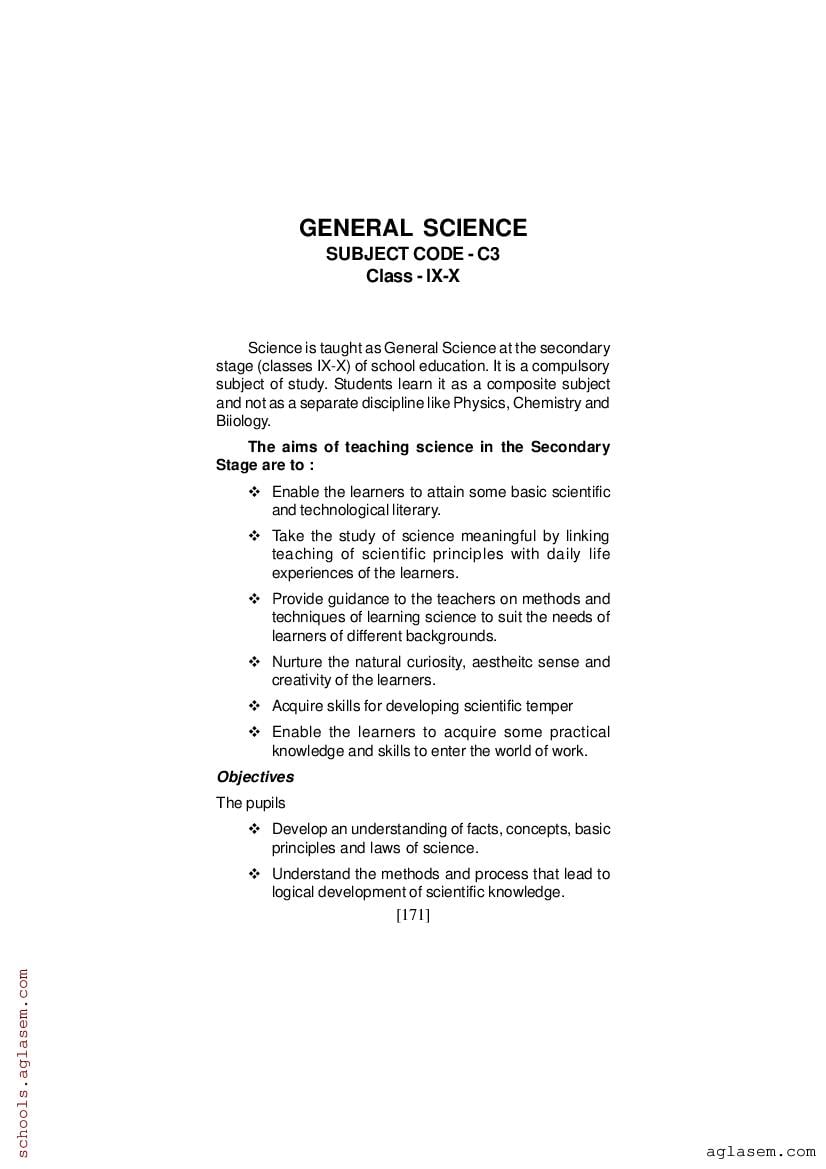
SUBJECT CODE - C3
Class - IX-X
Science is taught as General Science at the secondary
stage (classes IX-X) of school education. It is a compulsory
subject of study. Students learn it as a composite subject
and not as a separate discipline like Physics, Chemistry and
Biiology.
The aims of teaching science in the Secondary
Stage are to :
Enable the learners to attain some basic scientific
and technological literary.
Take the study of science meaningful by linking
teaching of scientific principles with daily life
experiences of the learners.
Provide guidance to the teachers on methods and
techniques of learning science to suit the needs of
learners of different backgrounds.
Nurture the natural curiosity, aestheitc sense and
creativity of the learners.
Acquire skills for developing scientific temper
Enable the learners to acquire some practical
knowledge and skills to enter the world of work.
Objectives
The pupils
Develop an understanding of facts, concepts, basic
principles and laws of science.
Understand the methods and process that lead to
logical development of scientific knowledge.
[171]
Page 2
to solve problems related to daily life.
Learn about the application of technology in daily
life and understand the principles on which they work.
Learn the techniques, skills and methods of exploring
the environment and enrich their experience.
Learn to observe, collect data, take measurements,
formulate hypotheses, perform simple experiments
and comunicate scientifically.
Recongnize the relationship of science, technology
and society.
Recognize the relationship of science, technology
and society.
Develop a scientific attitude and inculcate qualities
like open-mindedness, honesty, integrity, co-
operation, love and concern for life and environment.
Learn to think critically.
Learn to infer and interpret facts, principles and
experiments.
Acquire the skill to solve simple problems based on
scientific relations.
Learn to do experimentation.
Participate in co-curricular activites like doing
projects to solve problems related to agriculture, health,
nutrition, protection and preservation of environment etc.
Cultivate the habit of reading scientific journals,
papers reports.
Develop problem solving and decision making skills.
The Board has adopted the NCERT science syllabi
for Secondary stage w.e.f. the academic session
2013.
[172]
Page 3
2005. In the words of NCERT.
“The exercise of revising the syllabus for science and
technology has been carried out with ‘Learning without
burden’ as a guiding light and the position papers of the
National Focus Groups as points of reference. The aim is to
make the syllabus an enabling document for the creation of
textbooks that are interesting and challenging without being
loaded with factual information.
The themes chosen for class IX-X are : Food; Materials;
The world of the living; How things work; Moving things;
People and ideas; Natural phenomena and Natural
resources. However the theme ‘food has been excluded in
class X.
The syllabus is presented in four columns : Questions,
Key concepts, Resources and Activites/Process.
The questions lead to delve into the themes/subthemes.
In the process the key concepts emerge. The resource and
activity/process column guides the teachers to meaningful
classroom transaction.
Evaluation :
Assessment of learning is to be done by the process of
continuous and comprehensive evaluation and periiodic
evaluation (half yearly and annual examination, preparatory
examination.) Assessment of learning is to be done
continously hand in hand with the process of teaching. This
gives a feedback to the teachers to plan strategies for
meaningful teaching and learning in the classroom. The
areas of evaluation are assessment of knowledge, application
of knowledge, understanding of concepts, skill in solving
simple numerical problems and drawing. Regular remedial
teaching is to be imparted to ensure desirable level of learning
of the students.
[173]
Page 4
Experimentation is an integral part in science education.
The board has made an endeavour to make students learn
science in a joyful manner through simple activites.
Experimentation (Practical) has a weightage of 10%.
The is School based assessment i.e. Internal assessment.
Experimental activites :
There are three categories of experiments/activities.
A. Teacher’s activity : These have to be demostrated
by the teacher in the laboratory.
B. Student’s activity : These include simple
experiments/activites (from which one is allotted to student
in examination on the lottery system). The students shall
perform the experiment and write the procedure and results/
conclusion methodically. The minimum number of
experiments a students will perform is 3 (covering one each
from Phyisics and Chemistry and 1 from Botany or Zoology)
The experiments/activity will cary 6 marks. This 6 marks will
be distributed in the following way :
I. Performance in examination -3 marks :
For this item any experiment either from Physics or
Chemistry or Biology will be selected by the students and
perform.
II. Practical record book - 3 marks :
C. Activities relating to model/project preparation,
specimen collection etc. For this type of activities the
teacher will engage students to develop models of
instruments/ideas to prepare science projects based on
the facts of their own observations/practical experiences/
field experience/ideas, to prepare charts depicting the life
process/ to colect speciments (plants and animals). The
teachers will entrust the students for this kind of activities at
least six months before their final examination. The students
[174]
Page 5
commencement of final examination. This item will carry 4
marks.
Evaluation :
Evaluation will be school based. (Internal Assessment)
1. For experiments under category A, the teacher while
demonstating the experiments will ask studens
relevant questions and will evalute the student out
of a total weightage of 2 in eah demonstration. The
marks for each student will found by calculating the
average mark.
2. (i) For experiments under category B, students will
be evaluated on their performance out of a total
weightage 3.
The 3 marks will be distributed as follows : (i) Theory/
Principle : 1 mark, Experiment and result : 2 marks,
Total : 3 marks.
(ii) The students are required to maintain a neat well
recorded practical book. Marks on the record book
is 3.
3. Students will prepare charts/models. The total marks
is 2.
[175]
Page 6
Class - X
List of Experiments (Class - X)
BIOLOGY
1. To prepare a temporary mount of a leaf to demonstrate
its stomata.
2. To show that light is essential for potosynthesis.
3. To study binary fission of Amoeba or yeast with the help
of prepared slide.
4. To dissect and display differet parts of a complete flower
(China rose)
5. To study the morphological characters of cockroach.
PHYSICS
6. To find the image distance due to an object placed in
front of convex lens and hence to determine its focal
length.
7. To study the image distance corresponding to an object
placed at 2f, 3f, 4f distance in front of a convex lens.
8. To study the phenomenon of refraction through prism
(by pin method) and hence to determine the angle of
deviation.
9. To study the change of current due to variation of
resistance in an electric circuit.
10. To study and demonstate the principle of working of
electric motor.
CHEMISTRY
11. To show that electrovalent compounds are soluble in
water but convalent compounds are not.
12. To show that aqueous solution of ionic compounds
conduct electricity.
[179]
Page 7
help of reagents
(a) Litmus solution (blue/red) or litmus paper.
(b) Zinc metal
(c) Sodium carbonate
(ii) To test properties of sodium hydroxide with the help of
(a) Blue/red litmus solution
(b) zinc metal
(c) Sodium carbonate
(iii) Demonstration of a neutralization reaction.
14. To detect the presence of the functional group in car-
boxylic acid.
15. To study some redox reactions.
List of equipments and materials (Class-X)
BIOLOGY
1. Simple microscope
2. Compund microscope
3. Forceps, brush
4. Watch glass
5. Needle, dissecting needle
6. slides and coverslips
7. Ganong’s light screen or black paper
8. Potted plant
9. Beaker
10. Chemical reagents - Ethanol, Iodine solution
11. Slides of Binary fission of Amoeba and yeast
PHYSICS AND CHEMISTRY
1. Insulating copper wire
2. Torch light blub.
3. Lens (convex) focal length, 5cm)
[180]
Page 8
5. Prism
6. Pencil
7. Torch bulb or LED (bulb)
8. Razor Blade
9. Test Tubes, Test tube holders, Bunsen burner or spirit
lamp
10. Chemical reagents viz. sodium chloride, copper
sulphate, carbon tetrachloride, candle wax, nepthalene,
sodium carbonate, pieces of zinc, phenolphthalein,
distilled water, ethanoic acid/benzoic acid
11. Flexible wire
12. Adhensive tape
13. Litmus paper-blue and red
14. Match box
15. Bent glass tube (bent at the same angle at both ends)
16. Cork
17. Tissue paper
18. Droppers
19. Pipette
20. Burette
21. Conical flask
22. Beakers
23. Glass rod
[181]
Page 9
Theme/Sub-theme Questions Key concepts Resources Activities/Processes
1. Food Materials
2. Different kinds of Why are some Acids, bases and salts : General Orange juice, lemon juice, Testing different
materials substances sour and Properties, examples and uses soap solution, limus solution, substances with
some bitter in taste? Why zinc, copper and aluminium indicators.
does soap solution feel metals. Neutralisation reactions
slippery? Why does Acids : (Periods 5)
seawater taste salty? hydrochloric acid, sulphuric
[193]
acid, nitric acid. Bases :
sodium hydroxide.
Common salt.
Page 10
Why does iron rust? Why Types of chemical reactions: combination, Turmeric, limejuice, vinegar, Mixing pairs of substances
does painted iron not rust? decomposition, displacement, double mentioned alongside, to see the
Why is burning sensatin displacement, precipitation, neutralisation, reactions-discussion on
removed when one takes oxidation and reduction in terms of gain chemistry in the kitchen,
antacids? and loss of oxygen and hydrogen. chemistry inside our bodies.
Why do substances Carrying out simple projects
[194]
Page 11
stop burning in the adsence of baking soda, reactions that encompass
air? washing soda, yeast, hot decomposition, displacement,
Why is flame seen when water. Materials such as iron double displacement,
substances burn? nails, copper strip, aluminium precipitation, neutralisation,
Can substances burn without strip, zinc strip, galvanised oxidation and reduction.
flame? Why does a matchstics strip petri dishes with and (Periods 10)
kept in the blue part of the flame without covers, container that
not burn? Why is a red coating can be filled with water, cotton
formed on the zinc rod when it wool, etc.
is kept in copper sulphate
[195]
solution? What is the meterial of
the coating?
Page 12
How things change/react How do copper, silver, iron exist in Brief discussion of basic Samples of metals : iron, Discussions on metallurgical
with one another? nature? metallurgial processes. copper, lead, silver, zinc, processes and simple
Properties of common aluminium, gold; samples of experiments involving metals,
metals. Elementary idea non-metals : sulphur, graphite with chemical reactions.
about bonding. Alloys: steel, brass Models
What is the composition of natural gas Carbon compounds, Experiments involving reactions
used for cooking? elementray idea about of carbon and its compounds
What is petrol? bonding. Saturted with chemical reactions. Use of
[196]
What is Vinegar? hydrocarbons, alcohols, models.
carboxylic acids: (no (Periods 16)
preparation only properties)
Page 13
Meterials of common use How is common salt obtained? Soap-cleansing action of Kit Containing various Use of kit materials for
Besides its use in food, is it used for soap. materials like common salt, demonstration as well as
other purpose? What makes washing washing soda, lime, lime performing of experiments by
soda and banking soda different stone, bleaching powder, student of properties. Visits to
materials? How does bleaching plaster of Paris, soaps; factories.
powder make paper and cloth white? alcohol. (Periods 8)
What is the white material that is used
for making casts? How do soaps
clean clothes? Can some other?
[197]
Page 14
materials be used for cleaning clothes?
Why does a man lose control on his
body after drinking alcohol?
Why do people become blind on
drinking denatured alcohol?
How are elements How do chemists study such a large Gradation in properties: Brief historical account, Predicting trends on the basis
[198]
classified? number of elements? Mendeleev periodic table. charts, films etc. of the table
(Periods 5)
Page 15
3. The World of the What will happen if we bury Our environment: Discussion on food habits of Activity of burying different
Living different materials in the soil? Environmental problems, animals, finding out the materials in the soil and studying
Our Environment What will happen if we kill all what can we do? Bio various waste materials periodically what happens.
insects? Some of us eat meat; degradable, non-bio- producd and their disposal in Construction of food web using
some do not-what about animals? degradable. Ozone depletion different parts of the country. models, classification of some
common plants and animals as
consumers etc.
(Periods 8)
[199]
How do we stay alive What are processes needed for Define ‘living‘ things; Basic Models and charts of various Study various things around to
living? concept of nutrition, respiration, systems in animals, and parts decide whether they are living/
transport and excretion in in plants. non living.
plants and animals. (Periods 15)
Page 16
Control in the living Why do roots grow towards the Tropic movements in plants; Young plants for Experiments on tropic movments in
ground? Can we make them Introduction to plant experiments, seeds; Kit plants geotropism, hydrotropism,
grow upwards? Why do stems hormones; Control and materials; Pavlov’s phototropism, interaction of factors;
grow upwards? coordination in animals: experiment on conditioned experiment on apical dominance;
voluntary, involuntary and reflex. demonstration of reflex action.
reflex action, nervous (Periods 10)
system; chemical
coordination: animal
hormones.
Reproduction in the living Do plants and animals have Reproduction in plants and Permanent slide L.S. Study pollen tube growth and pollen tubes
[200]
similar reproductive cycle? animals. Need for and grain;charts/speciments on a sigmatic mount, mount soaked seeds
Can we decide how many methods of family planning. of embroyos, egg. Charts to see embroynal axis, cotyledons etc.,
children are born in a family? Safe sex vs. HIV/AIDS. and other materials on seeds germination- epigeal and hypogeal
Childbearing and women/s family planning. structure of the hen’s egg. Discussion on
health. Newspaper reports on family planning and responsible
HIV/AIDS. parenting.
(Periods 10)
Page 17
Heredity and evolution Why are we like our parents? Did Heredity, Origin of life: brief Data and worksheet from Phenotypic ratio 3 : 1, 2 : 1, 9 :
similar plants and animals exist in introduction; Basic concepts of Mendel’s experiments, 3:3:1
the past? Did life always exist? evolution. specimen of fossil. (Periods 10)
[201]
Page 18
4. Moving Things, Using a simple electric circuit, show
People and Ideas that charges flow from higher potential
5. How things work to lower potential. Use the analogy of
flow of water from higher to (potential
to highest energy) lower height (lower
Electric Circuits In which direction does current Potential difference, Battery, conductor potential energy).
flow inside a conductor? potential voltmeter, ammeter,
connecting wire, key.
[202]
How is potential difference Ohm’s law -do- Using a circuit consisting of a
across a conductor related to And reheostats conductor, battery, key, voltmeter and
current through the conductor? ammeter, establish a relationship
between potential difference and
current and hence Ohm’s law.
How can you arrange a given Series combination of -do- Using the Ohm’s law circuit,
set of resistors so that the same resistances. and given set of resistors. establishing the properties of series
current flows through all? combination and the rule for
resistance.
Page 19
How are appliances connected in a Parallel combination of -do- Establishing the rule for parallel
house? resistances. and given set of resistors. combination of resistors.
Appliances based on heating
effect of current in daily life. Identification of appliances in
How much heat is generated when a Power dissipated due to daily life base on heating effect
current I flows through a resistor? current. Inter relation between of current. Calculation of power
P,V,I and R. in daily life situations.
(Periods 12)
How does the needle of a compass Magnetic field lines A magnet,
Magnets change direction when placed at compass, white sheet, drawing Drawing magnetic field lines in
different points near a magnet? board, drawing pins. the vicinity of a bar magnet.
[203]
Demonstrating that a current
carrying conductor produces a
Does a current carrying conductor A battery, a conductor,
magnetic field.
produce a magnatic field? Field due to a current carrying compass, key, A coil, A
wire. Field due to current solenoid. Demonstrating the magnetic field
carrying coil or solenoid. produces by a current carrying
What happens to a current carrying coil or solenoid.
conductor when it is placed in a
magnetic field? Force on current carrying A small rod, stand and two wires Demonstrating that a current
conductor Fleming’s left hand for suspending the rod, a strong carrying conductor when placed
rule. horseshoe magnet. in a magnetic field experiences
force.
Page 20
How does the above effects help us Electric motor. Appliances using motors. Demonstrating the working of a
to design machines to do work? motor. Identifying the appliances
based on electric motors.
What do you observe when a magnet Electromagnetic induction. Two coils of wire, a magnet, a Demonstrating the phenomenon
is moved towards a wire connected galvanometer. of electromagnetic induction.
to a galvanometer?
Induced potential differences, Demonstrating that current is
induced current. Iron nails, battery, switch. induced in a coil kept near
How can the phenomenon of another coil in which current
[204]
electromagnetic induction be used to changes.
design a device to generate Electric genetor : principle and A simple model of electric
electricity? working generator Demonstrating the principle and
working of a generator.
Does the current produced by a Direct current. Model of electric Generetor Familiaising with voltage and
generator have the same direction all Alternating current; frequency frequency of AC in our homes.
the time? of AC. Advantage of AC. over
DC.
Page 21
How are the bulbs etc. connected to Domestic electric circuits. Demonstration board for Explaining the working of
the AC source in our homes? domestic electric circuit. domestic electric circuits.
Demonstrating the use of a fuse
in domestic circuits.
(Periods 12)
[205]
Page 22
6. Natural Why is paper burnt when light Convergence and divergence of light. Experience, Double Observation of convergence
Phenomena passing through a lens strikes it? convex lens and divergence with lenses.
Does a spherical mirror also exhibit Images formed by a concave mirror, A candle, stand to hold a Exploring and recording
similar phenomenon? Can we see a related concepts centre of curvature, mirror, meter scale. features of images formed by a
full image of a tall building using a principal axis. Optical centre, focus, concave mirror, by placing an
small mirror? focal length. object beyond c.c., between
c.c. and focus, and between
pole and focus; ray diagrams.
[206]
Why does a spoon partly immersed Refraction; laws of refraction. Glass slab, pins. Activity to explore laws of
in water in a transparent glass appear refraction.
broken at the level of water when
viewd from the sides?
What do lenses do? How do they Images formed by a convex lens; Convex lens. Activity exploring and recording
correct defects in vision? functioning of lens in human eye; features of images formed by
problems of vision and remedies. convex lens, Ray digrams.
Studying the glasses used by
Page 23
Application of spherical mirrors human beings to correct
and lenses different vision defects.
Why does the path of light change on Appreciation of concept of Concepts learnt earlier. Activities studying refraction.
entering a different medium? refraction; velocity of light;
refractive index; twinkling of
stars; dispersion of light.
[207]
Why or how does a prism disperse Dispersion of light. Prism, pins. Observation of objects through
light? prism; tracing rays refracted
through a prism; discussion.
Why is the sky blue? Scattering of light. Observations and experience Activity showing scattering of
light in emulsion etc.
(Periods 25)
Page 24
7. Natural
Resources
Conservation of How can we contribute to protect Management of natural resources, Articles/stories on Case studies with focus on
Natural Resources environment in our locality? Conservation and judicious use of conservation; Posters on commercial activities exploiting
What are the major global natural resources. Forest and wild life, evnironmental aware- natural resources.
environmental issues of direct coal and petroleum conservation. ness. Effect of these on various
relevance to us? cycles in natures.
[208]
Page 25
What are the steps expected on the People’s participation. Chipko Case studies on Chipko Making posters/slogans for
part of local administration to maintain movement. Legal perspectives in movement; CNG use. creating awareness.
balances in nature in your region? conservation and international
How can we help? scenario.
The regional How does the construction of big Big dams: advantages and Case study material on Case studies with focus on
environment dams affect the life of the people and limitations; alternatives if any. Water dams. Resource material issues of construction of dams
the regional environment? Are rivers, harvesting. Sustainability of natural on water harvesting. and related phenomena
lakes, forests and wild life safe in resources. (actual/probable). Debates on
[209]
your area? issues involved.
Sources of energy What are the various sources of Different forms of energy, leading to Experience; print material Discussion, making models
energy we use? Are any of these different sources for human use; fossil on various sources of and charts in groups. Making
sources limited? Are there reasons fuels, solar energy; biogas; wind, energy; materials to make a solar heater/cooker.
to prefer some of them over others? water and tidal energy;nuclear a solar heater. (Periods 8)
energy, Renewable versus non-
renewable sources.
Page 26
Subject Code : C3
Class : X Time : 3 hours
Total Marks : 100 Pass Marks : 30
Theory : 90
Internal Assessment : 10
Pass marks in written examination : 27
Marks
Unit CONTENTS Half
Final
Yearly
Chapter 1 Chemical Reactions and 12 6
Equations
Chapter 2 Acids, Bases and Salts 10 6
Chapter 3 Metals and Non-metals 7
Chapter 4 Carbon and its Compounds 6
Chapter 5 Periodic Classification of 10 4
Elements
Chapter 6 Life Processes 12 8
Chapter 7 Control and Coordination 8 6
Chapter 8 How do Organisms Reproduce 5
Chapter 9 Heredity and Evolution 10 5
Chapter 10 Light-Reflection and Refraction 14 8
Chapter 11 Human Eye and Colourful World 8 5
Chapter 12 Electricity 6
Chapter 13 Magnetic Effects of Electric 5
Current
Chapter 14 Sources of Energy 6 4
Chapter 15 Our Environment 4
Chapter 16 Management of Natural 5
Resources
Total (Theory) 90 90
Internal Assessment 10 10
Grand Total 100 100
[210]
Page 27
Marks - 10
Marks
Sl. No. CHAPTERS
1. Category A : Teacher’s activity- 2
(Teacher will evaluate the students
as he/she demonstrates)
2. Category B : Student’s activity-
Activity 3
Practical record book 3
3. Category C : Chart / Model / 2
Specimen Collection
Total 10
Textbook : Science (for Class X), published by The Assam State
Textbook Production and Publication Corporation Ltd.,
Guwahati-1
[211]
Document Details
| Board / Org | Assam Board |
| Exam | Class 10 |
| Type | Syllabus |
| Pages | 27 |
| Updated | 22 Jul 2026 |