MAHA SET 2019 Question Paper 2 Public Administration
Finished viewing? Save it for later —
Download MAHA SET 2019 Question Paper 2 Public Administration (PDF · 32 pages)About MAHA SET 2019 Question Paper 2 Public Administration
MAHA SET 2019 Question Paper 2 Public Administration is available here for free download. Published by Maharashtra Exams for Maharashtra State Eligibility Test, this question paper can be viewed online or downloaded as a PDF (32 pages). Candidates preparing for Maharashtra State Eligibility Test can use MAHA SET 2019 Question Paper 2 Public Administration to understand the exam pattern, the type of questions asked, and the overall difficulty level.
Frequently Asked Questions
How can I download MAHA SET 2019 Question Paper 2 Public Administration?
Open this page and click the Download button to save MAHA SET 2019 Question Paper 2 Public Administration as a PDF. It is completely free on AglaSem Docs.
Is MAHA SET 2019 Question Paper 2 Public Administration free to download?
Yes. MAHA SET 2019 Question Paper 2 Public Administration can be viewed online and downloaded as a PDF free of cost on AglaSem Docs.
How many pages does MAHA SET 2019 Question Paper 2 Public Administration have?
MAHA SET 2019 Question Paper 2 Public Administration contains 32 pages, which you can read online or download together as a single PDF.
Where can I find more Maharashtra State Eligibility Test study material?
You can find more Maharashtra State Eligibility Test question papers, sample papers, syllabus, and answer keys on AglaSem Docs.
MAHA SET 2019 Question Paper 2 Public Administration – Text
Read the full text of this question paper below — useful to quickly search, copy and reference the content online without downloading the PDF.
📄 View text version (32 pages)
Page 1
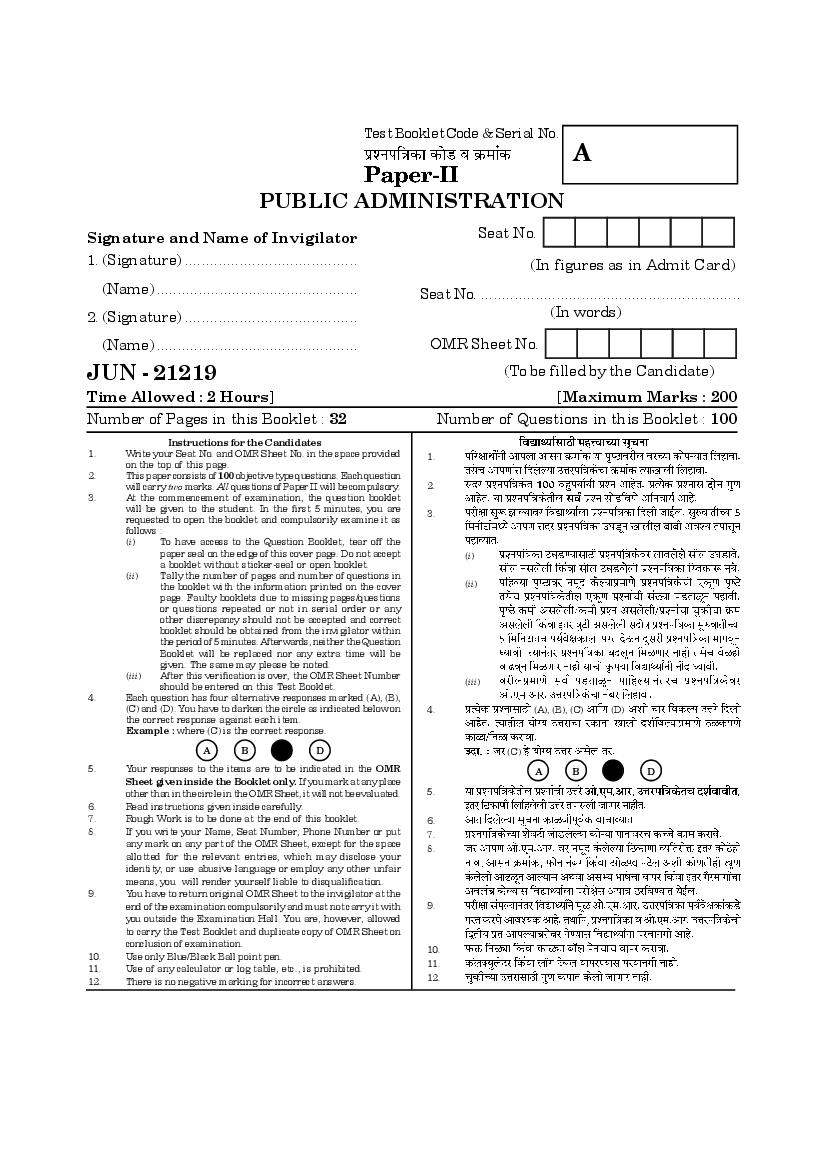
A
PUBLIC ADMINISTRATION
Signature and Name of Invigilator Seat No.
1. (Signature) ......................................... (In figures as in Admit Card)
(Name) ................................................ Seat No. ..............................................................
2. (Signature) ......................................... (In words)
(Name) ................................................ OMR Sheet No.
JUN - 21219 (To be filled by the Candidate)
Time Allowed : 2 Hours] [Maximum Marks : 200
Number of Pages in this Booklet : 32 Number of Questions in this Booklet : 100
Instructions for the Candidates
1. Write your Seat No. and OMR Sheet No. in the space provided 1.
on the top of this page.
2. This paper consists of 100 objective type questions. Each question
will carry two marks. All questions of Paper II will be compulsory. 2.
3. At the commencement of examination, the question booklet
will be given to the student. In the first 5 minutes, you are 3.
requested to open the booklet and compulsorily examine it as
follows :
(i) To have access to the Question Booklet, tear off the
paper seal on the edge of this cover page. Do not accept (i)
a booklet without sticker-seal or open booklet.
(ii) Tally the number of pages and number of questions in
the booklet with the information printed on the cover (ii)
page. Faulty booklets due to missing pages/questions
or questions repeated or not in serial order or any
other discrepancy should not be accepted and correct
booklet should be obtained from the invigilator within
the period of 5 minutes. Afterwards, neither the Question
Booklet will be replaced nor any extra time will be
given. The same may please be noted.
(iii) After this verification is over, the OMR Sheet Number
(iii)
should be entered on this Test Booklet.
4. Each question has four alternative responses marked (A), (B),
(C) and (D). You have to darken the circle as indicated below on 4. (A), (B), (C) (D)
the correct response against each item.
Example : where (C) is the correct response.
A B D (C)
5. Your responses to the items are to be indicated in the OMR A B D
Sheet given inside the Booklet only. If you mark at any place
other than in the circle in the OMR Sheet, it will not be evaluated. 5.
6. Read instructions given inside carefully.
7. Rough Work is to be done at the end of this booklet. 6.
8. If you write your Name, Seat Number, Phone Number or put 7.
any mark on any part of the OMR Sheet, except for the space
8.
allotted for the relevant entries, which may disclose your
identity, or use abusive language or employ any other unfair
means, you will render yourself liable to disqualification.
9. You have to return original OMR Sheet to the invigilator at the
end of the examination compulsorily and must not carry it with 9.
you outside the Examination Hall. You are, however, allowed
to carry the Test Booklet and duplicate copy of OMR Sheet on
conclusion of examination.
10.
10. Use only Blue/Black Ball point pen.
11.
11. Use of any calculator or log table, etc., is prohibited.
12. There is no negative marking for incorrect answers. 12.
Page 2
Page 3
Paper II
II
Time Allowed : 120 Minutes] [Maximum Marks : 200
Note : This Paper contains Hundred (100) multiple choice questions. Each question
carrying Two (2) marks. Attempt All questions.
(100) (2)
1. Integral view of Public Administration 1.
does not include :
(A) Managerial activities (A)
(B) Technical activities (B)
(C) Clerical activities (C)
(D) Mechanical activities (D)
2. Who is the gospel of neutral 2.
principles of administration ?
(A) Gulick (B) Mayo (A) (B)
(C) Simon (D) Riggs (C) (D)
3. Which is not the base for selecting 3.
an alternative in decision-making
process ?
(A)
(A) Experience
(B)
(B) Experimentation
(C) Research and analysis (C)
(D) Desired opinion (D)
3 [P.T.O.
Page 4
pattern :
Assertion (A) : Public Administra- (A) :
tion is more
comprehensive
than Private (R) :
Administration.
Reason (R) : Public Administration
regulates Private
Administration.
Codes : (A) (A) (R)
(A) Both (A) and (R) are true and (R) (A)
(R) is the correct explanation
of (A) (B) (A) (R)
(B) Both (A) and (R) are true but
(R) is not the correct (R) (A)
explanation of (A) (C) (A) (R)
(C) (A) is true but (R) is false
(D) (A) is false but (R) is true (D) (A) (R)
5. Decentralisation results from : 5.
(A) Span of control
(A)
(B) Delegation (B)
(C) Coordination (C)
(D) Leadership (D)
6. In modern times merit system of 6.
recruitment was first introduced
in :
(A) Prussia (B) India (A) (B)
(C) England (D) USA (C) (D)
7. ‘It does not command; its job is to 7.
sell, not tell’, has been said for :
(A) Functional staff
(A)
(B) Control staff (B)
(C) Technical staff (C)
(D) Advisory staff (D)
4
Page 5
of :
(A) Command (B) Authority (A) (B)
(C) High Morale (D) Control (C) (D)
9. Which rules govern pension and 9.
gratuity to the employees retiring
from central civil departments :
(A) Central Civil Services (Pension) (A)
Rules, 1972
(B) Central Civil Services (Pension) (B)
Rules, 1969
(C) Central Civil Services (Pension) (C)
Rules, 1975
(D) Central Civil Services (Pension) (D)
Rules, 1962
10. Match List I with List II and select 10. I II
the correct answer from the codes
given below : I
List I (a)
(a) Hatch Act
(b)
(b) Northcote Trevelyan Report
(c)
(c) Pendleton Act
(d)
(d) Kothari Committee Report
II
List II
(1) 1833
(1) 1833
(2) 1976
(2) 1976
(3) 1939 (3) 1939
(4) 1853 (4) 1853
Codes :
(a) (b) (c) (d) (a) (b) (c) (d)
(A) (3) (2) (4) (1) (A) (3) (2) (4) (1)
(B) (3) (4) (1) (2) (B) (3) (4) (1) (2)
(C) (4) (1) (3) (2) (C) (4) (1) (3) (2)
(D) (2) (3) (1) (4) (D) (2) (3) (1) (4)
5 [P.T.O.
Page 6
management is not propounded by
Lyndall Urwick ?
(A)
(A) Principle of Investigation
(B)
(B) Principle of Control
(C) Principle of Hierarchy (C)
(D) Principle of Experiment (D)
12. McGregor hypothesized that a 12.
manager’s assumption about human
behavior predetermined :
(A)
(A) his administrative style
(B)
(B) his decision-making
(C)
(C) his interpersonal relations
(D) his line of action (D)
13. Taylor’s scientific managment was 13.
first known as :
(A) Scientific Management (A)
(B) Time Study (B)
(C) Rubble Hypothesis (C)
(D) Task and Bonus Management (D)
14. Who was a key figure in the 14.
establishment of Administrative
staff college at Henley-on-Thames ?
(A) Lyndall Urwick (A)
(B) Luther Gulick (B)
(C) Henri Fayol (C)
(D) Fredrick Taylor (D)
15. Human Relations Theory believed 15.
that people are :
(A) Homogenous (A)
(B) Heterogenous (B)
(C) Atomistic (C)
(D) Economic men (D)
6
Page 7
Pattern :
Assertion (A) : Taylor’s primary (A) :
concern was
management at the
supervisory level
and gave much
stress on the
efficiency of workers (R) :
and managers at
operational level.
Reason (R) : Scientific management
is just a mental
revolution for both
employer and (A) (A) (R)
employees. (R) (A)
Codes :
(A) Both (A) and (R) are true and (B) (A) (R)
(R) is the correct explanation (R) (A)
of (A) (C) (A) (R)
(B) Both (A) and (R) are true but
(R) is not the correct
explanation of (A) (D) (A) (R)
(C) (A) is true but (R) is false
(D) (A) is false but (R) is true
17. Match List I with List II and select 17. I II
the correct answer by using the codes
given below : I
List I (a)
(a) The Art of cutting metals (b)
(b) Dynamic Administration (c)
(c) The Human side of Enterprise
(d)
(d) Fundamental Research in
Administration II
List II (1) 1953
(1) 1953 (2) 1941
(2) 1941 (3) 1906
(3) 1906 (4) 1960
(4) 1960
Codes : (a) (b) (c) (d)
(a) (b) (c) (d)
(A) (1) (3) (4) (2) (A) (1) (3) (4) (2)
(B) (3) (2) (4) (1) (B) (3) (2) (4) (1)
(C) (3) (1) (2) (4) (C) (3) (1) (2) (4)
(D) (3) (4) (2) (1) (D) (3) (4) (2) (1)
7 [P.T.O.
Page 8
the New Public Administration ?
(A) Dwight Waldo (A)
(B) Ferrel Heady (B)
(C) Christopher Hood (C)
(D) Both (A) and (C) (D) (A) (C)
19. Who elaborated the term 19.
‘consumerism’ in the context of post-
modernism ?
(A)
(A) Nietzsche
(B)
(B) Derrida
(C)
(C) Michel Foucault
(D) Jean Baudrillard (D)
20. The foundation stone of motivation 20.
theory is the integrated wholeness
of : (A)
(A) The organism
(B)
(B) The organization
(C)
(C) The society
(D) The nature (D)
21. During the Mahabharata period, the 21.
state has been called as :
(A) Rashtra (B) Saptanghi (A) (B)
(C) Janapada (D) Vish (C) (D)
22. The civil service system in India 22.
during the British times was based
essentially on :
(A)
(A) European System
(B)
(B) Modern System
(C) The Ancient Indian System (C)
(D) The Mughal System (D)
23. Recruitment to the ICS came to be 23.
based totally on merit, after :
(A) 1773 (B) 1855 (A) 1773 (B) 1855
(C) 1892 (D) 1922 (C) 1892 (D) 1922
8
Page 9
constitutional powers is not enjoyed
by the President of India ?
(A) Appointment of Governors of (A)
State (B)
(B) Enjoys discretionary powers
(C)
(C) Grants pardons
(D) Promulgates ordinances (D)
25. Who did not act as the Deputy Prime 25.
Minister of India ?
(A) Morarji Desai (A)
(B) Charansingh (B)
(C) Lal Bahadur Shastri (C)
(D) Devi Lal (D)
26. Who has recommended three-fold 26.
(Imperial, provincial and subordinate)
classifications of civil services ?
(A) Aitchison Commission (A)
(B) Lee Commission (B)
(C) Maxwell Commission (C)
(D) Islington Commission (D)
27. ‘Sandwich Pattern’ of training for the 27.
IAS probationers started in :
(A) 1986 (B) 1976 (A) 1986 (B) 1976
(C) 1979 (D) 1969 (C) 1979 (D) 1969
28. The single window system was first 28.
adopted in Union Public Service
Commission in the year :
(A) 2013 (B) 2012
(A) 2013 (B) 2012
(C) 2011 (D) 2010 (C) 2011 (D) 2010
9 [P.T.O.
Page 10
29.
statements is incorrect regarding
the concept of public interest
litigation ?
(A) It is related to social welfare (A)
(B) It safeguards the interests of
common man (B)
(C) It is a case fought in the
(C)
interest of people
(D) It safeguards the interests of (D)
Judiciary
30. Assertion (A) and Reason (R) 30. (A) (R)
Pattern :
Assertion (A) : The National (A) :
Security Council
was established in
1997. (R) :
Reason (R) : Its need was felt
because the Prime
Minister wanted
expert and popular
advice in defence
policies of the
Government.
Codes :
(A) (A) (R)
(A) Both (A) and (R) are true and
(R) is the correct explanation (R) (A)
of (A)
(B) (A) (R) (R)
(B) Both (A) and (R) are true but
(R) is not the correct (A)
explanation of (A)
(C) (A) (R)
(C) (A) is true but (R) is false
(D) (A) is false but (R) is true (D) (A) (R)
10
Page 11
about the Governor of a state who
has the power to appoint :
(1) Judges of the High Court
(1)
(2) Members of the State Public
Service Commission (2)
(3) Members of the State Finance (3)
Commission
(4)
(4) The Accountant General
Which of the statements given above
are correct ? (A) (1) (2)
(A) (1) and (2)
(B) (2) (3)
(B) (2) and (3)
(C) (1), (3) (4)
(C) (1), (3) and (4)
(D) (2), (3) and (4) (D) (2), (3) (4)
32. The Council of Minister of a state 32.
deals with the following matters :
(1)
(1) Governor’s address to the
Vidhan Sabha (2)
(2) Fixing the time, place and
agenda of cabinet meetings (3)
(3) Proposals to refer any matter to
the zonal council
(4)
(4) Important policy matters,
including changes in the
existing laws
Chose the correct code :
(A) (1)
(A) Only (1)
(B) (2)
(B) Only (2)
(C) (2), (3) and (4) (C) (2), (3) (4)
(D) (1) and (2) (D) (1) (2)
11 [P.T.O.
Page 12
Chief Secretary of the state are :
(1) Secretary to the Cabinet (1)
(2) Chief advisor to the Chief
(2)
Minister
(3)
(3) Chief of the secretaries
(4) Representative of the state in (4)
all legal matters
Select the correct answer by using
the codes given below :
(A) (1), (2) (4)
(A) (1), (2) and (4)
(B) (2), (3) (4)
(B) (2), (3) and (4)
(C) (1), (2) (3)
(C) (1), (2) and (3)
(D) (1), (3) and (4) (D) (1), (3) (4)
34. For the first time in the history of 34.
District Administration Collectors
were appointed in the year :
(A) 1772 (B) 1781
(A) 1772 (B) 1781
(C) 1919 (D) 1935 (C) 1919 (D) 1935
35. Which of the following statements 35.
is not correct ?
(A) Gram Sabha is representative (A)
body
(B)
(B) Gram Sabha is constitutional
body (C)
(C) Gram Sabha is lowest unit of
Indian local self government
(D) Gram Sabha is created by the
(D)
73rd Amendment of the
Constitution
12
Page 13
Assertion (A) : Chief Minister is
(A) :
formally appointed
and removed by the
Governor.
Reason (R) : District collector is
(R) :
formally appointed
and removed by the
Chief Minister
Answer the question using the below
given codes :
Codes : (A) (A) (R)
(A) Both (A) and (R) are true and (R) (A)
(R) is the correct explanation
(B) (A) (R) (R)
of (A)
(B) Both (A) and (R) are true but (A)
(R) is not the correct (C) (A) (R)
explanation of (A)
(C) (A) is true but (R) is false
(D) (A) is false but (R) is true (D) (A) (R)
37. Which of the following statements 37.
is correct ?
(A)
(A) The Mumbai Municipal
Corporation Act, 1888 (B)
(B) The City of Nagpur Corporation
Act, 1949
(C) The Maharashtra Municipal (C)
Corporation Act, 1974
(D) The Bombay Provincial
(D)
Municipal Corporation Act,
1948
13 [P.T.O.
Page 14
the correct answer from the codes
given below :
I
List I
(a) Taxation Enquiry Commission (a)
(b) Committee on the Training of (b)
Municipal Employees (c)
(c) Local Finance Enquiry
(d)
Committee
(d) Rural-urban Relationship II
Committee (1)
List II (2)
(1) P. K. Wattal
(3)
(2) A. P. Jain
(3) Nur-ud-din Ahmed (4)
(4) John Matthai
Codes : (a) (b) (c) (d)
(a) (b) (c) (d) (A) (3) (4) (2) (1)
(A) (3) (4) (2) (1)
(B) (4) (3) (1) (2)
(B) (4) (3) (1) (2)
(C) (4) (2) (3) (1)
(C) (4) (2) (3) (1)
(D) (3) (4) (1) (2) (D) (3) (4) (1) (2)
39. The list of functions of municipalities 39.
given in the twelfth schedule of the
Constitution does not include :
(A) Planning for economic and
social development (A)
(B) Fire services
(C) Promotion of cultural, (B)
educational and aesthetic
(C)
aspects
(D) Land management including
registration (D)
14
Page 15
the correct answer by using the codes
given below :
I
List I
(a)
(a) Backward Regions Grant Fund
(b) Sampoorna Grameen Rojgar (b)
Yojana (c)
(c) Swarnajayanti Gram Swarozgar (d)
Yojana
(d) Provision of Urban Amenities in II
Rural Areas
(1) 1999
List II
(1) 1999 (2) 2001
(2) 2001 (3) 2004
(3) 2004 (4) 2007
(4) 2007
Codes : (a) (b) (c) (d)
(a) (b) (c) (d) (A) (4) (2) (1) (3)
(A) (4) (2) (1) (3) (B) (3) (1) (2) (4)
(B) (3) (1) (2) (4)
(C) (2) (3) (4) (1)
(C) (2) (3) (4) (1)
(D) (1) (2) (3) (4)
(D) (1) (2) (3) (4)
41. Who viewed Weber’s bureaucratic 41.
model as a “paradigm” of Public
Administration ? (A)
(A) Michael Crozier
(B)
(B) Dwight Waldo
(C) Herbert Simon (C)
(D) Mary Parker Follett (D)
42. In the field of comparative public 42.
administration who amongst the
following have conducted empirical
studies of bureaucratic behaviour
in different social and cultural
perspectives : (A)
(A) Robert Presthus and Michael
Crozier (B)
(B) Pffifner and Presthus
(C)
(C) Peter Blau and Warren Bennis
(D) Miller and Rice (D)
15 [P.T.O.
Page 16
in comparative public administration
are ................. .
(1) Research focus is mostly on (1)
reforms and accountability
(2) Lack of theory and thoughtful (2)
methodological approaches in
research (3)
(3) Mostly relies on secondary data
Answer the question using the codes
given below :
(A) (1), (2) and (3) (A) (1), (2) (3)
(B) Only (2) (B) (2)
(C) Only (1) and (2) (C) (1) (2)
(D) Only (3) (D) (3)
44. The bureaucracy at the policy 44.
making level is, to a remarkable
extent, neither permanent nor
professional in :
(A) USA (B) UK (A) (B)
(C) France (D) Japan (C) (D)
45. Which is the smallest unit of rural 45.
local government in United
Kingdom ?
(A)
(A) Parish
(B) County (B)
(C) Borough (C)
(D) Both (A) and (C) (D) (A) (C)
46. Which of the following are 46.
important elements of development
administration ?
(1) Goal oriented (1)
(2) Planned (2)
(3) Participatory (3)
(4) Innovativeness (4)
Select the correct answer from the
codes given below :
(A) (1), (2), (3)
(A) (1), (2), (3)
(B) (3) and (4) (B) (3) (4)
(C) (1), (2), (3) and (4) (C) (1), (2), (3) (4)
(D) (1) and (2) (D) (1) (2)
16
Page 17
the correct answer from the codes
given below : I
List I (a)
(a) USA (b)
(b) UK
(c)
(c) France
(d)
(d) India
II
List II
(1)
(1) Ecole Nationale d’ Administration
(2)
(2) Civil Service Commissions
(3)
(3) Union Public Service Commission
(4)
(4) Executive Personnel Department
Codes :
(a) (b) (c) (d) (a) (b) (c) (d)
(A) (4) (2) (1) (3) (A) (4) (2) (1) (3)
(B) (1) (2) (3) (4) (B) (1) (2) (3) (4)
(C) (2) (3) (4) (1) (C) (2) (3) (4) (1)
(D) (4) (3) (2) (1) (D) (4) (3) (2) (1)
48. Assertion (A) and Reason (R) : 48. (A) (R)
Assertion (A) : The RTI Act has led
to enabled citizens. (A) :
Reason (R) : The citizens can
question decisions (R) :
and demand answers
beyond what the
government chooses
to disclose voluntarily
to the public.
Answer the correct question using
the codes given below :
Codes :
(A) Both (A) and (R) are true and (A) (A) (R) (R)
(R) is the correct explanation (A)
of (A)
(B) Both (A) and (R) are true but (B) (A) (R)
(R) is not the correct (R) (A)
explanation of (A)
(C) (A) is true but (R) is false (C) (A) (R)
(D) (A) is false but (R) is true (D) (A) (R)
17 [P.T.O.
Page 18
social responsibility of industries and
business :
(A)
(A) Business Development
(B) Industrial Productivity (B)
(C) Corporate Ethics (C)
(D) Corporate Effectiveness (D)
50. Which one of the following is not a 50.
step in social audit ?
(A) Clarifying purpose and goal
(B) Identify stakeholders (A)
(C) Definition of performance (B)
indicators (C)
(D) Training on social audit
methods (D)
51. Under Policy Resolution 1948, it 51. 1948
became the exclusive monopoly of
the Central Government :
(A) Ship building (A)
(B) Railways (B)
(C) Aircraft (C)
(D) Iron and Steel (D)
52. Restructuring economy under 52.
Liberalisation, Privatisation and (1991)
Globalisation Policy (1991) has
influenced :
(A) Equitable economic development (A)
(B) Centre-state relations (B)
(C) Nature of mixed economy
(C)
(D) Underlying ideals of the
Constitution (D)
53. A departmental form of public 53.
enterprise is characterised by :
(A) Administrative autonomy (A)
(B) Juridical nature (B)
(C) Independent personnel system (C)
(D) Executive creation (D)
18
Page 19
enterprises in the 20th century was
to facilitate :
(A)
(A) Competitiveness
(B)
(B) Planned development
(C) Public welfare (C)
(D) Economic stability (D)
55. Sale of a particular division or assets 55.
which are not compatible with its
core business is called :
(A)
(A) Privatisation
(B)
(B) Disinvestment
(C)
(C) Divestment
(D) Investment (D)
56. The Economic basis of poverty 56.
among forward classes was first
introduced for reservation by the
government under the Prime
Ministership of : (A)
(A) Jawahar Lal Nehru (B)
(B) Lal Bahadur Shastri
(C)
(C) P. V. Narsimha Rao
(D)
(D) Narendra Modi
57. The budgetary role of the US 57.
President through office of
Management and Budgeting is in
nature more :
(A) Financial (B) Managerial (A) (B)
(C) Political (D) Balancing (C) (D)
19 [P.T.O.
Page 20
the correct answer from the codes
given below :
I
List I
(a) Disaster Management Act (a)
(b) National Disaster Management (b)
Plan (c)
(c) National Disaster Management (d)
Authority
(d) Sendai Framework II
List II (1)
(1) Ministry of Home Affairs (2) 2015-30
(2) Disaster Risk Reduction (3) 2016
2015-30
(3) 2016 (4) 2005
(4) 2005
Codes : (a) (b) (c) (d)
(a) (b) (c) (d) (A) (4) (3) (1) (2)
(A) (4) (3) (1) (2) (B) (2) (1) (4) (3)
(B) (2) (1) (4) (3)
(C) (3) (2) (1) (4) (C) (3) (2) (1) (4)
(D) (1) (4) (3) (2) (D) (1) (4) (3) (2)
59. Match List I with List II and select 59. I II
the correct answer from the codes
given below : I
List I
(a)
(a) Central Board of Direct Taxes
(b) Central Board of Indirect Tax (b)
(c) Central Board of Excise and (c)
Customs (d)
(d) Income Tax Department II
List II (1)
(1) Policy formulation regarding
Levy and collection of customs
and excise duty
(2) Assistance in policy making
related to GST (3)
(3) Provides important inputs
(4) Income assessment
Codes : (a) (b) (c) (d)
(a) (b) (c) (d) (A) (3) (1) (2) (4)
(A) (3) (1) (2) (4)
(B) (2) (4) (3) (1) (B) (2) (4) (3) (1)
(C) (2) (3) (1) (4) (C) (2) (3) (1) (4)
(D) (4) (2) (1) (3) (D) (4) (2) (1) (3)
20
Page 21
specific date mentioned in its parent
statute is called :
(A) Executive legislation (A)
(B) Subordinate legislation (B)
(C) Sun set legislation (C)
(D) Delegated legislation (D)
61. “The social welfare policies lack an 61.
integrated approach and direction.”
Who commented ?
(A) Renuka Ray Committee, 1958 (A) 1958
(B) Committee on Child Care, 1962 (B) 1962
(C) Ranade Commission, 1967 (C) 1967
(D) National Expert Commission on (D)
1987
Women, 1987
62. Kaka Kalelkar Commission was 62.
appointed by the Government of
India to determine the criteria for
identification of :
(A) Population below the poverty
line (A)
(B) Socially and educationally
backward classes (B)
(C) Economically backward upper (C)
castes
(D) Socially and educationally (D)
backward communities
63. According to whom “social change is 63.
automatically determined by
economic factors” ?
(A) Karl Marx (A)
(B) Sumner and Keller (B)
(C) MacIver (C)
(D) Jenson (D)
21 [P.T.O.
Page 22
Assertion (A) : Affirmative action
consists of a set of (A) :
antidiscrimination
measures.
Reason (R) : It provide access to
preferred positions
(R) :
in a society for
members of
excluded or under-
represented groups.
Answer the question using the codes
given below :
Codes : (A) (A) (R)
(A) Both (A) and (R) are true and (R) (A)
(R) is the correct explanation
of (A) (B) (A) (R)
(B) Both (A) and (R) are true but (R) (A)
(R) is not the correct
explanation of (A) (C) (A) (R)
(C) (A) is true but (R) is false
(D) (A) (R)
(D) (A) is false but (R) is true
65. Reservation for citizens falling in 65.
backward classes has been permitted
under the Article :
(A) 13 (1) (B) 16 (4)
(A) 13 (1) (B) 16 (4)
(C) 19 (2) (D) 338
(C) 19 (2) (D) 338
66. The major objectives of tribal 66.
development do not include :
(A) Elimination of Untouchability (A)
(B) Elimination of Exploitation (B)
(C) Infrastructure Development (C)
(D) Human Resource Development (D)
22
Page 23
Assertion (A) : The Ministry of (A) :
Social Justice and
Empowerment is
the Nodal Ministry
for overseeing the
interests of the (R) :
scheduled castes.
Reason (R) : It protects them
from social injustice.
Answer the following by using the
codes given below : (A) (A) (R)
Codes : (R) (A)
(A) Both (A) and (R) are true and
(R) is the correct explanation (B) (A) (R)
of (A) (R) (A)
(B) Both (A) and (R) are true but (C) (A) (R)
(R) is not the correct
explanation of (A) (D) (A) (R)
(C) (A) is true but (R) is false 68.
(D) (A) is false but (R) is true
68. ‘In the happiness of his subjects lies
his happiness, in their welfare his (A)
welfare’ who stated ?
(B)
(A) Arya Bhatta
(B) Kautilya (C)
(C) Vivekananda (D)
(D) V. Ramaswamy Naiker 69.
69. Consider the following statements :
(1)
(1) Rural development is a strategy
to improve the social and
economic life of the people living
in villlage. (2)
(2) Rural development focus only
on social transformation.
Which of the statements given above
is/are incorrect ? (A) (1)
(A) Only (1) (B) (2)
(B) Only (2)
(C) (1) (2)
(C) Both (1) and (2)
(D) Neither (1) nor (2) (D)
23 [P.T.O.
Page 24
the correct answer from the codes
given below : I
List I (a)
(a) Social Justice (b)
(b) Social Change (c)
(c) Social Welfare (d)
(d) Social Awakening II
List II (1)
(1) Government programmes (2)
(2) Equity (3)
(3) Moulding public opinion (4)
(4) Mass mobilisation programmes
Codes :
(a) (b) (c) (d)
(a) (b) (c) (d)
(A) (2) (3) (1) (4)
(A) (2) (3) (1) (4)
(B) (3) (1) (2) (4)
(B) (3) (1) (2) (4)
(C) (2) (4) (1) (3)
(C) (2) (4) (1) (3)
(D) (1) (2) (4) (3)
(D) (1) (2) (4) (3)
71.
71. Which of the following is not a part
of policy typology developed by
(A)
Theodore Lowi ?
(B)
(A) Distributive Policy
(B) Regulatory Policy (C)
(C) Constituent Policy (D)
(D) Patronage Policy 72.
72. Public policy is whatever governments
choose to do or not to do :
(A)
(A) Thomas Dye
(B)
(B) Lindblom Charles
(C)
(C) Harold Laski
(D)
(D) David Easton
24
Page 25
“The Thinking Man’s response to
demands” ?
(A)
(A) David Easton
(B)
(B) Pareto
(C) Thomas Dye (C)
(D) Fred Riggs (D)
74. Process approach to the study of 74.
public policy is advocated by :
(A) Thomas Dye (A)
(B) Harold Lasswell (B)
(C) Yehezkel Dror (C)
(D) David Easton (D)
75. The Garbage Can Model of policy 75.
making is developed by :
(A) James Marck and Johan Olsen (A)
(B) Amitai Etzioni (B)
(C) Carol Weiss (C)
(D) Aaron Wildvasky (D)
76. In the outside initiation model of 76.
agenda setting issues arise in :
(A) Within the government (A)
(B) Non-governmental groups
(B)
(C) Influential group with access to
policy makers (C)
(D) In policy analysts contribution (D)
77. Who is considered as the most 77.
important actor in policy imple-
mentation ?
(A)
(A) Political leaders
(B) Non-governmental actors (B)
(C) Bureaucracy (C)
(D) Political parties (D)
25 [P.T.O.
Page 26
on rationality in public process ?
(A) Directives of executive (A)
(B) Objectives of the constitution (B)
(C) Conflicting demands (C)
(D) Multiple administrative units (D)
79. Match List I with List II and select
the correct answer from the codes 79. I II
given below :
List I I
(a) Lasswell Harold (a)
(b) Dror Y (b)
(c) David Easton (c)
(d) Lindblam Charles (d)
List II II
(1) The policy making process
(1)
(2) A framework for policy analysis
(3) Public policy making re-examined (2)
(4) A preview of policy sciences (3)
Codes :
(a) (b) (c) (d)
(A) (1) (2) (3) (4) (a) (b) (c) (d)
(B) (2) (3) (4) (1) (A) (1) (2) (3) (4)
(C) (3) (4) (2) (1) (B) (2) (3) (4) (1)
(D) (4) (3) (2) (1) (C) (3) (4) (2) (1)
80. Assertion (A) and Reason (R) Pattern : (D) (4) (3) (2) (1)
Assertion (A) : Government data 80. (A) (R)
and reports matter (A) :
in policy problem
definition.
Reason (R) : Feedback provides
information on (R) :
current performance
and unanticipated
consequences.
Answer the question using the codes
given below :
Codes :
(A) Both (A) and (R) are true and
(R) is the correct explanation (A) (A) (R)
of (A) (R) (A)
(B) Only (A) is true, (R) is false (B) (A) (R)
(C) Both (A) and (R) are true, but (C) (A) (R)
(R) is not the correct
explanation of (A) (R) (A)
(D) Both (A) and (R) are false (D) (A) (R)
26
Page 27
the following is not a set of principle
which embodies the essential
attribute of a state :
(A)
(A) Principle of division of labour
(B) Principle of authority (B)
(C) Principle of responsibility (C)
(D) Principle of discipline (D)
82. Which one of the following is not the 82.
main aspect of Governance ?
(A) Functionality
(A)
(B) Performance
(B)
(C) Political nature
(D) Outcomes (C)
83. What is not true ? (D)
(A) Disaster Management Act was 83.
passed in 2005 (A) 2005
(B) National Disaster Management
Plan is based upon Sendai
Framework (B)
(C) Sendai framework for DRR
2015-30 is an agreement (C) DRR 2015-30
(D) Under UN India is not a
signatory to the Sendai (D)
agreement
84. Which of the following is not a 84.
feature of New Public Management ?
(A) Managerial Autonomy in (A)
Public Management
(B) Process-Oriented Administration (B)
(C) Output Oriented Administration (C)
(D) Providing high quality services (D)
85. In good governance, perspective of 85.
sustainable development must rest
on the concept of :
(A) Accountability (A)
(B) Efficiency (B)
(C) Rule of law (C)
(D) Strategic vision (D)
27 [P.T.O.
Page 28
(A) Equity (A)
(B) Consensus orientation (B)
(C) Free flow of information (C)
(D) Cooperation (D)
87. Second Administrative Reform 87.
Commission has mentioned ‘Master
Key to Good Governance’ for :
(A)
(A) Crisis Management
(B)
(B) Unlocking Human Capital
(C) Right to Information (C)
(D) Public Order (D)
88. The term ‘Public Value’ was first 88.
coined by :
(A) Mark H. Moore (A)
(B) Timo Meynhardt (B)
(C) HHL Leipzig (C)
(D) Peter Self (D)
89. Match List I with List II and select 89. I II
the correct answer by using the codes
given below : I
List I
(a)
(a) Civil Society
(b)
(b) Plato
(c)
(c) Thomas Davenport
(d)
(d) R. Shamasastry
II
List II
(1) Business process re-engineering (1)
(2) Arthashastra (2)
(3) Philosopher king (3)
(4) Third sector (4)
Codes :
(a) (b) (c) (d) (a) (b) (c) (d)
(A) (2) (3) (1) (4) (A) (2) (3) (1) (4)
(B) (4) (3) (1) (2) (B) (4) (3) (1) (2)
(C) (1) (3) (2) (4) (C) (1) (3) (2) (4)
(D) (4) (2) (3) (1) (D) (4) (2) (3) (1)
28
Page 29
Assertion (A) : There is an
overlap between (A) :
e-government and
e-governance as
competing paradigms.
Reason (R) : E-governance is the (R) :
process of enabling
governance experts
using information
and communication
technology to make
governance effective.
Answer by using the codes given
below :
Codes : (A) (A) (R) (R)
(A) Both (A) and (R) are true and (A)
(R) is the correct explanation
of (A) (B) (A) (R)
(B) Both (A) and (R) are true but (R) (A)
(R) is not the correct
explanation of (A) (C) (A) (R)
(C) (A) is true but (R) is false
(D) (A) (R)
(D) (A) is false but (R) is true
91. Who put forth the ‘Empirical 91.
Approach’ ? (A)
(A) Machiavelli
(B)
(B) George Holmes
(C)
(C) Mark Abraham
(D) Thomas Moore (D)
92. Inductive Research is related 92.
to .................. .
(A) Theory building (A)
(B) Theory testing (B)
(C) Hypothesis testing (C)
(D) Research design (D)
29 [P.T.O.
Page 30
empirically verifiable observation” ?
(A) Goode and Hatt (A)
(B) P. V. Young (B)
(C) Thomas Moore (C)
(D) Durkheim (D)
94. The most important factor in the 94.
theoretical research is :
(A) Concept (A)
(B) Research Design (B)
(C) Interviews (C)
(D) Laboratory (D)
95. Cross cultural studies are an 95.
example of :
(A)
(A) Case study design
(B)
(B) Comparative design
(C) Experimental design (C)
(D) Longitudinal design (D)
96. Who said that, Hypothesis is a 96.
proposal to be examined ?
(A) E. S. Bogardus (A)
(B) Goode and Hatt (B)
(C) Paul Appleby (C)
(D) Augburn (D)
97. Unstructured interviews entail : 97.
(A) Systematic questioning (A)
(B) Reliable data (B)
(C) Natural conversation (C)
(D) Formal procedure (D)
30
Page 31
the correct answer by using the codes
given below :
I
List I
(a)
(a) Experiment
(b)
(b) Survey
(c) Case study (c)
(d) Desk research (d)
List II II
(1) Describe, test, diagnose (1)
(2) Explain, test, evaluate (2)
(3) Explore, evaluate, describe, (3)
diagnose, design
(4)
(4) Explain, evaluate, explore,
describe, diagnose, design, test
Codes :
(a) (b) (c) (d)
(a) (b) (c) (d)
(A) (2) (1) (3) (4) (A) (2) (1) (3) (4)
(B) (4) (3) (1) (2) (B) (4) (3) (1) (2)
(C) (2) (1) (4) (3) (C) (2) (1) (4) (3)
(D) (1) (4) (2) (3) (D) (1) (4) (2) (3)
99. In SPSS, what is the data viewer : 99.
(A) A table summarizing frequencies
of data (A)
(B) A spreadsheet to enter data
(C) A dialogue box to choose a test (B)
(D) A screen in which variables are (C)
defined (D)
100. What is the purpose of the 100.
conclusion in a research report ?
(A) It explains how concepts are
(A)
defined and measured
(B) It contains review of literature
(B)
(C) It outlines the research method
(C)
(D) It summarizes the key findings
in relation to the research (D)
questions
31 [P.T.O.
Page 32
32
Document Details
| Board / Org | Maharashtra Exams |
| Exam | Maharashtra State Eligibility Test |
| Type | Question Paper |
| Pages | 32 |
| Updated | 30 Apr 2026 |