DUET Question Paper 2019 for M.Sc Botany
Finished viewing? Save it for later —
Download DUET Question Paper 2019 for M.Sc Botany (PDF · 23 pages)About DUET Question Paper 2019 for M.Sc Botany
DUET Question Paper 2019 for M.Sc Botany is available here for free download. Published by NTA for DUET, this question paper can be viewed online or downloaded as a PDF (23 pages). Candidates preparing for DUET can use DUET Question Paper 2019 for M.Sc Botany to understand the exam pattern, the type of questions asked, and the overall difficulty level.
Frequently Asked Questions
How can I download DUET Question Paper 2019 for M.Sc Botany?
Open this page and click the Download button to save DUET Question Paper 2019 for M.Sc Botany as a PDF. It is completely free on AglaSem Docs.
Is DUET Question Paper 2019 for M.Sc Botany free to download?
Yes. DUET Question Paper 2019 for M.Sc Botany can be viewed online and downloaded as a PDF free of cost on AglaSem Docs.
How many pages does DUET Question Paper 2019 for M.Sc Botany have?
DUET Question Paper 2019 for M.Sc Botany contains 23 pages, which you can read online or download together as a single PDF.
Where can I find more DUET study material?
You can find more DUET question papers, sample papers, syllabus, and answer keys on AglaSem Docs.
DUET Question Paper 2019 for M.Sc Botany – Text
Read the full text of this question paper below — useful to quickly search, copy and reference the content online without downloading the PDF.
📄 View text version (22 pages)
Page 1
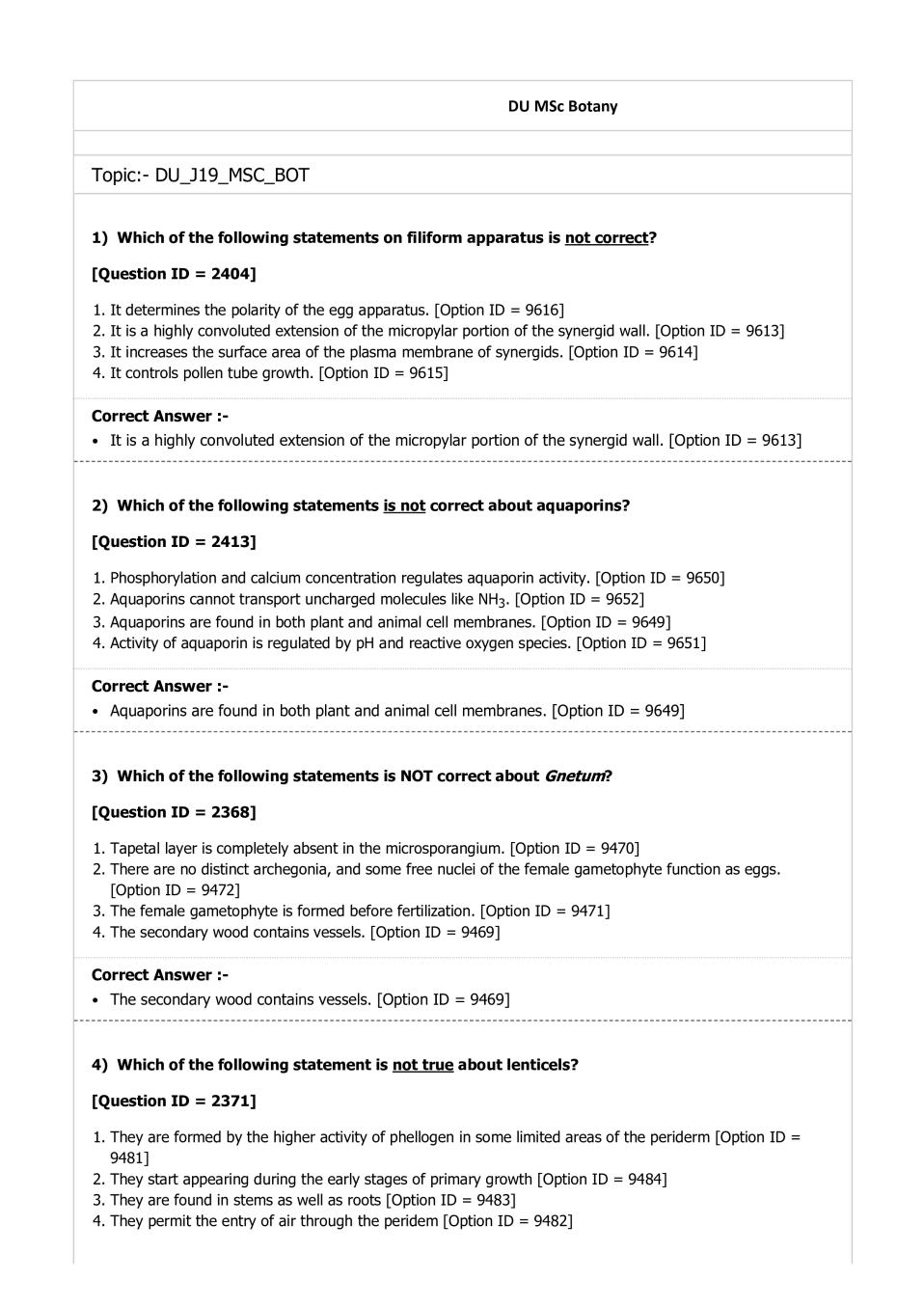
Topic:- DU_J19_MSC_BOT
1) Which of the following statements on filiform apparatus is not correct?
[Question ID = 2404]
1. It determines the polarity of the egg apparatus. [Option ID = 9616]
2. It is a highly convoluted extension of the micropylar portion of the synergid wall. [Option ID = 9613]
3. It increases the surface area of the plasma membrane of synergids. [Option ID = 9614]
4. It controls pollen tube growth. [Option ID = 9615]
It is a highly convoluted extension of the micropylar portion of the synergid wall. [Option ID = 9613]
2) Which of the following statements is not correct about aquaporins?
[Question ID = 2413]
1. Phosphorylation and calcium concentration regulates aquaporin activity. [Option ID = 9650]
2. Aquaporins cannot transport uncharged molecules like NH3. [Option ID = 9652]
3. Aquaporins are found in both plant and animal cell membranes. [Option ID = 9649]
4. Activity of aquaporin is regulated by pH and reactive oxygen species. [Option ID = 9651]
Aquaporins are found in both plant and animal cell membranes. [Option ID = 9649]
3) Which of the following statements is NOT correct about Gnetum?
[Question ID = 2368]
1. Tapetal layer is completely absent in the microsporangium. [Option ID = 9470]
2. There are no distinct archegonia, and some free nuclei of the female gametophyte function as eggs.
[Option ID = 9472]
3. The female gametophyte is formed before fertilization. [Option ID = 9471]
4. The secondary wood contains vessels. [Option ID = 9469]
The secondary wood contains vessels. [Option ID = 9469]
4) Which of the following statement is not true about lenticels?
[Question ID = 2371]
1. They are formed by the higher activity of phellogen in some limited areas of the periderm [Option ID =
9481]
2. They start appearing during the early stages of primary growth [Option ID = 9484]
3. They are found in stems as well as roots [Option ID = 9483]
4. They permit the entry of air through the peridem [Option ID = 9482]
Page 2
9481]
5) Which of the following is not true about the classic experiment carried out to study the nature
of mutations by the 1969 Nobel prize-winning team of Max Luria and Salvador Delbruck?
[Question ID = 2392]
1. Equal number of T1 phage resistant colonies were obtained in all the plates. [Option ID = 9568]
2. It demonstrated that genetic mutations arise in the absence of selection, and not as a response to
selection. [Option ID = 9566]
3. It is also called as Fluctuation Test [Option ID = 9565]
4. They inoculated equal number of .E coli into separate culture tubes with and without T1 phage. [Option ID
= 9567]
It is also called as Fluctuation Test [Option ID = 9565]
6) Which of the following chemical substances are secreted by some animals for communication
with other members of their species?
[Question ID = 2401]
1. Terpenoids [Option ID = 9603]
2. Pheromones [Option ID = 9604]
3. Alkaloids [Option ID = 9601]
4. Phenols [Option ID = 9602]
Alkaloids [Option ID = 9601]
7) Which of the following is the regulatory body conferring approval for transgenic plants?
[Question ID = 2431]
1. NBRI [Option ID = 9724]
2. GEAC [Option ID = 9723]
3. NBPGR [Option ID = 9721]
4. NBA [Option ID = 9722]
NBPGR [Option ID = 9721]
8) Which of the following parts is not observed in a mature seed-coat?
[Question ID = 2407]
1. Aril [Option ID = 9628]
2. Epidermis [Option ID = 9625]
3. Aerenchyma [Option ID = 9626]
4. Hypodermis [Option ID = 9627]
Page 3
9) Which type of wood is found in Pinus and Cycas ?
[Question ID = 2367]
1. Manoxylic in Pinus
, and pycnoxylic in Cycas [Option ID = 9466]
2. Manoxylic in both [Option ID = 9468]
3. Pycnoxylic in both [Option ID = 9467]
4. Pycnoxylic in Pinus
, and manoxylic in Cycas [Option ID = 9465]
Pycnoxylic in Pinus, and manoxylic in Cycas [Option ID = 9465]
10) Which one of the following is the most primitive basal angiosperm?
[Question ID = 2434]
1. Nymphaea [Option ID = 9734]
2. Hibiscus [Option ID = 9736]
3. Amborella [Option ID = 9733]
4. Magnolia [Option ID = 9735]
Amborella [Option ID = 9733]
11) Which one of the following sets of compounds is used as biopesticides?
[Question ID = 2384]
1. Pyrethrin, Azadirachtin, Spilanthol [Option ID = 9533]
2. Pyrethrin, Jatrophine, Curcumin [Option ID = 9535]
3. Capsaicin, Citronella oil, Piperine [Option ID = 9536]
4. Azadirachtin, Taxol, Curcumin [Option ID = 9534]
Pyrethrin, Azadirachtin, Spilanthol [Option ID = 9533]
12) Which one of the following statements about cDNA libraries is not correct?
[Question ID = 2428]
1. They can be used to study quantitative variations in gene expressions levels between different tissues
[Option ID = 9711]
2. They can be used to analyse variations in gene expression patterns between different developmental stages
of a plant [Option ID = 9712]
3. They can be used to study alternatively spliced forms of a gene [Option ID = 9710]
4. They are generally composed of larger fragments as compared to genomic DNA libraries [Option ID =
9709]
They are generally composed of larger fragments as compared to genomic DNA libraries [Option ID =
9709]
Page 4
[Question ID = 2436]
1. Keys are based on phylogeny. [Option ID = 9744]
2. In a taxonomic key, the two leads together comprise a couplet. [Option ID = 9743]
3. All keys comprise sequence of two contrasting statements, each statement is known as a lead. [Option ID
= 9742]
4. All taxonomic keys are dichotomous. [Option ID = 9741]
All taxonomic keys are dichotomous. [Option ID = 9741]
14) Which one of the following statements is not true?
[Question ID = 2444]
1. Cremocarp is characterstic fruit of Apiaceae [Option ID = 9776]
2. Cypsela is characteristic fruit of Poaceae [Option ID = 9775]
3. Verticillaster is the characteristic inflorescence of Lamiaceae. [Option ID = 9774]
4. The grouping of taxa by overall similarity is called phenetics. [Option ID = 9773]
The grouping of taxa by overall similarity is called phenetics. [Option ID = 9773]
15) Which one of the following statements is not true for aposporous embryo sac development?
[Question ID = 2408]
1. Three megaspores degenerate while functional haploid megaspore undergoes megagametogenesis. [Option
ID = 9630]
2. All the four megaspores degenerate while an aposporous initial forms the embryo sac. [Option ID = 9631]
3. Tetrad is surrounded by a callose wall. [Option ID = 9632]
4. The first and second meiotic divisions result in a tetrad of megaspores. [Option ID = 9629]
The first and second meiotic divisions result in a tetrad of megaspores. [Option ID = 9629]
16) Which one of the following statements is false for a population that is under natural
selection?
[Question ID = 2388]
1. At a given point of time, the sum total of all genotypic frequencies is equal to 1. [Option ID = 9552]
2. At a given point of time for any given bi-allelic gene, the sum of the allele frequencies would be equal to
one. [Option ID = 9551]
3. The genotypic frequencies can be estimated if the allele frequencies are known. [Option ID = 9550]
4. The population will not exhibit Hardy-Weinberg equilibrium. [Option ID = 9549]
The population will not exhibit Hardy-Weinberg equilibrium. [Option ID = 9549]
17) Which one of the following statements is not correct?
[Question ID = 2363]
Page 5
2. Amphigastria are found in Porella
[Option ID = 9451]
3. In Anthoceros,each cell contains single large chloroplast with a pyrenoid [Option ID = 9450]
4. In Funaria,
the dominant stage of life cycle is gametophytic [Option ID = 9452]
In bryophytes, meiosis occurs in the gametangia to produce sperms and eggs [Option ID = 9449]
18) Which one of the following is not a constituent of an ayurvedic herbal formulation, ‘Trifala’?
[Question ID = 2381]
1. Emblica officinalis [Option ID = 9524]
2. Terminalia bellerica [Option ID = 9521]
3. Terminalia arjuna [Option ID = 9522]
4. Terminalia officinalis [Option ID = 9523]
Terminalia bellerica [Option ID = 9521]
19) Which one of the following is not a member of Poaceae?
[Question ID = 2440]
1. Hordeum vulgare [Option ID = 9757]
2. Triticum aestivum [Option ID = 9758]
3. Secale cereale [Option ID = 9760]
4. Cynodon dactylon [Option ID = 9759]
Hordeum vulgare [Option ID = 9757]
20) Which one of the following is not found in Marchantia ?
[Question ID = 2365]
1. Barrel shaped epidermal pores in the thallus [Option ID = 9458]
2. Smooth walled as well as tuberculated rhizoids [Option ID = 9457]
3. Filamentous protonema [Option ID = 9460]
4. Elaters [Option ID = 9459]
Smooth walled as well as tuberculated rhizoids [Option ID = 9457]
21) Which one of the following contributes to the formation of peatlands?
[Question ID = 2362]
1. Sphagnum [Option ID = 9448]
2. Riccia [Option ID = 9445]
3. Porella [Option ID = 9446]
4. Cooksonia [Option ID = 9447]
Page 6
22) Which one of the following crops was the first to have its nuclear genome sequenced?
[Question ID = 2429]
1. Maize [Option ID = 9713]
2. Barley [Option ID = 9716]
3. Rice [Option ID = 9715]
4. Wheat [Option ID = 9714]
Maize [Option ID = 9713]
23) Which one of the following is considered to be a signal metabolite that regulates the
partitioning between sucrose and starch synthesis?
[Question ID = 2423]
1. Fructose 6-phosphate [Option ID = 9691]
2. Fructose 2-phosphate [Option ID = 9692]
3. Fructose-2, 6-bisphosphate [Option ID = 9689]
4. Fructose-1, 6-bisphosphate [Option ID = 9690]
Fructose-2, 6-bisphosphate [Option ID = 9689]
24) Which one of the following is an incorrect combination?
[Question ID = 2383]
1. Diospyros melanoxylon – Indian beedi [Option ID = 9530]
2. Cichorium intybus – khus-khus [Option ID = 9532]
3. Pongamia pinnata – biodiesel [Option ID = 9531]
4. Betula bhojpatra – bhojpatra [Option ID = 9529]
Betula bhojpatra – bhojpatra [Option ID = 9529]
25) Which one of the following genes does not confer resistance to a herbicide?
[Question ID = 2427]
1. ALS [Option ID = 9707]
2. nptII [Option ID = 9708]
3. EPSPS [Option ID = 9705]
4. pat [Option ID = 9706]
EPSPS [Option ID = 9705]
26) Which series is not included in the Gamopetalae in Bentham and Hooker’s system of
classification?
Page 7
1. Inferae [Option ID = 9765]
2. Heteromerae [Option ID = 9766]
3. Bicarpoellatae [Option ID = 9767]
4. Thalamiflorae [Option ID = 9768]
Inferae [Option ID = 9765]
27) Algae that grow at the interface of water and atmosphere are called as [Question ID =
2349]
1. epipelic [Option ID = 9393]
2. benthic [Option ID = 9396]
3. planktonic [Option ID = 9395]
4. neustonic [Option ID = 9394]
epipelic [Option ID = 9393]
28) In non-graminaceous plant roots, iron is transported across the plasma membrane as
[Question ID = 2417]
1. Both ferrous and ferric ions [Option ID = 9665]
2. Ferrous ions [Option ID = 9667]
3. Ferric ions [Option ID = 9668]
4. Fe-Chelate [Option ID = 9666]
Both ferrous and ferric ions [Option ID = 9665]
29) In root nodules of legumes, leg-haemoglobin is important because it
[Question ID = 2415]
1. transports oxygen to the root nodule. [Option ID = 9657]
2. acts as a catalyst in transamination. [Option ID = 9660]
3. acts as an oxygen scavenger. [Option ID = 9658]
4. provides energy to the nitrogen fixing bacterium. [Option ID = 9659]
transports oxygen to the root nodule. [Option ID = 9657]
30) Hygroscopic fibers located in the reaction wood are termed as [Question ID = 2376]
1. fiber-tracheids [Option ID = 9504]
2. libriform fibers [Option ID = 9502]
3. gelatinous fibers [Option ID = 9503]
4. substitute fibers [Option ID = 9501]
substitute fibers [Option ID = 9501]
Page 8
microscopes? [Question ID = 2348]
1. Fluorescent [Option ID = 9391]
2. Phase contrast [Option ID = 9390]
3. Differential interference contrast [Option ID = 9392]
4. Bright field [Option ID = 9389]
Bright field [Option ID = 9389]
32) Buzz pollination is associated with flowers, wherein the anthers exhibit
[Question ID = 2411]
1. poricidal dehiscence. [Option ID = 9643]
2. explosive dehiscence. [Option ID = 9644]
3. longitudinal dehiscence. [Option ID = 9641]
4. valvular dehiscence. [Option ID = 9642]
longitudinal dehiscence. [Option ID = 9641]
33) A distribution in which individuals within a population have an equal chance of living
anywhere within an area is called as
[Question ID = 2400]
1. Random. [Option ID = 9597]
2. Contiguous. [Option ID = 9600]
3. Regular. [Option ID = 9598]
4. Clumped. [Option ID = 9599]
Random. [Option ID = 9597]
34) The term ‘Glabrous’ refers to [Question ID = 2373]
1. sparsely hairy. [Option ID = 9491]
2. lack of trichomes. [Option ID = 9489]
3. presence of glandular trichomes. [Option ID = 9492]
4. presence of bristly hair. [Option ID = 9490]
lack of trichomes. [Option ID = 9489]
35) Identify the incorrect combination from the following:
[Question ID = 2432]
1. Somaclonal variation – F.C. Steward [Option ID = 9727]
2. GUS reporter system – R.A. Jefferson [Option ID = 9728]
3. Protoplast – E.C. Cocking [Option ID = 9725]
4. Edible vaccine – C.J. Arntzen [Option ID = 9726]
Page 9
36) Two different DNA molecules were isolated from a bacterial sample. Further experiments
demonstrated that one of these (X) was composed of 40%A, 40%G, 10%T and 10%C but could
not be cut by an exonuclease. The second DNA sample (Y) could be cut by the exonuclease and
was found to be composed of 30%A, 30%T, 20%G and 20%C. Which one of the following
statements can be correctly deduced from the above?
[Question ID = 2424]
1. DNA Y has a double-stranded and circular structure [Option ID = 9694]
2. DNA X has a single-stranded and linear structure [Option ID = 9695]
3. DNA X has a single-stranded and circular structure [Option ID = 9696]
4. DNA X has a double-stranded and linear structure [Option ID = 9693]
DNA X has a double-stranded and linear structure [Option ID = 9693]
37) A binomial in which the genus name and specific epithet are identical in spelling is called
[Question ID = 2439]
1. Autonym [Option ID = 9753]
2. Basionym [Option ID = 9756]
3. Tautonym [Option ID = 9754]
4. Synonym [Option ID = 9755]
Autonym [Option ID = 9753]
38) A plant heterozygous for two tightly linked genes A and B, has the genotype AB/ab. Which
of the following statements is true when the plant is self-pollinated?
[Question ID = 2393]
1. Both loci will segregate in a 3:1 ratio. [Option ID = 9571]
2. Gametes with genotype AB and ab will be less than those with aB and Ab. [Option ID = 9570]
3. The percentage of all the four types of gametes (AB, ab, Ab, aB) would be equal. [Option ID = 9569]
4. The segregation ratio of the two genes will depend upon the distance between them. [Option ID = 9572]
The percentage of all the four types of gametes (AB, ab, Ab, aB) would be equal. [Option ID = 9569]
39) The study of man-made areas with complex, dynamic ecological systems, influenced by
interconnected biological, physical and social components is called as [Question ID = 2397]
1. Social Ecology. [Option ID = 9588]
2. Ecosystem Ecology. [Option ID = 9586]
3. Urban Ecology. [Option ID = 9587]
4. System Ecology. [Option ID = 9585]
System Ecology. [Option ID = 9585]
Page 10
[Question ID = 2410]
1. Acid phosphatases and esterases [Option ID = 9637]
2. Pectinases and catalases [Option ID = 9638]
3. Kinases and β-1,3 glucanase [Option ID = 9640]
4. Lipases and cutinases [Option ID = 9639]
Acid phosphatases and esterases [Option ID = 9637]
41) In a population of diploid individuals, six alleles exist for a particular gene. What is the
expected number of alleles present in a chromosome; and types of alleles in a heterozygous
individual and in a homozygous individual respectively?
[Question ID = 2387]
1. 2; 2, 1 [Option ID = 9546]
2. 2; 2, 1 [Option ID = 9548]
3. 1; 2, 1 [Option ID = 9547]
4. 1; 2, 2 [Option ID = 9545]
1; 2, 2 [Option ID = 9545]
42) Polysporangiate anthers are seen in the family
[Question ID = 2409]
1. Agavaceae. [Option ID = 9636]
2. Annonaceae. [Option ID = 9635]
3. Anacardiaceae. [Option ID = 9634]
4. Amborellaceae. [Option ID = 9633]
Amborellaceae. [Option ID = 9633]
43) Pfr shows maximum absorption at
[Question ID = 2416]
1. 650 nm. [Option ID = 9664]
2. 660 nm. [Option ID = 9662]
3. 466 nm. [Option ID = 9663]
4. 730 nm. [Option ID = 9661]
730 nm. [Option ID = 9661]
44) Hyperthermophiles are heat loving microbes that can live in temperature optima above
[Question ID = 2399]
Page 11
2. 60 ⁰C [Option ID = 9595]
3. 80 ⁰C [Option ID = 9593]
4. 40 ⁰C [Option ID = 9596]
80 ⁰C [Option ID = 9593]
45) Dolipore septum is a characteristic of [Question ID = 2356]
1. Zygomycetes. [Option ID = 9423]
2. Chytridiomycetes. [Option ID = 9424]
3. Basidiomycetes. [Option ID = 9421]
4. Ascomycetes. [Option ID = 9422]
Basidiomycetes. [Option ID = 9421]
46) PEP carboxylase activity in C4 and CAM plants is regulated by
[Question ID = 2419]
1. isomerization [Option ID = 9676]
2. carboxylation-decarboxylation [Option ID = 9675]
3. phosphorylation-dephosphorylation [Option ID = 9673]
4. oxidation-reduction [Option ID = 9674]
phosphorylation-dephosphorylation [Option ID = 9673]
47) A globular or hook-like intracellular structure formed by a biotrophic fungus/oomycete for
absorption of nutrients from the host is known as [Question ID = 2359]
1. sclerotium. [Option ID = 9433]
2. vesicle. [Option ID = 9434]
3. sporophore. [Option ID = 9436]
4. haustorium. [Option ID = 9435]
sclerotium. [Option ID = 9433]
48) Glucosinolates do not occur in
[Question ID = 2437]
1. Papaveraceae [Option ID = 9746]
2. Capparaceae [Option ID = 9747]
3. Brassicaceae [Option ID = 9745]
4. Fabaceae [Option ID = 9748]
Brassicaceae [Option ID = 9745]
49) Fruits of which of the following pair of plants possess aril?
Page 12
1. Litchi chinensis and Aegle marmelos [Option ID = 9525]
2. Litchi chinensis and Ananas cosmosus [Option ID = 9528]
3. Vitis vinifera and Aegle marmelos [Option ID = 9527]
4. Myristica fragrans and Litchi chinensis [Option ID = 9526]
Litchi chinensis and Aegle marmelos [Option ID = 9525]
50) Channel proteins that are located in the outer membrane of Gram-negative bacteria are
known as [Question ID = 2345]
1. barrels [Option ID = 9377]
2. murins [Option ID = 9378]
3. granules [Option ID = 9380]
4. porins [Option ID = 9379]
barrels [Option ID = 9377]
51) Orthorhombic crystals of calcium carbonate are known as [Question ID = 2350]
1. aragonite. [Option ID = 9397]
2. detritus. [Option ID = 9399]
3. calcite. [Option ID = 9398]
4. stromatolites. [Option ID = 9400]
aragonite. [Option ID = 9397]
52) Anabolic component of the carbohydrate metabolism includes which one of the following
processes?
[Question ID = 2421]
1. Glycogenolysis [Option ID = 9681]
2. Glyconeogenesis [Option ID = 9683]
3. Citric Acid Cycle [Option ID = 9682]
4. Uronic Acid Pathways [Option ID = 9684]
Glycogenolysis [Option ID = 9681]
53) Aleurone layer is rich in
[Question ID = 2385]
1. essential oils. [Option ID = 9537]
2. starch grains. [Option ID = 9539]
3. proteins. [Option ID = 9538]
4. dietary fibers. [Option ID = 9540]
essential oils. [Option ID = 9537]
Page 13
[Question ID = 2372]
1. in which all the subsidiary cells have a common origin with guard cells. [Option ID = 9486]
2. having subsidiary cells that are indistinguishable from other epidermal cells. [Option ID = 9487]
3. having subsidiary cells that are aligned parallel to the long axis of the guard cells. [Option ID = 9488]
4. occurring in mesophytic plants. [Option ID = 9485]
occurring in mesophytic plants. [Option ID = 9485]
55) Vestures refer to [Question ID = 2377]
1. Plasmodesmatal connections between any wood elements [Option ID = 9507]
2. clogged hydathodes [Option ID = 9508]
3. resin droplets accumulated in the non-conducting vessel elements [Option ID = 9505]
4. wall ingrowths that impart sieve-like appearance to pits of the vessels [Option ID = 9506]
resin droplets accumulated in the non-conducting vessel elements [Option ID = 9505]
56) Dormant, tough, non-reproductive structure, produced by bacteria to tide over unfavourable
conditions is known as: [Question ID = 2347]
1. heterocyst [Option ID = 9388]
2. sclerotium [Option ID = 9386]
3. endospore [Option ID = 9385]
4. sporocarp [Option ID = 9387]
endospore [Option ID = 9385]
57) Gram-negative bacteria are more resistant to antibiotics than Gram-positive bacteria due to
the presence of [Question ID = 2346]
1. outer lipopolysaccharide layer. [Option ID = 9382]
2. peptidoglycan wall. [Option ID = 9381]
3. porin protein. [Option ID = 9383]
4. teichoic acid. [Option ID = 9384]
peptidoglycan wall. [Option ID = 9381]
58) In Lymnaea peregra , coiling behaviour is controlled by a single gene. Dextral coiling
behaviour is governed by dominant allele ‘D’ and sinistral coiling by recessive allele ‘d’. When a
cross is made using sinistral as female and dextral as male, all the snails are sinistral in F1 and
dextral in F2. Again in F3 a ratio of 3 dextral and 1 sinistral is observed. This kind of pattern is an
example of
[Question ID = 2390]
1. Epistasis [Option ID = 9560]
2. Cytoplasmic maternal inheritance [Option ID = 9558]
3. Cytoplasmic maternal effect [Option ID = 9559]
Page 14
Mendelian inheritance [Option ID = 9557]
59) Study the following pedigree. What can be the possible inheritance pattern?
[Question ID = 2391]
1. Autosomal inheritance [Option ID = 9564]
2. X-linked inheritance [Option ID = 9561]
3. Y-linked inheritance [Option ID = 9562]
4. Mitochondrial inheritance [Option ID = 9563]
X-linked inheritance [Option ID = 9561]
60) Accessory cambia, the activity of which leads to formation of a series of cylinders of
secondary vascular tissues are found in [Question ID = 2378]
1. Asclepiadaceae [Option ID = 9512]
2. Chenopodiaceae [Option ID = 9509]
3. Apocynaceae [Option ID = 9511]
4. Bignoniaceae [Option ID = 9510]
Chenopodiaceae [Option ID = 9509]
61) In species where pollen matures and is released prior to the maturation and receptivity of
the gynoecium, the condition is called
[Question ID = 2435]
1. dichogamy [Option ID = 9739]
2. protoandry [Option ID = 9738]
3. protogyny [Option ID = 9737]
4. androdioecy [Option ID = 9740]
protogyny [Option ID = 9737]
62) The sexual fruiting body in Neurospora is called as [Question ID = 2358]
1. cleistothecium. [Option ID = 9429]
2. perithecium. [Option ID = 9431]
3. apothecium. [Option ID = 9432]
Page 15
cleistothecium. [Option ID = 9429]
63) In the fine mapping of rII locus, Benzer was able to demonstrate intragenic recombination
in phages mainly because
[Question ID = 2389]
1. of the large number of phage progeny that could be screened. [Option ID = 9554]
2. phages have haploid genomes. [Option ID = 9556]
3. intragenic recombination occurs only in phages. [Option ID = 9553]
4. making crosses in phages is easier. [Option ID = 9555]
intragenic recombination occurs only in phages. [Option ID = 9553]
64) Blastozone refers to the [Question ID = 2375]
1. quiescent centre of Root Apical Meristem (RAM) [Option ID = 9500]
2. marginal meristem of growing leaves [Option ID = 9499]
3. meristematic region located in the rib zone of Shoot Apical Meristem (SAM) [Option ID = 9497]
4. intercalary meristem [Option ID = 9498]
meristematic region located in the rib zone of Shoot Apical Meristem (SAM) [Option ID = 9497]
65) The number of nucleosomes associated with one turn of solenoid configuration of chromatin
is [Question ID = 2355]
1. 6 [Option ID = 9419]
2. 2 [Option ID = 9417]
3. 8 [Option ID = 9420]
4. 4 [Option ID = 9418]
2 [Option ID = 9417]
66) Lloyd Botanical Garden is located at
[Question ID = 2441]
1. Ootacamund [Option ID = 9762]
2. Srinagar (Kashmir) [Option ID = 9763]
3. Dehra Dun [Option ID = 9764]
4. Darjeeling [Option ID = 9761]
Darjeeling [Option ID = 9761]
67) Similarity resulting from common ancestry is called
[Question ID = 2433]
Page 16
2. homology [Option ID = 9730]
3. homoplasy [Option ID = 9729]
4. homonym [Option ID = 9731]
homoplasy [Option ID = 9729]
68) Fluorochromatic reaction test to ascertain pollen viability was developed by
[Question ID = 2412]
1. J. Heslop-Harrison. [Option ID = 9647]
2. E. Strasburger. [Option ID = 9646]
3. S.G. Nawaschin. [Option ID = 9648]
4. P. Maheshwari. [Option ID = 9645]
P. Maheshwari. [Option ID = 9645]
69) In Pellia, the sporogenous tissue develops from the [Question ID = 2364]
1. amphithecium. [Option ID = 9454]
2. endothecium. [Option ID = 9455]
3. epidermis. [Option ID = 9453]
4. columella. [Option ID = 9456]
epidermis. [Option ID = 9453]
70) A pollen grain with colpi occurring in the equatorial region is called
[Question ID = 2438]
1. colporate [Option ID = 9752]
2. zonoporate [Option ID = 9750]
3. zonoaperturate [Option ID = 9751]
4. zonocolpate [Option ID = 9749]
zonocolpate [Option ID = 9749]
71) In plant tissue culture, a high cytokinin : auxin ratio promotes the formation of
[Question ID = 2426]
1. callus. [Option ID = 9702]
2. embryos. [Option ID = 9703]
3. roots. [Option ID = 9701]
4. shoots. [Option ID = 9704]
roots. [Option ID = 9701]
Page 17
1. Tamarindus indica [Option ID = 9515]
2. Punica granatum [Option ID = 9514]
3. Mangifera indica [Option ID = 9516]
4. Carica papaya [Option ID = 9513]
Carica papaya [Option ID = 9513]
73) Which of the following horizons in the soil profile has high amount of organic matter?
[Question ID = 2398]
1. C [Option ID = 9592]
2. A [Option ID = 9590]
3. B [Option ID = 9591]
4. O [Option ID = 9589]
O [Option ID = 9589]
74) Which one of the following is used as a sweetener? [Question ID = 2380]
1. Syzygium cumini [Option ID = 9519]
2. Carica papaya [Option ID = 9520]
3. Stevia rebaudiana [Option ID = 9518]
4. Gymnema sylvestre [Option ID = 9517]
Gymnema sylvestre [Option ID = 9517]
75) Which phylum contains organisms that most closely resemble the common ancestor of fungi
and animals? [Question ID = 2360]
1. Zygomycota [Option ID = 9437]
2. Chytridiomycota [Option ID = 9439]
3. Basidiomycota [Option ID = 9440]
4. Ascomycota [Option ID = 9438]
Zygomycota [Option ID = 9437]
76) Majority of the enzymes are inactive [Question ID = 2353]
1. above 75˚C [Option ID = 9412]
2. between 25-30˚C [Option ID = 9410]
3. at 25˚C [Option ID = 9409]
4. at 15˚C [Option ID = 9411]
at 25˚C [Option ID = 9409]
77) Syngenesious stamens are characteristic of the family
[Question ID = 2443]
Page 18
2. Brassicaceae [Option ID = 9772]
3. Malvaceae [Option ID = 9770]
4. Asteraceae [Option ID = 9771]
Ranunculaceae [Option ID = 9769]
78) High activity of sucrose synthase is present in
[Question ID = 2422]
1. tissues that utilize sucrose [Option ID = 9686]
2. tissues that synthesize sucrose [Option ID = 9685]
3. sucrose exporting tissue [Option ID = 9688]
4. photosynthetic leaves [Option ID = 9687]
tissues that synthesize sucrose [Option ID = 9685]
79) Methionine is the precursor of which of the following plant growth regulators?
[Question ID = 2418]
1. Indole acetic acid [Option ID = 9670]
2. Cytokinins [Option ID = 9671]
3. Ethylene [Option ID = 9672]
4. Abscisic acid [Option ID = 9669]
Abscisic acid [Option ID = 9669]
80) Trichoblasts are [Question ID = 2370]
1. excessively multiplying cells in the root epidermis [Option ID = 9480]
2. cells that markedly differ from other cells in the same tissue [Option ID = 9479]
3. cells in the root epidermis that gives rise to root hair [Option ID = 9477]
4. epidermal outgrowths that may or may not be glandular [Option ID = 9478]
cells in the root epidermis that gives rise to root hair [Option ID = 9477]
81) Which of the following enzyme is involved in tRNA synthesis? [Question ID = 2396]
1. RNA polymerase II [Option ID = 9582]
2. RNA polymerase IV [Option ID = 9584]
3. RNA Polymerase I [Option ID = 9581]
4. RNA Polymerase III [Option ID = 9583]
RNA Polymerase I [Option ID = 9581]
82) Which one of the following is a phospholipid? [Question ID = 2352]
1. Proline [Option ID = 9407]
Page 19
3. Lecithin [Option ID = 9408]
4. Valine [Option ID = 9406]
Methionine [Option ID = 9405]
83) Which one of the following amino acids has a nonpolar, aliphatic R group? [Question ID =
2351]
1. Lysine [Option ID = 9401]
2. Arginine [Option ID = 9403]
3. Glycine [Option ID = 9404]
4. Histidine [Option ID = 9402]
Lysine [Option ID = 9401]
84) Gynobasic style is a characteristic feature of the family
[Question ID = 2386]
1. Lamiaceae [Option ID = 9543]
2. Papilionaceae [Option ID = 9541]
3. Apiaceae [Option ID = 9544]
4. Asteraceae [Option ID = 9542]
Papilionaceae [Option ID = 9541]
85) Amphigynous antheridium is found in the genus [Question ID = 2357]
1. Phytophthora. [Option ID = 9425]
2. Alternaria. [Option ID = 9426]
3. Botrytis. [Option ID = 9428]
4. Fusarium. [Option ID = 9427]
Phytophthora. [Option ID = 9425]
86) Transfusion tissue in Cycas functions as [Question ID = 2366]
1. micropyle closing tissue after pollination. [Option ID = 9463]
2. lateral conducting channel for water in the leaves. [Option ID = 9461]
3. mucilage secreting tissue in the ducts. [Option ID = 9462]
4. nutritive tissue for embryo. [Option ID = 9464]
lateral conducting channel for water in the leaves. [Option ID = 9461]
87) The Shannon-Weiner index measures: [Question ID = 2403]
1. General diversity [Option ID = 9610]
2. Evenness [Option ID = 9611]
3. Similarity-dissimilarity [Option ID = 9612]
4. Dominance [Option ID = 9609]
Page 20
88) Hypostase refers to
[Question ID = 2405]
1. a group of cells below the embryo sac and above the funiculus. [Option ID = 9618]
2. nucellar cells above the embryo sac. [Option ID = 9619]
3. parietal cells. [Option ID = 9620]
4. a cap-like structure of cutinized cells above the embryo sac. [Option ID = 9617]
a cap-like structure of cutinized cells above the embryo sac. [Option ID = 9617]
89) Volatile substances that attract pollinators are emitted by [Question ID = 2374]
1. nectaries [Option ID = 9495]
2. osmophores [Option ID = 9493]
3. hydathodes [Option ID = 9494]
4. myrosine cells [Option ID = 9496]
osmophores [Option ID = 9493]
90) The factor responsible for mediating binding of core RNA polymerase to promoter is
[Question ID = 2395]
1. δ-70 [Option ID = 9580]
2. α-70 [Option ID = 9577]
3. Γ-55 [Option ID = 9579]
4. σ-70 [Option ID = 9578]
α-70 [Option ID = 9577]
91) The members of which of the following angiosperm families do not form endosperm?
[Question ID = 2406]
1. Poaceae [Option ID = 9621]
2. Papilionaceae [Option ID = 9624]
3. Brassicaceae [Option ID = 9623]
4. Podostemaceae [Option ID = 9622]
Poaceae [Option ID = 9621]
92) The probability of death of organisms with different ages in the current year is shown in
[Question ID = 2402]
1. Survivorship curve [Option ID = 9605]
Page 21
3. Natality [Option ID = 9608]
4. Cohort life table [Option ID = 9607]
Survivorship curve [Option ID = 9605]
93) The smallest known virus is
[Question ID = 2361]
1.Escherichia coli [Option ID = 9441]
2. Tobacco necrosis satellite virus [Option ID = 9444]
3. Tobacco mosaic virus [Option ID = 9443]
4. Vaccinia virus [Option ID = 9442]
Escherichia coli [Option ID = 9441]
94) The water potential of pure water at atmospheric pressure is
[Question ID = 2414]
1. -2.3 bar. [Option ID = 9653]
2. 1 bar. [Option ID = 9656]
3. 0 bar. [Option ID = 9655]
4. +2.3 bar. [Option ID = 9654]
-2.3 bar. [Option ID = 9653]
95) The microsporangia in the male cone and ovules in female cones of Pinus are positioned on
the
[Question ID = 2369]
1. adaxial surface of the sporophylls [Option ID = 9475]
2. adaxial surface and abaxial surface of the sporophylls, respectively [Option ID = 9473]
3. abaxial surface and adaxial surface of the sporophylls, respectively [Option ID = 9474]
4. abaxial surface of the sporophylls [Option ID = 9476]
adaxial surface and abaxial surface of the sporophylls, respectively [Option ID = 9473]
96) The term "Bio-pharming" refers to
[Question ID = 2430]
1. synthesis of drugs from transgenic plants/animals. [Option ID = 9718]
2. large scale farming of medicinal plants. [Option ID = 9720]
3. genetically modified foods from plants. [Option ID = 9717]
4. recombinant drugs from bacteria. [Option ID = 9719]
Page 22
97) The 5’ – 3’ nucleotide sequence of one of the strands of a double stranded DNA molecule is
given below:
5’ – ATGACGATGGACACATGACATAGACGATAATGCCGTGAC – 3’
In the absence of Tm effects, which one of the following sets of primers could, theoretically, be
used to amplify the target sequence by PCR? [Question ID = 2425]
1. 5’ – ATGACGA – 3’ and 5’ – CCGTGAC – 3’ [Option ID = 9700]
2. 5’ – ATGACGA – 3’ and 5’ – GTCACGG – 3’ [Option ID = 9697]
3. 5’ – TACTGCT – 3’ and 5’ – GGCACTG– 3’ [Option ID = 9698]
4. 5’ – TCGTCAT – 3’ and 5’ – CCGTGAC – 3’ [Option ID = 9699]
5’ – ATGACGA – 3’ and 5’ – GTCACGG – 3’ [Option ID = 9697]
98) The concept of symbiogenesis was first articulated by [Question ID = 2354]
1. Lynn Margulis [Option ID = 9414]
2. Lynn Sagan [Option ID = 9416]
3. Ivan Wallin [Option ID = 9413]
4. Konstantin Mereschkowski [Option ID = 9415]
Ivan Wallin [Option ID = 9413]
99) Mark the correct pairing of scientists and their contributions
I Nirenberg and Matthei 1 Telomerase
II Sidney Altman and Thomas Cech 2 DNA Polymerase I
III Arthur Kornberg 3 Ribozyme
IV Elizabeth Blackburn 4 Genetic code
[Question ID = 2394]
1. I-4; II-3; III-2; IV-1 [Option ID = 9575]
2. I-4; II-3; III-1; IV-2 [Option ID = 9574]
3. I-2; II-1; III-4; IV-3 [Option ID = 9573]
4. I-3; II-4; III-2; IV-1 [Option ID = 9576]
I-2; II-1; III-4; IV-3 [Option ID = 9573]
100) One molecule of Calmodulin, a calcium binding protein in eukaryotic cells binds to______
Ca2+ ions.
[Question ID = 2420]
1. 4 [Option ID = 9677]
2. 2 [Option ID = 9678]
3. 8 [Option ID = 9679]
4. 14 [Option ID = 9680]
4 [Option ID = 9677]
Document Details
| Board / Org | NTA |
| Exam | DUET |
| Type | Question Paper |
| Pages | 23 |
| Updated | 30 Apr 2026 |