DUET 2021 Question Paper M.Phil Ph.D in Buddhist Studies
Finished viewing? Save it for later —
Download DUET 2021 Question Paper M.Phil Ph.D in Buddhist Studies (PDF · 9 pages)About DUET 2021 Question Paper M.Phil Ph.D in Buddhist Studies
DUET 2021 Question Paper M.Phil Ph.D in Buddhist Studies is available here for free download. Published by NTA for DUET, this question paper can be viewed online or downloaded as a PDF (9 pages). Candidates preparing for DUET can use DUET 2021 Question Paper M.Phil Ph.D in Buddhist Studies to understand the exam pattern, the type of questions asked, and the overall difficulty level.
Frequently Asked Questions
How can I download DUET 2021 Question Paper M.Phil Ph.D in Buddhist Studies?
Open this page and click the Download button to save DUET 2021 Question Paper M.Phil Ph.D in Buddhist Studies as a PDF. It is completely free on AglaSem Docs.
Is DUET 2021 Question Paper M.Phil Ph.D in Buddhist Studies free to download?
Yes. DUET 2021 Question Paper M.Phil Ph.D in Buddhist Studies can be viewed online and downloaded as a PDF free of cost on AglaSem Docs.
How many pages does DUET 2021 Question Paper M.Phil Ph.D in Buddhist Studies have?
DUET 2021 Question Paper M.Phil Ph.D in Buddhist Studies contains 9 pages, which you can read online or download together as a single PDF.
Where can I find more DUET study material?
You can find more DUET question papers, sample papers, syllabus, and answer keys on AglaSem Docs.
DUET 2021 Question Paper M.Phil Ph.D in Buddhist Studies – Text
Read the full text of this question paper below — useful to quickly search, copy and reference the content online without downloading the PDF.
📄 View text version (9 pages)
Page 1
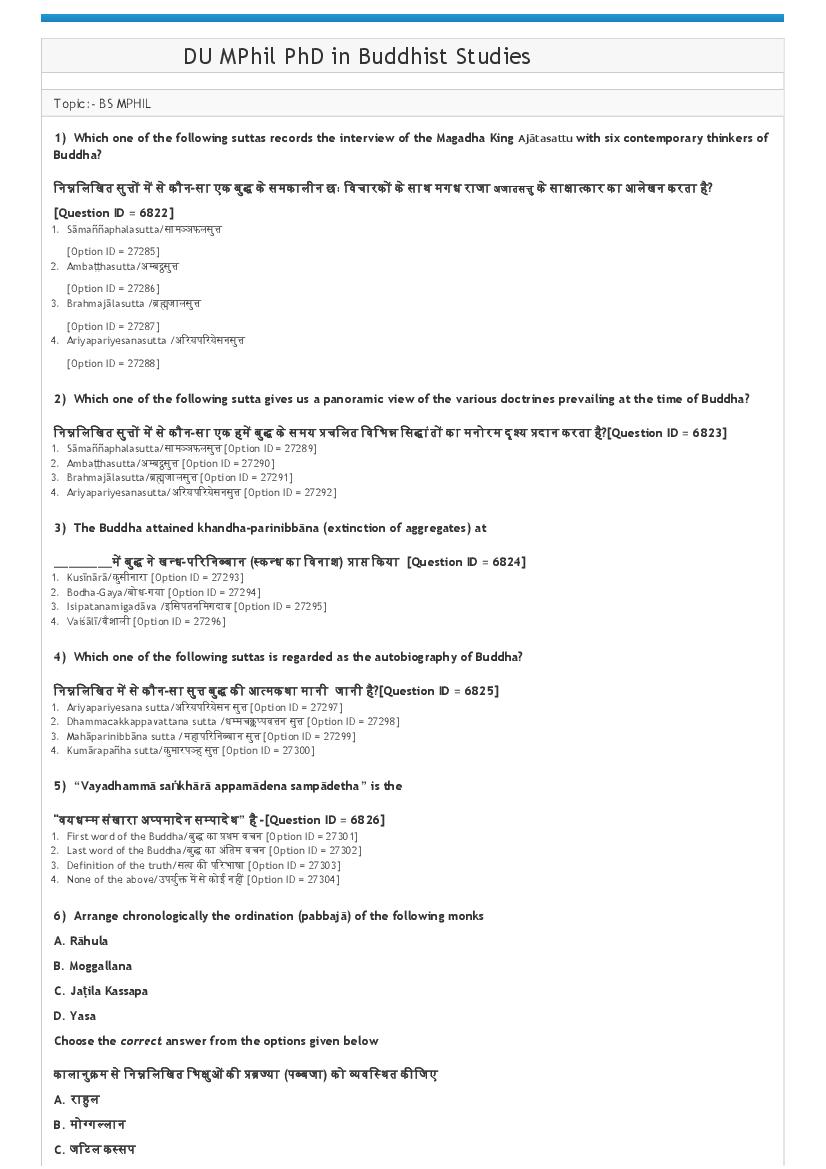
Topic:‐ BS MPHIL
1) Which one of the following suttas records the interview of the Magadha King Ajātasattu with six contemporary thinkers of
Buddha?
िन िलिखत सु म से क ौ न‐स ा ए क बु के समकालीन छ ः िवचारक के स ा थ म ग ध राजा अजातस ु के सा ा कार क ा आले ख न करता है?
[Question ID = 6822]
1. Sāmaññaphalasutta/साम ञफलसु
[Option ID = 27285]
2. Ambaṭṭhasutta/अ ब सु
[Option ID = 27286]
3. Brahmajālasutta / जालसु
[Option ID = 27287]
4. Ariyapariyesanasutta /अ रयप रयेसनसु
[Option ID = 27288]
2) Which one of the following sutta gives us a panoramic view of the various doctrines prevailing at the time of Buddha?
िन िलिखत सु म से क ौ न‐स ा ए क हम बु के स म य चिलत िविभ िस ां त क ा म न ो र म दृ य दान करता है?[Question ID = 6823]
1. Sāmaññaphalasutta/साम ञफलसु [Option ID = 27289]
2. Ambaṭṭhasutta/अ ब सु [Option ID = 27290]
3. Brahmajālasutta/ जालसु [Option ID = 27291]
4. Ariyapariyesanasutta/अ रयप रयेसनसु [Option ID = 27292]
3) The Buddha attained khandha‐parinibbāna (extinction of aggregates) at
________म बु ने ख ध‐प रिन बान ( क ध क ा िवनाश) ा कया [Question ID = 6824]
1. Kusīnārā/कुसीनारा [Option ID = 27293]
2. Bodha‐Gaya/बोध‐गया [Option ID = 27294]
3. Isipatanamigadāva /इिसपतनिमगदाव [Option ID = 27295]
4. Vaiśālī/वैशाली [Option ID = 27296]
4) Which one of the following suttas is regarded as the autobiography of Buddha?
िन िलिखत म से क ौ न‐स ा सु बु क आ म क थ ा म ा न ी जानी है?[Question ID = 6825]
1. Ariyapariyesana sutta/अ रयप रयेसन सु [Option ID = 27297]
2. Dhammacakkappavattana sutta /ध मच पव न सु [Option ID = 27298]
3. Mahāparinibbāna sutta /महाप रिन बान सु [Option ID = 27299]
4. Kumārapañha sutta/कुमारप ह सु [Option ID = 27300]
5) “Vayadhammā saṅkhārā appamādena sampādetha” is the
"व य ध म सं ख ारा अ पमादे न स पादे थ” है ‐[Question ID = 6826]
1. First word of the Buddha/बु का थम वचन [Option ID = 27301]
2. Last word of the Buddha/बु का अंितम वचन [Option ID = 27302]
3. Definition of the truth/स य क प रभाषा [Option ID = 27303]
4. None of the above/उपयु म से कोई नह [Option ID = 27304]
6) Arrange chronologically the ordination (pabbajā) of the following monks
A. Rāhula
B. Moggallana
C. Jaṭila Kassapa
D. Yasa
Choose the correct answer from the options given below
कालानु म से िन िलिखत िभ ु क या (प बजा) क ो वि थत क िजए
A. रा ल
B. मो ग लान
C. ज टल क सप
Page 2
[Question ID = 6827]
1. B, A, C, D
[Option ID = 27305]
2. D, B, C, A
[Option ID = 27306]
3. D, C, B, A
[Option ID = 27307]
4. B, C, A, D
[Option ID = 27308]
7) After hearing which of the following suttas the Jaṭila brothers gave up their cults of fire worship and joined the order
initiated by Buddha as bhikkhus?
िन िलिखत म से क स सु क ो सु न ने के ब ा द ज टल बं ध ु ने अि पू ज ा करने क अपनी थ ा क ो य ा ग दया औ र बु ारा ार भ क ए ग ए सं घ म
िभ ु के प म सि मिलत ह ो ग ए?[Question ID = 6828]
1. Ādittapariyāya/आ द प रयाय [Option ID = 27309]
2. Anattapariyāya/अन प रयाय [Option ID = 27310]
3. Mūlapariyāya/मूलप रयाय [Option ID = 27311]
4. Saṅgītipariyāya/संगीितप रयाय [Option ID = 27312]
8) The doctrine of Makkhali Gosāla may be termed as ____.
म खिल गोसाल के िस ां त क ो क ह ा ज ा स क त ा है ‐_____ [Question ID = 6829]
1. Śāsvatavāda/शा तवाद [Option ID = 27313]
2. Ucchedavāda/उ छेदवाद [Option ID = 27314]
3. Niyativāda/िनयितवाद [Option ID = 27315]
4. Saṁśayavāda/संशयवाद [Option ID = 27316]
9) Which one of the following was not a lay‐devotee of the Buddha?
िन िलिखत म से क ौ न बु क ा उपासक न ह थ ा?[Question ID = 6830]
1. Anāthapiṇḍika/अनाथ पिडक [Option ID = 27317]
2. Aṅgulimāla/अंगुिलमाल [Option ID = 27318]
3. Visākhā/िवसाखा [Option ID = 27319]
4. Jīvaka/जीवक [Option ID = 27320]
10) Given below are two statements, one is labelled as Assertion A and the other is labelled as Reason R
Assertion A: The Fourth Buddhist Council was held under the auspices of Kaniṣka who was a powerful king of the Śaka or
Turuṣka race.
Reason R: He was esteemed as highly by the Northern Buddhists as Aśoka.
नीचे द ो क थ न द ए ग ए ह , ए क क ो अिभकथन A औ र दू स रे क ो कारण R के प म अं कत कया ग य ा है
अिभकथन A : च ौ थ ी ब ौ प रषद किन क के त वावधान म आयोिजत क ग ई थ ी ज ो श क य ा तु क जाित क ा ए क शि शाली राजा थ ा
कारण R : उ री (महायान) ब ौ ारा उसे अशोक के प म अ यिधक स म ा न दया ग य ा
[Question ID = 6831]
1. Both A and R are true and R is the correct explanation of A/(A) और (R) दोन सही ह और (R), (A) क सही ा या है
[Option ID = 27321]
2. Both A and R are true but R is NOT the correct explanation of A/(A) और (R) दोन सही ह पर तु (R), (A) क सही ा या नह है
[Option ID = 27322]
3. A is true but R is false/(A) सही है पर तु (R) सही नह ह
[Option ID = 27323]
4. A is false but R is true/(A) सही नह है पर तु (R) सही ह
[Option ID = 27324]
11) Which one of the following pairs is not correct?
A. Sattapaṇṇiguhā – First Buddhist Council
B. Vālukārāma – Second Buddhist Council
C. Asokārāma – Third Buddhsit Council
D. Pubbārāma – Fourth Buddhist Council
Choose the correct answer from the options given below:
िन िलिखत म से क ौ न स ा यु म ग ल त न ह है?
Page 3
B. वालु क ाराम ‐ ि तीय ब ौ प रषद
C. आसोकाराम ‐ तृ त ीय ब ौ प रषद
D. पु बाराम ‐ चतु थ ब ौ प रषद
नीचे द ए ग ए िवक प म से स ह ी उ र चु ि नए:
[Question ID = 6832]
1. A only/केवल A
[Option ID = 27325]
2. B only/केवल B
[Option ID = 27326]
3. C only/केवल C
[Option ID = 27327]
4. D only/केवल D
[Option ID = 27328]
12) Which one of the following Buddhist sects believes in bāhya‐pratyakṣa‐vāda (direct realism)?
िन िलिखत म से क ौ न‐स ा ब ौ स दाय बा ‐ य ‐व ा द म िव ास करता है?[Question ID = 6833]
1. Vaibhāṣika/वैभािषक [Option ID = 27329]
2. Sautrāntika/सौ ांितक [Option ID = 27330]
3. Yogācāra/योगाचार [Option ID = 27331]
4. All the above/उपरो सभी [Option ID = 27332]
13) Which of the following styles of reference is used to cite the sources of research by Business, History, and the Fine
Arts?
िन िलिखत म से क स सं द भ शै ल ी क ा उपयोग ापार, इितहास औ र लिलत क ल ा सं ब ं ध ी अनु स ं ध ान म ो त क ो उ धृ त करने के िलए कया जाता
है?[Question ID = 6834]
1. APA/एपीए [Option ID = 27333]
2. MLA/एमएलए [Option ID = 27334]
3. Turabian/तुरािबयन [Option ID = 27335]
4. Turnitin/ट न टन [Option ID = 27336]
14) Which one of the following was the first Buddhist school to deify the Buddha and Bodhisattva?
िन िलिखत म से क ौ न बु औ र बोिधस व क ो दे व ता मानने वाला थम बौ स दाय थ ा?[Question ID = 6835]
1. Mahāsāṅghika/महासांिघक [Option ID = 27337]
2. Vaibhāṣika/वैभािषक [Option ID = 27338]
3. Sautrāntika/सौ ांितक [Option ID = 27339]
4. None of the above/उपयु म से कोई नह [Option ID = 27340]
15) Who of the following is the author of “The Buddhism of Tibet or Lamaism”?
िन िलिखत म से क ौ न “द बु ि म ऑ फ ि त ब त अथवा लामावाद” के ले ख क ह ?[Question ID = 6836]
1. L.A. Waddell/एल. ए. वाडेल [Option ID = 27341]
2. Rockhill/रॉकिह ल [Option ID = 27342]
3. Knight/नाइट [Option ID = 27343]
4. Dalai Lama/दलाई लामा [Option ID = 27344]
16) Who of the following was deified and celebrated in Lamaism as the Buddha himself?
िन िलिखत म से कसे ि त ब त म दे व ता म ा न ा ग य ा औ र लामावाद म बु के सदृ श स म ा न दया ग य ा?[Question ID = 6837]
1. Padmasambhava/प संभव [Option ID = 27345]
2. Atisha Dipaṅkara/अितश दीपंकर [Option ID = 27346]
3. Nāgārjuna/नागाजुन [Option ID = 27347]
4. Āryadeva/आयदेव [Option ID = 27348]
17) What is the use of Factorial Analysis?
त या मक िव े ष ण क ा य ा उपयोग है?[Question ID = 6838]
1. For setting the hypotheses/प रक पना को थािपत करने के िलए [Option ID = 27349]
2. To understand the difference between two variables/दो चर के बीच अंतर को समझने के िलए [Option ID = 27350]
3. To understand the relationship between two variables/दो चर के बीच संबध
ं को समझने के िलए [Option ID = 27351]
4. To understand the difference between various variables/िविभ चर के बीच अंतर को समझने के िलए [Option ID = 27352]
18) Match List I with List II
List I List II
Page 4
B.Dharmaskandha pāda II.Kātyāyanīputra
C. Saṅgīti‐paryāya pādaIII. Śāriputra
D. Prajñapti pāda IV.Kātyāyana
Choose the correct answer from the options given below:
सू च ी ‐I क ो सू च ी ‐II से सु म े ि लत क िजए :
सू च ी ‐I सू च ी ‐II
A. ान थान I. महामौ यायन
B. धम क धपाद II. का यायनीपु
C. सं ग ीितपया यपाद III. शा रपु
D. ि पाद IV. का यायन
नीचे द ए ग ए िवक प म से स ह ी उ र चु ि नए :
[Question ID = 6839]
1. A ‐ I, B ‐ II , C ‐ III , D ‐ IV
[Option ID = 27353]
2. A ‐ II, B ‐ I , C ‐ III , D ‐ IV
[Option ID = 27354]
3. A ‐ I, B ‐ III , C ‐ IV , D ‐ II
[Option ID = 27355]
4. A ‐ II, B ‐ III , C ‐ I , D ‐ IV
[Option ID = 27356]
19) Who of the following commentators composed the Paramatthamañjūsā?
िन िलिखत म से क स अ कथाकार ने परम थम जू स ा क रचना क ?[Question ID = 6840]
1. Mahānāma/महानाम [Option ID = 27357]
2. Buddhadatta/बु द [Option ID = 27358]
3. Kassapa/क सप [Option ID = 27359]
4. Dhammapāla/ध मपाल [Option ID = 27360]
20) Which one of the following books is not written by Dharmakīrti?
िन िलिखत म से क ौ न‐स ा ं थ धम क त ारा रिचत न ह है?[Question ID = 6841]
1. Pramāṇavārtika/ माणवा तक [Option ID = 27361]
2. Pramāṇasamuccaya/ माणसमु य [Option ID = 27362]
3. Sambandhaparikṣā/स बंधप र ा [Option ID = 27363]
4. Nyāyabindu/ यायिब दु [Option ID = 27364]
21) Which of the following variables cannot be expressed in quantitative terms?
िन िलिखत म से क ौ न स ा चर मा ा मक श द म नह कया ज ा स क त ा है?
[Question ID = 6842]
1. Numerical Aptitude/सं या मक यो यता
[Option ID = 27365]
2. Marital Status/वैवािहक ि थित
[Option ID = 27366]
3. Socio‐economic Status/सामािजक आ थक ि थित
[Option ID = 27367]
4. Professional Attitude/पेशव
े र रवैया
[Option ID = 27368]
22) According to Childers the three types of karma – kāya‐karma, vacī‐karma and mano‐karma originate in _______.
चाई डस के अनु स ार त ी न कार के कम ‐ क ा य‐कम , व च ी‐कम औ र म न ो‐कम _______ म उ प होते ह [Question ID = 6843]
1. Cetanā/चेतना [Option ID = 27369]
2. Saṁjñā/सं ा [Option ID = 27370]
3. Vedanā/वेदना [Option ID = 27371]
4. Vijñāna/िव ान [Option ID = 27372]
Page 5
िन िलिखत म से क ौ न स ा ए क नीवरण न ह है? [Question ID = 6844]
1. Thina/िथन [Option ID = 27373]
2. Byāpāda/ यापाद [Option ID = 27374]
3. Issā/इ सा [Option ID = 27375]
4. Vicikicchā/िविच क छा [Option ID = 27376]
24) Which one of the following mental states is not counted under the saṅkhārakkhandha (saṁskāraskandha)?
िन िलिखत मानिसक धम म से कसे सं ख ार खं ध (सं कार‐ कं ध) के अं त ग त प रगिणत न ह कया जाता है?[Question ID = 6845]
1. Lobha/लोभ [Option ID = 27377]
2. Dosa/दोस [Option ID = 27378]
3. Saddhā/स ा [Option ID = 27379]
4. Sukha/सुख [Option ID = 27380]
25) Which of the following Suttas was preached by Rakkhita Thera while disseminating Buddhism at Vanavāsi?
वनवासी म ब ौ धम क ा सार करते स म य रि खत थे र ारा िन िलिखत म से क स सु क ा वचन कया ग य ा ?[Question ID = 6846]
1. Brahmjālasutta/ जालसु [Option ID = 27381]
2. Anamataggasutta/अनमत गसु [Option ID = 27382]
3. Devadūtasutta/देवद सु [Option ID = 27383]
4. Kālakārāmasutta/कालकारामसु [Option ID = 27384]
26) Given below are two statements
Statement I: The Stupas are monument erected on the relics of the Buddha, Pacceka Buddha, a Buddhist saint, (Arahata)
and cakkavattin (Chakravarti).
Statement II: The Stupas erected on the relics of the Buddha, Pacceka Buddha, a Buddhist saint, (Arahata) and cakkavattin
(Cakravartī) are called the Sārīrika stupas.
In light of the above statements, choose the correct answer from the options given below
नीचे द ो क थ न द ए ग ए ह :
क थ न ‐ I : तू प बु , प े क बु , ए क ब ौ सं त, (अरहत ) औ र च वि न (च वत ) के अवशे ष पर बने मारक ह
क थ न ‐ II : बु , प े क बु , ए क ब ौ सं त, (अरहत) औ र च वि न (च वत ) के अवशे ष पर बने तू प क ो शारी रक तू प क ह ा जाता है
उपयु क थ न के आलोक म िन िलिखत िवक प म से स ह ी उ र चु न :
[Question ID = 6847]
1. Both Statement I and Statement II are true/कथन I और II दोन सही ह
[Option ID = 27385]
2. Both Statement I and Statement II are false/कथन I और II दोन गलत ह
[Option ID = 27386]
3. Statement I is true but Statement II is false/कथन I स य है , क तु कथन II गलत है |
[Option ID = 27387]
4. Statement I is false but Statement II is true/कथन I अस य है , क तु कथन II सही है
[Option ID = 27388]
27) According to Anand K. Coomaraswamy, the Buddha‐figures were first made in________.
आनं द के . कु म ार वामी के अनु स ार बु ‐मू त पहले ब न ा ई ग ई ___[Question ID = 6848]
1. Mathura/मथुरा म [Option ID = 27389]
2. Gandhara/गांधार म [Option ID = 27390]
3. Bharahuta/भर त म [Option ID = 27391]
4. None of the above/उपरो म से कसी म नह [Option ID = 27392]
28) Which one of the following phrases does not correspond to the meaning of research as a process?
िन िलिखत म से क ौ न स ा वा यां श ए क या के प म अनु स ं ध ान के अथ के अनु प न ह है?[Question ID = 6849]
1. Problem Solving/सम या का समाधान [Option ID = 27393]
2. Trial and Error/परी ण एवं ु ट [Option ID = 27394]
3. Objective Observation/व तुिन अवलोकन [Option ID = 27395]
4. Systematic Activity/ वि थत गितिविध [Option ID = 27396]
29) The process not needed in experimental research is____.
ायोिगक अनु स ं ध ान म ि ज स या क आव यकता न ह है व ह है___ [Question ID = 6850]
1. Controlling/िनयंि त करना [Option ID = 27397]
2. Observation/अवलोकन [Option ID = 27398]
Page 6
4. Manipulation and replication/हेरफेर और ितकृित [Option ID = 27400]
30) Given below are two statements
Statement I: Though not to the extreme extent as Jains do, Buddhists too consider flora and fauna as being animate.
Statement II: Keeping in view the protection of environment it is laid down by the Buddha that fully ordained monks should
abstain from harming all plants and trees.
In light of the above statements, choose the correct answer from the options given below
नीचे द ो क थ न द ए ग ए ह :
क थ न ‐ I : हालां क जै ि नय क तरह चरम स ी म ा त क न ह , ब ौ भ ी वन पितय औ र जीव क ो चे त न मानते ह
क थ न ‐ II :पया वरण क सु र ा क ो यान म रखते ए बु ने य ह िनधा रत कया है क पूण प से िनयु िभ ु क ो स भ ी पौध औ र वृ को
नु क सान प ं च ाने से बचना चािहए
उपयु क थ न के आलोक म िन िलिखत िवक प म से स ह ी उ र चु न :
[Question ID = 6851]
1. Both Statement I and Statement II are true/कथन I और II दोन सही ह
[Option ID = 27401]
2. Both Statement I and Statement II are false/कथन I और II दोन गलत ह
[Option ID = 27402]
3. Statement I is true but Statement II is false/कथन I स य है , क तु कथन II गलत है |
[Option ID = 27403]
4. Statement I is false but Statement II is true/कथन I अस य है , क तु कथन II सही है
[Option ID = 27404]
31) The author of the book named "Methods in Social Research is _____.
"मे थ स इ न सोशल रसच " न ा म क पु तक के ले ख क ह ______ [Question ID = 6852]
1. Kerlinger/क लगर [Option ID = 27405]
2. C. R. Kothari/सी. आर. कोठारी [Option ID = 27406]
3. Goode and Hatt /गुडे और हट [Option ID = 27407]
4. Wilkinson/िवि क सन [Option ID = 27408]
32) The conceptual framework in which the research is carried out is called______.
अवधारणा मक सं र चना, िजसम अनु स ं ध ान कया जाता है, क ो क ह ा जाता है ________ [Question ID = 6853]
1. Research hypothesis/अनुसध ं ान प रक पना [Option ID = 27409]
2. Synopsis of Research/अनुसध ं ान का सारांश [Option ID = 27410]
3. Research paradigm/अनुसध ं ान ितमान [Option ID = 27411]
4. Research design/अनुसधं ान ा प (िडजाइन) [Option ID = 27412]
33) Which of the following features is considered as critical in qualitative research?
िन िलिखत म से क ौ न‐स ी िवशे ष ता गु ण ा मक अनु स ं ध ान म मह वपू ण म ा न ी जाती है?[Question ID = 6854]
1. Collecting data with the help of standardized research tools./मानक कृत अनुसध
ं ान उपकरण क सहायता से डेटा एक करना [Option ID = 27413]
2. Design sampling with probability sample techniques./संभा ता नमूना/ ितदश तकनीक के साथ िडजाइन नमूनाकरण [Option ID = 27414]
3. Collecting data with bottom‐up empirical evidence./पाद‐शीष (नीचे से ऊपर) के अनुभवज य सा य के साथ डेटा (आंकड़ा) एक करना [Option ID = 27415]
4. Gathering data with top‐down schematic evidence./शीष‐पाद (ऊपर से नीचे) योजनाब सा य के साथ डेटा एक करना [Option ID = 27416]
34) Random sampling is helpful in research because____.
यादृ ि छक ितदश अनु स ं ध ान म सहायक होता है य क ________ [Question ID = 6855]
1. It is reasonably accurate./यह युि यु प से सटीक है [Option ID = 27417]
2. It is an economical method of data collection./यह डेटा (आंकड़ा) सं ह का एक िमत यी तरीका है [Option ID = 27418]
3. It is free from personal biases./यह ि गत पूवा ह से मु है [Option ID = 27419]
4. It carries all of the above benefits./यह उपरो सभी लाभ से यु है [Option ID = 27420]
35) Which of the following statements is true in respect of testing of hypotheses?
प रक पना के परी ण के सं द भ म िन िलिखत म से क ौ न स ा क थ न स य है?[Question ID = 6856]
1. Only the alternative hypotheses that can be tested./केवल वैकि पक प रक पना का परी ण कया जा सकता है [Option ID = 27421]
2. Only the null hypotheses that can be tested./केवल अश प रक पना का परी ण कया जा सकता है [Option ID = 27422]
3. Both the alternative and the null hypotheses can be tested./वैकि पक और अश दोन प रक पना का परी ण कया जा सकता है [Option ID = 27423]
4. Both the alternative and the null hypotheses cannot be tested./वैकि पक और अश दोन प रक पना का परी ण नह कया जा सकता है [Option ID = 27424]
36) Which of the following does not correspond to the characteristics of research?
Page 7
1. Research is not passive./अनुसधं ान िनि य नह होता है [Option ID = 27425]
2. Research is systematic./अनुसधं ान वि थत होता है [Option ID = 27426]
3. Research is not a problem‐oriented./अनुसधं ान सम यो मुख नह होता है [Option ID = 27427]
4. Research is not a process./अनुसध ं ान एक या नह है [Option ID = 27428]
37) Which of the following is regarded as the main aim of interdisciplinary research?
िन िलिखत म से कसे अं त ःिवषय अनु स ं ध ान क ा मु य उ े य म ा न ा जाता है?[Question ID = 6858]
1. To over simplify the problem of research/अनुसधं ान क सम या को अित सरल बनाने के िलए [Option ID = 27429]
2. To bring out the holistic approach to research/अनुसधं ान के िलए सम दृि कोण लाने के िलए [Option ID = 27430]
3. To create a new trend in research methodology/अनुसध ं ान प ित म एक नई वृि का िनमाण करने के िलए [Option ID = 27431]
4. To reduce the emphasis on a single subject in the research domain/अनुसध ं ान के े म कसी एक िवषय पर जोर कम करने के िलए [Option ID = 27432]
38) Which of the following methods for research should be preferred by a researcher in order to study the prospects of a
particular political party in an urban area?
ए क शहरी े म क स ी िवशे ष राजनीितक द ल क सं भ ावना क ा अ ययन करने के िलए ए क शोधकता ारा अनु स ं ध ान के िलए िन िलिखत म से
क ौ न स ी ि व ि ध क ो ाथिमकता द ी जानी चािहए?[Question ID = 6859]
1. Rating Scale/िनधारक पैमाना (रे टग केल) [Option ID = 27433]
2. Interview/सा ा कार [Option ID = 27434]
3. Questionnaire/ ावली [Option ID = 27435]
4. Schedule/अनुसचू ी [Option ID = 27436]
39) The conclusions of which of the following types of research cannot be generalized to other situations?
िन िलिखत म से क स कार के श ो ध के िन कष क ो अ य ि थितय के िलए सामा यीकृ त न ह कया ज ा स क त ा है?[Question ID = 6860]
1. Casual Comparative Research/आकि मक तुलना मक अनुसध ं ान [Option ID = 27437]
2. Historical Research/ऐितहािसक अनुसध
ं ान [Option ID = 27438]
3. Descriptive Research/वणना मक अनुसध ं ान [Option ID = 27439]
4. Experimental Research/ ायोिगक अनुसध ं ान [Option ID = 27440]
40) What sorts of researcher can successfully execute the Research work?
क स कार के अनु स ं ध ानकता के ारा अनु स ं ध ान काय सफलतापू व क याि वत कया ज ा स क त ा है?[Question ID = 6861]
1. He who is a hard worker./वह जो एक मेहनती है [Option ID = 27441]
2. He who possesses post‐graduation degree. /वह िजसके पास ातको र उपािध रखता है [Option ID = 27442]
3. He who has studied research methodology./वह िजसने अनुसध ं ान प ित का अ ययन कया है [Option ID = 27443]
4. He who possesses thinking and reasoning ability./वह जो सोचने और तक करने क मता रखता है [Option ID = 27444]
41) Authenticity of a research finding is its
क स ी श ो ध‐खोज क ामािणकता है इ स क [Question ID = 6862]
1. Validity/वैधता [Option ID = 27445]
2. Objectivity/िन प ता [Option ID = 27446]
3. Originality/मौिलकता [Option ID = 27447]
4. All of the above/ऊपरो सभी [Option ID = 27448]
42) What does a good thesis involve?
A. Reducing punctuations as well as grammatical errors to minimalist
B. Correct reference citations
C. Consistency in the way of thesis writing
D. Well defined abstract Select the answers from the codes given below:
ए क अ छे श ो ध‐ बं ध म य ा शािमल है?
A. िवराम िच न के स ा थ‐स ा थ ाकरण सं ब ं ध ी ु टय क ो यू न तम करना
B. स ह ी सं द भ उ रण
C. श ो ध‐ बं ध िलखने के तरीके म सं ग ित
D. अ छी तरह से प रभािषत स ा र नीचे द ए ग ए िवक प म से स ह ी उ र चु न :
[Question ID = 6863]
1. (B), (C) and (D)/केवल B, C, और D
[Option ID = 27449]
2. (A), (B), (C) and (D)/A, B, C, और D
[Option ID = 27450]
3. (A), (B) and (C)/केवल A, B और C
[Option ID = 27451]
Page 8
[Option ID = 27452]
43) Which of the following statements is correct regarding research?
A. Research refers to a series of systematic activity or activities undertaken to find out the solution to a problem.
B. It is a systematic, logical and unbiased process wherein verification of hypotheses, data analysis, interpretation and
formation of principles can be done.
C. It is an intellectual inquiry or quest towards truth.
D. It enhances knowledge. Select the correct answer from the codes given below:
अनु स ं ध ान के सं द भ म िन िलिखत म से क ौ न‐स ा क थ न स ह ी है?
A. अनु स ं ध ान क स ी सम या के स म ा ध ा न क ा पता लगाने के िलए क ग ई वि थत गितिविध य ा गितिविधय क ए क ृ ं ख ला क ो सं द भत करता है
B. य ह ए क वि थत, ता कक औ र िन प या है िजसम प रक पना क ा स यापन, डे ट ा (आं क ड़ा) िव े ष ण, ा या औ र िस ां त क ा िनमा ण
कया ज ा स क त ा है
C. य ह ए क बौि क जां च य ा स य क खोज है
D. य ह ा न क ो बढ़ाता है
नीचे द ए ग ए िवक प म से स ह ी उ र चु न :
[Question ID = 6864]
1. A, B, C and D/केवल A, B, C और D
[Option ID = 27453]
2. A, B and C/केवल A, B और C
[Option ID = 27454]
3. B, C and D/केवल B, C, और D
[Option ID = 27455]
4. A, C and D/केवल A, C और D
[Option ID = 27456]
44) What are the core elements of a dissertation?
ए क श ो ध बं ध के मू ल त व य ा ह ?
[Question ID = 6865]
1. Introduction; Data Collection; Data Analysis; Conclusions and Recommendations/प रचय; आंकड़ा सं हण; आकड़ा िव ेषण; िन कष और अनुशंसाय
[Option ID = 27457]
2. Executive Summary; Literature Review; Data Gathering; Conclusions; Bibliography/कायकारी सारांश; सािह य ‐ समी ा; आकड़ा एक ीकरण; िन कष; थसूची
[Option ID = 27458]
3. Research Plan; Research Data; Analysis; References/अनुसध
ं ान योजना; अनुसध
ं ान आकड़ा; िव ेषण; संदभ
[Option ID = 27459]
4. Introduction; Literature Review; Research Methodology; Results; Discussions and Conclusions./प रचय; सािह य‐समी ा; अनुसध
ं ान यािविध; प रणाम;
प रचचा और िन कष
[Option ID = 27460]
45) “Sampling Cases” can be defined as_____.
" ितदश करण” क ो ____ के प म प रभािषत कया ज ा स क त ा है [Question ID = 6866]
1. Sampling using a sampling frame/ ितदश ढांचा का उपयोग करके नमूना लेना [Option ID = 27461]
2. Identifying people who are suitable for research/अनुसध
ं ान के िलए उपयु लोग क पहचान करना [Option ID = 27462]
3. Literally the researcher's brief case/शोधकता का श दशः संि रचना [Option ID = 27463]
4. A sampling of people, newspapers, television programs etc./लोग , समाचार प , टेलीिवजन काय म आ द का नमूना लेना [Option ID = 27464]
46) Research problem is selected from the standpoint of___.
अनु स ं ध ान सम या क ा चयन _____ के दृ ि कोण से कया जाता है [Question ID = 6867]
1. Social relevance/सामािजक ासंिगकता [Option ID = 27465]
2. Financial support/िव ीय सहायता [Option ID = 27466]
3. Researcher's interest/शोधकता क िच [Option ID = 27467]
4. Availability of relevant literature/ ासंिगक सािह य क उपल धता [Option ID = 27468]
47) What are those conditions where a research problem is not viable?
वे क ौ न‐स ी प रि थितयाँ ह जहाँ ए क श ो ध सम या वहाय न ह है?[Question ID = 6868]
1. It is new and adds something to knowledge/यह नया है और ान म कुछ जोड़ता है [Option ID = 27469]
2. It can be researched/इस पर शोध कया जा सकता है [Option ID = 27470]
Page 9
4. It contains dependent and independent variables./इसम आि त और वतं चर शािमल ह [Option ID = 27472]
48) Action‐research can be understood as ___________.
या‐अनु स ं ध ान क ो ___________ के प म स म झ ा ज ा स क त ा है [Question ID = 6869]
1. A longitudinal research/एक अनुदै य अनुसधं ान [Option ID = 27473]
2. An applied research/एक अनु यु अनुसध ं ान [Option ID = 27474]
3. A kind of research being carried out to solve a specific problem/ कसी िविश सम या को हल करने के िलए कया जाने वाला एक कार का शोध [Option ID =
27475]
4. All of the above/ऊपरो सभी [Option ID = 27476]
49) Which of the following falls under the category of research development?
िन िलिखत म से क ौ न‐स ा अनु स ं ध ान िवकास क े ण ी म आ त ा है?[Question ID = 6870]
1. Descriptive Research/वणना मक अनुसध ं ान [Option ID = 27477]
2. Philosophical Research/दाशिनक अनुसधं ान [Option ID = 27478]
3. Action Research/ या मक अनुसध ं ान [Option ID = 27479]
4. All of the above/ऊपरो सभी [Option ID = 27480]
50) In the process of conducting research “Formulation of Hypothesis” is followed by______.
अनु स ं ध ान करने क या म “प रक पना क ा सू ीकरण” ____ के प ात आ त ा है [Question ID = 6871]
1. Statement of Objective/उ े य‐कथन [Option ID = 27481]
2. Analysis of Data/ द ‐िव ेषण [Option ID = 27482]
3. Selection of Research Tools/अनुसध
ं ान उपकरण‐चयन [Option ID = 27483]
4. Collection of Data/ द ‐सं ह [Option ID = 27484]
Document Details
| Board / Org | NTA |
| Exam | DUET |
| Type | Question Paper |
| Pages | 9 |
| Language | english |
| Updated | 30 Apr 2026 |