MAHA SET 2024 Paper II Physics Set A Question Paper
Finished viewing? Save it for later —
Download MAHA SET 2024 Paper II Physics Set A Question Paper (PDF · 28 pages)About MAHA SET 2024 Paper II Physics Set A Question Paper
MAHA SET 2024 Paper II Physics Set A Question Paper is available here for free download. Published by Maharashtra Exams for MAHA SET, this question paper can be viewed online or downloaded as a PDF (28 pages). Candidates preparing for MAHA SET can use MAHA SET 2024 Paper II Physics Set A Question Paper to understand the exam pattern, the type of questions asked, and the overall difficulty level.
Frequently Asked Questions
How can I download MAHA SET 2024 Paper II Physics Set A Question Paper?
Open this page and click the Download button to save MAHA SET 2024 Paper II Physics Set A Question Paper as a PDF. It is completely free on AglaSem Docs.
Is MAHA SET 2024 Paper II Physics Set A Question Paper free to download?
Yes. MAHA SET 2024 Paper II Physics Set A Question Paper can be viewed online and downloaded as a PDF free of cost on AglaSem Docs.
How many pages does MAHA SET 2024 Paper II Physics Set A Question Paper have?
MAHA SET 2024 Paper II Physics Set A Question Paper contains 28 pages, which you can read online or download together as a single PDF.
Where can I find more MAHA SET study material?
You can find more MAHA SET question papers, sample papers, syllabus, and answer keys on AglaSem Docs.
MAHA SET 2024 Paper II Physics Set A Question Paper – Text
Read the full text of this question paper below — useful to quickly search, copy and reference the content online without downloading the PDF.
📄 View text version (29 pages)
Page 1
MAHA SET 2024 Paper
II Physics Set A
Question Paper
EXAM YEAR TYPE
MAHA SET 2024 Question Paper
Notes · Sample Papers · Previous Year Papers · Mock Tests
Page 2
m .co
m .co s e m
se g l a
a
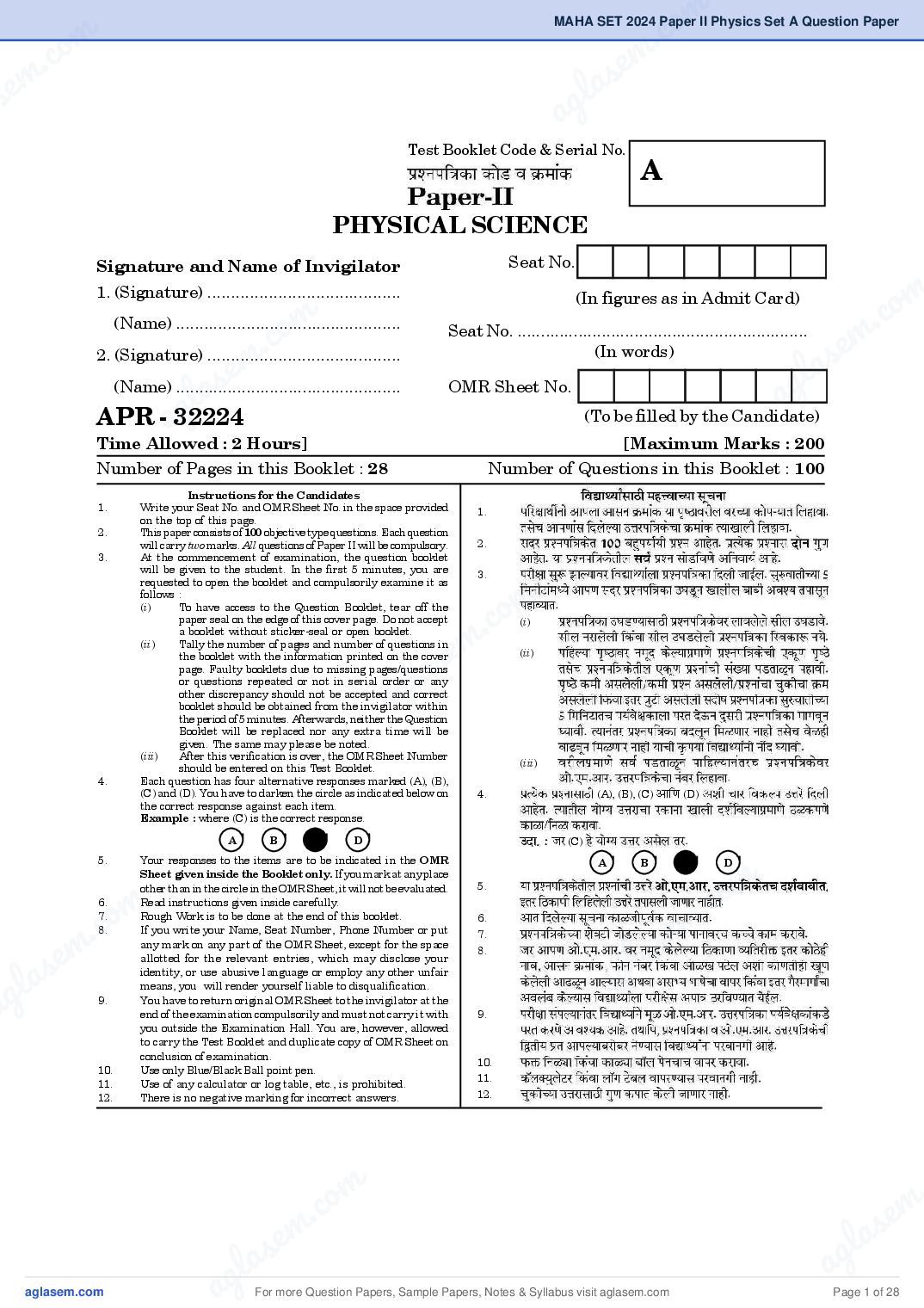
Test Booklet Code & Serial No.
A
PHYSICAL SCIENCE
Signature and Name of Invigilator Seat No.
m
.co
1. (Signature) ......................................... (In figures as in Admit Card)
o m m
c
(Name) ................................................
. e
Seat No. ..............................................................
e m
2. (Signature) ......................................... (In words)
l as
a s ag
gl
(Name) ................................................ OMR Sheet No.
APR -a32224 (To be filled by the Candidate)
Time Allowed : 2 Hours] [Maximum Marks : 200
Number of Pages in this Booklet : 28 Number of Questions in this Booklet : 100
Instructions for the Candidates
1. Write your Seat No. and OMR Sheet No. in the space provided 1.
on the top of this page.
2. This paper consists of 100 objective type questions. Each question
will carry two marks. All questions of Paper II will be compulsory. 2.
3. At the commencement of examination, the question booklet
will be given to the student. In the first 5 minutes, you are 3.
m
requested to open the booklet and compulsorily examine it as
.co
follows :
(i) To have access to the Question Booklet, tear off the
paper seal on the edge of this cover page. Do not accept (i)
a booklet without sticker-seal or open booklet.
e m
s
(ii) Tally the number of pages and number of questions in
la
the booklet with the information printed on the cover (ii)
page. Faulty booklets due to missing pages/questions
ag
or questions repeated or not in serial order or any
other discrepancy should not be accepted and correct
booklet should be obtained from the invigilator within
the period of 5 minutes. Afterwards, neither the Question
Booklet will be replaced nor any extra time will be
given. The same may please be noted.
(iii) After this verification is over, the OMR Sheet Number
(iii)
should be entered on this Test Booklet.
4. Each question has four alternative responses marked (A), (B),
(C) and (D). You have to darken the circle as indicated below on 4. (A), (B), (C) (D)
the correct response against each item.
Example : where (C) is the correct response.
A B D (C)
5. Your responses to the items are to be indicated in the OMR
m
A B D
.co
Sheet given inside the Booklet only. If you mark at any place
5.
m
other than in the circle in the OMR Sheet, it will not be evaluated.
.co
6. Read instructions given inside carefully.
7. Rough Work is to be done at the end of this booklet. 6.
e m
m s
8. If you write your Name, Seat Number, Phone Number or put 7.
s e
any mark on any part of the OMR Sheet, except for the space
allotted for the relevant entries, which may disclose your
8.
g l a
la a
identity, or use abusive language or employ any other unfair
ag 9.
means, you will render yourself liable to disqualification.
You have to return original OMR Sheet to the invigilator at the
end of the examination compulsorily and must not carry it with 9.
you outside the Examination Hall. You are, however, allowed
to carry the Test Booklet and duplicate copy of OMR Sheet on
conclusion of examination.
10.
10. Use only Blue/Black Ball point pen.
11.
11. Use of any calculator or log table, etc., is prohibited.
12. There is no negative marking for incorrect answers. 12.
m .
.co s e m
s em l a
g la ag
a For more Question Papers, Sample Papers, Notes & Syllabus visit Page 1 of 28
Page 3
For more Question Papers, Sample Papers, Notes & Syllabus visit Page 2 of 28
Page 4
m .co
m .co s e m
se g l a
a
Physical Science
Paper II
Time Allowed : 120 Minutes] [Maximum Marks : 200
m
.co
Note : This paper contains Hundred (100) multiple choice questions. Each question
o m
carrying Two (2) marks. Attempt All questions.
m
c
. equation s e
1.
e m
For the differential
l a
as 1 1 1 1
g
d ly 2a
x g
2
dy
adx dx (x – n ) y 0
2 2 2 2 2 2
x 2
2. The matrix 1 3 3 3 has
Which of the following statements 4 4 4 4
is true ? rank :
(A) 1
m
c. o (B) 2
(A) x = 0 and the point at infinity
e m
s
are regular singular points
g la (C) 3
a while
(B) x = 0 is an ordinary point,
(D) 4
the point at infinity is a regular
3. Most generic eigenvalues of a
singular point. 3 × 3 traceless matrix with zero
determinant are given as (a is some
m
(C) x = 0 is a regular singular point,
m constant) :
.co
.co m
while the point at infinity is an
m s e
s e
(A) 0, 0, 0
g l a
la
irregular singular point
g a
(B) 0, 0, a
a (D) x = 0 is an ordinary point, while (C) a, –a, 0
the point at infinity is singular. (D) a, –2a, a
3 [P.T.O.
m .
.co s e m
s em l a
g la ag
a For more Question Papers, Sample Papers, Notes & Syllabus visit Page 3 of 28
Page 5
6. The value of
d4 d2 C, where C is any open contour
4
2 2
f ( x) g( x)
dx dx
starting at z1 = (–1, 0) and ending
at z2 = (0, 1) is equal to :
Let F(k) and G(k) be the Fourier
(A) 0
transforms of f(x) and g(x)
(B)
respectively. Then F(k) is :
(C) 2
(A) F(k) = (k4 – 2k2) G(k) (D) 1
G(k) sin z
7. The value of the integral dz
(B) F(k) = z
(k4 – 2k2 )
over the contour C, C given by
(C) F(k) = (k4 + 2k2) G(k)
|z| = 1 and traversed counter-
G(k) clockwise, is :
(D) F(k) =
(k4 – 2ik2 ) (A) 2 i
5. Laplace transform of (1 + sin (2t)) 2 i
is : (B)
3
1 1 (C) 0
(A)
s s2 1
(D)
3
1 2
(B)
s s2 4 8. Mean is the same as variance for a :
(A) Poisson distribution
1 4s
(C)
s s2 4 (B) Normal distribution
(C) Uniform distribution
1
(D) 1
s2 4 (D) Binomial distribution
4
For more Question Papers, Sample Papers, Notes & Syllabus visit Page 4 of 28
Page 6
m .co
m .co s e m
se g l a
a
9. The Green’s function for the 11. The order of magnitude of the error
following boundary value problem in estimating the value of the
1
m
.co
d2 y integral ( x3 2 x2 4 x 9) dx
f ( x)
o m with boundary
0
m
c
2
. e
dx numerically, using Simpson’s 1/3rd
conditions : m
e y(0) = 0, y(1) = 1, is : method with a step size of 0.1 is :
l as
a s
l x (x–1) for 0 x x
(A) 10 –4
ag
(A) G (x, g (B) 10 –5
a x( x – 1) for x x 1
0 0
x )= 0
0 0
(C) 0
(D) 10–3
x0 /(x –1) for 0 x0 x
(B) G (x, x0 )= 12. A reservoir discharges water
x / ( x0 – 1) for x x0 1
through holes with shutters at depth
( x0 – 1) / x for 0 x0 x h and surface area A(h). The values
(C) G (x, x0 )=
( x – 1) / x0 for x x0 1
mare given in the following table. If
o t denotes the time in minutes and
. c
x0 (x+1)
e
for 0 x0 x
m
(D) G (x, x0 )=
las
x( x0 1) for x x0 1
the rate of fall of the water level is
ag
10. To find the roots of equation
given by the equation dh –
48h ,
dt A
x2 – 20 = 0 using the Newton-Raphson what is the time taken in minutes
method, the iterative formula for the for the water level to fall from
14 ft. to 10 ft. above the holes ?
successive trial root is :
xk 10
(A) xk 1 –
m
.co
2 xk
m
c. o (B) x xk 10
s e m
e m k 1 –
l a
las 2 xk
g
g (A) 8.41 a
a (C) xk 1 xk –
xk
20 (B) 2.63
20 (C) 5.48
(D) xk 1 xk –
xk (D) 6.06
5 [P.T.O.
m .
.co s e m
s em l a
g la ag
a For more Question Papers, Sample Papers, Notes & Syllabus visit Page 5 of 28
Page 7
l is pivoted about a horizontal axis
numbers, which of the following sets through its lower end at O (as shown
in the figure). Initially, it is held
of matrices forms a group under
vertically and is allowed to fall freely
matrix multiplication ? downwards (under the action of
gravity, with no air resistance). Its
angular velocity at the instant when
it makes an angle of 60º with the
vertical is (given that the moment of
(A) inertial I = ml2/3 and g is acceleration
0 0
due to gravity) :
1
(B) where 1
1
(A) 3 g / 2l
(B) 2 g / 3l
(C) 2g / l
*
(D) g / 2l
(C) where * is real
*
15. The velocities of a satellite (orbiting
around earth) at perigee and apogee
points are 25 km/s and 10 km/s
respectively. If the perigee distance
(D) where | | 2 + from the centre of the earth is 10000
– * * km, what is the apogee distance ?
(A) 25000 km
(B) 20000 km
| |2 = 1
(C) 2500 km
(D) 2000 km
6
For more Question Papers, Sample Papers, Notes & Syllabus visit Page 6 of 28
Page 8
m .co
m .co s e m
se g l a
a
16. Laplace-Runge Lenz vector A is 17. The plane of oscillation of a Foucault
defined as :
pendulum rotates :
m
m
µkr
.co
.co m
A px l – (A) 15º per hour at the equator
m
r
s e
e (B) 15º per hour at the pole la
s
la p is linear momentum
where l is angular momentum
ag
a g
vector, (C) 7.5º per hour at latitude 60º
vector, µ is the reduced mass, and
r is the radius vector. If A is (D) 30º per hour at latitude 60º
conserved for motion in – k/r
potential, then the direction of A in 18. A bead of mass m slides on a smooth
an elliptical orbit is :
massless rod. The rod is rotating
o m
about one end in X-Y plane with
. c uniform angular velocity (as shown
m
(A)
s e
g la in the figure). The Lagrangian of the
a system is given as :
(B)
m
m(C) 1
.co
.co
mr2 2 – mgr sin
(A) L =
2
e m
e m s
la2 2 – mgr cos
s
1
2ag
la
(B) L = mr
ag 1
(C) L = m (r 2 r 2 2 ) – mgr sin
2
(D)
1
(D) L = m (r 2 r 2 2 ) + mgr cos
2
7 [P.T.O.
m .
.co s e m
s em l a
g la ag
a For more Question Papers, Sample Papers, Notes & Syllabus visit Page 7 of 28
Page 9
pendulums, in general : motion. The frame S' is moving with
(A) The potential energy is a speed c/2, where c is the speed of
homogeneous quadratic light. In the frame S two events
function, when expressed in occur at (x1, t1) and (x2, t2). In the
terms of actual displacements frame S ' , these events occur
(B) The potential energy is a simultaneously. Then the value of
homogeneous quadratic (x2 – x1)/(t2 – t1) is :
function, when expressed in (A) c/2
terms of normal coordinates (B) 2c
(C) The potential energy is not a (C) c/4
homogeneous quadratic (D) 4c
function, when expressed in 21. The number of degrees of freedom
terms of actual coordinates of a system, comprising of an ant
(D) The potential energy is a moving on the surface of a sphere,
homogeneous quadratic which is rolling on a smooth
function, when expressed in horizontal surface, is :
terms of actual coordinates and (A) 3
not a homogeneous quadratic (B) 6
function, when expressed in (C) 5
terms of normal coordinates (D) 4
8
For more Question Papers, Sample Papers, Notes & Syllabus visit Page 8 of 28
Page 10
m .co
m .co s e m
se g l a
a
22. A particle is projected at an angle 24. The condition for generating
with respect to the horizontal axis. function F, defining canonical
Its path, observed in a frame of
m
.co
transformations, is that the
m
reference moving with a velocity
.co m
differential dF is exact. Which of the
equal to the horizontal component
s e
em a
following relations does not satisfy
s
of its velocity, will be :
g l
la line making an angle a
this condition ?
g
(A) a straight
a with the horizontal (A) dF i pi qi – i iP Q i
(B) a horizontal straight line (B) dF i qi pi i Qi Pi
(C) a vertical straight line
(C) dF i pi qi i Qi Pi
(D) a straight line making an angle
with the vertical (D) dF i qi pi i Pi Qi
23. A particle of mass m is falling freely 25. If the magnetic monopole existed,
m
then which of the following
.co
vertically in a uniform gravitational
field. The Hamilton-Jacobi equation Maxwell’s equations will be
e m
s
describing its motion is : modified ?
g la (A) .D
a
2 2
1 s s
(A) 2m x y + mgz (B) .B 0
(C) E – B/ t
s
+ 0 (D)
t H J D/ t
2 2 2
26. A conducting sphere of radius R has
1 s s s
(B) 2m charge +Q on its surface. If the
x y z
o m
charge on the surface is doubled and
m c
. the energy
.co
its radius is halved,
m
s
associated with e
+ mgz + 0
e m t
las the electric field
las 1 s
2
s
will :
g
a four times
ag (C) 2m z
mgz
t
0 (A) Increase
(B) Remain the same
2
1 s (C) Increase eight times
(D) 2m mgz 0
z (D) Decrease four times
9 [P.T.O.
m .
.co s e m
s em l a
g la ag
a For more Question Papers, Sample Papers, Notes & Syllabus visit Page 9 of 28
Page 11
and magnetic field vector H has the
( m ) is placed in a non-uniform
dimension of :
magnetic field B . If the position
(A) Inductance
vector of the dipole is r , the torque
(B) Capacitance
acting on the dipole about the origin
(C) Resistance
is :
(D) Product of inductance and
(A) r (m B)
capacitance
(B) r (m . B)
28. The value of Poynting vector at the
surface of a long cylindrical wire of (C) m B
radius R and length L carrying a (D) m B r (m . B)
current I when its ends are kept at
31. A 6 cm × 4 cm rectangular wave
a potential difference of V is :
(A) Zero guide is filled with dielectric of
(B) (VI)/(2 R2 + 2 RL)
refractive index 1.25. The range of
(C) (VI)/( R2L)
frequencies over which single mode
(D) (VI)/(2 RL)
29. For a good conductor skin depth operation will occur is :
varies inversely with ……… power
(A) 2.24 GHz < f < 3.33 GHz
of frequency.
(A) First (B) 2 GHz < f < 3 GHz
(B) Second
(C) 4.4 GHz < f < 70 GHz
(C) Half
(D) 4 GHz < f < 6 GHz
(D) Third
10
For more Question Papers, Sample Papers, Notes & Syllabus visit Page 10 of 28
Page 12
m .co
m .co s e m
se g l a
a
32. In Lorentz gauge, Lorentz condition 35. The ratio of skin depths of Copper
is given by : for the He-Ne laser ( = 6328 Å) to
m
(A) . A–1 m
c. o0
that for Nd : YAG laser ( = 1.06
m .co
c t
m s e
s e
µm) is :
l a
ag
.A +1
(B)
g l a c t
0
(A) 0.597
a . 1 (B) 0.95
(C) – A + 0
4 c t
(C) 1.294
.A – 1
(D) – 0
4 c2 t (D) 1.675
|E| 36. A particle of mass m is confined in
33. The SI unit of the quantity |B| is :
o m
a three-dimensional rectangular box
(A) s/m
.c
(B) m/s
s em of sides L, L/2 and 2 L. The third
(C) c2m/s
g la and fourth excited state energies and
(D) c2m2/s a their degeneracies (written in
34. Consider an ideal rectangular wave
brackets) are :
guide (dimension ~ 4.0 cm × 2.0 cm)
(A) 33/8 2 h 2/mL 2 (1), 9/2 2h 2 /
with vacuum inside. Plane
monochromatic electromagnetic mL2 (2)
radiation having a wavelength of
m
c. o
(B) 33/8 2h2/mL2 (1), 35/8 2h2/
m 6 cm is introduced in this wave
c. o guide. The radiation propagates mL2 (1)
s em
e m (C) 35/8 2hl2a
las inside the wave guide in mode :
ag /mL 2 (1), 9/2 2h2/
ag (A) Only TE10
mL2 (2)
(B) Only TM10
(D) 35/8 2 h 2/mL 2 (1), 9/2 2h 2 /
(C) Both TE10 and TM10
(D) Both TE10 and only TE01 mL2 (1)
11 [P.T.O.
m .
.co s e m
s em l a
g la ag
a For more Question Papers, Sample Papers, Notes & Syllabus visit Page 11 of 28
Page 13
2 + 3 is :
operators is the sum of the
(A) symmetric under interchanged
eigenvalues if :
of x and y.
(A) The operators are Hermitian
(B) antisymmetric under
interchanged x and y. (B) The operators have
(C) neither symmetric nor diagonalizable commuting
antisymmetric under the
matrices
interchange of x and y
(C) The operators are unitary
(D) both symmetric and
(D) The operators are anti-
antisymmetric under the
interchange of x and y Hermitian
respectively 40. If H is a Hermitian operator, the
38. A quantum particle is incident on
following is ‘‘always’’ true :
a potential barrier. The particle has
(A) H has real diagonal matrix
incident energy that is less than the
elements
height of the potential barrier. When
the particle penetrates the barrier, (B) H has positive diagonal matrix
its wave function is : elements
(A) Exponentially increasing
(C) H has imaginary off-diagonal
(B) Exponentially decreasing
matrix elements
(C) Oscillatory
(D) A positive constant (D) H has a trace equal to zero
12
For more Question Papers, Sample Papers, Notes & Syllabus visit Page 12 of 28
Page 14
m .co
m .co s e m
se g l a
a
41. Using the normalized trial wave 43. Consider a particle of mass m in a
one-dimensional box of length L. A
1
2b 4 time-independent perturbation
m
2
function (x) = e–bx , an
.co
H1 = (x – L/2) is applied to the
m
.co m
system. The first order correction to
upper bound for the ground state
s e
ema one-dimensional
the ground state energy is :
energy
sof
l a
la oscillator, oscillating with ag
(A) 2 2 (2 mL 2)
g
harmonic
a
frequency , is : (B) 0
(C) 2 /L
(A) 3/2 (D) L/
44. Using WKB approximation, the
1 transmission probability through a
(B)
2 parabolic barrier :
m
.co x2
em
3
(C) V0 1 – for | x| ! a
4
las V(x) =
a2
is :
(D) ag 0 for | x| ! a
42. The commutator of the orbital 2mV0 a2 E
(A) exp 2 2
1–
V0
angular momentum operators
[L+, L–], where L± = Lx ± iLy is :
2mV0 a2 E
(B) exp –
m
1–
.co
2 V0
(A) 0
m
c. o (B) 2 L s e m
e m x
l a 2mV0 a2 E
las (C) exp –
a g 2 V0
–1
ag (C) 2 Ly
2mV0 a2 E
(D) 2 Lz (D) exp – 2 2 V0
–1
13 [P.T.O.
m .
.co s e m
s em l a
g la ag
a For more Question Papers, Sample Papers, Notes & Syllabus visit Page 13 of 28
Page 15
is not correct ?
for central force potential is : (A) In the presence of spin-orbit
coupling, the Hamiltonian does
(A) Independent of incident energy not commute with L and S
operators
and scattering potential (B) Even in presence of spin-orbit
coupling, the Hamiltonian
(B) For strong scattering potential commutes with L 2, S 2 and J
operators
weak incident energy (C) The spin-orbit interaction for an
electron is described by Hso =
(C) For large incident energy and ( e2 / 8 "0 ) ) 1/(m2c2r3) S . L .
(D) In the presence of spin-orbit
weak scattering potential interaction, the physical
quantities measured by L 2, S 2
(D) For any central force potential and J are not conserved.
48. The differential scattering cross-
46. Spin-orbit coupling leads to : d#( )
section , within the first Born
d$
approximation, for the central
(A) Normal Zeeman effect
potential V(r) = /r e–µr, where
and µ are positive constants has the
(B) Anomalous Zeeman effect
dependence on scattering angle as
(A is constant) :
(C) Stark effect (A) (A2 + sin2 /2)
(B) (A2 + sin2 /2)–1
(D) Hyperfine splitting (C) (A2 + sin2 /2)–2
(D) (A2 + sin2 /2)2
14
For more Question Papers, Sample Papers, Notes & Syllabus visit Page 14 of 28
Page 16
m .co
m .co s e m
se g l a
a
49. Consider a random walk on a two- 52. If the temperature T of photon gas
dimensional triangular lattice. The in equilibrium in a radiation cavity
m
.co
probability of taking any of the six is doubled, the equilibrium number
o m m
c
possible steps is same. What is the
. the walker returns of photons will increase by the factor
s e
m
e position after taking
probability that
l a
s
of :
a
l three steps ?
to the starting
g (A) 2 ag
a
exactly
(B) 6
(A) 1/18
(C) 8
(B) 1/216
(D) 9
(C) 1/36
53. The volume of a perfect gas is
(D) 1/12
50. An ideal monoatomic gas is doubled, the number of atoms N and
m
c. o the change in entropy will be :
compressed (no heat is added or the energy E being held constant,
removed in the process) so that its
e m
l a
volume is halved. The ratio of the news (A) Nk ln V
pressure to the original pressureg
a is : (B) 2Nk ln V
(A) % 3 (C) Nk ln 2
(B) % 9 (D) ½ Nk ln (2V)
(C) & 12
54. In adiabatic expansion of a system
(D) % 15
in which temperature changes from
51. If a thermodynamic system has N
m
.co
T1 to T2 the entropy :
m particles at temperature T, then the
c. o fluctuation in average energy is em
(A) will increase
e m s
la unchanged
(B) will decrease
las proportional to :
ag
(C) will remain
ag (A) 1/N
(D) may increase or decrease
(B) 1 / N
(C) 1 / (3 N) depending on the ratio of
(D) N T1/T2
15 [P.T.O.
m .
.co s e m
s em l a
g la ag
a For more Question Papers, Sample Papers, Notes & Syllabus visit Page 15 of 28
Page 17
engine between two bodies of equal in contact with both a heat reservoir
and a particle reservoir, then the
capacity until their temperatures
ensemble is :
become equal. If the initial
(A) Canonical
temperatures of the bodies are T1
(B) Microcanonical
and T2 and T1 > T2, their common (C) Grandcanonical
final temperature will be (D) Isobaric–isothermal
58. Average energy of a Planck’s
(A) T1T2
oscillator of frequency v is :
(B) 2T1T2/(T1 + T2) (A) E = v
(B) E = n v
(C) (T1 + T2)/2
(C) E = v / (e v / kT – 1)
(D) 0 (D) E = mc2
59. Knowing the fractional population of
56. The difference between fermions and
a two level system in thermal
bosons is that bosons do not obey : equilibrium at temperature T in a
magnetic field B , the magnetic
(A) Aufbau principle
moment is proportional to :
(B) Pauli exclusion principle (A) The difference between the
population of the two states.
(C) Hund’s rule of maximum (B) The sum of the population of the
two states
multiplicity
(C) Product of the population of the
(D) Heisenberg’s uncertainty two states
(D) Ratio of the population of the
principle
two states
16
For more Question Papers, Sample Papers, Notes & Syllabus visit Page 16 of 28
Page 18
m .co
m .co s e m
se g l a
a
60. The partition function of a two-level 62. For the following OP-amp circuit,
R1 = R2 = R3 = RF =1.0 k , the
system described by the Hamiltonian
output voltage Vout is :
m
.co
–' –
m
.co m
H = is :
– –'
s e
s em l a
g a '
(A) 2 lcosh
2 2 ag
a
(B) 2 sinh '2 2
(A) +1.0V
1 2 2 2 2
(C) cosh ' sinh '
2 (B) –1.0V
o m
(C) +0.5V
1
'2 2
'2 2
. c (D) –0.5V
m
(D) cosh – sinh
2
s e 63. The following diode circuit acts
g la
a
61. Which of the following transistor as a :
amplifier configuration is often
used in impedance-matching
application ?
m
m(A) The common-base amplifier
.co
m .co s e m
s e (B) The emitter follower
(A) AND gate
g l a
g la a
a
(B) OR gate
(C) The common-emitter amplifier
(C) NAND gate
(D) The common-source amplifier
(D) NOR gate
17 [P.T.O.
m .
.co s e m
s em l a
g la ag
a For more Question Papers, Sample Papers, Notes & Syllabus visit Page 17 of 28
Page 19
the following logic circuit for the
sin t of frequency is given as an
inputs X3 X2 X1 X0 = 1 0 1 1 is :
input to the following circuit. If Vm
is the peak value of the input
voltage, the output voltage Vout
is :
(A) 1 1 0 1
(B) 1 0 1 0
(C) 1 1 1 1
(D) 0 1 0 1 (A) 2 V0 sin t
65. A four-bit ripple counter consists of
(B) 2 Vm
flip-flops that each have a
(C) 2 Vm
propagation delay from clock to Q
(D) (Vm/2) sin t
output of 12 ns. For the counter of
recycle from 1111 to 0000; it will 67. The modulation index of an AM
wave is :
take a total delay of :
(A) m = (Vmax – Vmin)/(Vmax + Vmin)
(A) 12 ns
(B) 24 ns (B) m = (Vmax + Vmin)/(Vmax – Vmin)
(C) 36 ns (C) m = (Vmax × Vmin)/(Vmax + Vmin)
(D) 48 ns (D) m = (Vmax × Vmin)/(Vmax – Vmin)
18
For more Question Papers, Sample Papers, Notes & Syllabus visit Page 18 of 28
Page 20
m .co
m .co s e m
se g l a
a
68. A digital to analogue converter has 71. If the wavelength of the first line
m
5.0 V full scale output voltage and of the Balmer series in the hydrogen
m .co
.co m
an accuracy of ±0.2. The maximum
m
spectrum is , then the wavelength
s e
s e
error for any output voltage
l a
a
bel :
will g
ag
of the first line of the Lyman series
a is :
(A) 5.0 mV
(A) (27/32)
(B) 10.0 mV
(C) 20.0 mV (B) (27/5)
(D) 100 mV (C) (5/27)
m
c. o (D) (32/27)
69. A thermistor is suitable for :
e m
s
la 72. The gN value for F19 nucleus is
(A) High span but low sensitivity
a g
(B) High span and high sensitivity
5.256. The resonance frequency
(C) Low span but high sensitivity
when it is placed in a magnetic field
(D) Low span and low sensitivity
of strength 1.0 T is (Given µN =
70. The error of an instrument is
5.0504 × 10⁻²⁷ J/T) :
m
m normally given as percentage of :
c. o (A) Measured value m.co
m
(A) 40 MHz
s e
s e g l a
g la (B) Full scale value a
(B) 4.0 MHz
a (C) Mean value (C) 60 MHz
(D) RMS value (D) 0.60 MHz
19 [P.T.O.
m .
.co s e m
s em l a
g la ag
a For more Question Papers, Sample Papers, Notes & Syllabus visit Page 19 of 28
Page 21
spectroscopic term factor of this
transition takes place in :
ion is :
(A) Ne only
(A) 1D2
(B) He only
(B) 4F 3/2
(C) 3F 9/2 (C) Ne first and then in He
(D) 5D0 (D) He first and then in Ne
74. The energy separation between two
76. If the ESR frequency for a free
consecutive Stokes lines in Raman
electron is 9000 MHz, then the
spectrum depends on :
magnetic field, at which the ESR
(A) Energy separation between
vibrational levels in the excited spectrometer is working, will be
state (Given g = 2.0 and µB = 9.2732 ×
(B) Wavelength of the incident 10–24 J/T) :
light
(A) 600.5 mT
(C) Energy separation between
(B) 321.5 mT
vibrational levels in the ground
state (C) 400.0 mT
(D) Intensity of the incident light (D) 60.50 mT
20
For more Question Papers, Sample Papers, Notes & Syllabus visit Page 20 of 28
Page 22
m .co
m .co s e m
se g l a
a
77. Light of wavelength 1.5 µm incident 79. A muon from cosmic rays is trapped
by a proton to form a hydrogen-like
on a material with a characteristic
m
m .co
.co
atom. Given that a muon is
Raman frequency of 20 × 1012 Hz
e m
m approximately 200 times heavier s
s e g la
la
results in a Stokes-shifted line of
g a
than an electron, the longest
a
wavelength :
wavelength of the spectral line (in
(A) 1.47 µm analogy with the Lyman series) of
(B) 1.57 µm such an atom will be :
(A) 5.62 Å
(C) 1.67 µm
m
c. o (B) 6.67 Å
(D) 1.77 m
e m
las (C) 3.75 Å
ag
78. Assuming that the L-S coupling
(D) 13.3 Å
scheme is valid, the number of 80. An irradiated sample of MgO has a
permitted transitions from strong ESR line at 0.163 T when the
2P 2S ESR spectrometer is operating at
3/2 1/2 due to a weak
9.4 GHz. The g value of the ESR
magnetic field is :
o m
m line of MgO will be .: c
c. o (A) 2 s em
e m (A) 2.0
la
las g
(B) 2.205 a
(B) 4
ag
(C) 6 (C) 4.13
(D) 10 (D) 3.020
21 [P.T.O.
m .
.co s e m
s em l a
g la ag
a For more Question Papers, Sample Papers, Notes & Syllabus visit Page 21 of 28
Page 23
two atoms having masses 2 kg and
lattice is :
16 kg respectively. The extremum
(A) Rhombic dodecahedron
frequency of optical branch is :
(B) Truncated octahedron
(A) 2
(C) Cube
(B) 2
(D) Parallelepiped
(C) 1/ 2
82. The specific heat of bulk copper has (D) 1/2
the behaviour CV 4.6 × 10⁻² × T3 84. The wavelength of the photon which
Jmol–1K–1 at low temperature. The will be required to break a Cooper
pair in a superconductor like
Debye temperature of copper is
aluminium whose critical
found to be :
temperature is 1.2 K is :
(A) 2.48 K
(A) 2.5 × 10⁻³m
(B) 348 K
(B) 3.4 × 10⁻³m
(C) 448 K
(C) 4.4 × 10⁻³m
(D) 548 K (D) 5.4 × 10⁻³m
22
For more Question Papers, Sample Papers, Notes & Syllabus visit Page 22 of 28
Page 24
m .co
m .co s e m
se g l a
a
85. In the Kronig-Penney model, if 87. The ratio of the number of vacancies
in equilibrium at 300 K in
m
.co
there exists no potential barrier,
m
.co
aluminium to that produced by
e m
s
then :
e m a
rapid quenching at 800 K is (given
l
l a
(A) Theres is periodic dependence of
ag of
g
that the enthalpy of formation
aenergy on wave vector k vacancy in Al is 68 kJ/mole and
R = 8.314 kmol–1/K)
(B) Energy is not a continuous
(A) 3.75 × 10⁻⁸
function of wave vector k
(B) 2.15 × 10⁻¹⁰
(C) There are no forbidden energy
o m
(C) 3.18 × 10⁻¹⁰
. c (D) 3.75 × 10⁻¹⁰
regions
e m
s
a 88. The dispersion relation for a low
(D) All values of energy are lnot
ag
density plasma is 2 = + c2 k2, 2
0
allowed
where 0 is the plasma frequency
86. Trivalent iron ion is characterized
and c is the speed of light in free
by the spectroscopic term 6S7/2. Its space. The relationship between the
group velocity (V g ) and phase
m
.co
effective magneton number is :
m
c. o (A) 2.83 velocity (Vp) is :
e m
e m (A) Vp = Vg as
s g l
g la (B) 5.92
(B) Vp = a(Vg)½
a (C) 3.87 (C) VpVg = c2
(D) 2.32 (D) Vg = (Vp)½
23 [P.T.O.
m .
.co s e m
s em l a
g la ag
a For more Question Papers, Sample Papers, Notes & Syllabus visit Page 23 of 28
Page 25
constant ‘a’, the body-centered 200 µm is doped with 10 23
position from the origin is at a phosphorus atoms per m3. If the
distance of : sample is kept in a magnetic field
(A) 2a of 0.2 Wb/m2 and a current is passed
through the sample, the Hall voltage
3
(B) a
2 produced is :
3 (A) 62.5 µV
(C) a
2
(B) –6.25 µV
3
(D) a (C) +6.25 µV
4
(D) –62.5 µV
90. The chemical potential (µ) of a solid
92. What is the binding energy of the
coincides with Fermi energy (EF) at
nucleus for isobar 64
29 Cu ?
absolute zero. At temperature
[Given : M n = 1.008665 amu,
T > 0, which of the following options
Mp = 1.007825 amu, 64
29 Cu = 63.9298
is correct ?
amu]
(A) µ = EF
(A) 450.20 MeV
(B) µ > EF (B) 512.03 MeV
(C) µ < EF (C) 556.18 MeV
(D) 612.30 MeV
(D) µ = 0
24
For more Question Papers, Sample Papers, Notes & Syllabus visit Page 24 of 28
Page 26
m .co
m .co s e m
se g l a
a
93. What is the maximum energy of 95. The number of fissions per second
m
.co
-particle emitted when 13 H decays in a 100 Mwatt nuclear reactor
m
.co s e m
to 32 He ?
em a
is :
s l
g la: H = 3.01605 amu, He ag
a
[Given 3
1
3
2
(A) 3 × 106
= 3.01603 amu ] (B) 3 × 10¹²
(A) 9.8 kev (C) 3 × 10¹⁸
(B) 12.7 kev (D) 3 × 1024
o m
c
. What is the energy of gamma rays
(C) 15.5 kev
e m96.
l as
ag
28
emitted in the beta decay of 13
(D) 18.7 kev Al ?
28
[Given : Emax = 2.86 MeV, 13
94. The quark content of the subatomic Al =
27.981908 amu and 28 =
particle Kº with strangeness S = +1 14 Si
and isospin I =1/2 is given by : 27.976929 amu]
m
m(A) ds .co
.co
(A) 1.25 MeV
m
e m (B) 1.78 MeVla
se
las (B) ds
ag
ag (C) dd (C) 1.86 MeV
(D) uu (D) 2.30 MeV
25 [P.T.O.
m .
.co s e m
s em l a
g la ag
a For more Question Papers, Sample Papers, Notes & Syllabus visit Page 25 of 28
Page 27
97. The reaction ( n ) (0 K+
cannot be induced because
cannot be induced due to non-
n p + e– + ve
conservation of :
(A) Q and B are conserved but I3
(A) Isospin and L are not conserved
(B) Baryon number (B) Q, B and L are conserved but
I3 is not conserved
(C) Third component
(C) Q, B and I3 are conserved but
(D) Strangeness
L is not conserved
98. What spin-parity and isospin would (D) B, I3 and L are conserved but
Q is not conserved
the shell model predict for the
100. What are the appropriate values for
ground states of 13
6 C [Recall that the
the corresponding lifetimes of
P3/2 shell lies below P1/2]
hadronic decay, electromagnetic
(A) JP = (3/2)–, I = 3/2 decay and weak decay ?
(A) 10–9 sec, 10–6 sec, 10–3 sec
(B) JP = (1/2)–, I = 1/2
(B) 10–12 sec, 10–9 sec, 10–6 sec
(C) JP = (1/2)–, I = 1/2
(C) 10–15 sec, 10–13 sec, 10–6 sec
(D) JP = (3/2)–, I = 1/2 (D) 10–23 sec, 10–18 sec, 10–10 sec
26
For more Question Papers, Sample Papers, Notes & Syllabus visit Page 26 of 28
Page 28
m .co
m .co s e m
se g l a
a
ROUGH WORK
m
m .co
m .co s e m
s e l a
g l a ag
a
m
m .co
s e
g la
a
m
m .co
m .co s e m
s e g l a
g la a
a
27 [P.T.O.
m .
.co s e m
s em l a
g la ag
a For more Question Papers, Sample Papers, Notes & Syllabus visit Page 27 of 28
Page 29
28
For more Question Papers, Sample Papers, Notes & Syllabus visit Page 28 of 28
Document Details
| Board / Org | Maharashtra Exams |
| Exam | MAHA SET |
| Type | Question Paper |
| Pages | 28 |
| Updated | 17 Nov 2026 |