Goa Board Class 12 Question Paper Mar 2018 Applied And Consumer Electronics _New Pattern_
Finished viewing? Save it for later —
Download Goa Board Class 12 Question Paper Mar 2018 Applied And Consumer Electronics _New Pattern_ (PDF · 3 pages)About Goa Board Class 12 Question Paper Mar 2018 Applied And Consumer Electronics _New Pattern_
Goa Board Class 12 Question Paper Mar 2018 Applied And Consumer Electronics _New Pattern_ is available here for free download. Published by Goa Board for Class 12, this question paper can be viewed online or downloaded as a PDF (3 pages). Candidates preparing for Class 12 can use Goa Board Class 12 Question Paper Mar 2018 Applied And Consumer Electronics _New Pattern_ to understand the exam pattern, the type of questions asked, and the overall difficulty level.
Frequently Asked Questions
How can I download Goa Board Class 12 Question Paper Mar 2018 Applied And Consumer Electronics _New Pattern_?
Open this page and click the Download button to save Goa Board Class 12 Question Paper Mar 2018 Applied And Consumer Electronics _New Pattern_ as a PDF. It is completely free on AglaSem Docs.
Is Goa Board Class 12 Question Paper Mar 2018 Applied And Consumer Electronics _New Pattern_ free to download?
Yes. Goa Board Class 12 Question Paper Mar 2018 Applied And Consumer Electronics _New Pattern_ can be viewed online and downloaded as a PDF free of cost on AglaSem Docs.
How many pages does Goa Board Class 12 Question Paper Mar 2018 Applied And Consumer Electronics _New Pattern_ have?
Goa Board Class 12 Question Paper Mar 2018 Applied And Consumer Electronics _New Pattern_ contains 3 pages, which you can read online or download together as a single PDF.
Where can I find more Class 12 study material?
You can find more Class 12 question papers, sample papers, syllabus, and answer keys on AglaSem Docs.
Goa Board Class 12 Question Paper Mar 2018 Applied And Consumer Electronics _New Pattern_ – Text
Read the full text of this question paper below — useful to quickly search, copy and reference the content online without downloading the PDF.
📄 View text version (3 pages)
Page 1
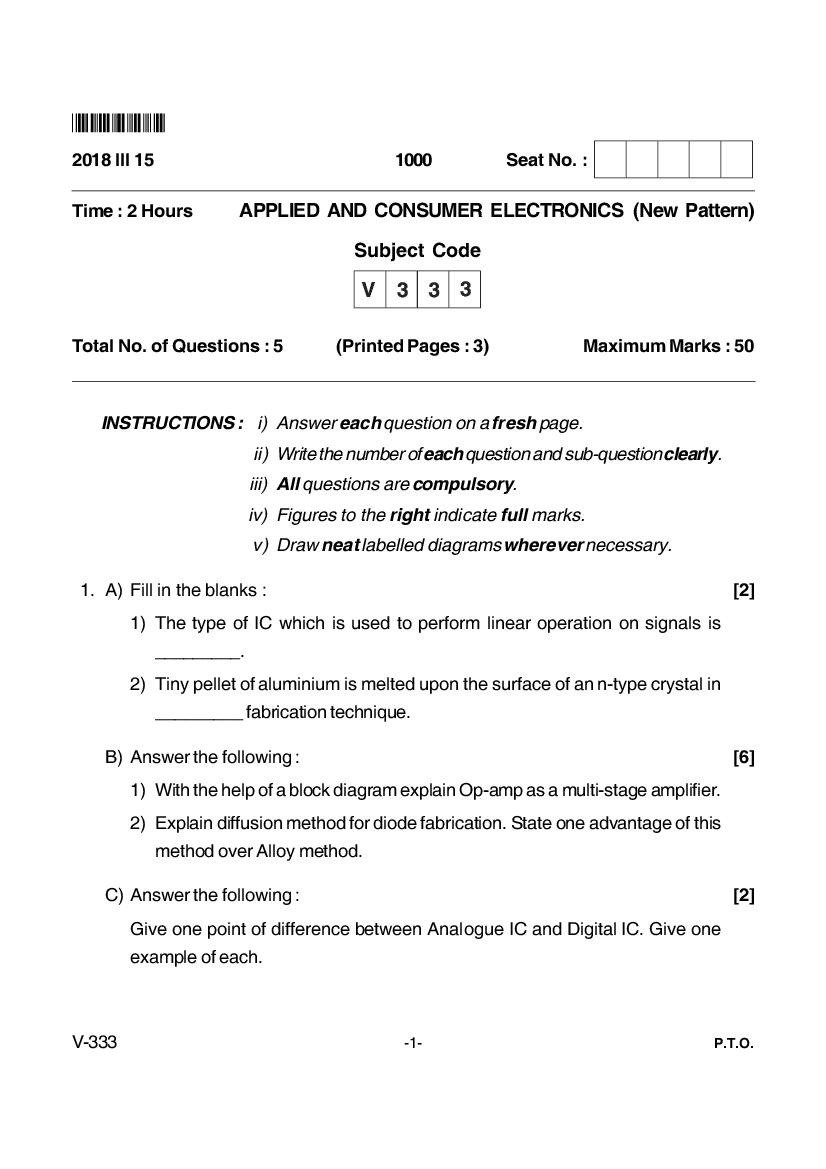
Time : 2 Hours APPLIED AND CONSUMER ELECTRONICS (New Pattern)
Subject Code
!
! !
8
Total No. of Questions : 5 (Printed Pages : 3) Maximum Marks : 50
INSTRUCTIONS : i) Answer each question on a fresh page.
ii) Write the number of each question and sub-question clearly.
iii) All questions are compulsory.
iv) Figures to the right indicate full marks.
v) Draw neat labelled diagrams wherever necessary.
1. A) Fill in the blanks : [2]
1) The type of IC which is used to perform linear operation on signals is
_________.
2) Tiny pellet of aluminium is melted upon the surface of an n-type crystal in
_________ fabrication technique.
B) Answer the following : [6]
1) With the help of a block diagram explain Op-amp as a multi-stage amplifier.
2) Explain diffusion method for diode fabrication. State one advantage of this
method over Alloy method.
C) Answer the following : [2]
Give one point of difference between Analogue IC and Digital IC. Give one
example of each.
V-333 -1- P.T.O.
Page 2
1) Give one advantage of storing information on a CD.
2) Name a device of a CD player that reads or writes informations on a CD.
B) Answer the following : [6]
1) How is signal processing done in a CD player ?
2) With the help of a neat labelled diagram explain the working of a dynamic
microphone.
C) Answer the following : [2]
Two speakers of 8 Ohms are to be connected to a 100 watt amplifier with 4
Ohm output terminals. Draw the wiring diagram to connect these speakers to
the amplifier. Why impedance matching necessary in PA system ?
3. A) Fill in the blanks : [2]
1) The sky waves in radio communication are reflected in the sky by ________.
2) The ability of the radio receiver to receive the weak signals is called
________.
B) Answer the following : [3]
State one function of a tone control circuit in radio receiver. Define AGC and
AVC with respect to radio receivers.
C) Answer any one of the following : [5]
1) Draw the block diagram of AM superheterodyne radio receiver. What are
the properties of radio wave ? Why is a ground wave a weak wave ?
2) Draw the block diagram of a FM superheterodyne radio receiver. Explain
how Limiter on FM receiver eliminates noise in FM reception. State IF
value of FM and AM receiver.
4. A) Answer the following : [2]
1) Name the primary colours of a coloured television.
2) State the scanning sequence of lines and frames in television
communication system.
B) Answer the following : [3]
State any two advantages of a DTH system. Name any two types of TFT
technologies.
V-333 -2-
Page 3
1) Name any two types of camera tubes and state their working principle.
Draw a neat block diagram of the video section of a B/W TV. State two
stages of a TV tuner.
2) What is a composite video signal ? Draw waveform to identify the three
components of composite video signal. State field frequency and picture
frequency in international standard recommendations.
5. Answer the following : [10]
1) State the function of a SIM used in Cell phone. What are the advantages of
Bluetooth Technology ?
2) State two limitations of Cordless Telephone over a mobile phone.
3) Name different speakers used in a 5.1 home theatre system.
4) Differentiate between DVDs and a CD. (any two points)
5) Give the full form of IMEI and GPRS.
V-333 -3-
Document Details
| Board / Org | Goa Board |
| Exam | Class 12 |
| Type | Question Paper |
| Pages | 3 |
| Updated | 30 Apr 2026 |