Karnataka 2nd PUC Question Bank 2026 Education
Finished viewing? Save it for later —
Download Karnataka 2nd PUC Question Bank 2026 Education (PDF · 16 pages)About Karnataka 2nd PUC Question Bank 2026 Education
Karnataka 2nd PUC Question Bank 2026 Education is available here for free download. Published by Karnataka Board for Class 12, this question bank can be viewed online or downloaded as a PDF (16 pages). Candidates preparing for Class 12 can use Karnataka 2nd PUC Question Bank 2026 Education to understand the exam pattern, the type of questions asked, and the overall difficulty level.
Frequently Asked Questions
How can I download Karnataka 2nd PUC Question Bank 2026 Education?
Open this page and click the Download button to save Karnataka 2nd PUC Question Bank 2026 Education as a PDF. It is completely free on AglaSem Docs.
Is Karnataka 2nd PUC Question Bank 2026 Education free to download?
Yes. Karnataka 2nd PUC Question Bank 2026 Education can be viewed online and downloaded as a PDF free of cost on AglaSem Docs.
How many pages does Karnataka 2nd PUC Question Bank 2026 Education have?
Karnataka 2nd PUC Question Bank 2026 Education contains 16 pages, which you can read online or download together as a single PDF.
Where can I find more Class 12 study material?
You can find more Class 12 question papers, sample papers, syllabus, and answer keys on AglaSem Docs.
Karnataka 2nd PUC Question Bank 2026 Education – Text
Read the full text of this question bank below — useful to quickly search, copy and reference the content online without downloading the PDF.
📄 View text version (16 pages)
Page 1
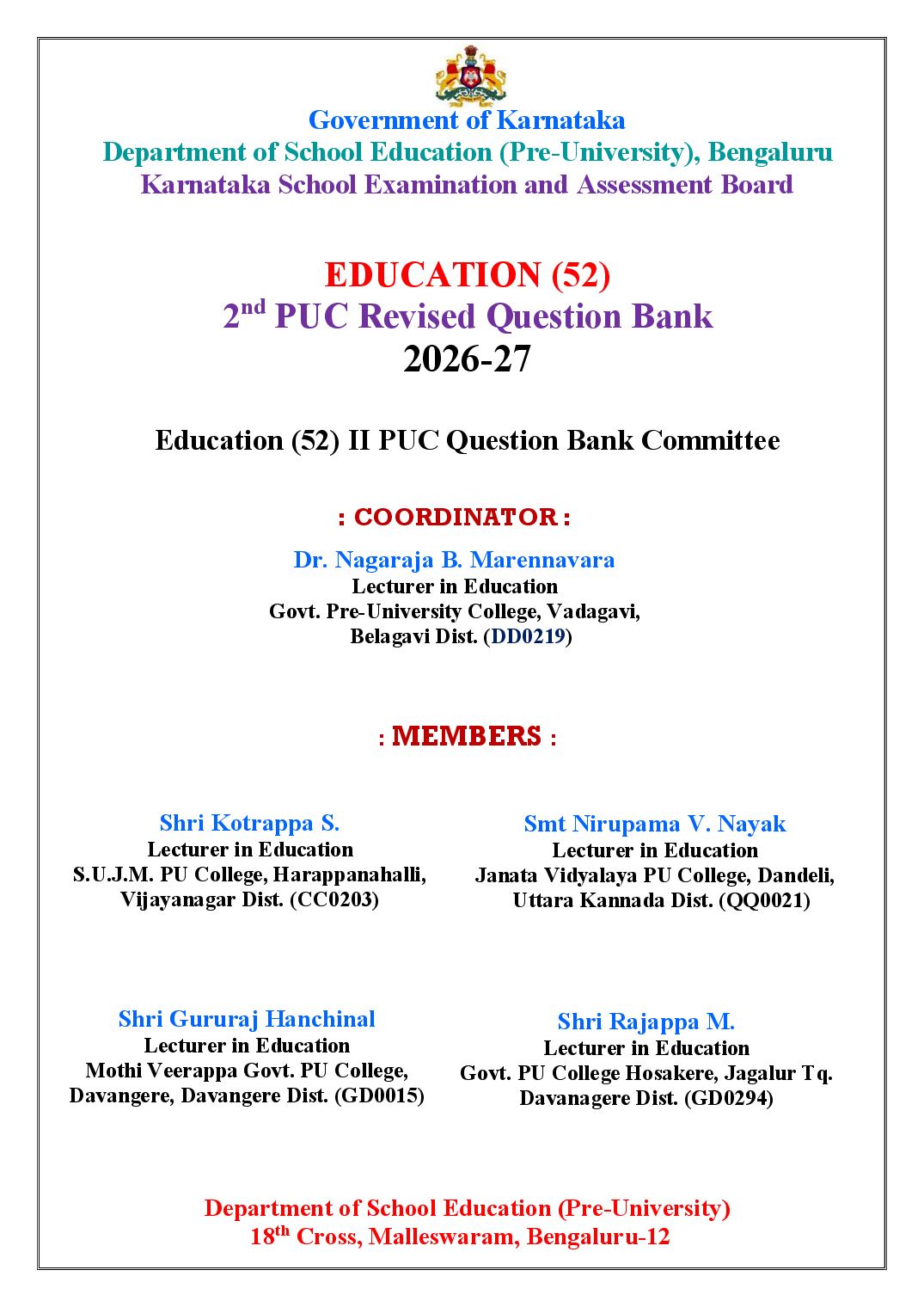
Department of School Education (Pre-University), Bengaluru
Karnataka School Examination and Assessment Board
EDUCATION (52)
2nd PUC Revised Question Bank
2026-27
Education (52) II PUC Question Bank Committee
: COORDINATOR :
Dr. Nagaraja B. Marennavara
Lecturer in Education
Govt. Pre-University College, Vadagavi,
Belagavi Dist. (DD0219)
: MEMBERS :
Shri Kotrappa S. Smt Nirupama V. Nayak
Lecturer in Education Lecturer in Education
S.U.J.M. PU College, Harappanahalli, Janata Vidyalaya PU College, Dandeli,
Vijayanagar Dist. (CC0203) Uttara Kannada Dist. (QQ0021)
Shri Gururaj Hanchinal Shri Rajappa M.
Lecturer in Education Lecturer in Education
Mothi Veerappa Govt. PU College, Govt. PU College Hosakere, Jagalur Tq.
Davangere, Davangere Dist. (GD0015) Davanagere Dist. (GD0294)
Department of School Education (Pre-University)
18th Cross, Malleswaram, Bengaluru-12
Page 2
Department of School Education (Pre-University), Bengaluru
Karnataka School Examination and Assessment Board
nd
🖎 QUESTION PAPER PATTERN :
QUESTIONS
NATURE OF TOTAL GRAND OBTAINED
PARTS TO BE
QUESTIONS QUESTION MARKS MARKS
ANSWERED
1 MARK
PART_A
MCQ, FB, MF, 1M
20 20 20 20
PART_B 2 MARKS 13 10 26 20
PART_C 5 MARKS 09 06 45 30
PART_D 10MARKS 03 01 30 10
TOTAL 45 37 121 80
🖎 UNIT-WISE QUESTION DISTRIBUTION :
TEACHING
UNITS
HOURS 1M 2M 5M 10M Q’S M’S
UNIT_1 09 2 1 1 - 4 09
UNIT_2 14 2 1 - 1 4 14
UNIT_3 14 2 1 - 1 4 14
UNIT_4 12 2 2 1 - 5 11
UNIT_5 14 2 1 2 - 5 14
UNIT_6 15 3 1 2 - 6 15
UNIT_7 12 2 2 1 - 5 11
UNIT_8 12 2 2 1 - 5 11
UNIT_9 06 2 2 - - 4 06
UNIT_10 12 1 - 1 1 3 16
Total Q’s 20 13 09 03 45 -
Total M’s 120 20 26 45 30 - 121
The Difficulty Level of Questions
1) Easy 2) Moderate (Mod) 3) Difficulty (Dif)
Page 3
Department of School Education (Pre-University), Bengaluru
Karnataka School Examination and Assessment Board
2nd PUC : Education (52) : Question Bank : 2026-27
General instructions:
1. The question paper format of the annual examination consists of A, B, C, D, and E parts
2. In Part-A, MCQ, FIB, MF, one-word/sentence questions can be interchanged.
3. Questions given in Part-E are applicable only for Visually challenged students.
4. Students must examine closely the nature of the questions related to HOTS and then answer.
5. Question paper setters should prefer the questions from the Question Bank.
UNIT_1 : Concept Formation and Thinking
I. Multiple choice questions (choose the appropriate answer from the given options)
1. ‘An abstract process of getting the information of the external world through body and mind’(E)
a) Thinking b) Sensation c) Concept Formation d) Perception
2. A definite and Imaginary mental activity_ (Easy)
a) Reasoning b) Creativity c) Past Experience d) Perception
3. A symbolic construction that represents some common and general features of many objects and events(M)
a) Perception b) Sensation c) Concepts d) Thinking
4. A logical and systematic way of thinking is called as - (Easy)
a) Past-Experience b) Tension c) Reasoning d) Sensation
5. The ability of a person to create a new field and make a new observation is called - (Easy)
a) Deduction b) Creative Thinking c) Induction d) Analogy
6. When Archimedes found a solution to the problem in the bathroom, he said, "Eureka!” What stage of
creative thinking came out as 'Eureka!'? (Dif)
a) Preparation b) Incubation c) Illumination d) Verification
II. Match the following
A B
a) Sensory Activity - 1. A determinant of perception (Easy)
b) Past Experience - 2. An element in concept formation (Easy)
c) Sensation + Meaning - 3. A stage of creative thinking (Mod)
d) Generalization - 4. Perception (Easy)
e) Illumination - 5. Sensation (Easy)
III. Select the correct answer from given in the bracket and fill in the blanks
(Psychomotor, Concept formation, Illumination, Motives, Commitment)
1) Perception + Generalization means that_______ (Easy)
2) If sensation is a sensory activity, then perception is a ________activity. (Easy)
3) One of the determinants of perception is________(Mod)
4) A factor that influences decision making_____ (Mod)
5) The stage in creative thinking where an idea for the solution may suddenly come down is____ (Dif)
IV. ONE-Mark questions (these questions should be answered in one word/sentence)
1) What is sensation? (Easy) 5) What is problem solving thinking? (Easy)
2) Define the term Perception. (Easy) 6) State the meaning of reasoning. (Easy)
3) What is the meaning of concept formation?(E) 7) What is decision making? (Easy)
4) Give a definition of thinking. (Easy) 8) What is the meaning of creative thinking? (E)
1 | Page
Page 4
1) State any two characteristics of sensation. (Easy)
2) Write any two characteristics of perception. (Mod)
3) Mention any two determinants of perception. (Easy)
4) Mention any two elements involved in the process of concept formation. (Easy)
5) Write any two stages of problem-solving thinking. (Mod)
6) Mention any two factors that influence problem solving thinking? (Mod)
7) What are the two types of reasoning? (Easy)
8) Mention any two types of formal reasoning. (Easy)
9) What are the two factors that influence decision making? (Mod)
10) Mention any two stages in creative thinking. (Easy)
VI. FIVE-Marks questions (each question should be answered in 10-12 sentences)
1) Explain the characteristics of sensation. (Mod)
2) List out the differences between sensation and perception in a table. (Mod)
3) Briefly explain the determinants of perception. (Mod)
4) Explain the process of concept formation with a picture. (Dif)
5) Explain the factors influencing problem solving thinking. (Dif)
6) Explain the stages of creative thinking. (Dif)
UNIT_2: Individual Differences
I. Multiple choice questions (choose the appropriate answer from the given options)
1. The differences which distinguish one individual from another are called ___(Easy)
a) Adjustment b) Sensation c) Individual Difference d) Concepts
2. 'The capacity to recognize our own feelings and those of others' is called_(Mod)
a) Genius b) Maladjustment c) Emotional Intelligence d) Aptitude
3. The process that results in a novel work__(Dif)
a) Attitude b) Interest c) Personality d) Creativity
4. The motivating force that implies us to attend an activity is called as __(Mod)
a) Interest b) Perception c) Attitude d) Thinking
5. A particular feeling about a person, an idea or object is called as__(Easy)
a) Attitude b) Creativity c) Intelligence d) Adjustment
6. A young woman, who had won a gold medal in higher education, commits suicide because she suffered
from a minor problem in her life. If so, what did she lack? (Dif)
a) Communication c) Emotional Intelligence
b) Leadership d) Peer influence
7. Five classmates passed class 10thstandard. Among them fifteen years later Raju is known as clock fixing
technician, Ravi as a Car mechanic, Rohan as a musician, Rachita as a Doctor, and Geeta as a teacher.
Among them the aptitude behind Rohan’s success is_(Dif)
a) Professional b) Sensory c) Mechanical d) Artistic
8. Geetha and Rupa of class 8, who have similar intelligence, undergo one year of music training. Later,
Geetha succeeds as a good musician, whereas Rupa fails to do so. The ability that helped Geetha to
become a good musician is_(Dif)
a) Interest b) Attitude c) Reasoning d) Aptitude
II. Match the Following
A B
a) Psychomotor skills - 1. Group Test of Intelligence (Easy)
b) Army Beta Test - 2. Component of emotional intelligence(Easy)
c) Self-awareness - 3. Measure to foster creativity (Dif)
d) Brainstorming Technique - 4. Artistic Aptitude(Easy)
e) Painting ability - 5. Mechanical Aptitude(Easy)
f) Technical Proficiency - 6. Area of individual difference(Mod)
2 | Page
Page 5
(Genius, Dance, Creare, Alfred Binet, Self-Regulation, Creativity, Osborn, Aptitude)
1) The word ‘Creativity’ is derived from the Latin term______(Easy)
2) The Father of intelligence tests is ______(Easy)
3) Individuals with IQ levels of 140 and above are called as ______(Mod)
4) A component of emotional intelligence is ______(Easy)
5) Intellectual invention means____(Easy)
6) ‘Brainstorming’, a technique to foster creativity, is developed by_____(Mod)
7) ‘The present condition which indicates an individual’s potential for the future’ is called as____( Mod)
8) Best example for artistic aptitude is_______(Easy)
IV. ONE-Mark questions (these questions should be answered in one word/sentence)
1) What is individual difference? (Easy) 4) What is the meaning of aptitude? (Mod)
2) Define the term ‘intelligence.’ (Mod) 5) State the meaning of interest. (Easy)
3) Define the term emotional intelligence. (Mod) 6) What is attitude? (Mod)
V. TWO-Marks questions (each question should be answered in 2-3 sentences)
1) If, 10-year-old Vandana is having a mental age of 12 years, then calculate her IQ. (Dif)
2) If, 10-year -old Mohan is having a mental age of 8 years, then calculate his IQ. (Dif)
3) 10-year-old Girish has a mental age of 10 years, calculating his IQ. (Dif)
4) Anagha, of 8 years age has a mental age of 10 years, calculates her IQ. (Dif)
5) A 10-year-old boy has a mental age of 9 years, calculates his IQ. (Dif)
6) A 10-year-old girl has a mental age of 11 years, calculates her IQ. (Dif)
7) Write any two uses of intelligence tests. (Mod)
8) State any two components of emotional intelligence. (Easy)
9) Mention any two measures to promote Emotional Intelligence. (Mod)
10) State any two characteristics of a creative person. (Easy)
11) Name any two types of aptitude. (Easy)
12) State any two advantages of interest. (Mod)
13) State any two advantages of attitude. (Mod)
VI. TEN-Marks questions (each question should be answered in 10-12 sentences)
1) Explain the areas of individual differences. (Mod)
2) Explain the intelligence tests with examples. (Dif)
3) What is creativity? List the characteristics of a creative individual. (Mod)
4) Explain the factors facilitating creativity. (Dif)
5) Briefly explain the measures to foster creativity. (Dif)
UNIT_3 : Personality and Adjustment
I. Multiple choice questions (choose the appropriate answer from the given options)
1. “The totality of one’s inner and outer behavioral traits” is depicted by the term_(Easy)
a) Personality b) Culture c) Confidence d) Adjustment
2. The basic components of heredity are the called (Easy)
a) Nervous b) Physique c) Genes d) Ductless Glands
3. The process of adapting modes of behavior suitable to the changes in the environment is called as (M)
a) Adjustment b) Socialization c) Creativity d) Self defense
4. The mental, emotional and nervous strain is called as _(Mod)
a) Stress b) Tension c) Frustration d) Conflict
5. Failure of an individual to adjust to the needs of self and demands of the environment is called as _(M)
a) Adjustment b) Mal-adjustment c) Sublimation d) Projection
6. The total number of standardized pictures used in the Thematic Apperception Test (TAT) is – (Diff)
a) 10 b) 20 c) 30 d) 40
7. A teacher who is insulted by the headmaster in the school shows his anger on the students in the class.
What kind of defense mechanism has the teacher used here? (Dif)
a) Self-blame b) Suppression c) Regression d) Displacement
3 | Page
Page 6
officer too. Here the girl is influenced by? (Dif)
a) Day dreaming b) Mass-media c) Peer groups d) Power influence
II. Match the Following
A B
a) Meaning of term ‘Persona’ - 1. Pituitary (Easy)
b) Master Gland - 2. Mass Media (Easy)
c) News Papers - 3. Objective Test (Mod)
d) Rating Scale - 4. Barrier to adjustment (Mod)
e) Frustration - 5. Escape Mechanism (Mod)
f) Daydreaming - 6. Adjustment Mechanism (Mod)
g) Sublimation - 7. Mask (Easy)
III. Select the correct answer from given in the bracket and fill in the blanks
(Repression, Heredity, Persona, Thyroxin, Adrenaline, TAT, Adjustment, Self-blame)
1. The term ‘Personality’ is derived from the Latin word ___.(Easy)
2. The sum total of inborn individual traits is called as____(Easy)
3. Hormone secreted by thyroid gland is____(Easy)
4. Hormone secreted by Adrenal gland is _____(Easy)
5. An example for projective test of personality ____( Mod)
6. The behavior to establish harmony with the environment is called as ______(Easy)
7. An example for aggressive defense mechanism______(Mod)
8. An example for escape defense mechanism ______(Easy)
IV. ONE-Mark questions (these questions should be answered in one word/sentence)
1. Define the term personality. (Mod) 5. What is mental conflict? (Dif)
2. What is heredity? (Easy) 6. What is stress? (Dif)
3. What is tension? (Dif) 7. Define the term adjustment. (Mod)
4. Write the meaning of frustration. (Mod) 8. What is maladjustment? (Mod)
V. TWO-Marks questions (each question should be answered in 2-3 sentences)
1) Name any two biological determinants of personality. (Mod)
2) What is mass media? Give an example. (Easy)
3) Write any two functions of the nervous system. (Mod)
4) Name any two ductless glands. (Easy)
5) Give two examples of Objective methods of personality. (Mod)
6) Give two examples of Subjective methods of personality. (Mod)
7) State any two barriers to adjustment. (Easy)
8) Mention two types of Conflict. (Dif)
9) Name Aggressive defense mechanisms. (Mod)
10) Name any two escape defense mechanisms. (Dif)
VI. TEN-Marks questions (each question should be answered in 25-30 sentences)
1) Explain the dimensions of personality. (Dif)
2) Explain the role of family and school in determining the personality of an individual. (Dif)
3) List the characteristics of a well-adjusted personality. (Mod)
4) Explain causes of mal adjustment. (Dif)
5) Suggest the measures to overcome mal-adjustment. (Mod)
4 | Page
Page 7
I. Multiple choice questions (choose the appropriate answer from the given options)
1) Providing education to the disabled child in the regular school and class, together with non-disabled
children is termed as__(Easy)
a) Gurukul Education c) Classical Education
b) Inclusive Education d) Non-Formal Education
2) ‘Dyslexia’ indicates disability of learning in__(Easy)
a) Writing b) Arithmetic c) Reading d) Drawing
3) ‘Dysgraphia’ indicates disability of learning in__(Easy)
a) Writing b) Arithmetic c) Reading d) Singing
4) ‘Dyscalculia’ shows disability of learning in__(Easy)
a) Reading b) Social Skills c) Writing d) Arithmetic
5) Children with sub average general intellectual functioning are called as_____ challenged. (Mod)
a) Orthopedically b) Hearing c) Visually d) Mentally
II. Match the Following
A B
a) Lateral curvature of spine - 1. Children with mental challenges (Mod)
b) Under Achievers - 2. Reading difficulty (Easy)
c) Dyslexia - 3. Writing difficulty (Easy)
d) Dysgraphia - 4. Children with orthopedic challenges (Easy)
e) Dyscalculia - 5. Untrainable Mental Retardation (Dif)
f) IQ Below 25 - 6. Children with orthopedic challenges (Easy)
g) Use of wheelchair - 7. Arithmetic difficulty (Easy)
III. Select the correct answer from given in the bracket and fill in the blanks
(20/70 to 20/200, flexible, 51 to 75, 35 to 69, hearing challenges)
1) If the traditional approach to education is static, then the inclusive approach to education is ____.(Easy)
2) The level of visual acuity of children with visual challenges is ______(Mod)
3) The special children who tries to copy from other’s books, when dictation is given ____. (Easy)
4) Volume of sound that children with hearing challenges can hear is ____ decibels (db). (Mod)
5) The IQ level of children with Educable Mental Retardation is ______(Dif)
IV. ONE-Mark questions (these questions should be answered in one word/sentence)
1) What is inclusive education? (Easy)
2) Who are children with orthopedic challenges? (Easy)
3) Who are children with visual challenges? (Easy)
4) Who are children with hearing challenges? (Easy)
5) Who are children with mental challenges? (Mod)
6) Who are children with learning challenges? (Mod)
V. TWO-Marks questions (each question should be answered in 2-3 sentences)
1) Write the two importance of inclusive education. (Easy)
2) State any two differences between traditional and inclusive approach to education. (Mod)
3) Mention any two characteristics of children with orthopedic challenges. (Easy)
4) State any two educational provisions for children with hearing challenges. (Easy)
5) Write any two characteristics of children with visual challenges. (Easy)
6) Write any two educational provisions for children with mental challenges. (Mod)
7) Write the educational classification of children with mental challenges. (Dif)
8) Name any two types of learning disabilities. (Easy)
9) State any two characteristics of children with learning challenges. (Easy)
5 | Page
Page 8
1) List the differences between traditional and inclusive approach to education. (Easy)
2) Write about the characteristics of children with orthopedic challenges. (Easy)
3) State the educational provisions for children with orthopedic challenges. (Mod)
4) Write the characteristics of children with hearing challenges. (Easy)
5) What are the characteristics of children with visual challenges? (Easy)
6) Mention the educational provisions for children with visual challenges. (Dif)
7) Mention the characteristics of children with mental challenges. (Easy)
8) Mention the educational provisions for children with learning challenges. (Easy)
UNIT_5 : Current Trends in Education
I. Multiple choice questions (choose the appropriate answer from the given options)
1. The chairperson of drafting committee of the UDHR was_(Mod)
a) Jack Donnelly b) Eleanor Roosevelt c) S. George d) G R Terry
2. As per the Convention on the Rights of Children, 1989, a 'child' means any individual _ (Easy)
a) Under 6 Years b) Under 18 years c) Under 21 years d) Under 10 Years
3. The commission established in India to protect the rights of children is (Mod)
a) NCPCR b) NHRC c) NCTE d) AICTE
4. The “Teacher-Student Ratio” in primary education recommended by the RTE Act, 2009 (Easy)
a) 1: 20 b) 1 : 30 c) 1 :50 d) 1 : 60
5. The process of transferring ownership of public sector units to private companies is called as_(Easy)
a) Globalization b) Privatization c) Liberalization d) Modernization
6. A person, working in an office, is ridiculed by his colleague on racial basis. He files a defamation case
against the colleague in the police station. Which right did the person exercise here? (Dif)
a) Human Right b) Religious Right c) Economic Right d) Education Right
II. Match the Following
A B
a) December 10 - 1. Learning Without Burden (Dif)
b) Yashpal Sharma - 2. International Women's Day (Easy)
c) March 8 - 3. Primary education is a fundamental right (Easy)
d) Article 21(A) of the Constitution - 4. Life Skill (Mod)
e) Common Education System - 5. International Human Rights Day (Easy)
f) Multinational Companies - 6. The goal of NCF 2005 (Mod)
g) Copying with Stress - 7. The impact of globalization(Mod)
III. Select the correct answer from given in the bracket and fill in the blanks
(45th, 20 November, NHRC, Bijapur, NCERT, Privatization, Liberalization, Self-Awareness, WHO)
1) The Commission established for the protection of human rights in India____(Mod)
2) The 'Convention on the Children Rights-1989' was adopted by the United Nations in the day_____.(E)
3) The____ article of the Constitution of India which stipulates free and compulsory primary education
for children aged 6-14 years. (Easy)
4) The institution that revises the National Curriculum Framework every five years_____(Mod)
5) Karnataka State Women University is situated in______(Easy)
6) Relaxation of regulations over free trade between the countries is known as_____(Mod)
7) The transfer of public sector units to private ownership is called _______(Easy)
8) The international organization which is suggested life skills in 1997 ______(Easy)
9) The life skill that helps us to understand our strength and weaknesses_____ (Dif)
IV. ONE-Mark questions (these questions should be answered in one word/sentence)
1) Define human rights. (Easy)
2) What are children’s rights? (Easy)
3) What is the meaning of women empowerment? (Easy)
6 | Page
Page 9
5) What is privatization? (Easy)
6) What is the meaning of globalization? (Mod)
7) What is Life Skill? (Easy)
8) Write the full form: NHRC, RTE, NWC, WHO (Dif)
V. TWO-Marks questions (each question should be answered in 2-3 sentences)
1) Write any two human rights. (Easy)
2) Name any two rights of children. (Easy)
3) Mention any two functions of the school in promoting children’s rights. (Easy)
4) Write any two responsibilities of schools as per the RTE Act, 2009. (Mod)
5) Write any two duties of teachers as per the RTE Act, 2009. (Easy)
6) State any two salient features of the National Curriculum Framework-2005. (Mod)
7) State any two guiding principles of the National Curriculum Framework-2005. (Mod)
8) Mention any two recommendations of National Curriculum Framework-2005 on language. (Dif)
9) Name any two laws formulated for women empowerment. (Easy)
10) State the two functions of the National Commission for Women. (Dif)
11) State any two life skills suggested by WHO. (Easy)
VI. FIVE-Marks questions (each question should be answered in 10-12 sentences)
1) Write any TEN human rights given in UDHR (Easy)
2) Mention the functions of the National Human Rights Commission. (Mod)
3) Write about the importance of children’s rights. (Easy)
4) What are the functions of the NCPCR? (Mod)
5) Write the responsibilities of schools as per RTE 2009. (Easy)
6) Justify the recommendations of the NCF-2005 on various educational subjects. (Dif)
7) Explain the needs for women empowerment. (Easy)
8) Briefly explain the strategies that can be undertaken to empower women. (Dif)
9) “Globalization has a positive impact on the quality of education.” Justify this statement. (Dif)
10) Explain the negative effects of globalization on education. (Mod)
11) Analyse the role of any five life skills suggested by WHO.(Dif)
UNIT_6 : Management and Quality in Education
I. Multiple choice questions (choose the appropriate answer from the given options)
1. The task of getting results through others by coordinating their efforts is called as (Mod)
a) Management b) Interview c) Communication d) Evaluation
2. A mental pre-disposition to do things in an orderly way, to think before and to act in the light of facts_(Dif)
a) leading b) organizing c) Planning d) Communication
3. The process of bringing harmony and coordinating with members of an institution to achieve the goals (Mod)
a) Organization b) Communication c) Controlling d) Adjustment
4. The managerial function of correcting the performance of subordinates to ensure that the pre-determined
objectives are accomplished (Dif)
a) Planning b) Coordinating c) Leading d) Controlling
5. Excellence, grade of goodness of an object or thing refers to the term (Easy)
a) Quality b) Assurance c) Accountability d) Reliability
6. In India, Doctors are required to compulsorily register their names with this Council to start their
medical practice. (Mod)
a) MCI b) AICTE c) NCTE d) UGC
II. Match the Following.
A B
a) Practicability - 1. Quality (Easy)
b) Continuous improvement means - 2. Basic element of TQM (Mod)
c) Customer Satisfaction - 3. Edward Deming (Easy)
d) Founder of TQM - 4. A dimension of quality (Mod)
e) Reliability - 5. A characteristic of management (Easy)
7 | Page
Page 10
(NCTE, Coordination, Management, Organization, Edward Daming, Checking, AICTE)
1) The task of the head of an organization is called _____(Easy)
2) The process of bringing unity and coordination among the members of an organization is called__(Mod)
3) Controlling means ______(Mod)
4) The act of building intimacy among the members is called _____. (Easy)
5) “Quality is continuous improvement” is defined by______. (Easy)
6) The council that assesses the quality of teacher education institutions in India_____( Dif)
7) The council that assesses the quality of technical education institutions in India_____ (Dif)
IV. ONE-Mark questions (these questions should be answered in one word/sentence)
1) What is management? (Easy) 5) What is controlling? (Dif)
2) What is the meaning of planning? (Mod) 6) Give a definition of quality. (Mod)
3) Define the term organization. (Mod) 7) What is total quality management? (Mod)
4) What is coordination? (Dif) 8) Write the full form: TQM, NCTE, MCI (Dif)
V. TWO-Marks questions (each question should be answered in 2-3 sentences)
1) State any two characteristics of management. (Easy)
2) Write any two importance of planning. (Mod)
3) State any two importance of organization. (Mod)
4) Mention any two importance of coordination. (Dif)
5) Mention any two importance of Control. (Dif)
6) State any two general managerial skills. (Easy)
7) State any two dimensions of quality. (Mod)
8) Write any two functions of NAAC. (Mod)
9) Write any two functions of NCTE. (Mod)
10) Write any two functions of AICTE. (Mod)
11) State any two functions of MCI. (Mod)
VI. FIVE-Marks questions (each question should be answered in 10-12 sentences)
1) Explain the process of management with diagram. (Dif)
2) Explain any five characteristics of management. (Easy)
3) State the importance of management in education. (Easy)
4) Briefly explain any five functions of management in education. (Mod)
5) Explain the managerial skills according to Daniel Katz with diagram. (Dif)
6) Elaborate upon any five general managerial skills. (Dif)
7) Explain the five important elements of quality. (Mod)
8) Explain the basic elements of TQM with a diagram. (Dif)
9) Explain the Deming's TQM process with diagram. (Dif)
10) What are the functions of NCTE as a quality assessing and controlling agency? (Mod)
UNIT_7: Communication
I. Multiple choice questions (choose the appropriate answer from the given options)
1. The process of exchanging thoughts and feelings from one person to another is called as___(Easy)
a) Management b) Communication c) coordination d) Adjustment
2. Best example for oral communication(Easy)
a) Letter b) Notes c) Discussion d) Posters
3. Best example for Written communication (Easy)
a) Speech b) Discussion c) Letters d) Phone call
4. Non-verbal communication is primarily related to (Mod)
a) Poetry writing b) Facial Expressions c) Telephone Debate d) Reading News
5. Identify the psychological barrier to effective communication among these. (Easy)
a) Loud noise b) Lack of facilities c) Time pressure d) Inadequate attention
8 | Page
Page 11
and gets appreciated by all. If so, which skill she has mastered? (Dif)
a) Technical Skills b) Leadership Skills c) Communication Skills d) Vocational Skills
7. A teacher is teaching mathematics in the classroom. But the children are watching a scene of a man
forcibly pulling a buffalo outside the window. What is the problem faced by the teacher here from the
children? (Dif)
a) Buffalo b) Mathematics c) Lack of attention d) Time pressure
II. Match the Following
A B
a) Radio Talks - 1. Written communication (Easy)
b) News Papers - 2. Remedy to overcome barrier of communication (Mod)
c) Gestures - 3. Physical barrier to communication (Mod)
d) Defect in the Media - 4. Non-verbal communication (Dif)
e) Proper language - 5. To make common (Easy)
f) Meaning of term ‘Communis’ - 6. Oral Communication (Easy)
III. Select the correct answer from given in the bracket and fill in the blanks
(Handbooks, Receiver, Communis, Time pressure, Lack of faith, Body language, Sender)
1) The word 'communication' is derived from the Latin term___. (Easy)
2) ‘Coder’ in the process of communication is ____.(Mod)
3) ‘Decoder’ in the process of communication is ____.(Mod)
4) An example of written communication_______.(Easy)
5) A physical barrier to effective communication is______.(Easy)
6) An individual barrier to effective communication is______(Dif)
7) Expressing opinion by pitch and tone of the voice, frowning, facial expression is called as__(Mod)
IV. ONE-Mark questions (these questions should be answered in one word/sentence)
1) Write the etymological meaning of the word 'Communication'. (Mod)
2) What is the meaning of communication? (Easy)
3) What is oral communication? (Easy)
4) What is written communication? (Easy)
5) Write the meaning of non-verbal communication? (Mod)
6) What is Classroom communication? (Easy)
V. TWO-Marks questions (each question should be answered in 2-3 sentences)
1) Name the types of communication. (Easy)
2) Write any two characteristics of communication. (Easy)
3) State any two merits of oral communication. (Easy)
4) State any two limitations of oral communication. (Mod)
5) Write any two merits of written communication. (Easy)
6) State any two limitations of written communication. (Mod)
7) State any two merits of Non-verbal communication. (Dif)
8) Write any two limitations of non-verbal communication. (Mod)
9) Mention any two semantic barriers to effective communication. (Dif)
10) Write any two skills of communication. (Easy)
VI. FIVE-Marks questions (each question should be answered in 10-12 sentences)
1) Write characteristics of communication. (Easy)
2) Explain the process of communication with a flowchart. (Dif)
3) Explain the physical barriers to effective communication. (Mod)
4) Mention the psychological barriers to effective communication. (Mod)
5) Write the individual barriers to effective communication. (Mod)
6) Briefly explain the remedies to overcome barriers of communication. (Mod)
7) Analyse the communication skills that a person should possess. (Dif)
9 | Page
Page 12
I. Multiple choice questions (choose the appropriate answer from the given options)
1. A suitable example for input devices used in a computer (Easy)
a) Printer b) Mouse c) Speaker d) DVD
2. A suitable example for output devices used in a computer (Easy)
a) Keyboard b) Web Camera c) Printer d) Joystick
3. Identify the storage device used in a computer (Easy)
a) CD b) Mouse c) Printer d) Speaker
4. The concept of WWW was first introduced by__(Mod)
a) Babbage b) Berners Lee c) Mark Bouley d) Laurence
5. Mozilla Firefox, Netscape Navigator, Nexus, LYNX are ___ types of computer software. (Dif)
a) Web Browser b) Web site c) Hyper Links d) E-mail
6. An attractive teaching method that a science teacher can use instead of a blackboard to explain DNA
structure or a geography teacher to teach about the structure of the solar system. (Dif)
a) E-Mail b) Social Media c) Mass Media d) Smart Class
II. Match the Following
A B
a) Father of Computer - 1. Supercomputer (Easy)
b) Study of earthquakes - 2. Input Device (Easy)
c) Keyboard - 3. Output device (Easy)
d) Speaker - 4. Data storage device (Mod)
e) Hard Disk Drive - 5. Internet (Easy)
f) Network of computers - 6. E-mail (Easy)
g) Eco-friendly letter - 7. Unsolicited Message (Mod)
h) Spam - 8. Charles Babbage ((Easy))
III. Select the correct answer from given in the bracket and fill in the blanks
(Input, Output, Computer, Supercomputer, Virus, Smart-Class, Spam, Hacking)
1) An electronic device which stores and processes information _____(Easy)
2) ______ is used for weather forecasting and nuclear weapons testing. (Mod)
3) Mouse, Keyboard, Joysticks used in computers are _____devices. (Easy)
4) Monitors, Printer, Speakers used in computers are ______devices. (Easy)
5) Unsolicited messages or unwanted advertisements on e-mail are called _____(Dif)
6) The act of breaking into computer security is termed as_____(Dif)
7) A program that harms computer systems_____(Dif)
8) A classroom equipped with multimedia components designed to enhance learning_____(Mod)
IV. ONE-Mark questions (these questions should be answered in one word/sentence)
1) What is computer? (Easy) 5) What is e-learning?
2) What are input devices? (Mod) 6) What is the meaning of e-mail? (Easy)
3) What are output devices? (Mod) 7) Define the term smart class. (Mod)
4) Write the meaning of internet. (Easy) 8) Write the full form: ROM, CPU, WWW (Dif)
V. TWO-Marks questions (each question should be answered in 2-3 sentences)
1) Mention any two types of computers. (Easy)
2) Write any two uses of supercomputers. (Easy)
3) Name any two input devices used in computer. (Easy)
4) Name any two output devices used in computer. (Easy)
5) Name any two storage devices used in computer. (Easy)
6) Name any two parts of Central Processing Unit. (Dif)
7) Name any two web browsers. (Dif)
8) State any two importance of e-mail. (Easy)
9) Write any two limitations of e-mail. (Mod)
10) Mention any two devices used in smart class. (Easy)
10 | Page
Page 13
1) Explain the uses computers in the field of education. (Mod)
2) Explain the uses of super computers. (Dif)
3) Write a short note on the input devices of used in computer. (Mod)
4) Elucidate upon the importance of internet service in the modern world (Dif)
5) Explain the importance of e-mail. (Mod)
6) Write the importance of Smart Class. (Dif)
UNIT_9 : Research in Education
I. Multiple choice questions (choose the appropriate answer from the given options)
1. A systematized effort to gain new knowledge is (Easy)
a) Research b) Statistics c) Psychology d) Philosophy
2. The ‘Founder of Action Research’ (Mod)
a) Edward Deming b) Philip Crosby c) Kurt Levin d) De Movier
3. A type of research that helps the teacher in finding immediate solution to the problems of classroom
group (Easy)
a) Action Research b) Applied Research c) Fundamental Research d) Social Research
4. The first step of action research is (Mod)
a) Identification of problem c) Developing action plan
b) Formulation of hypotheses d) Reporting
II. Match the Following
A B
a) Discovery of new knowledge - 1. Kurt Levin (Easy)
b) The founder of action research - 2. A proposal to test the truth (Mod)
c) Hypothesis means - 3. A step in action research (Dif)
d) Identification of problem - 4. Research (Easy)
III. Select the correct answer from given in the bracket and fill in the blanks
(Hypothesis, Research, Applied research, Educational research,)
1) Re-examining a thing through various dimensions is called as_____(Easy)
2) The study and investigation of problems in the field of education is called as ____(Easy)
3) The activity of implementing theories derived from fundamental research_____(Mod)
4) A temporary solution for the problem under the examination is____(Easy)
IV. ONE-Mark questions (these questions should be answered in one word/sentence)
1) What does research mean? (Easy) 3) Define the term ‘Action Research’. (Mod)
2) What is educational research? (Easy) 4) What is hypothesis? (Dif)
V. TWO-Marks questions (each question should be answered in 2-3 sentences)
1) State any two characteristics of research. (Mod)
2) Name any two types of research. (Easy)
3) Write any two importance of research in education. (Mod)
4) What is fundamental research? Give an example. (Dif)
5) What is applied research? Give an example. (Dif)
6) Write any two importance of action research. (Easy)
7) Name any two steps of action research. (Easy)
8) Mention two characteristics of the hypothesis. (Mod)
9) What is hypothesis? Give an example. (Dif)
10) Give two examples for hypothesis. (Dif)
UNIT_10 : Statistics in Education
I. Multiple choice questions (choose the appropriate answer from the given options)
1. Systematic grouping of the units according to their common characteristics (Easy)
a) Analysis b) Distribution c) Classification d) Interpretation
2. Systematic arrangement of classified data in rows and columns with a title (Mod)
a) Tabulation b) Classification c) Class Interval d) Frequency Distribution
11 | Page
Page 14
a) Range b) Mode c) Mean d) Classification
4. The point of a distribution below which we find 50% of the scores and above which 50% are found (Mod)
a) Median b) High Score c) Mean d) Low Score
II. Match the Following
A B
a) Science of averages - 1. Father of Statistics (Mod)
b) Ronald Fisher - 2. Mo = 3(Median) -2(Mean) (Dif)
c) Frequency Polygon - 3. Statistics (Easy)
d) Formula of Mode - 4. Graphical representation of data (Mod)
III. Select the correct answer from given in the bracket and fill in the blanks
(Mode, Range, Statistics, DeMovier, Median)
1) The science of collecting, analyzing and interpreting numerical data _____(Mod)
2) The ‘Equation of Normal Distribution’ was formulated by _________ (Dif)
3) The difference between the Highest Score and the Lowest Score of data is_____(Mod)
4) The value of the middle item of a series when it is arranged in ascending or descending order__(Mod)
5) The most frequently appearing score in a given data is known as____(Easy)
IV. ONE-Mark questions (these questions should be answered in one word/sentence)
1) Define statistics. (Mod)
2) What is educational statistics? (Mod)
3) Find the mode value in this given data: 8, 3, 5, 3, 9, 4, 3, 2, 5 (Easy)
4) Find the mode value in this given data: 5, 4, 3, 2, 1, 5, 6, 5, 7, 2, 5 (Easy)
5) Find the mode value in this given data: 2, 2, 3, 4, 3, 5, 6, 2, 7, 5, 8, 2 (Easy)
V. FIVE-Marks questions (each question should be answered in 10-12 sentences)
1) Prepare a frequency distribution table for the following data with the class interval size 5. (Dif)
48, 52, 47, 40, 64, 56, 62, 65, 62, 63, 56, 58, 56, 57, 59, 62, 43, 56, 51, 56
2) Prepare a frequency distribution table for the following data with the class interval size 5. (Dif)
35, 39, 42, 47, 52, 34, 42, 56, 39, 51, 49, 32, 38, 41, 45, 50, 54, 32, 45, 42
3) Prepare a frequency distribution table for the following data with the class interval size 5. (Dif)
10, 21, 25, 19, 31, 11, 18, 26, 17, 32, 12, 13, 27, 15, 33, 20, 14, 30, 20, 34
4) Draw a bar graph for the following data in the table. And find out the percentage of protein content in
Groundnut higher than that Rice? (Dif)
SL No Type of food Protein Content (%)
01 Groundnut 30
02 Tordal 25
03 Wheat 15
04 Rice 10
05 Egg 20
5) Draw a bar graph for the following data in the table. Find the difference between the marks in Kannada
and Economics subjects. (Dif)
SL No. Subjects Obtained Marks
01 Kannada 90
02 Sanskrit 55
03 History 80
04 Political Science 60
05 Economics 40
06 Education 95
12 | Page
Page 15
schools and High Schools. (Dif)
SL No. Education Institutions No, of Institutions
01 Primary Schools 1500
02 High Schools 1000
03 Pre-Universities Colleges 700
04 Degree Colleges 600
05 Professional Colleges 500
7) Draw a bar graph for the following data in the table. Name the highest and lowest number of colleges (Dif)
SL No. Education Institutions No, of Institutions
01 Nursing Colleges 2000
02 Diploma Colleges 3000
03 P U Colleges 5000
04 I T I Colleges 4000
05 Pharmacy Colleges 1500
8) Draw a bar graph for the following data in the table. In which year the highest result obtained? (Dif)
SL No Years % of Result
01 2010 60
02 2011 65
03 2012 70
04 2013 80
05 2014 95
9) Draw a histogram for the marks scored by 54 students of Class 10 in mathematics exam. In which
Class Interval is the marks obtained by the maximum students? (Dif)
Class Interval (CI) Frequency (f)
10-20 2
20-30 4
30-40 6
40-50 10
50-60 12
60-70 8
70-80 6
80-90 4
90-100 2
N=54
10) Draw a histogram for the following data of marks obtained by 80 students of 1st PUC Education subject.
In which class interval of marks has the maximum students? (Dif)
Class Interval (CI) Frequency (f)
10-20 05
20-30 10
30-40 15
40-50 20
50-60 15
60-70 10
70-80 05
N=80
13 | Page
Page 16
1. Write the importance of statistics. (Mod)
2. State the importance of statistics in education. (Mod)
3. State the Objectives of classification of data. (Easy)
4. Write the advantages of graphical representation. (Easy)
VI. TEN-Marks questions (each question should be answered in 25-30 sentences)
1. Calculate the Mean, Median, Mode for the data 5. Calculate the Mean, Median, Mode for the data
given in the following table. (Dif) given in the following table. (Dif)
Class Interval(CI) Frequency (f) Class Interval(CI) Frequency (f)
70-80 2
25-29 2
60-70 3
20-24 3 50-60 6
15-19 6 40-50 8
10-14 5 30-40 6
20-30 3
05-09 4
10-20 2
N=20 N = 30
2. Calculate the Mean, Median, Mode for the data 6. Calculate the Mean, Median, Mode for the
given in the following table. (Dif) data given in the following table. (Dif)
Class Interval (CI) Frequency (f) Class Interval (CI) Frequency (f)
45-49 2 80-90 4
40-44 3 70-80 6
35-39 8 60-70 8
30-34 12 50-60 12
25-29 5 40-50 10
20-24 10 30-40 8
N=40 20-30 4
10-20 2
3. Calculate the Mean, Median, Mode for the data N=54
given in the following table. (Dif)
Class Interval (CI) Frequency (f) 7. Calculate the Mean, Median, Mode for the data
40-44 3 given in the following table. (Dif)
35-39 1 Class Interval (CI) Frequency (f)
30-34 6 70-80 7
25-29 3 60-70 6
20-24 5 50-60 18
15-19 2 40-50 8
10-14 4 30-40 5
N=24 20-30 4
N=48
4. Calculate the Mean, Median, Mode for the data
given in the following table. (Dif) 8. Calculate the Mean, Median, Mode for the data
Class Interval (CI) Frequency (f) given in the following table. (Dif)
50-54 2 Class Interval (CI) Frequency (f)
45-49 3 50-60 10
40-44 6 40-50 20
35-39 8 30-40 30
30-34 6 20-30 25
25-29 3 10-20 10
20-24 2 0-10 5
N=30 N=100
14 | Page
Document Details
| Board / Org | Karnataka Board |
| Exam | Class 12 |
| Type | Question Bank |
| Pages | 16 |
| Language | english |
| Updated | 24 Sep 2026 |