NCERT Book Class 12 Chemistry Chapter 9 Amines
Finished viewing? Save it for later —
Download NCERT Book Class 12 Chemistry Chapter 9 Amines (PDF · 22 pages)About NCERT Book Class 12 Chemistry Chapter 9 Amines
NCERT Book Class 12 Chemistry Chapter 9 Amines is available here for free download. Published by NCERT for Class 12, this books can be viewed online or downloaded as a PDF (22 pages). Candidates preparing for Class 12 can use NCERT Book Class 12 Chemistry Chapter 9 Amines to understand the exam pattern, the type of questions asked, and the overall difficulty level.
Frequently Asked Questions
How can I download NCERT Book Class 12 Chemistry Chapter 9 Amines?
Open this page and click the Download button to save NCERT Book Class 12 Chemistry Chapter 9 Amines as a PDF. It is completely free on AglaSem Docs.
Is NCERT Book Class 12 Chemistry Chapter 9 Amines free to download?
Yes. NCERT Book Class 12 Chemistry Chapter 9 Amines can be viewed online and downloaded as a PDF free of cost on AglaSem Docs.
How many pages does NCERT Book Class 12 Chemistry Chapter 9 Amines have?
NCERT Book Class 12 Chemistry Chapter 9 Amines contains 22 pages, which you can read online or download together as a single PDF.
Where can I find more Class 12 study material?
You can find more Class 12 question papers, sample papers, syllabus, and answer keys on AglaSem Docs.
NCERT Book Class 12 Chemistry Chapter 9 Amines – Text
Read the full text of this books below — useful to quickly search, copy and reference the content online without downloading the PDF.
📄 View text version (1 page)
Page 1
Objectives
9
A mines
After studying this Unit, you will be
able to
“The chief commercial use of amines is as intermediates in the
· describe amines as derivatives of
synthesis of medicines and fibres” .
ammonia having a pyramidal
structure;
Amines constitute an important class of organic
· classify amines as primary,
secondary and tertiary;
compounds derived by replacing one or more hydrogen
atoms of ammonia molecule by alkyl/aryl group(s). In
· name amines by common names
and IUPAC system; nature, they occur among proteins, vitamins, alkaloids
and hormones. Synthetic examples include polymers,
· describe some of the important
methods of preparation of amines; dye stuffs and drugs. Two biologically active
· explain the properties of amines;
compounds, namely adrenaline and ephedrine, both
containing secondary amino group, are used to increase
· distinguish between primary,
secondary and tertiary amines; blood pressure. Novocain, a synthetic amino compound,
is used as an anaesthetic in dentistry. Benadryl, a well
· describe the method of prepara-
tion of diazonium salts and their known antihistaminic drug also contains tertiary amino
importance in the synthesis of a group. Quaternary ammonium salts are used as
series of aromatic compounds surfactants. Diazonium salts are intermediates in the
including azo dyes. preparation of a variety of aromatic compounds
including dyes. In this Unit, you will learn about amines
and diazonium salts.
I. AMINES
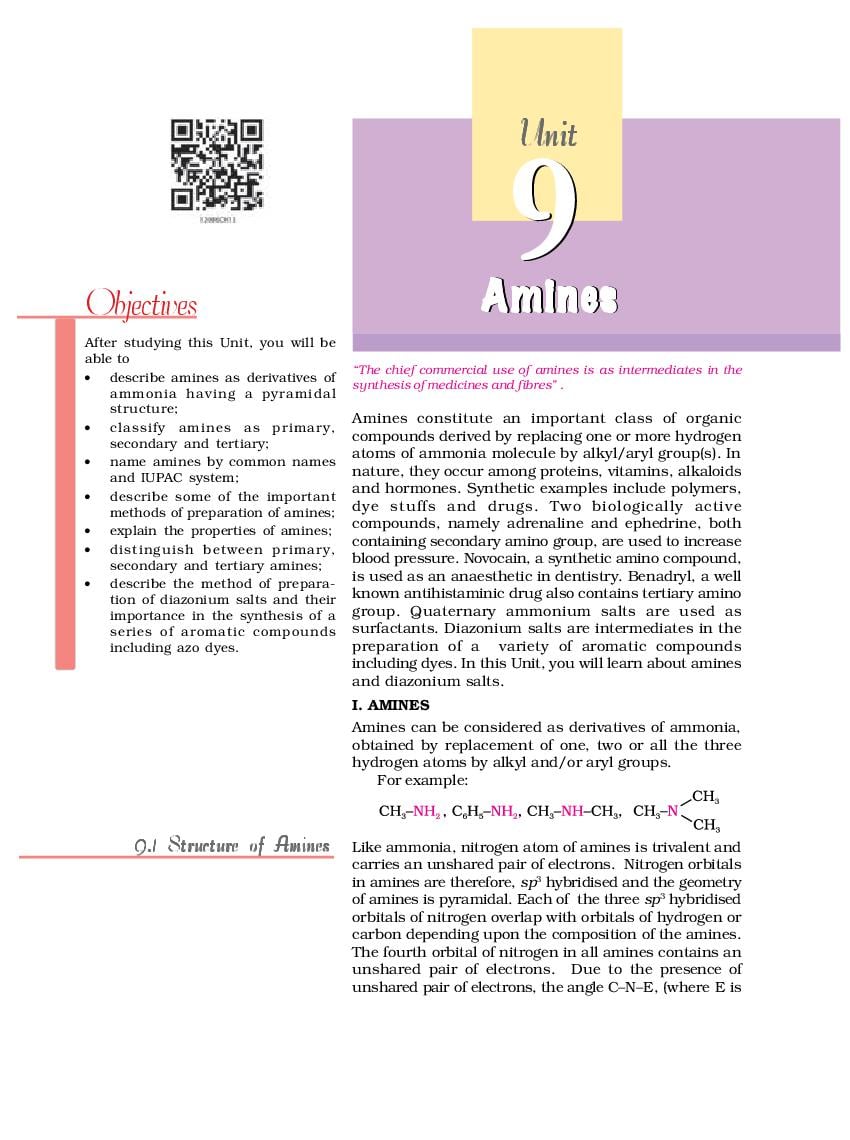
Amines can be considered as derivatives of ammonia,
obtained by replacement of one, two or all the three
hydrogen atoms by alkyl and/or aryl groups.
For example:
9.1 Structure of Amines Like ammonia, nitrogen atom of amines is trivalent and
carries an unshared pair of electrons. Nitrogen orbitals
in amines are therefore, sp3 hybridised and the geometry
of amines is pyramidal. Each of the three sp3 hybridised
orbitals of nitrogen overlap with orbitals of hydrogen or
carbon depending upon the composition of the amines.
The fourth orbital of nitrogen in all amines contains an
unshared pair of electrons. Due to the presence of
unshared pair of electrons, the angle C–N–E, (where E is
Showing the first page only. Download the PDF above for the complete document.
Document Details
| Board / Org | NCERT |
| Exam | Class 12 |
| Type | Books |
| Pages | 22 |
| Updated | 29 Aug 2026 |