DUET 2021 Question Paper M.Phil Ph.D in Economics
Finished viewing? Save it for later —
Download DUET 2021 Question Paper M.Phil Ph.D in Economics (PDF · 14 pages)About DUET 2021 Question Paper M.Phil Ph.D in Economics
DUET 2021 Question Paper M.Phil Ph.D in Economics is available here for free download. Published by NTA for DUET, this question paper can be viewed online or downloaded as a PDF (14 pages). Candidates preparing for DUET can use DUET 2021 Question Paper M.Phil Ph.D in Economics to understand the exam pattern, the type of questions asked, and the overall difficulty level.
Frequently Asked Questions
How can I download DUET 2021 Question Paper M.Phil Ph.D in Economics?
Open this page and click the Download button to save DUET 2021 Question Paper M.Phil Ph.D in Economics as a PDF. It is completely free on AglaSem Docs.
Is DUET 2021 Question Paper M.Phil Ph.D in Economics free to download?
Yes. DUET 2021 Question Paper M.Phil Ph.D in Economics can be viewed online and downloaded as a PDF free of cost on AglaSem Docs.
How many pages does DUET 2021 Question Paper M.Phil Ph.D in Economics have?
DUET 2021 Question Paper M.Phil Ph.D in Economics contains 14 pages, which you can read online or download together as a single PDF.
Where can I find more DUET study material?
You can find more DUET question papers, sample papers, syllabus, and answer keys on AglaSem Docs.
DUET 2021 Question Paper M.Phil Ph.D in Economics – Text
Read the full text of this question paper below — useful to quickly search, copy and reference the content online without downloading the PDF.
📄 View text version (14 pages)
Page 1
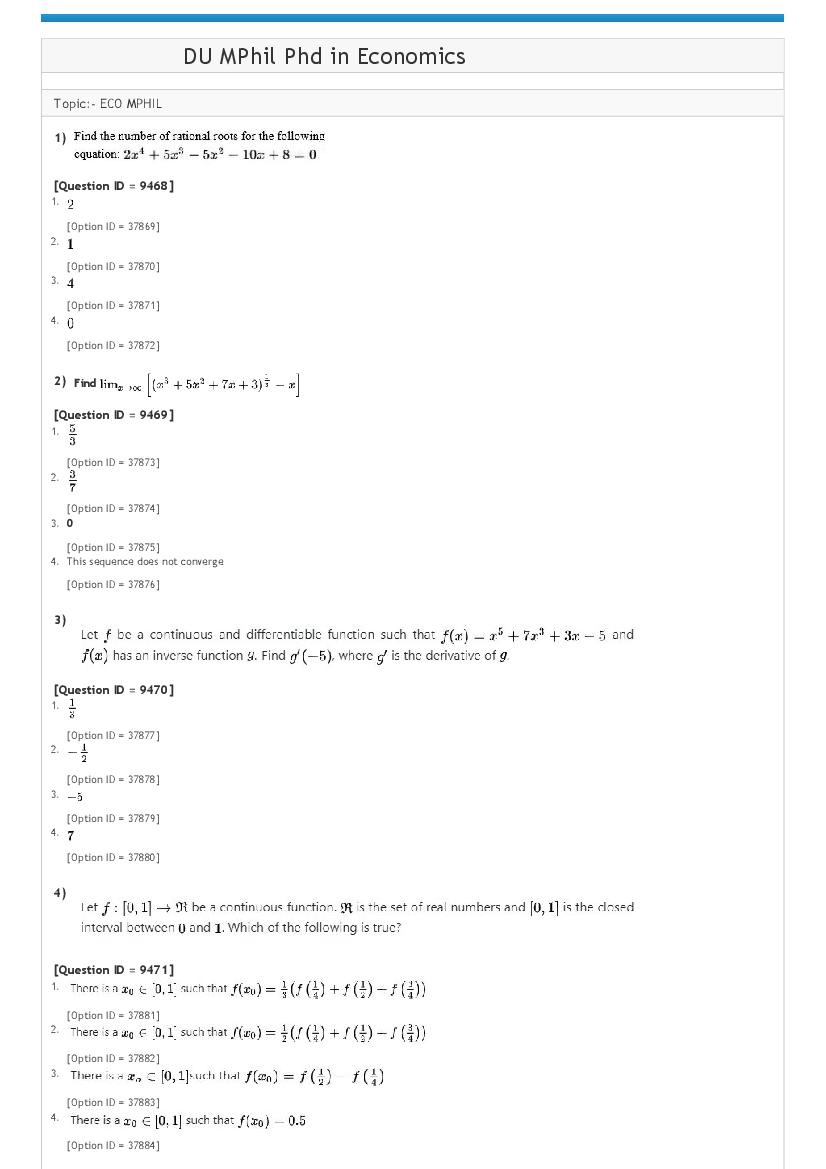
Topic:‐ ECO MPHIL
1)
[Question ID = 9468]
1.
[Option ID = 37869]
2.
[Option ID = 37870]
3.
[Option ID = 37871]
4.
[Option ID = 37872]
2) Find
[Question ID = 9469]
1.
[Option ID = 37873]
2.
[Option ID = 37874]
3. 0
[Option ID = 37875]
4. This sequence does not converge
[Option ID = 37876]
3)
[Question ID = 9470]
1.
[Option ID = 37877]
2.
[Option ID = 37878]
3.
[Option ID = 37879]
4.
[Option ID = 37880]
4)
[Question ID = 9471]
1.
[Option ID = 37881]
2.
[Option ID = 37882]
3.
[Option ID = 37883]
4.
[Option ID = 37884]
Page 2
[Question ID = 9472]
1.
[Option ID = 37885]
2.
[Option ID = 37886]
3.
[Option ID = 37887]
4.
[Option ID = 37888]
6)
[Question ID = 9473]
1.
[Option ID = 37889]
2.
[Option ID = 37890]
3.
[Option ID = 37891]
4.
[Option ID = 37892]
7)
[Question ID = 9474]
1. A = 0
[Option ID = 37893]
2. A has at least two distinct eigenvalues
[Option ID = 37894]
3. A is invertible
[Option ID = 37895]
4. If A is diagonalizable and nilpotent then A = 0
[Option ID = 37896]
8)
[Question ID = 9475]
1. S is a singular matrix
[Option ID = 37897]
2. S is symmetric
[Option ID = 37898]
3. S and M have the same eigenvectors
[Option ID = 37899]
4. S and M have the same eigenvalues
[Option ID = 37900]
9)
Page 3
1.
[Option ID = 37901]
2.
[Option ID = 37902]
3.
[Option ID = 37903]
4.
[Option ID = 37904]
10)
[Question ID = 9477]
1.
[Option ID = 37905]
2.
[Option ID = 37906]
3.
[Option ID = 37907]
4.
[Option ID = 37908]
11)
[Question ID = 9478]
1.
[Option ID = 37909]
2.
[Option ID = 37910]
3.
[Option ID = 37911]
4.
[Option ID = 37912]
12)
[Question ID = 9479]
1. 0
[Option ID = 37913]
2. 1
[Option ID = 37914]
3. 2
[Option ID = 37915]
4. Maximum does not exist
[Option ID = 37916]
13)
Page 4
1. Both Satement I and II are true
[Option ID = 37917]
2. Both Statement I and II are false
[Option ID = 37918]
3. Statement I is true but Statement II is false
[Option ID = 37919]
4. Statement I is false but Statement II is true
[Option ID = 37920]
14)
[Question ID = 9481]
1.
[Option ID = 37921]
2.
[Option ID = 37922]
3.
[Option ID = 37923]
4.
[Option ID = 37924]
15) Which of the following is an open set in under Euclidean distance?
[Question ID = 9482]
1.
[Option ID = 37925]
2.
[Option ID = 37926]
3.
[Option ID = 37927]
4.
[Option ID = 37928]
Page 5
which of the following is true?
[Question ID = 9483]
1. Income effect under Hicksian price decomposition is greater than the income effect under Slutsky's price decomposition
[Option ID = 37929]
2. Income effect under Hicksian price decomposition is less than the income effect under Slutsky's price decomposition
[Option ID = 37930]
3. Income effect under Hicksian price decomposition is the same as the income effect under Slutsky's price decomposition
[Option ID = 37931]
4. Income effect under Hicksian price decomposition and that under Slutsky's price decomposition cannot be ranked. It depends on the utility function.
[Option ID = 37932]
17)
[Question ID = 9484]
1.
[Option ID = 37933]
2.
[Option ID = 37934]
3.
[Option ID = 37935]
4.
[Option ID = 37936]
18) Which of the following statements is true?
[Question ID = 9485]
1. A complete preference is transitive.
[Option ID = 37937]
2. A transitive preference is complete.
[Option ID = 37938]
3. Completeness and transitivity are equivalent.
[Option ID = 37939]
4. Completeness and transitivity are independent.
[Option ID = 37940]
19)
[Question ID = 9486]
1.
[Option ID = 37941]
2.
[Option ID = 37942]
3.
[Option ID = 37943]
4.
[Option ID = 37944]
Page 6
be[Question ID = 9487]
1. Complete and transitive [Option ID = 37945]
2. Complete but not transitive [Option ID = 37946]
3. Transitive but not complete [Option ID = 37947]
4. Neither complete nor transitive [Option ID = 37948]
21) Suppose a buyer wants to purchase a product from a seller. Buyer's maximum willingness to pay and seller's cost are both drawn
independently from the
distribution. What is the expected gains from trade assuming that trade takes place whenever buyer's maximum willingness to pay
exceeds seller's cost?
[Question ID = 9488]
1.
[Option ID = 37949]
2.
[Option ID = 37950]
3.
[Option ID = 37951]
4.
[Option ID = 37952]
22)
[Question ID = 9489]
1.
[Option ID = 37953]
2.
[Option ID = 37954]
3.
[Option ID = 37955]
4.
[Option ID = 37956]
23)
[Question ID = 9490]
1.
[Option ID = 37957]
2.
[Option ID = 37958]
3.
[Option ID = 37959]
4.
[Option ID = 37960]
24)
Page 7
1. Only one strategy profile is Nash equilibrium
[Option ID = 37961]
2. Two strategy profiles are Nash equilibrium
[Option ID = 37962]
3. Five strategy profiles are Nash equilibrium
[Option ID = 37963]
4. There is no Nash equilibrium
[Option ID = 37964]
25)
[Question ID = 9492]
1. None [Option ID = 37965]
2.
[Option ID = 37966]
3.
[Option ID = 37967]
4.
[Option ID = 37968]
26) Which of the following is an example of asymmetric information game?[Question ID = 9493]
1. Chess [Option ID = 37969]
2. Matching coin game [Option ID = 37970]
3. An IPL auction where all bidders are equally informed about the ability and availability of a player [Option ID = 37971]
4. Bargaining between a lender and an unknown borrower [Option ID = 37972]
27)
[Question ID = 9494]
1.
[Option ID = 37973]
2.
[Option ID = 37974]
3.
[Option ID = 37975]
Page 8
[Option ID = 37976]
28)
[Question ID = 9495]
1.
[Option ID = 37977]
2.
[Option ID = 37978]
3.
[Option ID = 37979]
4.
[Option ID = 37980]
29)
[Question ID = 9496]
1.
[Option ID = 37981]
2.
[Option ID = 37982]
3.
[Option ID = 37983]
4.
[Option ID = 37984]
30)
[Question ID = 9497]
1.
[Option ID = 37985]
2.
[Option ID = 37986]
3.
Page 9
4.
[Option ID = 37988]
31)
[Question ID = 9498]
1.
[Option ID = 37989]
2.
[Option ID = 37990]
3.
[Option ID = 37991]
4.
[Option ID = 37992]
32)
[Question ID = 9499]
1.
[Option ID = 37993]
2.
[Option ID = 37994]
3.
[Option ID = 37995]
4.
[Option ID = 37996]
33)
[Question ID = 9500]
1.
[Option ID = 37997]
2.
[Option ID = 37998]
3.
[Option ID = 37999]
4.
[Option ID = 38000]
34)
Page 10
1. Both Statement I and Statement II are true
[Option ID = 38001]
2. Both Statement I and Statement II are false
[Option ID = 38002]
3. Statement I is true but Statement II is false
[Option ID = 38003]
4. Statement I is false but Statement II is true
[Option ID = 38004]
35)
[Question ID = 9502]
1. Consumption increases over time.
[Option ID = 38005]
2. Consumption decreases over time.
[Option ID = 38006]
3. Consumption is constant over time.
[Option ID = 38007]
4. Whether consumption increases, decreases or is constant depends on the specific utility function.
[Option ID = 38008]
36)
[Question ID = 9503]
1. The current consumption is proportion
of the cake left from the last period
[Option ID = 38009]
2. The current consumption is proportion
of the cake left from the last period
[Option ID = 38010]
3. The current consumption is proportion
Page 11
[Option ID = 38011]
4. The current consumption is proportion
of the cake left from the last period
[Option ID = 38012]
37)
[Question ID = 9504]
1.
[Option ID = 38013]
2.
[Option ID = 38014]
3.
[Option ID = 38015]
4.
[Option ID = 38016]
38)
[Question ID = 9505]
1. Price of the perpetuity will be doubled
[Option ID = 38017]
2. Price of the perpetuity will be halved
[Option ID = 38018]
3. A increase in the price of the perpetuity
[Option ID = 38019]
4. A fall in the price of the perpetuity
[Option ID = 38020]
39) Consider a closed economy. Which of the following is correct?
[Question ID = 9506]
1. Both fiscal and monetary policies are effective for unemployment
[Option ID = 38021]
2. Both fiscal and monetary policies are ineffective for unemployment
[Option ID = 38022]
3. Fiscal policy is effective for unemployment and monetary policy is ineffective for unemployment
[Option ID = 38023]
4. Monetary policy is effective for unemployment and fiscal policy is ineffective for unemployment
[Option ID = 38024]
40)
Page 12
1.
[Option ID = 38025]
2.
[Option ID = 38026]
3. ; it is independent of the utility function and capital stock
[Option ID = 38027]
4. ; it is independent of the utility function and capital stock
[Option ID = 38028]
41) Suppose in a linear model estimated using time‐series data using OLS, there is negative residual autocorrelation. What
does it imply?
[Question ID = 9508]
1. There is a cyclical pattern in the residuals
[Option ID = 38029]
2. There is an alternating pattern in the residuals
[Option ID = 38030]
3. The residuals are decreasing over time
[Option ID = 38031]
4. There is a systematic pattern to the residuals but it can be determined only on further inspection.
[Option ID = 38032]
42)
[Question ID = 9509]
1.
[Option ID = 38033]
2.
[Option ID = 38034]
3.
[Option ID = 38035]
4. There is insufficient information to compute this test.
[Option ID = 38036]
43)
[Question ID = 9510]
1.
[Option ID = 38037]
2.
[Option ID = 38038]
3.
[Option ID = 38039]
4.
Page 13
44)
[Question ID = 9511]
1. There is a unique solution to the set of coefficients and a unique solution to the Sum of Square of Residuals
[Option ID = 38041]
2. There is a unique solution to the set of coefficients but a non‐unique solution to the Sum of Square of Residuals
[Option ID = 38042]
3. There is a non‐unique solution to the set of coefficients but a unique solution to the Sum of Square of Residuals
[Option ID = 38043]
4. There is a non‐unique solution to the set of coefficients and a non‐unique solution to the Sum of Square of Residuals
[Option ID = 38044]
45) Estimation of regression coefficients in presence of high but NOT perfect multicollinearity may result in all of these
EXCEPT which of the following:
[Question ID = 9512]
1. Estimates are all Best Linear Unbiased Estimator (BLUE)
[Option ID = 38045]
2. A high Coefficient of determination ( )
[Option ID = 38046]
3. Almost all the estimates are statistically significant
[Option ID = 38047]
4. High confidence intervals for the regression estimates
[Option ID = 38048]
46)
[Question ID = 9513]
1.
[Option ID = 38049]
2.
[Option ID = 38050]
3.
[Option ID = 38051]
4.
[Option ID = 38052]
47)
[Question ID = 9514]
1. Weighted least squares estimation will give zero weight on observations with high variance
[Option ID = 38053]
2. Weighted least squares estimation will give every observation an identical weight
[Option ID = 38054]
3. In weighted least squares, less weight is given to observations with higher variance
[Option ID = 38055]
4. In weighted least squares less weight is given to observations with lower variances
[Option ID = 38056]
48)
Page 14
1. It is biased and inconsistent because of classical errors in variables.
[Option ID = 38057]
2. It is biased but consistent only if the smokers do not avoid covid‐19 test.
[Option ID = 38058]
3. It is unbiased but consistent only if the smokers do not avoid covid‐19 test.
[Option ID = 38059]
4. It is unbiased and consistent
[Option ID = 38060]
49)
[Question ID = 9516]
1.
[Option ID = 38061]
2.
[Option ID = 38062]
3.
[Option ID = 38063]
4.
[Option ID = 38064]
50)
[Question ID = 9517]
1.
[Option ID = 38065]
2.
[Option ID = 38066]
3.
[Option ID = 38067]
4.
[Option ID = 38068]
Document Details
| Board / Org | NTA |
| Exam | DUET |
| Type | Question Paper |
| Pages | 14 |
| Language | english |
| Updated | 30 Apr 2026 |