Karnataka 2nd PUC Question Bank 2026 Electronics and Hardware
Finished viewing? Save it for later —
Download Karnataka 2nd PUC Question Bank 2026 Electronics and Hardware (PDF · 29 pages)About Karnataka 2nd PUC Question Bank 2026 Electronics and Hardware
Karnataka 2nd PUC Question Bank 2026 Electronics and Hardware is available here for free download. Published by Karnataka Board for Class 12, this question bank can be viewed online or downloaded as a PDF (29 pages). Candidates preparing for Class 12 can use Karnataka 2nd PUC Question Bank 2026 Electronics and Hardware to understand the exam pattern, the type of questions asked, and the overall difficulty level.
Frequently Asked Questions
How can I download Karnataka 2nd PUC Question Bank 2026 Electronics and Hardware?
Open this page and click the Download button to save Karnataka 2nd PUC Question Bank 2026 Electronics and Hardware as a PDF. It is completely free on AglaSem Docs.
Is Karnataka 2nd PUC Question Bank 2026 Electronics and Hardware free to download?
Yes. Karnataka 2nd PUC Question Bank 2026 Electronics and Hardware can be viewed online and downloaded as a PDF free of cost on AglaSem Docs.
How many pages does Karnataka 2nd PUC Question Bank 2026 Electronics and Hardware have?
Karnataka 2nd PUC Question Bank 2026 Electronics and Hardware contains 29 pages, which you can read online or download together as a single PDF.
Where can I find more Class 12 study material?
You can find more Class 12 question papers, sample papers, syllabus, and answer keys on AglaSem Docs.
Karnataka 2nd PUC Question Bank 2026 Electronics and Hardware – Text
Read the full text of this question bank below — useful to quickly search, copy and reference the content online without downloading the PDF.
📄 View text version (29 pages)
Page 1
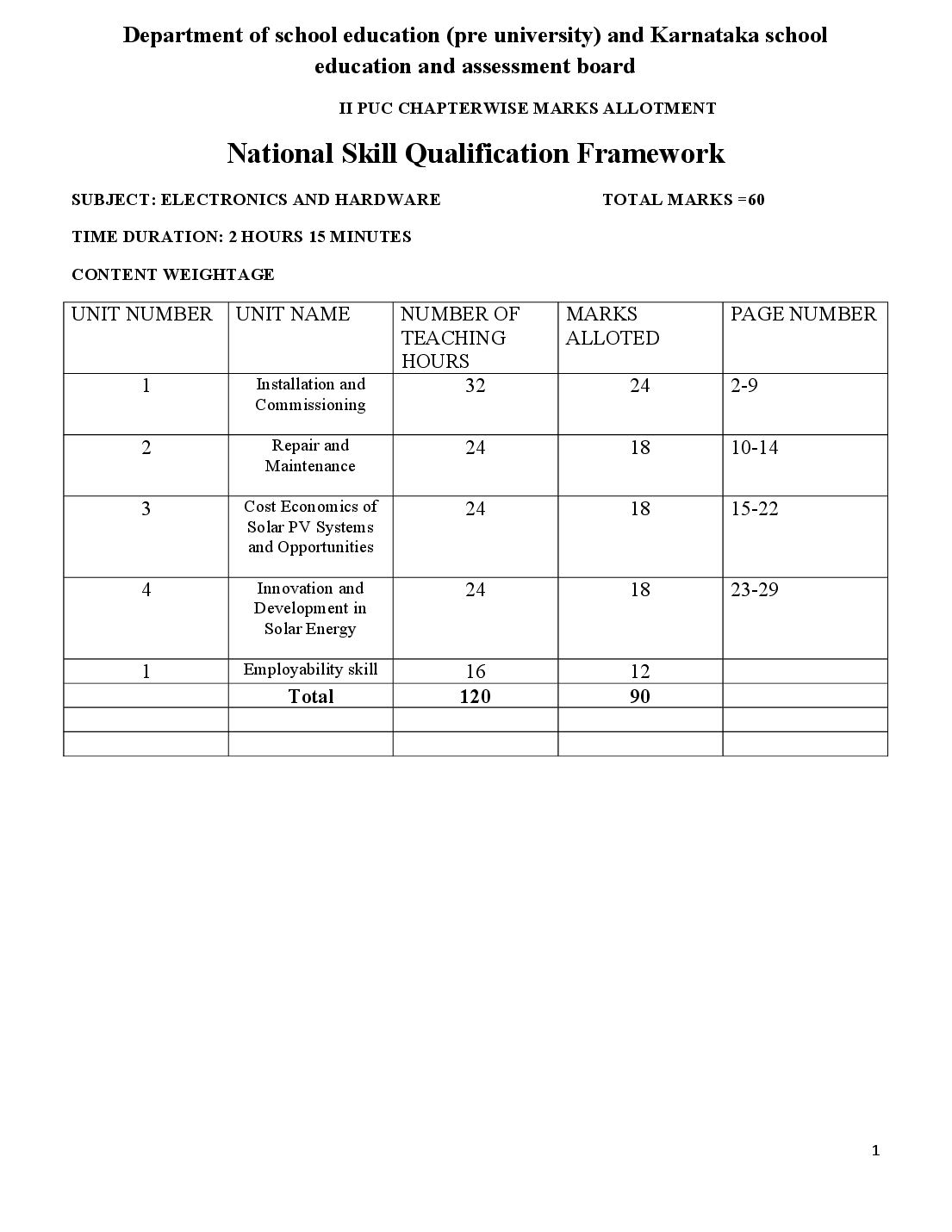
education and assessment board
II PUC CHAPTERWISE MARKS ALLOTMENT
National Skill Qualification Framework
SUBJECT: ELECTRONICS AND HARDWARE TOTAL MARKS =60
TIME DURATION: 2 HOURS 15 MINUTES
CONTENT WEIGHTAGE
UNIT NUMBER UNIT NAME NUMBER OF MARKS PAGE NUMBER
TEACHING ALLOTED
HOURS
1 Installation and 32 24 2-9
Commissioning
2 Repair and 24 18 10-14
Maintenance
3 Cost Economics of 24 18 15-22
Solar PV Systems
and Opportunities
4 Innovation and 24 18 23-29
Development in
Solar Energy
1 Employability skill 16 12
Total 120 90
1
Page 2
UNIT 1:
Installation and Commissioning of Solar Panel System
I. Multiple choice questions
1. Which type of Solar System not required battery. -E
A).On Grid System
B) Off Grid System
C) Hybrid System
D) B & C
2. Which type of solar system needs to be installed where grid power is notavailable? -A
A) On Grid System
B) Off-Grid System
C) Hybrid System
D )None of the above
3. If Grid is not available & we want to operate the Solar System at night,which type of solar system will
require? -E
A) Hybrid System
B) On-grid System
C) Off-grid System
D) a & c
4. Inverter used in which type of Solar system -E
A) On Grid system
B) Hybrid System
C) Off-Grid System
D) All of the above
5. The space needed for a 1KW solar system is ____feet -E
A) 50sq feet B) 80sq feet C) 40sq feet D) 60sq feet
6) In a solar P.V system the hours of isolation are equal to the _______received per square meter
A)Averagemonthly KW-hour -A
B) Average Annually Watt-hour
C) Average daily KW-hour
D) Average monthly Watt-hour
7) As a _______rule , a 10 square meter area for a 1 KW solar system capacity is required -E
A)Thumb rule B)Flemings rule C)Faradays rule D)Lens rule
2
Page 3
A) Inverter B)Battery C)Charge controller D) MC 4wire
9) for a south facing panel the recommended tilt angle is between _____to _____ -E
A)200 to 600 B) 600 TO 1200 C)100 to 300 D) 150 to 600
10) A device used for measuring solar irradiance on a planar surface bymeasuring the solar radiation flux density (in
units of W/m2), is -A
A)Pyranometer
B)Multimeter
C)Ammeter
D)Voltmeter
11. 1 hp equal to? -E
A)800 watts
B)750 watts
C)746 kW
D)746 watts
12. Why is a shading analysis crucial in site selection for a solar project? -E
A)determine the latitude of the site
B)To assess the wind speed
C)To identify obstacles affecting sunlight exposure
D)To evaluate soil conditions
13. What is the typical unit of measurement for solar irradiance as recordedby a pyranometer? -A
A)Watts per square meter (W/m²)
B)Kilowatt-hours (kWh)
C)Joules per second (J/s)
D)Lumens per square meter (lm/m²)
14) The formula of energy required per day is equal to -D
A)Power consumption ∗ Running hour/day
B)Discharge(Q) ∗ Total head(H)/3960
C)Voltage(V) ∗ Current(I)
D)None of the above
15) What is the primary function of an inverter in a solar PV system? -A
A)Convert AC electricity to DC
B)Convert DC electricity to AC
C)Store excess electricity in batteries
D)Measure solar irradiance levels
16. Formula Power is most commonly expressed as -E
A)kW
B) m3/s
C)m/s
D)m/s2
3
Page 4
A)the Utility grid
B)Battery bank
C)Solar panels
D)Load center
18) The series connection of PV module is used for -A
A)Increasing the voltage
B)Decreasing voltage
C)Increasing voltage and current remain same
D)Increasing current
19)The parallel connection of PV module is used for -A
A)Increasing the voltage
B)Decreasing voltage
C)Increasing voltage and current
D)Current increasing and voltage remain same
20)Which direction is best for solar power/ radiation in India? -E
A)East
B)North-west
C)South east
D)South
21)The series connection of PV module is used for -E
A)Increasing the voltage
B)Decreasing voltage
C)Increasing voltage and current remain same
D)Increasing current
22) Which factors that affect the output of Solar Power System -A
A)Tilt angle
B)Cleanliness of Solar Panel Surface
C)Weather Change
D)all of the above
23)The solar module has to be installed at a tilt angle approximately equal to the ____of the area -A
A) Latitude B)Altitude C)Longitude D)All of the above
24)In a series connection of the solar panel the current in that panel is -E
A) Same B)Different C)Zero D)Slightly increases
25) In a parallel connection of the solar panel the current in that panel is -E
A) Same B)Different C)Zero D)Slightly increases
26) In a series connection of the solar panel the voltage in that panel is -E
A) Same B)Different C)Zero D)Slightly increases
27) In a parallel connection of the solar panel the voltage in that panel is -E
A) Same B)Different C)Zero D)Slightly increases
28). What is the first and most important step before designing a solar panel system? -D
a) Buying the solar panels
b) Conducting a site survey
4
Page 5
d) Digging the foundation
29. Which direction is generally considered the best for installing solar panels in India? -E
a) North
b) East
c) West
d) South
30. What is the main function of an inverter in a solar power system? -A
a) To store electricity
b) To convert DC electricity from panels to AC for home use
c) To measure sunlight
d) To support the panels
31. Which tool is used to measure solar radiation? -E
a) Multimeter
b) Pyranometer
c) Thermometer
d) Anemometer
32. In a grid-connected solar system, what happens to the extra electricity produced? -A
a) It is stored in a battery
b) It is lost
c) It is sent back to the electricity grid
d) It is used to heat water
33. What is the approximate space required for a 1 kW solar system? -E
a) 10 square feet
b) 40 square feet
c) 80 square feet
d) 200 square feet
34. Which of these is NOT a main type of solar PV system? -E
a) Grid-connected
b) Off-grid
c) Hybrid
d) Wind-connected
35. What are MC4 connectors used for? -A
a) Connecting solar panels to each other
b) Fixing panels to the roof
c) Measuring system performance
d) Grounding the system
36. For an off-grid system, which additional component is essential? -E
a) Net Meter
b) Battery
5
Page 6
d) Main Grid Connection
37. What is the purpose of the mounting structure? -E
a) To convert DC to AC
b) To hold and support the solar panels at an angle
c) To store solar energy
d) To measure electricity
38. What is the primary function of an inverter in a solar PV system? -A
a) To store electrical energy
b) To convert DC electricity to AC electricity
c) To measure solar radiation
d) To provide structural support
39. For a grid-connected solar system, the excess power generated is fed back to the grid through a mechanism
called -A
a) Charge Controlling
b) Net Metering
c) Shade Analysis
d) Grounding
40. Which instrument is used to measure solar irradiance? -E
a) Multimeter
b) Pyranometer
c) Anemometer
d) Hygrometer
41. The recommended minimum tilt angle for a solar panel to allow self-cleansing by rain is -E
a) 5 degrees
b) 10 degrees
c) 15 degrees
d) 90 degrees
42. In a solar PV system, the component that allows for the safe isolation of DC power during maintenance is the
-E
a) AC Breaker Panel
b) Charge Controller
c) DC Disconnect Switch
d) Energy Meter
43. If three solar panels, each rated at 6V and 3A, are connected in series, the total output voltage and power will
be -A
a) 6V, 54W
b) 18V, 54W
c) 18V, 18W
d) 6V, 18W
6
Page 7
electricity grid? -E
a) Grid-Tied System
b) Hybrid System
c) Off-Grid System
d) Direct-Driven System
45. During a site survey, which factor is analyzed to ensure the solar array receives maximum sunlight between
9:00 am and 3:00 pm? -A
a) Soil Type
b) Shade Analysis
c) Roof Color
d) Existing Electrical Load
46. For a location with a low solar irradiation level, which of the following design considerations is most critical
for component selection? -A
a) Using a larger inverter than calculated
b) Selecting highly efficient solar panels
c) Increasing the battery bank size
d) Using a thicker gauge for DC cables
47. In the context of a solar PV system's structural design, the "worst wind load" is a primary consideration for
determining -D
a) The capacity of the charge controller
b) The depth of the foundation and strength of the mounting structure
c) The optimal tilt angle for summer
d) The rating of the AC disconnect switch
48. A hybrid solar system is distinct from a grid-tied system because it -A
a) Uses a net meter for billing
b) Can operate during a grid outage using stored energy
c) Exports all excess power to the grid
d) Does not require an inverter
49. When performing a shade analysis during a site survey, the critical time frame to ensure maximum sunlight
capture is -D
a) Sunrise to Sunset
b) 12:00 PM to 2:00 PM
c) 9:00 AM to 3:00 PM
d) 11:00 AM to 1:00 PM
50. The primary function of a pyranometer in solar PV system design is to measure -A
a) The wind speed at the site
b) The ambient temperature for panel efficiency correction
c) The global shortwave solar radiation (irradiance)
7
Page 8
51. If the total connected load is 2400W and the inverter power factor is 0.8, what is the minimum kVA rating of
the inverter required to handle the load?
a) 2.0 kVA
b) 2.5 kVA
c) 3.0 kVA
d) 3.5 kVA
52. The main technical reason for recommending a minimum tilt angle of 15 degrees for solar panels is to
a) Maximize exposure to diffuse radiation
b) Allow for self-cleansing by rain
c) Withstand high wind speeds
d) Simplify the mounting structure installation
53. In a system with energy storage, the charge controller is crucial because it directly
a) Converts DC from panels to AC for loads
b) Optimizes power output for the utility grid
c) Regulates battery charging and discharging to extend battery life
d) Measures the net energy exported to the grid
III. Two marks questions
1.List the main components of solar P.V system? -A
2.Explain The climate condition of the site for solar PV system -A
3. explain the Location of solar PV array -A
4. What are the Average sun shine hours on the test day ? -E
5. What is solar array? -E
6. How does inverter work in solar PV system ? -E
7. What is charge controller ? -E
8. What is ON GRIDE system? -A
9. What is OFF GRIDE system? -A
10. What is HYBRIDE system? -A
11. Why Hybrid system is used in solar PV system? -A
12. How pyranometer is used to measured the irradiation of solar power system? A
13.Write the formula for the selection of the inverter -E
14.What are the average sunshine hours in India? -E
15.Write the main components of the grid-connected solar PV system. -E
16.What is tilt angle? -E
17. Write the two types of the solar panel wiring ? -E
18.Write the difference between series ad parallel connections -A
19.Which direction is the face of solar module mount in India? -E
20.Why do we tilt solar panels? -A
21.What is parallel wiring?
22.Write all the steps of Solar PV system installation
23. Why is a site survey necessary before installing a solar system?
24. Name any two main components of a solar PV system.
25. What is the difference between a grid-connected and an off-grid solar system?
26. Why should solar panels be installed in a shadow-free area?
8
Page 9
IV) Three marks questions
1.list of parameters for the site survey and selection of the solar PV system. -A
2. Draw the diagram of Typical layout of grid connected solar PV System -A
3.List the required data for Performance evaluation of solar panel systems -A
4.List the main components of the solar PV system -E
5 Draw flow chart of a hybrid solar system -A
6Write the difference between on grid and off grid system.
7.Short note on shade analysis?
8.Write a short note on net metering.
9.Explain the Grid-connected solar PV system. -E
10.Write the important parameters for solar panel installation and commissioning
11.Write the main components of the grid-connected solar PV system.
12.Draw a Line diagram (layout) of the Solar PV system -A
13.Explain the Foundation Design of solar power system -A
14. If the latitude of roof top of your home is 340, then find the optimum tilt angle for solar panels during winter
and summer. -D
15.Calculate the power, if the 3 P.V panels are connected in series of current produces 3A, across the voltage of
6V each. -A
16.Calculate the power, if the 3 P.V panels are connected in parallel of current produces 3A each, across the
voltage of 6V.
17. Write the difference between series and parallel connections of solar panel.
18.Write all the steps of Solar PV system installation -E
19. List any three important factors to consider during a site survey for a solar installation.
20. Explain the purpose of a charge controller in a solar system with a battery. -A
21. A home has electrical appliances totaling 1200W. If the inverter has a power factor of 0.8, what should be the
VA rating of the inverter? Show your calculation. -A
22. Describe the process of 'net metering' in simple terms. -A
23. Why is the tilt angle of solar panels important? -E
24 "Tilt angle plays a crucial role in the efficiency of a solar panel." Justify this statement -D
V. Six marks questions
1.Briefly explain the parameters for the site survey and selection of the solar PV system -D
2. Explain the main components of solar PV system. -A
3.Explain the ON GRIDE,OFF GRIDE and HYBRIDE system in the solar PV system with diagram. -A
4.ExplainThe important parameters for solar panel installation and commissioning -A
5.Explain theconstruction of the foundation for the solar panel unit
6.With circuit connection diagram Explain the 2 types of solar panel wiring
7. Explain the step-by-step process for installing a solar panel system on a rooftop. -D
8. What are the different types of solar PV systems? Explain any two in detail.
9. Describe the safety checks and performance tests that should be done after installing a solar PV system.
10. Explain with a neat labeled diagram, the various main components of a grid-connected solar PV system and
briefly state the function of any four of them. -A
11.Describe the step-by-step procedure for the construction of the foundation and installation of a ground-mounted
solar panel array -D
12.. With the aid of a labeled block diagram, explain the power flow and the function of each key component in a
Hybrid Solar PV System. Highlight how it provides a power backup facility during a grid outage, which a standard
grid-tied system cannot -A
9
Page 10
Multiple choiceQuestios
1)The “Ω” symbol is used for -E
a) Current
b) Ohm
c) Voltage
d) AC Current
2)When zero load is connected to a PV device means -A
a) Zero Current
b) Zero resistance
c) Zero Voltage
d) Non of the above
3)Which setting should be used to test a fuse? -E
A) Continuity
B) Voltage
C) Current
D) hFE (Hybrid parameter forward current gain, common emitter)
4) What does 1 displayed on the left-hand side of the screen show? -E
a) 1A
b) 1V
c) 1 ohm
d) out of range
5) Which of the following is current measuring tool? -E
a) Voltmeter
b) Ammeter
c) Pyranometer
d Non of the above
6) Which of the following is the best way to clean solar panels? -A
a) Using abrasive soap
b) Using a soft rag or biodegradable soap
c) Using acid wash
d) Using metallic brushes
7) Power washing is risky because A
a) It consumes more water
b) It can damage the glass/metal seal
c) It doesn’t remove dust completely
d) It requires high voltage
10
Page 11
a) High-pressure water
b) Manual brushes
c) Vibration and electrostatic force
d) Compressed air
9) The open-circuit voltage (Voc) is measured when -E
a) Resistance = 0
b) Resistance = ∞
c) Voltage = 0
d) Current = Maximum
10) The short-circuit current (Isc) is measured when -E
a) Resistance = 0
b) Resistance = ∞
c) Voltage = Voc
d) Load = Maximum
11)Which of the following is part of routine maintenance? -A
a) Preventive inspection by technician
b) MMS tightening if needed
c) Replacing solar panels every month
d) Checking solar cell composition
12) Regular maintenance of solar PV systems helps to -A
a) Reduce system lifespan
b) Increase efficiency and output capacity
c) Increase energy losses
d) Decrease equipment safety
13) Which factor increases the shelf life of solar equipment? -E
a) Irregular maintenance
b) Regular monitoring and servicing
c) Keeping equipment idle
d) Using higher loads
14) What should be done if solar panels are shaded due to new buildings? -A
a) Ignore it
b) Move or reposition panels
c) Paint the panel
d) Reduce current
15) Broken solar panel glass should be -A
a) Ignored if small
b) Repaired or replaced immediately
c) Covered with tape
d) Painted black
11
Page 12
a) Voltmeter
b) Clamp-on ammeter
c) Wattmeter
d) Ohmmeter
17) Which of the following is a common cause for low power output of a PV module?
a) Proper tilt angle
b) Accumulation of dust
c) Correct wiring
d) Clean surface
18) What should be maintained by solar pump technicians at every site?
a) Electricity bills
b) Maintenance log books
c) Safety posters
d) Employee details
19) The bypass diode in a solar module helps to:
a) Increase shading
b) Protect against reverse current
c) Reduce insulation
d) Disconnect cables
20) Cables in a solar system should be -E
a) Left loose
b) Installed above the ground
c) Naked and open
d) Painted blue
21) What should be done if there’s corrosion on the support structure? -A
a) Replace immediately
b) Paint regularly to avoid exposure
c) Ignore it
d) Wash with acid
TWO marks questions
1. What do by short circuit current? -E
2.What is open circuit current? -E
3.What is operating current? -E
4.What will happen if the solar panel got damaged? -A
5. Explain Maintenance of solar water pumping system -D
6. What are check points that needs To be maintained in the log book? -A
12
Page 13
8. Why is it not recommended to use an abrasive sponge or soap when cleaning solar panels? -A
9. List any two advantages of automatic solar panel cleaning systems. -E
10. What are the key safety precautions to take while cleaning solar panels on a rooftop? -A
11. Define open-circuit voltage (Voc) and short-circuit current (Isc). -A
12. Mention two routine maintenance activities for a solar water pumping system. -A
13. List any two benefits of regular maintenance of solar PV systems. -A
14. What are the two main causes of charge controller failure? -A
15. Write two precautions to be taken while testing an inverter. -E
16. Mention two points to check during array maintenance. -E
17. What should be done when a PV module shows low power output? D
THREE marksquestions
1. Explain the importance of maintenance.? -A
2. What is the Open circuit voltage? Explain -A
3. Which parameter of the solar panel is measured by a multimeter? -A
4. What are the maintenance and components documents? -E
5. Explain modules and arrays? -E
6. What are the common failures of PV Module? -A
7. Solar panel not generating voltage properly. Write a minimum of three Possible reasons. -D
8. Explain the process of measuring open-circuit voltage (Voc) using a multimeter. -D
9. Describe the working principle of automatic solar panel cleaning technology. -D
10. Write a short note on preventive maintenance of solar water pumping systems. -A
11. Compare manual cleaning and power washing methods for solar panels.
12. Explain the importance of testing solar panels for long-term efficiency. -A
13. Explain the importance of maintaining log books for solar pump installations. -A
14. Describe the steps to check the performance of an inverter.
15. What are the common causes and solutions for low power output in PV modules?
13
Page 14
a) Cable defects and solutions
b) Grounding and safety in PV systems
17. Explain the need for proper documentation in solar PV maintenance.
Six Marks questios
1,Discuss the various cleaning methods of solar panels.? -A
2. Explain Monitoring the Technical Issues and Repair of The Solar PV SystemTroubleshooting -A
3. Describe in detail the various methods of cleaning solar photovoltaic panels. -A
4.Explain theprocedure for testing solar panels using a multimeter (Voc, Isc, and Operating Current). -D
5. Discuss the routine and preventive maintenance practices for a solar water pumping system. -A
6. What are the precautions and safety measures to be followed during solar panel cleaning and maintenance? -A
7. Explain how proper maintenance increases the efficiency and lifespan of solar panels. -A
8. Explain in detail the checklist for solar PV module and array maintenance. -D
9. Discuss the causes, checks, and solutions for common PV module failures. -A
10. Describe the complete maintenance procedure for inverter, wiring, and solar support structures. -E
11. Explain the steps and precautions for inverter testingusing measuring instruments.
12. Discuss theimportance of documentation, monitoring records, and data sheets in solar system maintenance.
14
Page 15
Cost Economics of Solar PV Systems and Opportunities
I.Multiple choice questions
1)The full form LCC is , -E
a)Life cycle cost b)Life cost cycle c)Life circle costd)Life cost cycle
2) A10kw solar PV system is installed ………… per kilowatt -E
a)4500 b)4000 c)3500 d)3000
3)Price of solar PV system is -E
a)7rs/kwh b)6rs/kwh c)5rs /kwh d)9rs /kwh
4)The concept of Net metering is related to -D
a)sewage dumping in the ocean and sea
b)electricity lost during distribution
c)solar energy generation
d)amount of natural gas wasted during tranporation
5)Main components of business strategy -E
a)Mission b) Vision c) Business objective d)All of the above
6)in which installation of 10 lakes grid connected agriculture pump of individual pumpcapacity up to 7.5HP -E
a)component A b)Component B c) component C d) none of the above
7) Important policy name are -E
a)Electricity Act 2003 b)traffic policy 2006 c)the national traffic policy, 2016 d)all of above
8) Which calculation is not included in simple payback? -E
a) Inflation
b) Price
c) Initial cost
d) Subsidy
9)What is the minimum lifespan for a quality solar panel? -E
a) 5 years
b) 10 years
15
Page 16
d) 30 years
10) Which policy is foundational to the solar industry? -E
a) MNRE Policy
b) GST Policy
c) Trade Policy
d) Labor Law
11)What is the main determinant of payback period? -E
a) Panel size
b) Power consumption
c) Installation cost
d) Brand name
12)What is the benchmark cost for systems above 10 KW (General Category)? -A
a) Lower than 1 KW
b) Higher than 1 KW
c) Same as 1 KW
d) No benchmark
13) Which cost influences LCC most in rural installation? -E
a) Labor
b) Panels
c) Land
d) Transportation
14) Net metering allows owners to bank credits for energy in which seasons? -E
a) Summer only
b) Winter only
c) All seasons
d) Monsoon only
15)Annual net metering is different from monthly by? -E
a) Frequency of settlement
b) Energy production
c) Type of panels
d) Installation cost
16
Page 17
a) Panels
b) Mounting equipment
c) Batteries
d) Fuel
17) Which market segment is fastest-growing for solar? -A
a) Residential
b) Industrial
c) Commercial
d) Agricultural
18)Which component regulates power output in PV systems? -E
a) Battery
b) Inverter
c) Mounting
d) Controller
19) Internal rate of return predicts? -E
a) Payback time
b) Net energy
c) Profitability
d) Panel output
20) Which factor impacts cost economics? -E
a) Brand
b) Subsidy
c) Locality
d) All of these
21)Payback period is used for? -A
a) Measuring energy output
b) Cost recovery time
c) Installation speed
d) Subsidy calculation
22)What is the role of a DCDB/ACDB? -A
a) Energy conversion
b) Safety and distribution
17
Page 18
d) Voltage regulation
23)What is a disadvantage of simple payback calculation? -A
A) Ignores maintenance costs
B) Ignores inflation and time value of money
C) Too complex
D) Overestimates subsidies
24) Which component is not part of LCC? -A
A) Initial cost
B) Maintenance cost
C) Operating cost
D) Advertising cost
25)What is meant by ‘avoided cost rate’ in metering? -A
A) Cost saved by using solar
B) Price paid for excess energy
C) Penalty for excess use
D) Storage cost
26)Net metering is most useful for which consumer category? -A
A) Residential
B) Industrial
C) Commercial
D) Agricultural
27) Which market is expected to have highest CAGR in solar pumps? -A
A) North India
B) South India
C) Rural India
D) Urban India
28)Which role is critical in post-installation solar services? -A
A) Installer
B) Manufacturer
C) Maintenance technician
D) Distributor
18
Page 19
A) Installation
B) Manufacturing
C) Consultancy
D) Maintenance
30)Which policy allows credit for excess energy produced? -E
A) Net metering
B) Gross metering
C) Rolling settlement
D) Time-of-use tariff
31)What is NOT an environmental benefit of PV? -A
A) Carbon reduction
B) Water pollution
C) Lower fossil fuel use
D) Energy independence
32) Internal rate of return is used to measure -E
A) Energy output
B) Rate of profitability
C) Payback duration
D) Maintenance cost
33)What is the formula for estimating annual solar energy production?
A) Panel Wattage × Sun hours × Efficiency
B) Panel cost × Hours used
C) Installation cost / Power used
D) None of these
34)Who sets the benchmark costs for grid-connected solar systems?
A) State government
B) Central Electricity Authority (CEA)
C) MNRE
D) Local utilities
35) Which is not included in MNRE eligibility?
A) Farm
B) Urban residence
19
Page 20
D) Industrial manufacturing
36)Subsidy calculation primarily depends on:
A) System size
B) Panel brand
C) Installation date
D) Location only
37) Which component is optional for grid-tied system?
A) Panels
B) Inverter
C) Batteries
D) Controller
2 marks questions
1)What is Life cycle cost? -E
2)List the types panels? -E
3)List the 10kw solar panel assumptions -A
4)What is gross metering method? -E
5)Define component B? -A
6)What is the features of component A? -A
7)Define net metering. -E
8. Name two types of solar panels. -E
9. List two benefits of solar energy. -E
10. Explain life cycle cost. -E
11.What factors affect installation cost? -A
12. Describe the use of energy meters. -E
13. What is the advantage of grid-tied solar systems? -E
14. Name two government schemes promoting solar. -A
15. What is gross metering? -E
16. List two environmental benefits of solar. -E
17. Mention two components besides panels in PV system.
20
Page 21
19. Define payback period. -E
20. Name two solar water pump brands. -A
21. List two hurdles for solar market growth. -A
3 marks questions:
1. Compare monocrystalline and polycrystalline panels. -A
2. Describe steps for site feasibility for solar. -D
3. Explain net metering monthly settlement. -A
4. List three government incentives for solar. -E
5. Write short note on solar water pumps. -A
6. Explain life cycle cost analysis. -A
7. What affects annual solar energy output? -D
8. Describe mounting structures. -A
9. List components of grid-tied PV system. -E
10. Explain importance of subsidies. -A
11. Compare off-grid and grid-tied systems. -A
12. Discuss environmental benefits of solar. -A
13. Write a note on payback calculation. -A
14. Describe solar pump market potential. -E
15. Explain incentive and penalty roles. -A
16. Describe components and installation steps. -A
17. Impact of subsidies on payback period. -A
18. Explain seasonal variations in solar output. -A
19. Detailed note on incentive calculation. -A
20. Essay on environmental benefits in India. -A
21. Discuss solar business roles and market. -A
22. Evaluate government penalties and incentives. -A
23. Analyze factors impacting installation cost. -D
24. Write about solar technologies in India. -A
21
Page 22
1)Calculate the cost of solar panel installation process? -E
2)List the cost of photovoltaic system? -E
3)List the business opportunities solar PV system? -E
4)List the main components of a business strategy? -E
5)Write the important policy names -E
6) Who is eligible for KUSUM scheme? -E
7)Write the benefits of KUSUM scheme? -E
8)Which documents required to apply the KUSUM scheme? -E
9)List the some most successful solar schemes in india? -E
10)What is main strategies to fuel business growth? -A
11)Explain solar system life cycle cost in detail. -A
12. Discuss net metering and monthly/annual settlements. -D
13. Analyze solar water pump business opportunities. -D
14. Write essay on government solar policies. -A
15. Compare gross and net metering with examples. -A
22
Page 23
Business Strategies, Government Scheme and Policy
1. India aims to achieve how much renewable energy capacity by 2030? -E
a) 100 GW
b) 280 GW
c) 450 GW
d) 500 GW
2. India’s first solar-powered EV charging station is known as -E
a) ATUM Charge
b) SunCharge
c) SolarLink
d) EcoVolt
3. Which of the following is not a component of a solar street light? -E
a) Solar panel
b) LED lamp
c) Wind turbine
d) Battery
4.The energy used at night in a solar cold storage system is stored as -E
a) Kinetic energy
b) Latent heat energy
c) Electric energy
d) Sound energy
5. The dish-type solar cooker can reach temperatures up to -E
a) 100°C
b) 250°C
c) 450°C
d) 650°C
6. Floating solar plants are installed mainly on -E
a) Rooftops
b) Land
c) Water surfaces
d) Underground tanks
7. Bifacial solar modules generate power from -E
a) Front side only
b) Back side only
c) Both sides
d) None of the above
23
Page 24
a) To illuminate the LED lamp
b) To regulate the charging of the battery from the solar panel
c) To convert solar energy directly into light
d) To provide structural support to the pole
9. Why are Lithium-ion or LiFePO4 batteries preferred over Lead-acid batteries in modern solar street lights -A
a) They are heavier and cheaper.
b) They require a higher voltage from the solar panel to charge.
c) They are compact, have a longer lifespan, and demand less maintenance.
d) They are less efficient in storing energy.
10. The principle behind a Dish-Type Solar Cooker is -A
a) Trapping heat inside an insulated box
b) Using photovoltaic panels to power an electric heater
c) Concentrating sunlight into a single focal point using a parabolic shape
d) Converting solar energy into wind energy for cooking
11. In a Solar Powered Cold Storage system, what is the purpose of the Thermal Energy Storage (TES)? -A
a) To power the solar panels during the day
b) To store excess solar energy generated during the day for use at night
c) To insulate the cold room from external heat
d) To purify the water used in the system
12. Building-Integrated Photovoltaic (BIPV) are considered advantageous because they -A
a) Are significantly less efficient than traditional panels
b) Replace standard building materials, saving costs and generating power
c) Can only be installed on rooftops
d) Require no sunlight to operate
13. A key advantage of Floating Solar Plants is -A
a) They are significantly cheaper to install than all other solar technologies.
b) They do not consume valuable land area.
c) They generate electricity from both sunlight and water current.
d) They are maintenance-free.
14. In a solar dryer, how is the product dried
a) By direct exposure to solar radiation
b) By immersing the product in hot water
c) By circulating hot, dry air around the product in a closed chamber
d) By using electric heaters powered by solar panels
15. Bifacial solar modules are designed to
a) Generate power only from the top side.
b) Generate power from both the front and back sides.
c) Be flexible and portable.
d) Work only under direct sunlight.
16. The main component used for converting solar energy into electricity in a solar lantern is the
a) LED Lamp
b) Battery
c) Solar Photovoltaic (PV) Panel
24
Page 25
17. Standards for solar panels are crucial for ensuring -A
a) That all panels look the same
b) The safety, reliability, and fair comparison of products
c) That panels are only manufactured by large companies
d) A constant decrease in panel prices
18. What is the main source of energy for a solar charging station? E
a) Wind
b) Sunlight
c) Natural Gas
d) Diesel
19. Which type of lamp is commonly used in modern solar street lights due to its low power and high
illumination? -E
a) Incandescent Bulb
b) CFL Lamp
c) LED Lamp
d) Halogen Lamp
20. What is the primary component that converts sunlight into electricity in a solar lantern?
a) Battery
b) LED Lamp
c) Solar Photovoltaic Panel
d) Switch
21. A Solar Rickshaw is powered by
a) Petrol
b) Diesel
c) An electric motor
d) Human pedaling only
22. In a solar-powered cold storage system, what stores the excess energy during the day for use at night?
a) The Solar Panels
b) The Compressor
c) The Thermal Energy Storage (TES)
d) The Evaporator
23. What is the shape of the dish in a Dish-Type Solar Cooker? -E
a) Flat
b) Spherical
c) Parabolic
d) Rectangular
24. What does a Solar Water ATM use to purify water? -E
a) UV Light
b) Chlorine
c) Reverse Osmosis (RO)
25
Page 26
25. Which technology involves installing solar panels on water bodies? -E
a) BIPV
b) Floating Solar Plants
c) Solar Dryers
d) Flexible Panels
26. Bifacial solar panels can generate electricity from -E
a) The top side only
b) The bottom side only
c) Both the top and bottom sides
d) Neither side
27. Why are standards important for solar panels? -A
a) To make them all look the same
b) To ensure they are safe and reliable
c) To increase their cost
d) To make them heavier
28. In a modern solar street light system using a 3.7V Li-ion battery, the primary role of the charge controller is to
a) Illuminate the LED at full intensity
b) Convert AC from the panel to DC for the battery
c) Regulate the variable voltage/current from the solar panel to safely charge the low-voltage battery
d) Act as a sensor to detect ambient light levels
29. The transition from Lead-acid to LiFePO4 batteries in solar street lights directly addresses which fundamental
limitation of the older technology?
a) The color temperature of the emitted light
b) The need for larger, less efficient solar panels and poor performance in low-light conditions
c) The mechanical strength of the light pole
d) The operating principle of the photovoltaic effect
30. The Thermal Energy Storage (TES) in a solar cold storage unit operates on the principle of
a) Converting electrical energy directly into light energy
b) Storing energy in the form of latent heat during a phase change (e.g., water to ice)
c) Using the thermoelectric effect to create a voltage difference
d) Reflecting solar radiation back into the atmosphere
31. A key functional difference between a Box-Type and a Dish-Type Solar Cooker is that the Dish-Type
a) Uses thermal insulation to trap heat
b) Relies on the photovoltaic effect for cooking
c) Employs geometric concentration to achieve high temperatures suitable for frying
d) Can only be used during the night
32. Building-Integrated Photovoltaics (BIPV) is considered a superior *system-level* solution compared to
traditional rooftop PV because it
a) Has a much higher single-panel efficiency rating
b) Eliminates the cost and material use of a separate mounting structure and substitutes for conventional building
materials
c) Operates without the need for an inverter
d) Does not require any sunlight to function
26
Page 27
a) In a shaded area to protect it from overheating
b) Flat on a dark, non-reflective surface
c) Over a highly reflective surface or with elevated mounting to capture albedo light on the rear side
d) Only in space-based applications
34. In the context of a solar-powered water ATM, the fundamental sequence of energy conversion is -E
a) Chemical Energy → Electrical Energy → Light Energy
b) Solar Radiant Energy → Electrical Energy → Mechanical Energy (for pumping and RO)
c) Thermal Energy → Kinetic Energy → Potential Energy
d) Nuclear Energy → Heat Energy → Electrical Energy
35. The primary technical challenge that Floating Solar Plants solve for large-scale solar deployment is -A
a) Increasing the efficiency of individual solar panels beyond the theoretical limit
b) Eliminating the need for any balance-of-system components like inverters
c) Reducing land acquisition costs and conserving valuable terrestrial land
d) Operating without the need for energy storage systems
36. The "standards" for solar panels, as mentioned in the text, are crucial for an electronics hardware engineer
because they ensure -D
a) All panels are manufactured by the same company
b) Interoperability, safety, and reliable performance metrics for system design and integration
c) That the panels are always the least expensive option
d) Aesthetic uniformity in all installations
37. Analyzing the text, a fundamental principle that allows a solar dryer to be more hygienic than open-air drying
is that it -D
a) Uses ultraviolet radiation to sterilize the product
b) Is a closed-loop system that prevents environmental contamination
c) Cooks the product instead of drying it
d) Operates at sub-zero temperatures
TWO marks questions
1. State any two benefits of using a Solar Charging Station for Electric Vehicles (EVs) -E
2. What are the two main operations that take place simultaneously in a Solar-Powered Cold Storage system
during the daytime? -A
3. How does a Solar Water ATM ensure the provision of clean water? -E
4. Differentiate between the primary applications of a Solar Lantern and a Solar Rickshaw. -A
5. Why are flexible solar panels ideal for portable applications? -A
6. Name any two benefits of using a solar charging station. -E
7. List the main components of a basic solar street light system. -E
8. What are the three main components of a solar lantern? -E
9. State one environmental benefit of using a solar rickshaw. -E
10. What is the main advantage of a Dish-Type Solar Cooker over a Box-Type Solar Cooker? -E
11. From a system design perspective, why is the voltage rating of the battery (e.g., 3.7V Li-ion vs. 12V Lead-
acid) a critical factor in selecting the size and type of the solar panel for a street light? -D
12. How does the principle of a p-n junction in a semiconductor material fundamentally enable the operation of a
solar PV panel? -D
27
Page 28
Storage (TES) unit in a solar cold storage system.
14. Explain why a Dish-Type Solar Cooker can achieve temperatures high enough for frying, while a Box-Type
generally cannot.
15. Why is the "level playing field" created by standardization important for the solar industry and for electronics
engineers?
THREE marks questions
1. Explain in simple steps how a solar street light works. -A
2. Describe how a solar lantern is useful in rural areas. -A
3. What is a Solar Powered Water ATM and how does it work? -E
4. What are Floating Solar Plants? State one advantage they offer. -A
5. Why are flexible solar panels considered ideal for portable applications? -A
6. Compare and contrast the operational challenges of using Lead-acid batteries versus Lithium-ion batteries in
standalone solar street lights. Explain how the battery technology influences the design of the rest of the system.
7. Describe the energy transfer and conversion pathway in a solar-powered bulk milk chiller from the moment
sunlight hits the panels to the point where milk is cooled. -D
8. Critically analyze two reasons why Floating Solar Plants (FPV), despite having a comparable installation cost to
land-based systems, might be considered a more sustainable long-term solution in a land-scarce region. -D
9. Explain the thermodynamic principle that allows a solar dryer to dehydrate food. Your answer should include
the relationship between air temperature, humidity, and water absorption capacity.
10. As an electronics hardware designer, list three specific parameters (besides cost) you would check against
established standards when selecting a solar panel for a reliable rooftop system, and justify your choices. -D
SIX marks questions
1. Explain the basic working principle of a standalone Solar Street Light, naming its key components. -A
2. Compare the old and new battery technologies used in solar street lights, highlighting two advantages of the
newer technology. -D
3. Describe how a Solar Dryer provides a more hygienic way of drying products compared to open-air drying.
4. Explain the concept and one major advantage of Floating Solar Plants. -A
5. What are the benefits of using Bifacial Solar Modules over traditional mono facial panels? -A
6. Explain the working of a solar-powered cold storage system. How does it provide cooling during the night? -A
7. What is Building-Integrated Photovoltaics (BIPV)? List any three benefits of using BIPV. -A
8. Describe the principle and working of a Solar Dryer. Why is it a more hygienic method of drying? -A
28
Page 29
Document Details
| Board / Org | Karnataka Board |
| Exam | Class 12 |
| Type | Question Bank |
| Pages | 29 |
| Language | english |
| Updated | 24 Sep 2026 |