UGC NET 2021 Question Paper Philosophy Shift 2
Finished viewing? Save it for later —
Download UGC NET 2021 Question Paper Philosophy Shift 2 (PDF · 73 pages)About UGC NET 2021 Question Paper Philosophy Shift 2
UGC NET 2021 Question Paper Philosophy Shift 2 is available here for free download. Published by NTA for UGC NET, this question paper can be viewed online or downloaded as a PDF (73 pages). Candidates preparing for UGC NET can use UGC NET 2021 Question Paper Philosophy Shift 2 to understand the exam pattern, the type of questions asked, and the overall difficulty level.
Frequently Asked Questions
How can I download UGC NET 2021 Question Paper Philosophy Shift 2?
Open this page and click the Download button to save UGC NET 2021 Question Paper Philosophy Shift 2 as a PDF. It is completely free on AglaSem Docs.
Is UGC NET 2021 Question Paper Philosophy Shift 2 free to download?
Yes. UGC NET 2021 Question Paper Philosophy Shift 2 can be viewed online and downloaded as a PDF free of cost on AglaSem Docs.
How many pages does UGC NET 2021 Question Paper Philosophy Shift 2 have?
UGC NET 2021 Question Paper Philosophy Shift 2 contains 73 pages, which you can read online or download together as a single PDF.
Where can I find more UGC NET study material?
You can find more UGC NET question papers, sample papers, syllabus, and answer keys on AglaSem Docs.
UGC NET 2021 Question Paper Philosophy Shift 2 – Text
Read the full text of this question paper below — useful to quickly search, copy and reference the content online without downloading the PDF.
📄 View text version (73 pages)
Page 1
Topic:‐ GP_20NOV_A_SH2
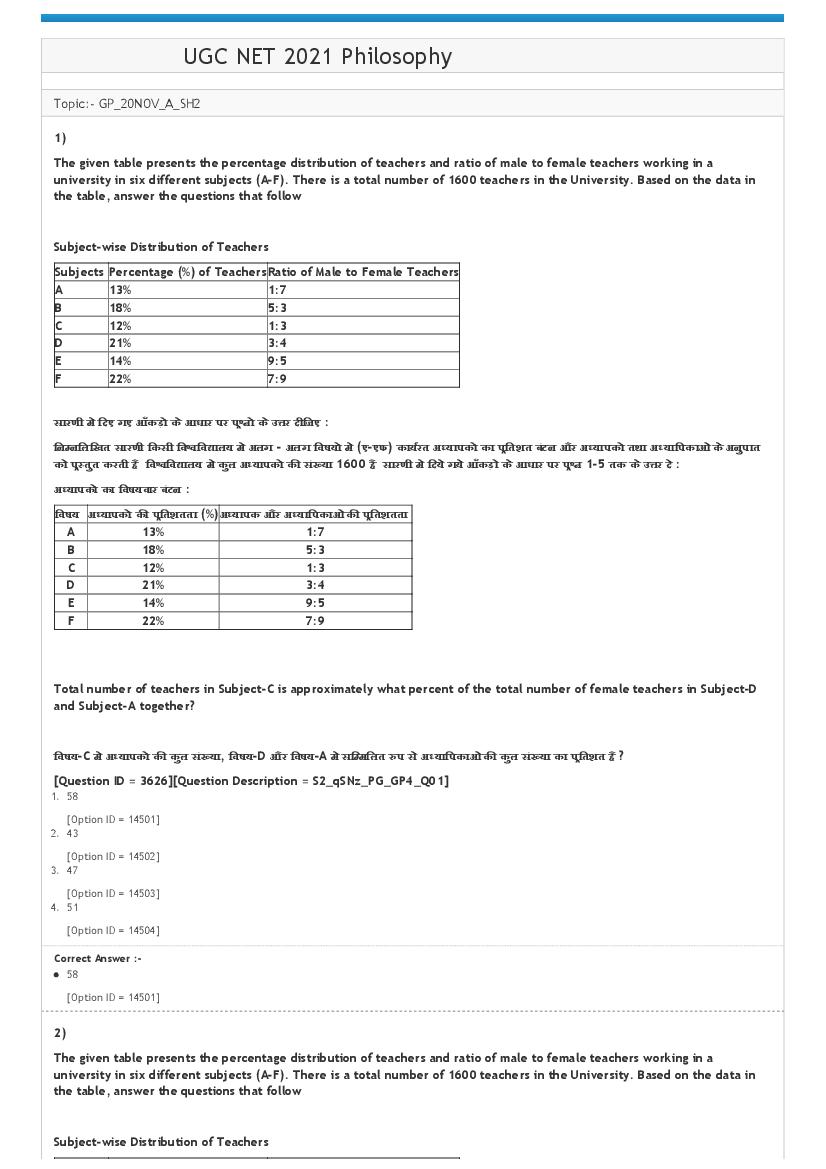
1)
The given table presents the percentage distribution of teachers and ratio of male to female teachers working in a
university in six different subjects (A‐F). There is a total number of 1600 teachers in the University. Based on the data in
the table, answer the questions that follow
Subject‐wise Distribution of Teachers
Subjects Percentage (%) of TeachersRatio of Male to Female Teachers
A 13% 1:7
B 18% 5:3
C 12% 1:3
D 21% 3:4
E 14% 9:5
F 22% 7:9
सारणी म िदए गए आँकड़ के आधार पर प के उ र दीिजए :
िन निलिखत सारणी िकसी िव िव ालय म अलग ‐ अलग िवषय म (ए‐एफ) कायरत अ यापक का पितशत बंटन और अ यापक तथा अ यािपकाओं के अनुपात
को प तुत करती है िव िव ालय म कुल अ यापक क सं या 1600 है सारणी म िदये गये आँकड़ो के आधार पर प 1‐5 तक के उ र द :
अ यापक का िवषयवार बंटन :
िवषय अ यापक क पितशतता (%)अ यापक और अ यािपकाओं क पितशतता
A 13% 1:7
B 18% 5:3
C 12% 1:3
D 21% 3:4
E 14% 9:5
F 22% 7:9
Total number of teachers in Subject‐C is approximately what percent of the total number of female teachers in Subject‐D
and Subject‐A together?
िवषय‐C म अ यापक क कुल सं या, िवषय‐D और िवषय‐A म सि मिलत प से अ यािपकाओं क कुल सं या का पितशत है ?
[Question ID = 3626][Question Description = S2_qSNz_PG_GP4_Q01]
1. 58
[Option ID = 14501]
2. 43
[Option ID = 14502]
3. 47
[Option ID = 14503]
4. 51
[Option ID = 14504]
58
[Option ID = 14501]
2)
The given table presents the percentage distribution of teachers and ratio of male to female teachers working in a
university in six different subjects (A‐F). There is a total number of 1600 teachers in the University. Based on the data in
the table, answer the questions that follow
Subject‐wise Distribution of Teachers
Page 2
A 13% 1:7
B 18% 5:3
C 12% 1:3
D 21% 3:4
E 14% 9:5
F 22% 7:9
सारणी म िदए गए आँकड़ के आधार पर प के उ र दीिजए :
िन निलिखत सारणी िकसी िव िव ालय म अलग ‐ अलग िवषय म (ए‐एफ) कायरत अ यापक का पितशत बंटन और अ यापक तथा अ यािपकाओं के अनुपात
को प तुत करती है िव िव ालय म कुल अ यापक क सं या 1600 है सारणी म िदये गये आँकड़ो के आधार पर प 1‐5 तक के उ र द :
अ यापक का िवषयवार बंटन :
िवषय अ यापक क पितशतता (%)अ यापक और अ यािपकाओं क पितशतता
A 13% 1:7
B 18% 5:3
C 12% 1:3
D 21% 3:4
E 14% 9:5
F 22% 7:9
What is the difference between the total number of teachers in Subject‐F and the total number of male teachers in
Subject‐A and Subject‐B together?
िवषय‐F म कुल अ यापक क सं या और िवषय‐A तथा िवषय‐B म सि मिलत प से अ यापक क सं या के बीच िकतना अंतर है ?
[Question ID = 3627][Question Description = S2_qSNz_PG_GP4_Q02]
1. 192
[Option ID = 14505]
2. 182
[Option ID = 14506]
3. 146
[Option ID = 14507]
4. 136
[Option ID = 14508]
192
[Option ID = 14505]
3)
The given table presents the percentage distribution of teachers and ratio of male to female teachers working in a
university in six different subjects (A‐F). There is a total number of 1600 teachers in the University. Based on the data in
the table, answer the questions that follow
Subject‐wise Distribution of Teachers
Subjects Percentage (%) of TeachersRatio of Male to Female Teachers
A 13% 1:7
B 18% 5:3
C 12% 1:3
D 21% 3:4
E 14% 9:5
F 22% 7:9
सारणी म िदए गए आँकड़ के आधार पर प के उ र दीिजए :
िन निलिखत सारणी िकसी िव िव ालय म अलग ‐ अलग िवषय म (ए‐एफ) कायरत अ यापक का पितशत बंटन और अ यापक तथा अ यािपकाओं के अनुपात
को प तुत करती है िव िव ालय म कुल अ यापक क सं या 1600 है सारणी म िदये गये आँकड़ो के आधार पर प 1‐5 तक के उ र द :
Page 3
िवषय अ यापक क पितशतता (%)अ यापक और अ यािपकाओं क पितशतता
A 13% 1:7
B 18% 5:3
C 12% 1:3
D 21% 3:4
E 14% 9:5
F 22% 7:9
What is the difference between the number of female teachers in Subject‐F and the number of male teachers in Subject‐
C?
िवषय‐F म अ यािपकाओं क सं या और िवषय‐C म अ यापक क सं या के बीच िकतना अंतर है ?
[Question ID = 3628][Question Description = S2_qSNz_PG_GP4_Q03]
1. 156
[Option ID = 14509]
2. 160
[Option ID = 14510]
3. 150
[Option ID = 14511]
4. 153
[Option ID = 14512]
156
[Option ID = 14509]
4)
The given table presents the percentage distribution of teachers and ratio of male to female teachers working in a
university in six different subjects (A‐F). There is a total number of 1600 teachers in the University. Based on the data in
the table, answer the questions that follow
Subject‐wise Distribution of Teachers
Subjects Percentage (%) of TeachersRatio of Male to Female Teachers
A 13% 1:7
B 18% 5:3
C 12% 1:3
D 21% 3:4
E 14% 9:5
F 22% 7:9
सारणी म िदए गए आँकड़ के आधार पर प के उ र दीिजए :
िन निलिखत सारणी िकसी िव िव ालय म अलग ‐ अलग िवषय म (ए‐एफ) कायरत अ यापक का पितशत बंटन और अ यापक तथा अ यािपकाओं के अनुपात
को प तुत करती है िव िव ालय म कुल अ यापक क सं या 1600 है सारणी म िदये गये आँकड़ो के आधार पर प 1‐5 तक के उ र द :
अ यापक का िवषयवार बंटन :
िवषय अ यापक क पितशतता (%)अ यापक और अ यािपकाओं क पितशतता
A 13% 1:7
B 18% 5:3
C 12% 1:3
D 21% 3:4
E 14% 9:5
F 22% 7:9
What is the total number of male teachers in the University?
Page 4
[Question ID = 3629][Question Description = S2_qSNz_PG_GP4_Q04]
1. 696
[Option ID = 14513]
2. 702
[Option ID = 14514]
3. 712
[Option ID = 14515]
4. 668
[Option ID = 14516]
696
[Option ID = 14513]
5)
The given table presents the percentage distribution of teachers and ratio of male to female teachers working in a
university in six different subjects (A‐F). There is a total number of 1600 teachers in the University. Based on the data in
the table, answer the questions that follow
Subject‐wise Distribution of Teachers
Subjects Percentage (%) of TeachersRatio of Male to Female Teachers
A 13% 1:7
B 18% 5:3
C 12% 1:3
D 21% 3:4
E 14% 9:5
F 22% 7:9
सारणी म िदए गए आँकड़ के आधार पर प के उ र दीिजए :
िन निलिखत सारणी िकसी िव िव ालय म अलग ‐ अलग िवषय म (ए‐एफ) कायरत अ यापक का पितशत बंटन और अ यापक तथा अ यािपकाओं के अनुपात
को प तुत करती है िव िव ालय म कुल अ यापक क सं या 1600 है सारणी म िदये गये आँकड़ो के आधार पर प 1‐5 तक के उ र द :
अ यापक का िवषयवार बंटन :
िवषय अ यापक क पितशतता (%)अ यापक और अ यािपकाओं क पितशतता
A 13% 1:7
B 18% 5:3
C 12% 1:3
D 21% 3:4
E 14% 9:5
F 22% 7:9
Which is the ratio of the number of female teachers in Subject‐E to the number of male teachers in Subject‐D?
िवषय‐E म अ यािपकाओं क सं या के पितशत का अनुपात िवषय‐D म अ यापक क सं या का िकतना है ?
[Question ID = 3630][Question Description = S2_qSNz_PG_GP4_Q05]
1. 5 : 9
[Option ID = 14517]
2. 2 : 9
[Option ID = 14518]
3. 3 : 7
[Option ID = 14519]
4. 5 : 3
[Option ID = 14520]
5:9
[Option ID = 14517]
Page 5
1) The variability or flexibility of delivery during the presentation of a lesson by a teacher is called as
एक अ यापक ारा पाठ के प तुतीकरण के दौरान प तुित के प रवतनशीलता अथवा न यता को िकस प म जाना जाता है ?
[Question ID = 3631][Question Description = S2_qSNz_PG_GP4_Q06]
1. Thinking curriculum/िचंतन पा यकम [Option ID = 14521]
2. Instructional variety/नैिमि क िविवधता [Option ID = 14522]
3. Comprehension/समझ [Option ID = 14523]
4. Procedural knowledge/पिकया मक ान [Option ID = 14524]
Thinking curriculum/िचंतन पा यकम [Option ID = 14521]
2) Ministry of Education, Government of India's, SWAYAM platform for offering MOOCs has how many quadrants for
designing courses?
भारत सरकार के िश ा मंतालय ारा संचािलत एम.ओ.ओ. सी. (MOOCs) पदान करने हेतु वयं (SWAYAM) मंच के कोस को बनाने (िडजाइिनंग) के िलए
िकतने चतुथक है ?
[Question ID = 3632][Question Description = S2_qSNz_PG_GP4_Q07]
1. 2 Quadrants/2 चतुथक [Option ID = 14525]
2. 4 Quadrants/4 चतुथक [Option ID = 14526]
3. 6 Quadrants/6 चतुथक [Option ID = 14527]
4. 8 Quadrants/8 चतुथक [Option ID = 14528]
2 Quadrants/2 चतुथक [Option ID = 14525]
3) Given below are two statements
Statement I: All components of working memory are in place by the age of 4 in a child as a development stage
Statement II: If a child does not continue to pay attention to information, the activation level weakens and finally drops so
low that the information cannot be reactivated and it disappears altogether
In light of the above statements, choose the most appropriate answer from the options given below
नीचे दो कथन िदए गए ह :
कथन ‐ I : िवकास क अव था के प म 4 वष क उम के बालक म िकयाशील मृित के सभी घटक अपने थान पर होते ह
कथन ‐ II : सूचनाओं के पित यिद एक बालक लगातार यान नह देता, तो उ पेरण तर कमजोर होता है और अ त म इतना िगर जाता है िक सूचना को पुनः
उ पे रत नह िकया जा सकता और यह पूण प से िवलु हो जाता है
उपरो कथन के आलोक म, नीचे िदए गए िवक प म से सही उ र का चयन क िजए :
[Question ID = 3633][Question Description = S2_qSNz_PG_GP4_Q08]
1. Both Statement I and Statement II are correct/कथन I और II दोन सही ह [Option ID = 14529]
2. Both Statement I and Statement II are incorrect/कथन I और II दोन गलत ह [Option ID = 14530]
3. Statement I is correct but Statement II is incorrect/कथन I सही है, िक तु कथन II गलत है [Option ID = 14531]
4. Statement I is incorrect but Statement II is correct/कथन I गलत है, िक तु कथन II सही है [Option ID = 14532]
Both Statement I and Statement II are correct/कथन I और II दोन सही ह [Option ID = 14529]
4) Match List I with List II
Neural system of BrainType of Memory
A. Conscious I. Implicit Memory
B. Unconscious II. Procedural Memory
C. Motor skills III. Explicit Memory
D. Own experiences IV. Episodic Memory
Choose the correct answer from the options given below:
सूची ‐I को सूची ‐II से सुमेिलत क िजए :
सूची ‐I सूची ‐II
(मि त क का यूरॉन संबंधी तंत) ( मृित पकार)
A. चेतन I. अंतिनिहत मृित
B. अचेतन II. कायिविधक मृित
Page 6
D. आ मानुभव IV. सांयोिगक मृित
नीचे िदए गए िवक प म से सही उ र चुिनए :
[Question ID = 3634][Question Description = S2_qSNz_PG_GP4_Q09]
1. A ‐ IV, B ‐ III, C ‐ I, D ‐ II [Option ID = 14533]
2. A ‐ III, B ‐ I, C ‐ II, D ‐ IV [Option ID = 14534]
3. A ‐ I, B ‐ II, C ‐ IV, D ‐ III [Option ID = 14535]
4. A ‐ II, B ‐ IV, C ‐ III, D ‐ I [Option ID = 14536]
A ‐ IV, B ‐ III, C ‐ I, D ‐ II [Option ID = 14533]
5) Cognitive domain for behavioural objectives comprises which of these objectives?
A. Evaluation
B. Valuing
C. Comprehension
D. Precision
E. Knowledge
Choose the correct answer from the options given below:
यवहारवादी उ े य के िलए सं ाना मक ेत म इन उ े य को समािव िकया जाता है :
A. मू यांकन
B. मू य िनधारण करना
C. समझ
D. यथाथता
E. ान
नीचे िदए गए िवक प म से सही उ र चुन :
[Question ID = 3635][Question Description = S2_qSNz_PG_GP4_Q10]
1. A, B and C only/केवल A, B, C
[Option ID = 14537]
2. B, C and D only/केवल B, C, D
[Option ID = 14538]
3. A, C and E only/केवल A, C, E
[Option ID = 14539]
4. C, D and E only/केवल C, D, E
[Option ID = 14540]
A, B and C only/केवल A, B, C
[Option ID = 14537]
6) During research when we avoid speculative and metaphysical approaches and instead concentrate on studying
observable facts, it is called:
शोध के दौरान जब हम मीमांसा मक और ताि वक ि कोण से बचते ह और पे णीय त य पर यान केि दत करते ह तो इसे िन निलिखत म से या कहा जाता है
:
[Question ID = 3636][Question Description = S2_qSNz_PG_GP4_Q11]
1. Feminism/नारीवाद [Option ID = 14541]
2. Ethnomethodology/नृजाितिव ान [Option ID = 14542]
3. Constructionism/संरचना मकता [Option ID = 14543]
4. Positivism/िन या मकता [Option ID = 14544]
Feminism/नारीवाद [Option ID = 14541]
7) In research, the combination of different methods, study groups, local and temporal settings, and different theoretical
perspectives in dealing with a phenomenon is called:
Page 7
[Question ID = 3637][Question Description = S2_qSNz_PG_GP4_Q12]
1. Triangulation/ितभुजन [Option ID = 14545]
2. Content analysis/िवषय सामगी िव ेषण [Option ID = 14546]
3. Corpus/कापस [Option ID = 14547]
4. Mediation/म य थता [Option ID = 14548]
Triangulation/ितभुजन [Option ID = 14545]
8) Identify the CORRECT sequence of steps for the centroid method of factor analysis
A. Work out the sum of coefficients in each column of the correlation matrix
B. Compute a matrix of correlation
C. Obtain the Sum (T) of columns
D. Divide the sum of each column by the square root of (T)
Choose the correct answer from the options given below
फै टर िव े ण क के दक प ित के िलए कदम के सहीकम क पहचान कर :
ष
A. सहसंबंध मैिट स के प येक कालम म गुणांक का योगफल िनकाल
B. सहसंबंध के मैिट स क गणना कर
C. कालम का योगफल (T) पा कर
D. प येक कालम के योगफल को (T) के वगमूल से िवभािजत कर
नीचे िदए गए िवक प म से सही उ र चुन :
[Question ID = 3638][Question Description = S2_qSNz_PG_GP4_Q13]
1. A, C, D, B [Option ID = 14549]
2. C, B, A, D [Option ID = 14550]
3. B, A, C, D [Option ID = 14551]
4. B, C, A, D [Option ID = 14552]
A, C, D, B [Option ID = 14549]
9) Match List I with List II for scale construction techniques
List I List II
A.
I. Number of individual items are developed into
Arbitrary
a test which is given to a group of respondents
approach
B.
Consensus II. Scale is developed on an ad‐hoc basis
approach
C. Item III. Chosen on the basis of their conforming to
Analysis some ranking of items with ascending and
approach descending discriminating power
D.
IV. Panel of Judges evaluate the items chosen
Cumulative
for inclusion in the instrument
scales
Choose the correct answer from the options given below:
सूची ‐I को सूची ‐II से सुमेिलत क िजए :
सूची ‐I सूची ‐II
A. या ि छक I. अलग‐अलग मद क सं या को एक पाठ म िवकिसत िकया जाता है
ि कोण िजसे उ रदाताओं के समूह को िदया जाता है
B. सवस मत
II. तदथ आधार पर पैमाने को िवकिसत िकया जाता है
ि कोण
Page 8
ष सिहत कुछ मद क शेणीकरण
ि कोण क अनु पता के आधार पर चयिनत
D. संचयी IV. िलखत म शािमल करने के िलए चुनी गई मद का मू यांकन करने के
पैमाना िलए िनणायक का पैनल
नीचे िदए गए िवक प म से सही उ र चुिनए :
[Question ID = 3639][Question Description = S2_qSNz_PG_GP4_Q14]
1. A ‐ III, B ‐ II, C ‐ I, D ‐ IV
[Option ID = 14553]
2. A ‐ II, B ‐ IV, C ‐ I, D ‐ III
[Option ID = 14554]
3. A ‐ I, B ‐ III, C ‐ II, D ‐ IV
[Option ID = 14555]
4. A ‐ IV, B ‐ I, C ‐ III, D ‐ II
[Option ID = 14556]
A ‐ III, B ‐ II, C ‐ I, D ‐ IV
[Option ID = 14553]
10) Given below are two statements
Statement I: The base of the binary number system is 2.
Statement II: Binary addition is just like decimal addition except that the rules are much simpler.
In light of the above statements, choose the correct answer from the options given below
नीचे दो कथन िदए गए ह :
कथन ‐ I : ि आधारी सं या पणाली का आधार 2 है
कथन ‐ II : ि आधारी योग, दशमलव जोड़ के समान ही होता है िसवाय इसके िक िनयम काफ सरल ह
उपरो कथन के आलोक म, नीचे िदए गए िवक प म से सही उ र का चयन क िजए :
[Question ID = 3640][Question Description = S2_qSNz_PG_GP4_Q15]
1. Both Statement I and Statement II are true/कथन I और II दोन स य ह [Option ID = 14557]
2. Both Statement I and Statement II are false/कथन I और II दोन अस य ह [Option ID = 14558]
3. Statement I is true but Statement II is false/कथन I स य है , िक तु कथन II अस य है [Option ID = 14559]
4. Statement I is false but Statement II is true/कथन I अस य है , िक तु कथन II स य है [Option ID = 14560]
Both Statement I and Statement II are true/कथन I और II दोन स य ह [Option ID = 14557]
11) More and more informal exchanges within a group to resolve conflicts is an example of
टकराव का समाधान करने के िलए एक समूह के भीतर अिधक से अिधक अनौपचा रक आदान‐पदान उदाहरण है ‐
[Question ID = 3641][Question Description = S2_qSNz_PG_GP4_Q16]
1. Vertical communication/उ वाधर संपषे ण का [Option ID = 14561]
2. Horizontal communication/ िै तज संपष े ण का [Option ID = 14562]
3. Risk communication/जोिखम संपष े ण का [Option ID = 14563]
4. Personal communication/वैयि क संपष े ण का [Option ID = 14564]
Vertical communication/उ वाधर संपष
े ण का [Option ID = 14561]
12) Which of the following are identified as verbal communication skills?
A. Use of aggressive language
B. Assertiveness
C. Opening feedback channels
D. Taking credit for oneself
E. Use of affirmative words
Choose the correct answer from the options given below:
Page 9
A. आकामक भाषा का पयोग
B. आगिहता
C. फ डबैक के चैनल का पावधान
D. वयं को शेय देना
E. वीकारा मक श द का पयोग
नीचे िदए गए िवक प म से सही उ र चुन :
[Question ID = 3642][Question Description = S2_qSNz_PG_GP4_Q17]
1. A, B and C only/केवल A, B और C [Option ID = 14565]
2. B, C and D only/केवल B, C और D [Option ID = 14566]
3. C, D and E only/केवल C, D और E [Option ID = 14567]
4. B, C and E only/केवल B, C और E [Option ID = 14568]
A, B and C only/केवल A, B और C [Option ID = 14565]
13) Given below are two statements
Statement I: Body language is the basis of deceptive communication.
Statement II: Non‐verbal cues have their own shared meanings.
In light of the above statements, choose the correct answer from the options given below
नीचे दो कथन िदए गए ह :
कथन ‐ I : सांकिे तक भाषा, भामक भाषा का आधार होती है
कथन ‐ II : गैर‐वािचक संकेत का अपना साझा अथ होता है
उपरो कथन के आलोक म, नीचे िदए गए िवक प म से सही उ र का चयन क िजए :
[Question ID = 3643][Question Description = S2_qSNz_PG_GP4_Q18]
1. Both Statement I and Statement II are true/कथन I और II दोन स य ह [Option ID = 14569]
2. Both Statement I and Statement II are false/कथन I और II दोन अस य ह [Option ID = 14570]
3. Statement I is true but Statement II is false/कथन I स य है , िक तु कथन II अस य है [Option ID = 14571]
4. Statement I is false but Statement II is true/कथन I अस य है , िक तु कथन II स य है [Option ID = 14572]
Both Statement I and Statement II are true/कथन I और II दोन स य ह [Option ID = 14569]
14) Identify the CORRECT sequence of categories of grapevine communication
A. Cluster chain
B. Probability chain
C. Gossip chain
D. Single strand chain
Choose the correct answer from the options given below
जनपवाद संपेषण क शेिणय के सही कम क पहचान कर :
A. समूह शख
ंृ ला
B. संभा यता शख
ंृ ला
C. गपशप शख
ंृ ला
D. एकल टांड शख
ंृ ला
नीचे िदए गए िवक प म से सही उ र चुन :
[Question ID = 3644][Question Description = S2_qSNz_PG_GP4_Q19]
1. A, B, C, D [Option ID = 14573]
2. B, C, D, A [Option ID = 14574]
3. D, C, B, A [Option ID = 14575]
4. C, D, A, B [Option ID = 14576]
A, B, C, D [Option ID = 14573]
Page 10
List I List II
Categories of communication Features
A. Lateral I. Touch communication
B. Haptics II. Between equals
C. Semantics III. Interpretation of signs
D. Semiotics IV. Concerned with meanings
Choose the correct answer from the options given below:
सूची ‐I को सूची ‐II से सुमेिलत क िजए :
सूची ‐I सूची ‐II
(संपेषण शेिणयाँ) (िवशेषताएँ)
A. पाि क I. संपेषण पश
B. पश िव ान II. समक के बीच संपेषण
C. अथपूरक III. संकेत क या या
D. सांकिे तक IV. अथ से संबंिधत
नीचे िदए गए िवक प म से सही उ र चुिनए :
[Question ID = 3645][Question Description = S2_qSNz_PG_GP4_Q20]
1. A ‐ II, B ‐ I, C ‐ IV, D ‐ III [Option ID = 14577]
2. A ‐ III, B ‐ II, C ‐ I, D ‐ IV [Option ID = 14578]
3. A ‐ IV, B ‐ III, C ‐ II, D ‐ I [Option ID = 14579]
4. A ‐ I, B ‐ IV, C ‐ III, D ‐ II [Option ID = 14580]
A ‐ II, B ‐ I, C ‐ IV, D ‐ III [Option ID = 14577]
16) What comes next in the following sequence?
8, 6, 4.5, 3.5, ___
8, 6, 4.5, 3.5 के अनुकम म अगला कौन‐सा अंक होगा ?
[Question ID = 3646][Question Description = S2_qSNz_PG_GP4_Q21]
1. 1/1 [Option ID = 14581]
2. 2/2 [Option ID = 14582]
3. 2.5/2.5 [Option ID = 14583]
4. 3/3 [Option ID = 14584]
1/1 [Option ID = 14581]
17) X has one and a quarter times as many as Y, and Z has one and a quarter times as many as X. Altogether, they have 61.
How many do Z, Y and X have, respectively?
X के पास Y का सवा गुना है और Z के पास X का सवा गुना है ये सभी के पास सि मिलत प से 61 ह Z, Y और X के पास कमशः िकतने ह ?
[Question ID = 3647][Question Description = S2_qSNz_PG_GP4_Q22]
1. 25, 16, 20/25, 16, 20 [Option ID = 14585]
2. 20, 16, 12/20, 16, 12 [Option ID = 14586]
3. 25, 20, 16/25, 20, 16 [Option ID = 14587]
4. 16, 20, 25/16, 20, 25 [Option ID = 14588]
25, 16, 20/25, 16, 20 [Option ID = 14585]
18) Showing the man in a photo, Kavita said, "He is the brother of my uncle's daughter".
How is the man realted to Kavita?
एक फोटो म एक यि को िदखाते हए किवता ने कहा, वह मेरे चाचा क बेटी का भाई है उस यि से किवता का या र ता है ?
[Question ID = 3648][Question Description = S2_qSNz_PG_GP4_Q23]
1. Nephew/भतीजा [Option ID = 14589]
2. Cousin/चचेरा भाई (किजन) [Option ID = 14590]
3. Uncle/चाचा [Option ID = 14591]
4. Son/पुत [Option ID = 14592]
Nephew/भतीजा [Option ID = 14589]
Page 11
Statement I: In one minute, the minute hand of a clock gains 5° over the hour hand.
Statement II: If both the minute and hour hands start moving together from the same position, both the hands will coincide
after 64 minutes.
In light of the above statements, choose the correct answer from the options given below
नीचे दो कथन िदए गए ह :
कथन ‐ I : एक िमनट म िकसी दीवार घडी क िमनट क सुई, घंटे क सुई से 5° आगे बढ़ जाती है
कथन ‐ II : यिद िमनट और घंटे क सुइयाँ एक ही ि थित म आगे बढ़ना शु करती ह तो दोन सुइयाँ 64 िमनट बाद एक, दूसरे से िमलगी
उपरो कथन के आलोक म, नीचे िदए गए िवक प म से सही उ र का चयन क िजए :
[Question ID = 3649][Question Description = S2_qSNz_PG_GP4_Q24]
1. Both Statement I and Statement II are true/कथन I और II दोन स य ह [Option ID = 14593]
2. Both Statement I and Statement II are false/कथन I और II दोन अस य ह [Option ID = 14594]
3. Statement I is true but Statement II is false/कथन I स य है , िक तु कथन II अस य है [Option ID = 14595]
4. Statement I is false but Statement II is true/कथन I अस य है , िक तु कथन II स य है [Option ID = 14596]
Both Statement I and Statement II are true/कथन I और II दोन स य ह [Option ID = 14593]
20)
[Question ID = 3650][Question Description = S2_qSNz_PG_GP4_Q25]
1. A and B only/केवल A और B [Option ID = 14597]
2. B and C only/केवल B और C [Option ID = 14598]
3. A and C only/केवल A और C [Option ID = 14599]
4. A only/केवल A [Option ID = 14600]
A and B only/केवल A और B [Option ID = 14597]
21) In the context of uses of language, which of the following is the fallacy that pertains to the relationship between a
person's beliefs and his circumstances?
िन निलिखत म से कौन‐सा तक दोष है जो यि के िव ास और प रि थितय के बीच संबंध को य करता है
[Question ID = 3651][Question Description = S2_qSNz_PG_GP4_Q26]
1. Argumentum and Baculum (force)/आगुमटम एंड बैकल
ु म (शि ) [Option ID = 14601]
2. Argumentum ad Hominem (circumstantial)/आगुमटम एंड होिमनेम (प रि थितज य) [Option ID = 14602]
3. Argumentum ad lgnorantiam (ignorance)/आगुमटम एंड इ नोरिटयन (अ ानता) [Option ID = 14603]
4. Argumentum ad Verecundiam (authority)/आगुमटम एंडवेरक
े िंु डयन (पािधकार) [Option ID = 14604]
Argumentum and Baculum (force)/आगुमटम एंड बैकल
ु म (शि ) [Option ID = 14601]
22) If 'Some members are not voters' is false in a square of the opposition of proposition, which of the following code can
Page 12
A. 'All members are voters' is false
B. 'Some members are voters' is true
C. 'All members are voters' is true
D. 'No members are voters' is true
Choose the correct answer from the options given below:
तक वा य के िवरोधी वग म यिद "कुछ सद य मतदाता नह ह" अस य है, तो िन निलिखत म से िकस कूट को सही माना जा सकता है
A. "सभी सद य मतदाता ह" अस य ह
B. "कुछ सद य मतदाता ह" स य है
C. "सभी सद य मतदाता है" स य है
D. "कोई सद य मतदाता नह ह" स य है
नीचे िदए गए िवक प म से सही उ र चुन :
[Question ID = 3652][Question Description = S2_qSNz_PG_GP4_Q27]
1. A and D only/केवल A और D [Option ID = 14605]
2. A and B only/केवल A और B [Option ID = 14606]
3. B and C only/केवल B और C [Option ID = 14607]
4. C and D only/केवल C और D [Option ID = 14608]
A and D only/केवल A और D [Option ID = 14605]
23) Which of the following codes correctly represents the figure and mood of the argument?
All businessmen are self‐confident
No self‐confident men are religious
Therefore, No religious men are businessmen
Choose the correct answer from the options given below
िन निलिखत कौन‐सा कूट तकवा य के आकार और पकार को सही प म प तुत करता है :
सभी यापारी आ म‐िव ासी होते है
आ म‐िव ास रिहत कोई भी यि धािमक नह होता
इसिलए कोई भी धािमक यि यापारी नह होता
[Question ID = 3653][Question Description = S2_qSNz_PG_GP4_Q28]
1. AEE ‐ I
[Option ID = 14609]
2. AEE ‐ II
[Option ID = 14610]
3. AEE ‐ III
[Option ID = 14611]
4. AEE ‐ IV
[Option ID = 14612]
AEE ‐ I
[Option ID = 14609]
24) The knowing self knows objects through the instrumentality of the sense organs (Indriyas) but the existence of Indriya
is proved by
ाता इि दय क सहायता से पदाथ के बारे म जानकारी पा करता है इि दय का अि त व पमािणत िकया जाता है िन न म से िकसके ारा :
[Question ID = 3654][Question Description = S2_qSNz_PG_GP4_Q29]
Page 13
2. Śabda pramana/श द पमाण ारा [Option ID = 14614]
3. Arthapatti Pramana/अथापि ारा [Option ID = 14615]
4. Upamana Pramana/उपमान पमाण ारा [Option ID = 14616]
Anumana Pramana/अनुमान पमाण ारा [Option ID = 14613]
25) Which form of knowledge is NOT derived through the instrumentality of other knowledge?
ान के िकस व प को अ य ान क सहायता से पा नह िकया जाता है
[Question ID = 3655][Question Description = S2_qSNz_PG_GP4_Q30]
1. Perception/प य [Option ID = 14617]
2. Inference/अनुमान [Option ID = 14618]
3. Word‐testimony/श द पमाण [Option ID = 14619]
4. Comparison/उपमान [Option ID = 14620]
Perception/प य [Option ID = 14617]
26) In respect of computer software, features of a typical operating system include:
A. The interface‐allowing communication between the user and the computer
B. Memory management‐allocating internal memory (RAM) to programs and data in use and retrieving and storing data on
the external memory devices
C. Resource handling‐controlling peripheral devices (input and output devices) and handling user requests for peripheral
devices
D. Internet access‐providing connectivity to the services on the Internet
Choose the correct answer from the options given below:
कं यूटर सॉ टवेअर के संबंध म िकसी पितिनिधक आपरेिटंग िस टम क िवशेषताओं म िन निलिखत शािमल होते है
A. िद इंटरफेस ‐ पयो ा व कं यूटर के बीच संपेषण क अनुमित देता है
B. मेमोरी पबंधन ‐ पयोग हो रहे पोगाम और आंकड़ के िलए आतं रक मेमोरी (आर ए एम) का आवंटन और बा मेमोरी डेवाइसेस पर आंकड़ क पुनःपाि
व भंडारण
C. संसाधन संभालना ‐ प रधीय डेवाइस (इनपुट व आउटपुट डेवाइस) को िनयंितत करना व प रघीय डेवाइस के िलए पयो ा अनुरोध को संभालना
D. इंटरनेट पहच
ं ‐ इंटरनेट पर से व ाओं के िलये संपक पदान करना
नीचे िदए गए िवक प म से सही उ र चुन :
[Question ID = 3656][Question Description = S2_qSNz_PG_GP4_Q31]
1. A, C and D only/केवल A, C और D [Option ID = 14621]
2. B, C and D only/केवल B, C और D [Option ID = 14622]
3. A, B and C only/केवल A, B और C [Option ID = 14623]
4. A, B and D only/केवल A, B और D [Option ID = 14624]
A, C and D only/केवल A, C और D [Option ID = 14621]
27) Match List I with List II
List I List II
(Description) (Appropriate Technical Term)
A. Authoring language used to create
documents to be viewed on the World I. Browser
Wide Web
B. Computer that responds to requests
to provide information and services II. HTTP
over the Internet
C. Defines how messages are
transmitted and formatted over the III. HTML
Internet
D. Software that enables users to
access/view documents and other IV. Internet server
resources on the Internet
Page 14
सूची ‐I को सूची ‐II से सुमेिलत क िजए :
सूची ‐I सूची ‐II
(िववरण) (उपयु तकनीक पद)
A. डॉ युमट बनाने के िलए ल वेज िलखना िजसे व ड वाइड
I. बाउजर
वेब पर देखा जाए
B. इंटरनेट पर सूचनाएँ एवं सेवाएँ देने के िलए िकए गए आगह
II. एच.टी.टी.पी.
का उ र देने वाले कं यूटर
C. इंटरनेट पर टांसिमट एवं फॉम ट होने वाले मैसेजेज को
III. एच.टी.एम.एल.
प रभािषत करना
D. ऐसा सॉ टवेयर जो पयोगक ा को इंटरनेट पर डॉ यूमट
IV. इंटरनेट सवर
और दूसरे संसाधन को ऐ सेस/देखने के यो य बनाता हो
नीचे िदए गए िवक प म से सही उ र चुिनए :
[Question ID = 3657][Question Description = S2_qSNz_PG_GP4_Q32]
1. A ‐ III, B ‐ IV, C ‐ I, D ‐ II
[Option ID = 14625]
2. A ‐ I, B ‐ IV, C ‐ II, D ‐ III
[Option ID = 14626]
3. A ‐ IV, B ‐ III, C ‐ I, D ‐ II
[Option ID = 14627]
4. A ‐ III, B ‐ IV, C ‐ II, D ‐ I
[Option ID = 14628]
A ‐ III, B ‐ IV, C ‐ I, D ‐ II
[Option ID = 14625]
28) Arrange the following optical storage devices in decreasing order of their storage capacity
A. DVD
B. CD‐ROM
C. Blu‐Ray
Choose the correct answer from the options given below
टोरेज कैपेिसटी के घटते कम म िन नांिकत टोरेज िडवाइसेस को यवि थत क िजए:
A. डी.वी.डी.
B. सी.डी. ‐ रौम
C. लू रे
नीचे िदए गए िवक प म से सही उ र चुन :
[Question ID = 3658][Question Description = S2_qSNz_PG_GP4_Q33]
1. C, B, A [Option ID = 14629]
2. C, A, B [Option ID = 14630]
3. B, C, A [Option ID = 14631]
4. A, C, B [Option ID = 14632]
C, B, A [Option ID = 14629]
29) Given below are two statements
Statement I: An operating system controls peripherals, and allocates memory and processor time.
Statement II: An operating system provides Internet access.
In light of the above statements, choose the correct answer from the options given below
नीचे दो कथन िदए गए ह :
Page 15
कथन ‐ II : एक ऑपरेिटंग िस टम इंटरनेट ऐ सेस पदान करता है
उपरो कथन के आलोक म, नीचे िदए गए िवक प म से सही उ र का चयन क िजए :
[Question ID = 3659][Question Description = S2_qSNz_PG_GP4_Q34]
1. Both Statement I and Statement II are true/कथन I और II दोन स य ह [Option ID = 14633]
2. Both Statement I and Statement II are false/कथन I और II दोन अस य ह [Option ID = 14634]
3. Statement I is true but Statement II is false/कथन I स य है , िक तु कथन II अस य है [Option ID = 14635]
4. Statement I is false but Statement II is true/कथन I अस य है , िक तु कथन II स य है [Option ID = 14636]
Both Statement I and Statement II are true/कथन I और II दोन स य ह [Option ID = 14633]
30) Which of the following is the appropriate GUI (Graphical User Interface) component used to select one from multiple
alternatives?
िन नांिकत म से कौन उपयु जी.यू.आई. (गैिफकल यूजर इंटरफेस) घटक है जो बह िवक प म से एक को चुनने म पयोग िकया जाता है
[Question ID = 3660][Question Description = S2_qSNz_PG_GP4_Q35]
1. Scroll bar/ कॉल बार [Option ID = 14637]
2. Push button/पुश बटन [Option ID = 14638]
3. Progress bar/पोगसे बार [Option ID = 14639]
4. Radio button/रेिडयो बटन [Option ID = 14640]
Scroll bar/ कॉल बार [Option ID = 14637]
31) Which one among the following diseases is NOT caused due to exposure to ultra‐violet radiation?
िन निलिखत म से कौन‐सा रोग परा बैगनी िविकरण पभावन के कारण नह होता है ?
[Question ID = 3661][Question Description = S2_qSNz_PG_GP4_Q36]
1. Bronchitis/ ासनली शोथ [Option ID = 14641]
2. Melanoma/मेलानोमा [Option ID = 14642]
3. Ocular damage/नेत ित [Option ID = 14643]
4. Erythema/ वकि मा [Option ID = 14644]
Bronchitis/ ासनली शोथ [Option ID = 14641]
32) Match List I with List II
List I List II
Class of water
Example/Explanation
pollutants
A. Disease‐causing I. Organic wastes decomposed by aerobic
agents bacteria
B. Oxygen depleting
II. Acids, salts, compounds of toxic metals
wastes
C. Inorganic plant
III. Bacteria, protozoa, worms etc.
nutrients
D. Water‐soluble IV. Water‐soluble nitrates and phosphate cause
inorganic chemicals excessive growth of algae etc
Choose the correct answer from the options given below:
सूची ‐I को सूची ‐II से सुमेिलत क िजए :
सूची ‐I सूची ‐II
जल पदूषक का वग उदाहरण / या या
A. रोगजनक कारक I. वायुजीवी जीवाणु ारा िवघिटत काबिनक अपिश
B. ऑ सीजन कम करने वाले
II. अ ल,लवण, िवषा धातु ओ ं के यौिगक
अपिश
C. पौध के अकाबिनक पोषक
III. जीवाणु, पजीवाणु (पोटोजोआ) कृिम इ यािद
तव
D. जल म घुलनशील IV. जल म घुलनशील नाइटेट और फॉ फेट शैवाल इ यािद
अकाबिनक रसायन क अित वृि करते ह
Page 16
[Question ID = 3662][Question Description = S2_qSNz_PG_GP4_Q37]
1. A ‐ I, B ‐ IV, C ‐ II, D ‐ III
[Option ID = 14645]
2. A ‐ II, B ‐ III, C ‐ I, D ‐ IV
[Option ID = 14646]
3. A ‐ III, B ‐ I, C ‐ IV, D ‐ II
[Option ID = 14647]
4. A ‐ IV, B ‐ II, C ‐ III, D ‐ I
[Option ID = 14648]
A ‐ I, B ‐ IV, C ‐ II, D ‐ III
[Option ID = 14645]
33) Given below are two statements
Statement I: Nitrification results in an increase in effluent ammonia toxicity
Statement II: Denitrification reduces nitrate to nitrogen gas using bacteria
In light of the above statements, choose the most appropriate answer from the options given below
नीचे दो कथन िदए गए ह :
कथन ‐ I : बिहःसाव क अमोिनया िवषा ता म वृि नाइटीकरण का प रणाम है
कथन ‐ II : िवनाइटीकरण म जीवाणु का पयोग कर नाइटेट को नाइटोजन गै स म अपचियत करते ह
उपरो कथन के आलोक म, नीचे िदए गए िवक प म से सही उ र का चयन क िजए :
[Question ID = 3663][Question Description = S2_qSNz_PG_GP4_Q38]
1. Both Statement I and Statement II are correct/कथन I और II दोन सही ह [Option ID = 14649]
2. Both Statement I and Statement II are incorrect/कथन I और II दोन गलत ह [Option ID = 14650]
3. Statement I is correct but Statement II is incorrect/कथन I सही है , िक तु कथन II गलत है [Option ID = 14651]
4. Statement I is incorrect but Statement II is correct/कथन I गलत है , िक तु कथन II सही है [Option ID = 14652]
Both Statement I and Statement II are correct/कथन I और II दोन सही ह [Option ID = 14649]
34) Flotation is a unit operation, used in wastewater treatment to
A. Remove the lighter suspended solids
B. Concentrate biological sludge
C. Remove oil and grease
D. Remove the temporary hardness of the water
Choose the correct answer from the options given below:
लवन एक इकाई िकया है िजसका उपयोग अपिश जल से या शु करने म िकया जाता है:
A. हिषत िनलंिबत ठोस पदाथ को हटाने म
B. सांद जैिवक य गाढ़े क चड़ के िलए
C. तेल और गीस (गीज) को हटाने म
D. जल के अ थायी कठोरता को हटाने म
नीचे िदए गए िवक प म से सही उ र चुन :
[Question ID = 3664][Question Description = S2_qSNz_PG_GP4_Q39]
1. A, B and C only/केवल A, B और C [Option ID = 14653]
2. B, C and D only/केवल B, C और D [Option ID = 14654]
3. A, B and D only/केवल A, B और D [Option ID = 14655]
4. A, B, C and D/A, B, C और D [Option ID = 14656]
A, B and C only/केवल A, B और C [Option ID = 14653]
35) Match List I with List II
Page 17
Ozone depleting substanceName
A. C3HF7 I. HCFC
B. C2FH3Cl2 II. Halons
C. C2F4Cl2 III. HFC
D. CF3Br IV. CFC
Choose the correct answer from the options given below:
सूची ‐I को सूची ‐II से सुमेिलत क िजए :
सूची ‐I सूची ‐II
ओजोन रत पदाथ नाम
A. C3HF7 I. HCFC
B. C2FH3Cl2 II. हैलो स
C. C2F4Cl2 III. HFC
D. CF3Br IV. CFC
नीचे िदए गए िवक प म से सही उ र चुिनए :
[Question ID = 3665][Question Description = S2_qSNz_PG_GP4_Q40]
1. A ‐ I, B ‐ III, C ‐ II, D ‐ IV [Option ID = 14657]
2. A ‐ III, B ‐ I, C ‐ IV, D ‐ II [Option ID = 14658]
3. A ‐ II, B ‐ IV, C ‐ III, D ‐ I [Option ID = 14659]
4. A ‐ IV, B ‐ II, C ‐ I, D ‐ III [Option ID = 14660]
A ‐ I, B ‐ III, C ‐ II, D ‐ IV [Option ID = 14657]
36) The country which has the highest number of higher education institutions is:
वह देश जहाँ पर उ च िश ा सं थान क सवािधक सं या है :
[Question ID = 3666][Question Description = S2_qSNz_PG_GP4_Q41]
1. India/भारत [Option ID = 14661]
2. China/चीन [Option ID = 14662]
3. USA/यु.एस.ए. [Option ID = 14663]
4. Russia/ स [Option ID = 14664]
India/भारत [Option ID = 14661]
37) Arrange the following in chronological order of their occurrence
A. Hartog Commission
B. Sadler Commission
C. Macaulay's Minutes
D. Sargent plan
E. Wood's Despatch
Choose the correct answer from the options given below
िन निलिखत को उनके गठन कम कालकमानुसार यवि थत क िजए
A. हाट ग आयोग
B. सेडलर आयोग
C. मैकाले कायवृत (िमन स)
D. साजट योजना ( लान)
E. वुड िड पैच
नीचे िदए गए िवक प म से सही उ र चुन :
[Question ID = 3667][Question Description = S2_qSNz_PG_GP4_Q42]
1. C, E, A, B, D [Option ID = 14665]
2. C, E, B, A, D [Option ID = 14666]
3. C, E, B, D, A [Option ID = 14667]
4. C, B, E, A, D [Option ID = 14668]
C, E, A, B, D [Option ID = 14665]
Page 18
A. NAAC
B. NMC
C. NCERT
D. AICTE
E. NCTE
Choose the correct answer from the options given below:
िन निलिखत म से कौन से सांिविधक िनकाय ह :
A. NAAC
B. NMC
C. NCERT
D. AICTE
E. NCTE
नीचे िदए गए िवक प म से सही उ र चुन :
[Question ID = 3668][Question Description = S2_qSNz_PG_GP4_Q43]
1. A and B only/केवल A और B [Option ID = 14669]
2. C and D only/केवल C और D [Option ID = 14670]
3. A and C only/केवल A और C [Option ID = 14671]
4. D and E only/केवल D और E [Option ID = 14672]
A and B only/केवल A और B [Option ID = 14669]
39) UGC is established for:
A. Promoting research and innovations in higher education in the country
B. Coordination, determination and maintenance of standards of university education
C. Increasing access to higher education in the country
D. Disbursing grants to the universities and colleges
E. Serving as a vital link between the Union and State governments and institutions of higher learning
Choose the correct answer from the options given below:
यू जी सी क थापना िकस उ े य के िलए हई है ?
A. देश म उ च िश ा म अनुसंधान और नवपवतन को बढ़ावा देना
B. िव िव ालयी िश ा के मानक का सम वयन, िनधारण और देखभाल
C. देश म उ च िश ा तक पहच
ँ को बढ़ाना
D. िव िव ालय और कॉलेज को अनुदान का िवतरण करना
E. संघ तथा रा य सरकार और उ च िश ा अिधगम सं थान के बीच मह वपूण कड़ी के प म सेवा पदान करना
नीचे िदए गए िवक प म से सही उ र का चयन क िजए :
[Question ID = 3669][Question Description = S2_qSNz_PG_GP4_Q44]
1. A, C and E only/केवल A, C और E [Option ID = 14673]
2. A, B and C only/केवल A, B और C [Option ID = 14674]
3. A, B, C and D only/केवल A, B, C और D [Option ID = 14675]
4. B, D and E only/केवल B, D और E [Option ID = 14676]
A, C and E only/केवल A, C और E [Option ID = 14673]
40) Match List I with List II
List I List II
A. AICTE I. Promotes research in Philosophy
B. ICHR II. Promotes research in History
C. ICPR III. Promotion of quality in Technical Education
D. ICSSR IV. Promotes research in Social Sciences
Choose the correct answer from the options given below:
Page 19
सूची ‐I सूची ‐II
A. AICTE I. दशनशा त म अनुसंधान को बढ़ाना
B. ICHR II. इितहास म अनुसंधान को बढ़ाना
C. ICPR III. तकनीक िश ा क गुणव ा को बढ़ावा देना
D. ICSSR IV. सामािजक िव ान म अनुसंधान को बढ़ाना
नीचे िदए गए िवक प म से सही उ र चुिनए :
[Question ID = 3670][Question Description = S2_qSNz_PG_GP4_Q45]
1. A ‐ III, B ‐ II, C ‐ I, D ‐ IV [Option ID = 14677]
2. A ‐ III, B ‐ II, C ‐ IV, D ‐ I [Option ID = 14678]
3. A ‐ II, B ‐ III, C ‐ I, D ‐ IV [Option ID = 14679]
4. A ‐ IV, B ‐ II, C ‐ III, D ‐ I [Option ID = 14680]
A ‐ III, B ‐ II, C ‐ I, D ‐ IV [Option ID = 14677]
Topic:‐ GP_20NOV_C_SH2
1) Read the given passage and answer the questions that follow
Social exclusion is a multi‐dimensional concept conceived to capture different aspects of social disadvantage‐economic,
social, political and cultural‐that exist in multiple variations across nations. Stripped to its essence, the term focuses on the
groups excluded in economic, social and cultural terms as well as on the mechanisms that work to relegate them to the
status of social outsiders. Originating mainly in the writings of French sociologists, the concept is receiving growing scholarly
attention in Western Europe. The emergence of the term, in fact, reflects an attempt to reconceptualise the changing
nature of social disadvantage in post‐industrial societies in the face of major technological change and economic
restructuring. The West, for example, has been experiencing an intensifying process of social integration that is occurring
because of long‐term unemployment, increasing migration and the rolling back of the welfare state. Consequently, new
vulnerable social groups have been emerging and are labelled in different ways: 'the new industrial poor', 'immigrants',
'ethnic groups', 'single parents', among others. Interest in social exclusion has grown in relation to the growth of new social
problems in the west. Two important issues are worth considering here. First, does the concept add anything new which
cannot be provided by analysis within a more conventional framework of, say, poverty, inequality, deprivation and so on.
Second and more important, can this concept be extended beyond a European perspective to a development setting? Can it
be exported from the North to the South, from a situation where the majority are well‐off to a situation where the majority
are poor? Clearly, a great deal of attention has been paid, in development analysis, to related issues such as poverty,
inequality, deprivation, entitlements and capabilities.
िदये गए ग ांश को पढ़ और नीचे िदए गए प के उ र द :
सामािजक बिह कार एक बह ‐ आयामी अवधारणा है जो स पूण देश म िविवध प म अि त ववान आिथक, सामािजक, राजनीितक और सां कृितक ‐ सामािजक
किमय के िविभ न पहलुओं को समािव करने क धारणा है इसके स व के िलए खुले हए; यह श द, उन समूह जो आिथक, सामािजक और सां कृितक प से
बिह कृत समूह पर यान किदत करता है और साथ ही यह श द सामािजक प से बाहरी लोग को उनक ि थित से बाहर िनकालने का काय करने वाले तंत पर
यान किदत करता है फाँस के समाज शाि तय के लेख म मु य प उ ूत यह अवधारणा पि मी यूरोप म बढ़ते हए प म िव ान का यान पा कर रही है इस
श द क उ पि , वा तव म मु य तकनीक बदलाव और आिथक पुनसरचना के चलते उ र ‐ आ ोिगक समाज म सामािजक कमी के बदलते व प को
पुनअवधारणा बनाने के एक पयास को पदिशत करती है उदाहरण के िलए पि म सामािजक िवख डन क एक घनीभूत होती पिकया का अनुभव कर रहा है जो
इसिलए हो रहा है य िक वहां लंबे समय क बेरोजगारी, बढ़ता अपवासन और क याणकारी रा य से पीछे हटने क गितिविधयाँ पायी जा रही है फल व प नये
सुभे सामािजक समूह का उ व हो रहा है और वे दूसर के बीच म िविभ न प म जाने जाते ह; 'नव औ ोिगक गरीब', 'अपवासी', 'नृजातीय समूह', 'एकल
अिभभावक' पि म म नयी सामािजक सम याओं के वृि के संबंध म सामािजक बिह कार म िच बढ़ गयी है यहाँ दो मह वपूण मु े मू यवान िवचार के ह पथम
या अवधारणा म नया शािमल होता है जो िव ष े ण ारा गरीबी, असमानता, वंचन इ यािद के जैसे अिधक परंपरागत फ े म वक के तहत नह पदान िकया जा
सकता दूसरा और अिधक मह वपूण, िक या इस अवधारणा का यूरोपीय प रपे य से िवकास यव था (सेिटंग) के अित र िव ता रत िकया जा सकेगा ? या यह
उ र क तरफ से दि ण क तरफ जा सकेगा, एक ऐसी ि थित िजसम बहसं यक लोग धनी ह से एक ऐसी ि थित िजसम बहसं यक लोग गरीब हो ? प प
से गरीबी, असमानता, वंचन हकदारी और मताओं वाले संबंिधत मु पर िवकास िव ष े ण म यापक प से यान िदया गया है
The concept of social exclusion is multidimensional because of:
सामािजक बिह कार क अवधारणा िकस कारण से बहआयामी है :
[Question ID = 3671][Question Description = S2_qSNz_PG_GP4_Q46]
1. multiple groups to focus on/िविवध समूह पर किदत [Option ID = 14681]
2. variations in deprivations/वंचना के व प म िभ नता [Option ID = 14682]
3. the prevalent notion about social outsiders/सामािजक प से बाहरी लोग के बारे म पचिलत अवधारणा [Option ID = 14683]
4. social statuses across nations/संपूण देश म सामािजक ि थित [Option ID = 14684]
multiple groups to focus on/िविवध समूह पर किदत [Option ID = 14681]
Page 20
Social exclusion is a multi‐dimensional concept conceived to capture different aspects of social disadvantage‐economic,
social, political and cultural‐that exist in multiple variations across nations. Stripped to its essence, the term focuses on the
groups excluded in economic, social and cultural terms as well as on the mechanisms that work to relegate them to the
status of social outsiders. Originating mainly in the writings of French sociologists, the concept is receiving growing scholarly
attention in Western Europe. The emergence of the term, in fact, reflects an attempt to reconceptualise the changing
nature of social disadvantage in post‐industrial societies in the face of major technological change and economic
restructuring. The West, for example, has been experiencing an intensifying process of social integration that is occurring
because of long‐term unemployment, increasing migration and the rolling back of the welfare state. Consequently, new
vulnerable social groups have been emerging and are labelled in different ways: 'the new industrial poor', 'immigrants',
'ethnic groups', 'single parents', among others. Interest in social exclusion has grown in relation to the growth of new social
problems in the west. Two important issues are worth considering here. First, does the concept add anything new which
cannot be provided by analysis within a more conventional framework of, say, poverty, inequality, deprivation and so on.
Second and more important, can this concept be extended beyond a European perspective to a development setting? Can it
be exported from the North to the South, from a situation where the majority are well‐off to a situation where the majority
are poor? Clearly, a great deal of attention has been paid, in development analysis, to related issues such as poverty,
inequality, deprivation, entitlements and capabilities.
िदये गए ग ांश को पढ़ और नीचे िदए गए प के उ र द :
सामािजक बिह कार एक बह ‐ आयामी अवधारणा है जो स पूण देश म िविवध प म अि त ववान आिथक, सामािजक, राजनीितक और सां कृितक ‐ सामािजक
किमय के िविभ न पहलुओं को समािव करने क धारणा है इसके स व के िलए खुले हए; यह श द, उन समूह जो आिथक, सामािजक और सां कृितक प से
बिह कृत समूह पर यान किदत करता है और साथ ही यह श द सामािजक प से बाहरी लोग को उनक ि थित से बाहर िनकालने का काय करने वाले तंत पर
यान किदत करता है फाँस के समाज शाि तय के लेख म मु य प उ ूत यह अवधारणा पि मी यूरोप म बढ़ते हए प म िव ान का यान पा कर रही है इस
श द क उ पि , वा तव म मु य तकनीक बदलाव और आिथक पुनसरचना के चलते उ र ‐ आ ोिगक समाज म सामािजक कमी के बदलते व प को
पुनअवधारणा बनाने के एक पयास को पदिशत करती है उदाहरण के िलए पि म सामािजक िवख डन क एक घनीभूत होती पिकया का अनुभव कर रहा है जो
इसिलए हो रहा है य िक वहां लंबे समय क बेरोजगारी, बढ़ता अपवासन और क याणकारी रा य से पीछे हटने क गितिविधयाँ पायी जा रही है फल व प नये
सुभे सामािजक समूह का उ व हो रहा है और वे दूसर के बीच म िविभ न प म जाने जाते ह; 'नव औ ोिगक गरीब', 'अपवासी', 'नृजातीय समूह', 'एकल
अिभभावक' पि म म नयी सामािजक सम याओं के वृि के संबंध म सामािजक बिह कार म िच बढ़ गयी है यहाँ दो मह वपूण मु े मू यवान िवचार के ह पथम
या अवधारणा म नया शािमल होता है जो िव ष े ण ारा गरीबी, असमानता, वंचन इ यािद के जैसे अिधक परंपरागत फ े म वक के तहत नह पदान िकया जा
सकता दूसरा और अिधक मह वपूण, िक या इस अवधारणा का यूरोपीय प रपे य से िवकास यव था (सेिटंग) के अित र िव ता रत िकया जा सकेगा ? या यह
उ र क तरफ से दि ण क तरफ जा सकेगा, एक ऐसी ि थित िजसम बहसं यक लोग धनी ह से एक ऐसी ि थित िजसम बहसं यक लोग गरीब हो ? प प
से गरीबी, असमानता, वंचन हकदारी और मताओं वाले संबंिधत मु पर िवकास िव ष े ण म यापक प से यान िदया गया है
The new reflection on social exclusion has emerged from
सामािजक बिह कार पर नव ‐ िचंतन कहाँ से उ प न हआ है ?
[Question ID = 3672][Question Description = S2_qSNz_PG_GP4_Q47]
1. The industrialisation process in Europe/यूरोप म औ ोगीकरण पिकया [Option ID = 14685]
2. The arrival of new scholarship in sociology/समाजशा त म नये पांिड य ( कालरिशप) का आगमन [Option ID = 14686]
3. The technological impact on societies/समाज पर तकनीक पभाव [Option ID = 14687]
4. The changes in the nature of social inclusion/सामािजक समावेशन के व प म बदलाव [Option ID = 14688]
The industrialisation process in Europe/यूरोप म औ ोगीकरण पिकया [Option ID = 14685]
3) Read the given passage and answer the questions that follow
Social exclusion is a multi‐dimensional concept conceived to capture different aspects of social disadvantage‐economic,
social, political and cultural‐that exist in multiple variations across nations. Stripped to its essence, the term focuses on the
groups excluded in economic, social and cultural terms as well as on the mechanisms that work to relegate them to the
status of social outsiders. Originating mainly in the writings of French sociologists, the concept is receiving growing scholarly
attention in Western Europe. The emergence of the term, in fact, reflects an attempt to reconceptualise the changing
nature of social disadvantage in post‐industrial societies in the face of major technological change and economic
restructuring. The West, for example, has been experiencing an intensifying process of social integration that is occurring
because of long‐term unemployment, increasing migration and the rolling back of the welfare state. Consequently, new
vulnerable social groups have been emerging and are labelled in different ways: 'the new industrial poor', 'immigrants',
'ethnic groups', 'single parents', among others. Interest in social exclusion has grown in relation to the growth of new social
problems in the west. Two important issues are worth considering here. First, does the concept add anything new which
cannot be provided by analysis within a more conventional framework of, say, poverty, inequality, deprivation and so on.
Second and more important, can this concept be extended beyond a European perspective to a development setting? Can it
be exported from the North to the South, from a situation where the majority are well‐off to a situation where the majority
are poor? Clearly, a great deal of attention has been paid, in development analysis, to related issues such as poverty,
inequality, deprivation, entitlements and capabilities.
Page 21
सामािजक बिह कार एक बह ‐ आयामी अवधारणा है जो स पूण देश म िविवध प म अि त ववान आिथक, सामािजक, राजनीितक और सां कृितक ‐ सामािजक
किमय के िविभ न पहलुओं को समािव करने क धारणा है इसके स व के िलए खुले हए; यह श द, उन समूह जो आिथक, सामािजक और सां कृितक प से
बिह कृत समूह पर यान किदत करता है और साथ ही यह श द सामािजक प से बाहरी लोग को उनक ि थित से बाहर िनकालने का काय करने वाले तंत पर
यान किदत करता है फाँस के समाज शाि तय के लेख म मु य प उ ूत यह अवधारणा पि मी यूरोप म बढ़ते हए प म िव ान का यान पा कर रही है इस
श द क उ पि , वा तव म मु य तकनीक बदलाव और आिथक पुनसरचना के चलते उ र ‐ आ ोिगक समाज म सामािजक कमी के बदलते व प को
पुनअवधारणा बनाने के एक पयास को पदिशत करती है उदाहरण के िलए पि म सामािजक िवख डन क एक घनीभूत होती पिकया का अनुभव कर रहा है जो
इसिलए हो रहा है य िक वहां लंबे समय क बेरोजगारी, बढ़ता अपवासन और क याणकारी रा य से पीछे हटने क गितिविधयाँ पायी जा रही है फल व प नये
सुभे सामािजक समूह का उ व हो रहा है और वे दूसर के बीच म िविभ न प म जाने जाते ह; 'नव औ ोिगक गरीब', 'अपवासी', 'नृजातीय समूह', 'एकल
अिभभावक' पि म म नयी सामािजक सम याओं के वृि के संबंध म सामािजक बिह कार म िच बढ़ गयी है यहाँ दो मह वपूण मु े मू यवान िवचार के ह पथम
या अवधारणा म नया शािमल होता है जो िव ष े ण ारा गरीबी, असमानता, वंचन इ यािद के जैसे अिधक परंपरागत फ े म वक के तहत नह पदान िकया जा
सकता दूसरा और अिधक मह वपूण, िक या इस अवधारणा का यूरोपीय प रपे य से िवकास यव था (सेिटंग) के अित र िव ता रत िकया जा सकेगा ? या यह
उ र क तरफ से दि ण क तरफ जा सकेगा, एक ऐसी ि थित िजसम बहसं यक लोग धनी ह से एक ऐसी ि थित िजसम बहसं यक लोग गरीब हो ? प प
से गरीबी, असमानता, वंचन हकदारी और मताओं वाले संबंिधत मु पर िवकास िव ष े ण म यापक प से यान िदया गया है
The post‐industrial society and economic restructuring have contributed for
उ र ‐ औ ोिगक समाज और आिथक पुनसरचना ने िकसके िलए योगदान िदया है ?
[Question ID = 3673][Question Description = S2_qSNz_PG_GP4_Q48]
1. The reconsideration of employment issue/रोजगार मु े पर पुनिवचार [Option ID = 14689]
2. Strategies aimed at social integration/सामािजक एक करण हेतु लि त रणनीितयाँ [Option ID = 14690]
3. Fragmentation of welfare state/क याणकारी रा य का िबखराव [Option ID = 14691]
4. Social disintegration into new deprived groups/नव वंिचत समूह म सामािजक िवख डन [Option ID = 14692]
The reconsideration of employment issue/रोजगार मु े पर पुनिवचार [Option ID = 14689]
4) Read the given passage and answer the questions that follow
Social exclusion is a multi‐dimensional concept conceived to capture different aspects of social disadvantage‐economic,
social, political and cultural‐that exist in multiple variations across nations. Stripped to its essence, the term focuses on the
groups excluded in economic, social and cultural terms as well as on the mechanisms that work to relegate them to the
status of social outsiders. Originating mainly in the writings of French sociologists, the concept is receiving growing scholarly
attention in Western Europe. The emergence of the term, in fact, reflects an attempt to reconceptualise the changing
nature of social disadvantage in post‐industrial societies in the face of major technological change and economic
restructuring. The West, for example, has been experiencing an intensifying process of social integration that is occurring
because of long‐term unemployment, increasing migration and the rolling back of the welfare state. Consequently, new
vulnerable social groups have been emerging and are labelled in different ways: 'the new industrial poor', 'immigrants',
'ethnic groups', 'single parents', among others. Interest in social exclusion has grown in relation to the growth of new social
problems in the west. Two important issues are worth considering here. First, does the concept add anything new which
cannot be provided by analysis within a more conventional framework of, say, poverty, inequality, deprivation and so on.
Second and more important, can this concept be extended beyond a European perspective to a development setting? Can it
be exported from the North to the South, from a situation where the majority are well‐off to a situation where the majority
are poor? Clearly, a great deal of attention has been paid, in development analysis, to related issues such as poverty,
inequality, deprivation, entitlements and capabilities.
िदये गए ग ांश को पढ़ और नीचे िदए गए प के उ र द :
सामािजक बिह कार एक बह ‐ आयामी अवधारणा है जो स पूण देश म िविवध प म अि त ववान आिथक, सामािजक, राजनीितक और सां कृितक ‐ सामािजक
किमय के िविभ न पहलुओं को समािव करने क धारणा है इसके स व के िलए खुले हए; यह श द, उन समूह जो आिथक, सामािजक और सां कृितक प से
बिह कृत समूह पर यान किदत करता है और साथ ही यह श द सामािजक प से बाहरी लोग को उनक ि थित से बाहर िनकालने का काय करने वाले तंत पर
यान किदत करता है फाँस के समाज शाि तय के लेख म मु य प उ ूत यह अवधारणा पि मी यूरोप म बढ़ते हए प म िव ान का यान पा कर रही है इस
श द क उ पि , वा तव म मु य तकनीक बदलाव और आिथक पुनसरचना के चलते उ र ‐ आ ोिगक समाज म सामािजक कमी के बदलते व प को
पुनअवधारणा बनाने के एक पयास को पदिशत करती है उदाहरण के िलए पि म सामािजक िवख डन क एक घनीभूत होती पिकया का अनुभव कर रहा है जो
इसिलए हो रहा है य िक वहां लंबे समय क बेरोजगारी, बढ़ता अपवासन और क याणकारी रा य से पीछे हटने क गितिविधयाँ पायी जा रही है फल व प नये
सुभे सामािजक समूह का उ व हो रहा है और वे दूसर के बीच म िविभ न प म जाने जाते ह; 'नव औ ोिगक गरीब', 'अपवासी', 'नृजातीय समूह', 'एकल
अिभभावक' पि म म नयी सामािजक सम याओं के वृि के संबंध म सामािजक बिह कार म िच बढ़ गयी है यहाँ दो मह वपूण मु े मू यवान िवचार के ह पथम
या अवधारणा म नया शािमल होता है जो िव ष े ण ारा गरीबी, असमानता, वंचन इ यािद के जैसे अिधक परंपरागत फ े म वक के तहत नह पदान िकया जा
सकता दूसरा और अिधक मह वपूण, िक या इस अवधारणा का यूरोपीय प रपे य से िवकास यव था (सेिटंग) के अित र िव ता रत िकया जा सकेगा ? या यह
उ र क तरफ से दि ण क तरफ जा सकेगा, एक ऐसी ि थित िजसम बहसं यक लोग धनी ह से एक ऐसी ि थित िजसम बहसं यक लोग गरीब हो ? प प
से गरीबी, असमानता, वंचन हकदारी और मताओं वाले संबंिधत मु पर िवकास िव ष े ण म यापक प से यान िदया गया है
The scholarship on social exclusion has gone beyond
सामािजक बिह कार पांिड य ( कॉलरिशप) इसके परे जा चुका है :
[Question ID = 3674][Question Description = S2_qSNz_PG_GP4_Q49]
Page 22
2. The conventional thinking/परंपरागत सोच [Option ID = 14694]
3. The normal issues of deprivation/वंचना के सामा य मु े [Option ID = 14695]
4. Common perspectives of inclusion/समावेशन के सामा य प रपे य [Option ID = 14696]
The reach of governments/सरकार क पहच
ँ [Option ID = 14693]
5) Read the given passage and answer the questions that follow
Social exclusion is a multi‐dimensional concept conceived to capture different aspects of social disadvantage‐economic,
social, political and cultural‐that exist in multiple variations across nations. Stripped to its essence, the term focuses on the
groups excluded in economic, social and cultural terms as well as on the mechanisms that work to relegate them to the
status of social outsiders. Originating mainly in the writings of French sociologists, the concept is receiving growing scholarly
attention in Western Europe. The emergence of the term, in fact, reflects an attempt to reconceptualise the changing
nature of social disadvantage in post‐industrial societies in the face of major technological change and economic
restructuring. The West, for example, has been experiencing an intensifying process of social integration that is occurring
because of long‐term unemployment, increasing migration and the rolling back of the welfare state. Consequently, new
vulnerable social groups have been emerging and are labelled in different ways: 'the new industrial poor', 'immigrants',
'ethnic groups', 'single parents', among others. Interest in social exclusion has grown in relation to the growth of new social
problems in the west. Two important issues are worth considering here. First, does the concept add anything new which
cannot be provided by analysis within a more conventional framework of, say, poverty, inequality, deprivation and so on.
Second and more important, can this concept be extended beyond a European perspective to a development setting? Can it
be exported from the North to the South, from a situation where the majority are well‐off to a situation where the majority
are poor? Clearly, a great deal of attention has been paid, in development analysis, to related issues such as poverty,
inequality, deprivation, entitlements and capabilities.
िदये गए ग ांश को पढ़ और नीचे िदए गए प के उ र द :
सामािजक बिह कार एक बह ‐ आयामी अवधारणा है जो स पूण देश म िविवध प म अि त ववान आिथक, सामािजक, राजनीितक और सां कृितक ‐ सामािजक
किमय के िविभ न पहलुओं को समािव करने क धारणा है इसके स व के िलए खुले हए; यह श द, उन समूह जो आिथक, सामािजक और सां कृितक प से
बिह कृत समूह पर यान किदत करता है और साथ ही यह श द सामािजक प से बाहरी लोग को उनक ि थित से बाहर िनकालने का काय करने वाले तंत पर
यान किदत करता है फाँस के समाज शाि तय के लेख म मु य प उ ूत यह अवधारणा पि मी यूरोप म बढ़ते हए प म िव ान का यान पा कर रही है इस
श द क उ पि , वा तव म मु य तकनीक बदलाव और आिथक पुनसरचना के चलते उ र ‐ आ ोिगक समाज म सामािजक कमी के बदलते व प को
पुनअवधारणा बनाने के एक पयास को पदिशत करती है उदाहरण के िलए पि म सामािजक िवख डन क एक घनीभूत होती पिकया का अनुभव कर रहा है जो
इसिलए हो रहा है य िक वहां लंबे समय क बेरोजगारी, बढ़ता अपवासन और क याणकारी रा य से पीछे हटने क गितिविधयाँ पायी जा रही है फल व प नये
सुभे सामािजक समूह का उ व हो रहा है और वे दूसर के बीच म िविभ न प म जाने जाते ह; 'नव औ ोिगक गरीब', 'अपवासी', 'नृजातीय समूह', 'एकल
अिभभावक' पि म म नयी सामािजक सम याओं के वृि के संबंध म सामािजक बिह कार म िच बढ़ गयी है यहाँ दो मह वपूण मु े मू यवान िवचार के ह पथम
या अवधारणा म नया शािमल होता है जो िव ष े ण ारा गरीबी, असमानता, वंचन इ यािद के जैसे अिधक परंपरागत फ े म वक के तहत नह पदान िकया जा
सकता दूसरा और अिधक मह वपूण, िक या इस अवधारणा का यूरोपीय प रपे य से िवकास यव था (सेिटंग) के अित र िव ता रत िकया जा सकेगा ? या यह
उ र क तरफ से दि ण क तरफ जा सकेगा, एक ऐसी ि थित िजसम बहसं यक लोग धनी ह से एक ऐसी ि थित िजसम बहसं यक लोग गरीब हो ? प प
से गरीबी, असमानता, वंचन हकदारी और मताओं वाले संबंिधत मु पर िवकास िव ष े ण म यापक प से यान िदया गया है
The concept of social exclusion is now
सामािजक बिह कार क आजकल अवधारणा है :
[Question ID = 3675][Question Description = S2_qSNz_PG_GP4_Q50]
1. The focus theme of Europeans/यूरोपीय लोग पर किदत िवषय (थीम) [Option ID = 14697]
2. An issue of developmental capability/िवकासा मक साम य का मु ा [Option ID = 14698]
3. A commodity for export from the North to the South/उ र से दि ण क तरफ िनयात के िलए व तु [Option ID = 14699]
4. Universal in character, going beyond the western hemisphere/वैि क व प वाली, पि मी गोलाध से बाहर जाती हई [Option ID = 14700]
The focus theme of Europeans/यूरोपीय लोग पर किदत िवषय (थीम) [Option ID = 14697]
Topic:‐ 03Philosophy_A_New
1)
Page 23
1. 1 [Option ID = 22571]
2. 2 [Option ID = 22572]
3. 3 [Option ID = 22573]
4. 4 [Option ID = 22574]
1 [Option ID = 22571]
2)
[Question ID = 5847][Question Description = Q02_03_Philosophy_SHAAN_20NOV21_Shift2_S1]
1. 1 [Option ID = 22575]
2. 2 [Option ID = 22576]
3. 3 [Option ID = 22577]
4. 4 [Option ID = 22578]
1 [Option ID = 22575]
3)
[Question ID = 5848][Question Description = Q03_03_Philosophy_SHAAN_20NOV21_Shift2_S1]
1. 1 [Option ID = 22579]
2. 2 [Option ID = 22580]
3. 3 [Option ID = 22581]
4. 4 [Option ID = 22582]
1 [Option ID = 22579]
4) Anumāna cannot be a pramāṇa according to the Cārvākas because:
(1) Anumāna is always incorrect
(2) Anumāna is sometimes incorrect
(3) Vyāpti relation of an anumāna cannot be established
(4) Anumāna is always dependent on pratyakṣa
Page 24
1. 1 [Option ID = 22583]
2. 2 [Option ID = 22584]
3. 3 [Option ID = 22585]
4. 4 [Option ID = 22586]
1 [Option ID = 22583]
5)
[Question ID = 5850][Question Description = Q05_03_Philosophy_SHAAN_20NOV21_Shift2_S1]
1. 1 [Option ID = 22587]
2. 2 [Option ID = 22588]
3. 3 [Option ID = 22589]
4. 4 [Option ID = 22590]
1 [Option ID = 22587]
6) Which school holds that there are external objects but we cannot perceive them?
(1) Sautrāntika (2) Vaibhāṣika
(3) Mādhyamika (4) Yogācāra
िकस दाशिनक मत के अनुसार ब यीय व तुएं होती तो ह िक तु हम उनका अनुभव नह कर सकते?
(1) सौताि तक (2) वैभािषक
(3) मा यिमक (4) योगाचार
[Question ID = 5851][Question Description = Q06_03_Philosophy_SHAAN_20NOV21_Shift2_S1]
1. 1 [Option ID = 22591]
2. 2 [Option ID = 22592]
3. 3 [Option ID = 22593]
4. 4 [Option ID = 22594]
1 [Option ID = 22591]
7)
[Question ID = 5852][Question Description = Q07_03_Philosophy_SHAAN_20NOV21_Shift2_S1]
1. 1 [Option ID = 22595]
2. 2 [Option ID = 22596]
3. 3 [Option ID = 22597]
4. 4 [Option ID = 22598]
Page 25
8) By what sannikarṣa, according to Nyāya, do we perceive the relation between a pot and its colour?
(1) Samavāya (2) Saṁyukta Samavāya
(3) Viśeṣanatā (4) Saṁyoga
[Question ID = 5853][Question Description = Q08_03_Philosophy_SHAAN_20NOV21_Shift2_S1]
1. 1 [Option ID = 22599]
2. 2 [Option ID = 22600]
3. 3 [Option ID = 22601]
4. 4 [Option ID = 22602]
1 [Option ID = 22599]
9) Which one among the following is not a means of śaktigraha according to Nyāya?
(1) Āptavākya (2) Vyākaraṇa
(3) Tarka (4) Upamāna
[Question ID = 5854][Question Description = Q09_03_Philosophy_SHAAN_20NOV21_Shift2_S1]
1. 1 [Option ID = 22603]
2. 2 [Option ID = 22604]
3. 3 [Option ID = 22605]
4. 4 [Option ID = 22606]
1 [Option ID = 22603]
10)
[Question ID = 5855][Question Description = Q10_03_Philosophy_SHAAN_20NOV21_Shift2_S1]
1. 1 [Option ID = 22607]
2. 2 [Option ID = 22608]
3. 3 [Option ID = 22609]
4. 4 [Option ID = 22610]
1 [Option ID = 22607]
11)
Page 26
1. 1 [Option ID = 22611]
2. 2 [Option ID = 22612]
3. 3 [Option ID = 22613]
4. 4 [Option ID = 22614]
1 [Option ID = 22611]
12) Who among the following holds that the existence of God cannot be proved for the lack of pramāṇa (Iśvarāsiddhe
Pramāṇābhāvāt)?
(1) Gautama (2) Saṅkara
(3) Kumārila (4) Kapila
[Question ID = 5857][Question Description = Q12_03_Philosophy_SHAAN_20NOV21_Shift2_S1]
1. 1 [Option ID = 22615]
2. 2 [Option ID = 22616]
3. 3 [Option ID = 22617]
4. 4 [Option ID = 22618]
1 [Option ID = 22615]
13)
[Question ID = 5858][Question Description = Q13_03_Philosophy_SHAAN_20NOV21_Shift2_S1]
1. 1 [Option ID = 22619]
2. 2 [Option ID = 22620]
3. 3 [Option ID = 22621]
4. 4 [Option ID = 22622]
1 [Option ID = 22619]
14) “When silver is perceived in a shell, the silver is actually remembered although it is not present in perception as
remembered silver.’’ Who holds this view?
(1) Nāgārjuna (2) Saṅkara
(3) Prabhākara (4) Kumārila
Page 27
1. 1 [Option ID = 22623]
2. 2 [Option ID = 22624]
3. 3 [Option ID = 22625]
4. 4 [Option ID = 22626]
1 [Option ID = 22623]
15) Which of the following systems approve jivanmukti? Select the code.
(1) Sāṁkhya and Dvaita only
(2) Advaita and Cārvāka only
(3) Dvaita and Advaita only
(4) Advaita and Sāṁkhya only
िन निलिखत म से कौन सा मत जीवनमुि क अवधारणा को मा यता देता है? सही कूट का चयन क िजये.
(1) केवल सां य और ैत ारा
(2) केवल अ ैत और चावाक ारा
(3) केवल ैत और अ ैत ारा
(4) केवल अ ैत और सां य ारा
[Question ID = 5860][Question Description = Q15_03_Philosophy_SHAAN_20NOV21_Shift2_S1]
1. 1 [Option ID = 22627]
2. 2 [Option ID = 22628]
3. 3 [Option ID = 22629]
4. 4 [Option ID = 22630]
1 [Option ID = 22627]
16) Given below are two statements, one is labelled as Assertion A and the other is labelled as Reason R
Consider them and select the correct code in the context of Cārvāka Philosophy.
Assertion A : Water flows downward.
Reason R : The earth is round.
In light of the above statements, choose the correct answer from the options given below
(1) Both A and R are true and R is the correct explanation of A
(2) Both A and R are true but R is NOT the correct explanation of A
(3) A is true but R is false
(4) A is false but R is true
Page 28
1. 1 [Option ID = 22631]
2. 2 [Option ID = 22632]
3. 3 [Option ID = 22633]
4. 4 [Option ID = 22634]
1 [Option ID = 22631]
17) Given below are two statements, one is labelled as Assertion A and the other is labelled as Reason R
Consider them and select the correct code
Assertion A : Even the state of nirvāṇa cannot be completely free from duḥkha.
Reason R : Sarvaṁ duḥkhaṁ duḥkhaṁ.
In light of the above statements, choose the correct answer from the options given below
(1) Both A and R are true and R is the correct explanation of A
(2) Both A and R are true but R is NOT the correct explanation of A
(3) A is true but R is false
(4) A is false but R is true
[Question ID = 5862][Question Description = Q17_03_Philosophy_SHAAN_20NOV21_Shift2_S1]
1. 1 [Option ID = 22635]
2. 2 [Option ID = 22636]
3. 3 [Option ID = 22637]
4. 4 [Option ID = 22638]
1 [Option ID = 22635]
18) Select the correct sequence of the following:
A. Avagraha
B. Ihā
C. Avāya
D. Dhāraṇā
Page 29
(1) A, C, B, D
(2) A, B, C, D
(3) B, A, D, C
(4) D, C, A, B
[Question ID = 5863][Question Description = Q18_03_Philosophy_SHAAN_20NOV21_Shift2_S1]
1. 1 [Option ID = 22639]
2. 2 [Option ID = 22640]
3. 3 [Option ID = 22641]
4. 4 [Option ID = 22642]
1 [Option ID = 22639]
19) Select the correct sequence of the following:
A. Samyak vyāyām
B. Samyak ājiva
C. Samyak samādhi
D. Samyak smṛti
Choose the correct answer from the options given below
(1) A, B, C, D
(2) A, C, B, D
(3) B, A, D, C
(4) D, C, A, B
Page 30
1. 1 [Option ID = 22643]
2. 2 [Option ID = 22644]
3. 3 [Option ID = 22645]
4. 4 [Option ID = 22646]
1 [Option ID = 22643]
20) Consider the following schools and select the code that represents the school(s) which take(s) the help of adṛṣta to
prove the existence of God.
(A) Nyāya
(B) Vaiśeṣika
(C) Mīmāṁsā
(D) Sāṁkhya
Choose the correct answer from the options given below:
(1) A only
(2) A and B only
(3) B only
(4) A, B and C only
[Question ID = 5865][Question Description = Q20_03_Philosophy_SHAAN_20NOV21_Shift2_S1]
1. 1 [Option ID = 22647]
2. 2 [Option ID = 22648]
3. 3 [Option ID = 22649]
4. 4 [Option ID = 22650]
1 [Option ID = 22647]
21) Which of the following statements are correct in the context of vedic philosophy? Select the code given below.
A. Ṛta comes out of God
B. God comes out of Ṛta
Page 31
D. Ṛta controls natural phenomena
Choose the correct answer from the options given below:
(1) A and B only
(2) B and C only
(3) B, C and D only
(4) A, B and C only
[Question ID = 5866][Question Description = Q21_03_Philosophy_SHAAN_20NOV21_Shift2_S1]
1. 1 [Option ID = 22651]
2. 2 [Option ID = 22652]
3. 3 [Option ID = 22653]
4. 4 [Option ID = 22654]
1 [Option ID = 22651]
22) Who among the following advocate(s) the apauruṣeyatva of the Vedas?
A. Jaimini
B. Kumārila
C. Prabhākara
D. Vasubandhu
Choose the correct answer from the options given below:
(1) B and D only
(2) A, B and C only
(3) A and D only
(4) C and D only
Page 32
1. 1
[Option ID = 22655]
2. 2
[Option ID = 22656]
3. 3
[Option ID = 22657]
4. 4
[Option ID = 22658]
1
[Option ID = 22655]
23) What is the role of sākṣi in Dvaita Vedānta?
A. In the production of knowledge
B. In the ascertainment and validation of knowledge
C. In being a sense organ
D. In producing doubtful cognition.
Choose the correct answer from the options given below:
(1) B and D only
(2) A, B and C only
(3) C only
(4) A and D only
ैत वेदा त म सा ी क भूिमका या है ?
A. ान के उ पि म
B. ान क पतीित और वैधता म
C. ानेि दय होने के पम
D. संदेहपूण अनुभिू त क रचना करने म
नीचे िदए गए िवक प म से सही उ र चुन :
(1) केवल B और D
(2) केवल A, B और C
(3) केवल C
(4) केवल A और D
[Question ID = 5868][Question Description = Q23_03_Philosophy_SHAAN_20NOV21_Shift2_S1]
1. 1
[Option ID = 22659]
2. 2
[Option ID = 22660]
3. 3
[Option ID = 22661]
4. 4
[Option ID = 22662]
1
[Option ID = 22659]
Page 33
List I List II
I. Direct Knowledge of past, subtle and distant
A. Kevala
object.
B. ManahparyāyaII. Direct knowledge of the thoughts of others.
C. Avadhi III. Mediate perceptual knowledge
D. Mati IV. Intuitive, complete and absolute knowledge
Choose the correct answer from the options given below:
(1) A ‐ I, B ‐ II, C ‐ III, D ‐ IV
(2) A‐ IV, B‐ II, C‐ I, D‐ III
(3) A‐ II, B‐ I, C‐ III, D‐ IV
(4) A‐ IV, B‐ II, C‐ III, D‐ I
[Question ID = 5869][Question Description = Q24_03_Philosophy_SHAAN_20NOV21_Shift2_S1]
1. 1 [Option ID = 22663]
2. 2 [Option ID = 22664]
3. 3 [Option ID = 22665]
4. 4 [Option ID = 22666]
1 [Option ID = 22663]
25) Match List I with List II
List I List II
A.Sattā i. Parasāmānya
B. Pṛ thivitva ii. Aparasāmānya
C. Guṇtva iii. Parāparsāmānya
D. Udbhūtatvaiv. Upādhi
Choose the correct answer from the options given below:
(1) A ‐ I, B ‐ II, C‐ III, D‐ IV
(2) A‐ II, B‐ I, C‐ III, D‐ IV
(3) A‐ II, B‐ III, C‐ I, D‐ IV
(4) A‐ I, B‐ III, C‐ IV, D‐ II
Page 34
1. 1 [Option ID = 22667]
2. 2 [Option ID = 22668]
3. 3 [Option ID = 22669]
4. 4 [Option ID = 22670]
1 [Option ID = 22667]
26) Vivekananda’s conception of Reality is:
(1) Pluralistic (2) Monistic
(3) Heterogenous (4) Imperfect Unity
[Question ID = 5871][Question Description = Q26_03_Philosophy_SHAAN_20NOV21_Shift2_S1]
1. 1 [Option ID = 22671]
2. 2 [Option ID = 22672]
3. 3 [Option ID = 22673]
4. 4 [Option ID = 22674]
1 [Option ID = 22671]
27) Consider the following statements with regard to the distinction between Satyagraha and
passive resistance that Gandhi maintains.
A. Satyagraha unlike passive resistance involves force.
B. Satyagrahi respects the law, unlike a person of passive resistance.
C. Satyagraha is based on the feeling of love.
Choose the correct answer from the options given below:
(1) A only (2) B only
(3) A and B only (4) B and C only
Page 35
1. 1 [Option ID = 22675]
2. 2 [Option ID = 22676]
3. 3 [Option ID = 22677]
4. 4 [Option ID = 22678]
1 [Option ID = 22675]
28) Given below are two statements, one is labelled as Assertion A and the other is labelled as Reason R
Assertion A : The difference between mind and supermind consists in the difference between their manners of
apprehending reality.
Reason R : Supermind essentially gets the unitary picture of reality, whereas the mind creates divisions.
In light of the above statements, choose the correct answer from the options given below
(1) Both A and R are true and R is the correct explanation of A
(2) Both A and R are true but R is NOT the correct explanation of A
(3) A is true but R is false
(4) A is false but R is true
[Question ID = 5873][Question Description = Q28_03_Philosophy_SHAAN_20NOV21_Shift2_S1]
1. 1 [Option ID = 22679]
2. 2 [Option ID = 22680]
3. 3 [Option ID = 22681]
4. 4 [Option ID = 22682]
1 [Option ID = 22679]
Page 36
A. Empirical consciousness
B. Objective consciousness
C. Spiritual consciousness
D. Transcendental consciousness
Choose the correct answer from the options given below:
(1) A and B only
(2) B and C only
(3) B, C and D only
(4) D only
के. सी. भ ाचाय के अनुसार दशन‐शा त िकस से स बंिधत है?
A. एि दकानुभाव
B. िवषय‐िन चेतना
C. आ याि मक चेतना
D. पगनुभािवकचेतना
िन निलिखत िदए गए िवक प म से सही उ र चुन :
(1) केवल A और B
(2) केवल B और C
(3) केवल B, C और D
(4) केवल D
[Question ID = 5874][Question Description = Q29_03_Philosophy_SHAAN_20NOV21_Shift2_S1]
1. 1 [Option ID = 22683]
2. 2 [Option ID = 22684]
3. 3 [Option ID = 22685]
4. 4 [Option ID = 22686]
1 [Option ID = 22683]
30) Given below are two statements, one is labelled as Assertion A and the other is labelled as Reason R
Assertion A : Intuition is an immediate knowledge of reality.
Reason R : Intuition is the property of the heart.
In light of the above statements, choose the correct answer from the options given below
(1) Both A and R are true and R is the correct explanation of A
(2) Both A and R are true but R is NOT the correct explanation of A
(3) A is true but R is false
(4) A is false but R is true
[Question ID = 5875][Question Description = Q30_03_Philosophy_SHAAN_20NOV21_Shift2_S1]
1. 1 [Option ID = 22687]
2. 2 [Option ID = 22688]
Page 37
4. 4 [Option ID = 22690]
1 [Option ID = 22687]
31) Leap of faith is explained by Kierkegaard in terms of:
(1) Intellectual, impassionate and finite commitment to God
(2) Non‐intellectual, passionate and finite commitment to God
(3) Non‐intellectual, passionate and infinite commitment to God
(4) Intellectual, impassionate, infinite commitment to God.
[Question ID = 5876][Question Description = Q31_03_Philosophy_SHAAN_20NOV21_Shift2_S1]
1. 1 [Option ID = 22691]
2. 2 [Option ID = 22692]
3. 3 [Option ID = 22693]
4. 4 [Option ID = 22694]
1 [Option ID = 22691]
32) Consider the following statements with reference to Sartre.
A. Human beings have being‐in‐itself alone.
B. Human beings have being‐for‐itself alone.
C. Human beings have both being‐in‐itself and being‐for‐itself.
D. Human beings are condemned to be free, as God exists.
Choose the correct answer from the options given below:
(1) A and D only
(2) B and D only
(3) C only
(4) C and D only
[Question ID = 5877][Question Description = Q32_03_Philosophy_SHAAN_20NOV21_Shift2_S1]
1. 1 [Option ID = 22695]
2. 2 [Option ID = 22696]
3. 3 [Option ID = 22697]
4. 4 [Option ID = 22698]
1 [Option ID = 22695]
33) The concept of everydayness is used by Heidegger to:
(1) Explain how human beings lead authentic lives
(2) Explain why human beings lead unthinking lives
(3) Explain why human beings lead lives to their potential
Page 38
[Question ID = 5878][Question Description = Q33_03_Philosophy_SHAAN_20NOV21_Shift2_S1]
1. 1 [Option ID = 22699]
2. 2 [Option ID = 22700]
3. 3 [Option ID = 22701]
4. 4 [Option ID = 22702]
1 [Option ID = 22699]
34) Who among the following argued that the subjectivity is primordially ethical and our responsibility
for the other is the foundation of our subjectivity?
(1) Immanuel Levinas
(2) Morleau‐Ponty
(3) Rorty
(4) Nietzsche
[Question ID = 5879][Question Description = Q34_03_Philosophy_SHAAN_20NOV21_Shift2_S1]
1. 1 [Option ID = 22703]
2. 2 [Option ID = 22704]
3. 3 [Option ID = 22705]
4. 4 [Option ID = 22706]
1 [Option ID = 22703]
35) Consider the following statements with reference to Arthasastra.
A. The aim of the polity is the yogakshema and the rakshana of the subjects.
B. Yogakshema is not the responsibility of the state.
C. Curbing of the matasyanyāya within the State is advocated.
Choose the correct answer from the options given below:
(1) A only
(2) A and C only
(3) C only
(4) A, B and C
Page 39
1. 1
[Option ID = 22707]
2. 2
[Option ID = 22708]
3. 3
[Option ID = 22709]
4. 4
[Option ID = 22710]
1
[Option ID = 22707]
36) Who among the following advocated upeksha as a supreme virtue?
(1) Yudhisthira
(2) Kamandaka
(3) Kautilya
(4) Narada
[Question ID = 5881][Question Description = Q36_03_Philosophy_SHAAN_20NOV21_Shift2_S1]
1. 1 [Option ID = 22711]
2. 2 [Option ID = 22712]
3. 3 [Option ID = 22713]
4. 4 [Option ID = 22714]
1 [Option ID = 22711]
37) The purpose of affirmative action is:
(1) To promote historic inequalities
(2) To bridge historic inequalities
(3) To support absolute freedom
(4) To curb historic diversity
िवधाना मक/सकारा मक कृ य (एफेमिटव ए शन) का उ े य या है?
(1) एितहािसक असमानताओं को पो साहन देना
(2) एितहािसक असमानताओं के बीच अंतर समा करना
(3) पूण वतंतता का समथ न करना
(4) एितहािसक िविवधताओं पर िनयंतण करना
[Question ID = 5882][Question Description = Q37_03_Philosophy_SHAAN_20NOV21_Shift2_S1]
1. 1 [Option ID = 22715]
2. 2 [Option ID = 22716]
3. 3 [Option ID = 22717]
4. 4 [Option ID = 22718]
1 [Option ID = 22715]
Page 40
(1) It explores the relationship between nature and humans.
(2) It addresses the parallels between oppression of nature and oppression of women.
(3) It considers a separation between nature and culture to be the root source of all planetary ills.
(4) It criticizes the oppressing role of nature on women.
[Question ID = 5883][Question Description = Q38_03_Philosophy_SHAAN_20NOV21_Shift2_S1]
1. 1 [Option ID = 22719]
2. 2 [Option ID = 22720]
3. 3 [Option ID = 22721]
4. 4 [Option ID = 22722]
1 [Option ID = 22719]
39) The problematic separation between a subject and an object that properly belong together is conceptualized in
Marxism as;
(1) Objectification
(2) Alienation
(3) Fetishism
(4) Estrangement
[Question ID = 5884][Question Description = Q39_03_Philosophy_SHAAN_20NOV21_Shift2_S1]
1. 1 [Option ID = 22723]
2. 2 [Option ID = 22724]
3. 3 [Option ID = 22725]
4. 4 [Option ID = 22726]
1 [Option ID = 22723]
40) As per the politics of recognition of Charles Taylor, which one of the following it true.
(1) It advocated politics of difference that emphasized that everyone owed recognition of the unique identity.
(2) It advocated politics of indifference that emphasized that everyone owed recognition of the unique identity.
(3) It advocated politics of difference that emphasized that everyone owed recognition of the universal shared identity.
(4) It emphasized a move from recognition to non‐recognition
Page 41
1. 1 [Option ID = 22727]
2. 2 [Option ID = 22728]
3. 3 [Option ID = 22729]
4. 4 [Option ID = 22730]
1 [Option ID = 22727]
41) As per the axioms of Quantity of a categorical syllogism;
(1) The middle term must be undistributed at least once
(2) The middle term must be distributed in all cases
(3) The middle term must be distributed at least once
(4) The middle term must be undistributed in all the cases
[Question ID = 5886][Question Description = Q41_03_Philosophy_SHAAN_20NOV21_Shift2_S1]
1. 1 [Option ID = 22731]
2. 2 [Option ID = 22732]
3. 3 [Option ID = 22733]
4. 4 [Option ID = 22734]
1 [Option ID = 22731]
42) Which one of the following is the correct combination of moods of the second figure?
(1) Camestres, Baroco, Cesare and Festino
(2) Camestres, Baroco, Celarent and Festino
(3) Camestres, Celarent, Cesare and Festino
(4) Camestres, Baroco, Cesare, Ferio
[Question ID = 5887][Question Description = Q42_03_Philosophy_SHAAN_20NOV21_Shift2_S1]
1. 1
[Option ID = 22735]
2. 2
[Option ID = 22736]
3. 3
[Option ID = 22737]
4. 4
[Option ID = 22738]
1
[Option ID = 22735]
43) Which one of the following represents the relation between the following propositions?
Page 42
Some dogs are cats.
(1) Subcontrary (2) Contradictory
(3) Subaltern (4) Contrary
[Question ID = 5888][Question Description = Q43_03_Philosophy_SHAAN_20NOV21_Shift2_S1]
1. 1 [Option ID = 22739]
2. 2 [Option ID = 22740]
3. 3 [Option ID = 22741]
4. 4 [Option ID = 22742]
1 [Option ID = 22739]
44) Which one of the following is a valid inference?
(1) If p then q, p, therefore q.
(2) If p then q, not q, therefore p.
(3) If p then q, not p, therefore not q.
(4) Either p or q, p, therefore not q.
[Question ID = 5889][Question Description = Q44_03_Philosophy_SHAAN_20NOV21_Shift2_S1]
1. 1 [Option ID = 22743]
2. 2 [Option ID = 22744]
3. 3 [Option ID = 22745]
4. 4 [Option ID = 22746]
1 [Option ID = 22743]
45) Which one of the following is a tautology?
(1) (p∨ q) ⊃ p
(2) (p⊃ q) ∨ (q ⊃ p)
(3) p⊃ q
(4) (p • q) ∨ p
[Question ID = 5890][Question Description = Q45_03_Philosophy_SHAAN_20NOV21_Shift2_S1]
1. 1 [Option ID = 22747]
Page 43
3. 3 [Option ID = 22749]
4. 4 [Option ID = 22750]
1 [Option ID = 22747]
46) Consider the following statements with reference to the distribution of the terms of the Categorical propositions?
A. Predicate term of the Negative propositions is distributed.
B. Subject term of the particular propositions is undistributed.
C. Subject term of the universal propositions is distributed.
Choose the correct answer from the options given below:
(1) A only
(2) A and B only
(3) B only
(4) A, B and C
िन पािधक पित ी के पद म या ता (िड टी यूशन) के स दभ म िन निलिखत कथन पर िवचार क िजये.
A. नकारा मक तकवा य का िवधेय पद या होता है.
B. िवशेषा मक तकवा य का उ े य पद या होता है.
C. साव भौिमक तकवा य का उ े य पद या होता है.
नीचे िदये गए िवक प म से सही िवक प म से सही उ र चुिनए:
(1) केवल A
(2) केवल A और B
(3) केवल B
(4) A, B और C
[Question ID = 5891][Question Description = Q46_03_Philosophy_SHAAN_20NOV21_Shift2_S1]
1. 1
[Option ID = 22751]
2. 2
[Option ID = 22752]
3. 3
[Option ID = 22753]
4. 4
[Option ID = 22754]
1
[Option ID = 22751]
47) Consider the following syllogism and mark the correct code.
Some dogs are friendly
No friendly animals bark
Therefore, No dogs bark
(1) it is a valid syllogism (2) Commits the fallacy of illicit major
(3) Commits the fallacy of four terms (4) Commits the fallacy of illicit minor
[Question ID = 5892][Question Description = Q47_03_Philosophy_SHAAN_20NOV21_Shift2_S1]
Page 44
2. 2 [Option ID = 22756]
3. 3 [Option ID = 22757]
4. 4 [Option ID = 22758]
1 [Option ID = 22755]
48) The contraposition of which one of the following propositions is not a valid inference?
(1) Universal Affirmative proposition (2) Universal Negative proposition
(3) Particular Affirmative proposition (4) Particular Negative proposition
[Question ID = 5893][Question Description = Q48_03_Philosophy_SHAAN_20NOV21_Shift2_S1]
1. 1 [Option ID = 22759]
2. 2 [Option ID = 22760]
3. 3 [Option ID = 22761]
4. 4 [Option ID = 22762]
1 [Option ID = 22759]
49) If two standard form categorical propositions with the same subject and the same predicate are related in
such a manner that if one is undetermined, the other must be undetermined, what is their relation?
(1) Contrary (2) Sub‐contrary
(3) Sub‐altern (4) Contradictory
यिद सामान उ े य तथा सामान िवधेय वाले दो मानक प िनरपे तकवा य इस प म स बंिधत ह क यिद एक अिनि त हो तो दूसरा भी अव य ही अिनि त
होगा, तो उनके बीच या तािकक स ब ध है?
(1) िवपरीत (2) उप‐िवपरीत
(3) उपाशयी (4) याघातक
[Question ID = 5894][Question Description = Q49_03_Philosophy_SHAAN_20NOV21_Shift2_S1]
1. 1 [Option ID = 22763]
2. 2 [Option ID = 22764]
3. 3 [Option ID = 22765]
4. 4 [Option ID = 22766]
1 [Option ID = 22763]
50) Given below are two premises (I and II). Four Conclusions are drawn from them. (A, B, C and D).
Select the code that indicates validly drawn conclusion(s) only (taking the premises individually or jointly).
Premises:
I. Most of the Students are honest.
II. Most of the girls are students.
Conclusions:
A. Most of the girls are honest.
B. Most of the honest persons are students.
C. Most of the students are girls.
D. Most of the honest persons are girls.
Choose the correct answer from the options given below:
(1) A, B and C only
(2) B and C only
(3) C and D only
(4) A and D only
Page 45
1. 1 [Option ID = 22767]
2. 2 [Option ID = 22768]
3. 3 [Option ID = 22769]
4. 4 [Option ID = 22770]
1 [Option ID = 22767]
51) "Being, knowledge and communication are all impossible" ‐ who holds this view ?
(1) Socrates (2) Plato
(3) Gorgias (4) Aristotle
[Question ID = 5896][Question Description = Q51_03_Philosophy_SHAAN_20NOV21_Shift2_S1]
1. 1 [Option ID = 22771]
2. 2 [Option ID = 22772]
3. 3 [Option ID = 22773]
4. 4 [Option ID = 22774]
1 [Option ID = 22771]
52) "Oak tree is already there in the Oak seed though not in the manifest form" This is view of
(1) Socrates (2) Plato
(3) Aristotle (4) Thales
[Question ID = 5897][Question Description = Q52_03_Philosophy_SHAAN_20NOV21_Shift2_S1]
1. 1 [Option ID = 22775]
2. 2 [Option ID = 22776]
3. 3 [Option ID = 22777]
4. 4 [Option ID = 22778]
Page 46
53) Which of the following statements are true with reference to Plato? Mark the correct code:
A: Plato rejected the view that knowledge is opinion
B: Plato said that artists should be banished from the country
C: Plato said that everything is subjective.
(1) A and B are true
(2) B and C are true
(3) C and A are true
(4) C alone is true
[Question ID = 5898][Question Description = Q53_03_Philosophy_SHAAN_20NOV21_Shift2_S1]
1. 1
[Option ID = 22779]
2. 2
[Option ID = 22780]
3. 3
[Option ID = 22781]
4. 4
[Option ID = 22782]
1
[Option ID = 22779]
54) Which of the following statements are true with reference to Heraclitus?
A. Air is the fundamental stuff of the universe.
B. The real remains the same forever.
C. Strife is the father of all the things.
D. A thing is an identity of opposites.
(1) A and B are true
(2) A and C are true
(3) C and D are true
(4) A and D are true
Page 47
1. 1 [Option ID = 22783]
2. 2 [Option ID = 22784]
3. 3 [Option ID = 22785]
4. 4 [Option ID = 22786]
1 [Option ID = 22783]
55) “Conventional morality is man‐made; it is invented by the weak. Might is right”. Who holds this view?
(1) Socrates (2) Plato
(3) Sophists (4) Marcus Aurelius
[Question ID = 5900][Question Description = Q55_03_Philosophy_SHAAN_20NOV21_Shift2_S1]
1. 1 [Option ID = 22787]
2. 2 [Option ID = 22788]
3. 3 [Option ID = 22789]
4. 4 [Option ID = 22790]
1 [Option ID = 22787]
56) Which statements among the following are correct?
A. St Augustine was a theist
B. St Augustine closely follows Plato
C. St Augustine was a sceptic
D. St Augustine was an agnostic
(1) A and B are correct
(2) B and C are correct
(3) C and D are correct
(4) A and D are correct
[Question ID = 5901][Question Description = Q56_03_Philosophy_SHAAN_20NOV21_Shift2_S1]
1. 1 [Option ID = 22791]
2. 2 [Option ID = 22792]
3. 3 [Option ID = 22793]
4. 4 [Option ID = 22794]
1 [Option ID = 22791]
Page 48
This is acceptable to whom?
(1) St Augustine
(2) St Thomas Aquinas
(3) St Anselm
(4) Plotinus
[Question ID = 5902][Question Description = Q57_03_Philosophy_SHAAN_20NOV21_Shift2_S1]
1. 1 [Option ID = 22795]
2. 2 [Option ID = 22796]
3. 3 [Option ID = 22797]
4. 4 [Option ID = 22798]
1 [Option ID = 22795]
58) Mark this correct answer with reference to Leibnitz
A. In Leibnitz monism and pluralism are reconciled
B. In Leibnitz idealism and realism meet
C. In Leibnitz, utter materialism is accepted
D. ‘Law of sufficient Reason’ is Leibnitz’s defence of monadology.
(1) A and C are true
(2) B and C are true
(3) C and D are true
(4) A, B and D are true
[Question ID = 5903][Question Description = Q58_03_Philosophy_SHAAN_20NOV21_Shift2_S1]
1. 1 [Option ID = 22799]
2. 2 [Option ID = 22800]
3. 3 [Option ID = 22801]
4. 4 [Option ID = 22802]
1 [Option ID = 22799]
59) “This world created by god is the best of all the possible worlds” – who propounds this view?
(1) Descartes
(2) Spinoza
(3) Leibnitz
(4) Locke
Page 49
1. 1 [Option ID = 22803]
2. 2 [Option ID = 22804]
3. 3 [Option ID = 22805]
4. 4 [Option ID = 22806]
1 [Option ID = 22803]
60) “The events are so organized in this universe that there is no room for chance”‐ this is advocated by whom?
(1) David Hume
(2) Spinoza
(3) Heraclitus
(4) Anaximenes
[Question ID = 5905][Question Description = Q60_03_Philosophy_SHAAN_20NOV21_Shift2_S1]
1. 1 [Option ID = 22807]
2. 2 [Option ID = 22808]
3. 3 [Option ID = 22809]
4. 4 [Option ID = 22810]
1 [Option ID = 22807]
61) Match List I with List II
List I List II
(Doctrines)
(Philosophers)
A. Subjective Idealism I. Spinoza
B. Mind‐body Dualism II. Leibnitz
C. Pantheism III. Descartes
D. Monadology IV. Berkeley
Choose the correct answer from the options given below:
(1) A ‐ III , B ‐ IV , C ‐ II, D ‐ I (2) A ‐IV , B ‐III , C ‐I , D ‐II
(3) A ‐II , B ‐I , C ‐IV , D ‐III (4) A ‐ I, B ‐II , C ‐III , D ‐IV
Page 50
1. 1 [Option ID = 22811]
2. 2 [Option ID = 22812]
3. 3 [Option ID = 22813]
4. 4 [Option ID = 22814]
1 [Option ID = 22811]
62) “All essential truths about the world are ascertainable through reason”‐ This is the basic contention of?
(1) Kantianism
(2) Rationalism
(3) Empiricism
(4) Mysticism
[Question ID = 5907][Question Description = Q62_03_Philosophy_SHAAN_20NOV21_Shift2_S1]
1. 1 [Option ID = 22815]
2. 2 [Option ID = 22816]
3. 3 [Option ID = 22817]
4. 4 [Option ID = 22818]
1 [Option ID = 22815]
63) Who propounded Epistemological dualism?
(1) Berkeley
(2) Locke
(3) Descartes
(4) Democritus
[Question ID = 5908][Question Description = Q63_03_Philosophy_SHAAN_20NOV21_Shift2_S1]
1. 1 [Option ID = 22819]
2. 2 [Option ID = 22820]
3. 3 [Option ID = 22821]
4. 4 [Option ID = 22822]
1 [Option ID = 22819]
64) Who among the following propounded the doctirine of Nominalism?
(1) Berkeley
(2) Kant
(3) Descartes
(4) Leibnitz
Page 51
1. 1 [Option ID = 22823]
2. 2 [Option ID = 22824]
3. 3 [Option ID = 22825]
4. 4 [Option ID = 22826]
1 [Option ID = 22823]
65) Which of the following are true, with reference to Kant? Mark the correct answer.
A. Space and time are apriori forms of perception
B. The existence of god can be proved by the ontological argument
C. The Noumenon cannot be known
(1) Only A is true
(2) Only A and B are true
(3) Only A and C are true
(4) Only B and C are true
[Question ID = 5910][Question Description = Q65_03_Philosophy_SHAAN_20NOV21_Shift2_S1]
1. 1 [Option ID = 22827]
2. 2 [Option ID = 22828]
3. 3 [Option ID = 22829]
4. 4 [Option ID = 22830]
1 [Option ID = 22827]
66) “Art is a form of intuition”. This is acceptable to whom?
(1) Kant
(2) Hegel
(3) Spinoza
(4) Leibnitz
[Question ID = 5911][Question Description = Q66_03_Philosophy_SHAAN_20NOV21_Shift2_S1]
1. 1 [Option ID = 22831]
2. 2 [Option ID = 22832]
3. 3 [Option ID = 22833]
4. 4 [Option ID = 22834]
1 [Option ID = 22831]
Page 52
A. Monads are windowless
B. Monads are physical points
C. Monads are mathematical points
(1) A and B are correct
(2) A and C are correct
(3) B and C are correct
(4) A only is correct
[Question ID = 5912][Question Description = Q67_03_Philosophy_SHAAN_20NOV21_Shift2_S1]
1. 1 [Option ID = 22835]
2. 2 [Option ID = 22836]
3. 3 [Option ID = 22837]
4. 4 [Option ID = 22838]
1 [Option ID = 22835]
68) Who strongly advocated Determinism?
(1) Bertrand Russell
(2) Spinoza
(3) David Hume
(4) Protagoras
[Question ID = 5913][Question Description = Q68_03_Philosophy_SHAAN_20NOV21_Shift2_S1]
1. 1 [Option ID = 22839]
2. 2 [Option ID = 22840]
3. 3 [Option ID = 22841]
4. 4 [Option ID = 22842]
1 [Option ID = 22839]
69) To which of the following views, Descartes did not subscribe? Mark the correct code.
A. Theory of Innate ideas
B. Tertium quid
C. Representative theory of knowledge
D. Interactionism
(1) A and B
(2) A and D
(3) B and D
Page 53
[Question ID = 5914][Question Description = Q69_03_Philosophy_SHAAN_20NOV21_Shift2_S1]
1. 1 [Option ID = 22843]
2. 2 [Option ID = 22844]
3. 3 [Option ID = 22845]
4. 4 [Option ID = 22846]
1 [Option ID = 22843]
70) According to whom human mind is only receptive and not creative?
(1) Descartes
(2) Locke
(3) Berkeley
(4) Leibnitz
[Question ID = 5915][Question Description = Q70_03_Philosophy_SHAAN_20NOV21_Shift2_S1]
1. 1 [Option ID = 22847]
2. 2 [Option ID = 22848]
3. 3 [Option ID = 22849]
4. 4 [Option ID = 22850]
1 [Option ID = 22847]
71) Mark the correct option of the following:
(1) Hegel is an absolute idealist and Hume a rationalist.
(2) Hegel’s is Dialectical method and Descartes doctrine is Ontological Dualism.
(3) Hegel toned down Kant’s philosophical agnosticism and Locke is a consistent empiricist.
(4) ‘The real is the rational’ is Hegel’s statement and Berkeley’s stand is in materialism.
Page 54
1. 1 [Option ID = 22851]
2. 2 [Option ID = 22852]
3. 3 [Option ID = 22853]
4. 4 [Option ID = 22854]
1 [Option ID = 22851]
72) “Whenever we know any object, there is an idea of that object in our mind through which we know that object” What
does this statement imply?
(1) Idealistic theory
(2) Representative theory of perception
(3) Realistic theory
(4) Scepticism
[Question ID = 5917][Question Description = Q72_03_Philosophy_SHAAN_20NOV21_Shift2_S1]
1. 1 [Option ID = 22855]
2. 2 [Option ID = 22856]
3. 3 [Option ID = 22857]
4. 4 [Option ID = 22858]
1 [Option ID = 22855]
73) Which of the following is approved by David Hume?
A. Relations of ideas
B. Matters of fact
C. Unperceived substratum
D. Rejection of the doctrine of Causation
(1) A, B and D
(2) A and D
(3) B and C
(4) A and C
[Question ID = 5918][Question Description = Q73_03_Philosophy_SHAAN_20NOV21_Shift2_S1]
1. 1 [Option ID = 22859]
2. 2 [Option ID = 22860]
3. 3 [Option ID = 22861]
4. 4 [Option ID = 22862]
1 [Option ID = 22859]
Page 55
A. Knowledge is limited to the phenomenon
B. The Noumenon is beyond knowledge
C. Phenomenon is the appearance of the Noumenon
D. The categories of understanding are twenty in number
(1) A and D are true
(2) B and D are true
(3) C and D are true
(4) A, B and C are true
[Question ID = 5919][Question Description = Q74_03_Philosophy_SHAAN_20NOV21_Shift2_S1]
1. 1 [Option ID = 22863]
2. 2 [Option ID = 22864]
3. 3 [Option ID = 22865]
4. 4 [Option ID = 22866]
1 [Option ID = 22863]
75) Mark what is true of the following statements with reference to Kant
A. Kant rejects the traditional proofs for the existence of god.
B. Kant accepts space and time as transcendentally real.
C. The categorical Imperative is a moral maxim.
D. Kant’s book Critique of judgement is a work of moral principles.
(1) A and B are true
(2) B and C are true
(3) C and D are true
(4) A and C are true
Page 56
1. 1 [Option ID = 22867]
2. 2 [Option ID = 22868]
3. 3 [Option ID = 22869]
4. 4 [Option ID = 22870]
1 [Option ID = 22867]
76) According to the Jaina ethics which of the following qualities (guṇas) does the jīva possess?
A. Caitanya (Consciousness)
B. Sukha (Bliss)
C. vīrya (Virtue)
D. Śreyas (Lasting good)
(1) A, B and D Only
(2) A, B and C only
(3) A and D only
(4) A and C only
[Question ID = 5921][Question Description = Q76_03_Philosophy_SHAAN_20NOV21_Shift2_S1]
1. 3 [Option ID = 22873]
2. 4 [Option ID = 22874]
3. 1 [Option ID = 22871]
4. 2 [Option ID = 22872]
1 [Option ID = 22871]
77) Which of the following statements is true regarding theory of karma advocated in Classical theories of Indian Ethics?
A. The karma doctrine requires that man's own 'character' be his own 'destiny'.
B. An ethical agent’s past actions are responsible for his/her present joys and sorrows.
C. A person’s present is determined by his/her past.
D. Human beings are free agents
E. A person’s future is not determined by the present
(1) A, B and C only
(2) A, B, C and D only
(3) A, B, C and E only
(4) A, B, C, D and E
Page 57
1. 1
[Option ID = 22875]
2. 2
[Option ID = 22876]
3. 3
[Option ID = 22877]
4. 4
[Option ID = 22878]
1
[Option ID = 22875]
78) Given below are two statements
Statement I : We can 'solve' the problem of evil and inequalities of individual happiness and unhappiness in a theistic
system only if we assume the karma hypothesis.
Statement II : In a non‐theistic system like Buddhism, karma is posited in order to explain the same inequalities between
one man's potential and another.
(1) Both Statement I and Statement II are correct
(2) Both Statement I and Statement II are incorrect
(3) Statement I is correct but Statement II is incorrect
(4) Statement I is incorrect but Statement II is correct
Page 58
1. 1 [Option ID = 22879]
2. 2 [Option ID = 22880]
3. 3 [Option ID = 22881]
4. 4 [Option ID = 22882]
1 [Option ID = 22879]
79) “The mind, though diversified by countless impressions, is there in order to provide experience and liberation for
something else, viz. the soul; this follows from its composite nature.” This statement pertains to which of the following
schools of Classical Indian Philosophy?
(1) Nyāya
(2) Mīmāṁsā
(3) Jainism
(4) Sāṃkhya
[Question ID = 5924][Question Description = Q79_03_Philosophy_SHAAN_20NOV21_Shift2_S1]
1. 1 [Option ID = 22883]
2. 2 [Option ID = 22884]
3. 3 [Option ID = 22885]
4. 4 [Option ID = 22886]
1 [Option ID = 22883]
80) Which of the following is correct according to Sāṁkhya philosophy?
(1) The soul is conscious and completely inactive
(2) Soul is physically inactive but mentally active
(3) Soul is not conscious but mentally active
(4) Soul is inactive but can influence both body and mind
[Question ID = 5925][Question Description = Q80_03_Philosophy_SHAAN_20NOV21_Shift2_S1]
1. 1 [Option ID = 22887]
2. 2 [Option ID = 22888]
3. 3 [Option ID = 22889]
4. 4 [Option ID = 22890]
1 [Option ID = 22887]
81) Arrange the following in chronological order with reference to Vaiśeṣika philosophy?
A. Effort (prayatna)
B. Knowledge (buddhi)
Page 59
D. Virtue (dharma)
Choose the correct answer from the options given below
(1) B, C, D, A
(2) A, B, D, C
(3) B, A, D, C
(4) B, C, A, D
[Question ID = 5926][Question Description = Q81_03_Philosophy_SHAAN_20NOV21_Shift2_S1]
1. 1 [Option ID = 22891]
2. 2 [Option ID = 22892]
3. 3 [Option ID = 22893]
4. 4 [Option ID = 22894]
1 [Option ID = 22891]
82) “The disappearance of incorrect knowledge (mithyājñāna) is followed by the disappearance of the faults (doṣa), this in
its turn by the disappearance of activity (pravṛtti), this by the disappearance of birth (janman), this again by the
disappearance of suffering.” This statement pertains to the text of which of the following schools of Indian Philosophy?
(1) Nyāya
(2) Mīmāṁsā
(3) Jainism
(4) Cārvāka
[Question ID = 5927][Question Description = Q82_03_Philosophy_SHAAN_20NOV21_Shift2_S1]
1. 1 [Option ID = 22895]
2. 2 [Option ID = 22896]
3. 3 [Option ID = 22897]
4. 4 [Option ID = 22898]
1 [Option ID = 22895]
Page 60
pleasant good?” means the same as the question “is anything which is pleasant pleasant?”
(1) Kant
(2) G E Moore
(3) C L Stevenson
(4) R M Hare
[Question ID = 5928][Question Description = Q83_03_Philosophy_SHAAN_20NOV21_Shift2_S1]
1. 1 [Option ID = 22899]
2. 2 [Option ID = 22900]
3. 3 [Option ID = 22901]
4. 4 [Option ID = 22902]
1 [Option ID = 22899]
84) Given below are two statements
Statement I : According to Rule Utilitarianism an action is right if and only if it conforms to a set of rules the general
acceptance of which would produce the greatest balance of pleasure over pain for the greatest number.
Statement II : According to Act Utilitarianism an action is right if and only if it produces the greatest balance of pleasure
over pain for the greatest number.
In light of the above statements, choose the most appropriate answer from the options given below
(1) Both statement I and Statement II are correct
(2) Both statement I and Statement II are incorrect
(3) Statement I is correct while Statement II is incorrect
(4) Statement I is incorrect while Statement II is correct
िन निलिखत कथन को यानपूवक पढ़ तथा सबसे उपयु िवक प को चुन:
कथन‐I: िनयम‐उपयोिगतावाद के अनुसार एक कृ य तभी और केवल तभी उिचत होगा जब वह एक एसे िनयम‐समूह का अनुगमन करता हो िजससे अिधकतम लोग
के िलए दुःख पर सुख का अिधकतम संतुलन उ प न होता हो.
कथनII: कृ यउपयोिगतावाद के अनुसार एक कृ य तभी और केवल तभी उिचत होगा जब वह एक एसे िनयमसमूह का अनुगमन करता हो िजससे अिधकतम लोग के िलए दुःख पर सु ख का
अिधकतम संतुलन उ प न होता हो.
उपयु कथन के अलोक म िन निलिखत िवक प म से सही उ र का चुनाव क िजए:
(1) कथन I और II दोन सही ह
(2) कथन I और II दोन गलत ह
(3) कथन I स य है िक तु कथन II गलत ह
(4) कथन I अस य है िक तु कथन II सही ह
[Question ID = 5929][Question Description = Q84_03_Philosophy_SHAAN_20NOV21_Shift2_S1]
1. 1 [Option ID = 22903]
2. 2 [Option ID = 22904]
3. 3 [Option ID = 22905]
4. 4 [Option ID = 22906]
1 [Option ID = 22903]
85) The statement ‐ "The criminal act is a negation, and punishment is the negation of a negation” ‐ is an expression of
Page 61
(1) Retributive theory
(2) Reformative theory
(3) Deterrent theory
(4) Preventive Theory
[Question ID = 5930][Question Description = Q85_03_Philosophy_SHAAN_20NOV21_Shift2_S1]
1. 1 [Option ID = 22907]
2. 2 [Option ID = 22908]
3. 3 [Option ID = 22909]
4. 4 [Option ID = 22910]
1 [Option ID = 22907]
86) Which of the following statements are true with regard to ethical thoughts of Locke and Kant?
A. They maintained that the foremost of “the rights of man” is the right to life.
B. They argued that these rights are violated when one commits a crime of taking somebody’s life.
C. They believed that a murderer “forfeits” his own life and therefore deserves to die.
D. They believed that right to life being foremost it can never be taken away even from the criminal.
Choose the correct answer from the options given below:
(1) A, B and C only
(2) A, B and D only
(3) A, C and D only
(4) B, C and D only
[Question ID = 5931][Question Description = Q86_03_Philosophy_SHAAN_20NOV21_Shift2_S1]
1. 1 [Option ID = 22911]
2. 2 [Option ID = 22912]
3. 3 [Option ID = 22913]
4. 4 [Option ID = 22914]
1 [Option ID = 22911]
Page 62
Statement I : Kant’s moral theory supports capital punishment.
Statement II : Supporters of Capital Punishment rest their position on principles of retributive justice and the
appropriateness of society’s moral indignation at murder.
(1) Both Statement I and Statement II are correct
(2) Both Statement I and Statement II are incorrect
(3) Statement I is correct but Statement II is incorrect
(4) Statement I is incorrect but Statement II is correct
नीचे दो कथन िदए गए ह :
कथन‐I : कांट का नैितक िस ांत मृ यु‐ दंड को समथन देता है.
कथनII : ह या के िलए मृ युदंड के समथ क पितकारा मक याय तथा समाज के नैितक रोष क उपयु ता पर अपने मत को आधा रत करते ह.
उपयु कथन के अलोक म िन निलिखत िवक प म से सही उ र का चुनाव क िजए:
(1) कथन I और II दोन सही ह
(2) कथन I और II दोन गलत ह
(3) कथन I स य है िक तु कथन II गलत ह
(4) कथन I अस य है िक तु कथन II सही ह
[Question ID = 5932][Question Description = Q87_03_Philosophy_SHAAN_20NOV21_Shift2_S1]
1. 1
[Option ID = 22915]
2. 2
[Option ID = 22916]
3. 3
[Option ID = 22917]
4. 4
[Option ID = 22918]
1
[Option ID = 22915]
88) Read the following two statements carefully and choose the most appropriate option:
Statement I : Charles L. Stevenson regarded evaluative utterances and factual statements as having different logical
characters.
Statement II : Charles L. Stevenson considered that there could be no logical relationships between evaluative and factual
utterances.
(1) Both Statement I and Statement II are correct
(2) Both Statement I and Statement II are incorrect
(3) Statement I is correct but Statement II is incorrect
(4) Statement I is incorrect but Statement II is correct
िन निलिखत कथन को यानपूवक पढ़ तथा सबसे उपयु िवक प को चुन:
कथन‐I: चा स एल टीव सन ने मू यांकन‐परक कथन तथा त या मक कथन को िभ न तािकक िवशेषताओं से यु माना.
कथनII: चा स एल टीवसन ने माना क मू यांकनपरक कथन तथा त या मक कथन के बीच कोई स ब ध नह होता.
उपयु कथन के अलोक म िन निलिखत िवक प म से सही उ र का चुनाव क िजए:
(1) कथन I और II दोन सही ह
(2) कथन I और II दोन गलत ह
(3) कथन I स य है िक तु कथन II गलत ह
(4) कथन I अस य है िक तु कथन II सही ह
[Question ID = 5933][Question Description = Q88_03_Philosophy_SHAAN_20NOV21_Shift2_S1]
1. 1
[Option ID = 22919]
2. 2
[Option ID = 22920]
3. 3
[Option ID = 22921]
Page 63
[Option ID = 22922]
1
[Option ID = 22919]
89) Which of the following branches of ethics is construed as an inquiry into the meanings and logical properties of the
MORAL TERMS?
(1) Metaethics
(2) Act‐Deontology
(3) Rule‐Deontology
(4) Conventional Ethics
नीितशा त क कौन सी िन निलिखत शाखा को नैितक पद के अथ और तािकक िवशेषताओं िवषयक अ वेषण के प म संपेिषत िकया जाता है?
(1) अिधिनितशा त
(2) कृ य‐फलिनप नीितशा त (ए ट‐ डीओंटोलोजी)
(3) िनयम‐ फलिनप नीितशा त ( लडीओंटोलोजी)
(4) पारंप रक नीितशा त
[Question ID = 5934][Question Description = Q89_03_Philosophy_SHAAN_20NOV21_Shift2_S1]
1. 1 [Option ID = 22923]
2. 2 [Option ID = 22924]
3. 3 [Option ID = 22925]
4. 4 [Option ID = 22926]
1 [Option ID = 22923]
90) Which of the following statements are true of The Separation Thesis in the area of Business Ethics?
A. Sentences like “X is a business decision” have no moral content
B. Sentences like “X is a moral decision” have no business content
C. Sentences like “X is a business decision” has both moral and business content
D. Sentences like “X is a business decision” have a moral content whereas sentences like “X is a moral decision” may or may
not have business content
Choose the correct answer from the options given below:
(1) A and B only
(2) A and D only
(3) C and D only
(4) B and C only
Page 64
1. 1 [Option ID = 22927]
2. 2 [Option ID = 22928]
3. 3 [Option ID = 22929]
4. 4 [Option ID = 22930]
1 [Option ID = 22927]
Topic:‐ 03Philosophy_B_New
1) Read the passage and answer the following question:‐
The value of philosophy is, in fact, to be sought largely in its very uncertainty. The man who has no tincture of philosophy
goes through life imprisoned in the prejudices derived from common sense, from the habitual beliefs of his age or his
nation, and from convictions which have grown up in his mind without the co‐operation or consent of his deliberate reason.
To such a man the world tends to become definite, finite, obvious; common objects rouse no questions, and unfamiliar
possibilities are contemptuously rejected. As soon as we begin to philosophize, on the contrary, we find that even the most
everyday things lead to problems to which only very incomplete answers can be given. Philosophy, though unable to tell us
with certainty what is the true answer to the doubts which it raises, is able to suggest many possibilities which enlarge our
thoughts and free them from the tyranny of custom. Thus, while diminishing our feeling of certainty as to what things are,
it greatly increases our knowledge as to what they may be; it removes the somewhat arrogant dogmatism of those who have
never travelled into the region of liberating doubt, and it keeps alive our sense of wonder by showing familiar things in an
unfamiliar aspect. Philosophy is to be studied, not for the sake of any definite answers to its questions since no definite
answers can, as a rule, be known to be true, but rather for the sake of the questions themselves; because these questions
enlarge our conception of what is possible, enrich our intellectual imagination and diminish the dogmatic assurance which
closes the mind against speculation; but above all because, through the greatness of the universe which philosophy
contemplates, the mind also is rendered great, and becomes capable of that union with the universe which constitutes its
highest good.
“As soon as we begin to philosophize, on the contrary, we find that even the most everyday things lead to problems to
which only very incomplete answers can be given.” With reference to the overall import of the passage, what could be
possibly inferred from this statement?
(1) The ultimate fate of Philosophy is to become decadent in skepticism
(2) Philosophy should rather work to preserve our already existent ken of knowledge
(3) We may never find definite answers to certain questions but philosophers should keep raising questions for their
emancipatory value
(4) Philosophy should stop engaging with questions regarding nature of things
दशन शा त का मह व मु यतः उसक अिनि तता म खोजा जाना चािहए. कोई यि िजसे दशन शा त का ान नह एसे पूवागह क कैद म अपना जीवन
यतीत करता है िजनका िनमाण, िकसी यि के रा तथा सामा य प रवेश से जुडी आदतगत मा यताओं तथा एसे िव ास से जिनत लोकमा यताओं से होता है
जो उसके िवचारशील तक वीकृित अथवा सहयोग के िबना ही उ प न हो गए होते ह . एसे यि के िलए संसार िनि त, सीिमत तथा सु प हो जाता है; सामा य
िवषय पर उसके िलए कोई प नह उठते, अ जानी संभा यताएं उसके ारा पूवागह ारा अ वीकृत कर दी जाती ह . उसके िवपरीत हम जैसे ही दाशिनक‐िचंतन
आर भ करते ह, हम पाते ह िक पितिदन व तुएं भी एसे प से पूण हो जाती ह िजसके केवल अपूण उ र ही िदए जा सकते ह . दशन‐शा त हालाँिक अपने ारा
उठाये गए संशय का िनि त उ र नह दे पता, पर तु वह हम बहत सी संभावनाय ज र दशा देता है िजससे हमारी सोच का दायरा बढ़ता है तथा हमारी सोच को
पर पराओं के बंधन से मुि िमलती है. इससे एसे लोग क हठी ढ़ीवािदता का वरण होता है, िज ह ने वत ततादायी संशय के ेत म कभी पवेश ही नह िकया
तथा यह जानी‐पहचानी व तु ओ ं को अनजाने प रपे म प तुत कर हमारे अ ायबोध को भी सजीव रखता है.
दशन‐शा त को िनि त उ र के िलए नह पढ़ा जाना चािहए य िक िक ही भी उ र को कभी भी िनि तता के साथ सही नह जाना जा सकता. बि क इसे प के
मह व के िलए ही पढ़ा जाना चािहए य िक प संभावनाओं क हमारी समझ को बढ़ाते ह, हमारी बोिधक क पना को संविधत करते ह, तथा एसी िढ़गत
सुिनि तता का वरण करते ह जो हमारी बुि क िवचारशीलता को सीिमत करती ह; िक तु सव प र इसे इसिलए पढ़ा जाना चािहए, य िक दशन‐शा त िव क
िजस िवशालता का मनन करता है िजससे बुि भी उसी िवशालता को पा करती है तथा उस ब ा ड से तादा य थािपत करती है िजससे परमशुभ का िनमाण होता
है.
“उसके िवपरीत हम जैसे ही दाशिनक‐िचंतन आर भ करते ह, हम पाते ह िक पितिदन व तुएं भी एसे प से पूण हो जाती ह िजसके केवल अपूण उ र ही िदए जा
सकते ह .” ग ांश के अिभपाय के स दभ म, इस कथन से संभवतः या िन कष िनकाला जा सकता है?
Page 65
1. 1 [Option ID = 22931]
2. 2 [Option ID = 22932]
3. 3 [Option ID = 22933]
4. 4 [Option ID = 22934]
1 [Option ID = 22931]
2) Read the passage and answer the following question:‐
Value of Philosophy The value of philosophy is, in fact, to be sought largely in its very uncertainty. The man who has no
tincture of philosophy goes through life imprisoned in the prejudices derived from common sense, from the habitual beliefs
of his age or his nation, and from convictions which have grown up in his mind without the co‐operation or consent of his
deliberate reason. To such a man the world tends to become definite, finite, obvious; common objects rouse no questions,
and unfamiliar possibilities are contemptuously rejected. As soon as we begin to philosophize, on the contrary, we find that
even the most everyday things lead to problems to which only very incomplete answers can be given. Philosophy, though
unable to tell us with certainty what is the true answer to the doubts which it raises, is able to suggest many possibilities
which enlarge our thoughts and free them from the tyranny of custom. Thus, while diminishing our feeling of certainty as to
what things are, it greatly increases our knowledge as to what they may be; it removes the somewhat arrogant dogmatism
of those who have never travelled into the region of liberating doubt, and it keeps alive our sense of wonder by showing
familiar things in an unfamiliar aspect. Philosophy is to be studied, not for the sake of any definite answers to its questions
since no definite answers can, as a rule, be known to be true, but rather for the sake of the questions themselves; because
these questions enlarge our conception of what is possible, enrich our intellectual imagination and diminish the dogmatic
assurance which closes the mind against speculation; but above all because, through the greatness of the universe which
philosophy contemplates, the mind also is rendered great, and becomes capable of that union with the universe which
constitutes its highest good.
Which of the following statements could be said to be true with regard to the above passage?
A. It presents an argument against dogmatism
B. It presents an argument in favour of scepticism
C. It presents an argument in favour of critical nature of philosophy
D. It presents an argument against the speculative nature of Philosophy
Choose the correct answer from the options given below:
(1) A and D only (2) A and C only
(3) C and D only (4) A and B only
दशन शा त का मह व मु यतः उसक अिनि तता म खोजा जाना चािहए. कोई यि िजसे दशन शा त का ान नह एसे पूवागह क कैद म अपना जीवन
यतीत करता है िजनका िनमाण, िकसी यि के रा तथा सामा य प रवेश से जुडी आदतगत मा यताओं तथा एसे िव ास से जिनत लोकमा यताओं से होता है
जो उसके िवचारशील तक वीकृित अथवा सहयोग के िबना ही उ प न हो गए होते ह . एसे यि के िलए संसार िनि त, सीिमत तथा सु प हो जाता है; सामा य
िवषय पर उसके िलए कोई प नह उठते, अ जानी संभा यताएं उसके ारा पूवागह ारा अ वीकृत कर दी जाती ह . उसके िवपरीत हम जैसे ही दाशिनक‐िचंतन
आर भ करते ह, हम पाते ह िक पितिदन व तुएं भी एसे प से पूण हो जाती ह िजसके केवल अपूण उ र ही िदए जा सकते ह . दशन‐शा त हालाँिक अपने ारा
उठाये गए संशय का िनि त उ र नह दे पता, पर तु वह हम बहत सी संभावनाय ज र दशा देता है िजससे हमारी सोच का दायरा बढ़ता है तथा हमारी सोच को
पर पराओं के बंधन से मुि िमलती है. इससे एसे लोग क हठी ढ़ीवािदता का वरण होता है, िज ह ने वत ततादायी संशय के ेत म कभी पवेश ही नह िकया
तथा यह जानी‐पहचानी व तु ओ ं को अनजाने प रपे म प तुत कर हमारे अ ायबोध को भी सजीव रखता है.
दशन‐शा त को िनि त उ र के िलए नह पढ़ा जाना चािहए य िक िक ही भी उ र को कभी भी िनि तता के साथ सही नह जाना जा सकता. बि क इसे प के
मह व के िलए ही पढ़ा जाना चािहए य िक प संभावनाओं क हमारी समझ को बढ़ाते ह, हमारी बोिधक क पना को संविधत करते ह, तथा एसी िढ़गत
सुिनि तता का वरण करते ह जो हमारी बुि क िवचारशीलता को सीिमत करती ह; िक तु सव प र इसे इसिलए पढ़ा जाना चािहए, य िक दशन‐शा त िव क
िजस िवशालता का मनन करता है िजससे बुि भी उसी िवशालता को पा करती है तथा उस ब ा ड से तादा य थािपत करती है िजससे परमशुभ का िनमाण होता
है.
उपरो ग ांश के स दभ म िन निलिखत कथन म िकस को सही मन जा सकता है?
A. यह िढ़वािदता के िवरोध म तक प तुत करता है.
B. यह संशयवाद के प म तक प तुत करता है.
C. यह दशन‐शा त के आलोचना मक व प के प म तक प तुत करता है.
D. यह दशनशा त के प रक पना मक व प के िवरोध म तक प तुत करता है.
Page 66
(1) केवल A और D
(2) केवल A और C
(3) केवल C और D
(4) केवल A और B
[Question ID = 5937][Question Description = Q92_03_Philosophy_SHAAN_20NOV21_Shift2_S1]
1. 1 [Option ID = 22935]
2. 2 [Option ID = 22936]
3. 3 [Option ID = 22937]
4. 4 [Option ID = 22938]
1 [Option ID = 22935]
3) Read the passage and answer the following question:‐
Value of Philosophy The value of philosophy is, in fact, to be sought largely in its very uncertainty. The man who has no
tincture of philosophy goes through life imprisoned in the prejudices derived from common sense, from the habitual beliefs
of his age or his nation, and from convictions which have grown up in his mind without the co‐operation or consent of his
deliberate reason. To such a man the world tends to become definite, finite, obvious; common objects rouse no questions,
and unfamiliar possibilities are contemptuously rejected. As soon as we begin to philosophize, on the contrary, we find that
even the most everyday things lead to problems to which only very incomplete answers can be given. Philosophy, though
unable to tell us with certainty what is the true answer to the doubts which it raises, is able to suggest many possibilities
which enlarge our thoughts and free them from the tyranny of custom. Thus, while diminishing our feeling of certainty as to
what things are, it greatly increases our knowledge as to what they may be; it removes the somewhat arrogant dogmatism
of those who have never travelled into the region of liberating doubt, and it keeps alive our sense of wonder by showing
familiar things in an unfamiliar aspect. Philosophy is to be studied, not for the sake of any definite answers to its questions
since no definite answers can, as a rule, be known to be true, but rather for the sake of the questions themselves; because
these questions enlarge our conception of what is possible, enrich our intellectual imagination and diminish the dogmatic
assurance which closes the mind against speculation; but above all because, through the greatness of the universe which
philosophy contemplates, the mind also is rendered great, and becomes capable of that union with the universe which
constitutes its highest good.
What is being interpreted as liberating nature of philosophy in the above passage?
(1) Pursuit of philosophy explicates the limitations of our customary ways of thinking
(2) Philosophy shows us the limits of our thought
(3) Philosophy helps us preserve our already existent limit of knowledge
(4) Philosophy liberates us by providing us definite answer to metaphysical questions
दशन शा त का मह व मु यतः उसक अिनि तता म खोजा जाना चािहए. कोई यि िजसे दशन शा त का ान नह एसे पूवागह क कैद म अपना जीवन
यतीत करता है िजनका िनमाण, िकसी यि के रा तथा सामा य प रवेश से जुडी आदतगत मा यताओं तथा एसे िव ास से जिनत लोकमा यताओं से होता है
जो उसके िवचारशील तक वीकृित अथवा सहयोग के िबना ही उ प न हो गए होते ह . एसे यि के िलए संसार िनि त, सीिमत तथा सु प हो जाता है; सामा य
िवषय पर उसके िलए कोई प नह उठते, अ जानी संभा यताएं उसके ारा पूवागह ारा अ वीकृत कर दी जाती ह . उसके िवपरीत हम जैसे ही दाशिनक‐िचंतन
आर भ करते ह, हम पाते ह िक पितिदन व तुएं भी एसे प से पूण हो जाती ह िजसके केवल अपूण उ र ही िदए जा सकते ह . दशन‐शा त हालाँिक अपने ारा
उठाये गए संशय का िनि त उ र नह दे पता, पर तु वह हम बहत सी संभावनाय ज र दशा देता है िजससे हमारी सोच का दायरा बढ़ता है तथा हमारी सोच को
पर पराओं के बंधन से मुि िमलती है. इससे एसे लोग क हठी ढ़ीवािदता का वरण होता है, िज ह ने वत ततादायी संशय के ेत म कभी पवेश ही नह िकया
तथा यह जानी‐पहचानी व तु ओ ं को अनजाने प रपे म प तुत कर हमारे अ ायबोध को भी सजीव रखता है.
दशन‐शा त को िनि त उ र के िलए नह पढ़ा जाना चािहए य िक िक ही भी उ र को कभी भी िनि तता के साथ सही नह जाना जा सकता. बि क इसे प के
मह व के िलए ही पढ़ा जाना चािहए य िक प संभावनाओं क हमारी समझ को बढ़ाते ह, हमारी बोिधक क पना को संविधत करते ह, तथा एसी िढ़गत
सुिनि तता का वरण करते ह जो हमारी बुि क िवचारशीलता को सीिमत करती ह; िक तु सव प र इसे इसिलए पढ़ा जाना चािहए, य िक दशन‐शा त िव क
िजस िवशालता का मनन करता है िजससे बुि भी उसी िवशालता को पा करती है तथा उस ब ा ड से तादा य थािपत करती है िजससे परमशुभ का िनमाण होता
है.
[Question ID = 5938][Question Description = Q93_03_Philosophy_SHAAN_20NOV21_Shift2_S1]
1. 1 [Option ID = 22939]
2. 2 [Option ID = 22940]
Page 67
4. 4 [Option ID = 22942]
1 [Option ID = 22939]
4) Read the passage and answer the following question:‐
Value of Philosophy The value of philosophy is, in fact, to be sought largely in its very uncertainty. The man who has no
tincture of philosophy goes through life imprisoned in the prejudices derived from common sense, from the habitual beliefs
of his age or his nation, and from convictions which have grown up in his mind without the co‐operation or consent of his
deliberate reason. To such a man the world tends to become definite, finite, obvious; common objects rouse no questions,
and unfamiliar possibilities are contemptuously rejected. As soon as we begin to philosophize, on the contrary, we find that
even the most everyday things lead to problems to which only very incomplete answers can be given. Philosophy, though
unable to tell us with certainty what is the true answer to the doubts which it raises, is able to suggest many possibilities
which enlarge our thoughts and free them from the tyranny of custom. Thus, while diminishing our feeling of certainty as to
what things are, it greatly increases our knowledge as to what they may be; it removes the somewhat arrogant dogmatism
of those who have never travelled into the region of liberating doubt, and it keeps alive our sense of wonder by showing
familiar things in an unfamiliar aspect. Philosophy is to be studied, not for the sake of any definite answers to its questions
since no definite answers can, as a rule, be known to be true, but rather for the sake of the questions themselves; because
these questions enlarge our conception of what is possible, enrich our intellectual imagination and diminish the dogmatic
assurance which closes the mind against speculation; but above all because, through the greatness of the universe which
philosophy contemplates, the mind also is rendered great, and becomes capable of that union with the universe which
constitutes its highest good.
According to the passage the phrase ‐ “feeling of certainty as to what things are” ‐ is being associated with which of
following terms used in the passage?
(1) Intellectual Imagination (2) Dogmatism
(3) Speculation (4) Deliberate Reason
दशन शा त का मह व मु यतः उसक अिनि तता म खोजा जाना चािहए. कोई यि िजसे दशन शा त का ान नह एसे पूवागह क कैद म अपना जीवन
यतीत करता है िजनका िनमाण, िकसी यि के रा तथा सामा य प रवेश से जुडी आदतगत मा यताओं तथा एसे िव ास से जिनत लोकमा यताओं से होता है
जो उसके िवचारशील तक वीकृित अथवा सहयोग के िबना ही उ प न हो गए होते ह . एसे यि के िलए संसार िनि त, सीिमत तथा सु प हो जाता है; सामा य
िवषय पर उसके िलए कोई प नह उठते, अ जानी संभा यताएं उसके ारा पूवागह ारा अ वीकृत कर दी जाती ह . उसके िवपरीत हम जैसे ही दाशिनक‐िचंतन
आर भ करते ह, हम पाते ह िक पितिदन व तुएं भी एसे प से पूण हो जाती ह िजसके केवल अपूण उ र ही िदए जा सकते ह . दशन‐शा त हालाँिक अपने ारा
उठाये गए संशय का िनि त उ र नह दे पता, पर तु वह हम बहत सी संभावनाय ज र दशा देता है िजससे हमारी सोच का दायरा बढ़ता है तथा हमारी सोच को
पर पराओं के बंधन से मुि िमलती है. इससे एसे लोग क हठी ढ़ीवािदता का वरण होता है, िज ह ने वत ततादायी संशय के ेत म कभी पवेश ही नह िकया
तथा यह जानी‐पहचानी व तु ओ ं को अनजाने प रपे म प तुत कर हमारे अ ायबोध को भी सजीव रखता है.
दशन‐शा त को िनि त उ र के िलए नह पढ़ा जाना चािहए य िक िक ही भी उ र को कभी भी िनि तता के साथ सही नह जाना जा सकता. बि क इसे प के
मह व के िलए ही पढ़ा जाना चािहए य िक प संभावनाओं क हमारी समझ को बढ़ाते ह, हमारी बोिधक क पना को संविधत करते ह, तथा एसी िढ़गत
सुिनि तता का वरण करते ह जो हमारी बुि क िवचारशीलता को सीिमत करती ह; िक तु सव प र इसे इसिलए पढ़ा जाना चािहए, य िक दशन‐शा त िव क
िजस िवशालता का मनन करता है िजससे बुि भी उसी िवशालता को पा करती है तथा उस ब ा ड से तादा य थािपत करती है िजससे परमशुभ का िनमाण होता
है.
ग ांश के अनुसार वा यांश ‐ "व तुएं या ह इस िवषय म िनि तता" ‐ िन निलिखत म से िकस िवषय से जुड़ा है?
(1) बौि क क पनाशीलता (2) मतागह/ िढ़वािदता
(3) पका पना/मीमा सीय िचंतन (4) मंतणा तकबुि
[Question ID = 5939][Question Description = Q94_03_Philosophy_SHAAN_20NOV21_Shift2_S1]
1. 1 [Option ID = 22943]
2. 2 [Option ID = 22944]
3. 3 [Option ID = 22945]
4. 4 [Option ID = 22946]
1 [Option ID = 22943]
5) Read the passage and answer the following question:‐
Value of Philosophy The value of philosophy is, in fact, to be sought largely in its very uncertainty. The man who has no
tincture of philosophy goes through life imprisoned in the prejudices derived from common sense, from the habitual beliefs
Page 68
deliberate reason. To such a man the world tends to become definite, finite, obvious; common objects rouse no questions,
and unfamiliar possibilities are contemptuously rejected. As soon as we begin to philosophize, on the contrary, we find that
even the most everyday things lead to problems to which only very incomplete answers can be given. Philosophy, though
unable to tell us with certainty what is the true answer to the doubts which it raises, is able to suggest many possibilities
which enlarge our thoughts and free them from the tyranny of custom. Thus, while diminishing our feeling of certainty as to
what things are, it greatly increases our knowledge as to what they may be; it removes the somewhat arrogant dogmatism
of those who have never travelled into the region of liberating doubt, and it keeps alive our sense of wonder by showing
familiar things in an unfamiliar aspect. Philosophy is to be studied, not for the sake of any definite answers to its questions
since no definite answers can, as a rule, be known to be true, but rather for the sake of the questions themselves; because
these questions enlarge our conception of what is possible, enrich our intellectual imagination and diminish the dogmatic
assurance which closes the mind against speculation; but above all because, through the greatness of the universe which
philosophy contemplates, the mind also is rendered great, and becomes capable of that union with the universe which
constitutes its highest good.
Which of the following is a crucial contributing factor to the Value of Philosophy according to the author of the passage?
(1) Adhering to certainty (2) Adhering to definite answers
(3) Unquestioned assurance (4) Questions that we raise as philosophers
दशन शा त का मह व मु यतः उसक अिनि तता म खोजा जाना चािहए. कोई यि िजसे दशन शा त का ान नह एसे पूवागह क कैद म अपना जीवन
यतीत करता है िजनका िनमाण, िकसी यि के रा तथा सामा य प रवेश से जुडी आदतगत मा यताओं तथा एसे िव ास से जिनत लोकमा यताओं से होता है
जो उसके िवचारशील तक वीकृित अथवा सहयोग के िबना ही उ प न हो गए होते ह . एसे यि के िलए संसार िनि त, सीिमत तथा सु प हो जाता है; सामा य
िवषय पर उसके िलए कोई प नह उठते, अ जानी संभा यताएं उसके ारा पूवागह ारा अ वीकृत कर दी जाती ह . उसके िवपरीत हम जैसे ही दाशिनक‐िचंतन
आर भ करते ह, हम पाते ह िक पितिदन व तुएं भी एसे प से पूण हो जाती ह िजसके केवल अपूण उ र ही िदए जा सकते ह . दशन‐शा त हालाँिक अपने ारा
उठाये गए संशय का िनि त उ र नह दे पता, पर तु वह हम बहत सी संभावनाय ज र दशा देता है िजससे हमारी सोच का दायरा बढ़ता है तथा हमारी सोच को
पर पराओं के बंधन से मुि िमलती है. इससे एसे लोग क हठी ढ़ीवािदता का वरण होता है, िज ह ने वत ततादायी संशय के ेत म कभी पवेश ही नह िकया
तथा यह जानी‐पहचानी व तु ओ ं को अनजाने प रपे म प तुत कर हमारे अ ायबोध को भी सजीव रखता है.
दशन‐शा त को िनि त उ र के िलए नह पढ़ा जाना चािहए य िक िक ही भी उ र को कभी भी िनि तता के साथ सही नह जाना जा सकता. बि क इसे प के
मह व के िलए ही पढ़ा जाना चािहए य िक प संभावनाओं क हमारी समझ को बढ़ाते ह, हमारी बोिधक क पना को संविधत करते ह, तथा एसी िढ़गत
सुिनि तता का वरण करते ह जो हमारी बुि क िवचारशीलता को सीिमत करती ह; िक तु सव प र इसे इसिलए पढ़ा जाना चािहए, य िक दशन‐शा त िव क
िजस िवशालता का मनन करता है िजससे बुि भी उसी िवशालता को पा करती है तथा उस ब ा ड से तादा य थािपत करती है िजससे परमशुभ का िनमाण होता
है.
ग ांश के लेखक के अनुसार िन निलिखत म से कौन दशन‐शा त के मू य म योगदान देने वाला एक मह वपूण घटक है?
(1) िनि तता के साथ संस होना
(2) िनि त उ र के साथ संस होना
(3) अपरीि त आ ासन
(4) प िज ह हम दशनशा ती के प म पूछते ह
[Question ID = 5940][Question Description = Q95_03_Philosophy_SHAAN_20NOV21_Shift2_S1]
1. 1 [Option ID = 22947]
2. 2 [Option ID = 22948]
3. 3 [Option ID = 22949]
4. 4 [Option ID = 22950]
1 [Option ID = 22947]
Topic:‐ 03Philosophy_C_New
1) Read the passage and answer the following question:‐
The Logicians intend to mean that word‐interpenetrated perception may be analysed into two elements, viz. (1) its
knowledge element and (2) its word‐element. The knowledge‐element represents perceptions. It is generated by the
sense‐organ. If it illuminates its object aright then it is piece of valid perceptual knowledge. Again, if its word‐element,
i.e., the designation of the above perception such as the apprehension of colour or that of taste is stressed upon then it
does not discharge the function of an apprehension (i.e., the words, e.g., the apprehension of colour etc., do not reveal
colour but simply signify an object). Thus, the word 'apprehension' plays the role of an object. Hence, in the capacity of a
word, it is not at all, a piece of knowledge. Thus, there is no possibility of its being called a fifth type of valid knowledge,
i.e., a new species of valid knowledge.
Though, in some cases, the recollection of the name of an object is one of the conditions of determinate perception yet it is
not derived only from the knowledge of the word since the sense‐organ plays the important role of a cause but the
remembrance of the name plays the subordinate part of an accessory condition like a lamp to the eye.
Page 69
viz., indeterminate perception does not come within the province of perception.
On the other hand, some critics think that the so‐called determinate perception is derived from the verbal testimony since
it is a piece of verbalized knowledge. Now, a retort to this critical remark is as follows:
If even some word‐interpenetrated knowledge is proved to be sense‐perception then there is no doubt that apprehension
which is absolutely free from the association with words is sense‐perception.
The argument –“the recollection of the name of an object is one of the conditions of determinate perception yet it is not
derived only from the knowledge of the word” is aimed to prevent equivocation between which of the following two kinds
of cognitions?
(1) Śabda with Nirvikalpaka Pratyakṣa
(2) Savikalpaka Pratyakṣa with Upamāna
(3) Savikalpaka Pratyakṣa with śabda
(4) Nirvikalpaka Pratyakṣa with Savikalpaka Pratyakṣa
िन निलिखत ग ांश को पिढ़ए तथा उसके बाद िदए गए प का उ र दीिजये:
नैयाियक के अनुसार श दाब प य को दो अवयव म िव िे षत िकया जा सकता है (१) उसका ान‐अवयव तथा (२) उसका श द‐अवयव. ान अवयव प य
को ददशाता है तथा इि दय ारा जिनत होता है. यिद वह अपने िवषय को सही पकार से पकाशमान कर रहा है तो वह वै प य ‐ ान का अंश है. यिद उसके श द‐
अवयव जैसे क रंग, वाद का बोध के नाम को अिधक मह व िदया जाये तब वह अपने अवबोध के काय का िन पादन नह कर पायेगा (रंग से जुड़ा श द रंग का
बोध तो कराता है िक तु रंग क प तुित नह करता वरन केवल उसे िवषय के प म इंिगत करता है) . अतः ‘बोध’ श द यहाँ िवषय क भूिमका िनभाता है. इसिलए
श द क भूिमका म वह िकसी भी प म ान का अंश नह है. इसिलए इसक , पांचव पकार के ान यािन वै ान क नयी पजाित कहलाने, क कोई संभावना
नह होती.
हालाँिक कुछ प रि थितय म व तु के नाम का सं मरण सिवक पक प य क शत म से एक है, तब भी उसे श द के ान से जिनत नह माना जा सकता य िक
इि दयां वहां कारण क िवशेष भूिमका िनभाती ह िक तु सं मरण यहाँ आँख के देखने के िलए पकाश‐सोत के सहायक भूिमका क तरह एक गौण भूिमका िनभाता है.
अब यिद इस पा क पना िक सिवक पक प य इि दय‐प य है को पमािणत मान भी िलया जाये तब एक नयी सम या सामने आ जाती है िक िनिवक पक‐
प य प य क प रिध से बाहर चला जाता है.
दूसरी ओर कुछ समी क के अनुसार तथाकिथत सिवक पक प य श द‐पमाण से ही जिनत होता है य िक वह शि दकृत ान का ही अंश है. इसका प रहार करने
के िलए िन निलिखत आलोचना मक िट पणी है:
यिद श दाब ान का इि दय‐प य होना पमािणत मान भी िलया जाये तब यह िनःसंशय कहा जा सकता है िक वह अवबोध जो श दब ता से िबलकुल वत त है
इि दय प य होता है.
“कुछ प रि थितय म व तु के नाम का सं मरण सिवक पक प य क शत म से एक है, तब भी उसे श द के ान से जिनत नह माना जा सकता.” इस तक का
उ े य सं ान के िन निलिखत दो पकार म से िकनके बीच अनेकाथता का िनवारण करना है?
(1) िनिवक पक प य का श द के साथ
(2) उपमान का सिवक पक प य के साथ
(3) श द का सिवक पक प य से साथ
(4) सिवक पक प य का िनिवक पक प य के साथ
[Question ID = 5941][Question Description = Q96_03_Philosophy_SHAAN_20NOV21_Shift2_S1]
1. 1 [Option ID = 22951]
2. 2 [Option ID = 22952]
3. 3 [Option ID = 22953]
4. 4 [Option ID = 22954]
1 [Option ID = 22951]
2) Read the passage and answer the following question:‐
The Logicians intend to mean that word‐interpenetrated perception may be analysed into two elements, viz. (1) its
knowledge element and (2) its word‐element. The knowledge‐element represents perceptions. It is generated by the
sense‐organ. If it illuminates its object aright then it is piece of valid perceptual knowledge. Again, if its word‐element,
i.e., the designation of the above perception such as the apprehension of colour or that of taste is stressed upon then it
does not discharge the function of an apprehension (i.e., the words, e.g., the apprehension of colour etc., do not reveal
colour but simply signify an object). Thus, the word 'apprehension' plays the role of an object. Hence, in the capacity of a
word, it is not at all, a piece of knowledge. Thus, there is no possibility of its being called a fifth type of valid knowledge,
i.e., a new species of valid knowledge.
Though, in some cases, the recollection of the name of an object is one of the conditions of determinate perception yet it is
not derived only from the knowledge of the word since the sense‐organ plays the important role of a cause but the
remembrance of the name plays the subordinate part of an accessory condition like a lamp to the eye.
Now, if the hypothesis that determinate perception is sense‐perception is thus proved then a new difficulty is to be faced
Page 70
On the other hand, some critics think that the so‐called determinate perception is derived from the verbal testimony since
it is a piece of verbalized knowledge. Now, a retort to this critical remark is as follows:
If even some word‐interpenetrated knowledge is proved to be sense‐perception then there is no doubt that apprehension
which is absolutely free from the association with words is sense‐perception.
Which of the following statements form a part of the overall theme of the given passage?
A. Deliniating the domain of knowledge by perception
B. Whether perception is only 'pure unverbalised seeing'
C. Whether perception should always have a determinate character
D. Whether perception is a valid source of knowledge
(1) A, B and D only (2) A, B and C only
(3) B and D only (4) B, C and D only
िन निलिखत ग ांश को पिढ़ए तथा उसके बाद िदए गए प का उ र दीिजये:
नैयाियक के अनुसार श दाब प य को दो अवयव म िव िे षत िकया जा सकता है (१) उसका ान‐अवयव तथा (२) उसका श द‐अवयव. ान अवयव प य
को ददशाता है तथा इि दय ारा जिनत होता है. यिद वह अपने िवषय को सही पकार से पकाशमान कर रहा है तो वह वै प य ‐ ान का अंश है. यिद उसके श द‐
अवयव जैसे क रंग, वाद का बोध के नाम को अिधक मह व िदया जाये तब वह अपने अवबोध के काय का िन पादन नह कर पायेगा (रंग से जुड़ा श द रंग का
बोध तो कराता है िक तु रंग क प तुित नह करता वरन केवल उसे िवषय के प म इंिगत करता है) . अतः ‘बोध’ श द यहाँ िवषय क भूिमका िनभाता है. इसिलए
श द क भूिमका म वह िकसी भी प म ान का अंश नह है. इसिलए इसक , पांचव पकार के ान यािन वै ान क नयी पजाित कहलाने, क कोई संभावना
नह होती.
हालाँिक कुछ प रि थितय म व तु के नाम का सं मरण सिवक पक प य क शत म से एक है, तब भी उसे श द के ान से जिनत नह माना जा सकता य िक
इि दयां वहां कारण क िवशेष भूिमका िनभाती ह िक तु सं मरण यहाँ आँख के देखने के िलए पकाश‐सोत के सहायक भूिमका क तरह एक गौण भूिमका िनभाता है.
अब यिद इस पा क पना िक सिवक पक प य इि दय‐प य है को पमािणत मान भी िलया जाये तब एक नयी सम या सामने आ जाती है िक िनिवक पक‐
प य प य क प रिध से बाहर चला जाता है.
दूसरी ओर कुछ समी क के अनुसार तथाकिथत सिवक पक प य श द‐पमाण से ही जिनत होता है य िक वह शि दकृत ान का ही अंश है. इसका प रहार करने
के िलए िन निलिखत आलोचना मक िट पणी है:
यिद श दाब ान का इि दय‐प य होना पमािणत मान भी िलया जाये तब यह िनःसंशय कहा जा सकता है िक वह अवबोध जो श दब ता से िबलकुल वत त है
इि दय प य होता है.
िन निलिखत म से कौन से कथन िदए गए ग ांश के समग मूल िवषय के भाग ह?
A. प य ारा ान के ेत का वणन.
B. या प य केवल ‘िवशु श द‐रिहत अवलोकन’ है.
C. या प य का हमेशा एक िनधा रत व प होना चािहए.
D. या प य ान का वै सोत है.
(1) केवल A, B और D
(2) केवल A, B और C
(3) केवल B और D
(4) केवल B, C और D
[Question ID = 5942][Question Description = Q97_03_Philosophy_SHAAN_20NOV21_Shift2_S1]
1. 1 [Option ID = 22955]
2. 2 [Option ID = 22956]
3. 3 [Option ID = 22957]
4. 4 [Option ID = 22958]
1 [Option ID = 22955]
3) Read the passage and answer the following question:‐
The Logicians intend to mean that word‐interpenetrated perception may be analysed into two elements, viz. (1) its
knowledge element and (2) its word‐element. The knowledge‐element represents perceptions. It is generated by the
sense‐organ. If it illuminates its object aright then it is piece of valid perceptual knowledge. Again, if its word‐element,
i.e., the designation of the above perception such as the apprehension of colour or that of taste is stressed upon then it
Page 71
colour but simply signify an object). Thus, the word 'apprehension' plays the role of an object. Hence, in the capacity of a
word, it is not at all, a piece of knowledge. Thus, there is no possibility of its being called a fifth type of valid knowledge,
i.e., a new species of valid knowledge.
Though, in some cases, the recollection of the name of an object is one of the conditions of determinate perception yet it is
not derived only from the knowledge of the word since the sense‐organ plays the important role of a cause but the
remembrance of the name plays the subordinate part of an accessory condition like a lamp to the eye.
Now, if the hypothesis that determinate perception is sense‐perception is thus proved then a new difficulty is to be faced
viz., indeterminate perception does not come within the province of perception.
On the other hand, some critics think that the so‐called determinate perception is derived from the verbal testimony since
it is a piece of verbalized knowledge. Now, a retort to this critical remark is as follows:
If even some word‐interpenetrated knowledge is proved to be sense‐perception then there is no doubt that apprehension
which is absolutely free from the association with words is sense‐perception.
What according to the author of the passage is the most appropriate condition to be fulfilled for perceptual knowledge to be
deemed as valid?
(1) It is indeterminate in character
(2) It corresponds to the actual nature of the object thus revealed
(3) It is determinate in character
(4) It is both indeterminate and determinate in character
िन निलिखत ग ांश को पिढ़ए तथा उसके बाद िदए गए प का उ र दीिजये:
नैयाियक के अनुसार श दाब प य को दो अवयव म िव िे षत िकया जा सकता है (१) उसका ान‐अवयव तथा (२) उसका श द‐अवयव. ान अवयव प य
को ददशाता है तथा इि दय ारा जिनत होता है. यिद वह अपने िवषय को सही पकार से पकाशमान कर रहा है तो वह वै प य ‐ ान का अंश है. यिद उसके श द‐
अवयव जैसे क रंग, वाद का बोध के नाम को अिधक मह व िदया जाये तब वह अपने अवबोध के काय का िन पादन नह कर पायेगा (रंग से जुड़ा श द रंग का
बोध तो कराता है िक तु रंग क प तुित नह करता वरन केवल उसे िवषय के प म इंिगत करता है) . अतः ‘बोध’ श द यहाँ िवषय क भूिमका िनभाता है. इसिलए
श द क भूिमका म वह िकसी भी प म ान का अंश नह है. इसिलए इसक , पांचव पकार के ान यािन वै ान क नयी पजाित कहलाने, क कोई संभावना
नह होती.
हालाँिक कुछ प रि थितय म व तु के नाम का सं मरण सिवक पक प य क शत म से एक है, तब भी उसे श द के ान से जिनत नह माना जा सकता य िक
इि दयां वहां कारण क िवशेष भूिमका िनभाती ह िक तु सं मरण यहाँ आँख के देखने के िलए पकाश‐सोत के सहायक भूिमका क तरह एक गौण भूिमका िनभाता है.
अब यिद इस पा क पना िक सिवक पक प य इि दय‐प य है को पमािणत मान भी िलया जाये तब एक नयी सम या सामने आ जाती है िक िनिवक पक‐
प य प य क प रिध से बाहर चला जाता है.
दूसरी ओर कुछ समी क के अनुसार तथाकिथत सिवक पक प य श द‐पमाण से ही जिनत होता है य िक वह शि दकृत ान का ही अंश है. इसका प रहार करने
के िलए िन निलिखत आलोचना मक िट पणी है:
यिद श दाब ान का इि दय‐प य होना पमािणत मान भी िलया जाये तब यह िनःसंशय कहा जा सकता है िक वह अवबोध जो श दब ता से िबलकुल वत त है
इि दय प य होता है.
ग ांश के लेखक के अनुसार प य ान को वै माने जाने के िलए उपयु शत या है?
(1) वह व पगत िनिवक पक होता है
(2) वह त पकािशत व तु के वा तिवक प के अनु प होता है.
(3) वह व पगत सिवक पक होता है.
(4) वह व पगत िनिवक पक तथा सिवक पक दोन होता है.
[Question ID = 5943][Question Description = Q98_03_Philosophy_SHAAN_20NOV21_Shift2_S1]
1. 1 [Option ID = 22959]
2. 2 [Option ID = 22960]
3. 3 [Option ID = 22961]
4. 4 [Option ID = 22962]
1 [Option ID = 22959]
4) Read the passage and answer the following question:‐
The Logicians intend to mean that word‐interpenetrated perception may be analysed into two elements, viz. (1) its
knowledge element and (2) its word‐element. The knowledge‐element represents perceptions. It is generated by the
sense‐organ. If it illuminates its object aright then it is piece of valid perceptual knowledge. Again, if its word‐element,
i.e., the designation of the above perception such as the apprehension of colour or that of taste is stressed upon then it
does not discharge the function of an apprehension (i.e., the words, e.g., the apprehension of colour etc., do not reveal
colour but simply signify an object). Thus, the word 'apprehension' plays the role of an object. Hence, in the capacity of a
word, it is not at all, a piece of knowledge. Thus, there is no possibility of its being called a fifth type of valid knowledge,
Page 72
Though, in some cases, the recollection of the name of an object is one of the conditions of determinate perception yet it is
not derived only from the knowledge of the word since the sense‐organ plays the important role of a cause but the
remembrance of the name plays the subordinate part of an accessory condition like a lamp to the eye.
Now, if the hypothesis that determinate perception is sense‐perception is thus proved then a new difficulty is to be faced
viz., indeterminate perception does not come within the province of perception.
On the other hand, some critics think that the so‐called determinate perception is derived from the verbal testimony since
it is a piece of verbalized knowledge. Now, a retort to this critical remark is as follows:
If even some word‐interpenetrated knowledge is proved to be sense‐perception then there is no doubt that apprehension
which is absolutely free from the association with words is sense‐perception.
Which of the following statements is true with regard to the role of remembrance in knowledge according to the passage?
(1) Remembrance is an independent source of knowledge
(2) Remembrance of name gives a determinate character to perception
(3) Remembrance of name constitutes indeterminate character of all perception
(4) Remembrance of name is an invariable part of knowledge through similarity
िन निलिखत ग ांश को पिढ़ए तथा उसके बाद िदए गए प का उ र दीिजये:
नैयाियक के अनुसार श दाब प य को दो अवयव म िव िे षत िकया जा सकता है (१) उसका ान‐अवयव तथा (२) उसका श द‐अवयव. ान अवयव प य
को ददशाता है तथा इि दय ारा जिनत होता है. यिद वह अपने िवषय को सही पकार से पकाशमान कर रहा है तो वह वै प य ‐ ान का अंश है. यिद उसके श द‐
अवयव जैसे क रंग, वाद का बोध के नाम को अिधक मह व िदया जाये तब वह अपने अवबोध के काय का िन पादन नह कर पायेगा (रंग से जुड़ा श द रंग का
बोध तो कराता है िक तु रंग क प तुित नह करता वरन केवल उसे िवषय के प म इंिगत करता है) . अतः ‘बोध’ श द यहाँ िवषय क भूिमका िनभाता है. इसिलए
श द क भूिमका म वह िकसी भी प म ान का अंश नह है. इसिलए इसक , पांचव पकार के ान यािन वै ान क नयी पजाित कहलाने, क कोई संभावना
नह होती.
हालाँिक कुछ प रि थितय म व तु के नाम का सं मरण/ मृित सिवक पक प य क शत म से एक है, तब भी उसे श द के ान से जिनत नह माना जा सकता
य िक इि दयां वहां कारण क िवशेष भूिमका िनभाती ह िक तु सं मरण यहाँ आँख के देखने के िलए पकाश‐सोत के सहायक भूिमका क तरह एक गौण भूिमका
िनभाता है.
अब यिद इस पा क पना िक सिवक पक प य इि दय‐प य है को पमािणत मान भी िलया जाये तब एक नयी सम या सामने आ जाती है िक िनिवक पक‐
प य प य क प रिध से बाहर चला जाता है.
दूसरी ओर कुछ समी क के अनुसार तथाकिथत सिवक पक प य श द‐पमाण से ही जिनत होता है य िक वह शि दकृत ान का ही अंश है. इसका प रहार करने
के िलए िन निलिखत आलोचना मक िट पणी है:
यिद श दाब ान का इि दय‐प य होना पमािणत मान भी िलया जाये तब यह िनःसंशय कहा जा सकता है िक वह अवबोध जो श दब ता से िबलकुल वत त है
इि दय प य होता है.
ग ांश के अनुसार ान म मृित/सं मरण क भूिमका के स ब ध म िन निलिखत म से कौन स कथन सही है?
(1) मृित ान का वत त सोत है
(2) नाम क मृित प य को एक सिवक पक प पदान करता है.
(3) नाम क मृित सम त प य को िनिवक पक प पदान करता है.
(4) नाम क मृित उपिमित का अप रहाय भाग है.
[Question ID = 5944][Question Description = Q99_03_Philosophy_SHAAN_20NOV21_Shift2_S1]
1. 1 [Option ID = 22963]
2. 2 [Option ID = 22964]
3. 3 [Option ID = 22965]
4. 4 [Option ID = 22966]
1 [Option ID = 22963]
5) Read the passage and answer the following question:‐
The Logicians intend to mean that word‐interpenetrated perception may be analysed into two elements, viz. (1) its
knowledge element and (2) its word‐element. The knowledge‐element represents perceptions. It is generated by the
sense‐organ. If it illuminates its object aright then it is piece of valid perceptual knowledge. Again, if its word‐element,
i.e., the designation of the above perception such as the apprehension of colour or that of taste is stressed upon then it
does not discharge the function of an apprehension (i.e., the words, e.g., the apprehension of colour etc., do not reveal
colour but simply signify an object). Thus, the word 'apprehension' plays the role of an object. Hence, in the capacity of a
word, it is not at all, a piece of knowledge. Thus, there is no possibility of its being called a fifth type of valid knowledge,
i.e., a new species of valid knowledge.
Though, in some cases, the recollection of the name of an object is one of the conditions of determinate perception yet it is
Page 73
remembrance of the name plays the subordinate part of an accessory condition like a lamp to the eye.
Now, if the hypothesis that determinate perception is sense‐perception is thus proved then a new difficulty is to be faced
viz., indeterminate perception does not come within the province of perception.
On the other hand, some critics think that the so‐called determinate perception is derived from the verbal testimony since
it is a piece of verbalized knowledge. Now, a retort to this critical remark is as follows:
If even some word‐interpenetrated knowledge is proved to be sense‐perception then there is no doubt that apprehension
which is absolutely free from the association with words is sense‐perception.
Which of the following statements most appropriately represents the position of the author of the passage regarding
perceptual knowledge?
(1) Author accepts only indeterminate cognition as perception
(2) Author accepts only determinate cognition as perception
(3) Author accepts both determinate and indeterminate cognition as perception
(4) Author makes no difference between perception and inference as sources of knowledge
िन निलिखत ग ांश को पिढ़ए तथा उसके बाद िदए गए प का उ र दीिजये:
नैयाियक के अनुसार श दाब प य को दो अवयव म िव िे षत िकया जा सकता है (१) उसका ान‐अवयव तथा (२) उसका श द‐अवयव. ान अवयव प य
को ददशाता है तथा इि दय ारा जिनत होता है. यिद वह अपने िवषय को सही पकार से पकाशमान कर रहा है तो वह वै प य ‐ ान का अंश है. यिद उसके श द‐
अवयव जैसे क रंग, वाद का बोध के नाम को अिधक मह व िदया जाये तब वह अपने अवबोध के काय का िन पादन नह कर पायेगा (रंग से जुड़ा श द रंग का
बोध तो कराता है िक तु रंग क प तुित नह करता वरन केवल उसे िवषय के प म इंिगत करता है) . अतः ‘बोध’ श द यहाँ िवषय क भूिमका िनभाता है. इसिलए
श द क भूिमका म वह िकसी भी प म ान का अंश नह है. इसिलए इसक , पांचव पकार के ान यािन वै ान क नयी पजाित कहलाने, क कोई संभावना
नह होती.
हालाँिक कुछ प रि थितय म व तु के नाम का सं मरण सिवक पक प य क शत म से एक है, तब भी उसे श द के ान से जिनत नह माना जा सकता य िक
इि दयां वहां कारण क िवशेष भूिमका िनभाती ह िक तु सं मरण यहाँ आँख के देखने के िलए पकाश‐सोत के सहायक भूिमका क तरह एक गौण भूिमका िनभाता है.
अब यिद इस पा क पना िक सिवक पक प य इि दय‐प य है को पमािणत मान भी िलया जाये तब एक नयी सम या सामने आ जाती है िक िनिवक पक‐
प य प य क प रिध से बाहर चला जाता है.
दूसरी ओर कुछ समी क के अनुसार तथाकिथत सिवक पक प य श द‐पमाण से ही जिनत होता है य िक वह शि दकृत ान का ही अंश है. इसका प रहार करने
के िलए िन निलिखत आलोचना मक िट पणी है:
यिद श दाब ान का इि दय‐प य होना पमािणत मान भी िलया जाये तब यह िनःसंशय कहा जा सकता है िक वह अवबोध जो श दब ता से िबलकुल वत त है
इि दय प य होता है.
प य ान के स ब ध क िन निलिखत म से कौन सा कथन ग ांश के लेखक के मत को सवािधक उपयु प म प तुत करता है?
(1) लेखक केवल िनिवक पक सं ान को ही प य के प म वीकार करता है.
(2) लेखक केवल सिवक पक सं ान को ही प य के प म वीकार करता है.
(3) लेखक केवल िनिवक पक और सिवक पक सं ान दोन को प य के प म वीकार करता है.
(4) लेखक प माण के पमप य और अनुमान के बीच कोई अंतर नह करता.
[Question ID = 5945][Question Description = Q100_03_Philosophy_SHAAN_20NOV21_Shift2_S1]
1. 1 [Option ID = 22967]
2. 2 [Option ID = 22968]
3. 3 [Option ID = 22969]
4. 4 [Option ID = 22970]
1 [Option ID = 22967]
Document Details
| Board / Org | NTA |
| Exam | UGC NET |
| Type | Question Paper |
| Pages | 73 |
| Updated | 22 Jul 2026 |