UGC NET 2021 Question Paper Physical Education
Finished viewing? Save it for later —
Download UGC NET 2021 Question Paper Physical Education (PDF · 88 pages)About UGC NET 2021 Question Paper Physical Education
UGC NET 2021 Question Paper Physical Education is available here for free download. Published by NTA for UGC NET, this question paper can be viewed online or downloaded as a PDF (88 pages). Candidates preparing for UGC NET can use UGC NET 2021 Question Paper Physical Education to understand the exam pattern, the type of questions asked, and the overall difficulty level.
Frequently Asked Questions
How can I download UGC NET 2021 Question Paper Physical Education?
Open this page and click the Download button to save UGC NET 2021 Question Paper Physical Education as a PDF. It is completely free on AglaSem Docs.
Is UGC NET 2021 Question Paper Physical Education free to download?
Yes. UGC NET 2021 Question Paper Physical Education can be viewed online and downloaded as a PDF free of cost on AglaSem Docs.
How many pages does UGC NET 2021 Question Paper Physical Education have?
UGC NET 2021 Question Paper Physical Education contains 88 pages, which you can read online or download together as a single PDF.
Where can I find more UGC NET study material?
You can find more UGC NET question papers, sample papers, syllabus, and answer keys on AglaSem Docs.
UGC NET 2021 Question Paper Physical Education – Text
Read the full text of this question paper below — useful to quickly search, copy and reference the content online without downloading the PDF.
📄 View text version (88 pages)
Page 1
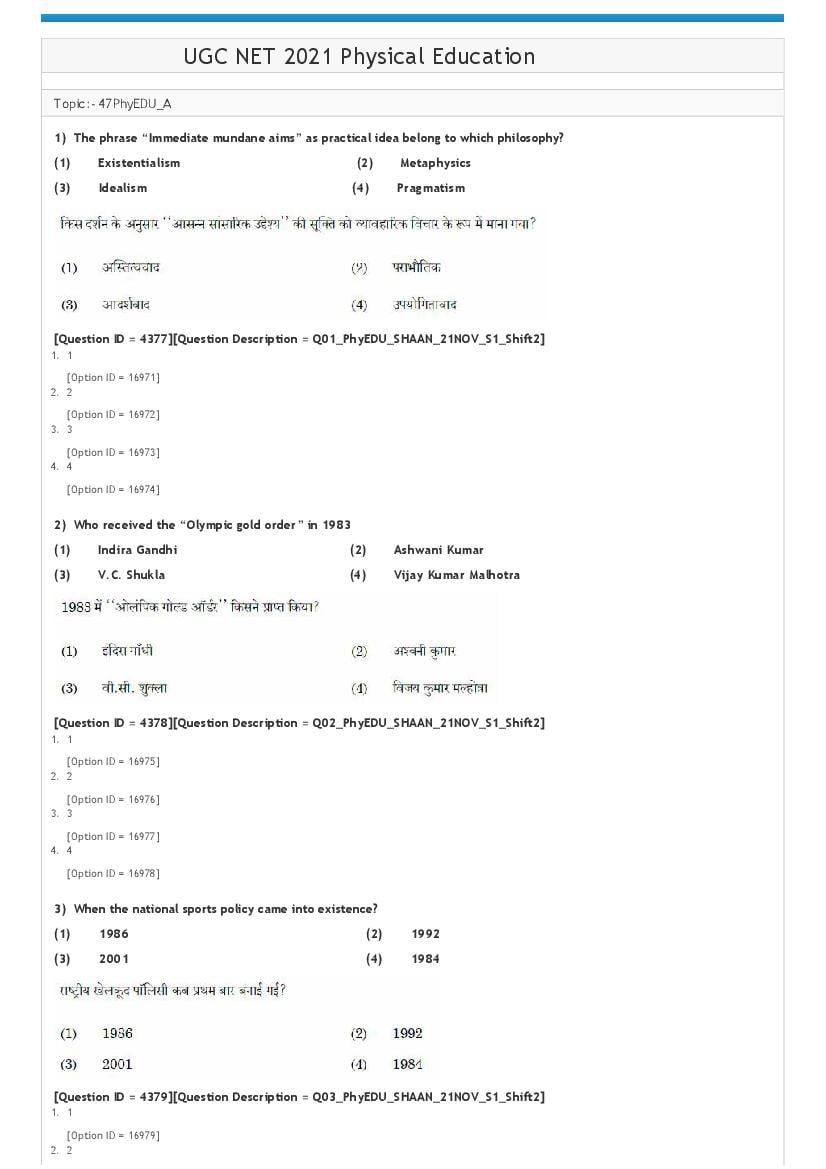
Topic:‐ 47PhyEDU_A
1) The phrase “Immediate mundane aims” as practical idea belong to which philosophy?
(1) Existentialism (2) Metaphysics
(3) Idealism (4) Pragmatism
[Question ID = 4377][Question Description = Q01_PhyEDU_SHAAN_21NOV_S1_Shift2]
[Option ID = 16971]
[Option ID = 16972]
[Option ID = 16973]
[Option ID = 16974]
2) Who received the “Olympic gold order” in 1983
(1) Indira Gandhi (2) Ashwani Kumar
(3) V.C. Shukla (4) Vijay Kumar Malhotra
[Question ID = 4378][Question Description = Q02_PhyEDU_SHAAN_21NOV_S1_Shift2]
[Option ID = 16975]
[Option ID = 16976]
[Option ID = 16977]
[Option ID = 16978]
3) When the national sports policy came into existence?
(1) 1986 (2) 1992
(3) 2001 (4) 1984
[Question ID = 4379][Question Description = Q03_PhyEDU_SHAAN_21NOV_S1_Shift2]
[Option ID = 16979]
Page 2
[Option ID = 16981]
[Option ID = 16982]
4) In which following city, the Commonwealth Games were held twice?
(1) Delhi (2) Gold cost
(3) Glasgow (4) Edinburgh
[Question ID = 4380][Question Description = Q04_PhyEDU_SHAAN_21NOV_S1_Shift2]
[Option ID = 16983]
[Option ID = 16984]
[Option ID = 16985]
[Option ID = 16986]
5) Many athletes using diuretics as an ergogenic aid but diuretics
(1) Increases fat free mass
(2) Increasing urine production and excretion
(3) Decreasing urine production
(4) Increases body weight and fat mass
[Question ID = 4381][Question Description = Q05_PhyEDU_SHAAN_21NOV_S1_Shift2]
[Option ID = 16987]
[Option ID = 16988]
[Option ID = 16989]
[Option ID = 16990]
6) Stroke volume increases proportionately with increasing exercise intensity but usually achieves its maximal value at
about
(1) 30% – 40% of VO2 max (2) 50% – 60% of VO2 max
(3) 70% to 80% of VO2 max (4) 80% to 90% of VO2 max
[Question ID = 4382][Question Description = Q06_PhyEDU_SHAAN_21NOV_S1_Shift2]
Page 3
[Option ID = 16992]
[Option ID = 16993]
[Option ID = 16994]
7) Women can experience major increases in strength as a result of resistance training and gains in strength may be
attributed more to
(1) Hormonal factor (2) Neural factor
(3) More Muscle mass (4) More fat mass
[Question ID = 4383][Question Description = Q07_PhyEDU_SHAAN_21NOV_S1_Shift2]
[Option ID = 16995]
[Option ID = 16996]
[Option ID = 16997]
[Option ID = 16998]
8) Of the following, which one is responsible for maintaining homeostasis by regulating almost all processes that affect the
body’s internal environment
(1) Hypothalamus (2) Thalamus
(3) Cerebellum (4) Cerebrum
[Question ID = 4384][Question Description = Q08_PhyEDU_SHAAN_21NOV_S1_Shift2]
[Option ID = 16999]
[Option ID = 17000]
[Option ID = 17001]
[Option ID = 17002]
9)
Page 4
1. 1 [Option ID = 17003]
2. 2 [Option ID = 17004]
3. 3 [Option ID = 17005]
4. 4 [Option ID = 17006]
10) Which of following is not correct when body comes in push‐up dip‐position (Flexion of elbow) from normal position?
(1) Shoulder joing Horizontal abduction
(2) Wrists Reduction of hyperextension (flexion)
(3) Shoulder Girdle Adbuction
(4) Hips flexors in static contraction
[Question ID = 4386][Question Description = Q10_PhyEDU_SHAAN_21NOV_S1_Shift2]
[Option ID = 17007]
[Option ID = 17008]
[Option ID = 17009]
[Option ID = 17010]
11) How much force is needed to accelerate a 300 N object 2 m/s2?
(1) 150 N (2) 30.61 N
(3) 61.22 N (4) 15.31 N
[Question ID = 4387][Question Description = Q11_PhyEDU_SHAAN_21NOV_S1_Shift2]
[Option ID = 17011]
[Option ID = 17012]
[Option ID = 17013]
[Option ID = 17014]
12) Which of the following muscle is not a primary respiratory muscle?
(1) Diaphragm (2) Transversus thoracis
(3) Levatores costorum (4) Erector spinal
Page 5
[Option ID = 17015]
[Option ID = 17016]
[Option ID = 17017]
[Option ID = 17018]
13) Which type of imagery should be used to reduce athletes anxiety prior to a competition?
(1) Cognitive specific imagery (2) Motivational specific imagery
(3) Motivational general imagery (4) Motivational general arousal
[Question ID = 4389][Question Description = Q13_PhyEDU_SHAAN_21NOV_S1_Shift2]
[Option ID = 17019]
[Option ID = 17020]
[Option ID = 17021]
[Option ID = 17022]
14) Which type of goal depends not only on your own efforts but also on the ability and play of your opponent?
(1) Outcome goal (2) Performance goal
(3) Process goal (4) Short term goal
[Question ID = 4390][Question Description = Q14_PhyEDU_SHAAN_21NOV_S1_Shift2]
[Option ID = 17023]
[Option ID = 17024]
[Option ID = 17025]
[Option ID = 17026]
15) The most basic level of your personality is called as
(1) The typical responses (2) Personality trait
(3) The Role related bahaviour (4) The psychological core
Page 6
[Option ID = 17027]
[Option ID = 17028]
[Option ID = 17029]
[Option ID = 17030]
16) The social facilitation theory was formulated by
(1) Zajonc (2) Jerry Reynolds
(3) Hoffman (4) Norman Triplett
[Question ID = 4392][Question Description = Q16_PhyEDU_SHAAN_21NOV_S1_Shift2]
[Option ID = 17031]
[Option ID = 17032]
[Option ID = 17033]
[Option ID = 17034]
17) Which type of feedback is more effective for facilitating skill performance?
(1) Informative feedback (2) Positive feedback
(3) Corrective feedback (4) Negative feedback
[Question ID = 4393][Question Description = Q17_PhyEDU_SHAAN_21NOV_S1_Shift2]
[Option ID = 17035]
[Option ID = 17036]
[Option ID = 17037]
[Option ID = 17038]
18) Which is an advisory body for the central and State Governments on teacher education in India?
(1) UGC (2) ICMR
(3) NCTE (4) NCERT
Page 7
[Option ID = 17039]
[Option ID = 17040]
[Option ID = 17041]
[Option ID = 17042]
19) In the National Sports talent search scheme acronym PESAT stands for
(1) Physical, Efficiency, Sports, Aptitude, Tests
(2) Performance, Excellence, Sports, Attitude, Training
(3) Physical, Education, Sports, Attitude, Time
(4) Physical, Efficiency, Sports, Aptitude, Training
[Question ID = 4395][Question Description = Q19_PhyEDU_SHAAN_21NOV_S1_Shift2]
[Option ID = 17043]
[Option ID = 17044]
[Option ID = 17045]
[Option ID = 17046]
20) Which one of the following activity is not an open skill practice?
(1) Volleyball spike (2) Free‐throw in Basketball
(3) Catching a throw ball (4) Tennis ground strokes
[Question ID = 4396][Question Description = Q20_PhyEDU_SHAAN_21NOV_S1_Shift2]
[Option ID = 17047]
[Option ID = 17048]
[Option ID = 17049]
[Option ID = 17050]
21) Mostly CNS affecting viral disease is :
(1) Leprosy (2) Small Pox
(3) Rabies (4) Covid‐19
Page 8
[Option ID = 17051]
[Option ID = 17052]
[Option ID = 17053]
[Option ID = 17054]
22) Identify the symptom of disorder ‘Hypervitaminosis’ caused by excess Vitamin C as nutrient:
(1) Gastrointestinal disturbance
(2) Deposition of calcium in soft tissues
(3) Stone formation in urinary tract
(4) Nervous system depressed
[Question ID = 4398][Question Description = Q22_PhyEDU_SHAAN_21NOV_S1_Shift2]
[Option ID = 17055]
[Option ID = 17056]
[Option ID = 17057]
[Option ID = 17058]
23) Which of the following is not passive immunity?
(1) Humoral immunity (2) Normal human Ig
(3) Specific human Ig (4) Animal antitoxins or antisera
[Question ID = 4399][Question Description = Q23_PhyEDU_SHAAN_21NOV_S1_Shift2]
[Option ID = 17059]
[Option ID = 17060]
[Option ID = 17061]
[Option ID = 17062]
24) Which of the water pollutant is a source of water borne diseases like cholera?
(1) Animal waste (2) Fertilizers
(3) Sewage (4) Mercury
Page 9
[Option ID = 17063]
[Option ID = 17064]
[Option ID = 17065]
[Option ID = 17066]
25) Identify the appropriate intensity zone for strength training of an althlete :
(1) Sub‐Maximal – 50‐70% of maximum
(2) Low – 50‐60% of maximum
(3) Medium – 70‐80% of maximum
(4) Maximum – 80‐90% of maximum
[Question ID = 4401][Question Description = Q25_PhyEDU_SHAAN_21NOV_S1_Shift2]
[Option ID = 17067]
[Option ID = 17068]
[Option ID = 17069]
[Option ID = 17070]
26) The factor which is not considered as determining the endurance ability
(1) Aerobic capacity (2) Phosphogen store
(3) Technical perfection (4) Tactical ability
[Question ID = 4402][Question Description = Q26_PhyEDU_SHAAN_21NOV_S1_Shift2]
[Option ID = 17071]
[Option ID = 17072]
[Option ID = 17073]
[Option ID = 17074]
27) Which of the following is concerned with shoulder width?
(1) Bicondylar diameter
(2) Bicristal diameter
Page 10
(4) Bitrochantric diameter
[Question ID = 4403][Question Description = Q27_PhyEDU_SHAAN_21NOV_S1_Shift2]
[Option ID = 17075]
[Option ID = 17076]
[Option ID = 17077]
[Option ID = 17078]
28) The highest level of intrinsic motivation is known as
(1) Flow (2) Peaking
(3) Self confidence (4) Mastry
[Question ID = 4404][Question Description = Q28_PhyEDU_SHAAN_21NOV_S1_Shift2]
[Option ID = 17079]
[Option ID = 17080]
[Option ID = 17081]
[Option ID = 17082]
29)
[Question ID = 4405][Question Description = Q29_PhyEDU_SHAAN_21NOV_S1_Shift2]
1. 1 [Option ID = 17083]
2. 2 [Option ID = 17084]
3. 3 [Option ID = 17085]
4. 4 [Option ID = 17086]
30) Which of the following is not correct about quota sampling?
Page 11
(2) It is subjective
(3) It is based on the experiance of researcher
(4) It is objective
[Question ID = 4406][Question Description = Q30_PhyEDU_SHAAN_21NOV_S1_Shift2]
[Option ID = 17087]
[Option ID = 17088]
[Option ID = 17089]
[Option ID = 17090]
31) If mean of the experimental group is 15, mean of control group is 12 and standard deviation of the control group is 5
then the effect size (Δ) will be
(1) 5.4 (2) 0.60
(3) 1.2 (4) 0.40
[Question ID = 4407][Question Description = Q31_PhyEDU_SHAAN_21NOV_S1_Shift2]
[Option ID = 17091]
[Option ID = 17092]
[Option ID = 17093]
[Option ID = 17094]
32) If r‐represent the correlation coefficient between age and weight and N is the number of subjects. The calculated
value of r = 0.510 and N = 15. The table value of r under column 0.05 is 0.514 and 0.01 is 0.561 for N – 2(=13)df. Then
which of the following will be correct?
(1) There is a siginificant correlation between age and weight at 0.01 level
(2) There is a significant correlation between age and weight at 0.05 level
(3) There is no significant correlation between age and weight
(4) Null hypothesis is rejected
Page 12
[Option ID = 17095]
[Option ID = 17096]
[Option ID = 17097]
[Option ID = 17098]
33)
[Question ID = 4409][Question Description = Q33_PhyEDU_SHAAN_21NOV_S1_Shift2]
1. 1 [Option ID = 17099]
2. 2 [Option ID = 17100]
3. 3 [Option ID = 17101]
4. 4 [Option ID = 17102]
34) Which is not an item of Poole Badminton test?
(1) Forehand clear test (2) Smash test
(3) Backhand clear test (4) Long serve test
[Question ID = 4410][Question Description = Q34_PhyEDU_SHAAN_21NOV_S1_Shift2]
[Option ID = 17103]
[Option ID = 17104]
[Option ID = 17105]
[Option ID = 17106]
35) A subject completed the exercise period of 5 minutes in harvard step test. His recovery period pulse count were : 75
for 1‐1 ½ minutes, 50 for 2‐2½ minutes and 35 for 3‐3½ minutes. Physical Efficiency Index (PEI) of the subject for long
form of the harvard step test will be :
(1) 94 (2) 95
(3) 93 (4) 84
Page 13
[Option ID = 17107]
[Option ID = 17108]
[Option ID = 17109]
[Option ID = 17110]
36) Which is not an item of SAI badminton skill test?
(1) Badminton Shuttle Run
(2) Standing Backward Jump
(3) Standing Broad Jump
(4) Tennis Ball Throw
[Question ID = 4412][Question Description = Q36_PhyEDU_SHAAN_21NOV_S1_Shift2]
[Option ID = 17111]
[Option ID = 17112]
[Option ID = 17113]
[Option ID = 17114]
37) Petty cash is synonymous to which of the following funds?
(1) Discretionary funds (2) Contingency funds
(3) Revolving funds (4) Sinking funds
[Question ID = 4413][Question Description = Q37_PhyEDU_SHAAN_21NOV_S1_Shift2]
[Option ID = 17115]
[Option ID = 17116]
[Option ID = 17117]
[Option ID = 17118]
38) Which type of administration is also known as ‘paternalistic’?
Page 14
(3) Autocratic (4) Anarchic
[Question ID = 4414][Question Description = Q38_PhyEDU_SHAAN_21NOV_S1_Shift2]
[Option ID = 17119]
[Option ID = 17120]
[Option ID = 17121]
[Option ID = 17122]
39) Who developed the scientific management theory?
(1) Elton Mayo
(2) Max Weber
(3) F.W. Taylor
(4) Henary Fayol
[Question ID = 4415][Question Description = Q39_PhyEDU_SHAAN_21NOV_S1_Shift2]
[Option ID = 17123]
[Option ID = 17124]
[Option ID = 17125]
[Option ID = 17126]
40) What will the total number of matches, if in a league cum knockout tournament of 16 teams which initially played in 4
groups of four, where all teams in a given group play league matches? Top two teams from each group qualify for knockout
stage and losing semi‐finalist also play to decide for 3rd and 4th place
(1) 32
(2) 31
(3) 30
(4) 33
Page 15
[Option ID = 17127]
[Option ID = 17128]
[Option ID = 17129]
[Option ID = 17130]
41) In Greece mythology of Ancient Olympics, which relationship of God zeus with Hera is correct?
(A) Wife
(B) Sister
(C) Daughter
(D) Newphew
Choose the correct answer from the options given below:
(1) (A) and (B) only
(2) (B) and (C) only
(3) (C) and (D) only
(4) (D) and (A) only
[Question ID = 4417][Question Description = Q41_PhyEDU_SHAAN_21NOV_S1_Shift2]
[Option ID = 17131]
[Option ID = 17132]
[Option ID = 17133]
[Option ID = 17134]
42) Philosophy consists of followings :
(A) Axiology
(B) Ethics
(C) Aesthetics
Page 16
Choose the correct answer from the options given below:
(1) (A), (C) and (D) only
(2) (B), (C) and (D) only
(3) (D), (B) and (A) only
(4) (A), (B) and (C) only
[Question ID = 4418][Question Description = Q42_PhyEDU_SHAAN_21NOV_S1_Shift2]
[Option ID = 17135]
[Option ID = 17136]
[Option ID = 17137]
[Option ID = 17138]
43) Energy expenditure can be measured by indirect calorimetry, involves measuring
(A) Heat produced by the body
(B) Oxidative enzyme levels
(C) Oxygen consumption
(D) Carbondioxide production
(E) Respiratory exchange ratio
Choose the correct answer from the options given below:
(1) (A), (C), (E) only
(2) (B), (D), (E) only
(3) (A), (B), (C) only
(4) (C), (D), (E) only
Page 17
[Option ID = 17139]
[Option ID = 17140]
[Option ID = 17141]
[Option ID = 17142]
44)
Page 18
1. 1 [Option ID = 17143]
2. 2 [Option ID = 17144]
3. 3 [Option ID = 17145]
4. 4 [Option ID = 17146]
45)
[Question ID = 4421][Question Description = Q45_PhyEDU_SHAAN_21NOV_S1_Shift2]
1. 1 [Option ID = 17147]
2. 2 [Option ID = 17148]
3. 3 [Option ID = 17149]
4. 4 [Option ID = 17150]
Page 19
(A) They are cartilaginous type
(B) They are fibrous type
(C) They are ligamentous type
(D) They have joint capsule
(E) They have no articular cavity
Choose the correct answer from the options given below:
(1) (A), (B) and (C) only
(2) (A), (C) and (D) only
(3) (A), (B), (C) and (E) only
(4) (A), (D) and (E) only
[Question ID = 4422][Question Description = Q46_PhyEDU_SHAAN_21NOV_S1_Shift2]
[Option ID = 17151]
[Option ID = 17152]
[Option ID = 17153]
[Option ID = 17154]
47) Which of the following are correct?
(A) Lifting the foot and leg backward from the knee is known as flexion
(B) Radial and ulnar flexion is also known as lateral flexion
(C) Circumduction is done only at siggital axis and frontal plane
(D) Median plane divides the body into posterior and anterior halves
Choose the correct answer from the options given below:
(1) (A), (B) and (C) only
(2) (A) and (B) only
(3) (B), (C) and (D) only
(4) (A), (C) and (D) only
Page 20
[Option ID = 17155]
[Option ID = 17156]
[Option ID = 17157]
[Option ID = 17158]
48) Which of the following are characteristics of Diarthrosis joints?
(A) An articular cavity is present
(B) Joint is encased with in a sleeve‐like ligamentous capsule
(C) The articulating surfaces are covered with white fibro‐cartilage
(D) The articulating surfaces are smooth
(E) Synovial membrane secretes synovial fluid is present
Choose the correct answer from the options given below:
(1) (A), (B), (C) and (D) only
(2) (A), (B), (C) and (E) only
(3) (A), (B), (D) and (E) only
(4) (B), (C), (D) and (E) only
Page 21
[Option ID = 17159]
[Option ID = 17160]
[Option ID = 17161]
[Option ID = 17162]
49) When we experiment with a new behaviour, the possible out comes are
(A) Positive reinforcement
(B) Negative reinforcement
(C) Vicarious reinforcement
(D) A neutral response
(E) Punishment
Choose the correct answer from the options given below:
(1) (A), (B), (D) and (E) only
(2) (A), (B), (C) and (D) only
(3) (A), (B) and (C) only
(4) (A), (B) and (D) only
[Question ID = 4425][Question Description = Q49_PhyEDU_SHAAN_21NOV_S1_Shift2]
[Option ID = 17163]
[Option ID = 17164]
[Option ID = 17165]
Page 22
50) Which of the following theories are part of group development?
(A) Linear theory
(B) Cyclical theory
(C) Pendular theory
(D) Non linear theroy
(E) Triangle theroy
Choose the correct answer from the options given below:
(1) (A), (B), (D) and (E) only
(2) (A), (B) and (C) only
(3) (B), (C) and (D) only
(4) (A), (B), (C) and (E) only
[Question ID = 4426][Question Description = Q50_PhyEDU_SHAAN_21NOV_S1_Shift2]
[Option ID = 17167]
[Option ID = 17168]
[Option ID = 17169]
[Option ID = 17170]
51) Which of the following are not a functions of NCTE
(A) Undertaking surveys and studies relating to various aspects of teacher education and publish the result thereof
(B) Recruiting qualified staff in the teacher education institutions
(C) Co‐ordinating and monitoring teacher education and its development in the country
(D) Laying down norms for any specified category of courses or trainings in teacher education
(E) Creating job opportunities for the students who have completed teacher education programmes in the NCTE recognised
institutions
Choose the correct answer from the options given below:
(1) (A) and (E) only
(2) (C) and (D) only
(3) (B) and (E) only
Page 23
[Question ID = 4427][Question Description = Q51_PhyEDU_SHAAN_21NOV_S1_Shift2]
[Option ID = 17171]
[Option ID = 17172]
[Option ID = 17173]
[Option ID = 17174]
52) The contents for developing curriculum involves
(A) The dynamics of change
(B) Education trends
(C) Values and myths
(D) Philosophical view points
(E) Curriculum issues
Choose the correct answer from the options given below:
(1) (A), (B), (D) and (E) only
(2) (A), (B) and (E) only
(3) (B), (C) and (E) only
(4) (B), (C) (D) and (E) only
Page 24
[Option ID = 17175]
[Option ID = 17176]
[Option ID = 17177]
[Option ID = 17178]
53) Which of the followings are correct?
(A) Vitamin A and D are stored beyond certain limit, can reach toxic level
(B) Calcium and sodium are called major mineral
(C) Zinc and Iodine are called trace mineral
(D) Riboflavin and Thiamin are fat solube
Choose the correct answer from the options given below:
(1) (A), (B) and (C) only
(2) (A), (C) and (D) only
(3) (A) and (B) only
(4) (B), (C) and (D) only
[Question ID = 4429][Question Description = Q53_PhyEDU_SHAAN_21NOV_S1_Shift2]
[Option ID = 17179]
[Option ID = 17180]
[Option ID = 17181]
Page 25
54) From the list of following diseases, identify which are linked to obesity
(A) Cancer
(B) AIDS
(C) Diabetes
(D) Osteoarthritis
(E) Hepatitis
Choose the correct answer from the options given below:
(1) (A), (B), (E) only
(2) (B), (C) only
(3) (B), (D), (E) only
(4) (A), (C), (D) only
[Question ID = 4430][Question Description = Q54_PhyEDU_SHAAN_21NOV_S1_Shift2]
[Option ID = 17183]
[Option ID = 17184]
[Option ID = 17185]
[Option ID = 17186]
55) Which of the following are correct
(A) Insulin‐dependent diabetes ‐ pancreas cannot secrete adequate amounts of insulin
(B) Diabetes mellitus ‐ body unable to metabolize glucose
(C) Non‐insulin dependent diabetes ‐ adequate number of insulin ‐ receptor sites in cells to absorb glucose
(D) Peptic ulcer ‐ repeated over secration of gastic acids
Choose the correct answer from the options given below:
(1) (A), (B) and (C) only
(2) (A), (B) and (D) only
(3) (B, (C)) and (D) only
Page 26
[Question ID = 4431][Question Description = Q55_PhyEDU_SHAAN_21NOV_S1_Shift2]
[Option ID = 17187]
[Option ID = 17188]
[Option ID = 17189]
[Option ID = 17190]
56) Competitions may be classified on the basis of certain criteria like :
(A) Place of competition
(B) Level of competition
(C) Mode of organising competition
(D) Training methodical aspect of competition
(E) Dates of competition
Choose the correct answer from the options given below:
(1) (A), (B), (C) only
(2) (B), (C), (D) only
(3) (C), (D), (A) only
(4) (D), (A), (E) only
Page 27
[Option ID = 17191]
[Option ID = 17192]
[Option ID = 17193]
[Option ID = 17194]
57) There may be different types of meso‐cycle training programmes used in sports training in general like:‐
(A) Introductory meso ‐ cycle
(B) Preparatory meso ‐ cylce
(C) Pre ‐ competition meso ‐ cycle
(D) After competition meso ‐ cycle
(E) Pre ‐ introductory meso ‐ cycle
Choose the correct answer from the options given below:
(1) (A), (B), (C) only
(2) (A), (C), (E) only
(3) (A), (C), (D) only
(4) (C), (D). (E) only
[Question ID = 4433][Question Description = Q57_PhyEDU_SHAAN_21NOV_S1_Shift2]
[Option ID = 17195]
[Option ID = 17196]
Page 28
[Option ID = 17198]
58) An I.Q. test was Given to a group of students. The mean score was 66.34, median 70.34 and standard deviation was
9.67. On the basis of given result which of the following are correct?
(A) The test is easy for the student
(B) The test is difficult for the student
(C) The distribution will be positively skewed
(D) The distribution will be negative skewed
Choose the correct answer from the options given below:
(1) (A) and (D) only
(2) (B) and (C) only
(3) (A) and (C) only
(4) (B) and (D) only
[Question ID = 4434][Question Description = Q58_PhyEDU_SHAAN_21NOV_S1_Shift2]
[Option ID = 17199]
[Option ID = 17200]
[Option ID = 17201]
[Option ID = 17202]
59) Which of the following are correct?
(A) Descriptive research is concerned with status and most prevalent technique in survey
(B) Qualitative research is characterised by intensive first hand presence and data is conducted through observation and
interviews
(C) Analytical research involves in‐depth study and evalaution in an attempt to explain complex phenomena
(D) Epidemiological research is form of experimental research
Choose the correct answer from the options given below:
(1) (A) and (B) only
(2) (A), (B) and (D) only
Page 29
(4) (A), (B) and (C) only
[Question ID = 4435][Question Description = Q59_PhyEDU_SHAAN_21NOV_S1_Shift2]
[Option ID = 17203]
[Option ID = 17204]
[Option ID = 17205]
[Option ID = 17206]
60)
Page 30
1. 1 [Option ID = 17207]
2. 2 [Option ID = 17208]
3. 3 [Option ID = 17209]
4. 4 [Option ID = 17210]
61) Which of the following statements are correct regarding the Sports Motivation Scale (SMS) by R.J. Vallerand and L.G.
Pelletier etc. (1995)
(A) Scale consist of 28 items
(B) Scale comparised of intrinsic motivation as a sub‐scale
(C) Scale has 5 point likert scale
(D) Amotivation is one of the sub scale
Choose the correct answer from the options given below:
(1) (A), (B) and (C) only
(2) (B), (C) and (D) only
(3) (A), (B) and (D) only
(4) (A), (C) and (D) only
[Question ID = 4437][Question Description = Q61_PhyEDU_SHAAN_21NOV_S1_Shift2]
[Option ID = 17211]
[Option ID = 17212]
Page 31
[Option ID = 17214]
62) Which of the following are the items of Chang badminton test?
(A) Long serve
(B) Overhead Drop Shot
(C) Smash
(D) Strategy
Choose the correct answer from the options given below:
(1) (A), (B) and (D) only
(2) (A) and (C) only
(3) (A), (C) and (D) only
(4) (A), (B) and (C) only
[Question ID = 4438][Question Description = Q62_PhyEDU_SHAAN_21NOV_S1_Shift2]
[Option ID = 17215]
[Option ID = 17216]
[Option ID = 17217]
[Option ID = 17218]
63) Which of the following statements are correct regarding achievement motivation questionnarie by M.L. Kamlesh
(1990)?
(A) Questionnaire consists of 20 items
(B) Each statement has maximum 2 as response value
(C) Subjects scoring below 24 points indicated moderate sports achievement motivation
(D) Subjects scoring above 30 points indicated high sports achievement motivation
Choose the correct answer from the options given below:
(1) (A), (B) and (C) only
(2) (B), (C) and (D) only
Page 32
(4) (A), (B) and (D) only
[Question ID = 4439][Question Description = Q63_PhyEDU_SHAAN_21NOV_S1_Shift2]
[Option ID = 17219]
[Option ID = 17220]
[Option ID = 17221]
[Option ID = 17222]
64) Which of the following are the principles of personnel management?
(A) Avenues for career advancement
(B) Delegation of authority
(C) Recognition of Individual differences
(D) Autocratic approach
Choose the correct answer from the options given below:
(1) (A), (B) and (C) only
(2) (A) and (B) only
(3) (A), (C) and (D) only
(4) (A), (B) and (D) only
Page 33
[Option ID = 17223]
[Option ID = 17224]
[Option ID = 17225]
[Option ID = 17226]
65) Which of the following are the branches of the classical theory of management?
(A) Scientific management Theory
(B) Administrative Theory
(C) Bureaucracy Theory
(D) Human resource Theory
Choose the correct answer from the options given below:
(1) (A), (B) and (D) only
(2) (B), (C) and (D) only
(3) (A) and (B) only
(4) (A), (B) and (C) only
[Question ID = 4441][Question Description = Q65_PhyEDU_SHAAN_21NOV_S1_Shift2]
[Option ID = 17227]
[Option ID = 17228]
Page 34
[Option ID = 17230]
66) Match List I with List II :
List I (Countries they belong) List II (Physical Educationist)
(A) Sweden (I) Archebald Maclarn
(B) Germany (II) Per Henrik ling
(C) Great Britain (III) Eduward Hitchcock
(D) United States of America (IV) J.C.F. Guts Muths
Choose the correct answer from the options given below:
(A) – (II), (B) – (I), (C) – (IV), (D) –
(1)
(III)
(A) – (I), (B) – (III), (C) – (II), (D) –
(2)
(IV)
(3) (A) – (III), (B) – (II), (C) – (IV), (D) – (I)
(A) – (II), (B) – (IV), (C) – (I), (D) –
(4)
(III)
[Question ID = 4442][Question Description = Q66_PhyEDU_SHAAN_21NOV_S1_Shift2]
[Option ID = 17231]
[Option ID = 17232]
[Option ID = 17233]
[Option ID = 17234]
67) Match List I with List II :
List I (Altitude condition) List II (Consequence)
(A) Hypobaric environment (I) Impaired oxygen uptake
(B) Hypoxia (II) Air temperature decreases
(C) Partial pressure reduction (III) Reduced Atmospheric pressure
(D) Dehydration (IV) Increased pulmonary ventilation
Choose the correct answer from the options given below:
Page 35
(1)
(III)
(A) – (III), (B) – (I), (C) – (IV), (D) –
(2)
(II)
(3) (A) – (IV), (B) – (III), (C) – (II), (D) – (I)
(A) – (III), (B) – (IV), (C) – (I), (D) –
(4)
(II)
[Question ID = 4443][Question Description = Q67_PhyEDU_SHAAN_21NOV_S1_Shift2]
[Option ID = 17235]
[Option ID = 17236]
[Option ID = 17237]
[Option ID = 17238]
68) Match List I with List II :
List I (Joint) List II (Movement)
(A) Irregular (I) Uniaxial
(B) Hinge (II) Bioaxial
(C) Condyloid (III) Triaxial
(D) Ball and socket (IV) Nonaxial
Choose the correct answer from the options given below:
(A) – (I), (B) – (IV), (C) – (II), (D) –
(1)
(III)
(A) – (IV), (B) – (I), (C) – (II), (D) –
(2)
(III)
(A) – (I), (B) – (IV), (C) – (III), (D) –
(3)
(II)
(A) – (II), (B) – (I), (C) – (IV), (D) –
(4)
(III)
Page 36
[Option ID = 17239]
[Option ID = 17240]
[Option ID = 17241]
[Option ID = 17242]
69) Match List I with List II :
List I (Psychological approach) List II (Examples in sport psychology)
(A) Social psychology (I) Skill acquisition
(B) Cognitive psychology (II) Team Cohesion
(C) Physiological psychology (III) Arousal and performance
(D) Developmental psychology (IV) Social learning
Choose the correct answer from the options given below:
(A) – (IV), (B) – (I), (C) – (II), (D) –
(1)
(III)
(A) – (II), (B) – (I), (C) – (III), (D) –
(2)
(IV)
(A) – (III), (B) – (I), (C) – (II), (D) –
(3)
(IV)
(4) (A) – (IV), (B) – (III), (C) – (II), (D) – (I)
Page 37
[Option ID = 17243]
[Option ID = 17244]
[Option ID = 17245]
[Option ID = 17246]
70) Match List I with List II :
List I (Technological resources in PE class) List II (Benefits/Purpose)
(A) Pedometers (I) Tracking of speed and direction
(B) Heart rate monitors (II) Assessing body composition
(III) Records the number of steps
(C) GPS
taken
(D) Bioimpedance devices (IV) Intensity levels of activity
Choose the correct answer from the options given below:
(A) – (II), (B) – (III), (C) – (I), (D) –
(1)
(IV)
(A) – (II), (B) – (I), (C) – (III), (D) –
(2)
(IV)
(A) – (III), (B) – (IV), (C) – (I), (D) –
(3)
(II)
(A) – (IV), (B) – (II), (C) – (III), (D) –
(4)
(I)
[Question ID = 4446][Question Description = Q70_PhyEDU_SHAAN_21NOV_S1_Shift2]
[Option ID = 17247]
[Option ID = 17248]
Page 38
[Option ID = 17250]
71) Match List I with List II :
List I (Programme/policy) List II (Year of starting)
(A) National Malaria Control
(I) 1955
Programme
(B) National Filaria Control
(II) 1962
Programme
(C) National Tuberclosis Programme (III) 1953
(D) National AIDS Control Policy (IV) 2002
Choose the correct answer from the options given below:
(1) (A) – (III), (B) – (II), (C) – (IV), (D) – (I)
(A) – (II), (B) – (I), (C) – (III), (D) –
(2)
(IV)
(A) – (III), (B) – (I), (C) – (II), (D) –
(3)
(IV)
(A) – (II), (B) – (III), (C) – (I), (D) –
(4)
(IV)
[Question ID = 4447][Question Description = Q71_PhyEDU_SHAAN_21NOV_S1_Shift2]
[Option ID = 17251]
[Option ID = 17252]
[Option ID = 17253]
[Option ID = 17254]
72) Match List I with List II :
List I (Periods) List II (Types of exercises)
(I) Training forms of competitive
(A) Preparatory period – I exercises (coincide but different
movements)
Page 39
(B) Preparatory period – II preliminary, (Mastering the forms of
movement)
(III) Competitive exercise proper
(C) Preparatory period – III
(Real condition with rules)
(IV) Special preparatory exercises,
(D) Competition period – IV
developing (improve physical qualities)
Choose the correct answer from the options given below:
(A) – (IV), (B) – (II), (C) – (I), (D) –
(1)
(III)
(A) – (I), (B) – (IV), (C) – (II), (D) –
(2)
(III)
(A) – (I), (B) – (II), (C) – (III), (D) –
(3)
(IV)
(A) – (IV), (B) – (I), (C) – (III), (D) –
(4)
(II)
[Question ID = 4448][Question Description = Q72_PhyEDU_SHAAN_21NOV_S1_Shift2]
[Option ID = 17255]
[Option ID = 17256]
[Option ID = 17257]
[Option ID = 17258]
73) Match List I with List II :
List I (Limits) List II (% of area in NPC)
(A) –2 sigma to –1 sigma (I) 95.44
(B) 0 to + 2 sigma (II) 13.59
(C) –1 to +2 sigma (III) 72.67
(D) –2 sigma to +2 sigma (IV) 81.85
(V) 47.72
Choose the correct answer from the options given below:
(A) – (I), (B) – (III), (C) – (V), (D) –
(1)
(II)
Page 40
(2)
(II)
(A) – (II), (B) – (V), (C) – (IV), (D) –
(3)
(I)
(A) – (II), (B) – (III), (C) – (V), (D) –
(4)
(I)
[Question ID = 4449][Question Description = Q73_PhyEDU_SHAAN_21NOV_S1_Shift2]
[Option ID = 17259]
[Option ID = 17260]
[Option ID = 17261]
[Option ID = 17262]
74) Match List I with List II :
List I (Measurement) List II (Test)
(A) Motor educability (I) Fleishman test
(B) Motor fitness (II) Metheny ‐ Johnson test
(C) Motor Ability (III) Newton test
(D) Physical fitness (IV) Kirchner test
Choose the correct answer from the options given below:
(1) (A) – (II), (B) – (IV), (C) – (III), (D) – (I)
(2) (A) – (II), (B) – (III), (C) – (IV), (D) – (I)
(3) (A) – (III), (B) – (IV), (C) – (II), (D) – (I)
(4) (A) – (IV), (B) – (II), (C) – (III), (D) – (I)
Page 41
[Option ID = 17263]
[Option ID = 17264]
[Option ID = 17265]
[Option ID = 17266]
75) Match List I with List II :
List I (Game) List II (Circumference of the ball)
(A) Cricket (Women) (I) 22.4 – 23.5 cm
(B) Hockey (II) 27.6 – 28.3 cm
(C) Softball (Women) (III) 22.4 – 22.9 cm
(D) Tennis (IV) 22 – 22.9 cm
Choose the correct answer from the options given below:
(A) – (II), (B) – (III), (C) – (I), (D) –
(1)
(IV)
(A) – (III), (B) – (II), (C) – (I), (D) –
(2)
(IV)
(A) – (I), (B) – (III), (C) – (II), (D) –
(3)
(IV)
(A) – (III), (B) – (I), (C) – (II), (D) –
(4)
(IV)
Page 42
[Option ID = 17267]
[Option ID = 17268]
[Option ID = 17269]
[Option ID = 17270]
76) Arrange in sequence the presidents of Indian Olympic assocation from first to last
(A) Ashwani Kumar
(B) Suresh Kalmadi
(C) Sir Dorabji Tata
(D) Maharaja Bhupinder singh
Choose the correct answer from the options given below:
(1) (B), (C), (D), (A)
(2) (A), (B), (C), (D)
(3) (D), (A), (B), (C)
(4) (C), (D), (A), (B)
[Question ID = 4452][Question Description = Q76_PhyEDU_SHAAN_21NOV_S1_Shift2]
[Option ID = 17271]
[Option ID = 17272]
[Option ID = 17273]
[Option ID = 17274]
77) Some steps of chemical reactions of glycotycis are depicted below; find the correct sequence of their appearance
(A) Citric acid
(B) Acetyl CO‐A
(C) Fructose‐1‐6‐diphosphate
Page 43
(E) Glucose‐6‐phosphate
Choose the correct answer from the options given below:
(1) (C), (E), (B), (D), (A)
(2) (C), (E), (D), (A), (B)
(3) (E), (C), (B), (A), (D)
(4) (E), (C), (D), (A), (B)
[Question ID = 4453][Question Description = Q77_PhyEDU_SHAAN_21NOV_S1_Shift2]
[Option ID = 17275]
[Option ID = 17276]
[Option ID = 17277]
[Option ID = 17278]
78) Arrange the skeletal muscle macro structures in a sequence from outer to inner
(A) Endomysum
(B) Epimysium
(C) Sarcolemma
(D) Perimysium
(E) Scarcoplasm
Choose the correct answer from the options given below:
(1) (D), (B), (A), (E), (C)
(2) (B), (D), (A), (C), (E)
(3) (B), (A), (D), (E), (C)
(4) (D), (A), (B), (C), (E)
Page 44
[Option ID = 17279]
[Option ID = 17280]
[Option ID = 17281]
[Option ID = 17282]
79) Find the correct sequence of Maslow’s hierarchy of needs in ascending order
(A) Safety and social needs
(B) Physiological needs
(C) Self‐actualisation
(D) Esteem needs
(E) Intellectual and aesthetic needs
Choose the correct answer from the options given below:
(1) (C), (E), (D), (A), (B)
(2) (B), (C), (D), (E), (A)
(3) (B), (A), (D), (E), (C)
(4) (C), (A), (D), (E), (B)
Page 45
[Option ID = 17283]
[Option ID = 17284]
[Option ID = 17285]
[Option ID = 17286]
80) Find the correct sequence of Indian universities ranks in the first edition of Khelo India university games. From top to
bottom
(A) Punjabi University, Patiala
(B) Panjab University
(C) MDU, Rohtak
(D) Mangalore University
(E) Savitribai Phule Pune University
Choose the correct answer from the options given below:
(1) (E), (B), (A), (D), (C)
(2) (B), (E), (A), (C), (D)
(3) (A), (C), (E), (B), (D)
(4) (B), (D), (A), (C), (E)
[Question ID = 4456][Question Description = Q80_PhyEDU_SHAAN_21NOV_S1_Shift2]
[Option ID = 17287]
[Option ID = 17288]
[Option ID = 17289]
[Option ID = 17290]
81) Arrange the following vaccines in a sequence of first to last from their years of invention
(A) Rubella
(B) DTP
Page 46
(D) Yellow fever
(E) Diphtheria
Choose the correct answer from the options given below:
(1) (C), (D), (A), (B), (E)
(2) (E), (D), (B), (C), (A)
(3) (B), (A), (C), (D), (E)
(4) (C), (D), (E), (B), (A)
[Question ID = 4457][Question Description = Q81_PhyEDU_SHAAN_21NOV_S1_Shift2]
[Option ID = 17291]
[Option ID = 17292]
[Option ID = 17293]
[Option ID = 17294]
82) Sequentially arrange start to compeletion, the following factors in order of their developmental phases during a training
programme in sports
(A) Technical aspects development
(B) Mental training
(C) Tactical aspect development
(D) Physical fitness development
(E) Model forms of competitive exercises
Choose the correct answer from the options given below:
(1) (D), (C), (B), (A), (E)
(2) (D), (A), (B), (C), (E)
(3) (D), (E), (A), (C), (B)
(4) (D), (A), (E), (C), (B)
Page 47
[Option ID = 17295]
[Option ID = 17296]
[Option ID = 17297]
[Option ID = 17298]
83) Arrange the following steps of planning a questionnarie in correct sequence from start to end
(A) Determining research objectives
(B) Revise as needed, finalise and duplicate
(C) Gather data, tabulation and final report
(D) Evaluation of questions and pretest
(E) Development of questions
Choose the correct answer from the options given below:
(1) (A), (B), (E), (D), (C)
(2) (A), (E), (D), (B), (C)
(3) (A), (D), (E), (C), (B)
(4) (A), (E), (B), (C), (D)
Page 48
[Option ID = 17299]
[Option ID = 17300]
[Option ID = 17301]
[Option ID = 17302]
84) Arrange the following steps of skill test construction in ascending order
(A) Establish the exact procedures for the administration and scoring of the test
(B) Analyse the game or physical qualities
(C) Determine reliability and compute objectivity
(D) Establish validity
(E) Select the test items that measure desired qualities
Choose the correct answer from the options given below:
(1) (B), (E), (A), (D), (C)
(2) (B), (E), (A), (C), (D)
(3) (B), (A), (E), (C), (D)
(4) (E), (B), (A), (C), (D)
[Question ID = 4460][Question Description = Q84_PhyEDU_SHAAN_21NOV_S1_Shift2]
[Option ID = 17303]
[Option ID = 17304]
[Option ID = 17305]
[Option ID = 17306]
85) Arrange the sequence of steps of budgetting process in ascending order
(A) Analyse past budgets and compare it with new requests
Page 49
(C) Interpret and Evaluate the budget
(D) Gather Data
(E) Construct the budget
Choose the correct answer from the options given below:
(1) (D), (A), (E), (B), (C)
(2) (D), (E), (A), (B), (C)
(3) (E), (D), (A), (B), (C)
(4) (D), (E), (B), (A), (C)
[Question ID = 4461][Question Description = Q85_PhyEDU_SHAAN_21NOV_S1_Shift2]
[Option ID = 17307]
[Option ID = 17308]
[Option ID = 17309]
[Option ID = 17310]
86) Given below are two statements: one is labelled as Assertion A and the other is labelled as Reason R
Assertion A : During prolonged exercise in the cold, as energy supplies diminish and exercise intensity declines, a person
becomes increasingly susceptible to hypothermia
Reason R : Exercise triggers release of the catecholamines, which increase the mobilization and use of free fatty acids for
fuel. But in cold vasoconstriction occur.
In the light of the above statements, choose the most appropriate answer from the options given below:
(1) Both A and R are correct and R is the correct explanation of A
(2) Both A and R are correct and R is NOT the correct explanation of A
(3) A is correct but R is not correct
(4) A is not correct but R is correct
Page 50
[Option ID = 17311]
[Option ID = 17312]
[Option ID = 17313]
[Option ID = 17314]
87) Given below are two statement :
Statement I : In two tail test, 2.5% of the area of the normal curve falls on the right of 1.96 standard deviation above the
mean and 2.5% to the left of 1.96 standard deviation below the mean.
Statement II : In one tail test, for testing the difference between large sample means, z score of 1.64 is taken as Yardstick
at the 5% level of significance.
In the light of the above statements, choose the most appropriate answer from the options given below:
(1) Both Statement I and Statement II are correct.
(2) Both Statement I and Statement II are incorrect.
(3) Statement I is correct but Statement II is incorrect
(4) Statement I is incorrect but Statement II is correct
[Question ID = 4463][Question Description = Q87_PhyEDU_SHAAN_21NOV_S1_Shift2]
[Option ID = 17315]
[Option ID = 17316]
Page 51
[Option ID = 17318]
88) Given below are two statements: one is labelled as Assertion A and the other is labelled as Reason R
Assertion A : If the only force acting on the projectile is the force of gravity, the trajectory of projectile will be parabolic.
Reason R : During the flight vertical factor remain constant and horizontal factor provides downward acceleration at 9.8 m/s
In the light of the above statements, choose the correct answer from the options given below:
(1) Both A and R are true and R is the correct explanation of A
(2) Both A and R are true and R is NOT the correct explanation of A
(3) A is ture but R is false
(4) A is false but R is true
[Question ID = 4464][Question Description = Q88_PhyEDU_SHAAN_21NOV_S1_Shift2]
[Option ID = 17319]
[Option ID = 17320]
[Option ID = 17321]
[Option ID = 17322]
89) Given below are two statements:
Statement I : Whenever subjective measurement is called for, every effort should be made to make the subjective
evaluation as objective as possible
Statement II : No amount of objective measurement will replace sound judgement, nor is there anything wrong with
subjective judgement.
In the light of the above statements, choose the correct answer from the options given below:
(1) Both Statement I and Statement II are true.
(2) Both Statement I and Statement II are false.
(3) Statement I is true but Statement II is false
(4) Statement I is false but Statement II is true
Page 52
[Option ID = 17323]
[Option ID = 17324]
[Option ID = 17325]
[Option ID = 17326]
90) Given below are two statements:
Statement I : Financial management helps the organisation to survive and sustain itself by preventing misuse and wastage of
funds.
Statement II : Physical education and sports programmes can never be effective, if there is no sound financial management.
In the light of the above statements, choose the correct answer from the options given below:
(1) Both Statement I and Statement II are true.
(2) Both Statement I and Statement II are false.
(3) Statement I is true but Statement II is false
(4) Statement I is false but Statement II is true
[Question ID = 4466][Question Description = Q90_PhyEDU_SHAAN_21NOV_S1_Shift2]
Page 53
[Option ID = 17328]
[Option ID = 17329]
[Option ID = 17330]
Topic:‐ 47PhyEDU_B
1) Answer the question on the basis of the following passage :
Carona‐Virus has caused world‐wide pandemic of respiratory illness. Club‐shaped glycoprotein spikes in the envelop give the
virus a crown like appearence. To fight against virus or bacteria immune system of our body performs four major functions;
(i) It recognizes foreign substances
(ii) It defends our body by attacking these substances
(iii) It protects from reinfection
(iv) It performs survillance
Innate immunity is the protection that we are born with. Active or adaptive immunity developes when we are
infected with or vaccinated. Passive immunity happens when we receive antibodies from out side, say transfusion of blood
products.
Physical activity may boost our immune system. Exercise may help flush bacteria out of the lungs and air ways.
Exercise causes change in antibodies and WBCs, the body’s immune system cells that fight against disease. The brief rise in
body temperature during exercise may prevent bacteria from growing. Exercise slows down the release of stress hormone
which may protect against illness. When people are rather forced to stay at home to stop spread of corona virus, WHO
suggested for participation in physical activity, 60 mts/day moderate to vigorous for 6‐17 years, 75 mts/wk vigorous or 150
mts/wk moderate 2 to 3 days/wk, respectively for adults.
Structure of covid‐19 virus includes protruding spikes made up of
(1) Lipid (2) Cystokinine
(3) Starch (4) Protein
Page 54
[Option ID = 17331]
[Option ID = 17332]
[Option ID = 17333]
[Option ID = 17334]
2) Answer the question on the basis of the following passage :
Carona‐Virus has caused world‐wide pandemic of respiratory illness. Club‐shaped glycoprotein spikes in the envelop give the
virus a crown like appearence. To fight against virus or bacteria immune system of our body performs four major functions;
(i) It recognizes foreign substances
(ii) It defends our body by attacking these substances
(iii) It protects from reinfection
(iv) It performs survillance
Innate immunity is the protection that we are born with. Active or adaptive immunity developes when we are
infected with or vaccinated. Passive immunity happens when we receive antibodies from out side, say transfusion of blood
products.
Physical activity may boost our immune system. Exercise may help flush bacteria out of the lungs and air ways.
Exercise causes change in antibodies and WBCs, the body’s immune system cells that fight against disease. The brief rise in
body temperature during exercise may prevent bacteria from growing. Exercise slows down the release of stress hormone
which may protect against illness. When people are rather forced to stay at home to stop spread of corona virus, WHO
suggested for participation in physical activity, 60 mts/day moderate to vigorous for 6‐17 years, 75 mts/wk vigorous or 150
mts/wk moderate 2 to 3 days/wk, respectively for adults.
One of the functions of body’s immune system is to identify the foreign harmful substance and destroy the mutant cells, is
called
(1) Recognization
(2) Protection
(3) Survillance
(4) Defence
Page 55
[Option ID = 17335]
[Option ID = 17336]
[Option ID = 17337]
[Option ID = 17338]
3) Answer the question on the basis of the following passage :
Carona‐Virus has caused world‐wide pandemic of respiratory illness. Club‐shaped glycoprotein spikes in the envelop give the
virus a crown like appearence. To fight against virus or bacteria immune system of our body performs four major functions;
(i) It recognizes foreign substances
(ii) It defends our body by attacking these substances
(iii) It protects from reinfection
(iv) It performs survillance
Innate immunity is the protection that we are born with. Active or adaptive immunity developes when we are
infected with or vaccinated. Passive immunity happens when we receive antibodies from out side, say transfusion of blood
products.
Physical activity may boost our immune system. Exercise may help flush bacteria out of the lungs and air ways.
Exercise causes change in antibodies and WBCs, the body’s immune system cells that fight against disease. The brief rise in
body temperature during exercise may prevent bacteria from growing. Exercise slows down the release of stress hormone
which may protect against illness. When people are rather forced to stay at home to stop spread of corona virus, WHO
suggested for participation in physical activity, 60 mts/day moderate to vigorous for 6‐17 years, 75 mts/wk vigorous or 150
mts/wk moderate 2 to 3 days/wk, respectively for adults.
Passive immunity developes by way of
(1) Vaccination (2) In‐born quality
(3) Blood product transfusion (4) Infected from an affected person
Page 56
[Option ID = 17339]
[Option ID = 17340]
[Option ID = 17341]
[Option ID = 17342]
4) Answer the question on the basis of the following passage :
Carona‐Virus has caused world‐wide pandemic of respiratory illness. Club‐shaped glycoprotein spikes in the envelop give the
virus a crown like appearence. To fight against virus or bacteria immune system of our body performs four major functions;
(i) It recognizes foreign substances
(ii) It defends our body by attacking these substances
(iii) It protects from reinfection
(iv) It performs survillance
Innate immunity is the protection that we are born with. Active or adaptive immunity developes when we are
infected with or vaccinated. Passive immunity happens when we receive antibodies from out side, say transfusion of blood
products.
Physical activity may boost our immune system. Exercise may help flush bacteria out of the lungs and air ways.
Exercise causes change in antibodies and WBCs, the body’s immune system cells that fight against disease. The brief rise in
body temperature during exercise may prevent bacteria from growing. Exercise slows down the release of stress hormone
which may protect against illness. When people are rather forced to stay at home to stop spread of corona virus, WHO
suggested for participation in physical activity, 60 mts/day moderate to vigorous for 6‐17 years, 75 mts/wk vigorous or 150
mts/wk moderate 2 to 3 days/wk, respectively for adults.
To protect our body from infection exercise may be helpful by way of
(A) Increasing body temperature to prevent bacteria to grow
(B) Increasing muscular strength to fight against bacteria
(C) Exercise may help flush bacteria from lungs
(D) Exercise slows down release of stress hormone
Page 57
(1) (A), (C), (D) only
(2) (A), (B), (C) only
(3) (A), (B), (D) only
(4) (B), (C), (D) only
[Question ID = 4470][Question Description = Q94_PhyEDU_SHAAN_21NOV_S1_Shift2]
[Option ID = 17343]
[Option ID = 17344]
[Option ID = 17345]
[Option ID = 17346]
5) Answer the question on the basis of the following passage :
Carona‐Virus has caused world‐wide pandemic of respiratory illness. Club‐shaped glycoprotein spikes in the envelop give the
virus a crown like appearence. To fight against virus or bacteria immune system of our body performs four major functions;
(i) It recognizes foreign substances
(ii) It defends our body by attacking these substances
(iii) It protects from reinfection
(iv) It performs survillance
Innate immunity is the protection that we are born with. Active or adaptive immunity developes when we are
infected with or vaccinated. Passive immunity happens when we receive antibodies from out side, say transfusion of blood
products.
Physical activity may boost our immune system. Exercise may help flush bacteria out of the lungs and air ways.
Exercise causes change in antibodies and WBCs, the body’s immune system cells that fight against disease. The brief rise in
body temperature during exercise may prevent bacteria from growing. Exercise slows down the release of stress hormone
which may protect against illness. When people are rather forced to stay at home to stop spread of corona virus, WHO
suggested for participation in physical activity, 60 mts/day moderate to vigorous for 6‐17 years, 75 mts/wk vigorous or 150
mts/wk moderate 2 to 3 days/wk, respectively for adults.
Page 58
(A) Moderate PA for 150 mns/wk, 2 days/wk
(B) Moderate PA for 150 mns/wk, 3 days/wk
(C) Vigorous PA for 75 mns/wk, 2 days/wk
(D) Vigorous PA for 75 mns/wk, 3 days/wk
Choose the correct answer from the options given below:
(1) (A) and (C) only
(2) (A) and (D) only
(3) (B) and (D) only
(4) (B) and (C) only
[Question ID = 4471][Question Description = Q95_PhyEDU_SHAAN_21NOV_S1_Shift2]
[Option ID = 17347]
[Option ID = 17348]
[Option ID = 17349]
[Option ID = 17350]
Topic:‐ 47PhyEDU_C
1) Answer the question on the basis of the following passage :
Page 59
because most of the people in Western cultures saw genders in terms of differences that divide all humans into two distinct
and mutually exclusive categories: females and males. According to this classification system, females are defined as the
“weaker sex” and femenity is associated with being soft petite, emotional and in need of protection, in fact dominant
standard of feminine beauty over the past century has been associated with vulenerability and weakness. Males on the
other hand, are defined as the stronger sex and mascularity is associated with being hard, strong, rational and defender of
women. In fact masculine attractiveness traditionally has been associated with invulnerability and strength. And many
people simply assume that “Nature intended in that way. Women body builders have challenged this gender logic and in the
process have threatered many people’s ideas about how the world works. According to dominant gender ideology, women
body‐builders are unfemine, because they are “too muscular”, and ugly because their bodies are not soft and vulnerable.
But not everyone accepts this ideology. For those seeking alternative definitions of feminity, women bodybuilding has
provided new images that some people find exciting. They like the idea of challenging traditional notions of “Female
frailty” and raising questions about the biology of gender difference. Women bodybuilding has encouraged this process by
showing that hardness and strength are not exclusively the attributes of males.
Female bodybuilders are considered as which of the following :
(1) Unfeminine (2) Soft
(3) Vulnerable (4) Female frailty
[Question ID = 4477][Question Description = Q96_PhyEDU_SHAAN_21NOV_S1_Shift2]
[Option ID = 17371]
[Option ID = 17372]
[Option ID = 17373]
[Option ID = 17374]
2) Answer the question on the basis of the following passage :
Many people in the recent past saw women body‐builders as rebels or deviants, as freaks of nature. This was the case
because most of the people in Western cultures saw genders in terms of differences that divide all humans into two distinct
and mutually exclusive categories: females and males. According to this classification system, females are defined as the
“weaker sex” and femenity is associated with being soft petite, emotional and in need of protection, in fact dominant
standard of feminine beauty over the past century has been associated with vulenerability and weakness. Males on the
other hand, are defined as the stronger sex and mascularity is associated with being hard, strong, rational and defender of
Page 60
people simply assume that “Nature intended in that way. Women body builders have challenged this gender logic and in the
process have threatered many people’s ideas about how the world works. According to dominant gender ideology, women
body‐builders are unfemine, because they are “too muscular”, and ugly because their bodies are not soft and vulnerable.
But not everyone accepts this ideology. For those seeking alternative definitions of feminity, women bodybuilding has
provided new images that some people find exciting. They like the idea of challenging traditional notions of “Female
frailty” and raising questions about the biology of gender difference. Women bodybuilding has encouraged this process by
showing that hardness and strength are not exclusively the attributes of males.
Male is defined as ;
(A) Hard
(B) Strong
(C) Rational
(D) Too mascular
Choose the correct answer from the options given below:
(1) (B), (C) and (D) only
(2) (A), (C) and (D) only
(3) (D), (B) and (A) only
(4) (A), (B) and (C) only
[Question ID = 4478][Question Description = Q97_PhyEDU_SHAAN_21NOV_S1_Shift2]
[Option ID = 17375]
Page 61
[Option ID = 17377]
[Option ID = 17378]
3) Answer the question on the basis of the following passage :
Many people in the recent past saw women body‐builders as rebels or deviants, as freaks of nature. This was the case
because most of the people in Western cultures saw genders in terms of differences that divide all humans into two distinct
and mutually exclusive categories: females and males. According to this classification system, females are defined as the
“weaker sex” and femenity is associated with being soft petite, emotional and in need of protection, in fact dominant
standard of feminine beauty over the past century has been associated with vulenerability and weakness. Males on the
other hand, are defined as the stronger sex and mascularity is associated with being hard, strong, rational and defender of
women. In fact masculine attractiveness traditionally has been associated with invulnerability and strength. And many
people simply assume that “Nature intended in that way. Women body builders have challenged this gender logic and in the
process have threatered many people’s ideas about how the world works. According to dominant gender ideology, women
body‐builders are unfemine, because they are “too muscular”, and ugly because their bodies are not soft and vulnerable.
But not everyone accepts this ideology. For those seeking alternative definitions of feminity, women bodybuilding has
provided new images that some people find exciting. They like the idea of challenging traditional notions of “Female
frailty” and raising questions about the biology of gender difference. Women bodybuilding has encouraged this process by
showing that hardness and strength are not exclusively the attributes of males.
Which of the following is an alternative definition of female
1) Female frailty (2) Soft
(3) Emotional (4) Female new image
[Question ID = 4479][Question Description = Q98_PhyEDU_SHAAN_21NOV_S1_Shift2]
[Option ID = 17379]
[Option ID = 17380]
[Option ID = 17381]
[Option ID = 17382]
4) Answer the question on the basis of the following passage :
Page 62
because most of the people in Western cultures saw genders in terms of differences that divide all humans into two distinct
and mutually exclusive categories: females and males. According to this classification system, females are defined as the
“weaker sex” and femenity is associated with being soft petite, emotional and in need of protection, in fact dominant
standard of feminine beauty over the past century has been associated with vulenerability and weakness. Males on the
other hand, are defined as the stronger sex and mascularity is associated with being hard, strong, rational and defender of
women. In fact masculine attractiveness traditionally has been associated with invulnerability and strength. And many
people simply assume that “Nature intended in that way. Women body builders have challenged this gender logic and in the
process have threatered many people’s ideas about how the world works. According to dominant gender ideology, women
body‐builders are unfemine, because they are “too muscular”, and ugly because their bodies are not soft and vulnerable.
But not everyone accepts this ideology. For those seeking alternative definitions of feminity, women bodybuilding has
provided new images that some people find exciting. They like the idea of challenging traditional notions of “Female
frailty” and raising questions about the biology of gender difference. Women bodybuilding has encouraged this process by
showing that hardness and strength are not exclusively the attributes of males.
Gender is defined in the following categories :
(A) Male
(B) Rebel
(C) Female
(D) Deviant
Choose the correct answer from the options given below:
(1) (B) and (A) only (2) (D) and (C) only
(3) (B) and (D) only (4) (A) and (C) only
[Question ID = 4480][Question Description = Q99_PhyEDU_SHAAN_21NOV_S1_Shift2]
[Option ID = 17383]
Page 63
[Option ID = 17385]
[Option ID = 17386]
5) Answer the question on the basis of the following passage :
Many people in the recent past saw women body‐builders as rebels or deviants, as freaks of nature. This was the case
because most of the people in Western cultures saw genders in terms of differences that divide all humans into two distinct
and mutually exclusive categories: females and males. According to this classification system, females are defined as the
“weaker sex” and femenity is associated with being soft petite, emotional and in need of protection, in fact dominant
standard of feminine beauty over the past century has been associated with vulenerability and weakness. Males on the
other hand, are defined as the stronger sex and mascularity is associated with being hard, strong, rational and defender of
women. In fact masculine attractiveness traditionally has been associated with invulnerability and strength. And many
people simply assume that “Nature intended in that way. Women body builders have challenged this gender logic and in the
process have threatered many people’s ideas about how the world works. According to dominant gender ideology, women
body‐builders are unfemine, because they are “too muscular”, and ugly because their bodies are not soft and vulnerable.
But not everyone accepts this ideology. For those seeking alternative definitions of feminity, women bodybuilding has
provided new images that some people find exciting. They like the idea of challenging traditional notions of “Female
frailty” and raising questions about the biology of gender difference. Women bodybuilding has encouraged this process by
showing that hardness and strength are not exclusively the attributes of males.
“Nature intended it that way” Which means male is defined as
(1) Defender of women (2) Weak
(3) Vulnerable (4) Bold
[Question ID = 4481][Question Description = Q100_PhyEDU_SHAAN_21NOV_S1_Shift2]
[Option ID = 17387]
[Option ID = 17388]
[Option ID = 17389]
[Option ID = 17390]
Topic:‐ GP_Set4_A
Page 64
What is the total number of PCs produced by Company A which remain unsold in all the six years together?
(1) 137400 (2) 144340
(3) 152200 (4) 168000
[Question ID = 4582][Question Description = Q01_GP_21NOV_S2_SHAAN_Shift2]
1. 1 [Option ID = 17791]
2. 2 [Option ID = 17792]
3. 3 [Option ID = 17793]
4. 4 [Option ID = 17794]
2)
Page 65
in the year 2015?
(1) 5 : 2 (2) 4 : 1
(3) 5 : 3 (4) 4 : 3
[Question ID = 4583][Question Description = Q02_GP_21NOV_S2_SHAAN_Shift2]
1. 1 [Option ID = 17795]
2. 2 [Option ID = 17796]
3. 3 [Option ID = 17797]
4. 4 [Option ID = 17798]
3)
Page 66
years together?
(1) 68700 (2) 70500
(3) 72100 (4) 73800
[Question ID = 4584][Question Description = Q03_GP_21NOV_S2_SHAAN_Shift2]
1. 1 [Option ID = 17799]
2. 2 [Option ID = 17800]
3. 3 [Option ID = 17801]
4. 4 [Option ID = 17802]
4)
Page 67
2019?
(1) 82.5% (2) 87.5%
(3) 90% (4) 97.5%
[Question ID = 4585][Question Description = Q04_GP_21NOV_S2_SHAAN_Shift2]
1. 1 [Option ID = 17803]
2. 2 [Option ID = 17804]
3. 3 [Option ID = 17805]
4. 4 [Option ID = 17806]
5)
Page 68
in year 2016?
(1) 250%> (2) 200%
(3) 120% (4) 80%
[Question ID = 4586][Question Description = Q05_GP_21NOV_S2_SHAAN_Shift2]
1. 1 [Option ID = 17807]
2. 2 [Option ID = 17808]
3. 3 [Option ID = 17809]
4. 4 [Option ID = 17810]
Topic:‐ GP_Set4_B
1) Which level of teaching is also designated as ‘exploratory understanding’?
(1) Memory level (2) Understanding level
(3) Reflective level (4) Autonomous development level
[Question ID = 4587][Question Description = Q06_GP_21NOV_S2_SHAAN_Shift2]
1. 1 [Option ID = 17811]
2. 2 [Option ID = 17812]
3. 3 [Option ID = 17813]
4. 4 [Option ID = 17814]
2) Identify the characteristics of ‘Field‐independent learner’
(A) Seeks guidance and demonstrations from teacher
(B) Focuses on details of curriculum materials
(C) Likes to compete
(D) Relates concepts to personal experience
(E) Can organize imformation by himself or herself
Choose the correct answer from the options given below :
(1) (A), (B) and (C) only (2) (A), (C) and (D) only
(3) (B), (C) and (E) only (4) (C), (D) and (E) only
Page 69
1. 1 [Option ID = 17815]
2. 2 [Option ID = 17816]
3. 3 [Option ID = 17817]
4. 4 [Option ID = 17818]
3) Match List I with List II
List I List II
(Teaching Method) (Examples)
(A) Monologic teaching method (I) Cybernetics and computer‐aided instruction
(B) Dialogic teaching method (II) Case studies and tutorials
(C) Action based teaching method (III) Team teaching and demonstration
(D) Self study based teaching method (IV) Simulation and role playing
Choose the correct answer from the options given below :
(1) (A)‐(II), (B)‐(III), (C)‐(I), (D)‐(IV) (2) (A)‐(III), (B)‐(II), (C)‐(IV), (D)‐(I)
(3) (A)‐(I), (B)‐(IV), (C)‐(II), (D)‐(III) (4) (A)‐(IV), (B)‐(I), (C)‐(III), (D)‐(II)
[Question ID = 4589][Question Description = Q08_GP_21NOV_S2_SHAAN_Shift2]
1. 1 [Option ID = 17819]
2. 2 [Option ID = 17820]
3. 3 [Option ID = 17821]
4. 4 [Option ID = 17822]
4) Given below are two statements :
Statement I : Engagement in the learning process refers to the amount of time students devote to learning in the classroom.
Statement II : Formative assessment is formal whereas summative assessment is informal.
In the light of the above statements, Choose the correct answer from the options given below :
(1) Both Statement I and Statement II are true. (2) Both Statement I and Statement II are false.
(3) Statement I is true but Statement II is false. (4) Statement I is false but Statement II is true.
Page 70
1. 1 [Option ID = 17823]
2. 2 [Option ID = 17824]
3. 3 [Option ID = 17825]
4. 4 [Option ID = 17826]
5) Given below are two statements : One is labelled as Assertion A and the other is labelled as Reason R.
Assertion (A) : Teaching support system as provided by ICT based gadgets is intended to optimise learning and interest in
learning material.
Reasons (R) : Any meaningful support in teaching has to be instrumental in augmenting learning conditions and outcomes.
In the light of the above statements, Choose the most appropriate answer from the options given below :
(1) Both (A) and (R) are correct and (R) is the correct explanation of (A). (2) Both (A) and (R) are correct but (R) is NOT
the correct explanation of (A).
(3) (A) is correct but (R) is not correct. (4) (A) is not correct but (R) is correct.
[Question ID = 4591][Question Description = Q10_GP_21NOV_S2_SHAAN_Shift2]
1. 1 [Option ID = 17827]
2. 2 [Option ID = 17828]
3. 3 [Option ID = 17829]
4. 4 [Option ID = 17830]
6) Data of research take the forms of words or pictures with the researcher as the key instrument in which of the following
studies?
(1) Participant observation based Studies (2) Ex Post Facto Studies
(3) Experimental Studies (4) Descriptive survey Studies
[Question ID = 4592][Question Description = Q11_GP_21NOV_S2_SHAAN_Shift2]
1. 1 [Option ID = 17831]
2. 2 [Option ID = 17832]
Page 71
4. 4 [Option ID = 17834]
7) Identify the characteristic features of ‘Hypothetico‐deductive research’ paradigm :
(A) Researcher is detached from the study to avoid bias
(B) Researcher becomes immersed in the research situation present or past
(C) The researcher seeks to establish relationships and explains causes of changes in measured social facts
(D) Actual settings are the direct source of data
(E) An attempt is made to set up universal context free generalizations.
Choose the correct answer from the options given below :
(1) (A), (B) and (C) only (2) (B), (C) and (D) only
(3) (A), (C) and (E) only (4) (C), (D) and (E) only
[Question ID = 4593][Question Description = Q12_GP_21NOV_S2_SHAAN_Shift2]
1. 1 [Option ID = 17835]
2. 2 [Option ID = 17836]
3. 3 [Option ID = 17837]
4. 4 [Option ID = 17838]
8) Match List I with List II
List I List II
Research Types Goal of Research
(A) Fundamental Research (I) Appraising impact of interventions
(B) Applied Research (II) Amelioration of a given situation
(C) Action of Research (III) Exploring applicability of already established principles
(D) Evaluative Research (IV) Advancing the corpus of knowledge in a field
Choose the correct answer from the options given below :
(1) (A)‐(I), (B)‐(II), (C)‐(III), (D)‐(IV) (2) (A)‐(IV), (B)‐(III), (C)‐(II), (D)‐(I)
(3) (A)‐(III), (B)‐(IV), (C)‐(I), (D)‐(II) (4) (A)‐(II), (B)‐(I), (C)‐(IV), (D)‐(III)
Page 72
1. 1 [Option ID = 17839]
2. 2 [Option ID = 17840]
3. 3 [Option ID = 17841]
4. 4 [Option ID = 17842]
9) Given below are two statements :
Statement I : At every step of research genuineness is to be vouched. Hence the issue of research ethics becomes
germane.
Statement II : ICT application in research is supportive and facilitative rather than mandatory and absolute.
In the light of the above statements, Choose the most appropriate answer from the options given below :
(1) Both Statement I and Statement II are correct. (2) Both Statement I and Statement II are incorrect.
(3) Statement I is correct but Statement II is incorrect. (4) Statement I is incorrect but Statement II is correct.
[Question ID = 4595][Question Description = Q14_GP_21NOV_S2_SHAAN_Shift2]
1. 1 [Option ID = 17843]
2. 2 [Option ID = 17844]
3. 3 [Option ID = 17845]
4. 4 [Option ID = 17846]
10) Given below are two statements : One is labelled as Assertion A and the other is labeled as Reason R.
Assertion (A) : Research Hypothesis (H1) cannot be directly verified.
Reasons (R) : Null Hypothesis (H0) is helpful in making a claim by the researcher that his/her findings are not fortuitous or by
chance.
In the light of the above statements, Choose the most appropriate answer from the options given below :
(1) Both (A) and (R) are correct and (R) is the correct explanation of (A). (2) Both (A) and (R) are correct but (R) is NOT
the correct explanation of (A).
(3) (A) is correct but (R) is not correct. (4) (A) is not correct but (R) is correct.
Page 73
1. 1 [Option ID = 17847]
2. 2 [Option ID = 17848]
3. 3 [Option ID = 17849]
4. 4 [Option ID = 17850]
11) Which type of Communication is most difficult in gearing message to an audience?
(1) Interpersonal Communication (2) Mass Communication
(3) Intrapersonal Communication (4) Group Communication
[Question ID = 4597][Question Description = Q16_GP_21NOV_S2_SHAAN_Shift2]
1. 1 [Option ID = 17851]
2. 2 [Option ID = 17852]
3. 3 [Option ID = 17853]
4. 4 [Option ID = 17854]
12) Given below are two statements :
Statement I : Audience noise is potent when the message is controversial.
Statement II : It is impossible for any communication to convert an audience from one viewpoint to another.
In the light of the above statements, Choose the correct answer from the options given below :
(1) Both Statement I and Statement II are true. (2) Both Statement I and Statement II are false.
(3) Statement I is true but Statement II is false. (4) Statement I is false but Statement II is true.
[Question ID = 4598][Question Description = Q17_GP_21NOV_S2_SHAAN_Shift2]
1. 1 [Option ID = 17855]
2. 2 [Option ID = 17856]
3. 3 [Option ID = 17857]
4. 4 [Option ID = 17858]
13) Given below are two statements : One is labelled as Assertion A and the other is labeled as Reason R.
Assertion (A) : Research has shown that the two‐step flow theory is oversimplified for every field of interest.
Reasons (R) : People tend to make great use of the media now in their respective interest.
In the light of the above statements, Choose the most appropriate answer from the options given below :
(1) Both (A) and (R) are correct and (R) is the correct explanation of (A). (2) Both (A) and (R) are correct but (R) is NOT
the correct explanation of (A).
(3) (A) is correct but (R) is not correct. (4) (A) is not correct but (R) is correct.
Page 74
1. 1 [Option ID = 17859]
2. 2 [Option ID = 17860]
3. 3 [Option ID = 17861]
4. 4 [Option ID = 17862]
14) Physical barriers to communication are rapidly disappearing, but psychological obstacles remain owing to which of the
following?
(A) By formal language
(B) By visual presentation
(C) By use of technology
(D) By emotional appeal
(E) By cultural attitude
Choose the correct answer from the options given below :
(1) (A), (D) and (E) only (2) (A), (B) and (C) only
(3) (B), (C) and (D) only (4) (C), (D) and (E) only
[Question ID = 4600][Question Description = Q19_GP_21NOV_S2_SHAAN_Shift2]
1. 1 [Option ID = 17863]
2. 2 [Option ID = 17864]
3. 3 [Option ID = 17865]
4. 4 [Option ID = 17866]
15) Match List I with List II.
List I List II
Elements of Communication Characteristic feature
(A) Source (I) Means used to convey the message
(B) Receiver (II) Set of verbal and nonverbal cues from a source
(C) Message (III) A person who interprets the message
(D) Channel (IV) A person or an event which provides verbal/non verbal cues.
Page 75
[Question ID = 4601][Question Description = Q20_GP_21NOV_S2_SHAAN_Shift2]
1. 1 [Option ID = 17867]
2. 2 [Option ID = 17868]
3. 3 [Option ID = 17869]
4. 4 [Option ID = 17870]
16) If the selling price is doubled, the profit triples. What would be the profit percentage?
(1) 25% (2) 50%
(3) 100% (4) 125%
[Question ID = 4602][Question Description = Q21_GP_21NOV_S2_SHAAN_Shift2]
1. 1 [Option ID = 17871]
2. 2 [Option ID = 17872]
3. 3 [Option ID = 17873]
4. 4 [Option ID = 17874]
17) Mohan buys a second hand television at a cost of Rs. 7,500 and spends Rs. 500 on its repair. Later on he sells it at a
cost of Rs. 9,000. How much profit he gets in this process?
(1) 7.5% (2) 12.5%
(3) 20% (4) 25%
[Question ID = 4603][Question Description = Q22_GP_21NOV_S2_SHAAN_Shift2]
1. 1 [Option ID = 17875]
2. 2 [Option ID = 17876]
3. 3 [Option ID = 17877]
4. 4 [Option ID = 17878]
18) The cost price of 10 items is same as the selling price of N items. If the profit is 25%, then the value of N is?
(1) 8% (2) 16%
(3) 20% (4) 25%
Page 76
1. 1 [Option ID = 17879]
2. 2 [Option ID = 17880]
3. 3 [Option ID = 17881]
4. 4 [Option ID = 17882]
19) The average age of A, B and C is 25 years. If the average age of A and B is 22 and that of B and C is 23. Then what is
the age of B?
(1) 15 years (2) 20 years
(3) 25 years (4) 30 years
[Question ID = 4605][Question Description = Q24_GP_21NOV_S2_SHAAN_Shift2]
1. 1 [Option ID = 17883]
2. 2 [Option ID = 17884]
3. 3 [Option ID = 17885]
4. 4 [Option ID = 17886]
20) In a cricket match, in the first 20 overs run rate was 4.5. What should be the run rate in the remaining 30 overs to
meet a target of 325?
(1) 6.24 (2) 7.83
(3) 5.94 (4) 8.21
[Question ID = 4606][Question Description = Q25_GP_21NOV_S2_SHAAN_Shift2]
1. 1 [Option ID = 17887]
2. 2 [Option ID = 17888]
3. 3 [Option ID = 17889]
4. 4 [Option ID = 17890]
21) Which of the following statements is true regarding two contrary propositions?
(1) They can both be true (2) The truth of one entails the falsity of the other
(3) They cannot both be false (4) The falsity of one entails the truth of the other
[Question ID = 4610][Question Description = Q29_GP_21NOV_S2_SHAAN_Shift2]
1. 1 [Option ID = 17903]
2. 2 [Option ID = 17904]
3. 3 [Option ID = 17905]
4. 4 [Option ID = 17906]
22) Given below are two statements :
Statement I : An informal fallacy is one that may be identified through mere inspection of the form or structure of an
argument.
Statement II : Formal fallacy is one that can be detected only through analysis of the content of the argument.
In the light of the above statements, Choose the most appropriate answer from the options given below :
Page 77
(3) Statement I is correct but Statement II is incorrect. (4) Statement I is incorrect but Statement II is correct.
[Question ID = 4611][Question Description = Q30_GP_21NOV_S2_SHAAN_Shift2]
1. 1 [Option ID = 17907]
2. 2 [Option ID = 17908]
3. 3 [Option ID = 17909]
4. 4 [Option ID = 17910]
23) Which of the following statements about blogs in network communication is True?
(1) The content of a blog can be edited by anyone. (2) A blog is a synchronous communication system that allows people
to chat in real‐time.
(3) A blog consists of posts in reverse chronological order. (4) A blog is a history of web pages that you have visited,
maintained by an ISP.
[Question ID = 4612][Question Description = Q31_GP_21NOV_S2_SHAAN_Shift2]
1. 1 [Option ID = 17911]
2. 2 [Option ID = 17912]
3. 3 [Option ID = 17913]
4. 4 [Option ID = 17914]
24) Identify the correct order of the following INTEL processors in the increasing order of speed.
(A) 80486
(B) 8085
(C) Dual Core
(D) Pentium‐III
Choose the correct answer from the options given below :
(1) (A), (B), (C), (D) (2) (B), (A), (D), (C)
(3) (A), (B), (D), (C) (4) (A), (C), (D), (B)
Page 78
1. 1 [Option ID = 17915]
2. 2 [Option ID = 17916]
3. 3 [Option ID = 17917]
4. 4 [Option ID = 17918]
25) Given below are two statements :
Statement I : Bus, Ring, Star, and Mesh are types of network protocols.
Statement II : A short‐range radio communication standard that transmits data over short distances upto approximately 30
feet is known as Bluetooth.
In the light of the above statements, Choose the correct answer from the options given below :
(1) Both Statement I and Statement II are true. (2) Both Statement I and Statement II are false.
(3) Statement I is true but Statement II is false. (4) Statement I is false but Statement II is true.
[Question ID = 4614][Question Description = Q33_GP_21NOV_S2_SHAAN_Shift2]
1. 1 [Option ID = 17919]
2. 2 [Option ID = 17920]
3. 3 [Option ID = 17921]
4. 4 [Option ID = 17922]
26) Which of the following group of statements in the context of Information Technology (IT) is correct?
(A) Mouse, Keyboard, and Plotter are all input devices.
(B) Unix, Windows, and Linux are all operating systems.
(C) Register, Cache Memory, and Hard Disk are all memory modules.
(D) Montior, Printer, and Scanner are all output devices.
Choose the correct answer from the options given below :
(1) (A) and (B) only (2) (A) and (D) only
(3) (C) and (D) only (4) (B) and (C) only
Page 79
1. 1 [Option ID = 17923]
2. 2 [Option ID = 17924]
3. 3 [Option ID = 17925]
4. 4 [Option ID = 17926]
27) Match List I with List II
List I List II
(Computer Terms) (Description)
(A) Processor (I) Part that runs executable programs
(B) RAM (II) Part that stores files permanently
(C) Hard Disk (III) Part that stores instructions and data temporarily for use
(D) Compiler (IV) Part that translates source program to executable program
Choose the correct answer from the options given below :
(1) (A)‐(I), (B)‐(III), (C)‐(II), (D)‐(IV) (2) (A)‐(IV), (B)‐(III), (C)‐(II), (D)‐(I)
(3) (A)‐(II), (B)‐(I), (C)‐(III), (D)‐(IV) (4) (A)‐(I), (B)‐(II), (C)‐(IV), (D)‐(III)
[Question ID = 4616][Question Description = Q35_GP_21NOV_S2_SHAAN_Shift2]
1. 1 [Option ID = 17927]
2. 2 [Option ID = 17928]
3. 3 [Option ID = 17929]
4. 4 [Option ID = 17930]
28) A coal fired thermal power plant has an efficiency of 35%. The electricity from the power plant is used entirely for
lighting purposes with average efficiency of 20%. What is the overall efficiency of conversion form coal to lighting?
(1) 15% (2) 55%
(3) 70% (4) 7%
Page 80
1. 1 [Option ID = 17931]
2. 2 [Option ID = 17932]
3. 3 [Option ID = 17933]
4. 4 [Option ID = 17934]
29) As per Sustainable Development Goal 3, one of the targets is to reduce under‐5 mortality per 1000 live births to at
least as low as
(1) 50 (2) 40
(3) 25> (4) 15
[Question ID = 4619][Question Description = Q38_GP_21NOV_S2_SHAAN_Shift2]
1. 1 [Option ID = 17939]
2. 2 [Option ID = 17940]
3. 3 [Option ID = 17941]
4. 4 [Option ID = 17942]
30) In a polluted urban area, which of the following constituents of photochemical smog has the least concentration (parts
per billion by volume)?
(1) CO Carbon monoxide (2) Nitrogen dioxide
(3) Hydrocarbons (without methane) (4) Ozone
[Question ID = 4620][Question Description = Q39_GP_21NOV_S2_SHAAN_Shift2]
1. 1 [Option ID = 17943]
2. 2 [Option ID = 17944]
3. 3 [Option ID = 17945]
4. 4 [Option ID = 17946]
31) For drinking and irrigation purposes, the availability of suitable water out of earth’s total water supplies is about less
than
(1) 1% (2) 5%
(3) 6% (4) 10%
[Question ID = 4621][Question Description = Q40_GP_21NOV_S2_SHAAN_Shift2]
1. 1 [Option ID = 17947]
2. 2 [Option ID = 17948]
3. 3 [Option ID = 17949]
4. 4 [Option ID = 17950]
32) The Indian council of Social Science Research was established for :
(A) strengthening different disciplines
(B) promoting researches in social science
(C) enhancing quality of social science as a discipline
(D) providing a platform for discussion on social scientists’ concerns
(E) supporting seminars and conferences organized by Universities
Choose the correct answer from the options given below :
(1) (A) and (C) only (2) (B) and (C) only
(3) (A) and (B) only (4) (B) and (D) only
Page 81
1. 1 [Option ID = 17951]
2. 2 [Option ID = 17952]
3. 3 [Option ID = 17953]
4. 4 [Option ID = 17954]
33) The first regulatory body in higher education in India was set up under the rubric of :
(1) UGC (2) MCI
(3) BCI (4) AICTE
[Question ID = 4623][Question Description = Q42_GP_21NOV_S2_SHAAN_Shift2]
1. 1 [Option ID = 17955]
2. 2 [Option ID = 17956]
3. 3 [Option ID = 17957]
4. 4 [Option ID = 17958]
34) Who among the following was the Chairman of University Education Commission (1948)?
(1) Dr. D.S. Kothari (2) Maulana Abul Kalam Azad
(3) Dr. Zakir Hussain (4) Dr. S. Radhakrishnan
[Question ID = 4624][Question Description = Q43_GP_21NOV_S2_SHAAN_Shift2]
1. 1 [Option ID = 17959]
2. 2 [Option ID = 17960]
3. 3 [Option ID = 17961]
4. 4 [Option ID = 17962]
35) For maintenance of standards of teaching examination and research and coordination of University Education which of
the following section of UGC act should be referred to?
(1) Section 28 (2) Section 25
(3) Section 15 (4) Section 12
Page 82
1. 1 [Option ID = 17963]
2. 2 [Option ID = 17964]
3. 3 [Option ID = 17965]
4. 4 [Option ID = 17966]
36) The NEP 2020 prioritises the increase in the GER in preschool to secondary level by 100% by the year
(1) 2025 (2) 2030
(3) 2035 (4) 2040
[Question ID = 4626][Question Description = Q45_GP_21NOV_S2_SHAAN_Shift2]
1. 1 [Option ID = 17967]
2. 2 [Option ID = 17968]
3. 3 [Option ID = 17969]
4. 4 [Option ID = 17970]
37)
[Question ID = 4627][Question Description = Q26_GP_21NOV_S2_SHAAN_Shift2]
1. 1 [Option ID = 17971]
2. 2 [Option ID = 17972]
3. 3 [Option ID = 17973]
4. 4 [Option ID = 17974]
38)
[Question ID = 4628][Question Description = Q27_GP_21NOV_S2_SHAAN_Shift2]
1. 1 [Option ID = 17975]
2. 2 [Option ID = 17976]
3. 3 [Option ID = 17977]
4. 4 [Option ID = 17978]
39)
Page 83
1. 1 [Option ID = 17979]
2. 2 [Option ID = 17980]
3. 3 [Option ID = 17981]
4. 4 [Option ID = 17982]
40)
[Question ID = 4630][Question Description = Q37_GP_21NOV_S2_SHAAN_Shift2]
1. 1 [Option ID = 17983]
2. 2 [Option ID = 17984]
3. 3 [Option ID = 17985]
4. 4 [Option ID = 17986]
Topic:‐ GP_Set4_C
1) Read the passage carefully and answer the question that follow:
How much time should you allot for group work? It depends on task complexity, but you must make some more refined
estimates as well. You need to determine the time to devote to group work and time to devote to all groups coming
together to share their contributions. This latter time may be used for group reports, a whole‐class discussion, debriefing to
relate the work experiences of each group to the end product, or some combination of these tasks. Group work can easily
get out of hand in the excitement, controversy, and natural dialogue that can come from passionate discussion. This
possibility requires you to place limits on each stage of the cooperative learning activity, so one stage does not take time
from another and leave the task disjointed and incomplete in your learners’ minds. Most time naturally will be devoted to
the work of individual groups, during which the major portion of the end product will be completed. Individual group work
normally will consume 60% to 80% of the time devoted to the cooperative learning activity. The remaining time must be
divided among individual group presentations and/or whole class discussion and debriefing that places the group work into
the perspective of a single end product. If you plan both group reports and whole class discussion for the same day, be
aware that the discussion probably will get squeezed into a fraction of the time required to make it meaningful. To avoid
this, the group discussion or debriefing for the following class day may be so scheduled so that class members have ample
time to reflect on their group reports and to pull together their own thoughts about the colloborative process, which may or
may not have occured as intended. Providing 15 or 20 minutes at the begining of class the next day is usually enough time
for students to have acquired the proper distance to reflect meaningfully on their experiences of the day before‐and to
learn from them.
What is the main determinant of time allocation in cooperative learning?
(1) Time devoted to group work (2) Time devoted to all groups
(3) Time devoted to presentation of reports (4) Complexity and the number of tasks involved
Page 84
[Option ID = 17987]
[Option ID = 17988]
[Option ID = 17989]
[Option ID = 17990]
2) Read the passage carefully and answer the question that follow:
How much time should you allot for group work? It depends on task complexity, but you must make some more refined
estimates as well. You need to determine the time to devote to group work and time to devote to all groups coming
together to share their contributions. This latter time may be used for group reports, a whole‐class discussion, debriefing to
relate the work experiences of each group to the end product, or some combination of these tasks. Group work can easily
get out of hand in the excitement, controversy, and natural dialogue that can come from passionate discussion. This
possibility requires you to place limits on each stage of the cooperative learning activity, so one stage does not take time
from another and leave the task disjointed and incomplete in your learners’ minds. Most time naturally will be devoted to
the work of individual groups, during which the major portion of the end product will be completed. Individual group work
normally will consume 60% to 80% of the time devoted to the cooperative learning activity. The remaining time must be
divided among individual group presentations and/or whole class discussion and debriefing that places the group work into
the perspective of a single end product. If you plan both group reports and whole class discussion for the same day, be
aware that the discussion probably will get squeezed into a fraction of the time required to make it meaningful. To avoid
this, the group discussion or debriefing for the following class day may be so scheduled so that class members have ample
time to reflect on their group reports and to pull together their own thoughts about the colloborative process, which may or
may not have occured as intended. Providing 15 or 20 minutes at the begining of class the next day is usually enough time
for students to have acquired the proper distance to reflect meaningfully on their experiences of the day before‐and to
learn from them.
What can disrupt group work?
(1) Difficulty of task (2) A whole class discussion
(3) Discussions which involve emotions (4) Arguments on various points
Page 85
[Option ID = 17991]
[Option ID = 17992]
[Option ID = 17993]
[Option ID = 17994]
3) Read the passage carefully and answer the question that follow:
How much time should you allot for group work? It depends on task complexity, but you must make some more refined
estimates as well. You need to determine the time to devote to group work and time to devote to all groups coming
together to share their contributions. This latter time may be used for group reports, a whole‐class discussion, debriefing to
relate the work experiences of each group to the end product, or some combination of these tasks. Group work can easily
get out of hand in the excitement, controversy, and natural dialogue that can come from passionate discussion. This
possibility requires you to place limits on each stage of the cooperative learning activity, so one stage does not take time
from another and leave the task disjointed and incomplete in your learners’ minds. Most time naturally will be devoted to
the work of individual groups, during which the major portion of the end product will be completed. Individual group work
normally will consume 60% to 80% of the time devoted to the cooperative learning activity. The remaining time must be
divided among individual group presentations and/or whole class discussion and debriefing that places the group work into
the perspective of a single end product. If you plan both group reports and whole class discussion for the same day, be
aware that the discussion probably will get squeezed into a fraction of the time required to make it meaningful. To avoid
this, the group discussion or debriefing for the following class day may be so scheduled so that class members have ample
time to reflect on their group reports and to pull together their own thoughts about the colloborative process, which may or
may not have occured as intended. Providing 15 or 20 minutes at the begining of class the next day is usually enough time
for students to have acquired the proper distance to reflect meaningfully on their experiences of the day before‐and to
learn from them.
A major chunk of time in cooperative learning is devoted to which of the following?
(1) Individual group presentation (2) Whole class discussion
(3) Individual group work (4) Debriefing
Page 86
[Option ID = 17995]
[Option ID = 17996]
[Option ID = 17997]
[Option ID = 17998]
4) Read the passage carefully and answer the question that follow:
How much time should you allot for group work? It depends on task complexity, but you must make some more refined
estimates as well. You need to determine the time to devote to group work and time to devote to all groups coming
together to share their contributions. This latter time may be used for group reports, a whole‐class discussion, debriefing to
relate the work experiences of each group to the end product, or some combination of these tasks. Group work can easily
get out of hand in the excitement, controversy, and natural dialogue that can come from passionate discussion. This
possibility requires you to place limits on each stage of the cooperative learning activity, so one stage does not take time
from another and leave the task disjointed and incomplete in your learners’ minds. Most time naturally will be devoted to
the work of individual groups, during which the major portion of the end product will be completed. Individual group work
normally will consume 60% to 80% of the time devoted to the cooperative learning activity. The remaining time must be
divided among individual group presentations and/or whole class discussion and debriefing that places the group work into
the perspective of a single end product. If you plan both group reports and whole class discussion for the same day, be
aware that the discussion probably will get squeezed into a fraction of the time required to make it meaningful. To avoid
this, the group discussion or debriefing for the following class day may be so scheduled so that class members have ample
time to reflect on their group reports and to pull together their own thoughts about the colloborative process, which may or
may not have occured as intended. Providing 15 or 20 minutes at the begining of class the next day is usually enough time
for students to have acquired the proper distance to reflect meaningfully on their experiences of the day before‐and to
learn from them.
The members of cooperative learning team should be given enough time to
(1) reflect (2) discuss
(3) ask questions (4) present new ideas
Page 87
[Option ID = 17999]
[Option ID = 18000]
[Option ID = 18001]
[Option ID = 18002]
5) Read the passage carefully and answer the question that follow:
How much time should you allot for group work? It depends on task complexity, but you must make some more refined
estimates as well. You need to determine the time to devote to group work and time to devote to all groups coming
together to share their contributions. This latter time may be used for group reports, a whole‐class discussion, debriefing to
relate the work experiences of each group to the end product, or some combination of these tasks. Group work can easily
get out of hand in the excitement, controversy, and natural dialogue that can come from passionate discussion. This
possibility requires you to place limits on each stage of the cooperative learning activity, so one stage does not take time
from another and leave the task disjointed and incomplete in your learners’ minds. Most time naturally will be devoted to
the work of individual groups, during which the major portion of the end product will be completed. Individual group work
normally will consume 60% to 80% of the time devoted to the cooperative learning activity. The remaining time must be
divided among individual group presentations and/or whole class discussion and debriefing that places the group work into
the perspective of a single end product. If you plan both group reports and whole class discussion for the same day, be
aware that the discussion probably will get squeezed into a fraction of the time required to make it meaningful. To avoid
this, the group discussion or debriefing for the following class day may be so scheduled so that class members have ample
time to reflect on their group reports and to pull together their own thoughts about the colloborative process, which may or
may not have occured as intended. Providing 15 or 20 minutes at the begining of class the next day is usually enough time
for students to have acquired the proper distance to reflect meaningfully on their experiences of the day before‐and to
learn from them.
The most appropriate caption for the passage will be :
(1) Guidelines for cooperative learning (2) Procedure for cooperative learning
(3) Precaution in the conduct of cooperative learning (4) Limitations of cooperative learning
Page 88
[Option ID = 18003]
[Option ID = 18004]
[Option ID = 18005]
[Option ID = 18006]
Document Details
| Board / Org | NTA |
| Exam | UGC NET |
| Type | Question Paper |
| Pages | 88 |
| Updated | 22 Jul 2026 |