GNDU 2020 Entrance Exam Question Paper MA English
Finished viewing? Save it for later —
Download GNDU 2020 Entrance Exam Question Paper MA English (PDF · 14 pages)About GNDU 2020 Entrance Exam Question Paper MA English
GNDU 2020 Entrance Exam Question Paper MA English is available here for free download. Published by Default for Admission Tests, this question paper can be viewed online or downloaded as a PDF (14 pages). Candidates preparing for Admission Tests can use GNDU 2020 Entrance Exam Question Paper MA English to understand the exam pattern, the type of questions asked, and the overall difficulty level.
Frequently Asked Questions
How can I download GNDU 2020 Entrance Exam Question Paper MA English?
Open this page and click the Download button to save GNDU 2020 Entrance Exam Question Paper MA English as a PDF. It is completely free on AglaSem Docs.
Is GNDU 2020 Entrance Exam Question Paper MA English free to download?
Yes. GNDU 2020 Entrance Exam Question Paper MA English can be viewed online and downloaded as a PDF free of cost on AglaSem Docs.
How many pages does GNDU 2020 Entrance Exam Question Paper MA English have?
GNDU 2020 Entrance Exam Question Paper MA English contains 14 pages, which you can read online or download together as a single PDF.
Where can I find more Admission Tests study material?
You can find more Admission Tests question papers, sample papers, syllabus, and answer keys on AglaSem Docs.
GNDU 2020 Entrance Exam Question Paper MA English – Text
Read the full text of this question paper below — useful to quickly search, copy and reference the content online without downloading the PDF.
📄 View text version (14 pages)
Page 1
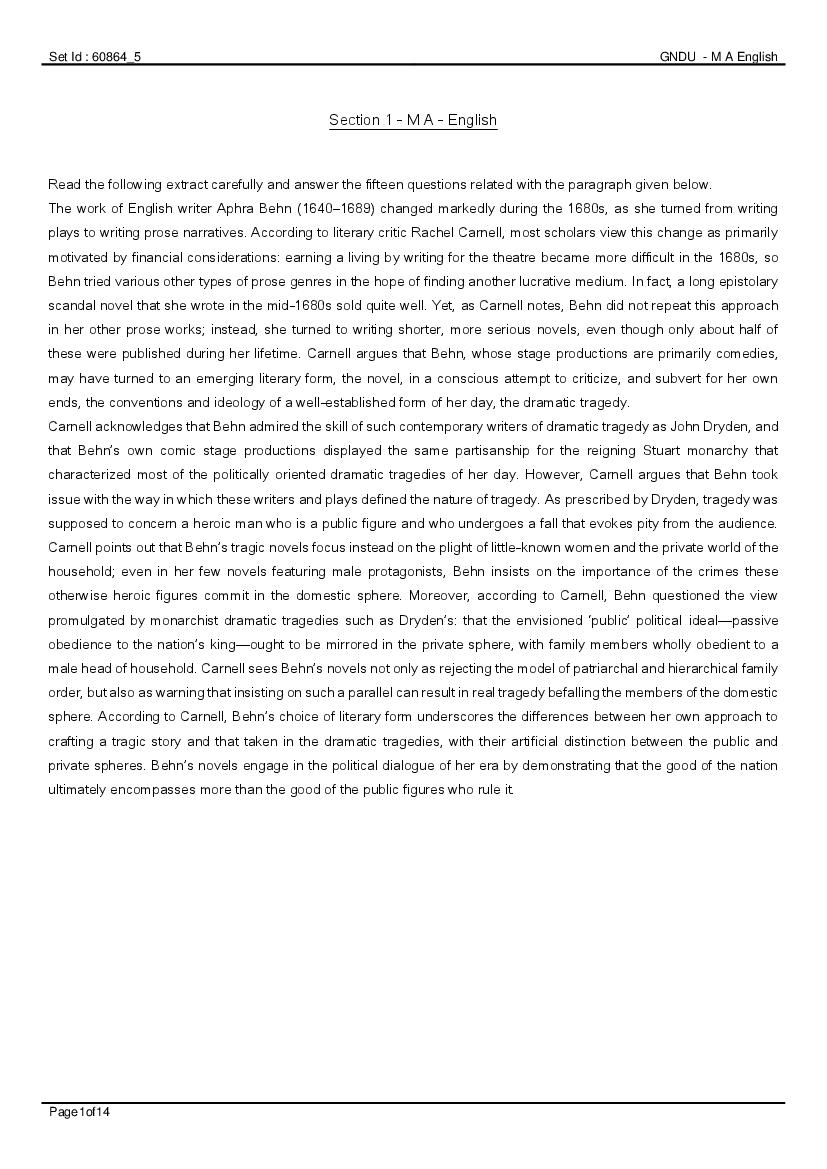
Section 1 - M A - English
Read the following extract carefully and answer the fifteen questions related with the paragraph given below.
The work of English writer Aphra Behn (1640–1689) changed markedly during the 1680s, as she turned from writing
plays to writing prose narratives. According to literary critic Rachel Carnell, most scholars view this change as primarily
motivated by financial considerations: earning a living by writing for the theatre became more difficult in the 1680s, so
Behn tried various other types of prose genres in the hope of finding another lucrative medium. In fact, a long epistolary
scandal novel that she wrote in the mid-1680s sold quite well. Yet, as Carnell notes, Behn did not repeat this approach
in her other prose works; instead, she turned to writing shorter, more serious novels, even though only about half of
these were published during her lifetime. Carnell argues that Behn, whose stage productions are primarily comedies,
may have turned to an emerging literary form, the novel, in a conscious attempt to criticize, and subvert for her own
ends, the conventions and ideology of a well-established form of her day, the dramatic tragedy.
Carnell acknowledges that Behn admired the skill of such contemporary writers of dramatic tragedy as John Dryden, and
that Behn’s own comic stage productions displayed the same partisanship for the reigning Stuart monarchy that
characterized most of the politically oriented dramatic tragedies of her day. However, Carnell argues that Behn took
issue with the way in which these writers and plays defined the nature of tragedy. As prescribed by Dryden, tragedy was
supposed to concern a heroic man who is a public figure and who undergoes a fall that evokes pity from the audience.
Carnell points out that Behn’s tragic novels focus instead on the plight of little-known women and the private world of the
household; even in her few novels featuring male protagonists, Behn insists on the importance of the crimes these
otherwise heroic figures commit in the domestic sphere. Moreover, according to Carnell, Behn questioned the view
promulgated by monarchist dramatic tragedies such as Dryden’s: that the envisioned ‘public’ political ideal—passive
obedience to the nation’s king—ought to be mirrored in the private sphere, with family members wholly obedient to a
male head of household. Carnell sees Behn’s novels not only as rejecting the model of patriarchal and hierarchical family
order, but also as warning that insisting on such a parallel can result in real tragedy befalling the members of the domestic
sphere. According to Carnell, Behn’s choice of literary form underscores the differences between her own approach to
crafting a tragic story and that taken in the dramatic tragedies, with their artificial distinction between the public and
private spheres. Behn’s novels engage in the political dialogue of her era by demonstrating that the good of the nation
ultimately encompasses more than the good of the public figures who rule it.
Page1of14
Page 2
1) The passage suggests that Carnell believes Behn held which of the following attitudes about the relationship between
the private and public spheres?
A) The structure of the private sphere should not replicate the hierarchical order of the public sphere.
B) The private sphere is more appropriate than is the public sphere as the setting for plays about political events.
C) Actions in the private sphere are more fundamental to ensuring the good of the nation than are actions in the
public sphere.
D) Crimes committed in the private sphere are likely to cause tragedy in the public sphere rather than vice versa.
2) How does, according to Cornell, Dryden define tragedy?
A) Tragedy focuses on the plight of little-known women
B) Tragedy concerns the private and domestic world of the household
C) Tragedy concerns a heroic man who is a public figure and who undergoes a fall that evokes pity from the audience
D) Tragedy concerns the plight of children
3) In the context in which it appears, ‘befall’ most nearly means
A) pretermit
B) stay
C) happen to
D) pass over
4) Replacement of the word ‘primarily’ with which of the following of words results in the least change in meaning for the
passage?
A) predominately
B) marginally
C) Secondarily
D) finally
Page2of14
Page 3
5) What does the final line of the passage suggest?
A) The larger good of the nation is as important as the good of the public figures who rule it
B) The larger good of the nation is more important than the good of the public figures who rule it
C) The larger good of the public figures is more important than the larger good of the nation
D) The larger good of the nation is less important than the good of the public figures who rule it
6) It can be inferred from the passage that the ‘artificial distinction’ refers to the
A) convention that drama ought to concern events in the public sphere and that novels ought to concern events in
the private sphere
B) ideology of many dramatic tragedies that advocate passive obedience only in the private sphere and not in the
public sphere
C) practice utilized in dramatic tragedies of providing different structural models for the public and the private spheres
D) assumption made by the authors of conventional dramatic tragedies that legitimate tragic action occurs only in
the public sphere
7) In the context in which it appears, ‘promulgate’ most nearly means
A) convention
B) assumption
C) make widely known
D) strange
8) The passage mentions epistolary novel in the context of Aphra Behn’s work. Which of the following defines the
epistolary novel?
A) a novel told through the medium of letters written by one or more of the characters
B) A form of novel, usually a first-person narrative, relating the adventures of a rogue or lowborn adventurer
C) A form of novel having a prevailing atmosphere of mystery and terror
D) A form of novel that attempts to give the written equivalent of the character’s thought processes
Page3of14
Page 4
9) In which years, a long epistolary novel by Aphra Behn was sold well ?
A) In the mid-1670s
B) In the mid-1680s
C) In the mid-1690s
D) In the mid-1660s
10) The passage suggests that Behn’s choice of literary form
A) underscores the difference between her own approach to crafting a tragic story and that taken in the dramatic
tragedies
B) underscores the similarity between her own approach to crafting a tragic story and that taken in the dramatic
tragedies
C) underscores the similarity between public and private sphere
D) underscores the difference between the poetic and the prosaic mediums
11) Why did, according to Cornell, Aphra Behn adopt an emerging literary form, the novel?
A) To criticize and subvert the conventions and ideology of comedy-drama
B) To criticize and subvert the conventions and ideology of the dramatic tragedy
C) To acknowledge and adopt the conventions and ideology of comedy-drama
D) To acknowledge and adopt the conventions and ideology of the dramatic tragedy
12) In the context in which it appears, ‘plight’ most nearly means
A) advantage
B) benefit
C) solution
D) situation
Page4of14
Page 5
13) The passage suggests that Carnell sees Behn’s novels featuring male protagonists as differing from dramatic
tragedies such as Dryden’s featuring male protagonists in that the former
A) are aimed at a predominantly female audience
B) depict these characters as less than heroic in their public actions
C) insist on a parallel between the public and the private spheres
D) emphasize the consequences of these characters’ actions in the private sphere
14) The passage is primarily concerned with
A) Explaining one author’s view of Behn’s contribution to the development of an emerging literary form
B) Presenting one scholar’s explanation for a major development in Behn’s literary career
C) Differentiating between the early and the late literary works of Behn
D) Tracing how Behn’s view of the nature of tragedy changed over time
15) In the context in which it appears, ‘hierarchical’ most nearly means
A) unordered
B) unranked
C) non-stratified
D) ranked according to relative status or authority
Directions for Questions 16 - 25:
Literary Information
16) George Orwell’s ‘Animal Farm’ is an allegory for:
A) American Revolution
B) World War II
C) French Revolution
D) Russian Revolution
17) A literary work that imitates the style or theme of another literary work, is called:
A) Sonnet
Page5of14
Page 6
B) Parody
C) Anecdote
D) Genre
18) Something which the audience is aware of in a drama but the characters do not know, is called:
A) Dramatic Irony
B) Bildungsroman
C) Soliloquy
D) Juxtaposition
19) The specific character types that occur repeatedly in a particular literary genre, and are recognizable as part of the
conventions of the form, are called:
A) Flat characters
B) Stock characters
C) Dynamic characters
D) Round characters
20) ‘My love is like a red, red rose,’ is an example of:
A) Understatement
B) Simile
C) Hyperbole
D) Alliteration
21) Which of the following is a poem written for mourning or loss?
A) Elegy
B) Ode
C) Sonnet
D) Epic
Page6of14
Page 7
22) The phrase ‘when to the sessions of sweet silent thoughts’ is an example of:
A) Hyperbole
B) Irony
C) Alliteration
D) Pun
23) What is the Greek term for Pride usually referred to as tragic flaw in the protagonist?
A) Hamartia
B) Hubris
C) Motif
D) Pun
24) The struggle between two opposing forces leading to tension in the narrative, is called:
A) Plot
B) Scene
C) Conflict
D) Theme
25) ‘The sky is a rainbow of colours’ is an example of:
A) Metaphor
B) Simile
C) Personification
D) Alliteration
Page7of14
Page 8
Directions for Questions 26 - 40:
Choose the correct option to fill in the blank.
26) The doctor ____________she visited was famous.
A) whom
B) whose
C) which
D) whomever
27) She ____________ visited her parents as she worked on weekends also.
A) lately
B) probably
C) hardly
D) perhaps
28) I would have gone for the party, if I ______tired.
A) had not been
B) was
C) was not
D) had been
29) It rained ________ three days without stopping.
A) since
B) while
C) during
D) for
Page8of14
Page 9
30) Neither this book nor this pen ___________ to me.
A) belong
B) was belonging
C) belongs
D) is belonging
31) ____________it would rain tonight, the concert has been cancelled.
A) Although
B) Therefore
C) Since
D) While
32) I fell asleep ______ the movie.
A) for
B) since
C) while
D) during
33) The new project sounds _______________.
A) exciting
B) excite
C) excited
D) excitement
34) Let’s play a match, ___________?
A) will we
B) must we
C) shall we
D) do we
Page9of14
Page 10
35) They did not see you, ___________?
A) do they
B) did they
C) don’t they
D) didn’t they
36) His name was mentioned in the article, although it was spelled incorrectly ______.
A) thereafter
B) therein
C) henceforth
D) whereupon
37) Caesar marched towards Rome, _______________Pompei fled the city.
A) therein
B) whereupon
C) henceforth
D) thereafter
38) I am looking for somebody ____________ I can trust.
A) whom
B) who
C) when
D) which
39) The Three Musketeers _________________ written by Alexander Dumas.
A) can be
B) were
C) can
D) was
Page10of14
Page 11
40) If you take medicines regularly, you ___________ get well in no time.
A) will
B) ought to
C) could
D) have to
Directions for Questions 41 - 50:
Choose the correct meaning of the given word.
41) Abridge
A) Abort
B) Cross
C) Span
D) Shorten
42) Defunct
A) Demand
B) Supply
C) Anticipate
D) Inoperative
43) Pandemonium
A) big crowd
B) great joy
C) loud noise
D) utter confusion
Page11of14
Page 12
44) Abeyance
A) Rigid
B) Suspension
C) Persistence
D) Continuation
45) Epitome
A) Spurn
B) Exemplar
C) Summary
D) Precise
46) Virulent
A) Defunct
B) Daring
C) Deceptive
D) Deadly
47) Aesthetic
A) Beautiful
B) Prevalent
C) Mediocre
D) Ugly
48) Imbecile
A) Aid
B) Astute
C) Foolish
D) Sane
Page12of14
Page 13
49) Vindicate
A) Identify
B) Destroy
C) Argue
D) Acquit
50) Gregarious
A) Blend
B) Social
C) Single
D) Shag
Page13of14
Page 14
Answer Keys
Question Paper No: 60864_5
1 A 26 A
2 C 27 C
3 C 28 A
4 A 29 D
5 B 30 C
6 D 31 C
7 C 32 D
8 A 33 A
9 B 34 C
10 A 35 B
11 B 36 B
12 D 37 B
13 D 38 A
14 B 39 D
15 D 40 A
16 D 41 D
17 B 42 D
18 A 43 D
19 B 44 B
20 B 45 B
21 A 46 D
22 C 47 A
23 B 48 C
24 C 49 D
25 A 50 B
Page14of14
Document Details
| Board / Org | Default |
| Exam | Admission Tests |
| Type | Question Paper |
| Pages | 14 |
| Updated | 22 Jul 2026 |