TG EdCET 2026 Syllabus
Finished viewing? Save it for later —
Download TG EdCET 2026 Syllabus (PDF · 9 pages)About TG EdCET 2026 Syllabus
TG EdCET 2026 Syllabus is available here for free download. Published by TGCHE for Telangana Education Common Entrance Test, this syllabus can be viewed online or downloaded as a PDF (9 pages). Candidates preparing for Telangana Education Common Entrance Test can use TG EdCET 2026 Syllabus to understand the exam pattern, the type of questions asked, and the overall difficulty level.
Frequently Asked Questions
How can I download TG EdCET 2026 Syllabus?
Open this page and click the Download button to save TG EdCET 2026 Syllabus as a PDF. It is completely free on AglaSem Docs.
Is TG EdCET 2026 Syllabus free to download?
Yes. TG EdCET 2026 Syllabus can be viewed online and downloaded as a PDF free of cost on AglaSem Docs.
How many pages does TG EdCET 2026 Syllabus have?
TG EdCET 2026 Syllabus contains 9 pages, which you can read online or download together as a single PDF.
Where can I find more Telangana Education Common Entrance Test study material?
You can find more Telangana Education Common Entrance Test question papers, sample papers, syllabus, and answer keys on AglaSem Docs.
TG EdCET 2026 Syllabus – Text
Read the full text of this syllabus below — useful to quickly search, copy and reference the content online without downloading the PDF.
📄 View text version (9 pages)
Page 1
(Telangana Education Common Entrance Test)
(Conducted by Kakatiya University, Warangal on behalf of TGCHE, Hyderabad)
___________________________________________________________________________________________________
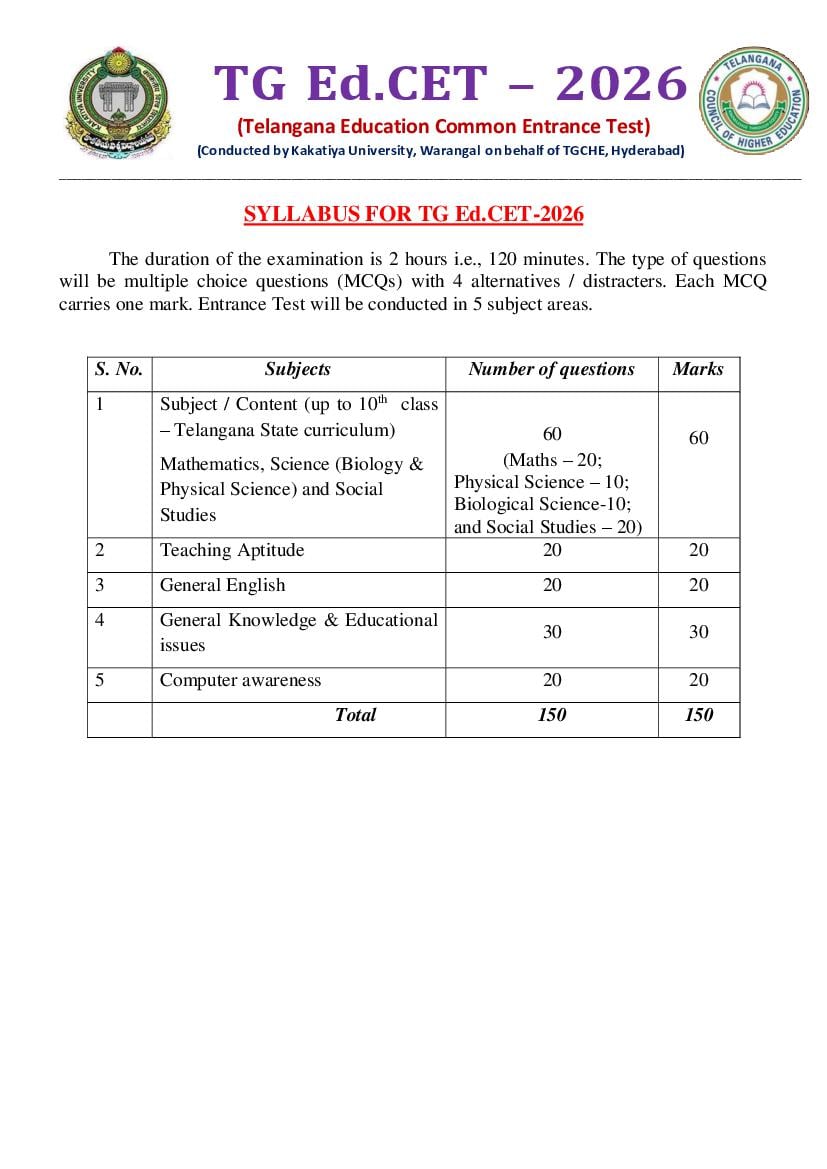
SYLLABUS FOR TG Ed.CET-2026
The duration of the examination is 2 hours i.e., 120 minutes. The type of questions
will be multiple choice questions (MCQs) with 4 alternatives / distracters. Each MCQ
carries one mark. Entrance Test will be conducted in 5 subject areas.
S. No. Subjects Number of questions Marks
1 Subject / Content (up to 10th class
– Telangana State curriculum) 60 60
Mathematics, Science (Biology & (Maths – 20;
Physical Science) and Social Physical Science – 10;
Biological Science-10;
Studies
and Social Studies – 20)
2 Teaching Aptitude 20 20
3 General English 20 20
4 General Knowledge & Educational
30 30
issues
5 Computer awareness 20 20
Total 150 150
Page 2
Section - 1
MATHEMATICS
1. NumberSystem
Fundamental operations - square roots and cubic roots -properties of different number
systemstoRealNumbers – propertiesofnumberslikeeven,odd,prime,composite, co- prime, multiples,
factors etc. – Polynomials of factorization- primefactorization, LCM and HCF of numbers- number
patterns-progressions (arithmetic progression) – Playing with numbers (divisibilityrules, number
puzzles) – fractions and decimals and their conversions with and without division- laws of logarithms-
Mathematical units and their conversions- exponents and powers.
Setsandtheirrepresentation–typesofsets–operationsonsets–Venndiagrams.
2. CommercialMathematics
Comparing quantities using proportions -Ratio – inverse ratio, compound ratio - Proportion (direct
and indirect) – unitary method – percentage – conversion from fraction, decimal to percentage and
vice-versa- profit and loss- discount – Interest (simple and compound) – Time and distance – Time
and work – Goods and Service Tax (GST)
3. Algebra
Algebraic expressions- Variables and constants, terms, expressions, degree –types of expressions
(based on degree and terms) -factorization.
Operations on Algebraic expressions-laws and properties of exponents– factorization– algebraic
identities- polynomials and their zeroes – remainder theorem and factortheorem– relationship
between zeroes and coefficients of polynomials
Linear equations in one variable and two variables – pair of linear equations in two variables
(conditions for consistent, inconsistent and dependent and their geometrical interpretations) and their
solutions – Quadratic equations (nature ofroots) and finding the roots and forming a quadratic
equation when roots are given.
4. Geometry
ElementsofGeometry – Basicgeometric ideas(point, line, planeetc.) –Angles(typesof angles)-Lines
and angles – pairs of angles (complementary, supplementary etc.) vertically opposite angles, linear
pair- parallel lines and a transversal, different angles formed and properties related to them.
Types of triangles (based on sides and angles) andtheirproperties-triangle inequalities – congruency
and similarity of triangles and their criterion- basic proportionality theorem and converse-Pythagoras
theorem and converse – areas of similar triangles.
Different types ofquadrilaterals (trapezium, parallelogram, etc.) and their properties – mid-point
theorem and its converse.
Parts of a circle – different angles formed by an arc (chord) – perimeter and area of a sector –
segments ofa circle – tangents and secants to a circle and their properties.
Cartesian system- plotting a point- distance between two points – section formula (mid-point,
centroid, etc.) – area oftriangle – collinearity - slope ofa line.
5. Mensuration
Perimeter and area of plane figures (triangle, circle etc.) – surface areas and volumes of different
solid figures (cubes, cylinder, etc.).
Page 3
Trigonometricratios–valuesforspecificangles(00,300,450,600,900)
Ratio of complementary angles – trigonometric identities – angle of elevation and depression and
simple problems related to them- applications of trigonometry.
7. DataHandling
Collection, classification and types of data – tabular forms – graphical representation of data
(pictogram, bar graph etc.) – reading and interpretation of data from graphs – mean, median and
mode of ungrouped data – simple problems related to probability (dice, coins, deck of cards etc.)-
Concept of complementary events. Frequency distribution.
Section – 1
PHYSICAL SCIENCE
1. Material
Transparent, translucent, opaque material. Characteristics of Solids, Liquids, Gases – sink & float –
Soluble in water. Methods of separation (Hand packing, Winnowing, Sedimentation, Sewing, Filtration,
Crystallization, Evaporation, Sublimation, Chromatography).
Characteristics of acids, bases – Change in color of litmus (Red, Blue) – Examples for acids & bases in
daily life – Acid rains, impact, remedies - Neutralization -uses of acids, bases in daily life – Acidic and
basic nature of salts – uses of salts.
Natural fiber, Synthetic fiber - Burning test - Blending – Laundry label symbols – plastic resin codes –
Thermoplastics, Thermosetting plastics – Reduce, Recycle, Reuse, Recover.
General Physical Properties of Metals and nonmetals – Uses of metals and non- metals in daily life.
Archimedes principle – Pascal’s principle and uses.
2. Light
Formation of shadow – Characteristics of shadow – straight line motion of light, pinhole camera –
differences between shadow and images.
Reflection of light – Laws of reflection– Plane of reflection- Periscope – concave and convex
mirrors - making of solar cooker.
Refraction of light - total internal reflection, applications - mirages – types of lenses - uses of convex
and concave lenses in daily life.
Least distance of distinct vision – Angle of vision –Accommodation defects of human eye (Myopia,
Hypermetropia, presbyopia) and their corrections – power of lens. Dispersion and formation of
rainbow, Scattering & Blue color of the sky, Red color of Sun at the time of dawn & dusk.
3. Electricity &Magnetism
Types of magnets –like, unlike poles.
Simple electric circuit – symbols of components of circuit - torch.
Conductors, Insulators– parts of dry cell – series & parallel connections of dry cells and bulbs.
Electric conductivity of liquids - Electroplating, uses of it.
Heating effects of electric current – Fuse & MCB – electricity bill & unit - electric shock, precautions.
Difference between motor & generator – difference between AC and DC.
Page 4
Heat is a form of energy –Heat and temperature – Thermometer (clinical thermometer, laboratory
thermometer).Evaporation, factors affecting evaporation – condensation – Humidity – Dew &Fog –
Boiling, Melting, Freezing – Enormous expansion of water.
5. Sound
Production of Sound – Propagation of sound in solids, liquids, gases & vacuum - Structure of human ear.
Types of waves (transverse , Longitudinal) –wave length, Amplitude, Loud and feeble sounds – Time
period, Frequency, pitch – speed of sound wave in solids, liquids, gases.
Reflection of sound – Echo - Reverberation. Audible Range –Infrasonic sounds, Ultrasonic sounds, Uses
of Ultrasonic sounds.Sound Pollution, effects, measures to be taken to control sound pollution.
6. Motion
Uniform, non-uniform motion - Translatory motion (Rectilinear motion, Curvilinear motion),
Rotatory motion, Oscillatory motion.
Field forces (Magnetic force, Electrostatic force, Gravitational force) – Contact forces (Muscular force,
Friction, Normal force, Tension) - Net Force, Free body diagram. Effects of force.
Factors affecting friction – Measures to be taken to increase friction, measures to be taken to decrease
friction.
Potential energy, Kinetic energy. Renewable & Non-renewable energy resources. Finding centre of
gravity.
Equations of Uniform accelerated motion.Daily life examples of Newton’s Laws of Motion (1, 2, 3).
7. Changes
Change in seasons –Natural, man-made changes – Permanent, temporary changes - Change in state &
shape of material – Reasons for change – Indications of change - Physical Change, Chemical
Change.Rusting of Iron / Corrosion, Galvanization - Browning of Cut vegetables & its prevention –
Crystallization.
8. Weather & Climate
Measuring the components of weather – Maximum-Minimum thermometer – Rain Gauge – Humidity.Air
exerts pressure – Air expands on heating – effects of moving air - formation of Cyclone - Do’s and Dont’s
during Cyclones – Post cyclone measures.
9. Coal &Petrol
Uses of coal, petroleum, natural gas –By products of petroleum, uses.Formation of coal, petroleum –
Indiscriminate usage of energy resources, its effects.
Combustion – Ignition temperature –fuel, Calorific Value. Fire Control. Structure of Flame, Zones in it.
10. Some Natural Phenomena
Producing charge on an object– identifying charge on an object – measures to be taken during thunder –
lightening conductor – earthquakes, causes, protection – seismograph – Richter scale
11. Stars & Solar System
Sundial–phases of moon – Types of solar and lunar eclipses – constellations – Polestar –Solar system
(Planets, Asteroids, Comets, Meteors).
12. Metallurgy
Minerals, ores, Reactivity series of Metals.
Page 5
Elements – Compounds–Mixtures-Types of Mixtures (Homogeneous, Heterogeneous) – Solutions –
Solvent, Solute.
Types of chemical reactions (chemical combination, chemical decomposition, chemical displacement,
chemical double displacement / double decomposition).
14. Structure of the Atom
Wave nature of the light, Bohr’s Model of Hydrogen atom, Quantum mechanical model of an atom.
Section -1
BIOLOGICALSCIENCE
1. Food
Food from plants and animals, Methods of preparing food, Food preservation methods, Food
components – Carbohydrates, Proteins, Fats, Vitamins, Balanced diet, Malnutrition, Deficiency
diseases, Food capture in organisms, Food habits inanimals.
2. LivingOrganisms
Prokaryotic and eukaryotic cell, Plant cell and animal cell, Cell structure and functions, Plant and
animaltissues; Plant parts and functions, Fibre fromplants.
Characteristicsofliving organism, HierarchyofClassification, Movement ofhuman beings and animals,
Characteristics ofdifferent animalphyla, Metamorphosis inorganisms, Sense organs.
Useful and harmful micro-organisms, Infectious and non-infectious diseases, Acute andChronic
Diseases
3. LifeProcesses
Human digestive system, Human respiratory system, Human circulatory system, Human excretory
system, Human nervous system, Human endocrine system, Human reproductive system; Cell cycle,
Mitosis, Meiosis, Sex determination in human beings, Physical and behavioral changes in adolescents,
Reproductive health, Speciation, Homologous and Analogous organs.
Photosynthesis,Partsoftheflower,vegetativepropagation,seeddispersal.
4. Biodiversity
Types of ecosystems - Terrestrial ecosystems and aquatic ecosystems, Adaptationsin plants and
animals living in different ecosystems, Food chain, Food web, Endemic, Endangered and extinct
species, Sanctuaries and National Parks.
Cultivation,Irrigation,Fertilization,Challengesinimprovingagriculturalproducts.
5. Pollution
Sourcesandeffectsofair,water,soilandsoundpollution,PollutionduetoUrbanization,Bioremediation,
Concepts of 4 Rs – Reduce, Reuse, Recycle, Recover.
Page 6
SOCIALSTUDIES
1. Geography
Our Earth: Evolution, Latitudes and Longitudes, Movements of the Earth and Seasons, Relief Features
ofIndia, Reading and Making Maps, Water Resources – Rivers and Tanks, Climate and Weather:
Factors affecting the Climate and Weather, Natural Realms of the Earth: Lithosphere, Atmosphere,
Hydrosphere, Biosphere, NaturalVegetation, Population, Settlements and Migration
2. History
Indus Valley Civilization, Emergence of Kingdoms: Mahajanapadas, First Empires: Mauryan Empire,
Emergence of Regional Kingdoms – Kakatiya’s and Vijayanagara Kingdoms, Delhi Sultanate-
Satavahana Kingdom, Mughal Empire, Establishment of British Empire in India, Freedom Movement
of India, Democratic and Nationalist Revolutions, Industrial Revolution, Colonialism in Latin America,
Asia and Africa, Social Protest Movements : Environmental Movements, Women’s Movements, World
Between World Wars, Post World Wars – League of Nations, UNO, NAM, Cold War, The Movement
forthe formation of Telangana State.
3. PoliticalScience
Indian Constitution- Salient Features, Forms of Government – Presidential and Parliamentary forms of
Government, Government at Different Levels- Union, State, Local Self Government, Judicial System in
India: Civil Law, Criminal Law, Courts at different levels, Democracy : An Evolving Ideas; Expansion
of Democracy-Libya, Myanmar, Election Process in India, Rights: Human Rights and Fundamentals
Rights, Disaster Management, SocialIssues: Communalism, Corruption, Poverty, Independent India:
1947- 1977, Emerging Political Trends- 1977-2000, Women Protection Acts-ChildRights, Traffic
Education.
4. Economics
Money and Banking, Sectors of Economy: Agricultural, Industries, Service, Credit in Financial
System, Prices and Cost of Living, The Government Budget and Taxation, Food Security, Factors of
Production, Globalization, Sustainable Development, Gross Domestic Product; National Income /Per
capita Income
Page 7
TEACHINGAPTITUDE
Teaching Aptitude questions will be related to understanding teaching-learning process, classroom
management and mentoring with specialreference to teacher – pupilrelationship.
Teaching requires certain characteristics like ability to communicate, ability to deal with Children,
ability to recognize individual differences etc., apart from analytical thinking and general intelligence.
One who has these characteristics will be able to become a goodteacher after training. Questions relating
to these aspects will be included to test one's teaching aptitude.
Teaching aptitude questions will analyze and examine Teaching proficiency in Numeracy,
Communication, and adaptability and would include the following
• Interest in Teaching
• Competencies and skills in Teaching
• Communication Skills related to Teaching
• Nature of Teaching
• Characteristics of Learners, Knowledge of Teaching methods.
• Knowledge of Evaluation Methods, Assessment and Measurement.
• How to Create Positive Learning Environment
• Attitude towards teaching.
• Teaching as a Profession, Teaching as an Occupation
• Ethics and Values in Teaching
• Concept of Learning; Process of Learning.
• Different types of Tests, Verbal test, Non-verbal test, Performance Test.
• Online Teaching, Features of Online Teaching
• Classroom management, Strategies for effective Classroom Management
• Student Engagement: Factors that enhance student engagement.
• Class work and Homework.
• Individual differences in students
• Concept of a Text Book and Work Book, Characteristics of a Good Text Book
• Teaching-Learning Resources
• Study habits and Study Skills of Students
Page 8
GENERALENGLISH
1. Reading Comprehension
2. Spelling, Articles, Prepositions
3. Tenses, Subject – Verb Agreement
4. Voice, Reported Speech
5. Vocabulary-Synonyms, Antonyms and Homonyms
6. Connectivesand Linkers
7. Rearranging Jumbled Words / Sentences
8. Error Correction
Section - 4
GENERAL KNOWLEDGE&EDUCATIONALISSUES
Currentaffairs(IndiaandInternational),ContemporaryEducationalIssues.
1. Questions will be designed to test the ability of the candidate's general knowledge of the
environment around him and its application to society.
2. Questions will also be designed to test knowledge of current events, Governance and Policy and of
such matters of every day observation and experience in their scientific outlook as is expected
ofaneducated person.
3. The test will also include questions relating to India and its neighboring Countries especially
pertaining to History, Culture, Geography, Ecology, Economics, General Policy and Scientific
Research, National Security, Cashless Economy.
4. NEP–2020, Success to Quality Education and Governance–School Education, Equitable and
Inclusive Education: Issues of Socio-Economically Disadvantaged Groups (SEDGs), SSA, RTE,
Digital Empowerment and Capacity Building, PM Gati-shakti National Master Plan, Holistic
Education through integration of skilling, Indian knowledge system, PARAKH.
Page 9
COMPUTERAWARENESS
Types of memory and memory devices, Components of a computer, Input and Output
devices, Various types of programming languages, Types of operating systems.
Importance of different types of databases (Relationalandnon-relational).Keys in DBMS.
MS Office – MS word: - Basic operations, saving retrievingfiles to and fromdifferent
locations (Drives).Spell check, Text editing.
MSExcel – components of Excel window, Editingdata in Excel worksheets, basic statistical
applications.
MSPowerPoint–creatingandviewingapresentation.
IntroductiontoInternet–searchengines,Emails-openingaccount,Mailbox- Inbox, Outbox,
Sorting and searching emails.
Virusesandprotectionsystems,ApplicationsofAlandMachineLearning.
Document Details
| Board / Org | TGCHE |
| Exam | Telangana Education Common Entrance Test |
| Type | Syllabus |
| Pages | 9 |
| Language | english |
| Updated | 22 Jul 2026 |