MBOSE Class 10 Question Paper 2022 for Science
Finished viewing? Save it for later —
Download MBOSE Class 10 Question Paper 2022 for Science (PDF · 23 pages)About MBOSE Class 10 Question Paper 2022 for Science
MBOSE Class 10 Question Paper 2022 for Science is available here for free download. Published by Meghalaya Board for Class 10, this question paper can be viewed online or downloaded as a PDF (23 pages). Candidates preparing for Class 10 can use MBOSE Class 10 Question Paper 2022 for Science to understand the exam pattern, the type of questions asked, and the overall difficulty level.
Frequently Asked Questions
How can I download MBOSE Class 10 Question Paper 2022 for Science?
Open this page and click the Download button to save MBOSE Class 10 Question Paper 2022 for Science as a PDF. It is completely free on AglaSem Docs.
Is MBOSE Class 10 Question Paper 2022 for Science free to download?
Yes. MBOSE Class 10 Question Paper 2022 for Science can be viewed online and downloaded as a PDF free of cost on AglaSem Docs.
How many pages does MBOSE Class 10 Question Paper 2022 for Science have?
MBOSE Class 10 Question Paper 2022 for Science contains 23 pages, which you can read online or download together as a single PDF.
Where can I find more Class 10 study material?
You can find more Class 10 question papers, sample papers, syllabus, and answer keys on AglaSem Docs.
MBOSE Class 10 Question Paper 2022 for Science – Text
Read the full text of this question paper below — useful to quickly search, copy and reference the content online without downloading the PDF.
📄 View text version (23 pages)
Page 1
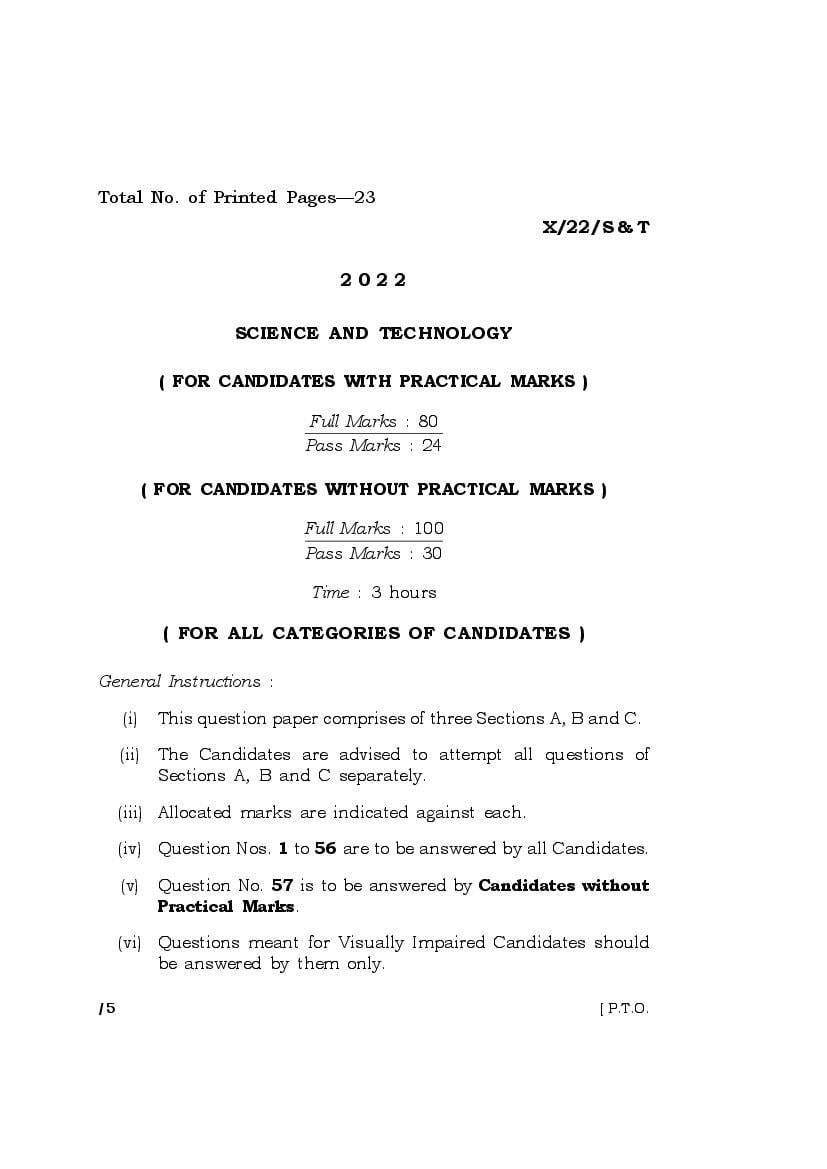
X/22/S & T
2022
SCIENCE AND TECHNOLOGY
( FOR CANDIDATES WITH PRACTICAL MARKS )
Full Marks : 80
Pass Marks : 24
( FOR CANDIDATES WITHOUT PRACTICAL MARKS )
Full Marks : 100
Pass Marks : 30
Time : 3 hours
( FOR ALL CATEGORIES OF CANDIDATES )
General Instructions :
(i) This question paper comprises of three Sections A, B and C.
(ii) The Candidates are advised to attempt all questions of
Sections A, B and C separately.
(iii) Allocated marks are indicated against each.
(iv) Question Nos. 1 to 56 are to be answered by all Candidates.
(v) Question No. 57 is to be answered by Candidates without
Practical Marks.
(vi) Questions meant for Visually Impaired Candidates should
be answered by them only.
/5 [ P.T.O.
Page 2
SECTION—A
( PHYSICS )
( Marks : 26 )
Choose and write the correct answer from the following
(any four) : 1×4=4
1. The perpendicular shift in the path of light while
emerging from another optical medium is called
(A) displacement
(B) lateral displacement
(C) shifting
(D) scattering
2. An object is at infinity with respect to the optical centre
of a converging lens. The image formed is
(A) diminished and erect
(B) magnified and inverted
(C) diminished to a point and inverted
(D) magnified and erect
3. The rate of flow of an electric charge is called
(A) electric current
(B) electric energy
(C) electric potential
(D) None of the above
X/22/S & T/5 [ Contd.
Page 3
4. Stars appear to twinkle due to
(A) atmospheric refraction
(B) movement of air
(C) Both (A) and (B)
(D) None of the above
5. The strength of magnetic field
(A) increases near the poles
(B) decreases near the poles
(C) remains the same
(D) None of the above
6. An electric device which converts electric energy into
mechanical energy is called
(A) transformer
(B) electric generator
(C) dynamo
(D) electric motor
7. Electrical resistivity of a given metallic wire depends on
(A) its length
(B) its thickness
(C) its shape
(D) nature of the material
X/22/S & T/5 [ P.T.O.
Page 4
8. The blind spot on retina has
(A) few nerve endings
(B) high concentration of nerve endings
(C) no nerve endings
(D) None of the above
Answer the following short answer-type questions (any four) :
2×4=8
9. State the characteristics of image formed when the
object is placed between optical centre and the first
principal focus of a convex lens. ½×4=2
10. State two uses of concave mirror. 1+1=2
11. What is myopia? Name the lens used for correcting this
defect. 1+1=2
12. What do you mean by monochromatic light and poly-
chromatic light? 1+1=2
13. State any two characteristics of material for heating
elements. 1+1=2
14. Define electric power. State the SI unit of power. 1+1=2
X/22/S & T/5 [ Contd.
Page 5
15. What is a solenoid? 2
16. What do you understand by the term ‘earthing’? Why is it
important to have earthing? 1+1=2
Answer the following short answer-type questions : 3×3=9
Answer either Part—A or Part—B from each question
Part—A
17. (a) State the nature of lens and the focal length if its
power is +4D. 1+2=3
Part—B
(b) What do you understand by the term ‘refractive
index’? 1
(c) What is one dioptre? 1
(d) What is the speed of light in air or vacuum? 1
Part—A
18. (a) An electric heater draws a current 5 A when
connected to 220 V supply mains in one minute.
Calculate the energy consumed by the heater in
kilojoules. 3
X/22/S & T/5 [ P.T.O.
Page 6
Part—B
(b) Three resistors of resistances 12 , 6 and 4 are
connected in parallel. Calculate the total resistance
of the circuit. 2
(c) State the SI unit of resistivity. 1
Part—A
19. (a) Give the function of coil, commutator and brushes of
an electric motor. 3
Part—B
(b) List three characteristics of magnetic field. 3
Answer the following long answer-type question : 5
Answer either Part—A or Part—B or Part—C
Part—A
20. (a) State the laws of reflection. 2
(b) How can the power of an electric motor be
increased? (Give any three points.) 3
Part—B
(c) What is a spectrum? 1
X/22/S & T/5 [ Contd.
Page 7
(d) Why is the sunlight reaching the earth yellowish? 2
(e) How is a rainbow formed? 1
(f) Why do the insulators not conduct electricity? 1
Part—C
(g) In the given diagram of human eye, name the
parts (1), (2), (3), (4), (5) and (6) : ½×6=3
Human Eye
[ For Visually Impaired Candidates only
in lieu of Question No. 20(g) ]
(g) What is vitreous humour? Give two functions of
vitreous humour. 1+2=3
(h) Give two differences between real and virtual
images. 2
X/22/S & T/5 [ P.T.O.
Page 8
SECTION—B
( CHEMISTRY )
( Marks : 26 )
Choose and write the correct answer from the following
(any three) : 1×3=3
21. Zinc or aluminium does not corrode because
(A) they do not react with moist air
(B) they react with moist air to form a very thin layer of
oxides which is very sticky and hard
(C) they are inactive metals
(D) they are metalloids
22. Which one of the following is not a neutral salt?
(A) NaCl
(B) NaNO3
(C) Na2SO4
(D) Na2CO3
23. Which of the following forms the basis of the Modern
Periodic Table?
(A) Atomic mass
(B) Atomic number
(C) Number of nucleons
(D) All of the above
X/22/S & T/5 [ Contd.
Page 9
24. Which of the following statements is not correct?
(A) All metal carbonates react with an acid to give salt,
water and carbon dioxide.
(B) All metal oxides react with water to give salt and
acid.
(C) Some metals react with acid to give salt and
hydrogen.
(D) Some non-metal oxides react with water to form an
acid.
25. What is the other name for Group 18 elements?
(A) Noble gases
(B) Alkali metals
(C) Alkaline earth metals
(D) Halogens
26. A chemical reaction is characterized by
(A) a change in state
(B) formation of new products
(C) evolution or absorption of energy
(D) All of the above
X/22/S & T/5 [ P.T.O.
Page 10
Answer the following short answer-type questions (any three) :
2×3=6
27. Balance the following chemical reactions : 1+1=2
(a) Cu(NO3)2 CuO + NO2 + O2
(b) MnO2 + HCl MnCl2 + Cl2 + H2O
28. What happens chemically, when quicklime is added to
water? Give the chemical equation. 1+1=2
29. State two limitations of the Mendeleev’s Periodic Table.
1+1=2
30. The atomic numbers of nitrogen and phosphorus are
7 and 15 respectively. Write the electronic configuration
of each of them and state to which Period do they belong.
½+½+½+½=2
31. (a) What are hydrocarbons? 1
(b) Give the names of the following functional groups :
½+½=1
(i) —OH
(ii) —COOH
32. (a) Name the organic acid present in vinegar. Write its
chemical formula. ½+½=1
(b) Name the reaction that is commonly used in the
conversion of vegetable oils to fats. 1
X/22/S & T/5 [ Contd.
Page 11
Answer the following short answer-type questions : 3×4=12
Answer either Part—A or Part—B from each question
Part—A
33. (a) On adding drop of barium chloride solution to an
aqueous solution of sodium sulphate, a white
precipitate is obtained.
(i) Write a balanced chemical equation and specify
the name of precipitate formed. 1+1=2
(ii) What other name can be given to this precipitation
reaction? 1
Part—B
(b) When an aqueous sodium hydroxide solution is added
to aqueous copper sulphate solution, it forms a bluish
white precipitate of copper hydroxide.
(i) What is the colour of copper sulphate solution? 1
(ii) What type of reaction is this? 1
(iii) Write a balanced chemical equation to represent
the above reaction. 1
Part—A
34. (a) (i) Write the chemical formula and chemical name
of Plaster of Paris. 1
(ii) What happens when gypsum is heated above
100 °C? 1
(iii) Give one use of Plaster of Paris. 1
X/22/S & T/5 [ P.T.O.
Page 12
Part—B
(b) (i) What is meant by the term ‘pH’ of a solution? 1
(ii) The pH of gastric juices extracted from the
stomachs of two persons A and B were found to
be 1 and 3 respectively. The stomach juice of
which person is more acidic? 1
(iii) Give an example each of strong acid and
strong base. ½+½=1
Part—A
35. (a) Draw a geometric diagram for the formation of
MgCl2 from magnesium and chlorine by transfer of
electrons. 3
[ For Visually Impaired Candidates only
in lieu of Question No. 35(a) ]
(a) (i) Why and how are alloys made? 1½
(ii) State any three properties of alloy. 1½
Part—B
(b) A solution of CuSO4 was kept in an aluminium
pot. After few days, the aluminium pot was found to
have a number of holes in it. Explain the reason
in terms of reactivity. Write the chemical equation
involved. 2+1=3
Part—A
36. (a) (i) What do you understand by saturated and
unsaturated carbon compounds? 1+1=2
(ii) Write two isomers of butane. ½+½=1
X/22/S & T/5 [ Contd.
Page 13
Part—B
(b) Acetone is the first member of ketones. Answer the
following questions :
(i) What is its molecular formula? 1
(ii) What is its IUPAC name? 1
(iii) Give its structural formula. 1
Answer the following long answer-type question : 5
Answer either Part—A or Part—B or Part—C
Part—A
37. (a) Identify and name the elements out of the following
elements whose electronic configurations are given
below : ½×4=2
(He, Li, Na, K, Ca, Mg, Cl)
(i) 2, 8, 2
(ii) 2, 8, 1
(iii) 2, 8, 7
(iv) 2, 1
(b) What is an oxidation reaction? Identify (i) the
substance oxidized and (ii) the substance reduced
in the following reaction : 1+½+½=2
ZnO + C Zn + CO
(c) Write down the valency of (i) fluorine and
(ii) aluminium. ½+½=1
X/22/S & T/5 [ P.T.O.
Page 14
Part—B
(d) What is concentration of ore? 1
(e) Explain the froth floatation process with neat
labelled diagram. 2½+1½=4
[ For Visually Impaired Candidates only
in lieu of Question No. 37(e) ]
(e) Define Roasting. State any three objectives achieved
during roasting. 1+3=4
Part—C
(f) (i) What is esterification? Give chemical equation. 1+1=2
(ii) What are esters used for? ½+½=1
(iii) Differentiate between soap and synthetic
detergents (any two points). 1+1=2
SECTION—C
( BIOLOGY )
( Marks : 28 )
Choose and write the correct answer from the following
(any three) : 1×3=3
38. During germination, a seedling develops from a/an
(A) seed
(B) embryo
(C) seed coat
(D) ovule
X/22/S & T/5 [ Contd.
Page 15
39. Select the mismatched pair.
(A) Adrenaline : Pituitary gland
(B) Testosterone : Testes
(C) Estrogen : Ovary
(D) Thyroxine : Thyroid gland
40. The movement of shoot towards light is called
(A) geotropism
(B) hydrotropism
(C) chemotropism
(D) phototropism
41. Platelets help in
(A) transport of oxygen
(B) transport of carbon dioxide
(C) clotting of blood
(D) pumping of blood
X/22/S & T/5 [ P.T.O.
Page 16
42. Which excretory organ stores urine?
(A) Kidney
(B) Ureter
(C) Urinary bladder
(D) Urethra
43. We can get disease-free plant by
(A) fission
(B) regeneration
(C) fragmentation
(D) micropropagation
Answer the following short answer-type questions (any four) :
2×4=8
44. Write any four basic requirements of photosynthesis.
½+½+½+½=2
45. What is the role of (a) tongue and (b) teeth in digestion?
1+1=2
X/22/S & T/5 [ Contd.
Page 17
46. What is reflex action? Give two examples. 1+½+½=2
47. Mention the mode of reproduction used by (a) Amoeba
and (b) Planaria. 1+1=2
48. (a) Which gland is known as ‘gland of emergency’ ? 1
(b) What causes dwarfism? 1
49. Illustrate, with the help of suitable diagram, the spore
formation in Rhizopus. ½×4=2
[ For Visually Impaired Candidates only
in lieu of Question No. 49 ]
49. Name two sexually transmitted diseases each caused due
to bacterial infection and viral infection. 1+1=2
50. Define heredity. Name the scientist who is referred to as
‘the father of genetics’. 1+1=2
51. What is speciation? Name two types of speciation.
1+½+½=2
X/22/S & T/5 [ P.T.O.
Page 18
Answer the following short answer-type questions : 3×4=12
Answer either Part—A or Part—B from each question
Part—A
52. (a) Give three points of difference between respiration in
plants and animals. 3
Part—B
(b) (i) In the given diagram, name the parts (1), (2),
(3) and (4) : ½×4=2
[ For Visually Impaired Candidates only
in lieu of Question No. 52(b)(i) ]
(i) How are acquired traits different from inherited
traits? 1+1=2
(b) (ii) Name any two autotrophic plants which also
show heterotrophic mode of nutrition. ½+½=1
X/22/S & T/5 [ Contd.
Page 19
Part—A
53. (a) (i) Define nerve impulse. Which structure in a
neuron helps to conduct a nerve impulse—
1. towards the cell body;
2. away from the cell body? 1+½+½=2
(ii) Define synapse. 1
Part—B
(b) Write down the functions of gibberellins, cytokinins
and abscisic acid (one each). 1+1+1=3
Part—A
54. (a) (i) What is vegetative propagation? 1
(ii) In which type of plant is it performed? 1
(iii) Name two methods of vegetative propagation.
½+½=1
Part—B
(b) (i) What do you mean by tissue culture? 1
(ii) Give any two advantages of tissue culture. 1+1=2
Part—A
55. (a) Enumerate the basis of Darwin’s theory of natural
selection (any six points). ½×6=3
X/22/S & T/5 [ P.T.O.
Page 20
Part—B
(b) Define the following : 1+1+1=3
(i) Genetics
(ii) Palaeontology
(iii) Evolution
Answer the following long answer-type question : 5
Answer either Part—A or Part—B or Part—C
Part—A
56. (a) (i) List three kinds of blood vessels of human
circulatory system. 1½
(ii) What makes red blood corpuscles red? ½
(iii) Name the main organs of human digestive
system for digestion of food. 2½
(iv) What is the mode of nutrition found in human
beings? ½
Part—B
(b) Explain the following terms : 1+1+1=3
(i) Implantation
(ii) Placenta
(iii) Parturition
X/22/S & T/5 [ Contd.
Page 21
(c) What is puberty? When does puberty occur in
human male and female? 1+1=2
Part—C
(d) State the differences between transpiration and
translocation. 1+1+1+1+1=5
[ For Candidates without Practical Marks ]
57. I. Answer any three of the following questions : 2×3=6
(a) State and write the mirror formula. 1+1=2
(b) State two uses of convex mirror. 1+1=2
(c) What is presbyopia? How is this defect
corrected? 1+1=2
(d) What do you understand by the term ‘electric
work’? State its SI unit. 1+1=2
(e) State the characteristics of magnetic field lines
(two points). 1+1=2
(f) List two characteristics of an image formed in a
plane mirror. 1+1=2
II. Answer any three of the following questions : 2×3=6
(a) Balance the following : 1+1=2
(i) H2 + O2 H2O
(ii) Mg + N2 Mg3N2
X/22/S & T/5 [ P.T.O.
Page 22
(b) What is chemical decomposition reaction? Give
an example. 1+1=2
(c) Explain the terms ‘rust’ and ‘rusting’. 1+1=2
(d) Name two allotropes of carbon. 1+1=2
(e) Write two uses of bleaching powder. 1+1=2
(f) (i) Name a molecule of an element that has one
covalent bond. 1
(ii) How do valence electrons vary on going
down the Group? 1
III. Answer any four of the following questions : 2×4=8
(a) Name the following : 1+1=2
(i) Small openings present on the leaf surface
(ii) The duct which carries urine from urinary
bladder to outside the body
(b) Name the following : 1+1=2
(i) Fission in which two organisms are formed
from one parent cell
(ii) Female reproductive whorl of a flower
(c) Write the full forms of the following : 1+1=2
(i) ATP
(ii) HIV
X/22/S & T/5 [ Contd.
Page 23
(d) Name four kinds of cells (elements) of xylem.
½×4=2
(e) Write the functions of (i) insulin and
(ii) testosterone. 1+1=2
(f ) Name the parts of flower which produce male
and female gamete. 1+1=2
(g) What is multiple fission? Name the organism
which reproduces by multiple fission. 2
(h) What is genetic drift? 2
X/22/S & T/5 22K—62410
Document Details
| Board / Org | Meghalaya Board |
| Exam | Class 10 |
| Type | Question Paper |
| Pages | 23 |
| Updated | 22 Jul 2026 |