DUET Question Paper 2020 for DU MA Applied Psychology
Finished viewing? Save it for later —
Download DUET Question Paper 2020 for DU MA Applied Psychology (PDF · 16 pages)About DUET Question Paper 2020 for DU MA Applied Psychology
DUET Question Paper 2020 for DU MA Applied Psychology is available here for free download. Published by NTA for DUET, this question paper can be viewed online or downloaded as a PDF (16 pages). Candidates preparing for DUET can use DUET Question Paper 2020 for DU MA Applied Psychology to understand the exam pattern, the type of questions asked, and the overall difficulty level.
Frequently Asked Questions
How can I download DUET Question Paper 2020 for DU MA Applied Psychology?
Open this page and click the Download button to save DUET Question Paper 2020 for DU MA Applied Psychology as a PDF. It is completely free on AglaSem Docs.
Is DUET Question Paper 2020 for DU MA Applied Psychology free to download?
Yes. DUET Question Paper 2020 for DU MA Applied Psychology can be viewed online and downloaded as a PDF free of cost on AglaSem Docs.
How many pages does DUET Question Paper 2020 for DU MA Applied Psychology have?
DUET Question Paper 2020 for DU MA Applied Psychology contains 16 pages, which you can read online or download together as a single PDF.
Where can I find more DUET study material?
You can find more DUET question papers, sample papers, syllabus, and answer keys on AglaSem Docs.
DUET Question Paper 2020 for DU MA Applied Psychology – Text
Read the full text of this question paper below — useful to quickly search, copy and reference the content online without downloading the PDF.
📄 View text version (16 pages)
Page 1
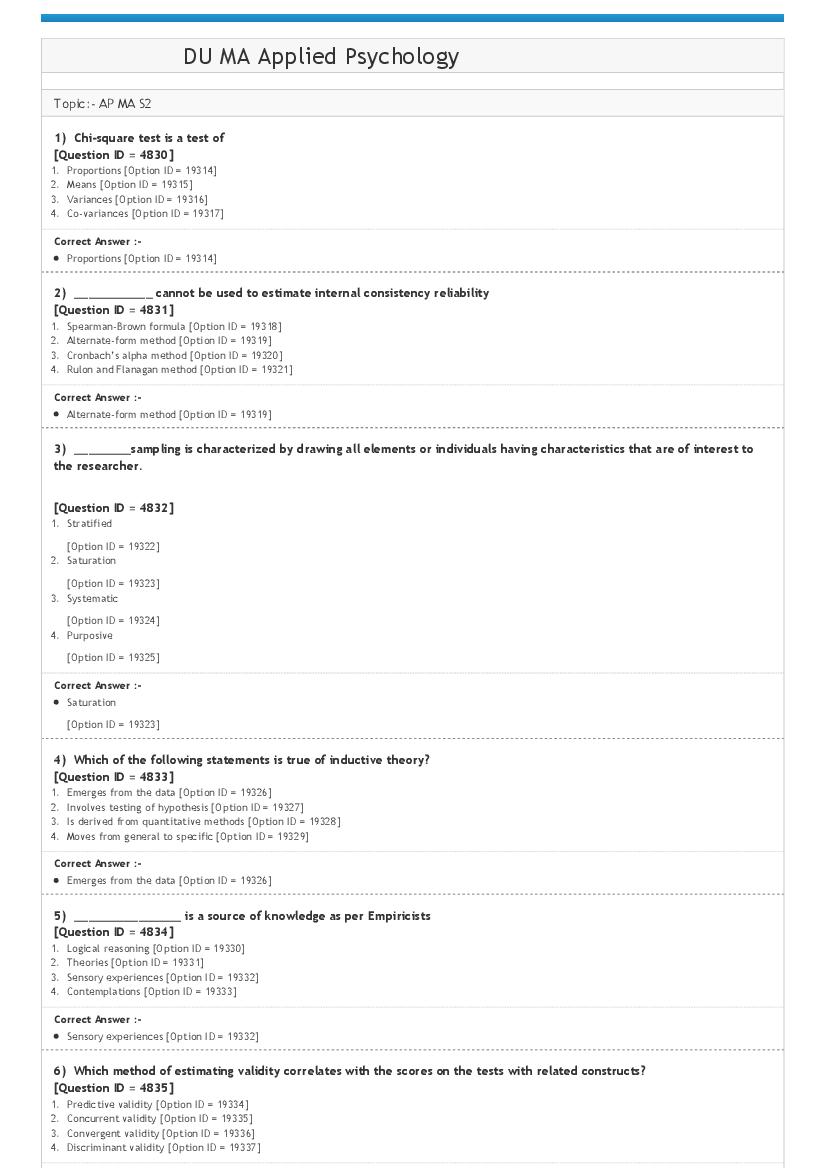
Topic:‐ AP MA S2
1) Chi‐square test is a test of
[Question ID = 4830]
1. Proportions [Option ID = 19314]
2. Means [Option ID = 19315]
3. Variances [Option ID = 19316]
4. Co‐variances [Option ID = 19317]
Proportions [Option ID = 19314]
2) ___________ cannot be used to estimate internal consistency reliability
[Question ID = 4831]
1. Spearman‐Brown formula [Option ID = 19318]
2. Alternate‐form method [Option ID = 19319]
3. Cronbach’s alpha method [Option ID = 19320]
4. Rulon and Flanagan method [Option ID = 19321]
Alternate‐form method [Option ID = 19319]
3) ________sampling is characterized by drawing all elements or individuals having characteristics that are of interest to
the researcher.
[Question ID = 4832]
1. Stratified
[Option ID = 19322]
2. Saturation
[Option ID = 19323]
3. Systematic
[Option ID = 19324]
4. Purposive
[Option ID = 19325]
Saturation
[Option ID = 19323]
4) Which of the following statements is true of inductive theory?
[Question ID = 4833]
1. Emerges from the data [Option ID = 19326]
2. Involves testing of hypothesis [Option ID = 19327]
3. Is derived from quantitative methods [Option ID = 19328]
4. Moves from general to specific [Option ID = 19329]
Emerges from the data [Option ID = 19326]
5) _______________ is a source of knowledge as per Empiricists
[Question ID = 4834]
1. Logical reasoning [Option ID = 19330]
2. Theories [Option ID = 19331]
3. Sensory experiences [Option ID = 19332]
4. Contemplations [Option ID = 19333]
Sensory experiences [Option ID = 19332]
6) Which method of estimating validity correlates with the scores on the tests with related constructs?
[Question ID = 4835]
1. Predictive validity [Option ID = 19334]
2. Concurrent validity [Option ID = 19335]
3. Convergent validity [Option ID = 19336]
4. Discriminant validity [Option ID = 19337]
Page 2
7) Find out the correct statement with respect to Reliability and Validity and the length of the test.
[Question ID = 4836]
1. Both increase with the increase in the length of the test
[Option ID = 19338]
2. Both decrease with increase in the length of the test
[Option ID = 19339]
3. Reliability increases whereas validity does not change with increase in length of test
[Option ID = 19340]
4. Validity increases whereas reliability decreases with increase in length of test
[Option ID = 19341]
Both increase with the increase in the length of the test
[Option ID = 19338]
8) In a 4 x 5 randomized group design with 10 observations in each treatment condition, the error / within degrees of
freedom will be
[Question ID = 4837]
1. 180 [Option ID = 19342]
2. 191 [Option ID = 19343]
3. 170 [Option ID = 19344]
4. 189 [Option ID = 19345]
180 [Option ID = 19342]
9) _______________ refers to those people who’s approval is crucial to gain access and acceptance in ethnographic
studies
[Question ID = 4838]
1. Researchers [Option ID = 19346]
2. Gatekeepers [Option ID = 19347]
3. Moderators [Option ID = 19348]
4. Facilitators [Option ID = 19349]
Gatekeepers [Option ID = 19347]
10) In case of two independent samples, the relationship between Student’s ‘t’ and F ratio is
[Question ID = 4839]
1. F=t2 [Option ID = 19350]
2. t=F2 [Option ID = 19351]
3. t=F [Option ID = 19352]
4. t≠F [Option ID = 19353]
F=t2 [Option ID = 19350]
11) ____________test consists of ten cards having prints of inkblots
[Question ID = 4840]
1. Rorschach test [Option ID = 19354]
2. Holtzman Inkblot Test [Option ID = 19355]
3. Draw a Person test [Option ID = 19356]
4. Thematic apperception test [Option ID = 19357]
Rorschach test [Option ID = 19354]
12) ___________refers to the process of assigning numerals or other symbols to answers so that responses can be put into a
limited number of categories or classes
[Question ID = 4841]
1. Classification [Option ID = 19358]
2. Tabulation [Option ID = 19359]
3. Coding [Option ID = 19360]
4. Editing [Option ID = 19361]
Coding [Option ID = 19360]
Page 3
[Question ID = 4842]
1. Mesokurtic [Option ID = 19362]
2. Leptokurtic [Option ID = 19363]
3. Platykurtic [Option ID = 19364]
4. Skewed [Option ID = 19365]
Mesokurtic [Option ID = 19362]
14) The process of reducing, usually dramatically, the number of people employed by a firm is called
[Question ID = 4843]
1. Rightsizing [Option ID = 19366]
2. Layoff [Option ID = 19367]
3. Downsizing [Option ID = 19368]
4. Turnover [Option ID = 19369]
Downsizing [Option ID = 19368]
15) The fairness and justice of a decisions result is termed as
[Question ID = 4844]
1. Informational justice [Option ID = 19370]
2. Distributive justice [Option ID = 19371]
3. Procedural justice [Option ID = 19372]
4. Processual justice [Option ID = 19373]
Distributive justice [Option ID = 19371]
16) Training employees to do different tasks or jobs than their own in order to facilitate flexibility and job rotation is called
[Question ID = 4845]
1. Functional training [Option ID = 19374]
2. Job training [Option ID = 19375]
3. Cross training [Option ID = 19376]
4. Management development [Option ID = 19377]
Cross training [Option ID = 19376]
17) Which among the following is not a cultural dimension given by Hofstede?
[Question ID = 4846]
1. Power distance [Option ID = 19378]
2. Uncertaininty avoidance [Option ID = 19379]
3. Individualism [Option ID = 19380]
4. Performance orientation [Option ID = 19381]
Performance orientation [Option ID = 19381]
18) Setting goals, monitoring performance, and providing a consequence to success or failure are features of
[Question ID = 4847]
1. Transformational leadership [Option ID = 19382]
2. Transactional leadership [Option ID = 19383]
3. Charismatic leadership [Option ID = 19384]
4. Participative leadership [Option ID = 19385]
Transactional leadership [Option ID = 19383]
19) According to Managerial Grid (Blake & Mouton, 1984), Country Club leadership style is characterized by
[Question ID = 4848]
1. High task and person orientation
[Option ID = 19386]
2. Low task and person orientation
[Option ID = 19387]
3. High task and low person orientation
[Option ID = 19388]
4. Low task and high person orientation
[Option ID = 19389]
Page 4
[Option ID = 19389]
20) A concept from training pertaining to the degree of similarity between the knowledge, skills, and abilities (KSAs)
learned in training and the KSAs needed to perform the job is called
[Question ID = 4849]
1. Physical fidelity [Option ID = 19390]
2. Psychological fidelity [Option ID = 19391]
3. Person analysis [Option ID = 19392]
4. Task analysis [Option ID = 19393]
Psychological fidelity [Option ID = 19391]
21) The concept that organizations are structured by a chain of command that grows with increasing levels of authority, is
referred to as
[Question ID = 4850]
1. Scalar principle [Option ID = 19394]
2. Unity of command [Option ID = 19395]
3. Span of control [Option ID = 19396]
4. Line functions [Option ID = 19397]
Scalar principle [Option ID = 19394]
22) _______________ refers to the way that the position and the tasks within that position are organized, including how
and when the tasks are done and any factors that affect the work
[Question ID = 4851]
1. Job analysis [Option ID = 19398]
2. Job enrichment [Option ID = 19399]
3. Job design [Option ID = 19400]
4. Job evaluation [Option ID = 19401]
Job design [Option ID = 19400]
23) A career stage in which one begins to search for work and finds a first job is called
[Question ID = 4852]
1. Exploration stage [Option ID = 19402]
2. Establishment stage [Option ID = 19403]
3. Mid‐career stage [Option ID = 19404]
4. Plateaued mid‐career stage [Option ID = 19405]
Establishment stage [Option ID = 19403]
24) The ability to control one’s impulsive judgment and reaction is known as
[Question ID = 4853]
1. Self‐efficacy [Option ID = 19406]
2. Self‐Awareness [Option ID = 19407]
3. Self‐regulation [Option ID = 19408]
4. Empathy [Option ID = 19409]
Self‐regulation [Option ID = 19408]
25) The __________ is defined as a desire to establish and maintain friendly and warm relations with other people
[Question ID = 4854]
1. Need for Affiliation [Option ID = 19410]
2. Need for Achievement [Option ID = 19411]
3. Need for Power [Option ID = 19412]
4. Need for Strength [Option ID = 19413]
Need for Affiliation [Option ID = 19410]
26) __________________ refers to the rules for engaging in appropriate and effective communication
[Question ID = 4855]
1. Pragmatics [Option ID = 19414]
2. Syntax [Option ID = 19415]
3. Semantics [Option ID = 19416]
4. Phonology [Option ID = 19417]
Page 5
27) _________________ refers to the rules governing the structure and sequence of speech sounds
[Question ID = 4856]
1. Phonology [Option ID = 19418]
2. Semantics [Option ID = 19419]
3. Morphology [Option ID = 19420]
4. Syntax [Option ID = 19421]
Phonology [Option ID = 19418]
28) _______________________ is a type of play in which children use materials to make things not for utilitarian purpose
but rather for the enjoyment they derive from making them
[Question ID = 4857]
1. Dramatic Play [Option ID = 19422]
2. Constructive Play [Option ID = 19423]
3. Active Play [Option ID = 19424]
4. Role Play [Option ID = 19425]
Constructive Play [Option ID = 19423]
29) The ____________ child‐rearing style is low in acceptance and involvement, high in coercive behavioral control, and
low in autonomy granting
[Question ID = 4858]
1. Authoritative [Option ID = 19426]
2. Authoritarian [Option ID = 19427]
3. Permissive [Option ID = 19428]
4. Uninvolved [Option ID = 19429]
Authoritarian [Option ID = 19427]
30) According to Sigmund Freud, the id operates on
[Question ID = 4859]
1. Pleasure principle [Option ID = 19430]
2. Reality principle [Option ID = 19431]
3. Unconscious mind [Option ID = 19432]
4. Conscious mind [Option ID = 19433]
Pleasure principle [Option ID = 19430]
31) In Ecological Theory_____________ includes the face‐to‐face interactions that a person has in her immediate settings,
such as home, school, or friendship groups
[Question ID = 4860]
1. Mesosystem [Option ID = 19434]
2. Microsystem [Option ID = 19435]
3. Exosystem [Option ID = 19436]
4. Macrosystem [Option ID = 19437]
Microsystem [Option ID = 19435]
32) Genes that are usually expressed in the phenotype are known as
[Question ID = 4861]
1. Recessive genes [Option ID = 19438]
2. Genotype [Option ID = 19439]
3. Dominant genes [Option ID = 19440]
4. Dormant genes [Option ID = 19441]
Dominant genes [Option ID = 19440]
33) If a child believes that stealing in order to save a life is OK because life is even more important than following the law,
this child would be in which stage of moral development?
[Question ID = 4862]
1. Level one: pre‐conventional [Option ID = 19442]
2. Level two: conventional [Option ID = 19443]
3. Level three: post‐conventional [Option ID = 19444]
4. Level four: operational [Option ID = 19445]
Page 6
34) As objects approach near the eye, the lens thickens to a more spherical shape through the contraction of the ciliary
body muscles. This phenomenon is called
[Question ID = 4863]
1. Transduction [Option ID = 19446]
2. Disparity [Option ID = 19447]
3. Accommodation [Option ID = 19448]
4. Stimulation [Option ID = 19449]
Accommodation [Option ID = 19448]
35) The procedures where in the research participants are given information about the nature and purposes of study after
they have participated in it is known as
[Question ID = 4864]
1. Informed consent [Option ID = 19450]
2. Debriefing [Option ID = 19451]
3. Deception [Option ID = 19452]
4. Rationalization [Option ID = 19453]
Debriefing [Option ID = 19451]
36) Put the following in the correct order
[Question ID = 4865]
1. Storming, Norming, Forming, Performing, Adjourning [Option ID = 19454]
2. Forming, Norming, Storming, Adjourning, Performing [Option ID = 19455]
3. Forming, Storming, Norming, Performing, Adjourning [Option ID = 19456]
4. Norming, Storming, Forming, Performing, Adjourning [Option ID = 19457]
Forming, Storming, Norming, Performing, Adjourning [Option ID = 19456]
37) Barriers based on organizational bias that prevent females from advancing to top‐level positions is known as
[Question ID = 4866]
1. Glass ceiling [Option ID = 19458]
2. Prejudice [Option ID = 19459]
3. Modern racism [Option ID = 19460]
4. Singlism [Option ID = 19461]
Glass ceiling [Option ID = 19458]
38) ____________ are referred to as beliefs about social groups in terms of traits or characteristics that provide a cognitive
framework for processing
[Question ID = 4867]
1. Stereotypes [Option ID = 19462]
2. Heuristics [Option ID = 19463]
3. Prejudice [Option ID = 19464]
4. Habit [Option ID = 19465]
Stereotypes [Option ID = 19462]
39) Ajay quits smoking as his favorite celebrity has recently started a campaign on healthy lifestyle. This behavior might
have been caused by
[Question ID = 4868]
1. Cognitive dissonance [Option ID = 19466]
2. Cognitive consonance [Option ID = 19467]
3. Instrumental learning [Option ID = 19468]
4. Vicarious Learning [Option ID = 19469]
Cognitive dissonance [Option ID = 19466]
40) Misperceptions resulting from misinterpretation of information received by our sensory organs are known as
[Question ID = 4869]
1. Delusions [Option ID = 19470]
2. Hallucinations [Option ID = 19471]
3. Illusions [Option ID = 19472]
4. Distortion [Option ID = 19473]
Page 7
41) Any relatively permanent change in behavior by experience is called
[Question ID = 4870]
1. Motivation [Option ID = 19474]
2. Learning [Option ID = 19475]
3. Adjustment [Option ID = 19476]
4. Emotion [Option ID = 19477]
Learning [Option ID = 19475]
42) The smallest meaningful units in the structure of language are called
[Question ID = 4871]
1. Phonemes [Option ID = 19478]
2. Abstraction [Option ID = 19479]
3. Morphemes [Option ID = 19480]
4. Syntax [Option ID = 19481]
Morphemes [Option ID = 19480]
43) ___________ is a condition that involves the persistent failure to speak in specific situations like school or in social
group‐ that interfere with educational or social adjustment.
[Question ID = 4872]
1. Separation anxiety disorder
[Option ID = 19482]
2. Childhood depression
[Option ID = 19483]
3. Selective mutism
[Option ID = 19484]
4. Autism
[Option ID = 19485]
Childhood depression
[Option ID = 19483]
44) ____________is disorder of children who have not learned appropriate toileting for bowel movements after age 4.
[Question ID = 4873]
1. Enuresis
[Option ID = 19486]
2. Tourette's syndrome
[Option ID = 19487]
3. Tics
[Option ID = 19488]
4. Encopresis
[Option ID = 19489]
Encopresis
[Option ID = 19489]
45) Most of the physiological changes that occur during intense emotion result from activation of the sympathetic division
of the:‐
[Question ID = 4874]
1. Peripheral Nervous system
[Option ID = 19490]
2. Autonomic Nervous system
[Option ID = 19491]
3. Endocrine system
[Option ID = 19492]
4. Limbic system
Page 8
Autonomic Nervous system
[Option ID = 19491]
46) Osmoreceptors are located in the hypothalamus just above the:‐
[Question ID = 4875]
1. Adrenal gland
[Option ID = 19494]
2. Pituitary gland
[Option ID = 19495]
3. Thymus gland
[Option ID = 19496]
4. Thyroid gland
[Option ID = 19497]
Pituitary gland
[Option ID = 19495]
47) Most people tend to ‘see the world through rose‐colored glasses’. This tendency is termed as:‐
[Question ID = 4876]
1. Optimistic bias
[Option ID = 19498]
2. Confident bias
[Option ID = 19499]
3. Overconfident bias
[Option ID = 19500]
4. Positive bias
[Option ID = 19501]
Optimistic bias
[Option ID = 19498]
48) Happiness includes all of the following except
[Question ID = 4877]
1. Feeling a positive emotion
[Option ID = 19502]
2. Being satisfied with your life
[Option ID = 19503]
3. Not experiencing a negative emotion
[Option ID = 19504]
4. Having a high‐paying job
[Option ID = 19505]
Having a high‐paying job
[Option ID = 19505]
49) Solomon Asch is popularly known for his research on
[Question ID = 4878]
1. Conformity [Option ID = 19506]
2. Obedience [Option ID = 19507]
3. Compliance [Option ID = 19508]
4. Cohesion [Option ID = 19509]
Conformity [Option ID = 19506]
50) We typically attribute our success to our internal characteristics whenever we perform well on a task. This
Page 9
[Question ID = 4879]
1. Fundamental attribution error [Option ID = 19510]
2. Self‐serving bias [Option ID = 19511]
3. Self schema [Option ID = 19512]
4. External attribution error [Option ID = 19513]
Self‐serving bias [Option ID = 19511]
51) A person who agrees to a small request initially, is more likely to comply with a larger demand later, describes the
phenomenon of
[Question ID = 4880]
1. Door‐in‐face effect [Option ID = 19514]
2. Foot‐in‐door effect [Option ID = 19515]
3. Low‐ball technique [Option ID = 19516]
4. Door‐in‐foot technique [Option ID = 19517]
Foot‐in‐door effect [Option ID = 19515]
52) Increased sensitivity to painful stimuli is
[Question ID = 4881]
1. Allodynia [Option ID = 19518]
2. Ischaemia [Option ID = 19519]
3. Hyperalgesia [Option ID = 19520]
4. Acute pain [Option ID = 19521]
Hyperalgesia [Option ID = 19520]
53) A negative effect of inactive substances as a result of the patient’s belief that these substances have the power to
cause harm is termed as
[Question ID = 4882]
1. Placebo effect [Option ID = 19522]
2. Nocebo effect [Option ID = 19523]
3. Active ingredient effect [Option ID = 19524]
4. Response treatment effect [Option ID = 19525]
Nocebo effect [Option ID = 19523]
54) ____________ serves to arouse the forebrain and set into motion the various behavioral signs.
[Question ID = 4883]
1. Ascending reticular activating system
[Option ID = 19526]
2. Descending reticular activating system
[Option ID = 19527]
3. Neutral reticular activating system
[Option ID = 19528]
4. All of these
[Option ID = 19529]
Ascending reticular activating system
[Option ID = 19526]
55) The first sleep state which is termed as _____________ normally develops fully within 30 minutes after drifting off to
sleep
[Question ID = 4884]
1. Wakefulness sleep [Option ID = 19530]
2. Variable sleep [Option ID = 19531]
3. Slow‐wave sleep [Option ID = 19532]
4. Faster waves [Option ID = 19533]
Slow‐wave sleep [Option ID = 19532]
56) _____________ produces distressing physiological effects such as nausea, vomiting, body weakness, drowsiness, and
pallor
Page 10
1. Transcranial magnetic [Option ID = 19534]
2. Vestibular stimulation [Option ID = 19535]
3. Cosyntropin Stimulation [Option ID = 19536]
4. Vagal Stimulation [Option ID = 19537]
Vestibular stimulation [Option ID = 19535]
57) __________ is concerned with the skills and underlying abilities which we have acquired during life
[Question ID = 4886]
1. Procedural memory [Option ID = 19538]
2. Declarative memory [Option ID = 19539]
3. Propositional memory [Option ID = 19540]
4. Semantic memory [Option ID = 19541]
Procedural memory [Option ID = 19538]
58) __________ is the process by which we adapt our memories to fit with our existing expectations
[Question ID = 4887]
1. Confabulation [Option ID = 19542]
2. Schemata [Option ID = 19543]
3. Flashbulb memory [Option ID = 19544]
4. Encoding [Option ID = 19545]
Confabulation [Option ID = 19542]
59) _____________ proposed that animals have the capacity to develop a mental representation, a cognitive map, of the
place.
[Question ID = 4888]
1. Tolman (1948)
[Option ID = 19546]
2. Harlow (1949)
[Option ID = 19547]
3. Köhler (1925)
[Option ID = 19548]
4. Gould (1986)
[Option ID = 19549]
Tolman (1948)
[Option ID = 19546]
60) The old disorders in DSM‐IV such as hypochondriasis, somatization disorder, and pain disorder have all now been
diagnosed as
[Question ID = 4889]
1. Conversion disorder [Option ID = 19550]
2. Illness anxiety disorder [Option ID = 19551]
3. Somatic symptom disorder [Option ID = 19552]
4. Body dysmorphic disorder [Option ID = 19553]
Somatic symptom disorder [Option ID = 19552]
61) Down’s syndrome is characterized by presence of an extra ________chromosome
[Question ID = 4890]
1. X [Option ID = 19554]
2. 21 [Option ID = 19555]
3. Y [Option ID = 19556]
4. 23 [Option ID = 19557]
21 [Option ID = 19555]
62) _______________is description of basic biological response to sustained and unrelenting physical stress.
[Question ID = 4891]
1. General Adaptation Syndrome [Option ID = 19558]
2. Diathesis‐stress Paradigm [Option ID = 19559]
3. Two‐factor Theory [Option ID = 19560]
Page 11
General Adaptation Syndrome [Option ID = 19558]
63) Impaired ability to carry out motor tasks despite having the motor ability to do so is known as:‐
[Question ID = 4892]
1. Aphasia [Option ID = 19562]
2. Apraxia [Option ID = 19563]
3. Agnosia [Option ID = 19564]
4. Dementia [Option ID = 19565]
Apraxia [Option ID = 19563]
64) The essential feature of _____________ is a recurrent pattern of negativistic, defiant, disobedient, and hostile
behavior towards authority figures in children, that persists for at least 6 months.
[Question ID = 4893]
1. Oppositional defiant disorder [Option ID = 19566]
2. Conduct disorder [Option ID = 19567]
3. ADHD [Option ID = 19568]
4. Childhood depression [Option ID = 19569]
Oppositional defiant disorder [Option ID = 19566]
65) Moderately retarded individuals are likely to fall in the educational category of:‐
[Question ID = 4894]
1. Self Sustainable [Option ID = 19570]
2. Dependent [Option ID = 19571]
3. Trainable [Option ID = 19572]
4. life support [Option ID = 19573]
Trainable [Option ID = 19572]
66) ____________ affects only females which includes webbing of neck, short fingers and toes, slow growth etc.
[Question ID = 4895]
1. Tay‐Sachs disease [Option ID = 19574]
2. Turner syndrome [Option ID = 19575]
3. Klinefelter Syndrome [Option ID = 19576]
4. Niemann‐Pick disease [Option ID = 19577]
Turner syndrome [Option ID = 19575]
67) ______________involves the conversion of sexual impulses into socially acceptable forms of behavior.
[Question ID = 4896]
1. Repression [Option ID = 19578]
2. Regression [Option ID = 19579]
3. Sublimation [Option ID = 19580]
4. Identification [Option ID = 19581]
Sublimation [Option ID = 19580]
68) Children with organic defects and those born into minority groups are likely to develop
[Question ID = 4897]
1. Superiority complex [Option ID = 19582]
2. Inferiority complex [Option ID = 19583]
3. Compensation [Option ID = 19584]
4. Fictional goals [Option ID = 19585]
Inferiority complex [Option ID = 19583]
69) Jung disagreed with Freud on the nature of the unconscious, arguing that it exists on two levels _____________and
_____________
[Question ID = 4898]
1. Collective and individual [Option ID = 19586]
2. Anima and animus [Option ID = 19587]
3. Extroversion and introversion [Option ID = 19588]
4. Intuitive and perceptive [Option ID = 19589]
Page 12
70) Maslow considers physiological and safety needs truly as
[Question ID = 4899]
1. Higher needs [Option ID = 19590]
2. Lower needs [Option ID = 19591]
3. Greatest potency needs [Option ID = 19592]
4. Transformational needs [Option ID = 19593]
Lower needs [Option ID = 19591]
71) In a psychoanalytic practice, where the patient relaxes on a couch and freely tells whatever comes into his/her mind is
called
[Question ID = 4900]
1. Dreaming [Option ID = 19594]
2. Narration [Option ID = 19595]
3. Free association [Option ID = 19596]
4. Story telling [Option ID = 19597]
Free association [Option ID = 19596]
72) According to John Dewey _______________ is the connection between sensory stimuli and motor responses
[Question ID = 4901]
1. Efferent arc [Option ID = 19598]
2. Reflex arc [Option ID = 19599]
3. Association arc [Option ID = 19600]
4. Dynamic arc [Option ID = 19601]
Reflex arc [Option ID = 19599]
73) According to Gestalt psychologists, ___________ doctrine is the correspondence between psychological or conscious
experience and the underlying brain experience
[Question ID = 4902]
1. Pragmatism [Option ID = 19602]
2. Eclectism [Option ID = 19603]
3. Isotropism [Option ID = 19604]
4. Isomorphism [Option ID = 19605]
Isomorphism [Option ID = 19605]
74) Karen Horney’s conception of feelings of pervasive loneliness and helplessness that are the foundation of neuroses, is
called
[Question ID = 4903]
1. Innate anxiety [Option ID = 19606]
2. Existential anxiety [Option ID = 19607]
3. Basic anxiety [Option ID = 19608]
4. Neurotic anxiety [Option ID = 19609]
Basic anxiety [Option ID = 19608]
75) _____________is a technique in which undesired behavior is eliminated by associating with unpleasantness
[Question ID = 4904]
1. Systematic desensitization [Option ID = 19610]
2. Covert sensitization [Option ID = 19611]
3. Covert desensitization [Option ID = 19612]
4. Systematic sensitization [Option ID = 19613]
Covert sensitization [Option ID = 19611]
76) Which among the following is the correct combination between stages of family life cycle and emotion experienced
[Question ID = 4905]
1. Unattached Adult –Accepting parent‐offspring separation [Option ID = 19614]
2. Newly married ‐ Accepting new members into the systems [Option ID = 19615]
3. Teenage child ‐ Accepting the new personality [Option ID = 19616]
4. Retreatment ‐ Accepting exists from and entries into the family [Option ID = 19617]
Unattached Adult –Accepting parent‐offspring separation [Option ID = 19614]
Page 13
[Question ID = 4906]
1. Empathy, unconditional positive regard and congruence [Option ID = 19618]
2. Empathy, unconditional sharing and congruence [Option ID = 19619]
3. Empathy, unconditional positive regard and motivational interviewing [Option ID = 19620]
4. Empathy, congruence and transparency [Option ID = 19621]
Empathy, unconditional positive regard and congruence [Option ID = 19618]
78) Fostering of equalitarian atmosphere in counseling is promoted by
[Question ID = 4907]
1. Psychoanalytic theory [Option ID = 19622]
2. Adlerian theory [Option ID = 19623]
3. Behavioral theory [Option ID = 19624]
4. Cognitive theory [Option ID = 19625]
Adlerian theory [Option ID = 19623]
79) The Ego is sometimes described as the _______ because it directs energies supplied by the Id
[Question ID = 4908]
1. Executive [Option ID = 19626]
2. Superordinate [Option ID = 19627]
3. Subordinate [Option ID = 19628]
4. Congruence [Option ID = 19629]
Executive [Option ID = 19626]
80) _________ memories are created at the time of high emotion situations of personal relevance and that are very vivid
in nature
[Question ID = 4909]
1. Flashbulb [Option ID = 19630]
2. Photographic [Option ID = 19631]
3. Implicit [Option ID = 19632]
4. Procedural [Option ID = 19633]
Flashbulb [Option ID = 19630]
81) The therapeutic technique in which the client is instructed to perform behaviours counter to the therapeutic goal is
[Question ID = 4910]
1. Paradoxical intention [Option ID = 19634]
2. Therapeutic alliance [Option ID = 19635]
3. Therapeutic transference [Option ID = 19636]
4. Talk therapy [Option ID = 19637]
Paradoxical intention [Option ID = 19634]
82) Cattell’s Personality theory is also known as:‐
[Question ID = 4911]
1. Psychoanalytic theory [Option ID = 19638]
2. Factor analytic theory [Option ID = 19639]
3. Behaviouristic theory [Option ID = 19640]
4. Projective theory [Option ID = 19641]
Factor analytic theory [Option ID = 19639]
83) _____________ means that the learner comes to anticipate the presence of a reward and if that reward is absent or
changed, behavior is disrupted
[Question ID = 4912]
1. Latent learning [Option ID = 19642]
2. Reward expectancy [Option ID = 19643]
3. Place learning [Option ID = 19644]
4. Forgetting [Option ID = 19645]
Reward expectancy [Option ID = 19643]
84) The third stage of Erikson’s Eight Stages of Development is termed as:‐
Page 14
1. Industry versus inferiority
[Option ID = 19646]
2. Initiative versus guilt
[Option ID = 19647]
3. Trust versus mistrust
[Option ID = 19648]
4. None of these
[Option ID = 19649]
Initiative versus guilt
[Option ID = 19647]
85) Classical conditioning of attitudes through exposure to stimuli lying below the individual’s threshold of conscious
experiences is
[Question ID = 4914]
1. Subliminal conditioning [Option ID = 19650]
2. Delayed conditioning [Option ID = 19651]
3. Minimal conditioning [Option ID = 19652]
4. Backward conditioning [Option ID = 19653]
Subliminal conditioning [Option ID = 19650]
86) Forgetting due to proactive interference occurs because
[Question ID = 4915]
1. Later and earlier learning interferes with the recall of new learning
[Option ID = 19654]
2. Later learning interferes with the recall of earlier learning
[Option ID = 19655]
3. Earlier learning interferes with the recall of later learning
[Option ID = 19656]
4. Both, Later learning interferes with the recall of earlier learning & Earlier learning interferes with the recall of later learning
[Option ID = 19657]
Earlier learning interferes with the recall of later learning
[Option ID = 19656]
87) ___________ is an advanced therapy that involves desensitizing a client to a situation by having him or her imagine an
anxiety producing situation that may have dire consequences
[Question ID = 4916]
1. General behavioral technique [Option ID = 19658]
2. Positive reinforcement [Option ID = 19659]
3. Implosive therapy [Option ID = 19660]
4. Covert sensitization [Option ID = 19661]
Implosive therapy [Option ID = 19660]
88) Sternberg’s conceptualization of love relationship is termed as
[Question ID = 4917]
1. Physical attractiveness [Option ID = 19662]
2. Passionate love [Option ID = 19663]
3. Unrequited love [Option ID = 19664]
4. Triangular model of love [Option ID = 19665]
Triangular model of love [Option ID = 19665]
89) The ability to imitate a person or pretend a behaviour in the absence of that person or the displayed behaviour is
called_________ which indicates that children form_________
[Question ID = 4918]
1. Immitation, mental representation [Option ID = 19666]
2. Deferred imitation, mental representation [Option ID = 19667]
3. Secondary imitation , representation [Option ID = 19668]
4. Tertiary imitation, symbolic thought [Option ID = 19669]
Page 15
90) “Sleeping on the problem of how to fund a vacation, hoping you will have a better idea when you wake up is an
example of
[Question ID = 4919]
1. Representation heuristic [Option ID = 19670]
2. Analogy [Option ID = 19671]
3. Algorithm [Option ID = 19672]
4. Incubation [Option ID = 19673]
Incubation [Option ID = 19673]
91) Having superior memory for the items at the beginning and at the end of the list is known as
[Question ID = 4920]
1. Von Restoff effect [Option ID = 19674]
2. Zeigarnik effect [Option ID = 19675]
3. Serial Position effect [Option ID = 19676]
4. Recency effect [Option ID = 19677]
Serial Position effect [Option ID = 19676]
92) Information about the frequency of members of different categories in the population is called
[Question ID = 4921]
1. Census [Option ID = 19678]
2. Base rate [Option ID = 19679]
3. Social Representation [Option ID = 19680]
4. Sociometry [Option ID = 19681]
Base rate [Option ID = 19679]
93) _______________ is aimed at reducing the impairment that has already resulted from a disorder or an event
[Question ID = 4922]
1. Primary prevention [Option ID = 19682]
2. Secondary prevention [Option ID = 19683]
3. Tertiary prevention [Option ID = 19684]
4. Quadruplet prevention [Option ID = 19685]
Tertiary prevention [Option ID = 19684]
94) According to Sigmund Freud wars and violence are evidence of:‐
[Question ID = 4923]
1. Life instinct
[Option ID = 19686]
2. Libido
[Option ID = 19687]
3. Death instinct
[Option ID = 19688]
4. None of these
[Option ID = 19689]
Death instinct
[Option ID = 19688]
95) The loosening of normal constraints on behavior when people can’t be identified (such as when they are in a crowd) is
called:‐
[Question ID = 4924]
1. Social loafing [Option ID = 19690]
2. Social facilitation [Option ID = 19691]
3. Deindividuation [Option ID = 19692]
4. Mob behavior [Option ID = 19693]
Deindividuation [Option ID = 19692]
Page 16
[Question ID = 4925]
1. Poor eye contact
[Option ID = 19694]
2. Delay in language acquisition
[Option ID = 19695]
3. Hand flapping
[Option ID = 19696]
4. Social smile
[Option ID = 19697]
Social smile
[Option ID = 19697]
97) __________ learning occurs when a person or animal suddenly grasps what something means and incorporates that
new knowledge into old knowledge
[Question ID = 4926]
1. Latent
[Option ID = 19698]
2. Insight
[Option ID = 19699]
3. Cognitive
[Option ID = 19700]
4. Observational
[Option ID = 19701]
Insight
[Option ID = 19699]
98) Recall that is better if it occurs in the same psychological state that is present when the information was first encoded
is explained by
[Question ID = 4927]
1. State‐dependent retrieval [Option ID = 19702]
2. Trait‐dependent retrieval [Option ID = 19703]
3. Hypermnesic retrieval [Option ID = 19704]
4. Emotional retrieval [Option ID = 19705]
State‐dependent retrieval [Option ID = 19702]
99) Observable characteristics that result from both genetic and environmental influences is called
[Question ID = 4928]
1. Karyotype [Option ID = 19706]
2. genotype [Option ID = 19707]
3. phenotype [Option ID = 19708]
4. heritability [Option ID = 19709]
phenotype [Option ID = 19708]
100) Children’s understanding of turn‐taking and perspective taking in interpersonal communication is indicator of
_____________ development
[Question ID = 4929]
1. Pragmatic [Option ID = 19710]
2. Semantic [Option ID = 19711]
3. Syntactic [Option ID = 19712]
4. Pre‐linguistic [Option ID = 19713]
Pragmatic [Option ID = 19710]