DUET 2021 Question Paper M.Phil Ph.D in Linguistics
Finished viewing? Save it for later —
Download DUET 2021 Question Paper M.Phil Ph.D in Linguistics (PDF · 9 pages)About DUET 2021 Question Paper M.Phil Ph.D in Linguistics
DUET 2021 Question Paper M.Phil Ph.D in Linguistics is available here for free download. Published by NTA for DUET, this question paper can be viewed online or downloaded as a PDF (9 pages). Candidates preparing for DUET can use DUET 2021 Question Paper M.Phil Ph.D in Linguistics to understand the exam pattern, the type of questions asked, and the overall difficulty level.
Frequently Asked Questions
How can I download DUET 2021 Question Paper M.Phil Ph.D in Linguistics?
Open this page and click the Download button to save DUET 2021 Question Paper M.Phil Ph.D in Linguistics as a PDF. It is completely free on AglaSem Docs.
Is DUET 2021 Question Paper M.Phil Ph.D in Linguistics free to download?
Yes. DUET 2021 Question Paper M.Phil Ph.D in Linguistics can be viewed online and downloaded as a PDF free of cost on AglaSem Docs.
How many pages does DUET 2021 Question Paper M.Phil Ph.D in Linguistics have?
DUET 2021 Question Paper M.Phil Ph.D in Linguistics contains 9 pages, which you can read online or download together as a single PDF.
Where can I find more DUET study material?
You can find more DUET question papers, sample papers, syllabus, and answer keys on AglaSem Docs.
DUET 2021 Question Paper M.Phil Ph.D in Linguistics – Text
Read the full text of this question paper below — useful to quickly search, copy and reference the content online without downloading the PDF.
📄 View text version (9 pages)
Page 1
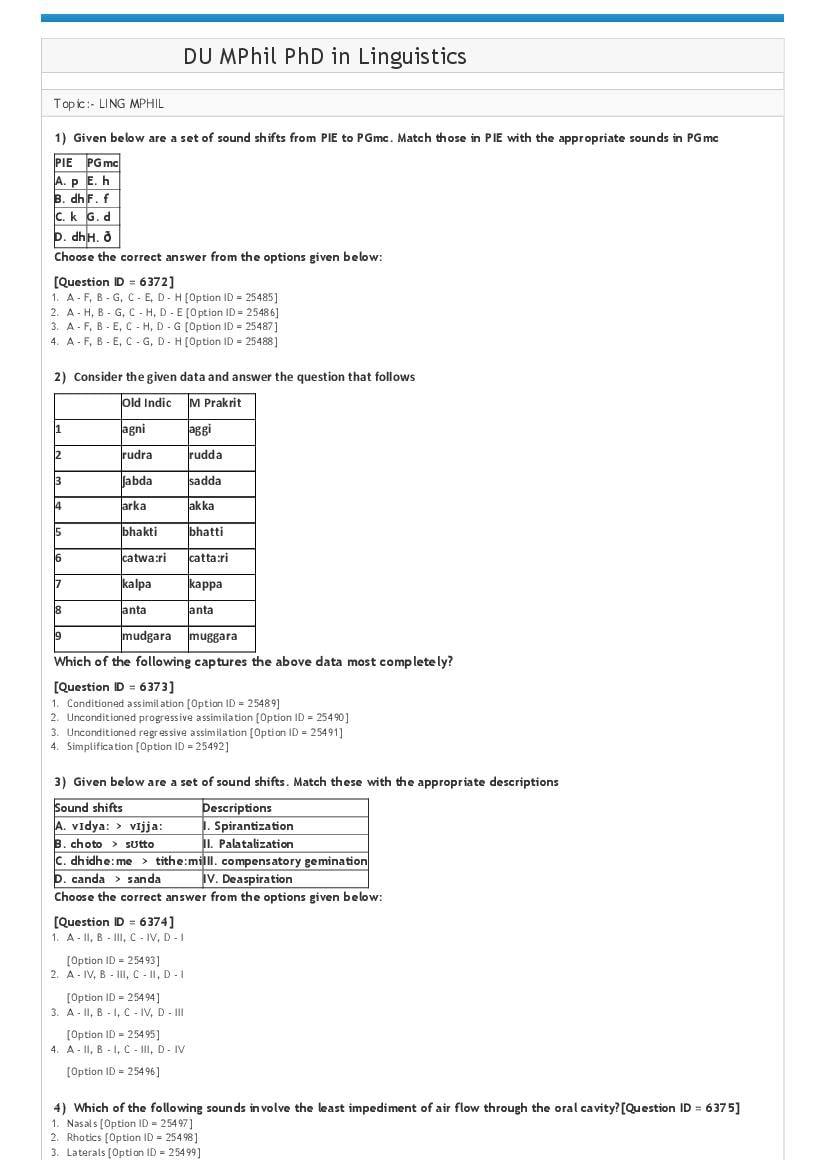
Topic:‐ LING MPHIL
1) Given below are a set of sound shifts from PIE to PGmc. Match those in PIE with the appropriate sounds in PGmc
PIE PGmc
A. p E. h
B. dh F. f
C. k G. d
D. dh H. ð
Choose the correct answer from the options given below:
[Question ID = 6372]
1. A ‐ F, B ‐ G, C ‐ E, D ‐ H [Option ID = 25485]
2. A ‐ H, B ‐ G, C ‐ H, D ‐ E [Option ID = 25486]
3. A ‐ F, B ‐ E, C ‐ H, D ‐ G [Option ID = 25487]
4. A ‐ F, B ‐ E, C ‐ G, D ‐ H [Option ID = 25488]
2) Consider the given data and answer the question that follows
Old Indic M Prakrit
1 agni aggi
2 rudra rudda
3 ʃabda sadda
4 arka akka
5 bhakti bhatti
6 catwa:ri catta:ri
7 kalpa kappa
8 anta anta
9 mudgara muggara
Which of the following captures the above data most completely?
[Question ID = 6373]
1. Conditioned assimilation [Option ID = 25489]
2. Unconditioned progressive assimilation [Option ID = 25490]
3. Unconditioned regressive assimilation [Option ID = 25491]
4. Simplification [Option ID = 25492]
3) Given below are a set of sound shifts. Match these with the appropriate descriptions
Sound shifts Descriptions
A. vɪdya: > vɪjja: I. Spirantization
B. choto > sʊtto II. Palatalization
C. dhidhe:me > tithe:miIII. compensatory gemination
D. canda > sanda IV. Deaspiration
Choose the correct answer from the options given below:
[Question ID = 6374]
1. A ‐ II, B ‐ III, C ‐ IV, D ‐ I
[Option ID = 25493]
2. A ‐ IV, B ‐ III, C ‐ II, D ‐ I
[Option ID = 25494]
3. A ‐ II, B ‐ I, C ‐ IV, D ‐ III
[Option ID = 25495]
4. A ‐ II, B ‐ I, C ‐ III, D ‐ IV
[Option ID = 25496]
4) Which of the following sounds involve the least impediment of air flow through the oral cavity?[Question ID = 6375]
1. Nasals [Option ID = 25497]
2. Rhotics [Option ID = 25498]
3. Laterals [Option ID = 25499]
Page 2
5) Which of the following best distinguishes different sibilant sounds from each other:[Question ID = 6376]
1. Frequency spectrum [Option ID = 25501]
2. The amount of air flow [Option ID = 25502]
3. Duration [Option ID = 25503]
4. Formant transitions [Option ID = 25504]
6) Match List I with List II
List I List II
A. Duration I. Milliseconds
B. FrequencyII. Hertz
C. Decibles III. Amplitude
D. Height IV. Degree
Choose the correct answer from the options given below:
[Question ID = 6377]
1. A ‐ I, B ‐ II, C ‐ III, D ‐ IV [Option ID = 25505]
2. A ‐ IV, B ‐ ,III C ‐ II, D ‐ I [Option ID = 25506]
3. A ‐ II, B ‐ I, C ‐ IV, D ‐ III [Option ID = 25507]
4. A ‐ II, B ‐ I, C ‐ III, D ‐ IV [Option ID = 25508]
7) Which of the following figures is not associated with production of a nasal stop?
[Question ID = 6378]
1. 1 and 2 [Option ID = 25509]
2. 2 [Option ID = 25510]
3. 1 and 3 [Option ID = 25511]
4. 1 [Option ID = 25512]
8) Which methodology was used in Labov’s Departmental stores Study?[Question ID = 6379]
1. Rapid and anonymous surveys [Option ID = 25513]
2. Sociolinguistic interviews [Option ID = 25514]
3. Reading minimal pairs [Option ID = 25515]
4. Questionnaire [Option ID = 25516]
9) Match List I with List II
List I List II
Language Type
Properties
I. Languages where the distinction between Morphology and Syntax is blurred with extensive
A. Analytic
agglutination and inflection
B. Agglutinating II. A single morph can represent more than one morpheme simultaneously
C. Inflecting III. Each morpheme represents a word
D. Incorporating IV. One‐to‐one matching of morphemes with morphs
Choose the correct answer from the options given below:
[Question ID = 6380]
1. A ‐ III, B ‐ IV, C ‐ I, D ‐ II
[Option ID = 25517]
2. A ‐ I, B ‐ II, C ‐ IV, D ‐ III
[Option ID = 25518]
3. A ‐ III, B ‐ IV, C ‐ II, D ‐ I
[Option ID = 25519]
4. A ‐ IV, B ‐ II, C ‐ III, D ‐ I
[Option ID = 25520]
10) Consider the following data from a language:
Language Data Meaning
Page 3
elim 'My hand'
eller 'The hands'
elimde 'In my hand'
Choose the correct form of the phrase 'in my hands' in this language:
[Question ID = 6381]
1. ellerde
[Option ID = 25521]
2. elde
[Option ID = 25522]
3. ellerim
[Option ID = 25523]
4. ellerimde
[Option ID = 25524]
11) Match List I with List II
List I List II
Words Type of affixes
A. Careful I. Inflectional
B. Played II. Derivational
C. Taller III. Compounding
D. Heartbeat IV. None
Choose the correct answer from the options given below:
[Question ID = 6382]
1. A ‐ I, B ‐ II, C ‐ III, D‐IV
[Option ID = 25525]
2. A ‐ II, B ‐ I, C ‐ III, D‐III
[Option ID = 25526]
3. A ‐ II, B ‐ I, C ‐ II, D‐I
[Option ID = 25527]
4. A ‐ II, B ‐ I, C ‐ I, D‐III
[Option ID = 25528]
12) Consider only the subordinate clauses out of the full sentences given in List I and match with their approapriate Types
in List II
List I List II
Sentences Types
A. I think that Maya left the party early. I. Exclamative
B. Kuki asked me what the time is. II. Imperative
C. Monica couldn’t believe how hot it is. III. Declarative
D. The driver requested the passenger not to smoke.IV. Interrogative
Choose the correct answer from the options given below:
[Question ID = 6383]
1. A ‐ I, B ‐ II, C ‐ III, D ‐ IV [Option ID = 25529]
2. A ‐ III, B ‐ I, C ‐ IV, D ‐ II [Option ID = 25530]
3. A ‐ III, B ‐ IV, C ‐ I, D ‐ II [Option ID = 25531]
4. A ‐ I, B ‐ IV, C ‐ II, D ‐ III [Option ID = 25532]
13) Choose the correct syntactic principle responsible for the ungrammaticality of the sentence: *It seems Rajesh to like
Meena Kumari:[Question ID = 6384]
1. Theta Theory [Option ID = 25533]
2. Case Theory [Option ID = 25534]
3. Binding Theory [Option ID = 25535]
4. Control Theory [Option ID = 25536]
14) Select the correct category of the adjunct in the sentence: Rani read the letter in Imphal:[Question ID = 6385]
1. AdjP [Option ID = 25537]
2. PP [Option ID = 25538]
3. IP [Option ID = 25539]
4. NP [Option ID = 25540]
15) Sociophonetics[Question ID = 6386]
1. Makes use of Tools of both Phonetics and Sociolinguistics [Option ID = 25541]
Page 4
3. is confined to the study of vowels [Option ID = 25543]
4. Both 1 and 2 [Option ID = 25544]
16) William Labov’s classic study ‘Social motivation for sound change’ is about[Question ID = 6387]
1. Resistance to change [Option ID = 25545]
2. Attitudes towards summer visitors [Option ID = 25546]
3. Localness and identity [Option ID = 25547]
4. All of these [Option ID = 25548]
17) Which of the following statements are true?[Question ID = 6388]
1. To study endangered languages it is more than sufficient to document them. [Option ID = 25549]
2. Language attrition and language change are two sides of the same phenomenon. [Option ID = 25550]
3. It is correct to assume that all small languages are critically endangered. [Option ID = 25551]
4. The relations among languages can best be understood in terms of power and prestige. [Option ID = 25552]
18) The signifier and signified are _________ entities and the relation between these is __________. Fill in the blanks
with the appropriate pair of words below:[Question ID = 6389]
1. physiological; arbitrary [Option ID = 25553]
2. metaphysical; indestructible [Option ID = 25554]
3. ontological; concrete [Option ID = 25555]
4. psychological; arbitrary [Option ID = 25556]
19) What is the relation between the sound segments [p], [b], [t], [d] in the following words: [pin], [bin], [tin], [din]
[Question ID = 6390]
1. Asynchronic [Option ID = 25557]
2. Syntagmatic [Option ID = 25558]
3. Paradigmatic [Option ID = 25559]
4. Asymptotic [Option ID = 25560]
20) Which of the following is not a criterion of good research?[Question ID = 6391]
1. The purpose of the research should be clearly defined. [Option ID = 25561]
2. The research procedure used should be described in sufficient detail to permit another researcher to repeat the research for further advancement.
[Option ID = 25562]
3. The procedural design of the research should be carefully planned to yield results that are as objective as possible. [Option ID = 25563]
4. The researcher should not report the flaws in research design. [Option ID = 25564]
21) Which of the following two sentences instantiates a Double Object Construction?
A Show me the money
B Show the money to me
[Question ID = 6392]
1. A
[Option ID = 25565]
2. B
[Option ID = 25566]
3. Neither A nor B
[Option ID = 25567]
4. Both A and B
[Option ID = 25568]
22) Complete the following sentence with the suitable option. Aphasia is usually…[Question ID = 6393]
1. Hereditary [Option ID = 25569]
2. Caused by injury to the brain [Option ID = 25570]
3. Induced in the lab [Option ID = 25571]
4. Is a result of natural selection [Option ID = 25572]
23) Fill in the gap with the correct option given below: The speaker of a language can potentially utter _______ novel
sentences.[Question ID = 6394]
1. on average 1000 [Option ID = 25573]
2. an infinite number of [Option ID = 25574]
3. a few very basic [Option ID = 25575]
4. about 10,000 [Option ID = 25576]
24) Which of the following is a Mass noun?[Question ID = 6395]
1. Advice [Option ID = 25577]
2. Anecdote [Option ID = 25578]
3. Wave [Option ID = 25579]
4. Mountain [Option ID = 25580]
25) The following is a list of English quantifiers. Pick the odd one out.
Page 5
[Question ID = 6396]
1. Usually
[Option ID = 25581]
2. Most
[Option ID = 25582]
3. Each
[Option ID = 25583]
4. All
[Option ID = 25584]
26) Observe the Child English words corresponding to the Adult English words in the table below.
Child English Adult English
(1) bu (i) blue
(2) pun (ii) prune
(3) sap (iii) snap
(4) sipali (iv) slippery
(5) mɑo (v) small
Which of the following statements is true, based on the data given above?
[Question ID = 6397]
1. Children cannot pronounce onset clusters.
[Option ID = 25585]
2. Children cannot pronounce word‐initial sibilants.
[Option ID = 25586]
3. Children cannot pronounce liquids.
[Option ID = 25587]
4. Children cannot pronounce word final consonants.
[Option ID = 25588]
27) A. The horse, which raced past the barn, fell.
B. The horse, raced past the barn, fell.
Which among these two sentences contains a Reduced Relative Clause?
[Question ID = 6398]
1. A
[Option ID = 25589]
2. B
[Option ID = 25590]
3. Both A and B
[Option ID = 25591]
4. Neither A nor B
[Option ID = 25592]
28) Order in chronological progression the following steps of scientific research:
A. Make predictions
B. Observe a certain phenomenon
C. Form hypotheses
D. Test predictions via replicable methods
Choose the correct answer from the options given below
[Question ID = 6399]
1. A, D, C, B
[Option ID = 25593]
2. C, A, D, B
[Option ID = 25594]
3. B, A, D, C
[Option ID = 25595]
4. B, C, A, D
Page 6
29) Fill in the blanks with the appropriate pair of words. _______ research is applicable to phenomena that can be
expressed in terms of quantity. On the other hand, ________research is concerned with phenomena relating to or involving
quality or kind.[Question ID = 6400]
1. Inferential; Experimental [Option ID = 25597]
2. Conceptual; Empirical [Option ID = 25598]
3. Quantitative; Qualitative [Option ID = 25599]
4. Field‐based; Laboratory [Option ID = 25600]
30) What is the most appropriate name for the phonological process instantiated by the following dataset from Latin :
A. [kasnus] > [ka:nus] ‘grey’
B. [kosmis] > [ko:mis] ‘courteous’
C. [fideslia] > [fide:lia] ‘pot’
[Question ID = 6401]
1. Suppletion
[Option ID = 25601]
2. Compensatory Lengthening
[Option ID = 25602]
3. Lenition
[Option ID = 25603]
4. Shortening
[Option ID = 25604]
31) Suppose a language has two rules a and b, with rule a being ordered to apply before rule b. If in a given derivation,
the application of a creates a representation to which b can apply, but which was not there before a applied, then rules a
and b are in a ___________ order. Choose the appropriate option from the list below to fill in the blanks:[Question ID =
6402]
1. Feeding [Option ID = 25605]
2. Bleeding [Option ID = 25606]
3. Counterbleeding [Option ID = 25607]
4. Counterfeeding [Option ID = 25608]
32) The vocal cords are part of the __________[Question ID = 6403]
1. Pharynx [Option ID = 25609]
2. Larynx [Option ID = 25610]
3. Velum [Option ID = 25611]
4. Nasal cavity [Option ID = 25612]
33) Choose the appropriate set of Distinctive Features from the options given below to describe the following group of
speech sounds:
[Question ID = 6404]
1. [+labial] [Option ID = 25613]
2. [‐labial] [Option ID = 25614]
3. [‐coronal] [Option ID = 25615]
4. [+coronal] [Option ID = 25616]
34) In a French language‐game called ‘Verlan’, the order of syllables in French words is reversed. The table below shows
the Verlan versions of some French words:
French Verlan
cafe´ fe´ka
bizarre zarbi
me´tro trome´
maestro stromae
What will the Verlan version for the word bistro sound like?
[Question ID = 6405]
1. bistro
[Option ID = 25617]
2. strobi
[Option ID = 25618]
3. strobis
Page 7
4. trobis
[Option ID = 25620]
35) Which of the statements given below is not entailed by the following statement?
Mihir is taller than Anoop and Anoop is taller than Sonia.
[Question ID = 6406]
1. Mihir is taller than Sonia.
[Option ID = 25621]
2. Anoop is shorter than Mihir.
[Option ID = 25622]
3. Mihir is the tallest among the three.
[Option ID = 25623]
4. Mihir is taller than Anu and Anu is taller than Sonia.
[Option ID = 25624]
36) There is an error in the glossing of the following example. Identify it.
wangmarra wardji
mad he‐went
‘He went away angry.’
[Question ID = 6407]
1. The gloss comes in the second line.
[Option ID = 25625]
2. The number of hyphens in the example does not match with the number of hyphens in the gloss.
[Option ID = 25626]
3. The example does not begin with capital letter.
[Option ID = 25627]
4. The gloss does not contain any abbreviations.
[Option ID = 25628]
37) Which of the following is not a common feature of South Asian languages?[Question ID = 6408]
1. Postpositions [Option ID = 25629]
2. Reduplication [Option ID = 25630]
3. Compound and Conjunct verbs [Option ID = 25631]
4. Expletive pronouns [Option ID = 25632]
38) As an editor of a journal you found a paper in which the Reference section contains references to works that are not
cited in the paper. What will you do?[Question ID = 6409]
1. Nothing. Reference may list sources that are consulted during the work but not cited in the paper. [Option ID = 25633]
2. Ask the author to either include those extra references in the text as citations, or to remove them from Reference. [Option ID = 25634]
3. Leave it to the choice of the author. [Option ID = 25635]
4. Both (1) and (3) [Option ID = 25636]
39) Which of the following models of aphasia has pathways and centres as a major route of information flow?[Question ID =
6410]
1. Connectionist models [Option ID = 25637]
2. Global models [Option ID = 25638]
3. Hierarchical models [Option ID = 25639]
4. Process models [Option ID = 25640]
40) Which of the following is known as Fluency disorder?[Question ID = 6411]
1. Stuttering [Option ID = 25641]
2. Aphasia [Option ID = 25642]
3. Dyslexia [Option ID = 25643]
4. Anomia [Option ID = 25644]
41) Which of the following types of aphasia is a comprehension disorder?[Question ID = 6412]
1. Wernicke's aphasia [Option ID = 25645]
2. Broca's aphasia [Option ID = 25646]
3. Conduction aphasia [Option ID = 25647]
4. Global aphasia [Option ID = 25648]
42) What kind of relation exists between the following sentences?
A: All men are mortal.
B: Some men are not mortal.
Page 8
1. Contrary
[Option ID = 25649]
2. Contradictory
[Option ID = 25650]
3. Entailment
[Option ID = 25651]
4. Presupposition
[Option ID = 25652]
43) In random sampling of a speech community every household[Question ID = 6414]
1. has an equal chance of being selected. [Option ID = 25653]
2. has a reasonably good chance of being selected. [Option ID = 25654]
3. has less than equal chance of being selected. [Option ID = 25655]
4. Both (1) and (2) [Option ID = 25656]
44) Which of the following is not a parameter to differentiate between conventional and conversational implicature?
[Question ID = 6415]
1. Calculability [Option ID = 25657]
2. Cancellability [Option ID = 25658]
3. Derivability [Option ID = 25659]
4. Universality [Option ID = 25660]
45) Examine the data set below and answer the questions that follow.
01. [atanipenda] ‘s/he will like me’
02. [atatupenda] ‘s/he will like us’
03. [atawapenda] ‘s/he will like them’
04. [tutampenda] ‘we will like him her’
05. [watamlipa] ‘they will pay him/her’
06. [tulikulipa] ‘we paid you’
07. [ananipiga] ‘s/he is beating me’
08. [amekupiga] ‘s/he has beaten you’
09. [nitakusumbua] ‘I will annoy you’
10. [unamsumbua] ‘you are annoying him/her’
What is the translation of the following phrases in English:
[atanilipa] & [walikupenda]
[Question ID = 6416]
1. 'S/he will beat me' & 'They liked you'
[Option ID = 25661]
2. 'S/he will pay me' & 'I have annoyed him/her'
[Option ID = 25662]
3. 'S/he will pay me' & 'They liked you'
[Option ID = 25663]
4. 'They liked you' & 'You will beat him/her'
[Option ID = 25664]
46) What is the translation of the following English phrases in the given language?
'I have beaten them' and 'They have annoyed me'
[Question ID = 6417]
1. [nimewapiga] and [ninamlipa]
[Option ID = 25665]
2. [nimewapiga] and [wamenilipa]
[Option ID = 25666]
3. [umetupiga] and [tuliwapiga]
[Option ID = 25667]
4. [nimewapiga] and [wamenisumbua]
[Option ID = 25668]
47) Which of the following is ungrammatical in this language?[Question ID = 6418]
Page 9
2. tuliwapiga [Option ID = 25670]
3. lipanimna [Option ID = 25671]
4. ninamsumbua [Option ID = 25672]
48) The statement ‘Diachrony is irrelevant to the study of language and linguistics’ is[Question ID = 6419]
1. True [Option ID = 25673]
2. False [Option ID = 25674]
3. Partially true [Option ID = 25675]
4. Partially false [Option ID = 25676]
49) The term __________ does not refer to a theta‐role. (pick the correct option)[Question ID = 6420]
1. agent [Option ID = 25677]
2. maleficiary [Option ID = 25678]
3. theme [Option ID = 25679]
4. goal [Option ID = 25680]
50) The production of discourse has important effects on the pitch contours, pauses and other____________ of
phonological structure. (pick the correct option)[Question ID = 6421]
1. surpasegmental aspects [Option ID = 25681]
2. linguistic subsystems [Option ID = 25682]
3. paralinguistic aspects [Option ID = 25683]
4. sociolinguistic variables [Option ID = 25684]
Document Details
| Board / Org | NTA |
| Exam | DUET |
| Type | Question Paper |
| Pages | 9 |
| Language | english |
| Updated | 30 Apr 2026 |