DUET 2021 Question Paper M.Phil Ph.D in Mathematics
Finished viewing? Save it for later —
Download DUET 2021 Question Paper M.Phil Ph.D in Mathematics (PDF · 14 pages)About DUET 2021 Question Paper M.Phil Ph.D in Mathematics
DUET 2021 Question Paper M.Phil Ph.D in Mathematics is available here for free download. Published by NTA for DUET, this question paper can be viewed online or downloaded as a PDF (14 pages). Candidates preparing for DUET can use DUET 2021 Question Paper M.Phil Ph.D in Mathematics to understand the exam pattern, the type of questions asked, and the overall difficulty level.
Frequently Asked Questions
How can I download DUET 2021 Question Paper M.Phil Ph.D in Mathematics?
Open this page and click the Download button to save DUET 2021 Question Paper M.Phil Ph.D in Mathematics as a PDF. It is completely free on AglaSem Docs.
Is DUET 2021 Question Paper M.Phil Ph.D in Mathematics free to download?
Yes. DUET 2021 Question Paper M.Phil Ph.D in Mathematics can be viewed online and downloaded as a PDF free of cost on AglaSem Docs.
How many pages does DUET 2021 Question Paper M.Phil Ph.D in Mathematics have?
DUET 2021 Question Paper M.Phil Ph.D in Mathematics contains 14 pages, which you can read online or download together as a single PDF.
Where can I find more DUET study material?
You can find more DUET question papers, sample papers, syllabus, and answer keys on AglaSem Docs.
DUET 2021 Question Paper M.Phil Ph.D in Mathematics – Text
Read the full text of this question paper below — useful to quickly search, copy and reference the content online without downloading the PDF.
📄 View text version (14 pages)
Page 1
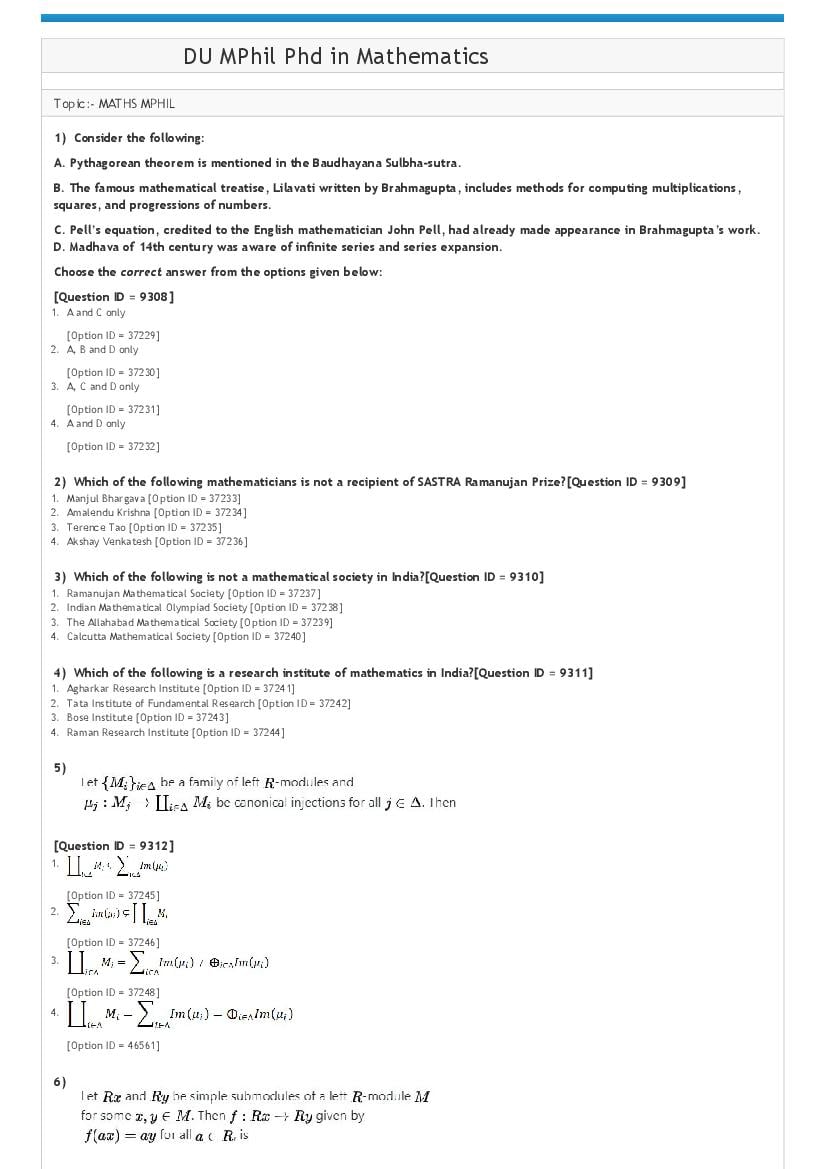
Topic:‐ MATHS MPHIL
1) Consider the following:
A. Pythagorean theorem is mentioned in the Baudhayana Sulbha‐sutra.
B. The famous mathematical treatise, Lilavati written by Brahmagupta, includes methods for computing multiplications,
squares, and progressions of numbers.
C. Pell’s equation, credited to the English mathematician John Pell, had already made appearance in Brahmagupta’s work.
D. Madhava of 14th century was aware of infinite series and series expansion.
Choose the correct answer from the options given below:
[Question ID = 9308]
1. A and C only
[Option ID = 37229]
2. A, B and D only
[Option ID = 37230]
3. A, C and D only
[Option ID = 37231]
4. A and D only
[Option ID = 37232]
2) Which of the following mathematicians is not a recipient of SASTRA Ramanujan Prize?[Question ID = 9309]
1. Manjul Bhargava [Option ID = 37233]
2. Amalendu Krishna [Option ID = 37234]
3. Terence Tao [Option ID = 37235]
4. Akshay Venkatesh [Option ID = 37236]
3) Which of the following is not a mathematical society in India?[Question ID = 9310]
1. Ramanujan Mathematical Society [Option ID = 37237]
2. Indian Mathematical Olympiad Society [Option ID = 37238]
3. The Allahabad Mathematical Society [Option ID = 37239]
4. Calcutta Mathematical Society [Option ID = 37240]
4) Which of the following is a research institute of mathematics in India?[Question ID = 9311]
1. Agharkar Research Institute [Option ID = 37241]
2. Tata Institute of Fundamental Research [Option ID = 37242]
3. Bose Institute [Option ID = 37243]
4. Raman Research Institute [Option ID = 37244]
5)
[Question ID = 9312]
1.
[Option ID = 37245]
2.
[Option ID = 37246]
3.
[Option ID = 37248]
4.
[Option ID = 46561]
6)
Page 2
1. not an R‐homomorphism.
[Option ID = 37249]
2. an R‐homomorphism but not one one.
[Option ID = 37250]
3. a one one R‐homomorphism but not onto.
[Option ID = 37251]
4. a one one, onto R‐homomorphism.
[Option ID = 37252]
7) If every cyclic module over a commutative ring R is free, then
[Question ID = 9314]
1. R has a nonzero maximal ideal.
[Option ID = 37253]
2. R has exactly two maximal ideals.
[Option ID = 37254]
3. R is a field.
[Option ID = 37255]
4. R has nonzero zero divisors.
[Option ID = 37256]
8) If R is a ring with unity such that a2 = a for all a ϵ R, then
[Question ID = 9315]
1.
[Option ID = 37257]
2.
[Option ID = 37258]
3.
[Option ID = 37259]
4.
[Option ID = 37260]
9)
[Question ID = 9316]
1. a maximal ideal of R.
[Option ID = 37261]
2. a proper but may not be a maximal ideal of R.
[Option ID = 37262]
3. a proper but may not be a prime ideal of R.
[Option ID = 37263]
4. the whole ring R.
[Option ID = 37264]
10)
[Question ID = 9317]
1. 2
[Option ID = 37265]
2. 3
[Option ID = 37266]
3. 4
[Option ID = 37267]
4. 6
[Option ID = 37268]
Page 3
[Question ID = 9318]
1. A and B only
[Option ID = 37269]
2. B and C only
[Option ID = 37270]
3. A and D only
[Option ID = 37271]
4. C and D only
[Option ID = 37272]
12)
[Question ID = 9319]
1.
[Option ID = 37273]
2.
[Option ID = 37274]
3.
[Option ID = 37275]
4.
[Option ID = 37276]
13)
[Question ID = 9320]
1. Both A and R are true and R is the correct explanation of A
[Option ID = 37277]
2. Both A and R are true but R is NOT the correct explanation of A
[Option ID = 37278]
3. A is true but R is false
[Option ID = 37279]
4. A is false but R is true
[Option ID = 37280]
14) The integral of ydx + xdy – 2 zdz = 0 is
[Question ID = 9321]
1.
[Option ID = 37281]
Page 4
[Option ID = 37282]
3.
[Option ID = 37283]
4.
[Option ID = 37284]
15) Solution(s) of the Dirichlet problem for Laplace equation is two‐dimensions, if exists
[Question ID = 9322]
1. is unique.
[Option ID = 37285]
2. are finitely many but more than one.
[Option ID = 37286]
3. are infinitely many.
[Option ID = 37287]
4. is unique up to addition of a constant.
[Option ID = 37288]
16) The eigen values associated with the system are
[Question ID = 9323]
1. 5 and ‐1
[Option ID = 37289]
2. 6 and ‐1
[Option ID = 37290]
3. 7 and 2
[Option ID = 37291]
4. 7 and ‐2
[Option ID = 37292]
17)
[Question ID = 9324]
1. 0
[Option ID = 37293]
2.
[Option ID = 37294]
3.
[Option ID = 37295]
4. 1
[Option ID = 37296]
18)
[Question ID = 9325]
1. Both Statement I and Statement II are true
[Option ID = 37297]
Page 5
3. Statement I is true but Statement II is false
[Option ID = 37299]
4. Statement I is false but Statement II is true
[Option ID = 37300]
19)
[Question ID = 9326]
1. Both Statement I and Statement II are true
[Option ID = 37301]
[Option ID = 37302]
3. Statement I is true but Statement II is false
[Option ID = 37303]
4. Statement I is false but Statement II is true
[Option ID = 37304]
20)
[Question ID = 9327]
1. Both Statement I and Statement II are true
[Option ID = 37305]
[Option ID = 37306]
3. Statement I is true but Statement II is false
[Option ID = 37307]
4. Statement I is false but Statement II is true
[Option ID = 37308]
21) Let X be a connected subset of the usual space of real numbers and Y be a compact subset of . Then X U Y
[Question ID = 9328]
1. is always uncountable and has a limit point in
[Option ID = 37309]
2. is always uncountable but may not have a limit point in
[Option ID = 37310]
3. may be finite without a limit point in
[Option ID = 37311]
4. may be finite but has a limit point in
[Option ID = 37312]
22)
Page 6
1. Both Statement I and Statement II are true
[Option ID = 37313]
[Option ID = 37314]
3. Statement I is true but Statement II is false
[Option ID = 37315]
4. Statement I is false but Statement II is true
[Option ID = 37316]
23)
[Question ID = 9330]
1.
[Option ID = 37317]
2.
[Option ID = 37318]
3.
[Option ID = 37319]
4. is not pointwise convergent.
[Option ID = 37320]
24)
[Question ID = 9331]
1. A has full rank.
[Option ID = 37321]
2. A has at least one eigen value which is zero.
[Option ID = 37322]
3. the image of the linear transformation T(X) = AX has dimension less than n.
[Option ID = 37323]
4. dimension of the null space of the linear transformation is strictly more than zero.
[Option ID = 37324]
25)
[Question ID = 9332]
1.
[Option ID = 37325]
2.
[Option ID = 37326]
3.
[Option ID = 37327]
4.
[Option ID = 37328]
Page 7
[Question ID = 9333]
1. Matrix d is diagonalizable.
[Option ID = 37329]
2. Matrices a and c are diagonalizable.
[Option ID = 37330]
3. All the eigen values are real for the matrix b.
[Option ID = 37331]
4. Matrix a is diagonalizable but c is not.
[Option ID = 37332]
27)
[Question ID = 9334]
1. both Riemann integrable and Lebesgue integrable
[Option ID = 37333]
2. Riemann integrable but not Lebesgue integrable
[Option ID = 37334]
3. Lebesgue integrable but not Riemann integrable
[Option ID = 37335]
4. neither Riemann integrable nor Lebesgue integrable
[Option ID = 37336]
28)
[Question ID = 9335]
1. Both Statement I and Statement II are true
[Option ID = 37337]
[Option ID = 37338]
3. Statement I is true but Statement II is false
[Option ID = 37339]
4. Statement I is false but Statement II is true
[Option ID = 37340]
29)
[Question ID = 9336]
1. Both Statement I and Statement II are true
[Option ID = 37341]
Page 8
3. Statement I is true but Statement II is false
[Option ID = 37343]
4. Statement I is false but Statement II is true
[Option ID = 37344]
30)
[Question ID = 9337]
1. 3
[Option ID = 37345]
2. 4
[Option ID = 37346]
3.
[Option ID = 37347]
4.
[Option ID = 37348]
31) The radius of convergence of the power series is
[Question ID = 9338]
1. 0
[Option ID = 37349]
2.
[Option ID = 37350]
3. 1
[Option ID = 37351]
4.
[Option ID = 37352]
32)
[Question ID = 9339]
1.
[Option ID = 37353]
2.
[Option ID = 37354]
3.
[Option ID = 37355]
4.
[Option ID = 37356]
33)
[Question ID = 9340]
1.
[Option ID = 37357]
2.
[Option ID = 37358]
3.
[Option ID = 37359]
4.
[Option ID = 37360]
Page 9
[Question ID = 9341]
1. Both Statement I and Statement II are true
[Option ID = 37361]
[Option ID = 37362]
3. Statement I is true but Statement II is false
[Option ID = 37363]
4. Statement I is false but Statement II is true
[Option ID = 37364]
35)
[Question ID = 9342]
1. Both A and R are correct and R is the correct explanation of A
[Option ID = 37365]
2. Both A and R are correct but R is NOT the correct explanation of A
[Option ID = 37366]
3. A is correct but R is not correct
[Option ID = 37367]
4. A is not correct but R is correct
[Option ID = 37368]
36) The number of Sylow 5‐subgroups of S 5 is
[Question ID = 9343]
1. 1
[Option ID = 37369]
2. 6
[Option ID = 37370]
3. 11
[Option ID = 37371]
4. 21
[Option ID = 37372]
37)
Page 10
1. A and B only
[Option ID = 37373]
2. A and C only
[Option ID = 37374]
3. C and D only
[Option ID = 37375]
4. B and D only
[Option ID = 37376]
38)
[Question ID = 9345]
1. A only
[Option ID = 37377]
2. B and C only
[Option ID = 37378]
3. A and B only
[Option ID = 37379]
4. A and C only
[Option ID = 37380]
39)
[Question ID = 9346]
1. A and B only
[Option ID = 37381]
2. B and C only
[Option ID = 37382]
3. A and C only
[Option ID = 37383]
4. A only
[Option ID = 37384]
40)
[Question ID = 9347]
1. Both Statement I and Statement II are true
[Option ID = 37385]
Page 11
3. Statement I is true but Statement II is false
[Option ID = 37387]
4. Statement I is false but Statement II is true
[Option ID = 37388]
41)
[Question ID = 9348]
1. A, B and C only
[Option ID = 37389]
2. B, C and D only
[Option ID = 37390]
3. A, B and D only
[Option ID = 37391]
4. A, C and D only
[Option ID = 37392]
42)
[Question ID = 9349]
1. A and B only
[Option ID = 37393]
2. C and D only
[Option ID = 37394]
3. A and C only
[Option ID = 37395]
4. B and D only
[Option ID = 37396]
43) Which of the following is correct?
[Question ID = 9350]
1.
[Option ID = 37397]
2. A nonempty subset of the usual metric space of real numbers which has largest and smallest elements is compact
[Option ID = 37398]
3.
[Option ID = 37399]
4.
Page 12
44)
[Question ID = 9351]
1. Both Statement I and Statement II are true
[Option ID = 37401]
[Option ID = 37402]
3. Statement I is true but Statement II is false
[Option ID = 37403]
4. Statement I is false but Statement II is true
[Option ID = 37404]
45)
[Question ID = 9352]
1. Both Statement I and Statement II are true
[Option ID = 37405]
[Option ID = 37406]
3. Statement I is true but Statement II is false
[Option ID = 37407]
4. Statement I is false but Statement II is true
[Option ID = 37408]
46)
[Question ID = 9353]
1. Both Statement I and Statement II are true
[Option ID = 37409]
[Option ID = 37410]
3. Statement I is true but Statement II is false
[Option ID = 37411]
4. Statement I is false but Statement II is true
[Option ID = 37412]
Page 13
[Question ID = 9354]
1.
[Option ID = 37413]
2.
[Option ID = 37414]
3.
[Option ID = 37415]
4.
[Option ID = 37416]
48)
[Question ID = 9355]
1. Both A and R are true and R is the correct explanation of A
[Option ID = 37417]
2. Both A and R are true but R is NOT the correct explanation of A
[Option ID = 37418]
3. A is true but R is false
[Option ID = 37419]
4. A is false but R is true
[Option ID = 37420]
49)
[Question ID = 9356]
1. is a Banach space.
[Option ID = 37421]
2.
[Option ID = 37422]
3.
[Option ID = 37423]
4.
[Option ID = 37424]
50)
Page 14
1. A and B only
[Option ID = 37425]
2. B, C and D only
[Option ID = 37426]
3. B and D only
[Option ID = 37427]
4. B only
[Option ID = 37428]
Document Details
| Board / Org | NTA |
| Exam | DUET |
| Type | Question Paper |
| Pages | 14 |
| Language | english |
| Updated | 30 Apr 2026 |