DUET 2021 Question Paper M.Phil Ph.D in Operational Research
Finished viewing? Save it for later —
Download DUET 2021 Question Paper M.Phil Ph.D in Operational Research (PDF · 7 pages)About DUET 2021 Question Paper M.Phil Ph.D in Operational Research
DUET 2021 Question Paper M.Phil Ph.D in Operational Research is available here for free download. Published by NTA for DUET, this question paper can be viewed online or downloaded as a PDF (7 pages). Candidates preparing for DUET can use DUET 2021 Question Paper M.Phil Ph.D in Operational Research to understand the exam pattern, the type of questions asked, and the overall difficulty level.
Frequently Asked Questions
How can I download DUET 2021 Question Paper M.Phil Ph.D in Operational Research?
Open this page and click the Download button to save DUET 2021 Question Paper M.Phil Ph.D in Operational Research as a PDF. It is completely free on AglaSem Docs.
Is DUET 2021 Question Paper M.Phil Ph.D in Operational Research free to download?
Yes. DUET 2021 Question Paper M.Phil Ph.D in Operational Research can be viewed online and downloaded as a PDF free of cost on AglaSem Docs.
How many pages does DUET 2021 Question Paper M.Phil Ph.D in Operational Research have?
DUET 2021 Question Paper M.Phil Ph.D in Operational Research contains 7 pages, which you can read online or download together as a single PDF.
Where can I find more DUET study material?
You can find more DUET question papers, sample papers, syllabus, and answer keys on AglaSem Docs.
DUET 2021 Question Paper M.Phil Ph.D in Operational Research – Text
Read the full text of this question paper below — useful to quickly search, copy and reference the content online without downloading the PDF.
📄 View text version (7 pages)
Page 1
Topic:‐ OR MPHIL
1) A constraint in a linear programming problem restricts:[Question ID = 8382]
1. value of the objective function [Option ID = 33525]
2. value of the decision variable [Option ID = 33526]
3. use of the available resources [Option ID = 33527]
4. all of these [Option ID = 33528]
2) Which of the following statement is not correct in linear programming?[Question ID = 8383]
1. Degeneracy in linear programming may arise at the initial stage [Option ID = 33529]
2. A degenerate solution can never be optimum [Option ID = 33530]
3. Degeneracy may be of temporary nature [Option ID = 33531]
4. The Big‐M method and Two‐phase method do not necessarily carry out same number of iterations to find an optimal solution [Option ID = 33532]
3) If the i‐th slack variable of the primal linear programming problem is not zero, then:[Question ID = 8384]
1. the j‐th dual variable is zero [Option ID = 33533]
2. the j‐th dual variable may be zero [Option ID = 33534]
3. the j‐th dual constraint is satisfied as an equality [Option ID = 33535]
4. none of these [Option ID = 33536]
4) In transportation problem, one of the dual variables is assigned an arbitrary value, because:[Question ID = 8385]
1. a solution can be obtained immediately [Option ID = 33537]
2. two of the constraints is redundant in the transportation problem [Option ID = 33538]
3. it facilitates construction of the loop [Option ID = 33539]
4. none of these [Option ID = 33540]
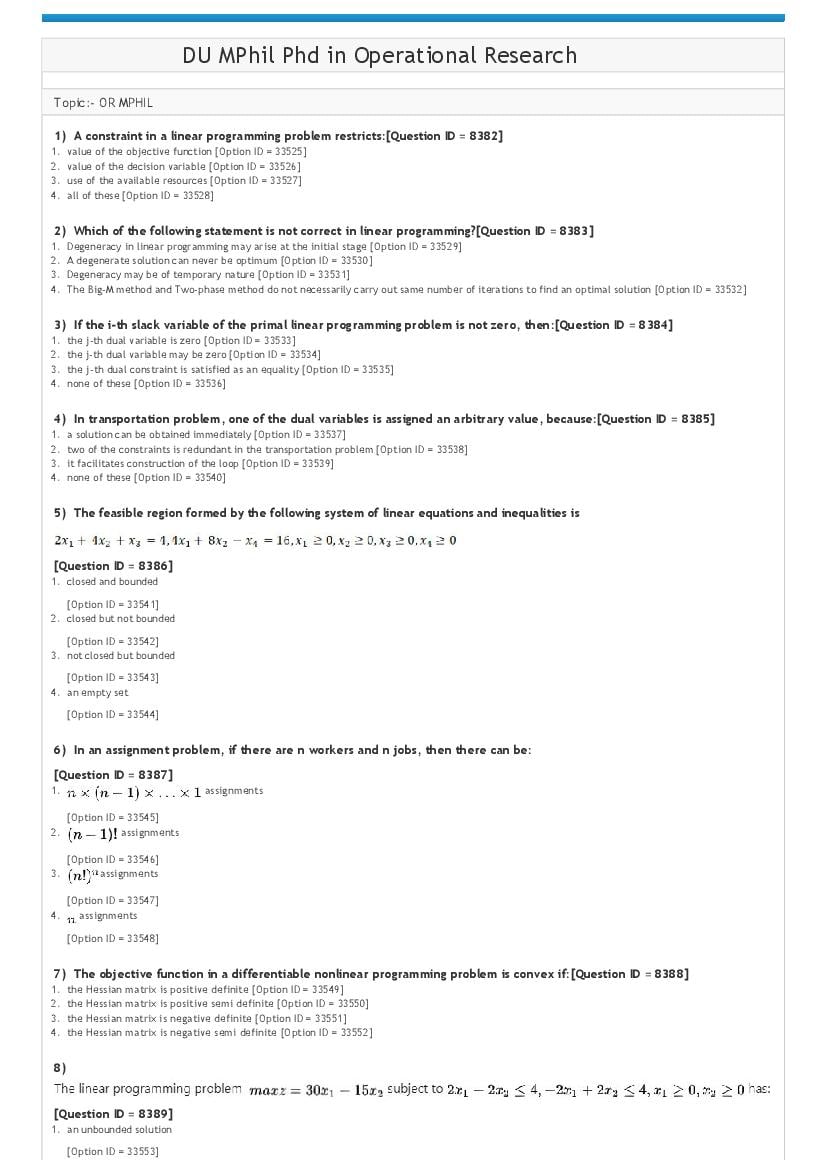
5) The feasible region formed by the following system of linear equations and inequalities is
[Question ID = 8386]
1. closed and bounded
[Option ID = 33541]
2. closed but not bounded
[Option ID = 33542]
3. not closed but bounded
[Option ID = 33543]
4. an empty set
[Option ID = 33544]
6) In an assignment problem, if there are n workers and n jobs, then there can be:
[Question ID = 8387]
1. assignments
[Option ID = 33545]
2. assignments
[Option ID = 33546]
3. assignments
[Option ID = 33547]
4. assignments
[Option ID = 33548]
7) The objective function in a differentiable nonlinear programming problem is convex if:[Question ID = 8388]
1. the Hessian matrix is positive definite [Option ID = 33549]
2. the Hessian matrix is positive semi definite [Option ID = 33550]
3. the Hessian matrix is negative definite [Option ID = 33551]
4. the Hessian matrix is negative semi definite [Option ID = 33552]
8)
[Question ID = 8389]
1. an unbounded solution
[Option ID = 33553]
Page 2
[Option ID = 33554]
3. an optimal objective value z=6
[Option ID = 33555]
4. no feasible solution
[Option ID = 33556]
9) In a transportation cost matrix, if a row has four cost entries given as a, b, c and d , then the penalty for
such a row is:
[Question ID = 8390]
1. 0, if
[Option ID = 33557]
2.
[Option ID = 33558]
3.
[Option ID = 33559]
4.
[Option ID = 33560]
10) Which of the following is not correct about the classical assignment problem?[Question ID = 8391]
1. A job cannot be assigned to more than one worker [Option ID = 33561]
2. Only one worker can be assigned to each job [Option ID = 33562]
3. A worker cannot be assigned to more than one job [Option ID = 33563]
4. None of these [Option ID = 33564]
11) Which of the following is correct about the Karush‐Kuhn‐Tucker (KKT) optimality conditions?[Question ID = 8392]
1. The conditions are not sufficient when the functions involved are convex [Option ID = 33565]
2. The conditions are sufficient when the constraint set is convex [Option ID = 33566]
3. The KKT point is an optimal solution of the problem [Option ID = 33567]
4. None of these [Option ID = 33568]
12) In ABC inventory classification system, the class A items may:[Question ID = 8393]
1. require higher safety stock [Option ID = 33569]
2. require frequent deliveries [Option ID = 33570]
3. require a periodic inventory system [Option ID = 33571]
4. require batch updating of inventory records [Option ID = 33572]
13) Let the total usage of the given item be 9,000 units per year, the cost per order be Rs. 15, and the unit cost is Rs. 30.
If the carrying charges are 10% of the average inventory per year, then the optimal economic order quantity is:[Question ID
= 8394]
1. 300 units [Option ID = 33573]
2. 443 units [Option ID = 33574]
3. 536 units [Option ID = 33575]
4. 315 units [Option ID = 33576]
14) The annual inventory costs are __________ of the lot size in each production run with a ___________slope.[Question
ID = 8395]
1. linear functions, negative [Option ID = 33577]
2. linear functions, positive [Option ID = 33578]
3. nonlinear functions, negative [Option ID = 33579]
4. nonlinear functions, positive [Option ID = 33580]
15) Let λ be the arrival rate of customers in a system, μ be the service rate of the system. The expected number of busy
servers is:
[Question ID = 8396]
1.
[Option ID = 33581]
2.
[Option ID = 33582]
3.
[Option ID = 33583]
4. none of these
[Option ID = 33584]
Page 3
rate follows a Poisson distribution, while service times follow an exponential distribution. If the average number of arrivals is
4 per minute and the average service rate of a single server is 7 per minute, then the proportion of the time the server is
busy:
[Question ID = 8397]
1. 0.43
[Option ID = 33585]
2. 0.67
[Option ID = 33586]
3. 0.10
[Option ID = 33587]
4. none of these
[Option ID = 33588]
17)
[Question ID = 8398]
1. 2500 hours
[Option ID = 33589]
2. 2100 hours
[Option ID = 33590]
3. 1100 hours
[Option ID = 33591]
4. none of these
[Option ID = 33592]
18) Given that the failure time probability density function is , the reliability is obtained as:
[Question ID = 8399]
1.
[Option ID = 33593]
2.
[Option ID = 33594]
3.
[Option ID = 33595]
4.
[Option ID = 33596]
19)
[Question ID = 8400]
1.
[Option ID = 33597]
2.
[Option ID = 33598]
3.
[Option ID = 33599]
4.
[Option ID = 33600]
20) The accessibility which is an important attribute of maintainability can be affected by:[Question ID = 8401]
1. location of item and its associated environment [Option ID = 33601]
2. type of maintenance tasks to be performed through the access opening [Option ID = 33602]
3. degree of danger involved in using access opening [Option ID = 33603]
4. all of these [Option ID = 33604]
21) In a transportation problem, while improving an existing solution a loop may be defined as an ordered set of at least:
[Question ID = 8402]
1. 3 cells [Option ID = 33605]
2. 4 cells [Option ID = 33606]
3. 5 cells [Option ID = 33607]
4. none of these [Option ID = 33608]
Page 4
25% of the investment in the inventories, and the unit cost is Rs. 10, then the optimal order cycle time is:[Question ID =
8403]
1. 0.894 year [Option ID = 33609]
2. 1 year [Option ID = 33610]
3. 0.978 year [Option ID = 33611]
4. 2 years [Option ID = 33612]
23) A suburban specialty restaurant has developed a single drive‐thru window. Customers order, pay, and pick up their food
at the same window. Arrivals follow a Poisson distribution, while service times follow an exponential distribution. If the
average number of arrivals is 8 per hour and the service rate is 2 every 12 minutes, then the average number of customers
in the system is:[Question ID = 8404]
1. 4 [Option ID = 33613]
2. 3 [Option ID = 33614]
3. 0.5 [Option ID = 33615]
4. 2.25 [Option ID = 33616]
24) The reliability of an item can be obtained using:
[Question ID = 8405]
1.
[Option ID = 33617]
2.
[Option ID = 33618]
3.
[Option ID = 33619]
4. all of these
[Option ID = 33620]
25) As per queue discipline, which of the following is not considered as a negative behavior of the customer?
[Question ID = 8406]
1. Balking
[Option ID = 33621]
2. Reneging
[Option ID = 33622]
3. Boarding
[Option ID = 33623]
4. Jockeying
[Option ID = 33624]
26) Failing to reject the null hypothesis, when it is false is:[Question ID = 8407]
1. alpha [Option ID = 33625]
2. Type I error [Option ID = 33626]
3. beta [Option ID = 33627]
4. Type II error [Option ID = 33628]
27) Observational studies allow:[Question ID = 8408]
1. population inference [Option ID = 33629]
2. casual inference [Option ID = 33630]
3. both population and casual inferences [Option ID = 33631]
4. neither population nor casual inferences [Option ID = 33632]
28) When asked questions regarding personal hygiene, people commonly lie. This is an example of:[Question ID = 8409]
1. sampling bias [Option ID = 33633]
2. confounding [Option ID = 33634]
3. non‐response bias [Option ID = 33635]
4. response bias [Option ID = 33636]
29) The need for inferential statistical methods derives from the need for:[Question ID = 8410]
1. Population [Option ID = 33637]
2. Association [Option ID = 33638]
3. Sampling [Option ID = 33639]
4. Probability [Option ID = 33640]
30) ___________ classification includes data according to the time period in which the items under consideration occured.
[Question ID = 8411]
1. Chronological
Page 5
2. Alphabetical
[Option ID = 33642]
3. Geographical
[Option ID = 33643]
4. Tropological
[Option ID = 33644]
31) The ________ random variables yield categorical responses so that the responses fit into one category or another.
[Question ID = 8412]
1. Quantitative [Option ID = 33645]
2. Discrete [Option ID = 33646]
3. Continuous [Option ID = 33647]
4. Qualitative [Option ID = 33648]
32) When a researcher uses a data which has already been collected by others, such data is called:
[Question ID = 8413]
1. Primary data
[Option ID = 33649]
2. Collected data
[Option ID = 33650]
3. Processed data
[Option ID = 33651]
4. Secondary data
[Option ID = 33652]
33) For any discrete distribution, standard deviation is not less than:
[Question ID = 8414]
1. Mean deviation from mean
[Option ID = 33653]
2. Mean deviation from median
[Option ID = 33654]
3. Mode
[Option ID = 33655]
4. None of these
[Option ID = 33656]
34) A dice is tossed twice and 'getting a number less than three' is termed as success. The mean of number of successes is:
[Question ID = 8415]
1. 1 [Option ID = 33657]
2. 3/2 [Option ID = 33658]
3. 1/4 [Option ID = 33659]
4. 2/3 [Option ID = 33660]
35) If the standard error of the population is reduced by 50%, the sample size becomes:[Question ID = 8416]
1. Double [Option ID = 33661]
2. Increase six times [Option ID = 33662]
3. Increase four times [Option ID = 33663]
4. None of these [Option ID = 33664]
36) How many different sample of size four can be taken from the population comprising seven elements?[Question ID =
8417]
1. 35 [Option ID = 33665]
2. 10 [Option ID = 33666]
3. 28 [Option ID = 33667]
4. 14 [Option ID = 33668]
37) The scale in which a respondent directly compares two or more objects and makes choices among them is:[Question ID =
8418]
1. Ranking Scale [Option ID = 33669]
2. Rating Scale [Option ID = 33670]
3. Graphic Scale [Option ID = 33671]
4. None of these [Option ID = 33672]
38) The whole process of scaling is based on the following bases:[Question ID = 8419]
1. Degree of subjectivity [Option ID = 33673]
2. Dimensionality [Option ID = 33674]
3. Response form [Option ID = 33675]
Page 6
39) The sample size of a sample is determined by the following factors:[Question ID = 8420]
1. Size of the population [Option ID = 33677]
2. Nature of the population [Option ID = 33678]
3. Objective and scope of the study [Option ID = 33679]
4. All of these [Option ID = 33680]
40) Which of the following is a non‐probability sampling:[Question ID = 8421]
1. Accidental sampling [Option ID = 33681]
2. Purposive sampling [Option ID = 33682]
3. Snowball sampling [Option ID = 33683]
4. All of these [Option ID = 33684]
41) Which of the following cannot be measured as such in any numeric scale:[Question ID = 8422]
1. Aroma [Option ID = 33685]
2. Gender [Option ID = 33686]
3. Education standard [Option ID = 33687]
4. All of these [Option ID = 33688]
42) Among the many estimators based on sample observations, a good estimator is one which is:
[Question ID = 8423]
1. Unbiased
[Option ID = 33689]
2. Consistent
[Option ID = 33690]
3. Efficient and sufficient
[Option ID = 33691]
4. All of these
[Option ID = 33692]
43) The name for a variable which is measured using two different values is:[Question ID = 8424]
1. Bionomial [Option ID = 33693]
2. Binary [Option ID = 33694]
3. Dichotomous [Option ID = 33695]
4. All of these [Option ID = 33696]
44) Reliability of a measurement is __________ of its validity.[Question ID = 8425]
1. Necessary and Sufficient condition [Option ID = 33697]
2. Neither Necessary nor Sufficient condition [Option ID = 33698]
3. Necessary but not Sufficient condition [Option ID = 33699]
4. Sufficient but not Necessary condition [Option ID = 33700]
45) Which of the following are the most similar?[Question ID = 8426]
1. Nominal and Interval data [Option ID = 33701]
2. Nominal and Ordinal data [Option ID = 33702]
3. Ordinal and Interval data [Option ID = 33703]
4. Nominal and Ratio data [Option ID = 33704]
46) The height of a human being is:[Question ID = 8427]
1. Ordinal variable [Option ID = 33705]
2. Nominal variable [Option ID = 33706]
3. Ratio variable [Option ID = 33707]
4. None of these [Option ID = 33708]
47) Let A, B and C be independent event with probabilities 0.3, 0.2 and 0.1, respectively. The probability of occurance of
atleast one of the three events A, B, C is:
[Question ID = 8428]
1. 0.41
[Option ID = 33709]
2. 0.37
[Option ID = 33710]
3. 0.496
[Option ID = 33711]
4. 0.387
[Option ID = 33712]
48) A student appears in an exam that has four subjects. The chance he passes an individual subject's test is 0.8. the
probability that he will pass in atleast one of the subject is:[Question ID = 8429]
Page 7
2. 0.9984 [Option ID = 33714]
3. 0.0004 [Option ID = 33715]
4. None of these [Option ID = 33716]
49) A die is thrown. The expectation of the number on it is:[Question ID = 8430]
1. 3.1 [Option ID = 33717]
2. 3.5 [Option ID = 33718]
3. 3.6 [Option ID = 33719]
4. 3 [Option ID = 33720]
50) A researcher is studying students of a city college she takes a sample of 400 students from ten colleges. The average
age of all college students is:[Question ID = 8431]
1. a statistic [Option ID = 33721]
2. a parameter [Option ID = 33722]
3. a population [Option ID = 33723]
4. none of these [Option ID = 33724]
Document Details
| Board / Org | NTA |
| Exam | DUET |
| Type | Question Paper |
| Pages | 7 |
| Language | english |
| Updated | 30 Apr 2026 |