MBOSE Class 10 Question Paper 2019 for Computer Science Old Course
Finished viewing? Save it for later —
Download MBOSE Class 10 Question Paper 2019 for Computer Science Old Course (PDF · 16 pages)About MBOSE Class 10 Question Paper 2019 for Computer Science Old Course
MBOSE Class 10 Question Paper 2019 for Computer Science Old Course is available here for free download. Published by Meghalaya Board for Class 10, this question paper can be viewed online or downloaded as a PDF (16 pages). Candidates preparing for Class 10 can use MBOSE Class 10 Question Paper 2019 for Computer Science Old Course to understand the exam pattern, the type of questions asked, and the overall difficulty level.
Frequently Asked Questions
How can I download MBOSE Class 10 Question Paper 2019 for Computer Science Old Course?
Open this page and click the Download button to save MBOSE Class 10 Question Paper 2019 for Computer Science Old Course as a PDF. It is completely free on AglaSem Docs.
Is MBOSE Class 10 Question Paper 2019 for Computer Science Old Course free to download?
Yes. MBOSE Class 10 Question Paper 2019 for Computer Science Old Course can be viewed online and downloaded as a PDF free of cost on AglaSem Docs.
How many pages does MBOSE Class 10 Question Paper 2019 for Computer Science Old Course have?
MBOSE Class 10 Question Paper 2019 for Computer Science Old Course contains 16 pages, which you can read online or download together as a single PDF.
Where can I find more Class 10 study material?
You can find more Class 10 question papers, sample papers, syllabus, and answer keys on AglaSem Docs.
MBOSE Class 10 Question Paper 2019 for Computer Science Old Course – Text
Read the full text of this question paper below — useful to quickly search, copy and reference the content online without downloading the PDF.
📄 View text version (16 pages)
Page 1
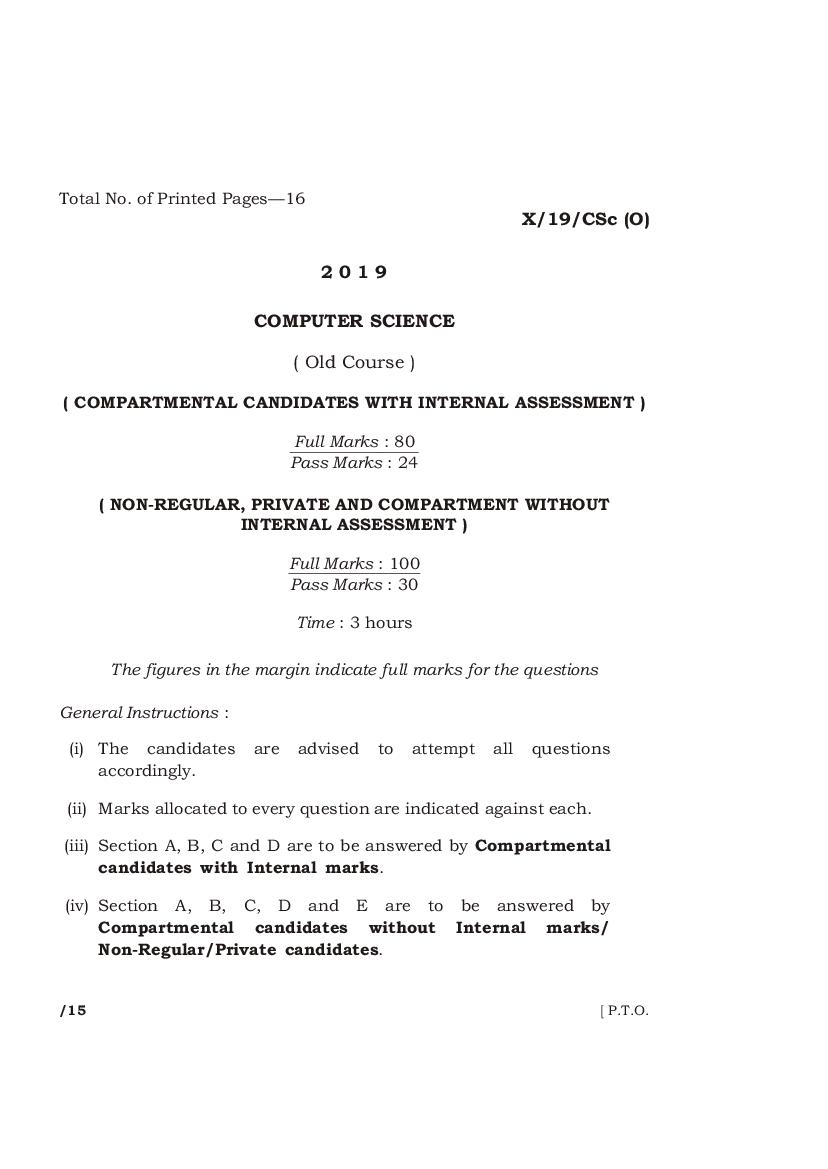
X/19/CSc (O)
2019
COMPUTER SCIENCE
( Old Course )
( COMPARTMENTAL CANDIDATES WITH INTERNAL ASSESSMENT )
Full Marks : 80
Pass Marks : 24
( NON-REGULAR, PRIVATE AND COMPARTMENT WITHOUT
INTERNAL ASSESSMENT )
Full Marks : 100
Pass Marks : 30
Time : 3 hours
The figures in the margin indicate full marks for the questions
General Instructions :
(i) The candidates are advised to attempt all questions
accordingly.
(ii) Marks allocated to every question are indicated against each.
(iii) Section A, B, C and D are to be answered by Compartmental
candidates with Internal marks.
(iv) Section A, B, C, D and E are to be answered by
Compartmental candidates without Internal marks/
Non-Regular/Private candidates.
/15 [ P.T.O.
Page 2
SECTION—A
( COMPUTER FUNDAMENTALS )
( Maximum Marks : 20 )
( Objective-type Questions )
I. Choose and write the correct answer for the following
(any three) : 1×3=3
1. Which of the following is the non-positional number
system?
(a) Roman
(b) Octal
(c) Decimal
(d) Hexadecimal
2. The logic gate NOR is represented by which Boolean
expression from the following?
(a) A+B (b) A×B
(c) A×B (d) A+B
3. A nibble is a string of
(a) 8 bits
(b) 2 bits
(c) 4 bits
(d) 16 bits
4. The equivalent binary number of a hexadecimal number
ABC is
(a) (1010 1011 1100)2 (b) (1010 1001 1100)2
(c) (1010 1011 1001)2 (d) (1010 1011 1011)2
X/19/CSc (O)/15 [ Contd.
Page 3
5. The 1’s complement of (10101110)2 will be
(a) (01010000)2 (b) (01010001)2
(c) (01011111)2 (d) (01010101)2
6. What is the sum of (10110)2 and (11001)2 ?
(a) (100100)2
(b) (110110)2
(c) (101111)2
(d) (100001)2
II. State whether the following statements are True or False
(any two) : 1×2=2
1. BCD represents each digit of a decimal number as a
nibble.
2. The product of (1011)2 ´ (101)2 according to binary
arithmetic is (110111)2 .
3. The Boolean algebra was developed by J. G. Kemeny and
T. E. Kurtz.
4. The NOT operation is also called complementation.
III. Fill in the blanks of the following sentences (any two) : 1×2=2
1. _____ are electronic circuits that implement the Boolean
operations.
2. The _____ operator acts on a single operand.
3. The binary equivalent of the number (28)10 is _____.
4. The ASCII–7 uses 7 bits, thereby allowing a total of _____
different codes.
X/19/CSc (O)/15 [ P.T.O.
Page 4
( Short Answer-type Questions )
IV. Answer the following questions : 1×3=3
1. Give the truth table of AND operation with two inputs.
2. Write the full form of EBCDIC.
3. Name the number systems that (1011) can belong.
( Descriptive-type Questions )
V. Either
(a) (i) What is NAND gate? Give its truth table. 1+1=2
(ii) Write the formulae of the binary arithmetic for
addition and subtraction. 1½+1½=3
Or
(b) (i) What is hexadecimal number? 1
(ii) Convert the following : 2
(432)5 = (?)6
(iii) Subtract the following using 2’s complement
method : 2
(11111)2 - (11001)2
X/19/CSc (O)/15 [ Contd.
Page 5
VI. Either
(a) (i) What is Boolean algebra? 2
(ii) Draw the logic circuit of the following : 3
A = (x + y × z) + (x × y + z )
[ For the Visually Handicapped (Blind) Students only
in lieu of Question No. VI(a)(ii) above ]
(ii) Explain the OR operation with its truth table and
logic symbol. 1+1+1=3
Or
(b) (i) Define bit and byte. 1+1=2
(ii) Give the Boolean expression of the following logic
circuit : 3
A
B
C
D Y
[ For the Visually Handicapped (Blind) Students only
in lieu of Question No. VI(b)(ii) above ]
(ii) What are the three rules for subtraction using 1’s
complement method? 1+1+1=3
X/19/CSc (O)/15 [ P.T.O.
Page 6
SECTION—B
( OPERATING SYSTEMS )
( Maximum Marks : 20 )
( Objective-type Questions )
I. Choose and write the correct answer for the following
(any two) : 1×2=2
1. The switch to display subdirectories with DIR command is
(a) /D
(b) /E
(c) /S
(d) /P
2. Which command deletes a file from the secondary storage
medium?
(a) RD
(b) MD
(c) DEL
(d) CLS
3. Which of the following DOS commands is a filter?
(a) SORT
(b) MOVE
(c) EDIT
(d) FIND
X/19/CSc (O)/15 [ Contd.
Page 7
4. Which Linux command from the following is used to
display the information about files and subdirectories in a
directory?
(a) who (b) cal
(c) ls (d) cd
II. State whether the following statements are True or False
(any two) : 1×2=2
1. VOL command just displays the disk volume name and
serial number.
2. FORMAT command can create a new root directory and
FAT for a disk.
3. Defragmentation is the process by which a file is written
on a disk in parts.
4. The BOSS Linux is an Indian distribution of Linux
operating system.
III. Fill in the blanks of the following sentences (any two) : 1×2=2
1. _____ DOS command is used to rename a file or files.
2. _____ DOS command checks drive C: for errors.
3. _____ DOS command displays the memory information.
4. In Linux, to rename a directory, we use _____ command.
( Short Answer-type Questions )
IV. Write the commands and their switches (or options) for the
following (any two) : 2×2=4
1. Copy a file TEST.TXT from current directory to D:\Exam.
2. Check the current disk for fragmentation.
X/19/CSc (O)/15 [ P.T.O.
Page 8
3. Move all the files from C:\TEMP to D:\MISC.
4. Delete a file TRY.TMP from current directory.
( Descriptive-type Questions )
V. Either
(a) (i) What is the purpose of TREE command? 1
(ii) Differentiate between MOVE and MORE commands.
2+2=4
Or
(b) (i) What is the purpose of ‘cal’ command in Linux? 1
(ii) Write the purpose and syntax of the following Linux
commands : 2+2=4
1. rmdir
2. rm
VI. Either
(a) Explain COPY command with its syntax and options in
DOS. 5
Or
(b) (i) Name any four common distributions of Linux. 2
(ii) Write the content of the following Linux directory
structures : 1×3=3
1. bin
2. boot
3. dev
X/19/CSc (O)/15 [ Contd.
Page 9
SECTION—C
( QBASIC )
( Maximum Marks : 28 )
( Objective-type Questions )
I. Choose and write the correct answer for the following
(any two) : 1×2=2
1. Which of the following characters is not a type declaration
character?
(a) ||
(b) %
(c) $
(d) #
2. ASCII code for alphabet D in QBasic is
(a) 65 (b) 66
(c) 67 (d) 68
3. Which one of the following can move both column and
row?
(a) TAB
(b) SPC
(c) LOCATE
(d) None of the above
X/19/CSc (O)/15 [ P.T.O.
Page 10
4. Which one of the following is the oldest loop?
(a) FOR_NEXT loop
(b) DO_LOOP
(c) WHILE_WEND loop
(d) IF_THEN_ELSE
II. State whether the following statements are True or False
(any two) : 1×2=2
1. XOR and EQV are logical operators in QBasic.
2. The statement PRINT USING “##.##”; 123·4567 will return
#123·46.
3. The variable that exists only in a procedure is called local
variable.
4. The ERASE statement reinitializes array elements or free
dynamic array storage.
III. Fill in the blanks of the following sentences (any two) : 1×2=2
1. _____ keyword is used to define global variables.
2. RIGHT$ (“WINDOW”, 3) will return _____.
3. GOTO is an _____ branching statement.
4. _____ function returns the length of a string.
IV. Answer the following questions : 1×3=3
1. Write the QBasic expression of
x+y
2a
2. What is the purpose of STATIC keyword?
3. How many elements can be stored in an array X(5, 6)?
X/19/CSc (O)/15 [ Contd.
Page 11
( Short Answer-type Questions )
V. Answer the following questions within 2 or 3 sentences or
steps (any two) : 2×2=4
1. Name the two argument passing mechanisms.
2. What is dynamic array?
3. What is the function of ASC?
4. Write the syntax of nested-IF structure.
( Descriptive-type Questions )
VI. Answer the following questions : 5×3=15
1. Either
(a) Differentiate between FIX and INT functions with
examples. 2½+2½=5
Or
(b) Write the QBasic code to find the sum of first 10 even
numbers. 5
2. Either
(a) Write a QBasic program to input any three numbers
and print out the largest. 5
Or
(b) Enumerate the rules of READ_DATA statement. 5
X/19/CSc (O)/15 [ P.T.O.
Page 12
3. Either
(a) Enumerate the points to be remembered while
writing QBasic expressions. 5
Or
(b) Enumerate the rules for naming variables in QBasic. 5
SECTION—D
( JAVA CONCEPT )
( Maximum Marks : 12 )
( Objective-type Questions )
I. Choose and write the correct answer for the following
(any two) : 1×2=2
1. The number of bytes required to store ‘short’ data type in
Java is
(a) 1
(b) 2
(c) 3
(d) 4
X/19/CSc (O)/15 [ Contd.
Page 13
2. Which one of the following is not a Java primitive data
type?
(a) float
(b) single
(c) double
(d) char
3. Which one of the following is not a numeric operator?
(a) %
(b) + +
(c) = =
(d) – –
4. Which one of the following is not a loop statement?
(a) for_next
(b) do_loop
(c) while_loop
(d) switch_case
X/19/CSc (O)/15 [ P.T.O.
Page 14
II. State whether the following statements are True or False
(any two) : 1×2=2
1. java.awt contains a number of miscellaneous utility
classes.
2. A method defines the operations that an object of a class
can execute.
3. next() reads a string as input terminated by white space.
4. A package is a group of classes stored together.
III. Fill in the blanks of the following sentences (any two) : 1×2=2
1. The keyword _____ is used to indicate that an identifier is
a constant.
2. The _____ symbol represents AND operator in Java.
3. A class declaration is enclosed within _____ brackets.
4. The full form of API is _____.
IV. Answer the following questions : 1×3=3
1. What is the purpose of ‘new’ keyword?
2. What is a constructor?
3. Define data encapsulation.
X/19/CSc (O)/15 [ Contd.
Page 15
V. Either
(a) (i) Define object in Java. 1
(ii) Write the two data types available in Java. 2
Or
(b) (i) Who developed Java programming language? 1
(ii) What are the two Java tools used for compiling and
executing Java codes? 2
SECTION—E
( Maximum Marks : 20 )
I. Answer the following questions within 2 or 3 sentences each
(any five) : 2×5=10
1. Define constant and variable.
2. Write the five type-declaration characters in QBasic.
3. What is the output of PRINT “12” + “12”?
4. What is a pseudocode?
5. What is the purpose of EXIT statement?
6. Write all the symbols of Boolean operators in Java.
7. Differentiate between public and private visibility
modifiers.
X/19/CSc (O)/15 [ P.T.O.
Page 16
II. Answer the following questions : 5×2=10
1. Either
(a) Write a QBasic code to print out the following :
1 2 3 4 5
1 2 3 4
1 2 3
1 2
1
Or
(b) Write a QBasic program to input two numbers and
print out their sum.
2. Either
(a) Write all the arithmetic operators available in QBasic
with their purposes and examples.
Or
(b) Write the results of the following QBasic
expressions :
(i) “Delhi” > “Guwahati”
(ii) “Assam” < “Meghalaya”
(iii) Total = 5 * 65/100
(iv) MID$ (“Europe”, 3)
(v) CHR$ (65)
HHH
X/19/CSc (O)/15 K9—330
Document Details
| Board / Org | Meghalaya Board |
| Exam | Class 10 |
| Type | Question Paper |
| Pages | 16 |
| Updated | 30 Apr 2026 |