MAHA SET 2026 Paper II Political Science Set A Question Paper
Finished viewing? Save it for later —
Download MAHA SET 2026 Paper II Political Science Set A Question Paper (PDF · 32 pages)About MAHA SET 2026 Paper II Political Science Set A Question Paper
MAHA SET 2026 Paper II Political Science Set A Question Paper is available here for free download. Published by Maharashtra Exams for MAHA SET, this question paper can be viewed online or downloaded as a PDF (32 pages). Candidates preparing for MAHA SET can use MAHA SET 2026 Paper II Political Science Set A Question Paper to understand the exam pattern, the type of questions asked, and the overall difficulty level.
Frequently Asked Questions
How can I download MAHA SET 2026 Paper II Political Science Set A Question Paper?
Open this page and click the Download button to save MAHA SET 2026 Paper II Political Science Set A Question Paper as a PDF. It is completely free on AglaSem Docs.
Is MAHA SET 2026 Paper II Political Science Set A Question Paper free to download?
Yes. MAHA SET 2026 Paper II Political Science Set A Question Paper can be viewed online and downloaded as a PDF free of cost on AglaSem Docs.
How many pages does MAHA SET 2026 Paper II Political Science Set A Question Paper have?
MAHA SET 2026 Paper II Political Science Set A Question Paper contains 32 pages, which you can read online or download together as a single PDF.
Where can I find more MAHA SET study material?
You can find more MAHA SET question papers, sample papers, syllabus, and answer keys on AglaSem Docs.
MAHA SET 2026 Paper II Political Science Set A Question Paper – Text
Read the full text of this question paper below — useful to quickly search, copy and reference the content online without downloading the PDF.
📄 View text version (33 pages)
Page 1
MAHA SET 2026 Paper
II Political Science Set A
Question Paper
EXAM YEAR TYPE
MAHA SET 2026 Question Paper
Notes · Sample Papers · Previous Year Papers · Mock Tests
Page 2
. s e
em l a
as
a g
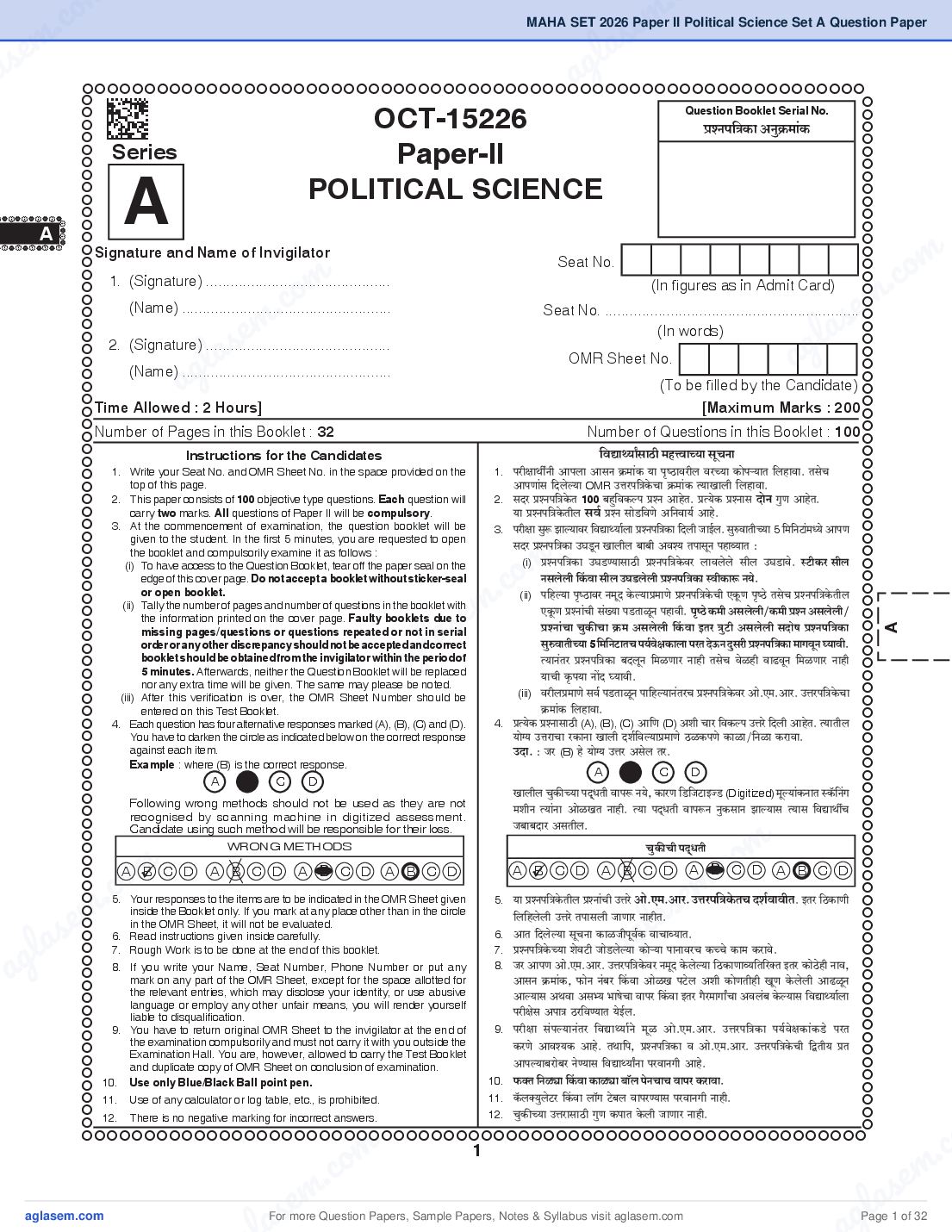
OCT-15226 Question Booklet Serial No.
àíZn{ÌH$m AZwH«$_m§H$
Series Paper-II
A political science
m
A
om co
Signature and Name of Invigilator
.
Seat No.
.c e m
1. (Signature) ............................................. (In figures as in Admit Card)
e m
(Name) ...................................................
l a s
Seat No. ..............................................................
l a s (In words)
a g
ag
2. (Signature) .............................................
OMR Sheet No.
(Name) ...................................................
(To be filled by the Candidate)
Time Allowed : 2 Hours] [Maximum Marks : 200
Number of Pages in this Booklet : 32 Number of Questions in this Booklet : 100
Instructions for the Candidates {dÚmÏ`mªgmR>r _hÎdmÀ`m gyMZm
1. Write your Seat No. and OMR Sheet No. in the space provided on the 1.narjmWvZr Amnbm AmgZ H«$_m§H$ `m n¥îR>mdarb daÀ`m H$monè`mV {bhmdm. VgoM
top of this page. AmnUm§g {Xboë`m OMR CÎman{ÌHo$Mm H«$_m§H$ Ë`mImbr {bhmdm.
2. This paper consists of 100 objective type questions. Each question will 2. gXa àíZn{ÌHo$V 100 ~hþ{dH$ën àíZ AmhoV. àË`oH$ àíZmg XmoZ JwU AmhoV.
carry two marks. All questions of Paper II will be compulsory. `m àíZn{ÌHo$Vrb gd© àíZ gmoS>{dUo A{Zdm`© Amho.
3. At the commencement of examination, the question booklet will be 3. narjm gwê$ Pmë`mda {dÚmÏ`m©bm àíZn{ÌH$m {Xbr OmB©b. gwédmVrÀ`m 5 {_{ZQ>m_
§ Ü`o AmnU
m
given to the student. In the first 5 minutes, you are requested to open
co
the booklet and compulsorily examine it as follows :
gXa àíZn{ÌH$m CKSy>Z Imbrb ~m~r Adí` VnmgyZ nhmì`mV :
.
(i) To have access to the Question Booklet, tear off the paper seal on the (i) àíZn{ÌH$m CKS>Ê`mgmR>r àíZn{ÌHo$da bmdbobo grb CKS>mdo. ñQ>rH$a grb
em
edge of this cover page. Do not accept a booklet without sticker-seal Zgbobr {H§$dm grb CKS>bobr àíZn{ÌH$m ñdrH$mê$ Z`o.
or open booklet.
s
(ii) n{hë`m n¥îR>mda Z_yX Ho$ë`mà_mUo àíZn{ÌHo$Mr EHy$U n¥îR>o VgoM àíZn{ÌHo$Vrb
a
(ii) Tally the number of pages and number of questions in the booklet with
l
EHy$U àíZm§Mr g§»`m nS>VmiyZ nhmdr. n¥îR>o H$_r Agbobr/H$_r àíZ Agbobr/
the information printed on the cover page. Faulty booklets due to
g
A
missing pages/questions or questions repeated or not in serial àíZm§Mm MwH$sMm H«$_ Agbobr {H§$dm BVa ÌwQ>r Agbobr gXmof àíZn{ÌH$m
a
order or any other discrepancy should not be accepted and correct gwédmVrÀ`m 5 {_{ZQ>mVM n`©dojH$mbm naV XoD$Z Xwgar àíZn{ÌH$m _mJdyZ ¿`mdr.
booklet should be obtained from the invigilator within the period of Ë`mZ§Va àíZn{ÌH$m ~XbyZ {_iUma Zmhr VgoM doihr dmT>dyZ {_iUma Zmhr
5 minutes. Afterwards, neither the Question Booklet will be replaced `mMr H¥$n`m Zm|X ¿`mdr.
nor any extra time will be given. The same may please be noted.
(iii) After this verification is over, the OMR Sheet Number should be (iii) darbà_mUo gd© nS>VmiyZ nm{hë`mZ§VaM àíZn{ÌHo$da Amo.E_.Ama. CÎman{ÌHo$Mm
entered on this Test Booklet. H«$_m§H$ {bhmdm.
4. Each question has four alternative responses marked (A), (B), (C) and (D). 4. àË`oH$ àíZmgmR>r (A), (B), (C) Am{U (D) Aer Mma {dH$ën CÎmao {Xbr AmhoV. Ë`mVrb
You have to darken the circle as indicated below on the correct response `mo½` CÎmamMm aH$mZm Imbr Xe©{dë`mà_mUo R>iH$nUo H$mim/{Zim H$amdm.
against each item. CXm. : Oa (B) ho `mo½` CÎma Agob Va.
Example : where (B) is the correct response.
A B C D
A B C D
Imbrb MwH$sÀ`m nX²²YVr dmnê$ Z`o, H$maU {S>{OQ>mBÁS> (Digitized) _yë`m§H$ZmV ñH°${Z§J
Following wrong methods should not be used as they are not
_erZ Ë`m§Zm AmoiIV Zmhr. Ë`m nX²YVr dmnê$Z ZwH$gmZ Pmë`mg Ë`mg {dÚmWuM
m
recognised by scanning machine in digitized assessment.
c. o
Candidate using such method will be responsible for their loss. O~m~Xma AgVrb.
m
wrong methods MwH$sMr nX²²YVr
c. o e m
A
B C D A B C D A B C D A B C D A
B C D A B C D A B C D A B C D
em
5. Your responses to the items are to be indicated in the OMR Sheet given
la s
`m àíZn{ÌHo$Vrb àíZm§Mr CÎmao Amo.E_.Ama. CÎman{ÌHo$VM Xe©dmdrV. BVa {R>H$mUr
s
5.
la ag
inside the Booklet only. If you mark at any place other than in the circle
in the OMR Sheet, it will not be evaluated.
{b{hbobr CÎmao Vnmgbr OmUma ZmhrV.
g
6. Read instructions given inside carefully. 6. AmV {Xboë`m gyMZm H$miOrnyd©H$ dmMmì`mV.
a
7. Rough Work is to be done at the end of this booklet. 7. àíZn{ÌHo$À`m eodQ>r OmoS>boë`m H$moè`m nmZmdaM H$ÀMo H$m_ H$amdo.
8. If you write your Name, Seat Number, Phone Number or put any 8. Oa AmnU Amo.E_.Ama. CÎman{ÌHo$da Z_yX Ho$boë`m {R>H$mUmì`{V{aŠV BVa H$moR>ohr Zmd,
mark on any part of the OMR Sheet, except for the space allotted for AmgZ H«$_m§H$, \$moZ Z§~a {H§$dm AmoiI nQ>ob Aer H$moUVrhr IyU Ho$bobr AmT>iyZ
the relevant entries, which may disclose your identity, or use abusive Amë`mg AWdm Agä` ^mfoMm dmna {H§$dm BVa J¡a_mJmªMm Adb§~ Ho$ë`mg {dÚmÏ`m©bm
language or employ any other unfair means, you will render yourself
liable to disqualification. narjog AnmÌ R>a{dÊ`mV `oB©b.
9. You have to return original OMR Sheet to the invigilator at the end of 9. narjm g§në`mZ§Va {dÚmÏ`m©Zo _yi Amo.E_.Ama. CÎman{ÌH$m n`©dojH$m§H$S>o naV
the examination compulsorily and must not carry it with you outside the H$aUo Amdí`H$ Amho. VWm{n, àíZn{ÌH$m d Amo.E_.Ama. CÎman{ÌHo$Mr {ÛVr` àV
Examination Hall. You are, however, allowed to carry the Test Booklet
and duplicate copy of OMR Sheet on conclusion of examination. Amnë`m~amo~a ZoÊ`mg {dÚmÏ`mªZm nadmZJr Amho.
10. Use only Blue/Black Ball point pen. 10. \$ŠV {Ziçm {H§$dm H$miçm ~m°b noZMmM dmna H$amdm.
11. Use of any calculator or log table, etc., is prohibited. 11. H°$bŠ`wboQ>a {H§$dm bm°J Q>o~b dmnaÊ`mg nadmZJr Zmhr.
12. MwH$sÀ`m CÎmamgmR>r JwU H$nmV Ho$br OmUma Zmhr.
c
12. There is no negative marking for incorrect answers.
m .
c. o
m
1
m s e
se
For more Question Papers, Sample Papers, Notes & Syllabus visit
g l a Page 1 of 32
Page 3
For more Question Papers, Sample Papers, Notes & Syllabus visit Page 2 of 32
Page 4
. s e
em l a
as a g
Political Science
Paper II
amOZr{V {dkmZ
o m
m
àíZn{ÌH$m II
. c
.co [Maximum Marks : 200em
m Hundred (100) multiple choice questions. Each question las
Time Allowed : 120 Minutes]
e
sTwo (2) marks. Attempt All questions. g
l a a
Note : This Paper contains
ag
carrying
gyMZm : `m àíZn{ÌHo$V e§^a (100) ~hþ{dH$ën àíZ {Xbobo AmhoV. àË`oH$ àíZmbm XmoZ (2) JwU AmhoV.
gd© àíZ gmoS>dm.
1. Who is credited with adapting 1. H$å`w{ZP_bm Am{e`mB© ñdê$nmer OwidyZ
communism to Asiatic form ? KoÊ`mMo lo` H$moUmbm OmVo ?
(A) M. N. Roy (A) E_. EZ. am°`
m
(B) Mao Zedong
c. o (B) _mAmo PoS>m|J
s em (C) bo{ZZ
a
(C) Lenin
g l
a
(D) Trotsky (D) Q´>m°Q>ñH$s
2. Which one among the following 2. Imbrbn¡H$s H$moUVo {dYmZ Iao Amho ?
statements is true ?
(A) The Prince deals with providing (A) {àÝg ho nwñVH$ àOmgËVmH$m§_Ü`o amOH$s`
requirements for the maintenance ApñWaVm amIÊ`mgmR>r _mJ©Xe©Z H$aVo.
of political instability in the
(B) X {S>gH$mog}g ho nwñVH$ g§ñWmZm§_Ü`o
m r>Mo {ddoMZ
Republics.
m . co
amOH$s` ApñWaVm OnÊ`mgmR>
c. o
(B) The Discourses expounds the
em
H$aVo.
s
requirements for the maintenance
s em of political instability in
(C) X {àÝg holanwñVH$ amOHw$_mam§À`m JwUm§er
gla
principalities.
ag Amho Am{U X {S>gH$mog}g ho
a (C) The Prince is concerned with the g§~§{YV
qualities of Princes; the Discourses nwñVH$ ZmJ[aH$m§Zm H$Sy>Z ZmJar _mJÊ`mda
place a greater emphasis on the A{YH$ ^a XoVmV.
civic demands on citizens.
(D) X {àÝg ho EImX²`m ì`ŠVrÀ`m hŠH$m§Mo
(D) The Prince is a book on rights of
an individual. nwñVH$ Amho.
m . c
3
c. o s e m
m a
se
For more Question Papers, Sample Papers, Notes & Syllabus visit
g l Page 3 of 32
Page 5
Government’ is AmhoV
(A) Jean Jacques Rousseau (A) OrZ O°H$ égmo
(B) John Locke (B) Om°Z bm°H$
(C) Karl Marx (C) H$mb© _mŠg©
(D) Jeremy Bentham (D) Ooao_r ~|W_
4. What term did Confucius use to 4. H$Ýâ`y{e`gZo AmXe© Z¡{VH$ emgH$mMo dU©Z
describe the ideal moral character that H$aÊ`mgmR>r H$moUVr g§km dmnabr Amho ?
a ruler should possess ?
(A) S>mAmo
(A) Dao
(B) aoZ
(B) Ren
(C) Li (C) {b
(D) Xiao (D) {OAmo
5. According to Frantz Fanon, what role 5. \«$± Q²>P \°$Zm°Z À`m _Vo _ZmÀ`m {Zd©gmhVrH$aUmÀ`m
does the process of “negritude” play in g§X^m©V “ ZoJ«rQ²>`wS>” ô`m à{H«$`oMr H$m` ^y{_H$m
the decolonization of the mind ? Amho ?
(A) A rejection of African heritage for (A) OmJ{VH$ AmoiIrgmR>r Am{\«$H$Z dmagm
a global identity ZmH$maUo
(B) Embracing one’s African identity
(B) à{VH$mamMo gmYZ åhUyZ EImX²`mMr
as a means of resistance
Am{\«$H$Z AmoiI ñdrH$maUo
(C) A passive acceptance of colonial
norms (C) Am¡n{Zdo{eH$ {Z`_m§Mm {ZîH«$s`
ñdrH$ma
(D) Negritude is unrelated to the
decolonization process (D) {Zd©gmhVrH$aUmer ho g§~§{YV Zmhr
6. ‘One Belt One Road’ initiative is 6. "dZ ~oëQ> dZ amoS>' CnH«$_ H$moUË`m XoemZo
proposed by which country ? àñVm{dV Ho$bm Amho ?
(A) USA (A) g§`wº$ amÁ`
(B) Russia (B) a{e`m
(C) India (C) ^maV
(D) China (D) MrZ
4
For more Question Papers, Sample Papers, Notes & Syllabus visit Page 4 of 32
Page 6
. s e
em l a
as a g
7. Which of the following statement is 7. Imbrbn¡H$s H$moUVo {dYmZ `mo½` Amho ?
correct ?
(A) ~m§JbmXoeMr ñWmnZm 1973 _Ü`o Pmbr
(A) Bangladesh is founded in 1973
m
(B) ~m§JbmXoeÀ`m g§H$Q>mZ§Va VmíH§$X H$ama
m . co
(B) Tashkent agreement was signed
o
Pmbm
c m
after Bangladesh crisis
m . of USA has s e
~m§JbmXoeÀ`m g§H$Q>mÀ`m H$mimV la
(C) A_o{aHo$Mo amîQ´>mÜ`j {ZŠgZ `m§Zr
e anti-India policy during
(C) President Nixon
l a s
adopted
^maV{damoYr YmoaU ñdrH$mabo ahmogVo
ag
Bangladesh crisis
(D) ~m§JbmXoeÀ`m g§H$Q>mÀ`m doir a{e`mZo
(D) Russia adopted anti-India policy
during Bangladesh crisis ^maV{damoYr YmoaU ñdrH$mabo hmoVo
8. FMCT stands for 8. FMCT Mo {dñV¥V ê$n
(A) Fissile Major Cut-off Tariff (A) {\${gb _oOa H$Q>-Am°\$ Q>[a\$
m
(B) Fissile Material Cut-off Transport (B) {\${gb _Q>o{a`b H$Q>-Am°\$ Q´>mÝgnmoQ>©
c. o (C) {\${gb _Q>o{a`b H$Q>-Am°\$ Q´>rQ>r
em (D) {\${gb _Q>o{a`b H$Q>-Am°\$ Q´>oS>
(C) Fissile Material Cut-off Treaty
(D) Fissile Material Cut-off Trade
l a s
9. Which one of the following is the a g 9. ^maVmÀ`m AmpÊdH$ YmoaUmMo VËd Imbrbn¡H$s
principle of India’s nuclear policy ? H$moUVo Amho ?
(A) First use of nuclear weapon (A) AÊdñÌm§Mm n{hbm dmna
(B) Maximum credible deterrence (B) H$_mb {dœmgmh© à{V~§Y
(C) Credible minimum deterrence (C) {dœmgmh© {H$_mZ à{V~§Y
m
c. o
(D) Use of nuclear weapons against (D) AÊdñÌ Zgboë`m amÁ`m§{déÕ AÊdñÌm§Mm
m
c. o m
non-nuclear states dmna
s e
s em 10. Choose l a
ZoV¥Ëdm~m~Vag`mo½` OmoS>r {ZdS>m.
a
the correct pair regarding 10. A{bßVVdmXr Midi Am{U Ë`m§À`m
l
ag
Non-Alignment Movement and its
leaders.
(A) _me©b {Q>Q>mo - B{OßV
(A) Marshell Tito – Egypt
(B) gwH$mUm} - `wJmoñbmpìh`m
(B) Sukarno – Yugoslavia
(C) Kwamen Nkrumah – Ghana (C) Šdm_oZ ZH«w$_mh - KmZm
(D) Nasser – Indonesia (D) Zmgoa - B§S>moZo{e`m
m . c
5
c. o se m
m a
se
For more Question Papers, Sample Papers, Notes & Syllabus visit
g l
Page 5 of 32
Page 7
(A) Political culture can be described as (A) amOH$s` g§ñH¥$VrMo dU©Z amOH$s`
overall pattern in society of beliefs, ì`dñWo~ÔbÀ`m lÕm, d¥Îmr Am{U
attitudes and values towards the
political system _yë`m§Mr Mm¡H$Q> åhUyZ Ho$br OmD$
eH$Vo
(B) Political economy defines the (B) amOH$s` AW©ì`dñWm amÁ`mMo ñdê$n
nature of the state
R>adVo
(C) New institutionalism focuses on (C) Zd g§ñWmË_rH$aU emgZmÀ`m
formal institutions of government Am¡nMm[aH$ g§ñWm§da ^a XoVo
(D) Comparative methods emerged in (D) VwbZmË_H$ Aä`mgnÕVr 21 ì`m
21st century eVH$mV CX`mbm Ambr
12. Sri Lanka was the colony of which 12. lrb§H$m hr H$moUË`m Xoem§Mr dgmhV hmoVr ?
countries ?
(A) {~«Q>Z
(A) Britain
(B) nmoVw©Jmb
(B) Portugal
(C) France (C) \«$mÝg
(D) All three of them (D) {VÝhr
13. Identify the event that did not led to 13. BQ>brV amîQ´>dmXmbm H$maUr^yV R>aUmar KQ>Zm
nationalism in a Italy. AmoiIm.
(A) Revolutions of 1848 (A) 1848 Mr H«$m§Vr
(B) Leadership of Mazzini (B) _m{PZr Mo ZoV¥Ëd
(C) Homogeneous identity of Italians (C) BQ>m{bAZ bmoH$m§_Yrb EH${OZgËd
(D) Victory of Giorgia Meloni (D) Om°{O©`m _obmoZrMm {dO`
14. During which period cultural revolution 14. MrZ _Ü`o gm§ñH¥${VH$ H«$m§Vr H$moUË`m
took place in China ? H$mbI§S>mV Pmbr ?
(A) From 1966 to 1976 (A) 1966 Vo 1976
(B) From 1948 to 1950 (B) 1948 Vo 1950
(C) From 1990 to 1999 (C) 1990 Vo 1999
(D) From 1976 to 1988 (D) 1976 Vo 1988
6
For more Question Papers, Sample Papers, Notes & Syllabus visit Page 6 of 32
Page 8
. s e
em l a
as a g
15. Match the pair using the following 15. Imbrb H$moS> dmnê$Z OmoS>r Owidm.
code.
`mXr – I `mXr – II
List – I List – II
m
co
1. g_mOdmXr amÁ` i. MrZ
1. Socialist state i. China
2. Monarchy omii. Great Britain .
.c
2. amOoemhr ii. J«oQ> {~«Q>Z
e m
m iii. Myanmar
3. Police estate
l a s
s g
3. nmo{bg amÁ` iii. å`mZ_ma
g la state iv. USA a
a
4. Liberal 4. CXma_VdmXr amÁ` iv. `yEgE
(A) i, ii, iii and iv all are correct (A) i, ii, iii Am{U iv gd© ~amo~a AmhoV
(B) i, ii are incorrect iii and iv are (B) i, ii MwH$sMo AmhoV iii Am{U iv ~amo~a
correct AmhoV
(C) iii is incorrect and i, ii, iv are (C) iii MwH$sMo Amho Am{U i, ii, iv ~amo~a
correct AmhoV
m
c. o (D) i~amoMwH~$sMo
(D) i is incorrect and ii, iii and iv are Amho Am{U ii, iii Am{U iv
correct
e m
s
a AmhoV
g l a
a and
16. Who among the following is the author
of the book ‘The Theory of Social
16. "X {WAar Am°\$ gmo{eAb A±S> BH$m°Zm°{_H$
Am°JZ© m`PoeZ' `m nwñVH$mMo boIH$ Imbrbn¡H$s
Economic Organization’ ?
H$moU AmhoV ?
(A) Talcott Parsons (A) Q>mbH$m°Q> nmg©Ýg
(B) Max Weber (B) _°Šg do~a
(C) A. M. Henderson (C) E. E_. h|S>agZ
m
co
(D) Henri Fayol (D) hoZ«r \o$`mob
m .
c. 17.o Douglas McGregor is famously s e m H$s H$moUË`m
m associated with which of the following
17. S>½bg _°H$J«oJa Imbrbn¡
s e g l a
a
ÑpîQ>H$moZmer à{gÕ Amho ?
l (A) _mZdra g§~§Y ÑîQ>rH$moZ
ag
approach ?
(A) Human Relations approach
(B) dV©ZdmXr ÑîQ>rH$moZ
(B) Behavioural approach
(C) Systems approach (C) ì`dñWm ÑîQ>rH$moZ
(D) Ecological approach (D) n`m©daUr` ÑîQ>rH$moZ
m . c
7
c. o s e m
m a
se
For more Question Papers, Sample Papers, Notes & Syllabus visit
g lPage 7 of 32
Page 9
as the chief proponent of public choice {gÕm§VmMo à_wI g_W©H$ _mZbo OmVo ?
theory ?
(A) {dë`_ {ZñH$mZoZ
(A) William Niskanen
(B) E_. nr. \$m°boQ>
(B) M. P. Follet
(C) Chester Barnard (C) MoñQ>a ~Zm©S>©
(D) Abraham Maslow (D) A~«mh_ _mñbmo
19. Who among the following asserted that, 19. Imbrbn¡H$s H$moUr Ago à{VnmXZ Ho$bo
“globalization challenges the human H$s, ""OmJ{VH$sH$aU ho gmd©O{ZH$ àemgZ
conscience of the public administration g_wXm`mÀ`m _mZdr {ddoH$mbm AmìhmZ
community” ?
XoVo''?
(A) Farazmand (A) \$amO_§S>
(B) John McMurtry (B) Om°Z _°H$_wQ´>u
(C) Daniel Bell (C) S>°{Z`b ~ob
(D) Robert Dahl (D) am°~Q>© S>hmb
20. Who among the following is considered 20. Imbrbn¡H$s H$moUmbm "g_mOì`dñWm' àdmhmMo
as the spiritual father of the ‘social AmÜ`mpË_H$ OZH$ _mZbo OmVo ?
system’ school ? (A) Q>mbH$m°Q> nmg©Ýg
(A) Talcott Parsons
(B) MoñQ>a ~Zm©S>©
(B) Chester Barnard
(C) A~«mh_ _mñbmo
(C) Abraham Maslow
(D) Chris Argyris (D) {¼g AmJu[ag
21. Who among the following thinkers 21. Imbrb {dMmad§Vm§n¡H$s H$moUmMo Ago _V hmoVo
maintained that the natural state was H$s Z¡g{J©H$ pñWVr ZmJar amÁ`mnojm Zoh_rM
always better than the civil state ? Mm§Jbr AgVo ?
(A) Aristotle (A) E°[añQ>m°Q>b
(B) Edmund Burke (B) ES>_§S> ~H©$
(C) Rousseau (C) égmo
(D) Hegel (D) hoJob
8
For more Question Papers, Sample Papers, Notes & Syllabus visit Page 8 of 32
Page 10
. s e
em l a
as a g
22. According to who among the 22. Imbrbn¡H$s H$moUmÀ`m _Vo, {ZgJm©À`m pñWVrV
following thinkers, there can be no `mo½` Am{U A`mo½` Agm ^oX Agy eH$V Zmhr ?
distinction between right and wrong
(A) Wm°_g hm°ãg
m
co
in the state of nature ?
m .
(B) Wm°_g E°{¹$Zmg
co
(A) Thomas Hobbes
m .
(B) Thomas Acquinas (C) Q>r. EM. J«rZ
s em
s e la
ag
(C) T. H. Green
l a
(D) Om°Z am°ëg
g
(D) John Rawls
a
23. Democratic centralism means 23. bmoH$emhr H|$ÐdmX åhUOo
(A) The principle of party organization
(A) MM}Mo ñdmV§Í` Am{U H¥$VrMr H$R>mao EH$Vm
based on a supposed balance `m§À`mVrb g_Vmob `mda AmYm[aV nj
between freedom of discussion g§KQ>ZoMo VËd
and strict unity of action
(B) The principle of regionalism (B) àmXo{eH$VoMo VËd
o m(C) g§KamÁ`mMo VËd
.c (D) ~hþ-njr` àUmbrMo VËd
(C) The principle of federalism
m
(D) The principle of multi-party
s e
a
system
g l
a
24. Which among the following books is 24. Imbrbn¡H$s H$moUË`m nwñVH$mbm ñÌrdmXmÀ`m
often credited with having stimulated "Xwgè`m bh[a' À`m CX`mg CÎmoOZ {Xë`mMo
the emergence of ‘Second Wave’ of lo` {Xbo OmVo ?
feminism ? (A) pìh§S>rHo$eZ Am°\$ X amB©Q>²g Am°\$ dw_oZ
(A) Vindication of the Rights of Women
(B) goŠewAb nm°{b{Q>Šg
(B) Sexual Politics
(C) X {\$_ob `wZH$
(D) X \o${_ZmBZ {_pñQ>H$ m
(C) The Female Eunuch
m . co
(D) The Feminine Mystique
c. 25.o The statement ‘the history of all hitherto 25. "AmVmn`ªVÀ`m gd© e
s
m Mm B{Vhmg
em existing societies is the history of class a
g_mOm§
hm dJ©g§Kfm©MmlB{Vhmg
las Imbrbn¡Ha$s gH$moUmer {ZJS>rV Amho ?
Amho' ho {dYmZ
ag struggle’, is associated with
(A) ñQ>°{bZ
(A) Stalin
(B) Karl Marx (B) H$mb© _mŠg©
(C) Lenin (C) bo{ZZ
(D) Karl Kautsky (D) H$mb© H$m¡ËñH$s
m . c
9
c. o s e m
m a
se
For more Question Papers, Sample Papers, Notes & Syllabus visit
g l
Page 9 of 32
Page 11
(A) An anti-corruption authority (A) ^«îQ>mMma {damoYr àm{YH$aU
(B) A body to conduct general (B) gmd©{ÌH$ {ZdS>UyH$ Am`mo{OV H$aUmar
election
g§ñWm
(C) An institution to tackle pollution
(C) àXÿfU g_ñ`oMm gm_Zm H$aUmar g§ñWm
problem
(D) A body to distribute funds between (D) H|$Ð Am{U amÁ` `m§À`mV {ZYrMo
centre and state {dVaU H$aUmar g§ñWm
27. Which of the following statement is 27. Imbrbn¡H$s H$moUVo {dYmZ ~amo~a Amho ?
true ?
(A) ghH$mar g§KamÁ`mbm ZrVr Am`moJ
(A) NITI Aayog is foster cooperative nm{R>§~m XoVmo.
federalism.
(B) g_mOdmXr àmê$nmbm ZrVr Am`moJ nm{R>~
§ m
(B) NITI Aayog is support to socialist
XoVmo.
model.
(C) {_l AW©H$maUmbm ZrVr Am`moJ
(C) NITI Aayog is support to mixed
economy.
nm{R>§~m XoVmo.
(D) _mŠg©À`m g§H$ënZm§Zm ZrVr Am`moJ
(D) NITI Aayog is support to Marx’s
idea. nm{R>§~m XoVmo.
28. Under which Act e-Governance was 28. ^maVm_Ü`o H$moUË`m H$m`X²`mZwgma
recognized in India ? B©-emgZmbm _mÝ`Vm XoÊ`mV Ambr ?
(A) Information and technology Act,
2000 (A) _m{hVr d V§ÌkmZ H$m`Xm, 2000
(B) Information and Technology Act, (B) _m{hVr d V§ÌkmZ H$m`Xm, 2005
2005
(C) _m{hVr A{YH$ma H$m`Xm, 2000
(C) Right to Information Act, 2000
(D) Right to Information Act, 2005 (D) _m{hVr A{YH$ma H$m`Xm, 2005
10
For more Question Papers, Sample Papers, Notes & Syllabus visit Page 10 of 32
Page 12
. s e
em l a
as a g
29. Which of the following Committees 29. Imbrbn¡H$s H$moUË`m g{_Ë`m§Mo H$m`© nañna
have complementary functions ? nyaH$ AgVo ?
(A) Estimates committee, business
m
co
advisory committee (A) A§XmO g{_Vr, H$m_H$mO gëbmJma
.c om
(B) Public accounts committee, g{_Vr
e m .
m
e
estimates committee
l a s
l a s
(C) Estimates committee, committee
(B) bmoH$ boIm g{_Vr, A§XmO g{_Vr
a g
ag
on public undertakings (C) A§XmO g{_Vr, bmoH$ CnH«$_ g{_Vr
(D) Public accounts committee,
(D) bmoH$ boIm g{_Vr, J¥h g{_Vr
committee on home affairs
30. Which Article is inserted by 86th àË`oH$ _mVm{nË`mZo {H§$dm nmbH$mZo ghm Vo Mm¡Xm
30.
Constitutional Amendment Act df} d`moJQ>mVrb AnË`mbm {H§$dm nmë`mbm
(2002) to make it the fundamental
o m{ejUmMr g§Yr CnbãY H$ê$Z XoUo ho H$V©ì`
duty of a parent or guardian to
m.c 86 ì`m KQ>ZmXwéñVr A{Y{Z`_ (2002) Ûmao
s e
a
provide opportunities for education
l
ag
of his child or ward between the age H$moUË`m H$b_m_Ü`o g_m{dîQ> H$aÊ`mV Ambo ?
group of six to fourteen years ?
(A) H$b_ 50
(A) Article 50
(B) H$b_ 50 A
(B) Article 50 A
(C) Article 51 (C) H$b_ 51
(D) Article 51 – A (D) H$b_ 51 – A
o m
m c
.?
c. 31.o Which pair is incorrect ? s e m
31. H$moUVr OmoS>r MwH$sMr Amho
s em (A) NSG : Nuclear Suppliers Group a
(A) EZEgOrgl: AUw nwadR>mXma JQ>
gla a
a (B) SALT : Strategic Arms Limitation
(B) gm°ëQ> : gm_[aH$ eñÌmñÌ _`m©Xm H$ama
Treaty
(C) TTBT : Threshold Test Ban Treaty (C) Q>rQ>r~rQ>r : W«oemoëS> MmMUr ~§Xr H$ama
(D) NPT : Nuclear Proliferation Treaty (D) EZnrQ>r : AUwàgma H$ama
m . c
11
c. o s e m
m a
se
For more Question Papers, Sample Papers, Notes & Syllabus visit
g l
Page 11 of 32
Page 13
(A) Indonesia, Malaysia, Philippines, (A) B§S>moZo{e`m, _bo{e`m, {\$brnmB©Ýg,
Brunei, Thailand ~«wZoB©, Wm`b§S>
(B) Indonesia, Brunei, Philippines, (B) B§S>moZo{e`m, ~«wZoB©, {\$brnmB©Ýg,
Myanmar, Thailand å`mZ_ma, Wm`b§S>
(C) Indonesia, Malaysia, Philippines, (C) B§S>moZo{e`m, _bo{e`m, {\$brnmB©Ýg,
Singapore, Thailand {g§Jmnya, Wm`b§S>
(D) Indonesia, Vietnam, Philippines, (D) B§S>moZo{e`m, pìhEVZm_, {\$brnmB©Ýg,
Laos, Thailand bmAmog, Wm`b§S>
33. By whom was ‘World System Analysis’ 33. "dëS>© {gñQ>_ A°Zm{b{gg' àW_ H$moUr
first introduced ? _m§S>bo ?
(A) David Easton (A) S>opìhS> B©ñQ>Z
(B) Gabriel Almond (B) J°{~«Eb Amë_§S>
(C) Raul Prebisch (C) amD$b àr{~e
(D) Immanuel Wallenstein (D) B_°Ý`wEb dm°boZñQ>mB©Z
34. Human Rights Council is under 34. _mZdm{YH$ma n[afX _______ A§VJ©V Amho.
(A) General Assembly (A) _hmg^m
(B) Security Council (B) gwajm n[afX
(C) UNESCO (C) `wZoñH$mo
(D) Economic Commission (D) Am{W©H$ Am`moJ
35. “Each generation has to positively 35. ""àË`oH$ {nT>rbm Ë`mÀ`m H$mimVrb g_ñ`m§À`m
redefine Panchsheel in the context g§X^m©V n§MerbMr gH$mamË_H$ ì`m»`m H$amdr
of the problems of its time.” Whose
narration is this ? bmJob.'' ho {dYmZ H$moUmMo Amho ?
(A) Atal Bihari Vajpayee (A) AQ>b{~hmar dmOno`r
(B) Narasimha Rao (B) Za{g§h amd
(C) Indra Kumar Gujral (C) B§Xa Hw$_ma JwOamb
(D) Rajiv Gandhi (D) amOrd Jm§Yr
12
For more Question Papers, Sample Papers, Notes & Syllabus visit Page 12 of 32
Page 14
. s e
em l a
as a g
36. Which of the following is correct ? 36. Imbrbn¡H$s H$m` ~amo~a Amho ?
(A) Idea of Laxmi – Tribal (A) bú_r_wŠVrMr – Am{Xdmgr
Mukti movement H$ënZm Midi
o m
m
(B) Idea of Laxmi – Farmers (B) bú_r_wŠVrMr – eoVH$ar Midi
. c
c. o
Mukti movement H$ënZm
s em
e m – Party la
s g
(C) Idea of Laxmi (C) bú_r_wŠVrMr – nj H$m`©H«$_
g l a
Mukti program H$ënZm
a
(D)aIdea of Laxmi – Caste agenda (D) bú_r_wŠVrMr – OmV _wÔm (AO|S>m)
Mukti H$ënZm
37. Who was the moving force behind the 37. OZVm njmÀ`m ñWmnZo _mJrb àUoVm H$moU
formation of Janata party ? hmoVm ?
(A) Lalkrishna Adwani (A) bmbH¥$îU AS>dmUr
m
(B) Jayprakash Narayan
c. o (B) O`àH$me Zmam`U
s em (C) A{_V ehm
a
(C) Amit Shah
g l
a
(D) Pramod Mahajan (D) à_moX _hmOZ
38. Which program was declared during 38. 1975 À`m amîQ´>r` Am{U~mUrÀ`m H$miI§S>mV
National Emergency of 1975 ? H$moUVm H$m`©H«$_ Kmo{fV H$aÊ`mV Ambm ?
(A) Twenty point program (A) drg H$b_r H$m`©H«$_
(B) Seventy point program (B) gÎma H$b_r H$m`©H«$_
o m
c
(C) Hundred point program (C) e§^a H$b_r H$m`©H«$_
m(D) Welfare program (D) H$ë`mUH$mar H$m`©H.«$_
c. o s em
s em 39. How many seats Congress won in l a
g H$ë`m hmoË`m ?
la
39. 1977 À`m bmo H$g^m {ZdS>UwH$sV H$m±J«ogZo
{H$Vr OmJma{O§
ag 1977’s Lok Sabha Elections ?
(A) 154 (A) 154
(B) 254 (B) 254
(C) 129 (C) 129
(D) 54 (D) 54
m . c
13
c. o s e m
m a
se
For more Question Papers, Sample Papers, Notes & Syllabus visit
g l
Page 13 of 32
Page 15
answer ?
(A) Peasant – Gram (A) eoVH$ar Midi – J«m_ Am§XmobZ
movement Andolan
(B) ñÌrdmXr Midi – _m°ñH$mo Am§XmobZ
(B) Feminist – Mosco
movement Andolan (C) n`m©daUdmXr – {MnH$mo Am§XmobZ
(C) Environment – Chipko Midi
movement Andolan
(D) Satyashodhak – Narmada (D) gË`emoYH$ – Z_©Xm Am§XmobZ
movement Andolan Midi
41. Which of the following thinkers 41. Imbrbn¡H$s H$moUË`m {dMmad§VmMm E_. Ho$. Jm§Yr
influenced M. K. Gandhi’s political `m§À`m amOH$s` {dMmamda à^md Amho ?
ideas ?
a. hoZ«r S>oìhrS> Wmoamo
a. Henry David Thoreau
b. Om°Z apñH$Z
b. John Ruskin
c. Martin Luther King Jr. c. _m{Q>©Z ë`yWa {H§$J Á`w{Z`a
d. Leo Tolstoy d. {bAmo Q>m°bñQ>m`
(A) a, b, c (A) a, b, c
(B) a, b, d (B) a, b, d
(C) a, c, d (C) a, c, d
(D) b, c, d
(D) b, c, d
42. Which one of the following option was 42. Imbrbn¡H$s H$moUVm n`m©` hm H$m¡{Q>ë`mZo
not a part of Kautilya’s ‘Four Branches gm§{JVboë`m "Mma emñÌm§Mm' ^mJ Zmhr ?
of Knowledge’ ?
(A) Trayi (The three Vedas) (A) Ì`r (VrZ doX)
(B) Varta (Agriculture and
(B) dmVm© (H¥${f d dm{UÁ`)
Commerce)
(C) Kosha (The treasury) (C) H$mof (I{OZm)
(D) Dand Niti (Politics and Public
Administration) (D) X§S>ZrVr (amOZrVr d bmoH$àemgZ)
14
For more Question Papers, Sample Papers, Notes & Syllabus visit Page 14 of 32
Page 16
. s e
em l a
as a g
43. Which one of the following thinker 43. Imbrbn¡H$s H$moUË`m {dMmad§VmZo "Mm¡I§~m
promote the concept of ‘Four Pillar
amÁ`' `m g§H$ënZoMm nwañH$ma Ho$bm ?
State’ ?
m
om co
(A) am_ _Zmoha bmo{h`m
(A) Ram Manohar Lohiya
c m .
m . se
a
(B) XrZX`mb CnmÜ`m`
e l
(B) Dindayal Upadhyay
l a s ag
g
(C) H$m¡{Q>ë`
a
(C) Kautilya
(D) Jaiprakash Narayan (D) O`àH$me Zmam`U
44. Which of the following pair is incorrectly 44. Imbrbn¡H$s H$moUVr OmoS>r A`mo½` Owidbr
matched ?
Amho ?
o m(A) ~mi J§JmYa - hmo_ê$b Midi
c
(A) Bal Gangadhar – Home Rule
m.
e
Tilak Movement
a s {Q>iH$
Movementgl
(B) M. K. Gandhi – Non-Cooperation
a (B) E_. Ho$. Jm§Yr - AghH$ma Midi
(C) Periyar E. V. – Self Respect
(C) no[a`ma B©. ìhr. - AmË_-gÝ_mZ
Ramasamy Movement
am_gm_r Midi
(D) Shri Aurobindo – Bhoodan
Movement (D) lr Aa{d§X - ^yXmZ Midi
B§Xÿ àH$me `m d¥ËVnÌmgmR>cr o"OwmÝ`m EodOr Zdo
m .
c. o Lamps for Old’ in Indu Prakash
45.
m
45. Who wrote the series of article ‘New
e Ur {b{hbr ?
Xrn' hr boI_mbmsH$mo
s em newspaper ? g l a
gla (A) ñdm_ra {ddoH$mZ§X
a (A) Swami Vivekanand
(B) lr Aa{d§X
(B) Shri Aurobindo
(C) V. D. Savarkar (C) {d. Xm. gmdaH$a
(D) Jawaharlal Nehru (D) Odmhabmb Zohê$
m . c
15
c. o s e m
m a
se
For more Question Papers, Sample Papers, Notes & Syllabus visit
g l
Page 15 of 32
Page 17
come from which country ? XoemVyZ `oVmV ?
(A) Nepal (A) Zonmi
(B) Bhutan (B) ^yVmZ
(C) Bangladesh (C) ~m§JbmXoe
(D) China (D) MrZ
47. In which year South Asian 47. H$moUË`m dfu X{jU E{e`Z ào\$a|{e`b Q´>oS>
Preferential Trade Arrangement Aa|O_|Q> (SAPTA) da ñdmjar Pmbr ?
(SAPTA) was signed ?
(A) 1991
(A) 1991
(B) 1992
(B) 1992
(C) 1993
(C) 1993
(D) 1994 (D) 1994
48. The ‘Look East Policy’ of India was 48. ^maVmMo "nyd}H$S>o nhm YmoaU' Imbrbn¡H$s
started by which of the following H$moUË`m àYmZ_§Í`m§Zr gwê$ Ho$bo ?
Prime Minister ?
(A) nr. ìhr. Za{g§h amd
(A) P. V. Narsimha Rao
(B) B§XaHw$_ma JwOamb
(B) Inder Kumar Gujral
(C) AQ>b{~hmar dmOno`r
(C) Atal Bihari Vajpayee
(D) Narendra Modi (D) Za|Ð _moXr
16
For more Question Papers, Sample Papers, Notes & Syllabus visit Page 16 of 32
Page 18
. s e
em l a
as a g
49. Which of the following is not a 49. Imbrbn¡H$s H$moUVo "JwOamb {gÕm§V'Mo VÎd
principle of ‘Gujral Doctrine’ ? Zmhr ?
(A) All South Asian countries must (A) gd© X{jU Am{e`mB© Xoem§Zr
m
co
respect each other’s territorial EH$_oH$m§À`m àmXo{eH$ AI§S>VoMm Am{U
om .
integrity and sovereignty
c m
gmd©^m¡_ËdmMm AmXa Ho$bm nm{hOo
m . se
e a
(B) No country should interfere in the
s l
(B) H$moUË`mhr XoemZo Xwgè`mÀ`m A§VJ©V
a g
internal affairs of another
l expansion a
~m~t_Ü`o hñVjon H$ê$ Z`o
ag
(C) Border
(C) gr_m {dñVma
(D) No South Asian country should
(D) X{jU Am{e`mVrb H$moUË`mhr XoemZo
allow its territory to be used
against the interest of another Amnbm ^y^mJ Xwgè`m XoemÀ`m {hVmgmR>r
country of the region dmnaÊ`mMr nadmZJr XoD$ Z`o
50. Chronologically arrange the Imbrb g§KQ>Zm§Mr Ë`m§À`m ñWmnZm dfm©Zwgma
50.
following organisations as per their
o mH$mbH«$_mZwgma _m§S>Ur H$am.
establishment year.
m.c a. ñH$mo
s e
a
a. SCO
l
b. gmH©$
ag
b. SAARC
c. {~«Šg
c. BRICS
d. Eo{g`mZ
d. ASEAN
(A) a b c d
(A) a b c d
(B) b c d a
(B) b c d a
(C) d b a c
m
(C) d b a c
m c. o
c. o
(D) d a b c (D) d a b c
em
H$moUË`m H$m`ÚmZoasH|$Ðm_Ü`o {ÛXb
s em 51. By l
agAdb§~ Ho$bm ?
51.
a
which act there started a system of
l
ag
Dyarchy at Centre ? amÁ`nÕVrMm
(A) Government of India Act of 1858 (A) 1858 Mm JìhZ©_|Q> Am°\$ B§{S>`m A°ŠQ>
(B) Government of India Act of 1909 (B) 1909 Mm JìhZ©_|Q> Am°\$ B§{S>`m A°ŠQ>
(C) Government of India Act of 1919 (C) 1919 Mm JìhZ©_|Q> Am°\$ B§{S>`m A°ŠQ>
(D) Government of India Act of 1935 (D) 1935 Mm JìhZ©_|Q> Am°\$ B§{S>`m A°ŠQ>
m . c
17
c. o s e m
m a
se
For more Question Papers, Sample Papers, Notes & Syllabus visit
g l
Page 17 of 32
Page 19
moved in the Constituent Assembly ? _m§S>Ê`mV Ambm ?
(A) 9th December, 1946 (A) 9 {S>g|~a, 1946
(B) 11th December, 1946 (B) 11 {S>g|~a, 1946
(C) 13th December, 1946 (C) 13 {S>g|~a, 1946
(D) 15th December, 1946 (D) 15 {S>g|~a, 1946
53. Which of the following Articles related 53. gdm}ÀM Ý`m`mb`mZo Imbrbn¡H$s H$moUË`m
to Fundamental Rights are considered _yb^yV A{YH$mam§À`m H$b_m§Zm amÁ`KQ>ZoMm
as “Golden Triangle” of the constitution ""gwdU© {ÌH$moU'' åh§Q>bo Amho ?
by the Supreme Court ?
(A) H$b_ 14, 21 Am{U 32
(A) Articles 14, 21 and 32
(B) H$b_ 17, 19 Am{U 32
(B) Articles 17, 19 and 32
(C) Articles 14, 25 and 29 (C) H$b_ 14, 25 Am{U 29
(D) Articles 14, 19 and 21 (D) H$b_ 14, 19 Am{U 21
54. Which Constitutional Amendment 54. Imbrbn¡H$s H$moUË`m KQ>Zm XwéñVr Ûmao
Act has given 10% reservation for ""Am{W©H$ÑîQ>çm Xw~b
© KQ>H$m§Zm''(B©.S>ãë`y. Eg.)
“Economic Weaker Sections” (EWS) 10% AmajU {ejU Am{U ZmoH$ar_Ü`o
in education and services ? XoÊ`mV Ambo ?
(A) 103rd Constitutional Amendment,
2019 (A) 103 KQ>Zm XwéñVr, 2019
(B) 104th Constitutional Amendment,
2020 (B) 104 KQ>Zm XwéñVr, 2020
(C) 105th Constitutional Amendment,
2021 (C) 105 KQ>Zm XwéñVr, 2021
(D) 102nd Constitutional Amendment,
(D) 102 KQ>Zm XwéñVr, 2018
2018
55. The form of oath of office for a Minister 55. g§KamÁ`mÀ`m _§Í`mH$[aVm nXmÀ`m enWoMm Z_wZm
for the Union is mentioned in which ^maVr` amÁ`KQ>ZoÀ`m H$moUË`m AZwgyMr_Ü`o
schedule of Indian Constitution ? g_m{dîQ> H$aÊ`mV Ambobo Amho ?
(A) First Schedule (A) n{hbr AZwgyMr
(B) Third Schedule (B) {Vgar AZwgyMr
(C) Fifth Schedule (C) nmMdr AZwgyMr
(D) Second Schedule (D) Xwgar AZwgyMr
18
For more Question Papers, Sample Papers, Notes & Syllabus visit Page 18 of 32
Page 20
. s e
em l a
as a g
56. Which of the following is not the 56. Imbrbn¡H$s Am{W©H$ gwYmaUm§Mm H$moUVm
negative impact of economic reform ? n[aUm_ ZH$mamË_H$ ñdê$nmMm Zmhr ?
(A) High fiscal deficit continued (A) _moR>çm à_mUmda MbZdmT> gwê$ am{hbr
m
co
(B) Jobless growth continued
m .
(B) ZmoH$è`m Zmhr nU dmT> gwê$
.co e m
(C) Government found it difficult
m s
(C) amOH$s` ApñWaVm ZîQ> H$aUmè`m
e gla
to move away from populist
s
bmoH$mZwa§OZdmXr YmoaUm§nmgyZ emgZmbm
a
measures leading to political
gl and revolutionary change in
instability Xÿa OmVm Ambo Zmhr
a
(D)aRapid (D) {dkmZ Am{U V§ÌkmZm_Ü`o J{V_mZ Am{U
information technology H«$m§VrH$maH$ ~Xb Pmbo
57. Which organisation initiate demand of 57. H$moUË`m g§KQ>ZoZo _m{hVrÀ`m hŠH$mg§X^m©Vrb
Right to Information Act ? _mJUrgmR>r nwT>mH$ma KoVbm ?
m (1990)
(A) Majdur Kisan Shakti Sanghtan – (A) _OXÿa {H$gmZ eŠVr g§KQ>Zm - amOñWmZ
c. o
Rajasthan (1990)
(B) Akhil Bharatiya Majur Sabha – em
la s (B) A{Ib ^maVr` _Oya g^m - _hmamîQ´>
a g
Maharashtra (1995) (1995)
(C) Scheduled Tribe Vikas Parishad – (C) eoS>çyëS> Q´>mB©~ {dH$mg n[afX -
Jharkhand (1999) PmaI§S> (1999)
(D) Bharatiya Kisan Majdur Sabha – (D) ^maVr` {H$gmZ _OXya g^m - {~hma
Bihar (2000) (2000)
Imbrbn¡H$s H$moUË`m amOH$s`mnjmMm JQ>
o Amho ?
Am§~oS>H$ar Midirer g§.~c§{YV
58. Which groups of political party are related 58.
m
c. o m
with Ambedkarite movement ?
s e
em la
(A) Jansangh, Bharatiya Janata Party,
s
(A) OZg§K, ^maVr` OZVm nj, OZVm nj
la ag
Janata Party
g
(B) Scheduled Caste Federation,
a
(B) eoS>çyëS> H$mñQ> \o$S>aoeZ, ^maVr`
Republican Party of India, Dalit [anpãbH$Z nj, X{bV n±Wa
Panther
(C) Congress, Shivsena, Nationalist (C) H$m±J«og, {edgoZm, amîQ´>dmXr H$m±J«og nj
Congress Party
(D) Ð>._w.H$., dm`. Ama. Eg. H$m±J«og,
(D) D.M.K., Y.R.S. Congress, Telugu
Desum VobJw Xog_²
m . c
19
c. o s e m
m a
se
For more Question Papers, Sample Papers, Notes & Syllabus visit
g l
Page 19 of 32
Page 21
of complete state ? XOm© {_imbm ?
(A) Pandit Nehru – Lalthan Hawla (A) n§S>rV Zohê$ - bmbWZ hmdbm H$ama :
Pact : 1947 1947
(B) Rajeev Gandhi – Laldenga Peace
(B) amOrd Jm§Yr - bmbS>J
| m em§VVm H$ama :
Pact : 1986
1986
(C) Atalbihari Vajpeyee –
(C) AQ>b{~hmar dmOno`r - nr. E. g§J_m
P. A. Sangma Pact : 2000
H$ama : 2000
(D) Narendra Modi – Oman Chandi
Pact : 2022 (D) ZaoЧ _moXr - Amo_mZ M§S>r H$ama : 2022
60. Which group of following Prime-minister 60. Imbrbn¡H$s H$moUË`m n§VàYmZ JQ>mZo Amnbm
not complete their tenure ? H$m`©H$mb nyU© Ho$bm Zmhr ?
(A) Pandit Nehru, Indira Gandhi,
(A) n§S>rV Zohê$, B§{Xam Jm§Yr, amOrd Jm§Yr
Rajeev Gandhi
(B) Atalbihari Vajpeyee, (B) AQ>b{~hmar dmOno`r, S>m.° _Z_mohZ {g§J,
Dr. Manmohan Sing, Narendra Zao§Ð _moXr
Modi
(C) ìhr. nr. {g§J, M§ÐeoIa,
(C) V. P. Sing, Chandrashekar,
I. K. Gujral
Am`. Ho$. JwOamb
(D) Rajeev Gandhi, Narsinha Rao, (D) amOrd Jm§Yr, Za{g§h amd, S>m°. _Z_mohZ
Dr. Manmohan Sing {g§J
61. In Frantz Fanon’s “The Wretched of 61. \«$m§ËP \°$Zm°ZÀ`m “ X aoMoS> Am°\$ X AW© ”
the Earth”, what does he argue about _Ü`o {Zd©gmhVrH$aUmÀ`m à{H«$`oV Vmo
the role of violence in the process of {h§gmMmamÀ`m ^y{_Ho$ ~Ôb H$m` VH©$ H$aVmo ?
decolonization ?
(A) {Zd©gmhVrH$aUmÀ`m à{H«$`oV {h§gm H$Yrhr
(A) Violence is never justified in the
Ý`mæ` Zmhr.
decolonization process.
(B) A{h§gH$ à{VH$ma ho EH$_od à^mdr YmoaU
(B) Non-violent resistance is the only
effective strategy. Amho.
(C) Violence is a necessary and (C) {h§gm ho _wŠVrgmR>r Amdí`H$ Am{U
cathartic tool for liberation. g§doXZmj_ gmYZ Amho.
(D) Violence should be limited to (D) {h§gmMma Ho$di Am{W©H$ {ZfoYmnwaVm
economic protests only. _`m©{XV Agmdm.
20
For more Question Papers, Sample Papers, Notes & Syllabus visit Page 20 of 32
Page 22
. s e
em l a
as a g
62. In “The Republic”, Plato introduces the 62. “X [anpãbH$” _Ü`o ßboQ>moZo JwhoMo ê$nH$ gmXa
Allegory of the Cave. What does this Ho$bo Amho amOH$s` VËdkmZmÀ`m g§X^m©V. ho
allegory symbolize in the context of
ê$nH$ H$emMo àVrH$ Amho ?
m
political philosophy ?
om
(A) The deceptive nature of (A) XoImì`mMo ^«m_H$ ñdê$n Am{U ~m¡{ÕH$
. co
.c
appearances and the importance
e m
m s
kmZmMo _hÎd.
e l a
of intellectual enlightenment.
l a s
(B) The necessity of physical strength
a g
(B) amOH$s` ZoV¥ËdmgmR>r emar[aH$ VmH$XrMr
ag
in political leadership.
Amdí`H$Vm.
(C) The unpredictability of political
revolutions. (C) amOH$s` H«$m§VrMr AàË`m{eVVm.
(D) The fleeting nature of material
(D) ^m¡{VH$ g§nËVrMo jU^§Jwa ñdê$n.
wealth.
63. Which of the following concepts in E°[añQ>moQ>bMr Imbrbn¡H$s H$moUVr g§H$ënZm
63.
m
Aristotle’s political thought
.co H$aÊ`mgmR>r gwdU©_Ü` gwMdVo ?
gX²JwU Am{U gaH$maMo gdm}ËV_ ñdê$n àmßV
emphasizes the importance of finding
the middle ground between extremes
e m
s
gla
for achieving virtue and the best form
(A) `wS>o_mo{Z`m
a
of government ?
(A) Eudemonia (B) \«$moZo{gg
(B) Phronesis
(C) JmoëS>Z _rZ
(C) Golden Mean
(D) Polity (D) amOH$maU
mZmhr
co
64. Karl Marx does not believe in 64. H$mb© _mŠg©Mm H$emda {dídmg
m .
c. o (A) Human consciousness determines
s e m
(A) _mZdr MoVZm gm_m{OH$ ApñVËd
em la
s
social existence
ag
R>adVo
gl a
a
(B) Ideas are the reflections of the
(B) H$ënZm hr ^m¡{VH$ eŠVtÀ`m nañna
interplay of material forces
{H«$`m§Mo à{V{~§~ AmhoV
(C) The base determines the
superstructure (C) nm`m A{YaMZm {ZpíMV H$aVmo
(D) Matter is active and dynamic (D) nXmW© g{H«$` Am{U J{V_mZ Amho
m . c
21
c. o s e m
m a
se
For more Question Papers, Sample Papers, Notes & Syllabus visit
g l
Page 21 of 32
Page 23
in the idea of Hw$R>ë`m {gÕm§Vmda AmYm[aV Amho ?
(A) Distributive principle (A) {dVaU VËd
(B) Agreement principle (B) H$amamMo VËd
(C) Difference principle (C) \$aH$ VËd
(D) Joint method principle (D) g§`wŠV nÕVrMo VËd
66. In which year Cabinet resolution 66. {Z`moOZ Am`moJmÀ`m OmJr Zì`mZo ñWmnZ
was passed to replace the planning Pmboë`m ZrVr Am`moJmMr (Z°eZb
commission with the newly formed
NITI Aayog (National Institution for
BpÝñQ>Q>çyeZ \$m°a Q´>mÝg\$m°{_ªJ B§{S>`m)
Transforming India) ? ñWmnZ H$aÊ`mMm _§{Ì_§S>imMm R>amd
(A) 2009
H$moUË`m dfu _§Oya H$aÊ`mV Ambm ?
(A) 2009
(B) 2005
(B) 2005
(C) 2015 (C) 2015
(D) 2012 (D) 2012
67. Which of the following committee 67. Imbrbn¡H$s H$moUË`m g{_VrZo {ÛñVar`
recommended for the two-tier n§Mm`V amO g§ñWmË_H$ aMZoMr {e\$mag
panchayati Raj institutional structure ?
Ho$br ?
(A) Balwant Rai Mehta committee
(A) ~bd§V am` _ohVm g{_Vr
(B) Hanumantha Rao Committee (B) hZw_§V amd g{_Vr
(C) Ashok Mehta Committee (C) AemoH$ _ohVm g{_Vr
(D) Eb. E_. {g§Kdr g{_Vr
(D) L. M. Singhvi Committee
68. Which of the following Committee was 68. Imbrbn¡H$s H$moUË`m g{_Vrbm 1997
given an responsibility to examine the _Ü`o _m{hVr A{YH$ma {dYo`H$mMm _gwXm
draft right to information bill in 1997 ?
VnmgÊ`mMr O~m~Xmar XoÊ`mV Ambr hmoVr ?
(A) Rangarajan Committee (A) a§JamOZ g{_Vr
(B) Shourie Committee (B) em¡ar g{_Vr
(C) Dinesh Goswamy Committee (C) {XZoe Jmoñdm_r g{_Vr
(D) Indrajit Gupta Committee (D) B§Ð{OV JwßVm g{_Vr
22
For more Question Papers, Sample Papers, Notes & Syllabus visit Page 22 of 32
Page 24
. s e
em l a
as a g
69. Who monitors the social audit under 69. _ZaoJm A§VJ©V gm_m{OH$ A§Ho$jUmda H$moU
MGNREGA ? bj R>odVo ?
(A) Zillha Parishad (A) {Oëhm n[afX
o m
c
(B) Auditor general of India
m .
(B) ^maVmMo _hmboIm narjH$
.c o m
se
(C) Home Ministry (C) J¥h _§Ìmb`
e
(D) Gram Sabha
m la
s
(D) J«m_ g^m
l a a g
g
a of the following writ is issued
70. Which 70. Z¡g{J©H$ Ý`m`mÀ`m Cëb§KZmgmR>r Imbrbn¡H$s
for the violation of natural justice ? H$moUVm AmXoe Omar Ho$bm OmVmo ?
(A) Writ of habeas corpus (A) ~§{XàË`jrH$aU
(B) Writ of Mandamus (B) na_mXoe
(C) Writ of certiorari
m
(C) CËàojU
(D) Writ of prohibition
c. o (D) à{VfoY
s em
g l a
a
71. Who among the following thinkers 71. Imbrb {dMmad§Vm§n¡H$s H$moUr "Owby_emhr' ho
considered ‘Tyranny’ to be the worst gaH$maMo gdm©V dmB©Q> ñdê$n _mZbo OmVo ?
form of government ?
(A) gm°H«o${Q>g
(A) Socrates
(B) ßboQ>mo
(B) Plato
(C) Aristotle (C) E°[añQ>m°Q>b
m
c. o
(D) Cicero (D) {ggoamo
m
c. 72.o Who developed a defence of s em`m H$ënZoda
em redistribution AmYm[aV nwZ{d©lVaaU Am{U H$ë`mUmMm
72. "g_mZVm hr Ý`mæ`Vm'
las and welfare based on
~Mmd H$moUarg{dH${gV Ho$bm ?
g
the idea of ‘equality as fairness’ ?
a (A) John Rawls (A) Om°Z am°ëg
(B) John F. Kennedy (B) Om°Z E\$. Ho$ZoS>r
(C) F. D. Roosevelt (C) E\$. S>r. éPdoëQ>
(D) John Maynard Keynes (D) Om°Z _oZmS>© Ho$Ýg
m . c
23
c. o s e m
m a
se
For more Question Papers, Sample Papers, Notes & Syllabus visit
g l
Page 23 of 32
Page 25
termed as a progressive conservative ? åhQ>bo Jobo ?
(A) T. H. Green (A) Q>r. EM. J«rZ
(B) Montesquieu (B) _m±Q>oñŠ`w
(C) Jean Bodin (C) OrZ ~mo{S>Z
(D) Rousseau (D) égmo
74. ‘Man is born free but is everywhere in 74. "_mUyg ñdV§Ì OÝ_mbm `oVmo nU Vmo gd©Ì
chains’, is the statement of gmIir_Ü`o AgVmo', ho {dYmZ H$moUr Ho$bo
Amho ?
(A) Rousseau
(A) égmo
(B) Karl Marx
(B) H$mb© _mŠg©
(C) Antonio Gramsci (C) A±Q>mo{Z`mo J«mågr
(D) Lenin (D) bo{ZZ
75. Who among the following thinkers 75. Imbrbn¡H$s H$moUmMm Agm {dœmg hmoVm
believed that the unrestrained pursuit H$s A{^OmV CXma_VdmXmZo g_W©Z Ho$boë`m
of profit as advocated by classical Zâ`mÀ`m A{Z`§{ÌV à`ËZm§_wio Jar~r Am{U
liberalism had given rise to new forms AÝ`m`mÀ`m ZdrZ àH$mam§Zm OÝ_ {_imbm ?
of poverty and injustice ?
(A) Or. Ho$. MoñQ>aQ>Z
(A) G. K. Chesterton
(B) Wm°_g hm°ãg
(B) Thomas Hobbes
(C) T. H. Green (C) Q>r. EM. J«rZ
(D) J. S. Mill (D) Oo. Eg. {_b
76. The Second Minnowbrook Conference 76. Xwgar {_Zmo~Hw« $ n[afX ________Ü`o Am`mo{OV
was held in the year H$aÊ`mV Ambr hmoVr.
(A) 1968 (A) 1968
(B) 1978 (B) 1978
(C) 1988 (C) 1988
(D) 2008 (D) 2008
24
For more Question Papers, Sample Papers, Notes & Syllabus visit Page 24 of 32
Page 26
. s e
em l a
as a g
77. ‘Papers on the Science of Administration’ 77. "nong© Am°Z X gm`Ýg Am°\$ A°S>{_{ZñQ´>oeZ' Mo
is written by boIH$
m
(A) Henri fayol (A) hoZ«r \o$`mob
om
(B) Mooney and Reiley (B) _yZr Am{U aobr
. co
.c e m
e m
(C) Gullick and Urwick (C) Jw{bH$ Am{U C{d©H$
l a s
l a s a g
g
(D) M. P. Follet (D) E_. nr. \$m°boQ>
a
78. Who among the following is famously 78. Imbrbn¡H$s H$moU "_mZdr JaOm§Mr loUr~ÕVm'
associated with the conceptualization `m g§H$ënZoer H$moU g§~§{YV Amho ?
of ‘hierarchy of human needs’ ?
(A) Q>mbH$m°Q> nmg©Ýg
(A) Talcott Parsons
(B) MoñQ>a ~Zm©S>©
(B) Chester Barnard
om
(C) Abraham Maslow (C) A~«mh_ _mñbmo
(D) Chris Argyris
m.c (D) {¼g AmJu[ag
s e
g l a Ý`y npãbH$ _°ZoO_|Q> hm eãX H$moUr V`ma
a
79. Who coined the term New Public 79.
Management ? Ho$bm ?
(A) R. Rhodes (A) Ama. amoS²>g
(B) L. Terry (B) Eb. Q>oar
(C) Christopher Hood (C) {¼ñVmo\$a hÿS>
(D) D. E. Osborne (D) S>r. B©. Am°ñ~moZ©
m
m c. o _m°S>ob
c. o Imbrbn¡H$s H$moUË`mem
80. A model of legal-rational bureaucracy 80. H$m`Xoera-VH©$g§JV ZmoH$aemhrMo
em Ho$bo Amho ? la s
is designed by which of the following {dMmad§VmZo V`ma
las thinkers ?
ag
ag (A) Vincent de Gournay (A) pìhÝg|Q> S>r JmoZ}
(B) Karl Marx (B) H$mb© _mŠg©
(C) Max Weber (C) _°Šg do~a
(D) Talcott Parsons (D) Q>mbH$m°Q> nmg©Ýg
m . c
25
c. o s e m
m a
se
For more Question Papers, Sample Papers, Notes & Syllabus visit
g l
Page 25 of 32
Page 27
challenge to Constitutionalism ? AmìhmZ Amho ?
(A) Floods (A) _hmnya
(B) Natural disaster (B) Z¡g{J©H$ AmnÎmr
(C) Dictatorship (C) hþHy$_emhr
(D) Earthquake (D) ^yH§$n
82. Which democratic leader was in jail for 82. H$moUVm bmoH$emhrdmXr ZoVm å`mZ_ma_Ü`o AZoH$
many years in Myanmar ? df} Vwé§JmVhmoVm ?
(A) Aung San Suu Kyi (A) Am±J g°Z gy H$s
(B) Ho Chi (B) hmo Mr
(C) Ling Pe (C) {b§J no
(D) Aan Pe (D) AmZ no
83. According to theory of modernization 83. AmYw{ZH$sH$aUmÀ`m {gÕm§VmZwgma Am{W©H$
what is the obstacle in the economic {dH$mgmV H$moUVm AS>Wim AgVmo ?
development ? (A) H$m¡Q>rpå~H$ CÚmoJ
(A) Family business (B) eoVr
(B) Agriculture
(C) Lack of confidence (C) AmË_{dœmgmMm A^md
(D) Traditions (D) na§nam
84. Identify the correct statement. 84. `mo½` {dYmZ AmoiIm.
(A) Elitist theory of democracy believes (A) bmoH$emhrÀ`m A{^OZdmXr {gÕm§VmZwgma
that in Democracy, power rests bmoH$emhr_Ü`o gÎmm gm_mÝ` dJm©H$S>o
with the masses AgVo
(B) Elitist theory of democracy (B) bmoH$emhrÀ`m A{^OZdmXr
believes that in Democracy, {gÕm§VmZwgma bmoH$emhr_Ü`o gÎmm
power rests with the elite class A{^OZ dJm©H$S>o AgVo
(C) Elitist theory of democracy believes (C) bmoH$emhrÀ`m A{^OZdmXr
that in Democracy, power rests {gÕm§VmZwgma bmoH$emhr_Ü`o gÎmm
with the scientists AZoH$ JQ>m§H$S>o {d^mJbobr AgVo
(D) Elitist theory of democracy believes (D) bmoH$emhrÀ`m A{^OZdmXr
that in Democracy, power is shared {gÕm§VmZwgma bmoH$emhr_Ü`o gÎmm
by many groups AZoH$ g_yhm§Ûmam dmnabr OmVo
26
For more Question Papers, Sample Papers, Notes & Syllabus visit Page 26 of 32
Page 28
. s e
em l a
as a g
85. Bi party system is primarily the feature 85. {Ûnjr` ì`dñWm ho àm_w»`mZo H$moUË`m amÁ`mMo
of which type of state ? d¡{eîQ>ç Amho ?
(A) Military dictatorship (A) bîH$ar hþHy$_emhr
m
om
(B) Liberal democratic (B) CXma_VdmXr bmoH$emhr
. co
.c e m
(C) Fascist
e m
(C) \°${gñQ>
l a s
l a s
(D) Totalitarian (D) {Za§Hw$e
ag
a g
86. Public Accounts Committee was 86.H$moUË`m H$m`ÚmÛmao ^maVm_Ü`o n{hë`m§Xm
established by which Act for the first bmoH$boIm g{_VrMr ñWmnZm H$aÊ`mV Ambr ?
time in India ?
(A) 1858 Mm JìhZ©_|Q> Am°\$ B§{S>`m A°ŠQ>
(A) Government of India Act of 1858
(B) 1909 Mm JìhZ©_|Q> Am°\$ B§{S>`m A°ŠQ>
(B) Government of India Act of 1909
(C) 1919 Mm JìhZ©_|Q> Am°\$ B§{S>`m A°ŠQ>
om(D) 1935 Mm JìhZ©_|Q> Am°\$ B§{S>`m A°ŠQ>
(C) Government of India Act of 1919
.c
(D) Government of India Act of 1935
e m
l a s
g
87. In which judgment, the Supreme Court 87. 24 Eà¡b, 1973 Z§Va Zdì`m AZwgyMr_Ü`o
declared that the subjects which are
a
included in the 9th Schedule after 24th
g_m{dîQ> Ho$boë`m {df`m§Mo Ý`m`mb`rZ
nwZ{d©bmoH$Z A§VJ©V narjU hmoD$ eH$Vo Ago
April, 1973 will be reviewed under gdm}ÀM Ý`m`mb`mZo H$moUË`m {ZU©`m_Ü`o
Judicial Review ?
Omhra Ho$bo ?
(A) Keshavananda Bharati Case
(1973) (A) Ho$edmZ§X ^maVr IQ>bm (1973)
(B) Waman Rao Case (1981) (B) dm_Z amd IQ>bm (1981)
o m
(C) Am`.Ama.H$moEëhmo IQ>bm (2009)
m(D) S. R. Bommai Case (1994) c
(C) I. R. Coelho Case (2009)
c. o . bm (1994)
m
e
(D) Eg.Ama. ~moå_B© IQ>
em 88. Who has authority to establish “Goods la s
las 88. ""dñVy d godgm H$a n[afX'' ñWmnZ H$aÊ`mMm
aUmbm Amho ?
ag and Services Tax Council” ? A{YH$ma H$mo
(A) President (A) amîQ´>nVr
(B) Central Finance Minister (B) H|$Ðr` {dÎm _§Ìr
(C) Central Principal Secretary (C) H|$Ðr` àYmZ g{Md
(D) Prime Minister (D) n§VàYmZ
m . c
27
c. o s e m
m a
se
For more Question Papers, Sample Papers, Notes & Syllabus visit
g l
Page 27 of 32
Page 29
a “Bargaining federalism” ? Amho Ago H$moU åhUmbo ?
(A) Morris Jones (A) _moarg OmoÝg
(B) K. C. Wheare (B) Ho$. gr. ìhrAa
(C) Granville Austin (C) J«°Z{dbo Am°pñQ>Z
(D) C. F. Strong (D) gr. E\$. ñQ´>m±J
90. When Ministry of Tribal Affairs was 90. Am{Xdmgr ì`dhma _§Í`mbm`Mr ñWmnZm Ho$ìhm
established ? H$aÊ`mV Ambr ?
(A) 1996 (A) 1996
(B) 1999 (B) 1999
(C) 2002 (C) 2002
(D) 2007 (D) 2007
91. Author of ‘American Foreign Policy : 91. "A_o[aH$Z \$m° aoZ nm°{bgr : W«r Egog' Mo
Three Aces’ boIH$
(A) Carl W. Dietsch (A) H$mb© S>ãë`y. S>m`Q>e
(B) S. Hoffman (B) Eg. hm°\$_Z
(C) Henry Kissinger (C) hoZ«r {H${g§Oa
(D) Woodrow Wilson (D) dwS´>mo {dëgZ
92. In 1989, which thinker called the end 92. 1989 _Ü`o gmå`dmXmÀ`m eodQ>mbm
of communism as ‘End of History’ ? "B{VhmgmMm eodQ>' Ago H$moUË`m
{dMmad§VmZo åhQ>bo Amho ?
(A) Francis Fukuyama
(A) \«$mpÝgg \w$Hw$`m_m
(B) Adam Smith
(B) A°S>_ pñ_W
(C) Rudolf Heberle (C) éS>m°ë\$ ho~b}
(D) Michel Foucault (D) _m`H$b \y$H$m°ëQ>
28
For more Question Papers, Sample Papers, Notes & Syllabus visit Page 28 of 32
Page 30
. s e
em l a
as a g
93. Which of the following statements about 93. "g§ñH¥$VrMo OmJ{VH$sH$aU' ~m~V Imbrbn¡H$s
‘globalization of culture’ is incorrect ? H$moUVo {dYmZ MwH$sMo Amho ?
(A) ‘Globalization of culture’ does not (A) "g§ñH¥$VrMo OmJ{VH$sH$aU' åhUOo gd©
m
co
mean creating a uniform culture OJmMr EH${OZgr g§ñH¥$Vr {Z_m©U hmoUo
o m
of the whole world.
.
c em
Agm hmoV Zmhr.
m . in his book s
e atofLarge: "_m°S>{Z©Q>r A°Q> bmO© : H$ëMab gla
(B) Arjun Appadurai (B) AOw©ZAßnmXþamB© `m§Zr Amnë`m
s
la the globalization of
‘Modernity Cultural
g
Dimensions Globalization’
S>m`_oÝeÝg Am°\ ½bmo~bm`PoeaZ'
aculture.
presented
`m nwñVH$mVg§ñH¥$VrMo OmJ{VH$sH$aU
{dMma _m§S>bo.$
(C) Culture is an important factor in
global trends. These currents are (C) OmJ{VH$ àdmhm§_Ü`o g§ñH¥$Vr hm EH$
flexible and flow in all directions. _hÎdmMm KQ>H$ Amho. ho àdmh bd{MH$
AgyZ gd© ~mOy§Zr dmhV AgVmV.
(D) ‘Globalization of culture’ means
(D) "g§ñH¥$VrMo OmJ{VH$sH$aU' åhUOo gd©
m OJmMr EH${OZgr g§ñH¥$Vr hmo`.
homogenous culture of all the
. co
world.
e m 94. ~mø A§Vami H$ama H$moUË`m dfu Pmbm ?
l a
94. In which year the Outer Space Treatys
ag
was held ?
(A) 1969
(A) 1969
(B) 1967
(B) 1967
(C) 1966 (C) 1966
(D) 1968 (D) 1968
95. ^maVmMm A_o[aHo$ ~amo~arb 29 Am°JñQ>
2016 Mm bm°{OpñQ>H$ EŠñM|m
95. India’s 29 August 2016 Logistics
m
Exchange Memorandum of
o
Am°\$ A°{J«_|Q> ({b_moAm .{H§c $dm bo_m)
O _o_moa|S>_
c. o H$ama __________em
Agreement (LEMO or Lema) with
em (A) Agreement to supply uranium to s
the US was related to
a
g§~§Yr hmoVm.
s (A) ^maVmbmgl`wao{Z`_ nwadR>m H$aÊ`mg
gla {df`raH$ama
a
India
(B) Agreement on Information
Technology (B) _m{hVr V§ÌkmZ {df`H$ H$ama
(C) Contracts for providing facilities (C) gm_[aH$ Vim§da gw{dYm nwa{dUmam
at military bases Ho$bobm H$ama
(D) Trade Agreements (D) ì`mnma {df`H$ H$ama
m . c
29
c. o s e m
m a
se
For more Question Papers, Sample Papers, Notes & Syllabus visit
g l
Page 29 of 32
Page 31
96.
Ramabai to society ? Amho ?
Choose your answer by using the Imbr {Xboë`m g§Ho$V gyMr_YyZ `mo½` CÎma
codes given below. {ZdS>m.
a. She promoted the welfare and
education of Indian widows a. Ë`m§Zr ^maVr` {dYdm _{hbm§À`m
{ejU d H$ë`mUmgmR>r H$m`© Ho$bo
b. She established ‘Arya Mahila
Samaj’ b. Ë`m§Zr "Am`© _{hbm g_mO' ñWmnZ
Ho$bm
c. She was the founder of ‘Sharda
Ashram’ c. Ë`m "emaXm Aml_' `m g§ñWoÀ`m
g§ñWmnH$ hmoË`m
d. She wrote a book titled ‘Stri Purush
Tulana’ d. Ë`m§Zr "ñÌr-nwéf VwbZm' hm J«§W
Codes :
{bhrbm
g§Ho$V gyMr :
(A) a, b, c
(A) a, b, c
(B) a, b, d
(B) a, b, d
(C) b, c, d (C) b, c, d
(D) c, d (D) c, d
97. Who was the revolutionary Marxist 97. _mZd|ÐZmW am°` `m§Zr 1919-1920 _Ü`o
leader with whom M. N. Roy had H$moUË`m H«$m§VrH$maH$ _mŠg©dmXr ZoË`m~amo~a
a prolonged political debate on dgmhVdmXr YmoaUmg§X^m©V amOH$s` MMm©
Colonial Policy in 1919-1920 ? Ho$br ?
(A) Joseph Stalin (A) Omogo\$ ñQ>°brZ
(B) Karl Marx (B) H$mb© _mŠg©
(C) Mao Tse Tung (C) _mAmo Ëgo Vw§J
(D) Vladimir Lenin (D) ìbm{X_ra bo{ZZ
98. Which thinker wrote the book 98. H$moUË`m {dMmad§VmZo "VmarI-E-{\$amoOemhr'
‘Tarikh-i-Firozshahi’ ? hm J«§W {bhrbm ?
(A) Muhammad Iqbal (A) _whå_X BH$~mb
(B) Kabir (B) H$~ra
(C) Barani (C) ~amZr
(D) M. N. Roy (D) E_. EZ. am°`
30
For more Question Papers, Sample Papers, Notes & Syllabus visit Page 30 of 32
Page 32
. s e
em l a
as a g
99. Match the following two lists of Imbr {Xboë`m XmoZ `mX²`m§_Yrb {dMmad§V
99.
thinkers and books written by them. d Ë`m§Zr {bhrbobr nwñVHo$ `m§À`m OmoS>çm
Choose your answer from the codes bmdm.
om
given below.
m
Z§Va {Xboë`m g§Ho$V gyMr_YyZ Vw_Mo CÎma
. c
List – I List – II
.co {ZdS>m.
s e m
a. Ram Manohar
e m
1. States and
`mXr – II a
l
s g
`mXr – I
l a
Lohia Minorities
a
ag
a. am_ _Zmoha bmohr`m 1. amÁ` Am{U
b. Jawaharlal Nehru 2. Modern India
c. Dr. B. R. Ambedkar 3. Wheel of
Aëng§»`mH$
History b. Odmhabmb Zohê$ 2. AmYw{ZH$ ^maV
d. Swami Vivekananda 4. Glimpses of c. S>m.° ~r. Ama. Am§~So >H$a 3. B{VhmgMH«$
world History d. ñdm_r {ddoH$mZ§X 4. OmJ{VH$ B{VhmgmMo
Codes : AmoPaVo Xe©Z
m
g§Ho$V gyMr :
c. o
a b c d
ab c d
em (A) 2 4 1 3
(A) 2 4 1 3
l a s
g
(B) 2 4 3 1
a
(B) 2 4 3 1
(C) 3 4 1 2 (C) 3 4 1 2
(D) 3 2 1 4 (D) 3 2 1 4
100. Which book is based on discourse 100. ^maX²dmO Am{U d{eîR> `m XmoZ ~«m÷U
imparted by the Buddha to two {eî`m§gmo~V Jm¡V_ ~wÕ `m§Zr Ho$boë`m
m
c. o
Brahmins : Bharadvaja and MM}À`m AmYmamda H$moUVm J«§W gmH$mabm
m
c. o (A) Dhammpada m
Vasistha ? Amho ?
s e
s em (A) Yå_nX
la
gla ag
a
(B) Vinaya pitaka (B) {dZ` {nQ>H$
(C) Buddha and his Dhamma (C) ~wÕ Am{U Ë`mMm Yå_
(D) Agganna Sutta (D) A½JZ gyËV
m . c
31
c. o s e m
m a
se
For more Question Papers, Sample Papers, Notes & Syllabus visit
g l
Page 31 of 32
Page 33
32
For more Question Papers, Sample Papers, Notes & Syllabus visit Page 32 of 32
Document Details
| Board / Org | Maharashtra Exams |
| Exam | MAHA SET |
| Type | Question Paper |
| Pages | 32 |
| Updated | 17 Nov 2026 |