MBOSE Class 10 Question Paper 2022 for Social Science
Finished viewing? Save it for later —
Download MBOSE Class 10 Question Paper 2022 for Social Science (PDF · 16 pages)About MBOSE Class 10 Question Paper 2022 for Social Science
MBOSE Class 10 Question Paper 2022 for Social Science is available here for free download. Published by Meghalaya Board for Class 10, this question paper can be viewed online or downloaded as a PDF (16 pages). Candidates preparing for Class 10 can use MBOSE Class 10 Question Paper 2022 for Social Science to understand the exam pattern, the type of questions asked, and the overall difficulty level.
Frequently Asked Questions
How can I download MBOSE Class 10 Question Paper 2022 for Social Science?
Open this page and click the Download button to save MBOSE Class 10 Question Paper 2022 for Social Science as a PDF. It is completely free on AglaSem Docs.
Is MBOSE Class 10 Question Paper 2022 for Social Science free to download?
Yes. MBOSE Class 10 Question Paper 2022 for Social Science can be viewed online and downloaded as a PDF free of cost on AglaSem Docs.
How many pages does MBOSE Class 10 Question Paper 2022 for Social Science have?
MBOSE Class 10 Question Paper 2022 for Social Science contains 16 pages, which you can read online or download together as a single PDF.
Where can I find more Class 10 study material?
You can find more Class 10 question papers, sample papers, syllabus, and answer keys on AglaSem Docs.
MBOSE Class 10 Question Paper 2022 for Social Science – Text
Read the full text of this question paper below — useful to quickly search, copy and reference the content online without downloading the PDF.
📄 View text version (16 pages)
Page 1
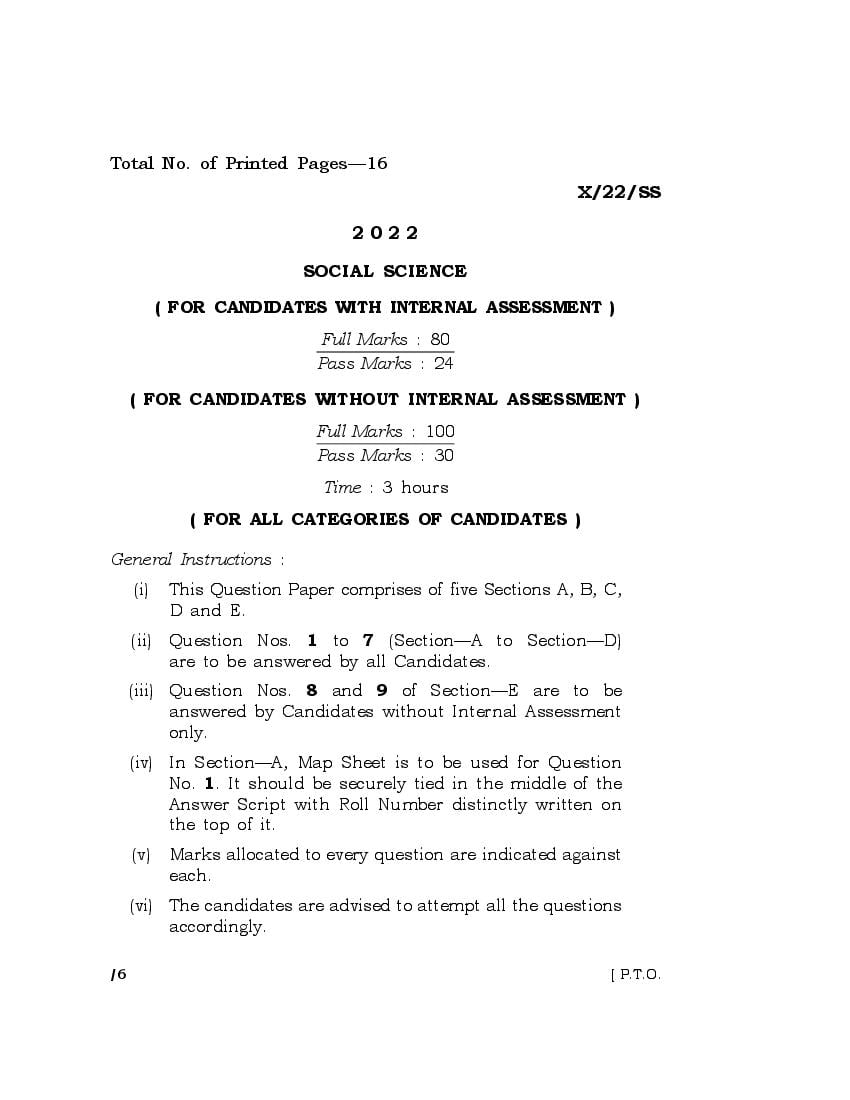
X/22/SS
2022
SOCIAL SCIENCE
( FOR CANDIDATES WITH INTERNAL ASSESSMENT )
Full Marks : 80
Pass Marks : 24
( FOR CANDIDATES WITHOUT INTERNAL ASSESSMENT )
Full Marks : 100
Pass Marks : 30
Time : 3 hours
( FOR ALL CATEGORIES OF CANDIDATES )
General Instructions :
(i) This Question Paper comprises of five Sections A, B, C,
D and E.
(ii) Question Nos. 1 to 7 (Section—A to Section—D)
are to be answered by all Candidates.
(iii) Question Nos. 8 and 9 of Section—E are to be
answered by Candidates without Internal Assessment
only.
(iv) In Section—A, Map Sheet is to be used for Question
No. 1. It should be securely tied in the middle of the
Answer Script with Roll Number distinctly written on
the top of it.
(v) Marks allocated to every question are indicated against
each.
(vi) The candidates are advised to attempt all the questions
accordingly.
/6 [ P.T.O.
Page 2
SECTION—A
( Marks : 4 )
1. In the same outline map of India supplied to you, locate
and label the following (choose any two each from
Group—I and Group—II) :
GROUP—I 1×2=2
(a) The place related to Militant Guerrilla Movement
(b) The famous Marine Drive was developed here
(c) The port which connected India to the Gulf and the
Red Sea Port
(d) The place (Battala) in which all kinds of books are
printed
GROUP—II 1×2=2
(a) Area where bamboo drip irrigation is practiced
(b) One major rice-producing State
(c) One area with silk textile industry
(d) One international airport
[ For Visually Handicapped (Blind) Students
only in lieu of the above questions ]
GROUP—I
Answer any two of the following : 1×2=2
(a) Name the place where the Militant Guerrilla
Movement was started.
(b) Name the place where the famous Marine Drive was
developed.
X/22/SS/6 [ Contd.
Page 3
(c) Name the port which connected India to the Gulf
and the Red Sea Port.
(d) Where is Battala located in India in which all kinds
of books are printed?
GROUP—II
Answer any two of the following : 1×2=2
(a) Name one area where bamboo drip irrigation is
practiced.
(b) Name one major rice-producing State in India.
(c) Name one area with silk textile industry in India.
(d) Name one international airport in India.
SECTION—B
( Marks : 12 )
2. Rewrite the following statements by choosing the most
appropriate answer from the given options (any twelve) :
1×12=12
(a) It was a custom union formed in 1834 at the
initiative of Prussia.
(i) Zollverein
(ii) Westphalia
(iii) Holstein
(iv) Mecklenburg
X/22/SS/6 [ P.T.O.
Page 4
(b) Who were the Gomasthas?
(i) Cotton growers
(ii) Cotton mill workers
(iii) Paid servants of the English East India Company
(iv) Security forces who looked after the workers
(c) Who were the philanthropists?
(i) People who wanted to stop crime and work for
social upliftment
(ii) People who work for social upliftment and
charity, donating time and money for the
purpose
(iii) People who wanted a hard-working orderly
labour force
(iv) People who worried about law and order
(d) The term ‘calligraph’ means
(i) the art of beautiful printing
(ii) the art of beautiful and stylised writing
(iii) the art of beautiful hand-printing
(iv) the art of printing an ‘accordion book’
(e) _____ resources such as water, wind and sunlight
must be used when and where they occur.
(i) Flow
(ii) Reserve
(iii) Stock
(iv) Actual
X/22/SS/6 [ Contd.
Page 5
(f) The total forest area in Meghalaya is
(i) 8,150 sq. km
(ii) 8,510 sq. km
(iii) 8,015 sq. km
(iv) 8,501 sq. km
(g) The economic strength of a country is measured by
the development of which of the following?
(i) Cultivation
(ii) Manufacturing
(iii) Servicing
(iv) Mining
(h) Which of the following is the term for age-old tribal
belief based on the premise that all creations of
nature have to be protected?
(i) Sacred groves
(ii) Nature worship
(iii) Virgin forests
(iv) Sonchuri
(i) What is true regarding sources of revenue in a
federal system?
(i) States have no financial powers or independent
sources of revenue
(ii) States are dependent for funds on the Central
Government
(iii) Sources of revenue for each level of government
are clearly specified to ensure its financial
autonomy
(iv) States have no financial autonomy
X/22/SS/6 [ P.T.O.
Page 6
(j) The word ‘election’ comes from the _____ word _____
meaning to choose or select.
(i) Greek, eligere
(ii) Latin, eligere
(iii) English, elect
(iv) Spanish, electo
(k) Which is the most difficult challenge faced by most
of the democracies of the world?
(i) Foundational challenge
(ii) Challenge of expansion
(iii) Challenge of deepening of democracy
(iv) None of the above
(l) A 2013 survey conducted by UNICEF confirms that
_____ has the world’s largest proportion of child
sexual assault cases.
(i) South Africa
(ii) North Korea
(iii) India
(iv) Brazil
(m) GDP is the total value of _____ produced during a
particular year.
(i) all intermediate goods and services
(ii) all goods and services
(iii) all final goods and services
(iv) all intermediate final goods and services
X/22/SS/6 [ Contd.
Page 7
(n) _____ has been constructed by the UNDP since 1990
to measure human development.
(i) Human Development Index (HDI)
(ii) Literacy rate
(iii) Export earning
(iv) Income
(o) Formal sources of credit include
(i) banks
(ii) moneylenders
(iii) employers
(iv) All of the above
(p) Fair globalization refers to ensuring benefits to
(i) labour
(ii) producers
(iii) consumers
(iv) All of the above
(q) Resource mapping refers to
(i) natural resources in a locality
(ii) skills
(iii) foods, boats or any other resources
(iv) All of the above
X/22/SS/6 [ P.T.O.
Page 8
(r) Usually sectional interest groups seek to promote
(i) the interest of a particular section
(ii) the interest of the society in general
(iii) the well-being and betterment of their members
(iv) Both (i) and (iii)
SECTION—C
( Marks : 24 )
(Short Answer-type Questions)
3. Answer any twelve questions : 2×12=24
(a) State any four virtues that Gandhiji extorted the
people of India to exercise at the start of the
Freedom Movement. ½×4=2
(b) Who was a jobber? Mention any two functions of a
jobber. 1+1=2
(c) Mention any two steps undertaken by the Londoners
to clean up their environment during the
late 19th Century. 1+1=2
(d) Enlist two reasons why the Chinese Imperial State
produced maximum printed materials. 1+1=2
(e) Which type of soil is formed due to leaching?
Mention any three features of this soil. ½+1½=2
X/22/SS/6 [ Contd.
Page 9
(f) Why are dams now referred to as multipurpose
projects? 2
(g) Explain any two different forms in which minerals
generally occur. 2
(h) What are the main objectives of National Jute
Policy, 2005? 2
(i) What are the basic steps to be taken for a
contingency plan? (Any four points) ½×4=2
(j) Examine the three prominent social differences in
our own country. What type of society does India
have? 1½+½=2
(k) Differentiate between a pressure group and a
people’s movement. 1+1=2
(l) Mention any two salient features of the convention
adopted by the United Nations General Assembly for
the empowerment of persons with disabilities. 1+1=2
(m) Analyze the necessity of political parties in India. 2
(n) If you get a job in a far-off place, before accepting
it you would try to consider many factors. Cite any
four such factors. ½×4=2
(o) What is infant mortality rate? How does it indicate
the development of a nation? 1+1=2
X/22/SS/6 [ P.T.O.
Page 10
(p) What are special economic zones? What benefit
does the government provide to multinational
corporations who set up their production units in
India? 1+1=2
(q) There is a need for consumer awareness. State two
reasons to support your answer. 1+1=2
(r) What does the term of credit constitute? What
happens if the borrower fails to repay the loan
amount? 1+1=2
SECTION—D
( Marks : 40 )
( Long Answer-type Questions )
PART—I
4. Answer any three questions : 4×3=12
(a) Who was the leader of the victorious European
powers who defeated Napoleon in 1815? Mention the
changes in the political map of Europe, brought
about by the victorious nations in accordance with
the terms of the ‘ Treaty of Vienna, 1815’. 1+3=4
(b) Gandhiji started the Civil Disobedience Movement
in 1930 in India. What role did women and the poor
peasants play during this movement? 2+2=4
Or
Outline the programme of the Indian National
Congress during the Non-Cooperation Movement.
½×8=4
X/22/SS/6 [ Contd.
Page 11
(c) In the 17th and 18th Centuries Europe, poor
peasants and artisans in the countryside began
working for merchants. Explain any four reasons to
support your answer. 4
(d) The 21st Century brought immense popularity to the
film industry in Mumbai. Discuss. 4
(e) Explain how print culture influenced the poor people
of India in the 19th Century. 4
(f) Examine the main features of the ‘Blood and Iron’
policy of Otto von Bismarck in the process of
German unification. 4
PART—II
5. Answer any three questions : 4×3=12
(a) What is resource planning? Explain the three levels
of resource planning. 1+3=4
(b) Why was the Project Tiger launched? What are its
objectives? What are its effects upon conservation of
wildlife? 1+1+2=4
(c) How is petroleum an important source of both
energy and raw material? Mention the name of the
areas which have petroleum deposits. 2+2=4
X/22/SS/6 [ P.T.O.
Page 12
(d) It is used as a food and fodder crop. Identify the
crop. Elaborate with the help of the points
mentioned below : 1×4=4
(i) Soil type
(ii) Temperature
(iii) Rainfall
(iv) Areas of cultivation
Or
Explain the favourable temperature, rainfall and soil
condition required for the growth of an annual crop.
Name the leading producing States of this crop in
India. 1+1+1+1=4
(e) Discuss the advantages and disadvantages of
pipeline transportation. 2+2=4
(f) How are industries responsible for environmental
degradation in India? Explain with examples. 1×4=4
PART—III
6. Answer any two questions : 4×2=8
(a) Panchayati Raj Institutions in India is rural based.
Describe any eight aims of this institution. ½×8=4
(b) “Political parties play a major role in democracy.”
Explain any four points to justify this statement. 1×4=4
(c) Mention any four challenges faced by the Indian
democracy. Analyze two measures that can be taken
to deepen democracy in India. 2+2=4
X/22/SS/6 [ Contd.
Page 13
(d) Describe in detail the contributions of the Women’s
Justice Initiative (WJI) in terms of safeguarding the
rights of women. 4
(e) Describe the role of Supreme Court of India in
checking child abuse and punishing the offenders. 4
PART—IV
7. Answer any two questions : 4×2=8
(a) Classify the economic sectors on the basis of nature
of activities. Explain the features of any one sector
with suitable examples. 1½+2½=4
(b) What is meant by economic development? What are
the two basis of measuring economic development of
a country? Mention any two features of a country
with a developed economy. 1+1+1+1=4
(c) What do the banks do with the deposits they accept
from the public? 4
(d) Describe the major impact of globalization on Indian
economy. 4
(e) Enlist the three measures undertaken by the
Government of India to protect the interest of
the consumers. Briefly describe any one of the
measures. 1½+2½=4
X/22/SS/6 [ P.T.O.
Page 14
SECTION—E
( Marks : 20 )
[ For Candidates without Internal Assessment ]
8. Rewrite the following statements by choosing the right
option from those given in the brackets : 1×12=12
(a) The term ‘liberalism’ has its roots in the Latin word
‘liber’ which means (free/slave).
(b) Lord Irwin signed a pact with Gandhiji in (1930/
1931) known as the Gandhi-Irwin Pact.
(c) Print technology was first developed in (China/India).
(d) The uppermost layer of the earth’s crust in which
plants grow is called (soil/sand).
(e) India has (7/6) nuclear power stations.
(f) (Jute/Rubber) is known as an equatorial crop.
(g) The Concurrent List has (61/47) subjects.
(h) All India Trinamool Congress was founded by
(Ms. Mamata Banerjee/P. A. Sangma).
(i) Legal literacy means legal (education/economy).
X/22/SS/6 [ Contd.
Page 15
(j) In the (public/private) sector, the government owns
most of the assets.
(k) (Reserve Bank of India/State Bank of India) issues
currency on behalf of the government.
(l) In October (2005/2006), the Government of India
enacted a law known as Right to Information Act.
9. Answer any eight of the following questions in one word
or in one sentence each : 1×8=8
(a) What is conservatism?
(b) Who formed the Swaraj Party?
(c) What does the term ‘city’ refer to?
(d) Give the full form of IUCN.
(e) Give one example of ferrous mineral.
(f) Name the oldest and cheapest means of transport.
(g) Define a political party.
(h) When is National Voters Day observed in India?
X/22/SS/6 [ P.T.O.
Page 16
(i) In which year India introduced the Rights of Persons
with Disabilities Act?
(j) What do you mean by ‘globalization’?
(k) Give the full form of ISI.
(l) Define literacy rate.
X/22/SS/6 22K—60010
Document Details
| Board / Org | Meghalaya Board |
| Exam | Class 10 |
| Type | Question Paper |
| Pages | 16 |
| Updated | 22 Jul 2026 |