DUET 2021 Question Paper M.Phil Ph.D in Philosophy
Finished viewing? Save it for later —
Download DUET 2021 Question Paper M.Phil Ph.D in Philosophy (PDF · 9 pages)About DUET 2021 Question Paper M.Phil Ph.D in Philosophy
DUET 2021 Question Paper M.Phil Ph.D in Philosophy is available here for free download. Published by NTA for DUET, this question paper can be viewed online or downloaded as a PDF (9 pages). Candidates preparing for DUET can use DUET 2021 Question Paper M.Phil Ph.D in Philosophy to understand the exam pattern, the type of questions asked, and the overall difficulty level.
Frequently Asked Questions
How can I download DUET 2021 Question Paper M.Phil Ph.D in Philosophy?
Open this page and click the Download button to save DUET 2021 Question Paper M.Phil Ph.D in Philosophy as a PDF. It is completely free on AglaSem Docs.
Is DUET 2021 Question Paper M.Phil Ph.D in Philosophy free to download?
Yes. DUET 2021 Question Paper M.Phil Ph.D in Philosophy can be viewed online and downloaded as a PDF free of cost on AglaSem Docs.
How many pages does DUET 2021 Question Paper M.Phil Ph.D in Philosophy have?
DUET 2021 Question Paper M.Phil Ph.D in Philosophy contains 9 pages, which you can read online or download together as a single PDF.
Where can I find more DUET study material?
You can find more DUET question papers, sample papers, syllabus, and answer keys on AglaSem Docs.
DUET 2021 Question Paper M.Phil Ph.D in Philosophy – Text
Read the full text of this question paper below — useful to quickly search, copy and reference the content online without downloading the PDF.
📄 View text version (9 pages)
Page 1
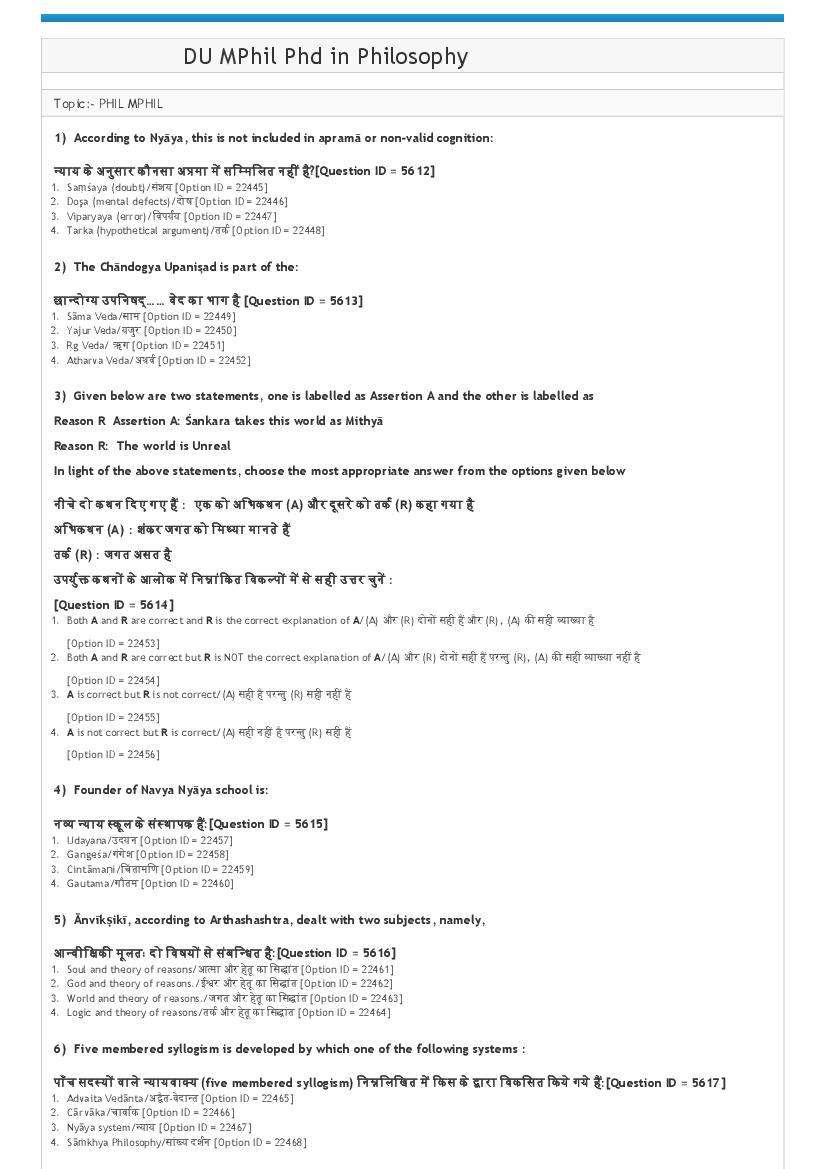
Topic:‐ PHIL MPHIL
1) According to Nyāya, this is not included in apramā or non‐valid cognition:
याय के अनु स ार कौनसा अ मा म सि मिलत न ह है?[Question ID = 5612]
1. Saṃśaya (doubt)/संशय [Option ID = 22445]
2. Doşa (mental defects)/दोष [Option ID = 22446]
3. Viparyaya (error)/िवपयय [Option ID = 22447]
4. Tarka (hypothetical argument)/तक [Option ID = 22448]
2) The Chāndogya Upanişad is part of the:
छा दो य उपिनषद्… … वे द क ा भ ा ग है [Question ID = 5613]
1. Sāma Veda/साम [Option ID = 22449]
2. Yajur Veda/यजुर [Option ID = 22450]
3. Ṛg Veda/ ऋग [Option ID = 22451]
4. Atharva Veda/अथव [Option ID = 22452]
3) Given below are two statements, one is labelled as Assertion A and the other is labelled as
Reason R Assertion A: Śankara takes this world as Mithyā
Reason R: The world is Unreal
In light of the above statements, choose the most appropriate answer from the options given below
नीचे द ो क थ न द ए ग ए ह : ए क क ो अिभकथन (A) औ र दू स रे क ो तक (R) क ह ा ग य ा है
अिभकथन (A) : शं क र ज ग त क ो िम या मानते ह
तक (R) : ज ग त अ स त है
उपयु क थ न के आलोक म िन ां कत िवक प म से स ह ी उ र चु न :
[Question ID = 5614]
1. Both A and R are correct and R is the correct explanation of A/(A) और (R) दोन सही ह और (R), (A) क सही ा या है
[Option ID = 22453]
2. Both A and R are correct but R is NOT the correct explanation of A/(A) और (R) दोन सही ह पर तु (R), (A) क सही ा या नह है
[Option ID = 22454]
3. A is correct but R is not correct/(A) सही है पर तु (R) सही नह ह
[Option ID = 22455]
4. A is not correct but R is correct/(A) सही नह है पर तु (R) सही ह
[Option ID = 22456]
4) Founder of Navya Nyāya school is:
न याय कू ल के सं थापक ह :[Question ID = 5615]
1. Udayana/उदयन [Option ID = 22457]
2. Gangeśa/गंगेश [Option ID = 22458]
3. Cintāmaṇi/ चतामिण [Option ID = 22459]
4. Gautama/गौतम [Option ID = 22460]
5) Ānvīkṣikī, according to Arthashashtra, dealt with two subjects, namely,
आ वीि क मू ल तः द ो िवषय से सं ब ि धत है:[Question ID = 5616]
1. Soul and theory of reasons/आ मा और हेतू का िस ांत [Option ID = 22461]
2. God and theory of reasons./ई र और हेतू का िस ांत [Option ID = 22462]
3. World and theory of reasons./जगत और हेतू का िस ांत [Option ID = 22463]
4. Logic and theory of reasons/तक और हेतू का िस ांत [Option ID = 22464]
6) Five membered syllogism is developed by which one of the following systems :
पाँ च सद य वाले यायवा य (five membered syllogism) िन िलिखत म क स के ारा िवकिसत कये गये ह :[Question ID = 5617]
1. Advaita Vedānta/अ ैत‐वेदा त [Option ID = 22465]
2. Cārvāka/चावाक [Option ID = 22466]
3. Nyāya system/ याय [Option ID = 22467]
4. Sāṁkhya Philosophy/सां य दश न [Option ID = 22468]
Page 2
जाित ि के स म ा न ह ी मह वपू ण है य ह ____ क ा म त है:[Question ID = 5618]
1. The Nyāya school/ याय [Option ID = 22469]
2. The Bauddha school/बौ [Option ID = 22470]
3. The Cārvaka school/चावाक [Option ID = 22471]
4. The Advaita Vedānta school/अ ैत वेदांत [Option ID = 22472]
8) “Knowledge is primarily of a definite object and is to be distinguished from the awareness of the indefinite” is the view
of which one of the following philosophers.
“ ा न मु यतः िनि त व तु क ा होता है औ र इसे अिनि त व तु के आ भ ा स से अलग म ा न ा जाना चािहए”, य ह ____ क ा म त है:[Question ID =
5619]
1. Ambedkar/अ बेडकर [Option ID = 22473]
2. Radhakrishnan/राधाकृ णन [Option ID = 22474]
3. K.C. Bhattacharya/के सी भ ाचाय [Option ID = 22475]
4. Tagore/टैगोर [Option ID = 22476]
9) Intuition as the source of knowledge is argued by
अं त ः ा को ा न के स ा ध न के प म वीकार कया है:[Question ID = 5620]
1. M. N. Roy/ऍम ऍन रॉय ने [Option ID = 22477]
2. S. Radhakrishnan/राधाकृ णन ने [Option ID = 22478]
3. Rahul Sankrityayan/रा ल सांकृ यायन ने [Option ID = 22479]
4. Debiprasad Chattopadhyaya/देबी साद च ोपा याय ने [Option ID = 22480]
10) Sri Auribindo’s philosophy is identified with:
मह ष अर बद क ा दश न क ह ा जाता है:[Question ID = 5621]
1. Integral Yoga/पूण योग [Option ID = 22481]
2. Materialism/भौितकवाद [Option ID = 22482]
3. Sahaja Yoga/सहजयोग [Option ID = 22483]
4. Supernaturalism/अित ाकृितकवाद [Option ID = 22484]
11) Consider the following statements:
A. Machinery is not capable of generating any value
B. Machinery is capable of generating value.
C. Machinery can only transfer value.
Which of the following statement/s is/are true about Karl Marx’s views?
Choose the correct answer from the options given below:
िन िलिखत क थ न पर िवचार कर :
A. मशीनरी क स ी भ ी मू य क ो उ प करने म स म न ह है
B. मशीनरी मू य पै द ा करने म स म है
C. मशीनरी के व ल मू य ह तां त रण क र स क त ी है
काल मा स के िवचार के बारे म िन िलिखत म से क ौ न स ा क थ न स ह ी है / ह ?
नीचे द ए ग ए िवक प म से स ह ी उ र चु न :
[Question ID = 5622]
1. A and C only/A और C
[Option ID = 22485]
2. A and B only/केवल A और B
[Option ID = 22486]
3. B and C only/केवल B और C
[Option ID = 22487]
4. A only/केवल A
[Option ID = 22488]
12) Match List I with List II
List I List II
Philosopher Concept / theory
A. Aurobindo I. Vernacular Gender
B. Illich II. India’s real problem is social in nature
C. Tagore III. Capability approach
Page 3
Choose the correct answer from the options given below:
सू च ी ‐I क ो सू च ी ‐II से सु म े ि लत क िजए :
सू च ी ‐I सू च ी ‐II
दाश िनक अवधारणा/ िस ां त
A. अरिव दI. वना कु ल र ज डर
B. इिलच II. भारत क वा तिवक सम या सामािजक है
C. टै ग ोर III. म त ा दृ ि कोण
D. नु बाम IV. र ा क ो माँ के प म म ा न न ा
नीचे द ए ग ए िवक प म से स ह ी उ र चु ि नए :
[Question ID = 5623]
1. A ‐IV , B ‐II , C ‐I , D ‐III [Option ID = 22489]
2. A ‐IV , B ‐I , C ‐II , D ‐III [Option ID = 22490]
3. A ‐IV , B ‐III , C ‐II , D ‐I [Option ID = 22491]
4. A ‐I , B ‐II , C ‐III , D ‐IV [Option ID = 22492]
13) Consider the following statements with reference to Aurobindo’s views:
A. An unconscious analysis is a contradiction in terms.
B. Nationalism is the highest synthesis.
C. Only rationalist attitude can save our nation.
Choose the correct answer from the options given below:
अरिव द के स दभ म िन िलिखत क थ न पर िवचार कर :
A. ए क अचे त न िव े ष ण श द म ए क वयं ि वरोधी क थ न है
B. रा वाद सव सं े ष ण है
C. के व ल तक वादी वृ ि ह ी हमारे दे श क ो ब च ा स क त ा है
नीचे द ए ग ए िवक प म से स ह ी उ र चु न :
[Question ID = 5624]
1. A only/केवल A
[Option ID = 22493]
2. A & B only/केवल A और B
[Option ID = 22494]
3. A & C only/केवल A और C
[Option ID = 22495]
4. A, B & C only/केवल A, B और C
[Option ID = 22496]
14) Which of the following perspectives can be attributed to Anti‐evidentialist?
िन िलिखत म से क स दृ ि कोण क ो ित‐ माणवादी से जोड़ा ज ा स क त ा है?[Question ID = 5625]
1. Beliefs about God can be ‘properly basic’ and can be held independent of any supporting evidence or reason./ई र के बारे म िव ास 'यथाथतः मौिलक' हो
सकते ह और कसी भी सहायक माण या कारण से वतं हो सकते ह [Option ID = 22497]
2. Beliefs about God can be ‘properly basic’ and can’t be held independent of any supporting evidence or reason./ई र के बारे म िव ास 'यथाथतः मौिलक' हो
सकते ह और कसी भी सहायक माण या कारण से वतं नह हो सकते ह [Option ID = 22498]
3. Beliefs about God are not ‘properly basic’ but can be held independent of any supporting evidence or reason./ई र के बारे म िव ास 'यथाथतः मौिलक' नह
हो सकते ह पर तु कसी भी सहायक माण या कारण से वतं हो सकते ह [Option ID = 22499]
4. Beliefs about God can’t be ‘properly basic,’ therefore can’t be held independent of any supporting evidence or reason./ई र के बारे म िव ास 'यथाथतः
मौिलक' नह हो सकते ह, अतः कसी भी सहायक माण या कारण से वतं नह हो सकते ह [Option ID = 22500]
15) Who among the following argues that ‘the properly basic belief in God can be held independent of reason’?
िन िलिखत म से क ौ न य ह तक दे त ा है क 'ई र म उिचत मौिलक िव ास क ो तक से वतं ठहराया ज ा स क त ा है'?[Question ID = 5626]
1. Sceptic/संशयवादी [Option ID = 22501]
2. Anti‐Evidentialist/ ित‐ माणवादी [Option ID = 22502]
3. Evidentialist/ माणवादी [Option ID = 22503]
4. Natural theologist/ ाकृितक धमशा ी [Option ID = 22504]
16) The specific view that the whole universe is God or part of God is that of a/an:
सं प ू ण ां ड ई र है य ा ई र क ा अं श है, कसका िविश दृ ि कोण है:[Question ID = 5627]
1. Deist/देवतावादी [Option ID = 22505]
2. Pantheist/सव रवादी [Option ID = 22506]
Page 4
4. Agnostic/अ य
े वादी [Option ID = 22508]
17) Husserl uses the concept of intentionality to elucidate:
सल ने िवषयापे ी (इं ट शनिलटी) क अवधारणा क ा उपयोग इनमे से कसको प करने के ि लए कया:[Question ID = 5628]
1. The distinction between different kinds of objects/िविभ कार क व तु के बीच का अंतर [Option ID = 22509]
2. The distinction between physical and non‐physical phenomena/भौितक और गैर‐भौितक घटना के बीच का अंतर [Option ID = 22510]
3. The concept of naturalism/ कृितवाद क अवधारणा [Option ID = 22511]
4. The fundamental nature of consciousness/चेतना क मौिलक कृित [Option ID = 22512]
18) Evolution according to Hegel is a:
हे ग े ल के अनु स ार िवकास ए क ______ है:[Question ID = 5629]
1. Logical process/ता कक या [Option ID = 22513]
2. Temporal process/सामियक या [Option ID = 22514]
3. Supernatural process/अलौ कक या [Option ID = 22515]
4. Process of natural selection/ ाकृितक चयन क या [Option ID = 22516]
19) Which of the following statements is not true with respect to Heideggerian philosophy?
िन िलिखत म से क ौ न स ा क थ न हे इ डे ग रयन दश न के सं ब ं ध म स ह ी न ह है?[Question ID = 5630]
1. Dasein is Being of man like that of Cartesian subjectivism./दासायन का टिसयन ि वाद के समान मानव का मूल स है [Option ID = 22517]
2. Dasein questions his own Being and that of other things in the world./दासायन अपने मूल स और अ य चीज क स ा पर सवाल उठाता है [Option ID = 22518]
3. Dasein is always aware of his being in the world./िव म अपने मूल स के िवषय म दासायन सदा सजग है [Option ID = 22519]
4. Being is already there at the origin of the becoming./स बनने क या के ार भ म मूल सत पहले से ही होता है [Option ID = 22520]
20) A main component of Hume’s theory of mind is the principle of ___
यू म के म न के िस ां त क ा ए क मु य घ ट क ___ क ा िस ां त है [Question ID = 5631]
1. Association/साहचय [Option ID = 22521]
2. Bootstrapping/ वो थान/बूट ै पग [Option ID = 22522]
3. Computation/संगणन [Option ID = 22523]
4. Dual‐coding/ ैत‐को डग [Option ID = 22524]
21) ___ is the philosophical account that mind and body are two different substances
___ ए क दाश िनक िस ां त है िजसके अनु स ार म न औ र शरीर द ो अलग‐अलग पदाथ ह [Question ID = 5632]
1. Panpsychism/पैनसाइ ककवाद [Option ID = 22525]
2. Property dualism/गुणधम ैतवाद [Option ID = 22526]
3. Cartesian dualism/काटिशयन ैतवाद [Option ID = 22527]
4. Russellian Monism/रसेिलयन एक ववाद [Option ID = 22528]
22) For Kant, category is a _____ concept of understanding
कां ट के िलए ‘क ो ट’ बु ि क _____ , ____ अवधारणा है [Question ID = 5633]
1. transcendental, a posteriori/अतीि य, अनुभवज य [Option ID = 22529]
2. empirical, a posteriori/आनुभिवक, अनुभवज य [Option ID = 22530]
3. experiential, a priori/अनुभवा मक, अनुभवातीत [Option ID = 22531]
4. pure, a priori/शु , अनुभवातीत [Option ID = 22532]
23) Leibniz’s theory of pre‐established harmony is a theory ____
Statement 1. Of causation between windowless monads.
Statement 2. Which eliminates the need of God.
Choose the correct answer from the options given below:
लाइबिनज क ा पू व ‐ थािपत सामं ज य ए क िस ां त है ____
क थ न 1. िखड़क रिहत िचदणु ओ के ब ी च काय ‐कारण क ा
क थ न 2. ज ो ई र क आव यकता क ो स म ा करता है
[Question ID = 5634]
1. Both statements are true./दोन कथन स य ह
[Option ID = 22533]
2. Both statements are false/दोन कथन अस य ह
[Option ID = 22534]
3. Statement 1 is true but Statement 2 is false/कथन 1 स य है पर तु कथन 2 अस य है
[Option ID = 22535]
4. Statement 1 is false but Statement 2 is true./कथन 1 अस य है ले कन कथन 2 स य है
Page 5
24) For Aristotle, things which are not constituted naturally are those that
अर तू के िलए, ज ो चीज वाभािवक प से ग ठ त न ह होती ह , वे ह िजनमे[Question ID = 5635]
1. Have in themselves source of change / वयं म प रवतन के ोत है [Option ID = 22537]
2. Have no innate tendency to change/प रवतन क कोई ज मजात वृि नह है [Option ID = 22538]
3. Have in themselves source of staying unchanged/अप रव तत रहने के ोत वयं म ह [Option ID = 22539]
4. Have in themselves source of alteration/ वयं म संशोधन के ोत है [Option ID = 22540]
25) Something can be treated as an outcome of luck for Aristotle only when
अर तू के िलए के व ल उ स क ो भा य के प रणाम के प म म ा न ा ज ा स क त ा है:
[Question ID = 5636]
1. It always happens/जो हमेशा होता है
[Option ID = 22541]
2. It happens concurrently/जो समवत प से होता है
[Option ID = 22542]
3. It is done by a child/जो एक ब े ारा कया जाता है
[Option ID = 22543]
4. It happens automatically/जो अपने आप होता है
[Option ID = 22544]
26) Which of the following philosophers discusses the missing shade of blue problem?
िन िलिखत दाश िनक म से क ौ न नीले रं ग क लापता छ ा य ा क सम या पर चचा करता है?[Question ID = 5637]
1. George Berkeley/जॉज बक ले [Option ID = 22545]
2. Immanuel Kant/इमैनुअल कांट [Option ID = 22546]
3. David Hume /डेिवड म [Option ID = 22547]
4. C D Broad/सी डी ॉड [Option ID = 22548]
27) Which of the following philosophers denied Innate Ideas?
िन िलिखत दाश िनक म से कसने ज मजात यय क ो अ वीकार कया है?
[Question ID = 5638]
1. Leibniz/लाइबिन स
[Option ID = 22549]
2. John Locke/जॉन लॉक
[Option ID = 22550]
3. Jerry Fodor/जेरी फोडर
[Option ID = 22551]
4. Gottlob Frege/गोटलोब गै
[Option ID = 22552]
28) According to Kant, the necessary and synthetic character of geometry shows that
कां ट के अनु स ार यािमित क ा आव यक औ र सं े ष णा मक च र दशा ता है क:[Question ID = 5639]
1. time is an a priori concept/काल एक पूवतोिस अवधारणा है [Option ID = 22553]
2. space is an a priori concept/िव तार एक पूवतोिस अवधारणा है [Option ID = 22554]
3. space is an a priori intuition/िव तार एक पूवतोिस अंत ान है [Option ID = 22555]
4. time is an a priori intuition/काल एक पूवतोिस अंत ान है [Option ID = 22556]
29) According to Kant transcendental schemata is the bridge between
कां ट के अनु स ार ां स ड टल क माटा (transcendental schemata) ………… के ब ी च क ा से त ु है:[Question ID = 5640]
1. the sensible manifold and categories/िविवध इि य साम ी(sensible manifold) और वग (categories) [Option ID = 22557]
2. the form of outer sense and form of inner sense/बाहरी भाव (outer)sense के प और आंत रक भाव (inner) sense के प [Option ID = 22558]
3. Understanding and Reason/समझ (understanding) और बुि (reason) [Option ID = 22559]
4. analytic and synthetic unities of apperception/मानिसक बोध क िव ेषणा मक एवं सं ष
े णा मक एकता [Option ID = 22560]
30) To obtain the logical form of a proposition we have to
क थ न क ा ता कक प ा करने के िलए[Question ID = 5641]
1. turn individual variables into constants/वैयि क‐चर (individual variable) को ि थरांक (constant) म बदल देना है [Option ID = 22561]
2. turn predicate variables into constants/िवधेय‐चर (predicate‐variable) को ि थरांक (constant) म बदल देना ह [Option ID = 22562]
3. turn all non‐logical constants into variables and retain all logical constants/सभी गैर‐ता कक (non‐logical) ि थरांक को चर म बदल देना ह और सभी ता कक ि थरांक
(logical constant) को बनाए रखना है [Option ID = 22563]
4. turn both logical and non‐logical constants into variables/ता कक और गैर‐ता कक दोन ि थरांक को चर म बदल देना ह [Option ID = 22564]
Page 6
“के व ल हवाई जहाज उड़ते ह ” क ा ता कक अनु व ाद िन िलिखत म ै से कौनसा होगा:
[Question ID = 5642]
1. (x) (Ax ⊃ Fx)
[Option ID = 22565]
2. (x) (Ax • Fx)
[Option ID = 22566]
3. (x) (Fx ⊃ Ax)
[Option ID = 22567]
4. (Ǝx) (Ax • ~Fx)
[Option ID = 22568]
32) If P is “Birds fly” and Q is “Birds have wings” then “Birds fly only if they have wings” is to be symbolized as
य द P है "पं छ ी उ ड़ त ा है" औ र Q है "पं छ ी के प ा स पं ख है" त ो "पं छ ी त भ ी उड़ते ह ज ब पं छ ी के पं ख होते ह " क ा ता कक अनु व ाद य ा होगा?
[Question ID = 5643]
1. P • Q
[Option ID = 22569]
2. P ⊃ Q
[Option ID = 22570]
3. P v Q
[Option ID = 22571]
4. P • ~Q
[Option ID = 22572]
33) If P is True and Q is False, then which of the following statements is true
य द P स य है औ र Q अस य है, त ो िन िलिखत म से क ौ न स ा क थ न स य है:
[Question ID = 5644]
1. (P ⊃ Q) • P
[Option ID = 22573]
2. (Q ⊃ P) • P
[Option ID = 22574]
3. (P • Q) v Q
[Option ID = 22575]
4. (P ≡ Q) v Q
[Option ID = 22576]
34) The Incompleteness theorems are attributed to
िन िलिखत म से कसने अपू ण ता के मे य द ए?[Question ID = 5645]
1. Bertrand Russell/ब ड रसेल [Option ID = 22577]
2. Kurt Gödel/कट गोडेल [Option ID = 22578]
3. Alfred North Whitehead/अ ेड नॉथ हाइटहेड [Option ID = 22579]
4. Saul Kripke/सल पके [Option ID = 22580]
35) According to Russell “The present king of India” can be considered as
रसे ल के अनु स ार, “द ेस ट क ग ऑ फ़ ां स” क ो िन िलिखत म से य ा म ा न ा ज ा स क त ा है:[Question ID = 5646]
1. indefinite description/अिनि त िववरण [Option ID = 22581]
2. definite description/िनि त िववरण [Option ID = 22582]
3. predicate‐word/िवधेय पद [Option ID = 22583]
4. proposition/कथन [Option ID = 22584]
36) Which of the following is true with reference to Russell’s Problems of Philosophy?
िन िलिखत म से क ौ न स ा रसे ल क ो ले स ऑ फ़ फलॉसोफ के सं द भ म स ह ी है?[Question ID = 5647]
1. Universals exist in both mental and physical worlds/सामा य, मानिसक और भौितक दोन दुिनया म अि त वमान ह [Option ID = 22585]
2. Universals have a subsistent status that belongs neither to physical nor to the mental world/सामा य, मानिसक और भौितक दुिनया से अलग थायी (subsistent)
त व ह [Option ID = 22586]
3. Universals are not relations/सामा य, संबध
ं नह ह [Option ID = 22587]
4. The world of Universals is fleeting and vague/सामा य क दुिनया णभंगरु और अ प है [Option ID = 22588]
Page 7
phrase?
राइल के अनु स ार िन िलिखत क ौ न से िवक प म वि थत प से ामक अध ‐रे फ़ र िशयल “the” ‐ वा यां श न ह होगा?
[Question ID = 5648]
1. 'Ronny is not the King of France'/रॉ ी इस नॉट द कग ऑफ़ ांस
[Option ID = 22589]
2. 'Ronny is not the king of England'/रॉ ी इस नॉट द कग ऑफ़ इं लड
[Option ID = 22590]
3. 'There is a bird sitting on the top of the tree'/देयर इस अ बड िस टग ऑन द टॉप ओफ़ द ी
[Option ID = 22591]
4. 'My arrow went through the center of the bush'/माइ एरो व ट ू द सटर ऑफ़ द बुश
[Option ID = 22592]
38) According to Ryle, mind and body belong to different categories because
राईल के अनु स ार म न औ र शरीर िविभ वग (category) के होते ह य क[Question ID = 5649]
1. mental dispositions cause bodily states/मानिसक वृि यां (dispositions)शारी रक अव था का कारण बनती ह [Option ID = 22593]
2. mental dispositions are opposed to bodily states/मानिसक वृि यां (dispositions) शारी रक अव था के िवरोध म ह [Option ID = 22594]
3. mind is a disposition of the body/मन शरीर का एक वभाव (disposition) है [Option ID = 22595]
4. mental dispositions are more primordial than bodily states/मानिसक वृि यां शारी रक अव था क तुलना म अिधक धान ह [Option ID = 22596]
39) Putnam’s view that mind is a machine implies that mind is
पु त नाम क ा िवचार है क म न ए क यं है िजसका अथ है क म न[Question ID = 5650]
1. an abstract structure devoid of any content/ कसी भी साम ी से रिहत एक अमूत संरचना है [Option ID = 22597]
2. a causal structure of inputs and outputs which is devoid of any specific content of the organism/जीव के कसी िविश साम ी से रिहत इनपुट और आउटपुट क
कारण संरचना है [Option ID = 22598]
3. the entire abstract structure of neurons and nerves/ यूरॉ स और तंि का क संपण ू अमूत संरचना है [Option ID = 22599]
4. the structure which describes how a machine is composed of its parts/एक संरचना है जो बताती है क यं के पुज कैसे कसी यं क रचना करते ह [Option ID =
22600]
40) According to Vedānta‐Paribhāṣā, in the case of part‐less internal organ, what is the nature of Psychosis?
वे द ा त‐प रभाषानु स ार, िनरवयव अ तःकरण के सं द भ म , मनोवृ ि क ा वभाव य ा ह ?
[Question ID = 5651]
1. Modification/प रवतन
[Option ID = 22601]
2. Unconscious/अचेतन
[Option ID = 22602]
3. One‐pointed/एका
[Option ID = 22603]
4. Restricted/िन
[Option ID = 22604]
41) Moral cognitivism considers moral judgments to be the expression of:
नै ि तक सं ानवाद नै ि तक िनण य क ो _____क अिभ ि म ा न त ा ह :[Question ID = 5652]
1. State of mind/मनः ि थित [Option ID = 22605]
2. Sentiments/मनोभाव [Option ID = 22606]
3. Belief states/ ान क ि थित [Option ID = 22607]
4. Prescription/िनदश [Option ID = 22608]
42) Utilitarianism endorses:
उपयोिगतावाद जीवन के िलए:[Question ID = 5653]
1. an egotistical attitude to life/अहंवादी दृि कोण का समथन करता है [Option ID = 22609]
2. an altruistic attitude to life/एक परोपकारी दृि कोण का समथन करता है [Option ID = 22610]
3. an attitude of generalized benevolence/सामा यीकृत परोपकार के दृि कोण का समथन करता है [Option ID = 22611]
4. a relativistic attitude to life/सापे क य दृि कोण का समथन करता है [Option ID = 22612]
43) Nietzsche rejects Christian morality as:
नी शे ई स ा ई (Christian) नै ि तकता क ो अ वीकार करते ह य क:[Question ID = 5654]
1. It gives us excessive freedom/यह हम अ यिधक वतं ता देता है [Option ID = 22613]
2. It is master morality/यह वामी क नैितकता है [Option ID = 22614]
3. It enforces us to behave like a slave/यह हम दास क तरह वहार करने को वा य करती है [Option ID = 22615]
4. It is based on bohemian ideology/यह बोहेिमयन िवचारधारा पर आधा रत है [Option ID = 22616]
Page 8
Assertion A : The notion of living will is related to Euthanasia.
Reason R : Euthanasia is popularly known as mercy killing.
In light of the above statements, choose the correct answer from the options given below
नीचे द ो क थ न द ए ग ए ह : ए क क ो अिभकथन (A) औ र दू स रे क ो तक (R) क ह ा ग य ा है
अिभकथन (A) : ‘िल वग ि व ल’ क अवधारणा इ छामृ यु से सं ब ं ि धत है
तक (R) : इ छामृ यु क ो लोकि य प से द य ा ह या के न ा म से जाना जाता है
उपयु क थ न के आलोक म िन ां कत िवक प म से स ह ी उ र चु न :
[Question ID = 5655]
1. Both A and R are true and R is the correct explanation of A/(A) और (R) दोन सही ह और (R), (A) क सही ा या है
[Option ID = 22617]
2. Both A and R are true but R is NOT the correct explanation of A/(A) और (R) दोन सही ह पर तु (R), (A) क सही ा या नह है
[Option ID = 22618]
3. A is true but R is false/(A) सही है पर तु (R) सही नह ह
[Option ID = 22619]
4. A is false but R is true/(A) सही नह है पर तु (R) सही ह
[Option ID = 22620]
45) Which of the following thinkers is criticized by Carol Gilligan for not supporting care ethics?
िन िलिखत म से क स िवचारक क कै र ोल िगिलगन ने ‘के य र एिथ स’ क ा समथ न न ह करने के िलए आलोचना क है?[Question ID = 5656]
1. Lawrence Blum/लॉरस लम [Option ID = 22621]
2. Lawrence Kohlberg/लॉरस कोलबग [Option ID = 22622]
3. Sara Ruddick/सारा िडक [Option ID = 22623]
4. Lawrence Thomas/लॉरस थॉमस [Option ID = 22624]
46) Who among the following believes that “irrefutability is not a virtue of a theory, but a vice”?
िन िलिखत म से क ौ न म ा न त ा है क "अखं ड नीयता क स ी िस ां त क ा ए क गु ण न ह है, ब ि क ए क अवगु ण है"?[Question ID = 5657]
1. Carl Hempel/काल हे पल [Option ID = 22625]
2. Karl Popper/काल पॉपर [Option ID = 22626]
3. Thomas Kuhn/थॉमस कु न [Option ID = 22627]
4. A J Ayer/ए जे एयर [Option ID = 22628]
47) Which of the following statements is not true regarding the views of Nancy Cartwright?
िन िलिखत म से क ौ न स ा क थ न नै सी काट राईट के िवचार के बारे म स ह ी न ह है?[Question ID = 5658]
1. She criticizes the covering law model./वह कव रग लॉ मॉडल क आलोचना करती है [Option ID = 22629]
2. ‘Ceteris paribus’ laws are used in explanations./सेटे रस परीबस िनयम का उपयोग प ीकरण म कया जाता है [Option ID = 22630]
3. Nature is well‐regulated./ कृित अ छी तरह से िनयंि त है [Option ID = 22631]
4. Laws are scarce./िनयम दुलभ ह [Option ID = 22632]
48) Given below are two statements, one is labelled as Assertion A and the other is labelled as Reason R
Assertion A : Van Fraassen says there is no explanation in science.
Reason R : There is a relation of explanation between theories and facts.
In light of the above statements, choose the correct answer from the options given below
नीचे द ो क थ न द ए ग ए ह : ए क क ो अिभकथन (A) औ र दू स रे क ो तक (R) क ह ा ग य ा है
अिभकथन (A) : व ा न ै स े न कहते ह क ि व ा न म क ो ई प ीकरण न ह है
तक (R) : िस ां त औ र त य के ब ी च प ीकरण क ा सं ब ं ध है
उपयु क थ न के आलोक म िन ां कत िवक प म से स ह ी उ र चु न :
[Question ID = 5659]
1. Both A and R are true and R is the correct explanation of A/(A) और (R) दोन सही ह और (R), (A) क सही ा या है
[Option ID = 22633]
2. Both A and R are true but R is NOT the correct explanation of A/(A) और (R) दोन सही ह पर तु (R), (A) क सही ा या नह है
[Option ID = 22634]
3. A is true but R is false/(A) सही है पर तु (R) सही नह ह
[Option ID = 22635]
4. A is false but R is true/(A) सही नह है पर तु (R) सही ह
[Option ID = 22636]
Page 9
अर तू ने ि ज न चार कारण क ब ा त क थ ी, वे ह :[Question ID = 5660]
1. Material, consistent, formal and efficient/उपादान, सुसग
ं त, आका रक और िनिम [Option ID = 22637]
2. Material, formal, efficient and final/उपादान, आका रक, िनिम और अंितम [Option ID = 22638]
3. Material, formal, efficient and performative/उपादान, आका रक, िनिम और या मक [Option ID = 22639]
4. Material, formal, teleological and final/उपादान, आका रक, उ े यवादी और अंितम [Option ID = 22640]
50) Given below are two statements
Statement I: A J Ayer was a logical positivist who claimed that a statement is meaningful if its truth value can be
established through reason and argument.
Statement II: A J Ayer was a logical positivist who criticized Descartes by pointing out that he had committed a category
mistake.
In light of the above statements, choose the most appropriate answer from the options given below
नीचे द ो क थ न द ए ग ए ह :
क थ न ‐ I : ए जे एयर ए क ता कक य वादी थे िज ह ने द ा व ा कया थ ा क ए क क थ न साथ क है य द उसके स य मू य क ो यु ि औ र तक के
म ा य म से थािपत कया ज ा स क त ा है
क थ न ‐ II : ए जे एयर ए क ता कक य वादी थे िज ह ने डे स काट स क आलोचना करते ए क ह ा क उ ह ने ेणी क ाि त क थ ी
उपयु क थ न के आलोक म िन िलिखत िवक प म से स ह ी उ र चु न :
[Question ID = 5661]
1. Both Statement I and Statement II are correct/कथन I और II दोन सही ह
[Option ID = 22641]
2. Both Statement I and Statement II are incorrect/कथन I और II दोन गलत ह
[Option ID = 22642]
3. Statement I is correct but Statement II is incorrect/कथन I स य है , क तु कथन II गलत है |
[Option ID = 22643]
4. Statement I is incorrect but Statement II is correct/कथन I अस य है , क तु कथन II सही है
[Option ID = 22644]
Document Details
| Board / Org | NTA |
| Exam | DUET |
| Type | Question Paper |
| Pages | 9 |
| Language | english |
| Updated | 30 Apr 2026 |